Eating Healthy on a Student Budget: High Protein Hostel and Dorm Room Meal Prep
A college student bodybuilding diet budget can still hit 130 g of protein. Cheap staples, no-cook hostel prep and a sample day, with the studies linked.
TL;DR. The short answer
- A college student bodybuilding diet budget works when most of your protein comes from cheap staples (eggs, dal, soya chunks, curd, roasted chana, peanuts, oats), not from supplements.
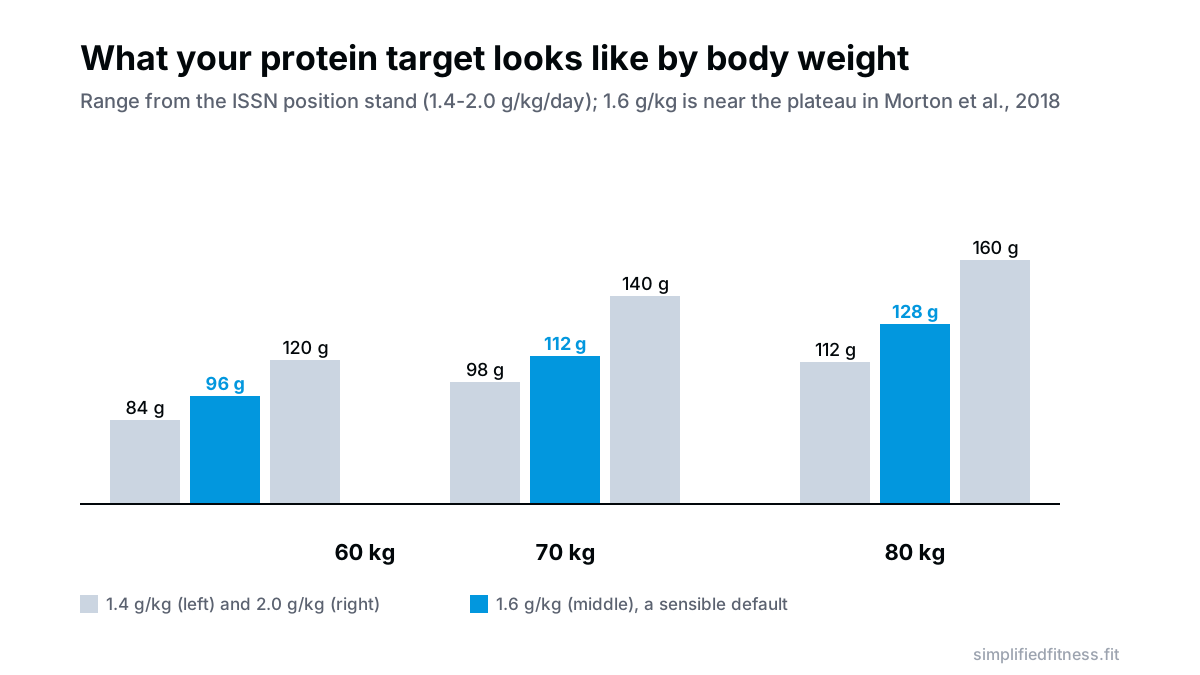
- Most students lifting to build muscle do well on about 1.4-2.0 g of protein per kg a day, so a 70-80 kg student is aiming for roughly 100-160 g. A fixed 130 g target is a reasonable middle for many.
- You need no kitchen. A box, a spoon, a shelf and (if your hostel allows one) an electric kettle cover overnight oats, soaked soya chunks and a sattu drink.
- Spreading protein over four feedings of about 0.4 g/kg each is a sensible pattern, but total daily protein matters more than perfect timing.
- If you skip meals because money is tight, feel faint, or have a kidney condition, talk to a doctor or your college welfare office before chasing a protein number.
Part of our complete guide: High-Protein Foods List: Protein per 100g, Cost per 30g and Meal Prep Guide
Table of contents
A college student bodybuilding diet budget is not a contradiction. You can reach roughly 100-160 g of protein a day (about 1.4-2.0 g/kg for most students) from cheap staples like eggs, dal, soya chunks, curd, roasted chana and oats, with no kitchen and no tub of supplements.
Most of the “student fitness” advice online assumes a fridge, a stove and a salary. You have a bed, a shelf and a mess. This guide works from that starting point, and it sits inside our bigger high protein foods and meal prep cost guide.
Quick note on money: I am not quoting prices because they swing by city, season and shop. Use the ideas, then check your local rates.
How much protein does a college student actually need?
Less than the internet will tell you, and probably more than your mess serves by default.
The International Society of Sports Nutrition says 1.4-2.0 g of protein per kg of body weight per day is sufficient for most exercising people who want to build or keep muscle (Jager et al., 2017). A large meta-analysis of 49 trials (1,863 people) found that in the protein supplementation studies, gains in fat-free mass stopped improving beyond about 1.62 g/kg/day (Morton et al., 2018). The same analysis found supplementation helped less with increasing age and more in resistance-trained people, and the effect on lean mass was modest (about 0.3 kg overall).
Put those together and 1.6 g/kg is a sensible default. For a 75 kg student that is about 120 g, and 130 g is a comfortable round target.
Want your exact number? Use the protein calculator.
What is the best college student bodybuilding diet budget plan?
Start with the cheapest protein, not the most fashionable. The ranking below is approximate (check labels and your local shop), but the pattern holds in most Indian hostels.
| Food | Roughly how much protein | Hostel notes |
|---|---|---|
| Eggs | about 6 g each | Cheap, versatile, needs careful storage in heat |
| Soya chunks (dry) | about 50 g per 100 g dry | Very dense, lasts for months, soak in hot water |
| Dal (dry) | about 20-25 g per 100 g dry | Mess often serves it, add extra at lunch |
| Roasted chana | about 18-20 g per 100 g | No cooking, pocket snack |
| Peanuts and peanut butter | about 25 g per 100 g | Calorie-dense, good if you are underweight |
| Curd | about 3-4 g per 100 g | Mess staple, helps but is not high-protein |
| Whey powder | about 20-25 g per scoop | Optional top-up |
Those are rough label-style values for common products, so confirm them on the pack. The point is not the decimals. It is that dry soya, dal, chana and peanuts carry far more protein per rupee than most “protein” snacks.
For a deeper rupee-focused plan, see our 120 g protein under 100 rupees guide and the cost per 30 g protein comparison.
Do I need protein powder as a student?
No. Not first, anyway.
In the Morton meta-analysis, protein supplementation did improve strength and muscle size, but the extra lean mass was modest and the benefit flattened out once total intake passed about 1.6 g/kg a day (Morton et al., 2018). Food can do that too. That points to total protein as the lever, and food can supply it. Whey is just a convenient, easy-to-carry option when the mess comes up short.
If you do want a scoop, whey concentrate versus isolate explains which is better value. If you cannot or will not use whey, a meta-analysis of nine trials with 266 participants found soy protein supplementation produced similar strength and lean mass gains to whey and other animal proteins (Messina et al., 2018). Caveat: those studies used soy protein products, not soya chunks specifically, and the groups were small.
What can you cook in a hostel room with minimal gear?
Less than you think, and that is fine. Most hostel prep is soaking, mixing and boiling, not cooking.
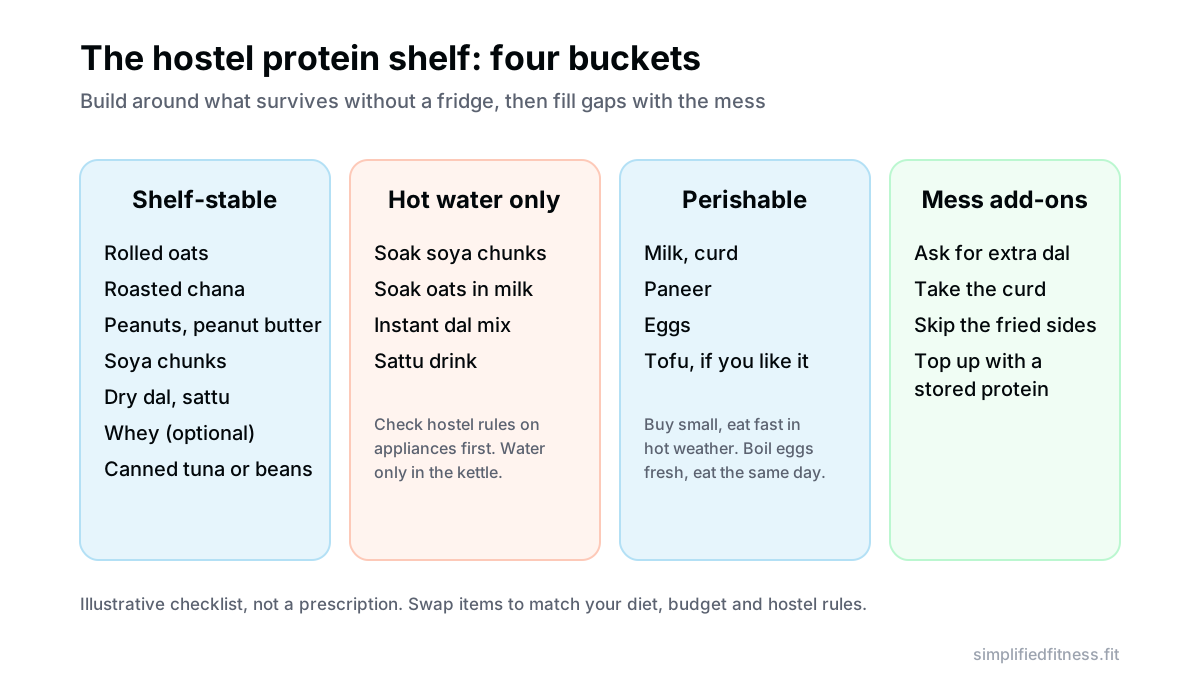
Here is a no-fuss starter kit.
- Overnight oats in a box. Rolled oats, milk, a spoon of peanut butter. Eat cold in the morning.
- Soaked soya chunks. Pour hot water from the kettle over dry chunks, wait 10-15 minutes, squeeze out the water, and mix into dal, curd or a chaat-style bowl with onion, tomato and masala.
- Boiled eggs. If you have a way to boil them, do a few fresh each morning. In a hot room, do not keep boiled eggs out overnight.
- Roasted chana and peanuts. Zero effort, good for the 4 pm slump.
- A sattu drink. Roasted gram flour stirred into water with salt or jaggery, if you like the taste.
- Mess upgrades. Ask for extra dal, take the curd, skip fried sides that crowd out protein.
If your hostel allows a microwave, an egg bowl takes minutes. But plenty of hostels ban appliances altogether, so check the rules. A kettle is for heating water only, so do not cook food in it. For more on gear choices, see our meal prep equipment guide.
What does a high protein hostel day look like?
This is an illustrative day, not a prescription. It uses approximate protein values and assumes a mess that serves dal, roti and curd.
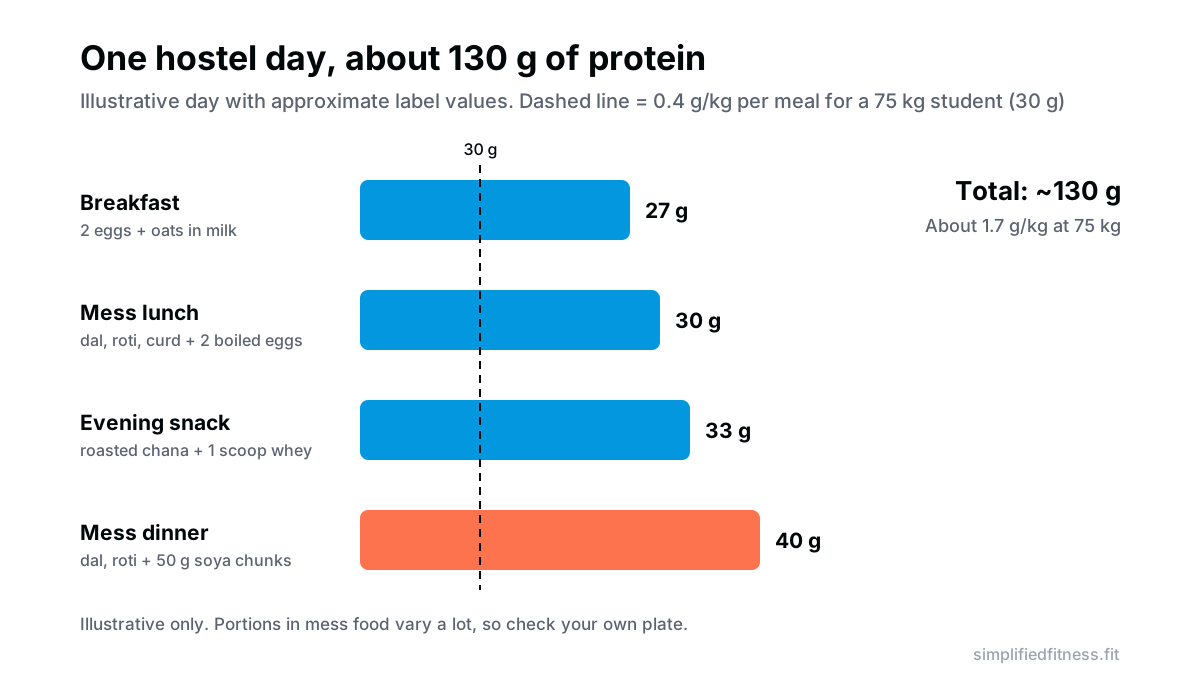
- Breakfast (about 27 g): two eggs plus overnight oats in milk.
- Mess lunch (about 30 g): dal, roti and curd, plus two boiled eggs from your stash.
- Evening snack (about 33 g): roasted chana and a scoop of whey, or a bigger chana and peanut portion if you skip whey.
- Mess dinner (about 40 g): dal and roti, with about 50 g of dry soya chunks (soaked) mixed in.
Does it have to look exactly like this? No. Vegetarian without eggs? Swap in paneer, extra soya chunks and more curd. The structure is what matters: a protein anchor at each feeding.
For a fuller vegetarian structure, see our vegetarian meal prep blueprint, or try the free diet plan.
Does spreading protein across meals matter?
A little. Probably less than gym culture suggests.
A review of per-meal protein suggests about 0.4 g/kg per meal across at least four meals to reach 1.6 g/kg a day, with the upper range of 2.2 g/kg needing up to about 0.55 g/kg per meal (Schoenfeld and Aragon, 2018). For a 75 kg student that is about 30 g per meal. The older idea that only 20-25 g can be used at once has been challenged, and the review itself notes the evidence is still debated.
So here is the practical takeaway. Total daily protein comes first. Splitting it into three or four anchored feedings is a nice-to-have that fits student life anyway.
Are eggs, soya and dal really worth it?
Short answer, yes, with caveats.
Eggs. In a crossover trial of 10 resistance-trained young men, eating whole eggs after training stimulated myofibrillar protein synthesis more than egg whites with the same 18 g of protein (van Vliet et al., 2017). It was a single-dose study in a small group, so it does not prove whole eggs build more muscle over months. It does back the budget-friendly habit of eating the yolk. For the Indian context, see eggs in the Indian diet.
Soya chunks. Very high protein per rupee, but easy to overdo and not a stand-in for variety. Read the soya chunks safety and myths guide before making it your only protein.
Dal and pulses. A Canadian study of nine cooked pulse classes (peas, lentils, chickpeas and beans), tested in rodent models, found digestibility above 70% and PDCAAS values above 0.5 (Nosworthy et al., 2017). That supports pulses as useful protein, but rodent data and moderate scores mean dal works best alongside curd, soya, paneer or eggs, not alone. Our dals and pulses guide covers moong, chana and rajma in detail.
What if you are cutting on a budget?
Protein needs rise a little when you eat less. A review of energy-restricted, resistance-trained lean athletes suggested 2.3-3.1 g per kg of fat-free mass, scaled up with the severity of the deficit and leanness (Helms et al., 2014). That review covered only six studies of already lean athletes, so most students on a modest cut do not need to chase the top of that range.
If you are cutting, keep the deficit gentle and keep lifting. Our energy balance guide explains how to set calories without crash dieting.
Can roommates help you save money?
Yes, with boundaries.
Buy the boring stuff in bulk: oats, dry soya chunks, peanuts, dal. Larger packs usually cost less per kilo and keep for weeks if stored in airtight boxes. Split the bill clearly, label your boxes, and keep perishables separate. Shared milk and curd in a warm room is how friendships and stomachs get tested.
When should you see a doctor or ask for help?
- You have kidney disease, diabetes affecting your kidneys, or another condition where protein intake is restricted. Ask your doctor first.
- You feel dizzy, faint or very weak, or you are losing weight without trying.
- You are skipping meals because of money. Talk to your college welfare office, warden or a trusted adult, because food security comes before macros.
- Food rules and weighing start to feel stressful or compulsive. Consider speaking to a doctor or counsellor.
The bottom line
A college student bodybuilding diet budget runs on boring, repeatable food: eggs, dal, soya, curd, chana, peanuts and oats. Aim for roughly 1.4-2.0 g/kg a day, use about 1.6 g/kg as a sensible default, and spread it over three or four feedings where you can. Powder is optional.
Start with one change this week. Add two eggs to breakfast, or soak soya chunks for dinner. Then get a personal number from the protein calculator and read the full high protein foods and meal prep cost guide when you are ready for more. For how much protein builds muscle in the first place, see optimal daily protein for hypertrophy.
Frequently Asked Questions
How can a college student eat a high protein diet on a tight budget?
Build meals around cheap protein staples such as eggs, dal, soya chunks, curd, roasted chana and peanuts. Research on lifters points to roughly 1.4-2.0 g of protein per kg a day as enough for most people, and cheap foods can reach that. Pick three or four staples, buy them in bulk, and repeat them.
How much protein does a student need to build muscle?
Most exercising adults do well on 1.4-2.0 g per kg of body weight per day, according to the International Society of Sports Nutrition. A meta-analysis found gains in fat-free mass stopped improving beyond about 1.6 g/kg/day in the supplement trials it pooled. Use our protein calculator to turn that range into grams for your own weight.
Is 130 g of protein a day realistic on a student budget?
For a 70-80 kg student, 130 g sits near 1.6-1.9 g/kg, which is inside the researched range. It is realistic if the mess provides some dal and curd and you add eggs, soya chunks and a cheap snack. If your budget is very tight, aim lower first (say 100-110 g) and build up.
Do I need protein powder as a student?
No. Protein supplements raised strength and muscle slightly in a large meta-analysis, and the benefit levelled off once total intake was adequate, which food can supply too. Whey is a convenient top-up, not a requirement. Buy it only after your food basics are covered.
What can I cook in a hostel room with only an electric kettle?
You can soak oats overnight in milk, rehydrate soya chunks in hot water, and make a sattu drink. A kettle is for heating water, so do not cook food directly in it, and check your hostel rules before bringing any appliance. Pair kettle prep with mess dal and roti rather than trying to replace the mess.
Are eggs good for building muscle on a budget?
Yes, eggs are one of the cheapest high-quality proteins. In one small crossover trial of 10 trained men, whole eggs stimulated muscle protein synthesis more than egg whites with the same protein, though that was a short acute study. Eat whole eggs unless a doctor has told you otherwise.
Is soya chunks protein as good as whey for muscle?
In a meta-analysis of nine trials (266 people), soy protein supplementation gave similar strength and lean mass gains to whey and other animal proteins. Those trials used soy protein products, not necessarily soya chunks, so treat the result as supportive rather than exact. Soya chunks are cheap and dense in protein, so they are worth using in moderation.
Are dal and pulses enough protein for a vegetarian student?
Dal gives useful protein but less per serving than people expect, so it works best combined with curd, soya, paneer or eggs if you eat them. A study of cooked pulses in rodent models found good digestibility and moderate protein quality scores. Eat a variety across the day and add a denser protein at one or two meals.
How many meals a day should a student eat for muscle?
A review suggests about 0.4 g/kg of protein per meal across at least four meals to reach 1.6 g/kg a day. That is a guide, not a rule, and the evidence on perfect timing is still debated. If your classes allow three meals plus one snack, you are already close.
How do I stop eggs and milk spoiling in a hot hostel room?
Heat speeds up spoilage, so buy small amounts of milk and curd and finish them quickly. Boil eggs fresh and eat them the same day rather than leaving them out overnight. Keep long-life items (oats, chana, peanuts, soya chunks) in airtight boxes.
Can I split groceries with roommates?
Yes, bulk staples such as oats, dry soya chunks, peanuts and dal are cheaper per kilo in larger packs and keep well. Agree on who buys what, keep separate labelled boxes for shared items, and divide the bill clearly. Do not share anything perishable unless everyone is happy with how it is stored.
Should I worry about eating too much protein?
For healthy people, intakes in the 1.4-2.0 g/kg range are described as sufficient for most exercising people in the position stand. Going far above what you need rarely adds benefit and costs money. If you have kidney disease or another medical condition, ask your doctor what is right for you.
What if I cannot afford to hit my protein target every day?
Hitting it most days is good enough, and being a little under does not undo your training. Prioritise the cheapest protein per rupee first, such as eggs, dal, soya chunks and curd. If you are regularly skipping meals for money reasons, speak to your college welfare office, because eating enough comes before optimising protein.
Sources & References
Every claim above is checked against peer-reviewed research (PubMed, U.S. National Library of Medicine) or guidance from established health bodies. How we fact-check.
- Morton RW, et al. A systematic review, meta-analysis and meta-regression of the effect of protein supplementation on resistance training-induced gains in muscle mass and strength in healthy adults. Br J Sports Med. 2018. PMID: 28698222
- Jager R, et al. International Society of Sports Nutrition Position Stand: protein and exercise. J Int Soc Sports Nutr. 2017. PMID: 28642676
- Schoenfeld BJ, Aragon AA. How much protein can the body use in a single meal for muscle-building? Implications for daily protein distribution. J Int Soc Sports Nutr. 2018. PMID: 29497353
- Messina M, et al. No difference between the effects of supplementing with soy protein versus animal protein on gains in muscle mass and strength in response to resistance exercise. Int J Sport Nutr Exerc Metab. 2018. PMID: 29722584
- van Vliet S, et al. Consumption of whole eggs promotes greater stimulation of postexercise muscle protein synthesis than consumption of isonitrogenous amounts of egg whites in young men. Am J Clin Nutr. 2017. PMID: 28978542
- Nosworthy MG, et al. Determination of the protein quality of cooked Canadian pulses. Food Sci Nutr. 2017. PMID: 28748078
- Helms ER, et al. A systematic review of dietary protein during caloric restriction in resistance trained lean athletes: a case for higher intakes. Int J Sport Nutr Exerc Metab. 2014. PMID: 24092765

Umair Hazrami · Founder & Head Coach, Simplified Fitness
Umair Hazrami founded Simplified Fitness and the Simplified Lifter channel to cut through fitness noise. With 4+ years of consistent training and 10+ coaching clients, he writes every guide from the peer-reviewed research and links the sources so you can check them. Our editorial standards.
Educational content only, not medical advice. If you have a medical condition, are pregnant, or take medication, talk to a qualified doctor before changing your diet, supplements or training. Full disclaimer.
Keep reading
Indian Diet
The 3-Hour Weekly Batch Meal Prep: Cooking 5 Days of Lunches and Dinners for Busy Lifters
Batch meal prep for the week in 3 hours: a station-by-station Sunday plan for 10 high-protein lunches and dinners, with Indian options and safe storage rules.
7 min read

Indian Diet
Cost per 30 Grams of Protein: 40 Common Fitness Foods Ranked by Price
Cost per 30g protein for 40 Indian gym foods, from soya chunks to whey and tuna. See the cheapest protein sources per gram and what to buy on a budget.
8 min read
Indian Diet
Essential Kitchen Equipment for Lifters: Scales, Air Fryers, Blenders and Containers
The best kitchen equipment for meal prep lifters: which four tools earn their space, what the research says about each, and what to buy first on a budget.
10 min read
Indian Diet
Fast Food Survival Guide: Macro-Friendly Orders at Major Global Chains
A fast food survival guide for lifters: how to build a high protein order at any chain, cut hidden calories, handle sodium and stay on track while travelling.
8 min read