Top 25 High-Protein Non-Vegetarian Foods: Lean Poultry, Meats, Seafood, and Egg White Ratios
A high protein non vegetarian foods list of 25 chicken, meat, fish and egg options with protein per 100 g and per 100 kcal, plus what the research says.
TL;DR. The short answer
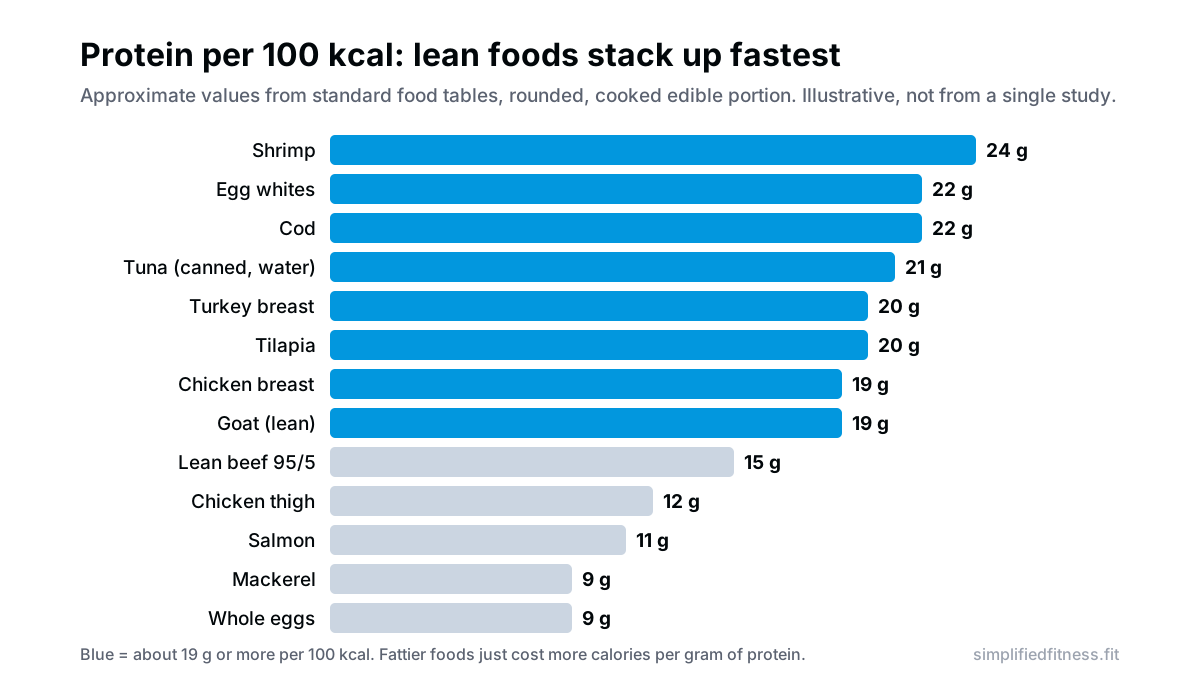
- The leanest high-protein picks are chicken or turkey breast, white fish, shrimp, canned tuna and egg whites, at roughly 19-24 g of protein per 100 kcal.
- Whole eggs, salmon, mackerel and chicken thigh carry more fat, so they give less protein per calorie but add omega-3, vitamins and flavour that help you stick to the plan.
- In resistance-trained men, eating whole eggs or isonitrogenous egg whites for 12 weeks produced similar muscle and body composition results, so the choice is mostly about calories and budget.
- Fish is linked to lower cardiovascular risk in cohort studies, while high intakes of red and processed meat are linked to higher cancer risk, so rotate and keep processed meat rare.
- Total daily protein matters more than any single food: gains in fat-free mass levelled off above about 1.6 g/kg/day in a large meta-analysis.
Part of our complete guide: High-Protein Foods List: Protein per 100g, Cost per 30g and Meal Prep Guide
Table of contents
A good high protein non vegetarian foods list starts with chicken breast, turkey breast, white fish, shrimp, canned tuna and egg whites. They give you about 19-24 g of protein per 100 kcal. Fattier options like whole eggs, salmon, mackerel and chicken thigh give less protein per calorie, but they are cheaper, tastier or richer in nutrients, so they earn a place too.
This guide ranks 25 animal protein sources with approximate macros, then covers what the research says about eggs, fish and red meat. It is the non-vegetarian companion to our pillar on high-protein foods, meal prep and cost. If you want the full ranking across all food types, see the top 30 high-protein foods ranked by protein per calorie. Vegetarian? Go to the vegetarian version.
How to read the numbers in this list
All figures below are rounded, approximate values for the cooked edible portion per 100 g, based on standard food composition tables. They are not from a single study. Cut, brand, fat trimming and cooking method move them by a few grams, so treat them as a guide and check your pack label when you can.
Why per 100 g cooked? Because meat loses water in the pan. 100 g of raw chicken breast is about 23 g of protein, while 100 g of cooked breast is about 31 g. Weigh consistently, either raw or cooked, and stick with it.
The top 25 high-protein non-vegetarian foods
| # | Food (cooked, per 100 g) | Protein (g) | Energy (kcal) | Good for |
|---|---|---|---|---|
| 1 | Chicken breast, skinless | ~31 | ~165 | Cutting, meal prep |
| 2 | Turkey breast, skinless | ~29 | ~145 | Cutting |
| 3 | Chicken breast mince, lean | ~27 | ~160 | Kebabs, keema |
| 4 | Chicken thigh, skinless | ~26 | ~210 | Bulking, flavour |
| 5 | Lean beef mince 95/5 | ~26 | ~170 | Iron, variety |
| 6 | Lean beef steak (trimmed) | ~28 | ~180 | Occasional meal |
| 7 | Goat (lean, chevon) | ~27 | ~145 | Indian curries |
| 8 | Bison | ~26 | ~160 | Lean red meat |
| 9 | Venison | ~30 | ~160 | Lean red meat |
| 10 | Pork loin, trimmed | ~26 | ~180 | Variety |
| 11 | Chicken liver | ~24 | ~165 | B12, iron (occasional) |
| 12 | Whole eggs | ~13 | ~145 | Budget, nutrients |
| 13 | Egg whites | ~11 | ~50 | Cutting |
| 14 | Rohu or catla | ~18-20 | ~100-130 | Indian staple fish |
| 15 | Tilapia | ~26 | ~130 | Cheap white fish |
| 16 | Cod | ~23 | ~105 | Very lean |
| 17 | Pomfret and similar sea fish | ~19-20 | ~100-120 | Local sea fish |
| 18 | Salmon | ~22 | ~200 | Omega-3 |
| 19 | Mackerel (bangda) | ~24 | ~260 | Omega-3, cheap |
| 20 | Sardines (canned) | ~25 | ~210 | Omega-3, calcium |
| 21 | Tuna, canned in water | ~24 | ~115 | Portable protein |
| 22 | Tuna steak, fresh | ~28 | ~140 | Lean, occasional |
| 23 | Shrimp | ~24 | ~100 | Highest per calorie |
| 24 | Crab | ~19 | ~100 | Variety |
| 25 | Squid or calamari, grilled | ~16-18 | ~90-110 | Variety |
A few notes on reading this table. Bison, venison and fresh tuna steak are hard to find and expensive in most Indian cities, so treat them as “if you can get them”. Chicken, eggs, rohu, tilapia, canned fish and goat are the realistic daily drivers for most readers.
Lean poultry: chicken breast, turkey and thigh
Chicken breast stays at the top of most lists because it combines decent protein per rupee with very few calories. The most common mistake here is overcooking it into rubber and then deciding you hate it. Brine it lightly, pressure cook it, or cook thighs on the days you want something juicy.
Chicken vs turkey vs beef macros are closer than gym arguments suggest. Turkey breast and chicken breast sit around 29-31 g per 100 g cooked. Lean beef is typically 26-28 g. The meaningful gap is calories and price, not protein.
Skinless thigh gives about 26 g with more fat. If you are bulking, that extra fat helps you hit your calories. If you are cutting, a thigh still works if you track it. Keep the skin off in either case if calories are tight.
Red meat: lean beef 95/5, goat and bison
Lean beef, goat and bison are useful for iron, zinc and B12 along with protein. Animal foods are among the main dietary sources of B12, which is one reason a mostly vegetarian lifter should think about it separately.
Does red meat add anything special for muscle? Two trials in older adults suggest it adds little on top of the training itself. In a 24-week randomized trial of 154 adults aged 65 or older doing resistance-based exercise, those eating two 80 g servings of lean red meat on training days did not gain significantly more lean mass, strength or executive function than those eating carbohydrates, though they did show small advantages in a few secondary measures like arm lean mass and gait speed (Formica et al., 2020).
A separate 12-week feeding trial in older women compared 0.8 g/kg protein, 1.4 g/kg from mixed foods and 1.4 g/kg emphasising lean beef. Strength and quadriceps muscle volume rose with training regardless of diet, including in the 0.8 g/kg group (Carroll et al., 2024).
What about the health risks of red meat?
This is where the evidence is less comfortable. A 2021 meta-analysis of 148 articles of prospective studies found that high red meat intake was associated with higher risk of colorectal cancer (RR 1.10) and colon cancer (RR 1.17), among other cancers, and processed meat showed an 18% greater colorectal cancer risk (Farvid et al., 2021).
These are observational associations comparing the highest with the lowest intake, and the effect sizes are modest. They cannot prove cause. A practical reading: lean, unprocessed red meat a few times a week is reasonable for most people, and sausages, salami, bacon and ham should not be daily staples. If you have a family history of bowel cancer or digestive symptoms, ask your doctor about your own limits.
Eggs and egg whites: ratios that actually work
Eggs are one of the cheapest complete proteins in most Indian kitchens. The real question is whether to throw away the yolk.
Here is where the studies differ. In a small crossover trial of 10 resistance-trained men, whole eggs (18 g protein, 17 g fat) stimulated more myofibrillar protein synthesis after a single workout than egg whites with the same 18 g of protein (van Vliet et al., 2017). But protein synthesis after one meal is not muscle you can see.
Over a longer period, 30 resistance-trained men trained for 12 weeks and ate either three whole eggs or six egg whites daily after sessions. Both groups gained muscle mass (about 2.9 and 2.7 kg) with no meaningful difference, and the authors concluded whole egg and egg white can be used interchangeably when protein intake is maintained (Bagheri et al., 2020).
Why the mismatch? One is an acute single-meal measure in 10 people, the other is 12 weeks of actual body composition in 30 people. For practical purposes, the longer trial matters more for most of us. We cover it in depth in whole eggs vs egg whites for muscle protein synthesis, and the cost and cholesterol angle in eggs in the Indian diet.
A practical egg white ratio: a whole large egg is about 6 g of protein and roughly 70 kcal, while a large egg white is about 3.5-4 g and about 17 kcal. So 2 whole eggs plus 3 whites gives roughly 23-24 g of protein for about 195 kcal. That is a good breakfast scramble on a cut.
Seafood: best fish for bodybuilding
Fish gives you protein plus the long-chain omega-3 fats EPA and DHA, which few other foods supply. The best fish for bodybuilding depends on what you need that day.
Lean choices: cod, tilapia, rohu, catla, shrimp and canned tuna in water are the highest protein per calorie. Fatty choices: salmon, sardines and mackerel carry more omega-3, along with more calories. For dosing details see our EPA and DHA omega-3 guide.
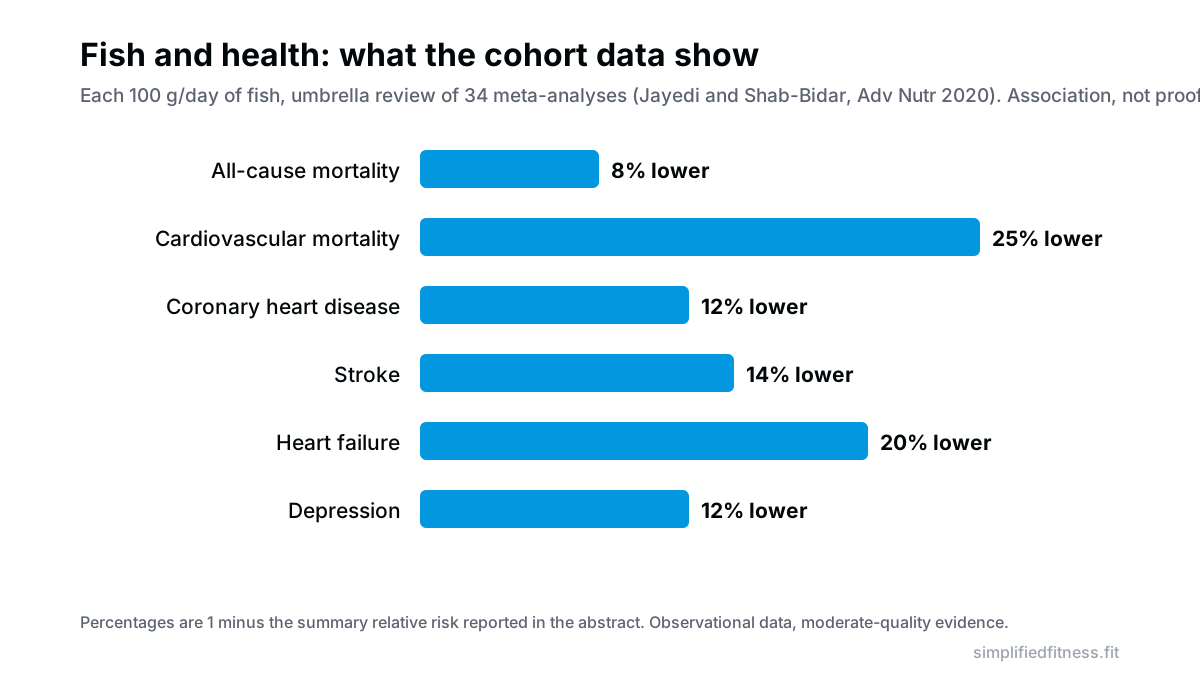
The health data on fish are encouraging. An umbrella review of 34 meta-analyses of prospective cohort studies found moderate-quality evidence that each extra 100 g/day of fish was associated with lower all-cause mortality (SRR 0.92), cardiovascular mortality (0.75), coronary heart disease (0.88), stroke (0.86), heart failure (0.80) and depression (0.88) (Jayedi and Shab-Bidar, 2020).
What about mercury? A JAMA review concluded that for major health outcomes in adults, the benefits of fish intake exceed the potential risks, though people eating five or more servings a week should limit the species highest in mercury, and women of childbearing age should consult regional advisories for locally caught freshwater fish (Mozaffarian and Rimm, 2006). That review is older, but its conclusion on balance is widely cited. Rotating species is the easy fix.
Indian context: rohu, catla and tilapia are widely available and cheap. Bangda (mackerel) and sardines (tarli) are budget omega-3 sources on the coast. For sourcing and cooking tips, see chicken breast and fish in India.
How much protein do you actually need from these foods?
More food from this list does not automatically mean more muscle. A meta-analysis of 49 trials with 1,863 participants found protein supplementation improved strength and fat-free mass during resistance training, but beyond total intakes of about 1.62 g/kg/day there was no further gain in fat-free mass (Morton et al., 2018). That analysis was of supplementation trials, not whole-food diets, so treat 1.6 g/kg as a sensible target rather than a hard ceiling.
For a 70 kg lifter, that is roughly 110-115 g a day. Get your own number with the protein calculator. A day might look like 3 eggs and 3 whites (about 30 g), 150 g of chicken breast (about 45 g) and 150 g of cooked rohu or tilapia (about 30-40 g), plus dal, curd or milk to fill in the gap.
Cooking methods and nutrient density
Cooking changes calories far more than protein. A tablespoon of oil adds about 120 kcal, so a “lean” tikka can quietly become a heavy meal. See hidden calorie traps in Indian cooking.
- Grill, bake, tandoor, steam or pressure cook for the leanest result.
- Pan-sear with a teaspoon of oil rather than deep frying.
- Avoid heavily charred or burnt surfaces, which form compounds that researchers are still studying.
- Keep fish curries light on coconut milk and oil if you are cutting.
- Weigh raw or cooked consistently so your logs stay accurate.
Meat and fish are also among the better dietary sources of B12, iron and zinc, which is useful context if you are choosing between foods. Our guide to protein quality scores such as DIAAS explains why animal proteins score well, and our cost per 30 g of protein comparison covers which options are cheapest in rupees.
A realistic week of choices
You do not need a perfect rotation. Something like this works for most lifters:
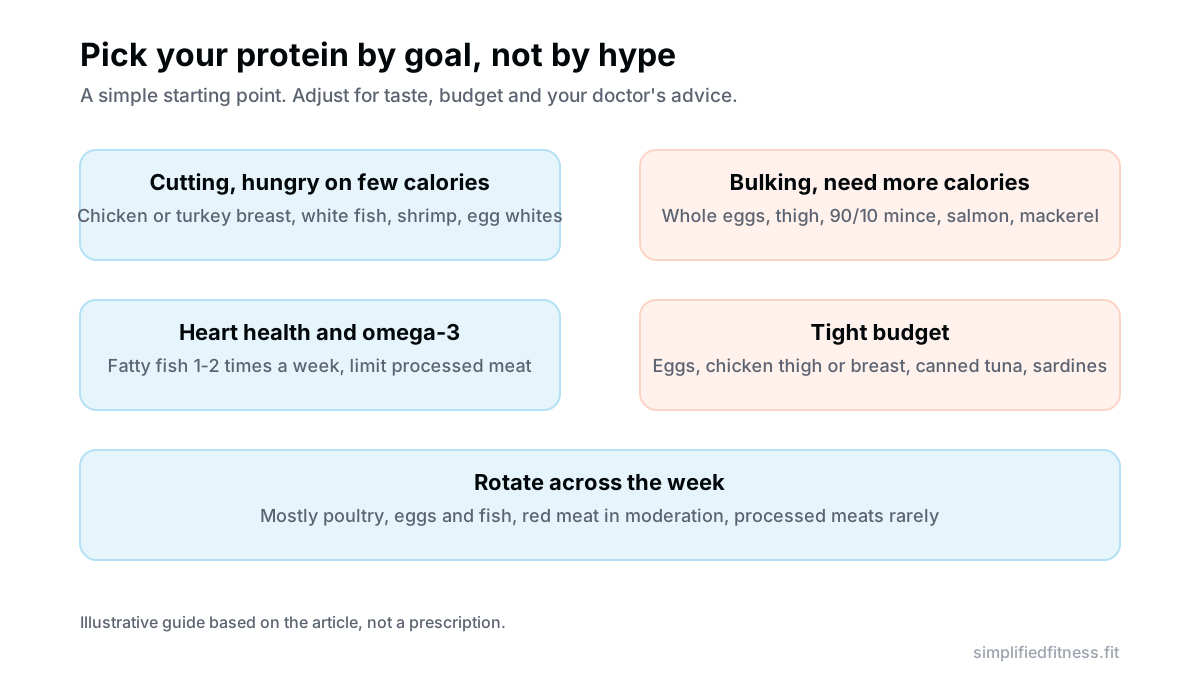
- 3-4 days chicken or turkey breast or thigh
- 2-3 days fish, including one fatty fish meal
- Eggs most days
- Lean red meat or goat once or twice a week
- Processed meats rarely
Want a full day built around this? Our non-vegetarian 1800 kcal cutting diet shows the numbers, and the free diet plan generator will build one around your targets.
Anyone with kidney disease, gout, a history of digestive cancers, pregnancy or any medical condition that changes protein or mercury advice should check with their doctor or a registered dietitian before changing intake. This article is general education, not personal medical advice.
Frequently Asked Questions
What is the best non-vegetarian food for protein?
Chicken breast is the most practical all-rounder, with roughly 31 g of protein per 100 g cooked and about 165 kcal. It is lean, cheap in most Indian cities and easy to batch cook. Rotate it with fish and eggs so you are not eating the same thing every day.
Which has more protein, chicken, turkey or beef?
Per 100 g cooked, skinless chicken breast and turkey breast are both around 29-31 g, while lean beef is usually about 26-28 g. The gap is small, and the real difference is calories: breast meat is leaner than most beef cuts. Pick by price, taste and fat content rather than chasing 2 g of protein.
Is lean beef 95/5 good for building muscle?
Yes, as one protein source among several. In a 12-week feeding trial in older women, a high-protein diet emphasising lean beef did not beat an equal-protein mixed diet, or even a 0.8 g/kg diet, for gains in strength or muscle volume. Lean beef works, but it is not special, so use it for variety, iron and B12.
What is the best fish for bodybuilding?
For lean protein, white fish like cod, tilapia and rohu or catla are low in calories, while salmon, sardines and mackerel give you omega-3 along with protein. Fish intake is linked to lower cardiovascular risk in cohort studies. Eating fatty fish once or twice a week and lean white fish on other days is a sensible mix.
Are egg whites better than whole eggs?
Egg whites are better only if you are counting calories closely. Whole eggs stimulated muscle protein synthesis more after exercise in one small crossover trial, but over 12 weeks of training whole eggs and egg whites gave similar muscle gains. Use both: whites to stretch protein, whole eggs for the yolk nutrients.
How many egg whites equal one whole egg in protein?
A large egg white has roughly 3.5-4 g of protein and a whole large egg has about 6 g, so about 1.5 to 2 whites match one whole egg. The yolk adds fat, vitamins and about 55 kcal more. A common gym split is two whole eggs plus three or four whites.
Is tuna safe to eat every day?
Daily tuna is not the best plan, because large predatory fish like tuna can carry more methylmercury than smaller fish. A JAMA review concluded that for adults the benefits of fish intake exceed the risks, but advised that people eating five or more servings a week limit the highest-mercury species. Rotate tuna with sardines, rohu, cod and shrimp, and follow your doctor's advice if you are pregnant or planning a pregnancy.
Is red meat bad for you if I lift weights?
Moderate amounts of unprocessed lean red meat can fit into a lifter's diet, but high intakes are associated with higher cancer risk in large cohort meta-analyses. Those studies show association, not proof, and the risk estimates are modest. Keep red meat to a few meals a week and avoid making processed meats like sausages and salami a staple.
Is chicken thigh as good as chicken breast for protein?
Skinless chicken thigh has about 26 g of protein per 100 g cooked versus about 31 g for breast, with more fat and around 210 kcal. The protein quality is similarly high. Thigh is often cheaper and juicier, so it is a good bulking choice and a fine cutting choice if you track the calories.
How much non-vegetarian protein do I need per day?
Most lifters do well around 1.6 g/kg of body weight per day, since a large meta-analysis found no further gain in fat-free mass beyond about 1.62 g/kg/day with supplementation. A 70 kg lifter would aim for roughly 110-115 g. Work out your own number with our protein calculator.
What is the cheapest high-protein non-vegetarian food in India?
Eggs and chicken are usually the cheapest in most cities, followed by canned fish, local freshwater fish and goat or buffalo meat at a higher price. Prices change by city and season, so compare cost per 30 g of protein rather than cost per kilo. Buying whole chicken and whole fish from a local market often beats packaged cuts.
Does cooking method change the protein in meat?
Cooking does not meaningfully reduce the protein you get, but it changes weight, because meat loses water and cooked 100 g holds more protein than raw 100 g. Frying in lots of oil adds calories fast. Grill, bake, pressure cook or pan-sear with a little oil, and avoid heavily charring the surface.
Should I eat chicken liver for protein?
Chicken liver gives about 24 g of protein per 100 g cooked and is rich in B12 and iron, which is why it is called nutrient-dense. It is also very high in vitamin A, so large or daily servings are not wise, particularly in pregnancy. Treat it as an occasional food, once a week at most, and speak to your doctor if you are pregnant.
Sources & References
Every claim above is checked against peer-reviewed research (PubMed, U.S. National Library of Medicine) or guidance from established health bodies. How we fact-check.
- Morton RW, et al. A systematic review, meta-analysis and meta-regression of the effect of protein supplementation on resistance training-induced gains in muscle mass and strength in healthy adults. Br J Sports Med. 2018. PMID: 28698222
- Jayedi A, et al. Fish Consumption and the Risk of Chronic Disease: An Umbrella Review of Meta-Analyses of Prospective Cohort Studies. Adv Nutr. 2020. PMID: 32207773
- Mozaffarian D, et al. Fish intake, contaminants, and human health: evaluating the risks and the benefits. JAMA. 2006. PMID: 17047219
- Farvid MS, et al. Consumption of red meat and processed meat and cancer incidence: a systematic review and meta-analysis of prospective studies. Eur J Epidemiol. 2021. PMID: 34455534
- van Vliet S, et al. Consumption of whole eggs promotes greater stimulation of postexercise muscle protein synthesis than consumption of isonitrogenous amounts of egg whites in young men. Am J Clin Nutr. 2017. PMID: 28978542
- Bagheri R, et al. Comparison of whole egg v. egg white ingestion during 12 weeks of resistance training on skeletal muscle regulatory markers in resistance-trained men. Br J Nutr. 2020. PMID: 32576297
- Formica MB, et al. Effect of lean red meat combined with a multicomponent exercise program on muscle and cognitive function in older adults: a 6-month randomized controlled trial. Am J Clin Nutr. 2020. PMID: 32469398
- Carroll CC, et al. Greater Protein Intake Emphasizing Lean Beef Does Not Affect Resistance Training-Induced Adaptations in Skeletal Muscle and Tendon of Older Women: A Randomized Controlled Feeding Trial. J Nutr. 2024. PMID: 38604504

Umair Hazrami · Founder & Head Coach, Simplified Fitness
Umair Hazrami founded Simplified Fitness and the Simplified Lifter channel to cut through fitness noise. With 4+ years of consistent training and 10+ coaching clients, he writes every guide from the peer-reviewed research and links the sources so you can check them. Our editorial standards.
Educational content only, not medical advice. If you have a medical condition, are pregnant, or take medication, talk to a qualified doctor before changing your diet, supplements or training. Full disclaimer.
Keep reading
Indian Diet
The 3-Hour Weekly Batch Meal Prep: Cooking 5 Days of Lunches and Dinners for Busy Lifters
Batch meal prep for the week in 3 hours: a station-by-station Sunday plan for 10 high-protein lunches and dinners, with Indian options and safe storage rules.
7 min read
Indian Diet
Cost per 30 Grams of Protein: 40 Common Fitness Foods Ranked by Price
Cost per 30g protein for 40 Indian gym foods, from soya chunks to whey and tuna. See the cheapest protein sources per gram and what to buy on a budget.
8 min read
Indian Diet
Eating Healthy on a Student Budget: High Protein Hostel and Dorm Room Meal Prep
A college student bodybuilding diet budget can still hit 130 g of protein. Cheap staples, no-cook hostel prep and a sample day, with the studies linked.
8 min read
Indian Diet
Essential Kitchen Equipment for Lifters: Scales, Air Fryers, Blenders and Containers
The best kitchen equipment for meal prep lifters: which four tools earn their space, what the research says about each, and what to buy first on a budget.
10 min read