Meal Prep Food Safety: How Long Cooked Chicken and Rice Last in the Fridge and Freezer
Meal prep food safety explained: how long cooked chicken and rice last in the fridge and freezer, how to cool rice fast, and when to reheat or bin it.
TL;DR. The short answer
- Cooked chicken and rice are generally kept for about 3-4 days in a fridge at 4 °C or colder. That is a cautious rule of thumb, and the clock starts when the food is cooked, not when you open the box.
- Cooked rice is the riskier half of the box. Bacillus cereus spores survive cooking and can multiply in rice left warm, and the toxin they make is not reliably removed by reheating.
- Get cooked food into the fridge within 2 hours (1 hour if it is hotter than 32 °C), and spread rice in a shallow box so it cools fast.
- Freezing pauses bacterial growth but does not sterilise food, so freeze early, reheat until steaming hot (74 °C), and reheat only once.
- Vomiting or diarrhoea that is severe, bloody, lasts over a couple of days, or hits a pregnant, elderly or very young person needs a doctor, not a home fix.
Part of our complete guide: High-Protein Foods List: Protein per 100g, Cost per 30g and Meal Prep Guide
Table of contents
Meal prep food safety comes down to two rules. Cooked chicken and rice are generally kept for about 3-4 days in a fridge at 4 °C or colder, and they need to get into that fridge within 2 hours of cooking. Rice is the one to be careful with, because its spores survive cooking.
This is the practical side of the high-protein foods and meal prep guide. You can plan a perfect week of protein and still lose two days to food poisoning if the boxes sit on the counter. It is also dull, which is why people skip it.
Here is what the research says, what it does not say, and a routine you can actually follow.
How long does cooked chicken last in the fridge?
The usual rule is about 3-4 days at 4 °C (40 °F) or below. That is a cautious guideline rather than a hard biological cutoff, and I will be honest: the studies behind it are not about gym lifters, and no single paper “proves” day 4 versus day 5.
What the research does show is why the fridge helps and why it is not magic. The cold slows growth, but some bacteria keep multiplying slowly even there. A survey of 2,060 US adults found that only 11% had a thermometer in their fridge, and roughly a quarter to a third of fridges were warmer than the recommended 4.4 °C (Kosa et al., 2007). So your fridge may not be as cold as you assume.
Cooked poultry also has a different risk profile from rice. In a lab study of cooked turkey, Clostridium perfringens counts rose by about 2.25-2.44 log10 CFU/g while uncured turkey chilled over 6 hours, but fell by about 2.5-2.75 log10 CFU/g during 7 days of cold storage (0.6-10 °C) in cured turkey (Kalinowski et al., 2003). For this bacterium, the cooling period is where the growth happens. That does not hold for every germ: Listeria, for example, can still grow slowly at fridge temperature. This was inoculated, lab-prepared turkey from an industry lab, not your home chicken breast, so treat it as a pattern and not a promise.
Why cooked rice is the riskier part of the box
Rice is often contaminated with Bacillus cereus spores, because the bacterium lives in soil. Review authors note that it can multiply in cooked rice at temperatures as low as 4 °C and cause diarrhoeal or vomiting illness when enough cells have grown (Rodrigo et al., 2021).
Cooking does not remove the spores. Boil the rice and the active bacteria die, but spores sit there waiting. Leave the pot on the counter overnight → spores germinate → bacteria multiply → toxin builds up.
How fast can this go? In a Japanese lab study, a vomiting-type strain in boiled rice rose to 10^7-10^8 CFU/g within 24 hours at 30 and 35 °C and produced emetic toxin (cereulide) (Agata et al., 2002). Thirty degrees is an ordinary Indian kitchen in summer.
That is the reason leftover rice has a reputation. It is also easy to overstate.
What the illness looks like
Bacillus cereus food poisoning comes in two forms. One is vomiting-type, caused by the cereulide toxin. The other is diarrhoeal, caused by enterotoxins (the Rodrigo review above describes both). I will not give precise onset times here. If you are ill and not sure what it is, see a doctor and do not self-diagnose.
The temperature danger zone and the 2-hour rule
A 2018 review of cooling and food containers describes a danger zone of 5-60 °C, and says cooked meat, rice and pasta in particular need to be kept outside it (Coorey et al., 2018). CDC guidance says to refrigerate cooked leftovers within 2 hours, or within 1 hour if the food has been above 90 °F (about 32 °C), and to keep the fridge at 40 °F or below and the freezer at 0 °F or below (CDC).
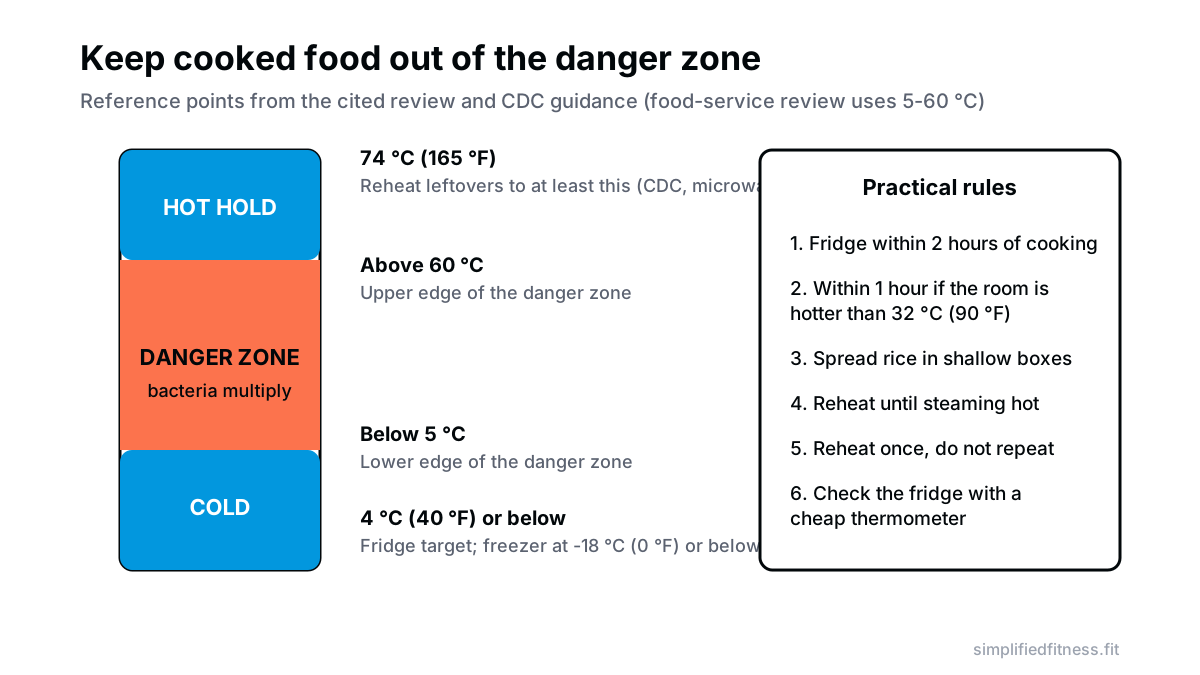
If you cook on a hot day in Delhi, Chennai or Hyderabad, the 1-hour rule is the one to follow. A pressure-cooked batch that sits in the open kitchen while you shower and scroll your phone has already used up most of its safe window.
How to cool rice properly (the part most people skip)
The goal is simple: make the rice lose heat quickly. The Coorey review notes that containers and packaging materials influence cooling rate (Coorey et al., 2018), and CDC advises packing warm food into several clean, shallow containers before refrigerating (CDC).
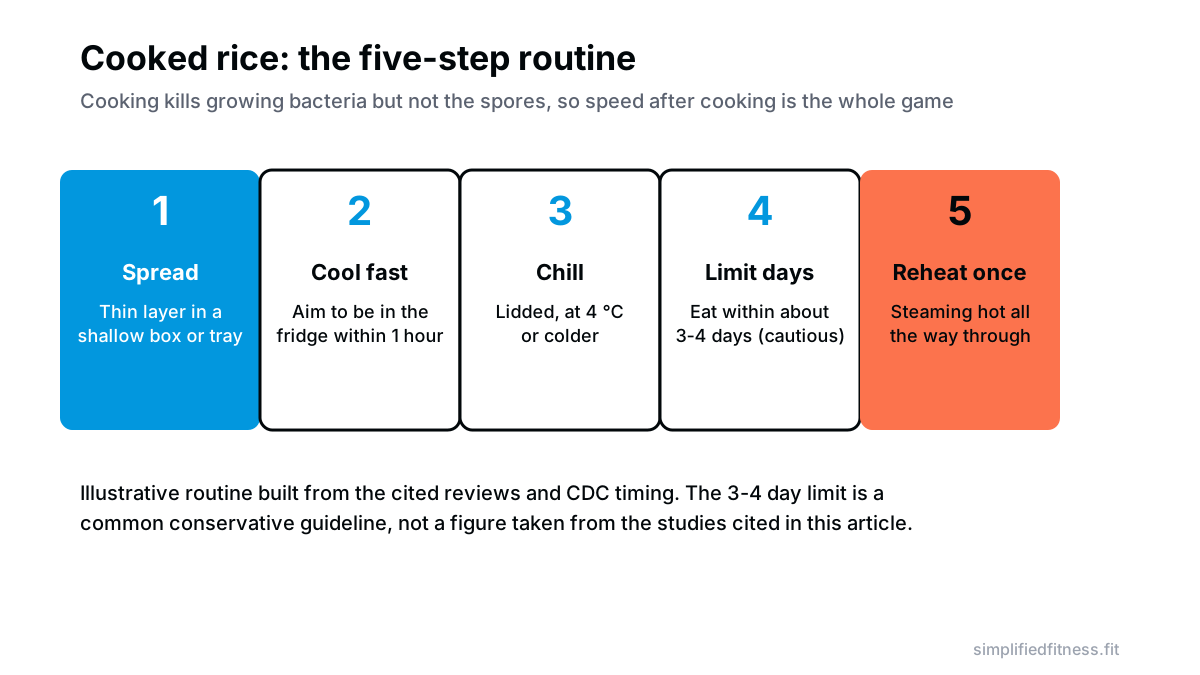
In practice:
- Spread the rice on a clean tray or in wide, shallow boxes. A thin layer of a few centimetres cools much faster than a full 1-litre tub.
- Do not leave the pressure cooker pot closed on the counter for the evening.
- Portion straight away into the boxes you will eat from. Fewer reopenings, fewer chances for contamination.
- Fridge the boxes within an hour, lids on once the steam has gone.
- Make less rice than you think you need. Cooking a small fresh pot midweek is cheap and quick.
The most common mistake here is cooking one big pot on Sunday and eating from it until Friday. If your meal prep week is that long, freeze the second half of the rice on day 1. Our 3-hour batch meal prep blueprint fits this in without extra time.
Can you reheat rice and chicken safely?
Yes, with limits. CDC advises using a food thermometer so microwaved food reaches 165 °F (74 °C) (CDC). In a home kitchen without a thermometer, the standard is steaming hot all the way through, with no cold centre.
A few habits that help:
- Reheat one portion at a time, not the whole tub.
- Stir halfway through the microwave, because microwaves heat unevenly.
- Add a splash of water to rice and cover it, so it steams.
- Reheat once. If you do not finish it, bin it rather than putting it back in the fridge.
Freezing meal prep safely
Freezing at -18 °C (0 °F) stops bacteria from multiplying. It is the best tool for a 5-7 day plan, and it is why the first thing I would do with a big Sunday cook is freeze Thursday’s and Friday’s boxes.
There is a limit, though. A 2025 lab study in beef, mutton and goat meat juice models found that Listeria monocytogenes and Salmonella Typhimurium persisted differently over up to 60 days of freezing, survival was highest in mutton juice, and the bacteria became more acid-resistant as freezing time rose (Kaboudari et al., 2025). This was a laboratory model with added bacteria, not cooked food in a home freezer, so I would not read it as a reason to avoid freezing. I would read it as a reason not to treat the freezer as a reset button. Freeze while fresh, not on day 4.
Practical points:
- Cool completely before freezing, so the box does not warm up the rest of the freezer.
- Flat portions freeze and thaw faster than a solid block.
- Thaw in the fridge overnight, not on the counter.
- Reheat to steaming hot. For taste and texture, see our guide to freezing and reheating meal prep.
Fridge and freezer shelf life cheat sheet
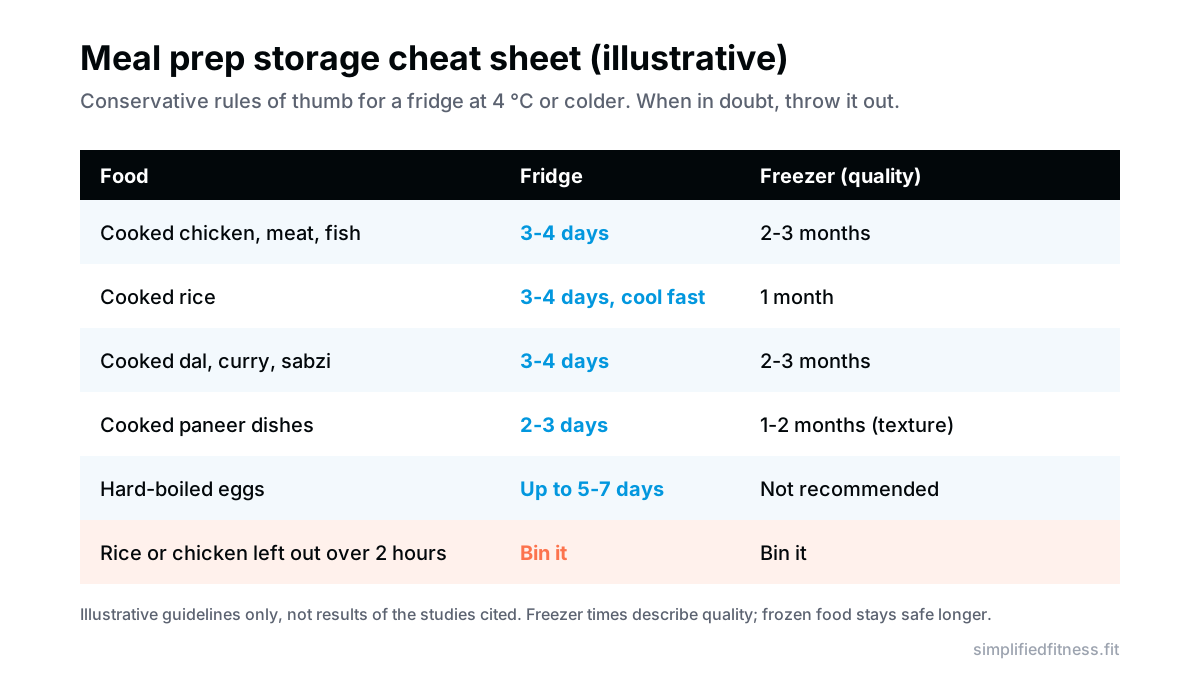
These numbers are conservative rules of thumb and not findings from the studies above. Dairy and Indian dishes vary: a paneer curry with plenty of acid and spice does not behave like plain boiled rice, though I would still not push it past 2-3 days. Dal and sabzi are generally fine for the same 3-4 days, as long as they are cooled and stored in the same way.
Glass or plastic containers for meal prep?
The honest answer is that the research does not crown a winner. What the cooling review does say is that containers and packaging materials affect how quickly food cools (Coorey et al., 2018). Shape matters too: CDC advises shallow containers, and a wide, shallow box in either material cools faster than a deep one.
My practical view: glass is easier to reheat and clean, plastic is lighter in a gym bag. Choose lidded, microwave-safe boxes, do not overfill them, and replace anything scratched or warped. For gear ideas see essential kitchen equipment for lifters.
A simple weekly routine
- Cook the chicken and rice together, so one timer runs both.
- Spread and portion within the first 30 minutes.
- Fridge by the 1-hour mark. Label with the date.
- Eat Monday to Wednesday from the fridge.
- Freeze Thursday and Friday boxes on day 1.
- Reheat once, to steaming hot.
If you want help working out how much protein to prep per box, use the protein calculator or our free diet plan.
When to see a doctor
Most food poisoning is miserable and over within a day or two, and dehydration is the usual danger. See a doctor if you have blood in your stool, a high fever, signs of dehydration (very dark urine, dizziness, not keeping fluids down), or symptoms lasting beyond a couple of days. Pregnant people, older adults, young children and anyone with a weakened immune system should get advice sooner. This article is general information and cannot diagnose anything.
Frequently Asked Questions
How long does cooked chicken last in the fridge?
Cooked chicken is generally kept for about 3-4 days in a fridge at 4 °C (40 °F) or colder. Bacteria grow slowly in the cold but they do grow, and some, like Listeria, can still multiply at fridge temperature. Label the box with the cooking date and eat the oldest portions first.
How long does cooked rice last in the fridge?
A cautious limit is about 3-4 days, provided the rice went into the fridge quickly after cooking. Reviews note that Bacillus cereus can multiply at temperatures as low as 4 °C in cooked rice, so slow cooling matters more than the number of days. If you are unsure how long it sat out, bin it.
Can you reheat rice safely?
Yes, if the rice was cooled quickly and stored cold, and you reheat it once until steaming hot all the way through. The catch is that reheating kills active bacteria but does not guarantee the removal of a toxin already formed. That is why the cooling step matters more than the reheating step.
Why is leftover rice dangerous?
Raw rice often carries Bacillus cereus spores that survive cooking. If cooked rice sits warm, the spores germinate and the bacteria can produce toxin, which in rice is linked to vomiting-type food poisoning. Cool the rice fast and refrigerate it within an hour or two.
How quickly should I refrigerate cooked food?
CDC advice is to refrigerate cooked leftovers within 2 hours, or within 1 hour if the food was exposed to temperatures above 90 °F (about 32 °C). In an Indian summer kitchen, assume the 1-hour rule applies. Portion into shallow boxes so the middle of the food cools as fast as the edges.
Can I freeze cooked chicken and rice for meal prep?
Yes, both freeze well in practice, and freezing at -18 °C (0 °F) or below stops bacterial growth. It does not kill everything, and a 2025 lab study found Listeria and Salmonella could survive freezing in meat juice models. Freeze portions while fresh, not on day 4, and reheat until steaming hot.
How long can cooked chicken stay in the freezer?
For quality, about 2-3 months is a sensible target for cooked chicken, though frozen food at a steady -18 °C stays safe far longer. Texture and flavour decline before safety does. Label boxes with the date and use the oldest first.
What is the temperature danger zone?
It is the range roughly between 5 and 60 °C, where bacteria multiply quickly. A 2018 review recommends keeping cooked items such as meat, rice and pasta outside this range. In practice that means hot food stays hot, cold food stays cold, and nothing sits on the counter for hours.
Is it safe to eat chicken that has been in the fridge for 5 days?
Probably not worth the risk. Beyond 3-4 days the safety margin shrinks, and spoilage bacteria are not the only concern because harmful bacteria often do not change smell or look. Cook smaller batches or freeze portions on day 1 or 2.
Does smelling the food tell me if it is safe?
No. Many harmful bacteria and toxins do not change how food smells or looks, so a sniff test can miss a real hazard. Use the cooking date and storage conditions to decide, not your nose.
Are glass or plastic containers better for meal prep?
Neither is proven safer in general. A 2018 review found that containers and packaging affect how quickly food cools, and CDC advises shallow containers, so shape matters at least as much as the material. Use lidded boxes that are microwave-safe and do not overfill them.
Can I put hot food straight into the fridge?
Yes, in small portions. CDC says small portions of hot food can go straight in because they chill faster, which beats leaving them on the counter. Very large hot pots take too long to cool in the middle, so split them into smaller boxes first. Keep the lid slightly open until the steam stops if the fridge is crowded.
When should I see a doctor after eating leftovers?
See a doctor for blood in stool, high fever, signs of dehydration, symptoms lasting more than a couple of days, or any illness in pregnancy, older age or small children. Most food poisoning is short-lived, but dehydration is the usual danger. This article is general information and cannot diagnose you.
Sources & References
Every claim above is checked against peer-reviewed research (PubMed, U.S. National Library of Medicine) or guidance from established health bodies. How we fact-check.
- Coorey R, et al. The impact of cooling rate on the safety of food products as affected by food containers. Compr Rev Food Sci Food Saf. 2018. PMID: 33350119
- Rodrigo D, et al. Risk of Bacillus cereus in relation to rice and derivatives. Foods. 2021. PMID: 33540849
- Agata N, et al. Production of Bacillus cereus emetic toxin (cereulide) in various foods. Int J Food Microbiol. 2002. PMID: 11883672
- Delbrassinne L, et al. Prevalence and levels of Bacillus cereus emetic toxin in rice dishes randomly collected from restaurants and comparison with the levels measured in a recent foodborne outbreak. Foodborne Pathog Dis. 2012. PMID: 22891880
- Kalinowski RM, et al. Impact of cooking, cooling, and subsequent refrigeration on the growth or survival of Clostridium perfringens in cooked meat and poultry products. J Food Prot. 2003. PMID: 12870757
- Kosa KM, et al. Consumer home refrigeration practices: results of a web-based survey. J Food Prot. 2007. PMID: 17685337
- Kaboudari A, et al. Effects of freezing period and meat juice model type on the survival, hydrophobicity, and acid resistance of Listeria monocytogenes and Salmonella Typhimurium. BMC Microbiol. 2025. PMID: 40413458
- Centers for Disease Control and Prevention. Food Safety: Prevention. CDC. cdc.gov

Umair Hazrami · Founder & Head Coach, Simplified Fitness
Umair Hazrami founded Simplified Fitness and the Simplified Lifter channel to cut through fitness noise. With 4+ years of consistent training and 10+ coaching clients, he writes every guide from the peer-reviewed research and links the sources so you can check them. Our editorial standards.
Educational content only, not medical advice. If you have a medical condition, are pregnant, or take medication, talk to a qualified doctor before changing your diet, supplements or training. Full disclaimer.
Keep reading
Indian Diet
The 3-Hour Weekly Batch Meal Prep: Cooking 5 Days of Lunches and Dinners for Busy Lifters
Batch meal prep for the week in 3 hours: a station-by-station Sunday plan for 10 high-protein lunches and dinners, with Indian options and safe storage rules.
7 min read
Indian Diet
Cost per 30 Grams of Protein: 40 Common Fitness Foods Ranked by Price
Cost per 30g protein for 40 Indian gym foods, from soya chunks to whey and tuna. See the cheapest protein sources per gram and what to buy on a budget.
8 min read
Indian Diet
Eating Healthy on a Student Budget: High Protein Hostel and Dorm Room Meal Prep
A college student bodybuilding diet budget can still hit 130 g of protein. Cheap staples, no-cook hostel prep and a sample day, with the studies linked.
8 min read
Indian Diet
Essential Kitchen Equipment for Lifters: Scales, Air Fryers, Blenders and Containers
The best kitchen equipment for meal prep lifters: which four tools earn their space, what the research says about each, and what to buy first on a budget.
10 min read