Cost per 30 Grams of Protein: 40 Common Fitness Foods Ranked by Price
Cost per 30g protein for 40 Indian gym foods, from soya chunks to whey and tuna. See the cheapest protein sources per gram and what to buy on a budget.
TL;DR. The short answer
- On illustrative Indian prices, soya chunks are the cheapest protein by a wide margin at roughly Rs 8 per 30 g, followed by masoor dal, atta, besan and other dals at about Rs 12-20.
- Whole eggs land near Rs 30 and chicken near Rs 47-52 per 30 g. Whey concentrate is closer to Rs 90, so at Indian prices it is a convenience product, not the cheapest gram of protein.
- Cheap does not always mean equal. Many plant staples carry less protein per calorie, are digested somewhat less completely, and need mixing, but total daily protein matters more than any single source.
- A lifter can hit about 1.6 g/kg a day, the level where extra protein stopped adding muscle in a large meta-analysis, for well under Rs 150 a day by building meals around soya, dal, eggs and milk.
- All prices here are approximate and city-dependent. Use the three-step formula to recalculate with the rates in your own market.
Part of our complete guide: High-Protein Foods List: Protein per 100g, Cost per 30g and Meal Prep Guide
Table of contents
If you want the cheapest protein, the answer in India is dry soya chunks, then dals, besan and atta, then eggs and chicken, with whey powder further down. The cost per 30g protein for soya chunks works out to roughly Rs 8 on typical retail prices, against about Rs 30 for eggs, Rs 50 for chicken breast and Rs 90 for whey concentrate.
That ranking surprises people who assume powder is always the budget option. This article is part of our high-protein foods and meal prep cost guide, and it does one job: put 40 common gym foods on the same price scale so you can shop with numbers, not marketing.
How we calculate cost per 30 g of protein
Price per kg is useless for comparing foods, because a kilo of chicken and a kilo of soya chunks carry very different amounts of protein. The fix is simple. Work out how much food gives you 30 g of protein, then price that amount.
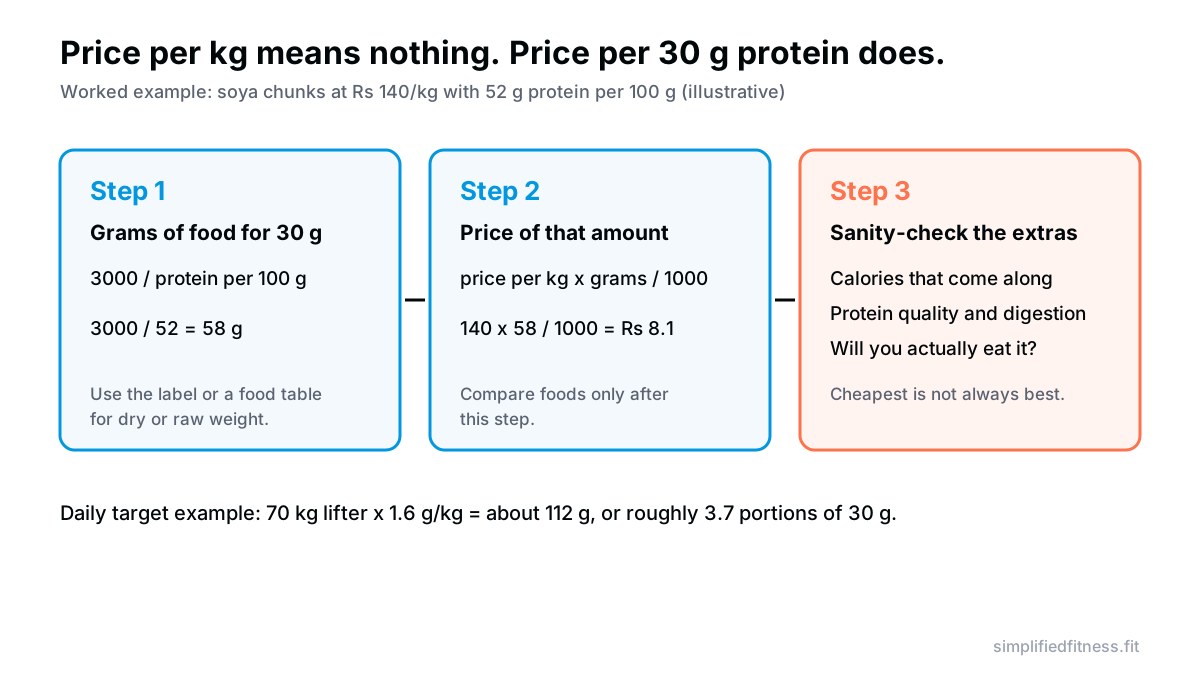
Why 30 g? It is a typical protein serving at a meal, which makes comparisons easy to picture. It is not a biological ceiling. What research links to muscle gain is total daily protein: one large meta-analysis of 49 trials (1,863 participants) found that protein supplementation improved strength and fat-free mass during resistance training, and that intakes above about 1.6 g/kg/day gave no further gain in fat-free mass (Morton et al., 2018). For a 70 kg lifter that is about 112 g a day, or roughly four portions of 30 g.
Which foods give the cheapest protein per gram?
Here are 14 of the 40 foods from the full table, drawn to scale.
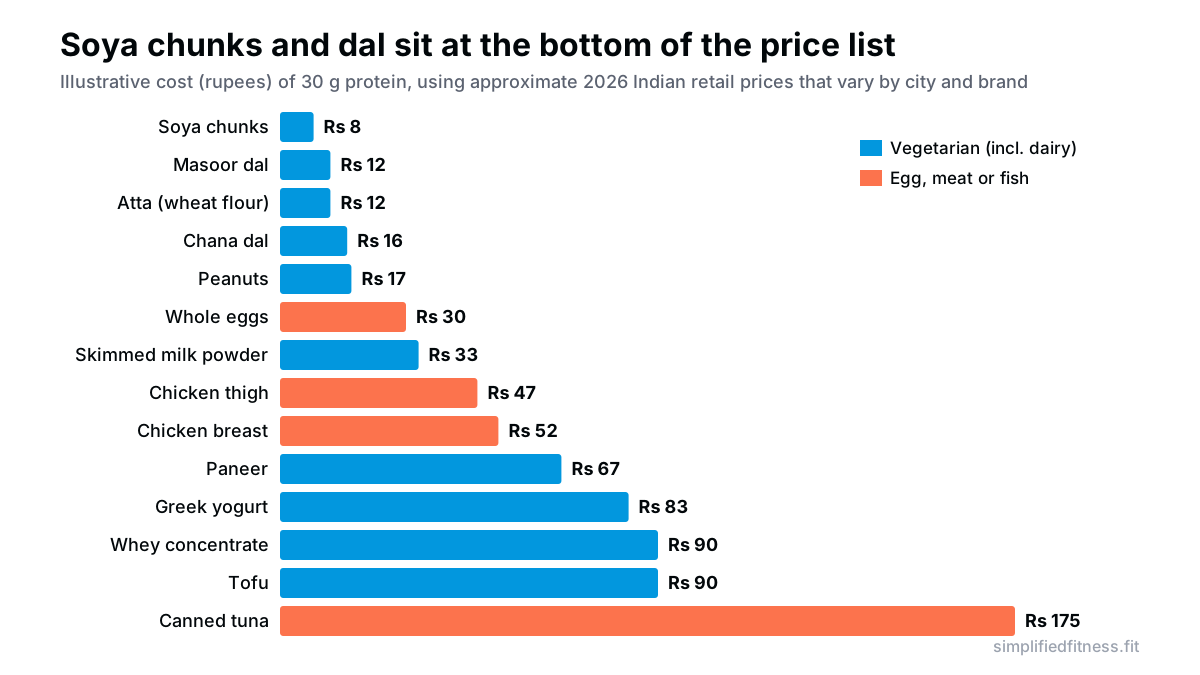
Three patterns stand out.
Dry soya chunks are in a class of their own. About 58 g of dry chunks gives 30 g of protein, for roughly Rs 8. That is why soya keeps showing up in budget lifter diets. We cover its protein profile and safety questions in our soya chunks guide.
Dals and flours beat meat on price. Masoor, chana, moong and urad dal land at about Rs 12-17 per 30 g. Even atta, a staple you already buy, delivers protein at about Rs 12 per 30 g, though you need over 270 g of it to get there, which is a lot of calories.
Whey is not the cheap option here. Many lifters assume powder is the cheapest protein. In India, at about Rs 2,400 per kg for an 80% concentrate, that is roughly Rs 90 per 30 g, well above eggs and chicken. In markets where chicken is expensive and whey is discounted, the order can flip. Whey earns its place through convenience and low calories, which we weigh in whey concentrate vs isolate.
Full table: 40 foods ranked by cost per 30 g protein
Prices are illustrative rupees per kg as bought (raw or dry). “Food for 30 g” is the raw or dry weight of the food.
| Rank | Food | Protein per 100 g (approx.) | Rs per kg (illustrative) | Food for 30 g | Rs per 30 g |
|---|---|---|---|---|---|
| 1 | Soya chunks (dry) | 52 g | 140 | 58 g | 8 |
| 2 | Masoor dal (dry) | 25 g | 100 | 120 g | 12 |
| 3 | Atta (wheat flour) | 11 g | 45 | 273 g | 12 |
| 4 | Besan (gram flour) | 22 g | 100 | 136 g | 14 |
| 5 | Chana dal (dry) | 21 g | 110 | 143 g | 16 |
| 6 | Moong dal (dry) | 24 g | 130 | 125 g | 16 |
| 7 | Kala chana (dry) | 20 g | 110 | 150 g | 17 |
| 8 | Urad dal (dry) | 25 g | 140 | 120 g | 17 |
| 9 | Peanuts (raw) | 25 g | 140 | 120 g | 17 |
| 10 | Sattu | 20 g | 120 | 150 g | 18 |
| 11 | Roasted chana (bhuna) | 20 g | 130 | 150 g | 20 |
| 12 | Toor dal (dry) | 22 g | 150 | 136 g | 21 |
| 13 | Rajma (dry) | 22 g | 150 | 136 g | 21 |
| 14 | Rice (raw) | 7 g | 60 | 429 g | 26 |
| 15 | Rolled oats | 13 g | 120 | 231 g | 28 |
| 16 | Whole egg | 12.6 g | 127 (about Rs 7 each) | 238 g (about 4-5 eggs) | 30 |
| 17 | Skimmed milk powder | 35 g | 380 | 86 g | 33 |
| 18 | Chicken thigh, boneless (raw) | 19 g | 300 | 158 g | 47 |
| 19 | Peanut butter | 25 g | 400 | 120 g | 48 |
| 20 | Rohu fish (edible, raw) | 17 g | 280 | 176 g | 49 |
| 21 | Buffalo meat (raw; legal status varies by state) | 21 g | 350 | 143 g | 50 |
| 22 | Chicken breast (raw) | 23 g | 400 | 130 g | 52 |
| 23 | Toned milk | 3.2 g | 56 | 938 g | 53 |
| 24 | Mackerel/bangda (edible) | 18 g | 350 | 167 g | 58 |
| 25 | Egg whites (yolks discarded) | 10.9 g | about 212 (whites from Rs 7 eggs) | 275 g (whites of about 8 eggs) | 58 |
| 26 | Curd (dahi) | 3.5 g | 70 | 857 g | 60 |
| 27 | Green peas (frozen) | 5 g | 100 | 600 g | 60 |
| 28 | Paneer (full-fat) | 18 g | 400 | 167 g | 67 |
| 29 | Pea protein powder (80%) | 80 g | 2,000 | 38 g | 75 |
| 30 | Greek yogurt | 9 g | 250 | 333 g | 83 |
| 31 | Whey concentrate (80%) | 80 g | 2,400 | 38 g | 90 |
| 32 | Tofu (firm) | 10 g | 300 | 300 g | 90 |
| 33 | Pumpkin seeds | 30 g | 900 | 100 g | 90 |
| 34 | Prawns (raw) | 19 g | 600 | 158 g | 95 |
| 35 | Quinoa (dry) | 14 g | 500 | 214 g | 107 |
| 36 | Almonds | 21 g | 800 | 143 g | 114 |
| 37 | Mutton (boneless, raw) | 19 g | 800 | 158 g | 126 |
| 38 | Whey isolate (90%) | 90 g | 4,500 | 33 g | 150 |
| 39 | Canned tuna (drained) | 24 g | 1,400 | 125 g | 175 |
| 40 | Makhana | 10 g | 1,000 | 300 g | 300 |
Read the table the way a coach would, not an accountant. A few rows are cheap but impractical: you would have to eat 429 g of raw rice for 30 g of protein, which is about 1,500 kcal. Others, like curd and milk, are valuable mostly for what else they bring (calcium, taste, an easy way to spread protein through the day).
Cheap is not the whole story: calories, quality and digestion
Three caveats keep the cost ranking honest.
Calories come along for the ride. Thirty grams of protein from chicken breast or whey is a modest number of calories. Thirty grams from peanuts, peanut butter, paneer or almonds brings a lot of fat with it. If you are cutting, that changes the real cost of staying in a deficit. During energy restriction, resistance-trained lean athletes likely need higher protein, an estimated 2.3-3.1 g/kg of fat-free mass in one systematic review of just six studies (Helms et al., 2014), which makes lean, protein-dense foods more valuable than the rupee figure alone suggests.
Protein quality differs, but less than people fear. A pig study measuring digestibility found most indispensable amino acids in whey and milk protein concentrates were digested better than in skimmed milk powder, soya, pea and wheat (Mathai et al., 2017). That is an animal model, and cooking and processing improve plant digestibility, which is one criticism of the scoring method itself (Craddock et al., 2021). In people lifting weights, a meta-analysis of 9 studies and 266 participants found soy and animal protein supplementation produced similar gains in strength and lean mass (Messina et al., 2018). The sample is small and limited to supplement-based trials, so treat it as encouraging rather than final. For the deeper debate, see plant vs animal protein for muscle.
Raw and cooked weights differ. The table uses dry or raw weights, because that is what you pay for. If you track cooked food, the numbers shift, as covered in our food scale guide.
How to build a cheap high protein grocery list
A practical approach is to buy a cheap base, then add a few higher-quality “anchors.”
- Base (cheapest grams): soya chunks, masoor or chana dal, besan, peanuts, roti and rice.
- Anchors (quality and variety): eggs, curd, milk, skimmed milk powder, and chicken or fish if you eat them.
- Convenience (optional): whey, bought on discount, for days with no time to cook.
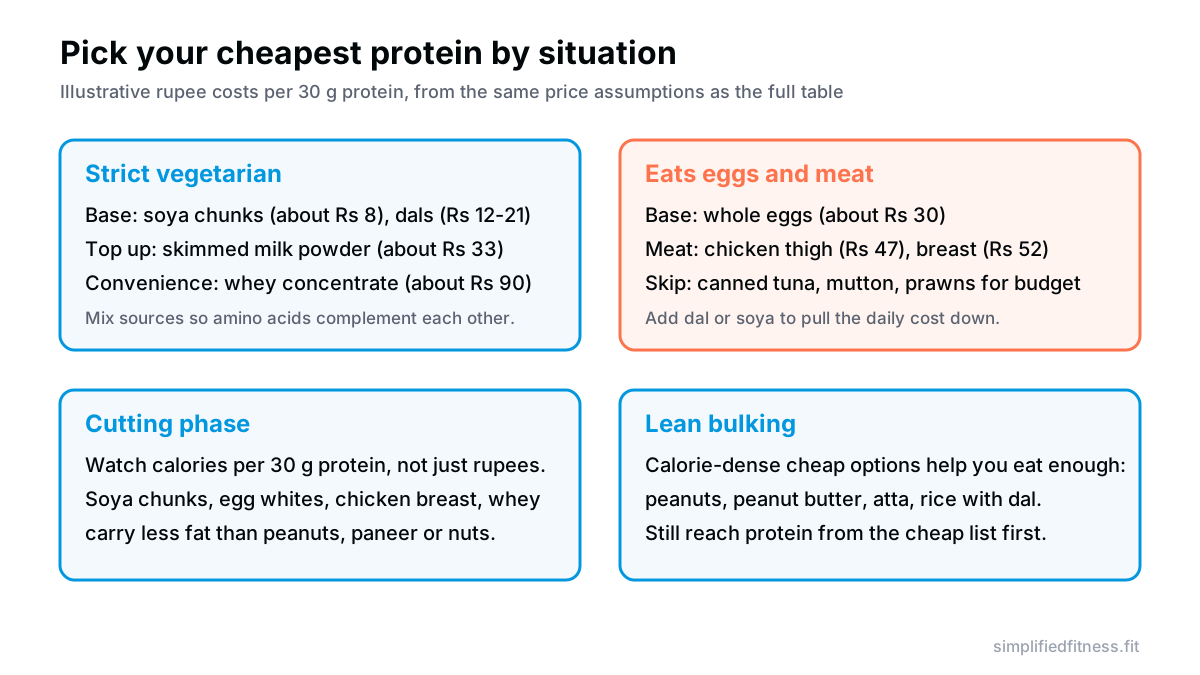
A simple day for a vegetarian lifter aiming near 110 g might be: dal with roti (about 25-30 g), soya chunk curry (30 g), curd or milk through the day (about 15-20 g), a peanut and roasted chana snack (about 15 g), and a scoop of whey or two more eggs if you eat eggs. That is a plausible shape, not a prescription, so adjust to your appetite and budget. For a full rupee-capped plan, see our Rs 100 a day, 120 g protein diet, and for rankings by protein per calorie see the top 30 high-protein foods. Vegetarians can also compare leucine content in our vegetarian food list.
Who should be careful
Most healthy adults can use all of these foods. Check with a doctor or registered dietitian first if you have kidney disease, a soy or peanut allergy, gout or a diagnosed digestive condition, because very high protein intakes or specific foods may not suit you. If soya chunks or dals cause persistent bloating or discomfort, soak and cook them longer, reduce portions, and see a doctor if symptoms continue.
The bottom line
On Indian prices, protein is cheapest from soya chunks and dals, then eggs and chicken, and priciest from nuts, seafood and premium powders. That ranking is useful, but it is a starting point: the best protein budget is one that mixes cheap staples with a few quality foods you enjoy and gets you to roughly 1.6 g/kg a day.
Work out your own number with the protein calculator, then use the free diet plan to turn it into meals.
Frequently Asked Questions
What is the cheapest source of protein per gram?
On typical Indian retail prices, dry soya chunks are the cheapest, at roughly Rs 8 for 30 g of protein. They carry about 52 g protein per 100 g, so a small portion goes a long way. Check your local rate and recalculate with the formula in this article.
Is whey protein cheaper than chicken per gram of protein?
At most Indian prices, no. Whey concentrate at around Rs 2,400 per kg costs roughly Rs 90 per 30 g of protein, while raw chicken breast is nearer Rs 50. Whey wins on convenience and calories, not on rupees, unless you buy during a sale.
How much does 30 g of protein from eggs cost?
About 5 whole eggs give 30 g of protein, which is roughly Rs 30-35 at Rs 6-7 an egg. A large egg carries around 6 g of protein, so exact numbers vary with egg size. Whole eggs also bring fat and calories along, so count them if you are cutting.
Are soya chunks really a good protein source?
Yes, they are an inexpensive, high-protein food. A meta-analysis found soy protein supplementation produced similar strength and lean mass gains to animal protein during resistance training (Messina et al., 2018). Soak, boil and squeeze them, and rotate with other foods rather than eating them as your only source.
How much protein do I need per day to build muscle?
A large meta-analysis found that protein intakes beyond about 1.6 g/kg/day produced no further gains in fat-free mass during resistance training. Protein works by supplying amino acids for muscle repair and growth. Use our protein calculator to turn that into grams for your body weight.
Is 30 g of protein per meal a limit?
No. 30 g is a convenient unit for comparing foods, not a hard cap on what your body can use. Total daily protein is what research links to muscle gain, so spread it over a few meals in whatever pattern you can sustain.
Is dal a good protein source for gym goers?
Dals are cheap and useful, giving about 20-25 g of protein per 100 g dry weight. They are lower in methionine than animal proteins, so pairing them with rice, roti or dairy fills the gap. Cooked dal is far more dilute than dry dal, so weigh dry for accurate tracking.
What is the cheapest vegetarian protein for bodybuilding?
Soya chunks, followed by masoor, chana and moong dal, besan and peanuts. These cost roughly Rs 8-17 per 30 g of protein on our assumptions. Add milk or curd to improve amino acid balance.
Is paneer a cost-effective protein?
Paneer is tasty but mid-priced, at about Rs 65-70 per 30 g of protein at Rs 400 a kg. It also carries a lot of fat, which raises the calories per gram of protein. Use it for variety and use soya or dal for the bulk of your protein.
Is chicken breast or thigh cheaper per gram of protein?
Boneless thigh is often a little cheaper per kg and has slightly less protein, so per 30 g the two end up close, about Rs 47 versus Rs 52 on our assumptions. Thigh has more fat. Pick breast for a cut, thigh for taste and budget.
Does cooked weight change the cost calculation?
Yes. Dal, rice and soya absorb water and chicken loses it, so protein per 100 g changes after cooking. Price and protein figures in this article are for raw or dry weight, which is how you buy them. Always calculate on the weight you pay for.
Is plant protein as good as animal protein for muscle?
When total protein is adequate and training is hard, soy and whey supplementation gave similar strength and lean mass gains in a meta-analysis of 9 studies (Messina et al., 2018). Plant proteins can be digested less completely, so vegetarians may want a slightly higher total intake. Mix sources like soya, dal, dairy and grains.
How can I lower my protein bill further?
Buy dry staples in bulk, use soya chunks and dal for the base, and add eggs or milk for quality. Skip protein bars and packaged high-protein snacks, which cost many times more per gram. Reserve whey for days when cooking is not possible.
Sources & References
Every claim above is checked against peer-reviewed research (PubMed, U.S. National Library of Medicine) or guidance from established health bodies. How we fact-check.
- Morton RW, et al. A systematic review, meta-analysis and meta-regression of the effect of protein supplementation on resistance training-induced gains in muscle mass and strength in healthy adults. Br J Sports Med. 2018. PMID: 28698222
- Messina M, et al. No difference between the effects of supplementing with soy protein versus animal protein on gains in muscle mass and strength in response to resistance exercise. Int J Sport Nutr Exerc Metab. 2018. PMID: 29722584
- Helms ER, et al. A systematic review of dietary protein during caloric restriction in resistance trained lean athletes: a case for higher intakes. Int J Sport Nutr Exerc Metab. 2014. PMID: 24092765
- Mathai JK, et al. Values for digestible indispensable amino acid scores (DIAAS) for some dairy and plant proteins may better describe protein quality than values calculated using the concept for protein digestibility-corrected amino acid scores (PDCAAS). Br J Nutr. 2017. PMID: 28382889
- Craddock JC, et al. Limitations with the Digestible Indispensable Amino Acid Score (DIAAS) with special attention to plant-based diets: a review. Curr Nutr Rep. 2021. PMID: 33409931

Umair Hazrami · Founder & Head Coach, Simplified Fitness
Umair Hazrami founded Simplified Fitness and the Simplified Lifter channel to cut through fitness noise. With 4+ years of consistent training and 10+ coaching clients, he writes every guide from the peer-reviewed research and links the sources so you can check them. Our editorial standards.
Educational content only, not medical advice. If you have a medical condition, are pregnant, or take medication, talk to a qualified doctor before changing your diet, supplements or training. Full disclaimer.
Keep reading
Indian Diet
The 3-Hour Weekly Batch Meal Prep: Cooking 5 Days of Lunches and Dinners for Busy Lifters
Batch meal prep for the week in 3 hours: a station-by-station Sunday plan for 10 high-protein lunches and dinners, with Indian options and safe storage rules.
7 min read
Indian Diet
Eating Healthy on a Student Budget: High Protein Hostel and Dorm Room Meal Prep
A college student bodybuilding diet budget can still hit 130 g of protein. Cheap staples, no-cook hostel prep and a sample day, with the studies linked.
8 min read
Indian Diet
Essential Kitchen Equipment for Lifters: Scales, Air Fryers, Blenders and Containers
The best kitchen equipment for meal prep lifters: which four tools earn their space, what the research says about each, and what to buy first on a budget.
10 min read
Indian Diet
Fast Food Survival Guide: Macro-Friendly Orders at Major Global Chains
A fast food survival guide for lifters: how to build a high protein order at any chain, cut hidden calories, handle sodium and stay on track while travelling.
8 min read