High-Volume Low-Calorie Foods: Cauliflower, Zucchini, Green Leaves, and Berries for Cutting
High volume low calorie foods cutting guide: how volumetrics works, what 200 kcal looks like on a plate, and Indian swaps to stay full on a deficit.
TL;DR. The short answer
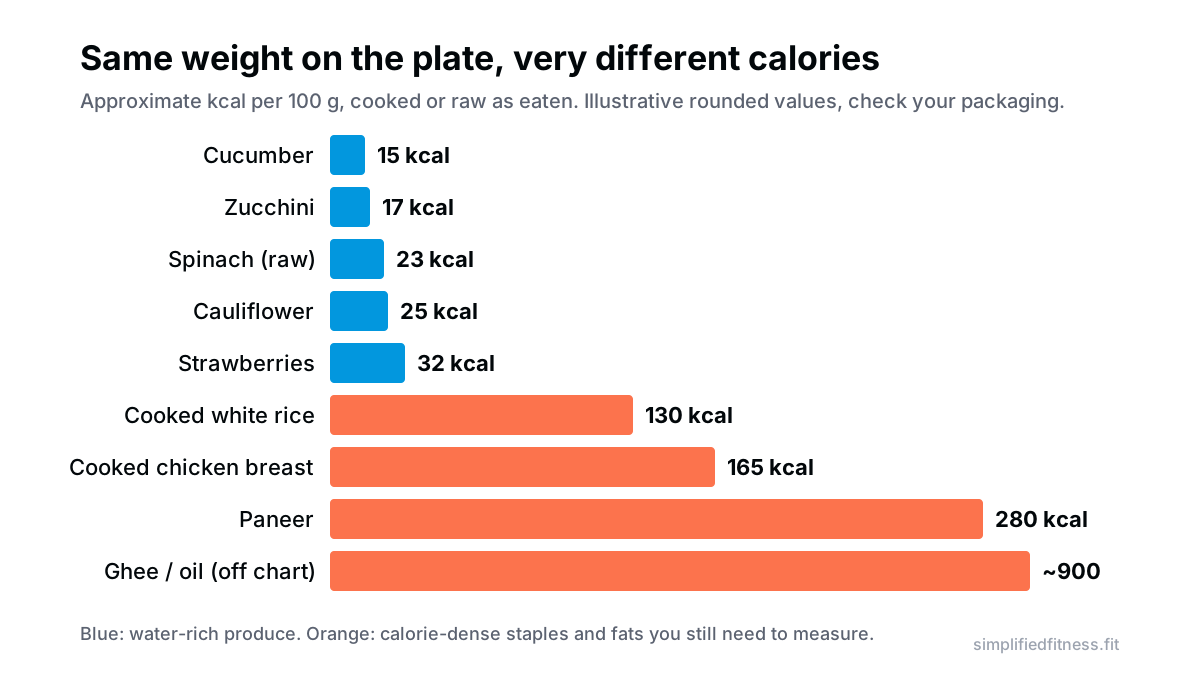
- Foods with a low energy density (few calories per gram, mostly water and fibre) let you eat a large plate for few calories. Zucchini, cauliflower, leafy greens and strawberries sit around 15-32 kcal per 100 g, versus roughly 130 for cooked rice and about 900 for ghee.
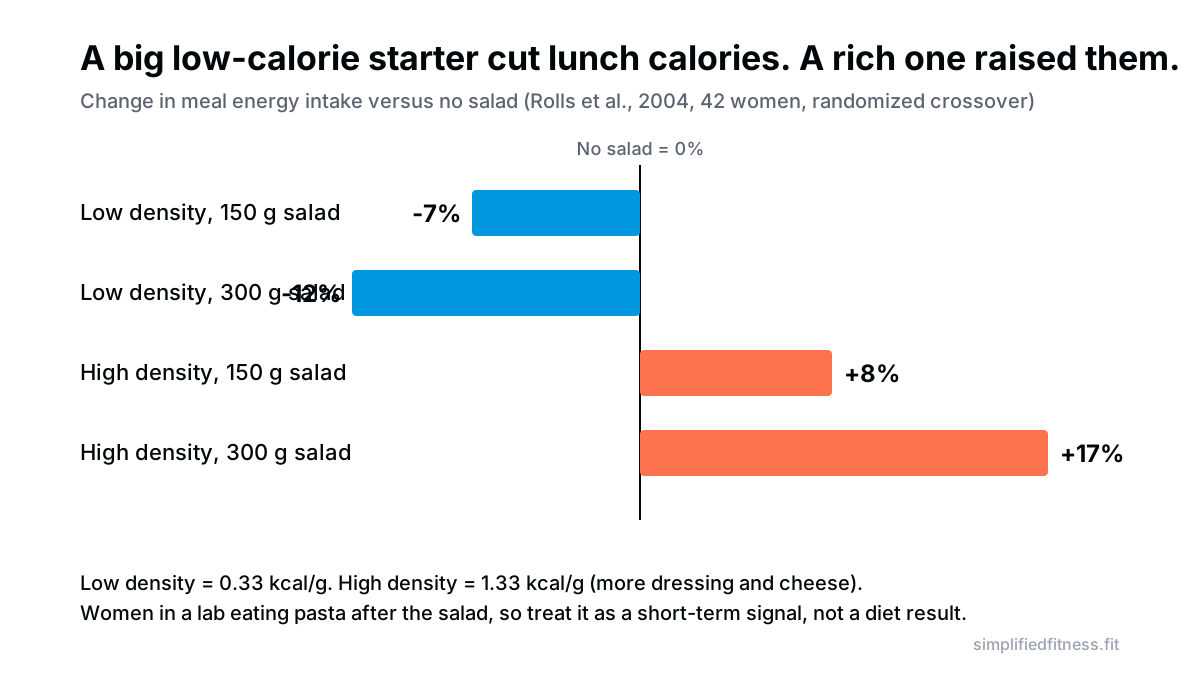
- In a lab trial, a big low-calorie starter cut calories eaten at the following meal by 7-12%, while a rich, calorie-dense starter raised them by 8-17% (42 women, one lunch each week, so short-term evidence).
- In a one-year trial of 97 obese women, adding water-rich fruit and vegetables to a lower-fat diet produced about 1.5 kg more weight loss and less reported hunger than lower-fat advice alone.
- Volume foods help with fullness but they do not replace protein. Build the plate around a lean protein source first, then pad it with vegetables, and measure the oil, ghee and rice.
- Too much raw fibre too fast can cause gas and bloating. Add vegetables gradually and speak to a doctor if you have ongoing digestive symptoms.
Part of our complete guide: High-Protein Foods List: Protein per 100g, Cost per 30g and Meal Prep Guide
Table of contents
The best high volume low calorie foods for cutting are water-rich vegetables and fruit: zucchini, cucumber, cauliflower, leafy greens, tomato and strawberries. They contain few calories per gram, so a large plate costs very little, and that bulk helps you feel full on a deficit.
If you are hungry at 6 pm with 300 kcal left for the day, the problem is rarely willpower. It is that a spoon of ghee and a handful of rice look like a snack, while the same calories in zucchini look like a bucket. This page is a practical extension of our high-protein foods and meal prep guide. That guide ranks protein per calorie; here we rank food by how much plate you get per calorie.
What does “volume eating” actually mean?
The idea is called energy density: calories divided by weight, written as kcal per gram. Water has zero calories and adds weight. Fat is the opposite, with about 9 kcal in every gram. A food that is mostly water and fibre is “low density”. A food that is mostly fat or dry starch is “high density”.
Barbara Rolls at Penn State built much of the research on this, and her summary is straightforward. People tend to eat a fairly consistent weight of food, so when the energy density of the available food drops, energy intake drops too (Rolls, 2009). The same review notes that mechanisms are not fully understood and that controlled data beyond several days are limited, so this is a useful tool, not a law of physics.
Two things seem to be at work. One is simple stretch: a large, bulky meal fills the stomach. The other is learned expectation, since we judge whether a meal was “big” partly by how it looks. Reviews of this work point to cognitive and sensory factors as well as gastric distension and emptying (Kral and Rolls, 2004).
How much food do 200 calories actually buy?
This is the comparison that makes it click. Using rounded, approximate values (exact numbers vary by variety, cooking and brand), here is the spread:
Flip that around and ask how many grams you get for about 200 kcal:
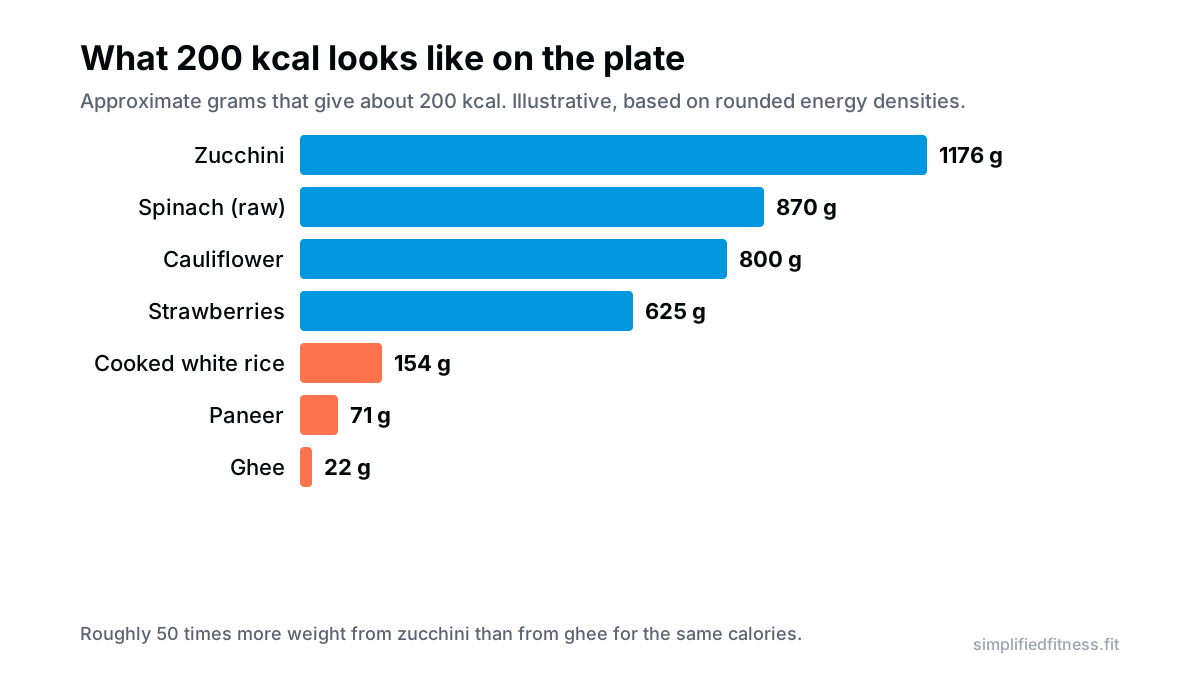
None of this means ghee or paneer are bad. They are just easy to under-count, which is why we cover weighing in our guide to raw vs cooked food weights.
Which high volume low calorie foods work best for cutting?
Here is how the main options behave on an actual plate. Values are approximate.
| Food | Approx. kcal per 100 g | Best use | Watch out for |
|---|---|---|---|
| Zucchini / lauki / tori | 15-20 | Noodles, sabzi, soup | Gets watery if overcooked |
| Cucumber / tomato | 15-20 | Salad, raita base | Salt and dressing add up |
| Spinach / palak / methi | about 20-25 | Bulk under curries, sabzi | Oxalates; vary your greens |
| Cauliflower / gobi | about 25 | Rice swap, mash, roasted | Gas for some people |
| Cabbage / mushrooms | 20-35 | Stir-fries, stuffing | Oil used to cook them |
| Strawberries / papaya / watermelon | 30-40 | Dessert, post-workout | Juice is not the same as whole fruit |
| Air-popped popcorn | high per gram, low per cup | Evening snack | Butter, oil, flavoured packets |
A few notes on the ones lifters ask about most.
Cauliflower rice and zucchini noodles. These are the classic cutting hacks. Grate raw gobi, dry-roast it for a few minutes with jeera and salt, and you have a bowl that looks like pulao. Spiralise or ribbon zucchini, salt it for ten minutes and drain it. A 300 g bowl of zucchini noodles costs roughly 50 kcal, which leaves your calorie budget for protein and a sensible portion of the real thing. They are not identical to rice or pasta in taste or in carbohydrate content, so treat them as extra volume rather than a perfect replacement.
Leafy greens. Raw baby spinach shrinks dramatically when cooked, so you can wilt a huge pile into dal or paneer bhurji. Rotate with methi, sarson or amaranth leaves rather than relying on one.
Berries and local fruit. Strawberries and blackberries are lovely if you can afford them. In India, papaya, guava, watermelon and oranges do the same job at a lower price, and jamun is great when in season. Whole fruit also carries fibre, which is why it beats juice for fullness.
Air-popped popcorn. It is dense per gram but low per cup because the kernel expands so much. In a small crossover study of 35 normal-weight adults, six cups (27 g, 100 kcal) reduced hunger more than potato chips (150 kcal), and combined intake with the next meal was not higher than control (Nguyen et al., 2012). That was a short-term study in people who were not dieting, so it supports popcorn as a decent snack, not as a fat loss tool on its own.
Does volume eating really keep you full?
The evidence is encouraging but should be read in context.
The salad studies. In a randomized crossover trial, 42 women ate one of six compulsory first-course salads (or no salad) before a pasta lunch they could eat freely. A low-density salad (0.33 kcal/g) reduced lunch energy intake by 7% for a small portion and 12% for a large one, compared with no salad. A high-density salad (1.33 kcal/g, with more dressing and cheese) increased intake by 8% and 17% (Rolls et al., 2004).
The one-year trial. In 97 obese women, one group was counselled to cut fat, and another to cut fat and increase water-rich fruit and vegetables, with no calorie targets. Among completers (n = 71), the fruit and vegetable group lost 7.9 kg versus 6.4 kg, ate a greater weight of food, and reported less hunger (Ello-Martin et al., 2007).
The newer trial in active adults. A 2025 randomized trial of 37 physically active middle-aged people compared a volumetrics diet (meals at or below 1.5 kcal/g) with time-restricted eating for 12 weeks. Both groups lost body weight and fat, kept lean mass, and did not differ significantly from each other, but adherence was lower on the volumetrics diet (Cloos et al., 2025).
Where the studies disagree (or fall short)
Not every result points the same way. Most of the lab work is short-term, in women, and under controlled conditions where people could not choose their own sides. The year-long trial was in women with obesity, and the gap between groups was modest. The 2025 trial was small, and the volumetrics group found it harder to stick to. Fibre alone is also not a magic switch: a systematic review of acute studies found that most fibre treatments did not reduce appetite (39% did) or food intake (22% did) (Clark and Slavin, 2013). That is a reminder that it is the water-rich, low-density whole foods on the plate that seem to matter, not a fibre supplement.
The cautious takeaway: volume foods are a reasonable way to make a deficit more comfortable, particularly for lifters who struggle with hunger. They are not proven to beat other approaches.
How do I build a high volume cutting plate?
Think in layers, not recipes.
- Protein first. Pick a lean protein: chicken, eggs, fish, paneer, tofu, soya chunks, dal or curd. Volume foods do not help muscle retention, and a systematic review in resistance-trained athletes suggested needs of roughly 2.3-3.1 g per kg of fat-free mass during energy restriction, rising with leaner physiques and bigger deficits (Helms et al., 2014). Work out your own target with the protein calculator. Our guide to protein during a cut goes deeper.
- Half the plate vegetables. Two or three types, at least one cooked in very little oil.
- A measured portion of carbs. Rice or roti around training, less at other times.
- Measured fats. Weigh the oil, ghee or nuts. This is where “healthy” meals often go over budget.
- Start with something big and light. A large salad, cucumber raita or a clear dal soup before the main course, the same trick the salad study used.
Want exact numbers for your own deficit? Start with the calorie calculator, then see how aggressive a deficit should be in moderate vs aggressive deficits. For ready-made meals, see the diet plan.
What are the common mistakes with high volume eating?
- Ignoring protein. A plate of vegetables will leave you full but under-fed. If protein is low, the deficit is more likely to cost muscle.
- Eating only raw vegetables. Raw bulk can cause gas and bloating, especially if you jump from almost no fibre to a lot overnight. Increase gradually and cook some of it.
- Drinking calories instead. Juice and smoothies strip out much of the bulk. Eat the fruit.
- Skipping carbohydrate entirely. Cauliflower rice every meal can leave training flat. Keep a carbohydrate source around hard sessions.
- Not tracking at all. A few weeks of logging shows where the calories really are. Our piece on hidden calories during plateaus shows the usual suspects.
When should I speak to a doctor?
Volume eating is a food-structure habit, not a medical treatment. Check with a doctor or registered dietitian before making big changes if you have kidney disease (some leafy greens are high in potassium or oxalate), a history of kidney stones, diabetes treated with medication, gut conditions such as IBS or inflammatory bowel disease, or a history of disordered eating. Constant hunger, dizziness, missed periods or fatigue on a diet are signs that the deficit is too aggressive, not signs that you need more cucumber.
The bottom line
Eating more weight of food for fewer calories is one of the more practical dieting tools there is. Choose water-rich vegetables and fruit, lead with a big low-calorie starter, keep protein anchored, and measure oil and ghee. It will not make a deficit effortless, but for many lifters it takes the edge off the hunger that makes diets fall apart.
Frequently Asked Questions
What are the best high volume low calorie foods for cutting?
The most useful are water-rich vegetables and fruit such as zucchini, cucumber, cauliflower, spinach, cabbage, tomato and strawberries, which sit around 15-32 kcal per 100 g. They are mostly water, so they fill the plate and stretch the stomach for very few calories. Build each meal around a protein source and then add two or three of these on the side.
What is the volumetrics diet?
Volumetrics is an eating pattern developed by Barbara Rolls that lowers the energy density (kcal per gram) of meals by adding water-rich foods like vegetables, fruit and soups. People tend to eat a fairly steady weight of food, so a lower-density plate means fewer calories without smaller portions. It is a way of structuring meals, not a strict plan with forbidden foods.
Does volume eating actually work for fat loss?
It can help, mainly by reducing hunger. In a one-year trial of 97 obese women, the group told to add fruit and vegetables lost 7.9 kg versus 6.4 kg for lower-fat advice alone, and reported less hunger. That is one trial in women with obesity, so results for a lean lifter in a small deficit may differ.
How can I stay full on low calories?
Combine protein, low-energy-density foods and slow eating. Protein is the most filling macro per calorie, and vegetables, soups and fruit add weight and volume. Put a large salad, sabzi or dal soup at the start of the meal and eat without distractions.
Is cauliflower rice a good swap on a cut?
Yes, if you like it. Cauliflower is roughly 25 kcal per 100 g versus about 130 for cooked white rice, so a large bowl costs far fewer calories. It does not give the carbohydrate that fuels hard training, so many lifters keep some regular rice around training and use cauliflower rice at other meals.
Are zucchini noodles worth making?
They are a good way to turn a tiny amount of pasta or sauce into a big plate. Zucchini is about 17 kcal per 100 g, so 300 g costs roughly 50 kcal. Salt and drain the noodles, and cook them briefly so they do not turn watery.
Is popcorn good for cutting?
Plain air-popped popcorn can be useful. In a small crossover study of 35 normal-weight adults, six cups (100 kcal) reduced hunger more than 150 kcal of potato chips, and snack plus next-meal intake was lower than with the chips. It was a short-term study, and butter or oil quickly erases the advantage, so keep it plain.
Can I use Indian vegetables for volume eating?
Yes. Lauki, tori, tinda, cabbage, gobi, palak, methi, cucumber, tomato, mushrooms and sprouts all work. The catch is the tadka, since oil and ghee are by far the densest part of the plate. Measure the oil with a teaspoon instead of pouring it.
What can I use instead of berries in India?
Berries are expensive and often imported, so use local water-rich fruit. Papaya, watermelon, guava, oranges and seasonal jamun give volume, fibre and sweetness for modest calories. Compare labels or a food database for exact values, because they vary with ripeness.
Can too much fibre or vegetables upset my stomach?
Yes. A sudden jump in raw vegetables or fibre can cause gas, bloating and cramps in some people. Increase portions over a week or two, cook some vegetables instead of eating everything raw, and drink water. If symptoms persist, see a doctor rather than guessing.
Does eating more vegetables replace the need for protein on a cut?
No. Vegetables add volume but very little protein, and protein is what helps protect muscle in a deficit. A systematic review of resistance-trained athletes suggested needs of roughly 2.3-3.1 g per kg of fat-free mass during energy restriction. Plan the protein first, then fill the plate.
Do I still need to count calories if I eat high volume foods?
Usually yes, at least for a few weeks. Volume foods make it easier to eat less, but oil, rice, nuts and paneer can still push intake above your target quickly. Track for a short period to calibrate, then rely on plate structure.
Is volume eating better than intermittent fasting for cutting?
Evidence suggests both can work. In a 12-week trial of 37 active middle-aged people, a volumetrics diet and time-restricted eating produced similar fat loss and kept lean mass, though volumetrics adherence was a little lower. Pick the approach you can actually follow.
Sources & References
Every claim above is checked against peer-reviewed research (PubMed, U.S. National Library of Medicine) or guidance from established health bodies. How we fact-check.
- Rolls BJ, et al. Salad and satiety: energy density and portion size of a first-course salad affect energy intake at lunch. J Am Diet Assoc. 2004. PMID: 15389416
- Ello-Martin JA, et al. Dietary energy density in the treatment of obesity: a year-long trial comparing 2 weight-loss diets. Am J Clin Nutr. 2007. PMID: 17556681
- Rolls BJ. The relationship between dietary energy density and energy intake. Physiol Behav. 2009. PMID: 19303887
- Kral TV, et al. Energy density and portion size: their independent and combined effects on energy intake. Physiol Behav. 2004. PMID: 15234601
- Cloos A, et al. Similar body composition outcomes following volumetric diet and time-restricted eating in middle-aged individuals: a 12-week randomized controlled trial. Nutr J. 2025. PMID: 40533752
- Nguyen V, et al. Popcorn is more satiating than potato chips in normal-weight adults. Nutr J. 2012. PMID: 22978828
- Clark MJ, et al. The effect of fiber on satiety and food intake: a systematic review. J Am Coll Nutr. 2013. PMID: 23885994
- Helms ER, et al. A systematic review of dietary protein during caloric restriction in resistance trained lean athletes: a case for higher intakes. Int J Sport Nutr Exerc Metab. 2014. PMID: 24092765

Umair Hazrami · Founder & Head Coach, Simplified Fitness
Umair Hazrami founded Simplified Fitness and the Simplified Lifter channel to cut through fitness noise. With 4+ years of consistent training and 10+ coaching clients, he writes every guide from the peer-reviewed research and links the sources so you can check them. Our editorial standards.
Educational content only, not medical advice. If you have a medical condition, are pregnant, or take medication, talk to a qualified doctor before changing your diet, supplements or training. Full disclaimer.
Keep reading
Indian Diet
The 3-Hour Weekly Batch Meal Prep: Cooking 5 Days of Lunches and Dinners for Busy Lifters
Batch meal prep for the week in 3 hours: a station-by-station Sunday plan for 10 high-protein lunches and dinners, with Indian options and safe storage rules.
7 min read
Indian Diet
Cost per 30 Grams of Protein: 40 Common Fitness Foods Ranked by Price
Cost per 30g protein for 40 Indian gym foods, from soya chunks to whey and tuna. See the cheapest protein sources per gram and what to buy on a budget.
8 min read
Indian Diet
Eating Healthy on a Student Budget: High Protein Hostel and Dorm Room Meal Prep
A college student bodybuilding diet budget can still hit 130 g of protein. Cheap staples, no-cook hostel prep and a sample day, with the studies linked.
8 min read
Indian Diet
Essential Kitchen Equipment for Lifters: Scales, Air Fryers, Blenders and Containers
The best kitchen equipment for meal prep lifters: which four tools earn their space, what the research says about each, and what to buy first on a budget.
10 min read