High-Protein Diets and Kidney Function: What the Evidence Says for Healthy Lifters
Does high protein damage kidneys? In healthy lifters, trials up to 3.3 g/kg found no harm to kidney markers. See what creatinine means and who should check.

TL;DR. The short answer
- In healthy adults with normal kidneys, randomized trials and a 28-trial meta-analysis have not found that higher protein intakes harm kidney function (measured as GFR).
- Resistance-trained men eating about 2.5-3.3 g/kg/day for 4 months and for a year showed no harmful changes in kidney or liver markers, but these were small studies.
- Eating more protein can raise estimated filtration (eGFR) by a few points in the short term. Researchers think this mostly reflects a short-term adaptation, though long-term effects are still uncertain.
- Muscle mass, creatine and protein can all push blood creatinine up without kidney damage. Ask for a cystatin C or urine test if the number alarms your doctor.
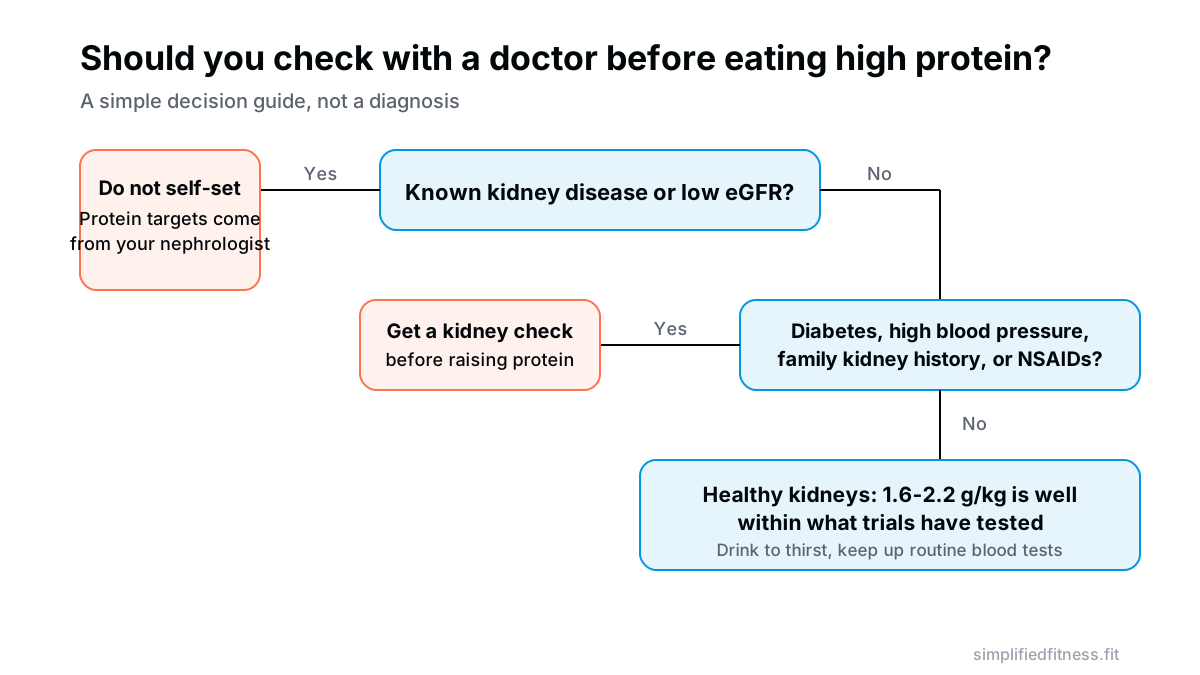
- If you already have kidney disease, protein limits are set by your nephrologist. Healthy kidneys and diseased kidneys are different questions.
Part of our complete guide: Complete Protein Guide: How Much, What Type, and When to Eat It for Muscle Growth
Table of contents
Does high protein damage kidneys? In healthy people with normal kidney function, the best evidence says no. A 2018 meta-analysis of 28 randomized trials found higher-protein diets did not worsen kidney filtration, and small trials in resistance-trained men eating over 3 g/kg a day found no harmful changes in kidney markers. The picture is different if your kidneys are already damaged. That is where the warning your doctor or parents gave you comes from.
This guide sits inside our complete protein guide for hypertrophy. Here we stay on one fear: what the trials actually measured, what a high creatinine result means, and where the real limits are. If you only want a daily number, start with optimal protein intake for hypertrophy.
Why do doctors and parents warn about protein and kidneys?
The warning is not random. It comes from kidney disease, where the advice is real and well established.
When kidneys are failing, they struggle to clear the waste produced by protein breakdown. Doctors reduce protein in some of these patients. A Cochrane review of adults with non-diabetic stage 3 to 5 chronic kidney disease found that very low protein diets (0.3 to 0.4 g/kg/day), compared with low protein diets, probably reduce the number of people with stage 4 or 5 disease who progress to end-stage kidney disease. Low protein diets (0.5 to 0.6 g/kg/day) compared with normal intake may make little difference (Hahn et al., 2020).
Then the message gets stretched. “Protein is bad for people with kidney disease” turns into “protein is bad for kidneys.” Those are not the same claim. One group has damaged filters. The other has healthy ones.
What do the lifter studies actually show?
Most of the “Antonio studies” get quoted loosely, so here are the details, because one of them did not measure kidneys at all.
Antonio 2014 (8 weeks, 4.4 g/kg). Thirty healthy resistance-trained men and women were randomized to a control or to a very high protein group. The high-protein group averaged 4.4 g/kg/day (about 307 g) versus 1.8 g/kg in controls. Body weight, fat mass and fat-free mass did not change significantly between groups (Antonio et al., 2014). Notice what is missing: this paper reports body composition, not kidney markers. It is a useful “protein does not automatically turn into fat” result, but it is not kidney evidence.
Antonio 2016, crossover (4 months). Twelve resistance-trained men did two 8-week periods, one on their habitual diet and one on a higher-protein diet. Intakes were 2.6 and 3.3 g/kg/day. There were no changes in blood lipids or markers of renal and hepatic function (Antonio et al., 2016).
Antonio 2016, one year. Fourteen resistance-trained men alternated habitual and higher-protein phases across a year (about 6 months on each), averaging 2.51 and 3.32 g/kg/day by self-reported food diaries. The authors reported no harmful effects on blood lipids or on liver and kidney function (Antonio et al., 2016).
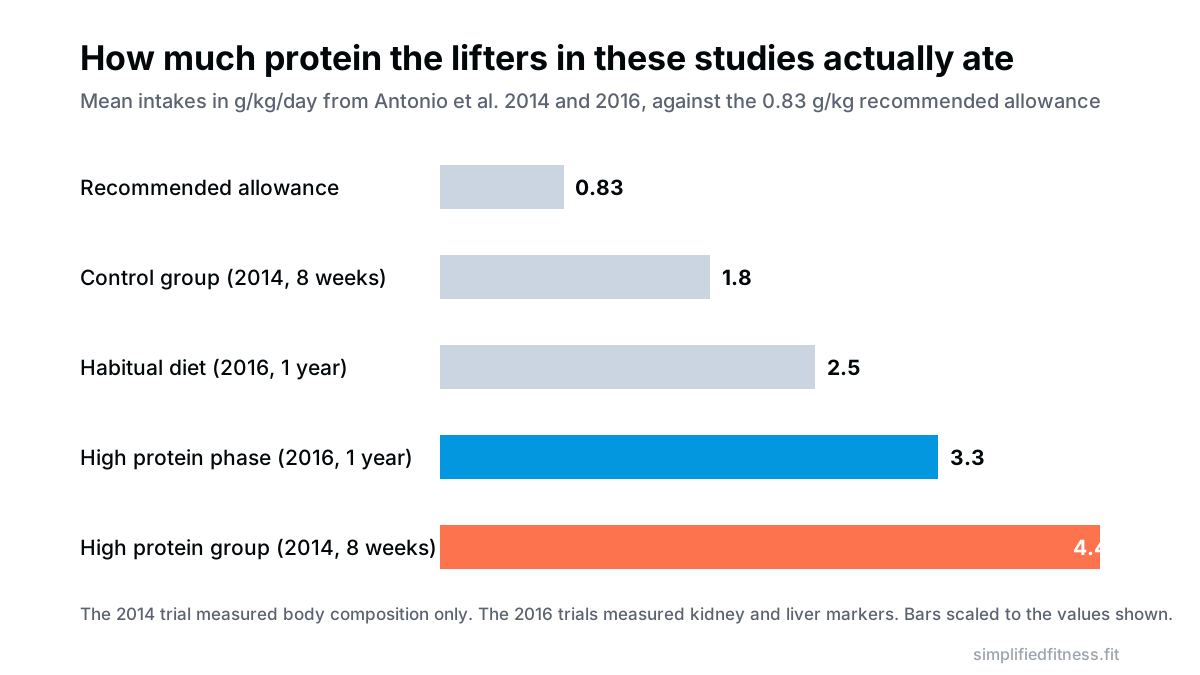
That is real data. It is also small data: 12 to 14 men, self-reported diets, all young, all healthy, all trained. I would not build a lifetime plan on those alone, which is why the next section matters more.
Does the bigger evidence agree?
Yes, with some honest caveats.
A 2018 systematic review and meta-analysis pooled 28 randomized trials with 1,358 adults without kidney disease. High protein was defined as 1.5 g/kg or more, 20% of energy or more, or 100 g a day or more. Post-intervention GFR was trivially higher on high protein (SMD 0.19), the change in GFR did not differ between groups, and the authors concluded that high-protein intakes did not adversely influence GFR in healthy adults. The main limitation they flagged was unclear risk of selection bias in the included trials (Devries et al., 2018).
A 2026 meta-analysis of 22 randomized trials in adults without chronic kidney disease found high-protein diets increased eGFR (SMD 0.39) but did not significantly change serum creatinine across 19 trials (1,044 people), with no consistent biochemical sign of kidney injury. The authors warn that most trials were short and relied on creatinine-based estimates, so the long-term picture remains uncertain (Teixeira Silva et al., 2026).
What is hyperfiltration, and is it a problem?
This is the part that makes the topic less tidy, so let me be straight about it.
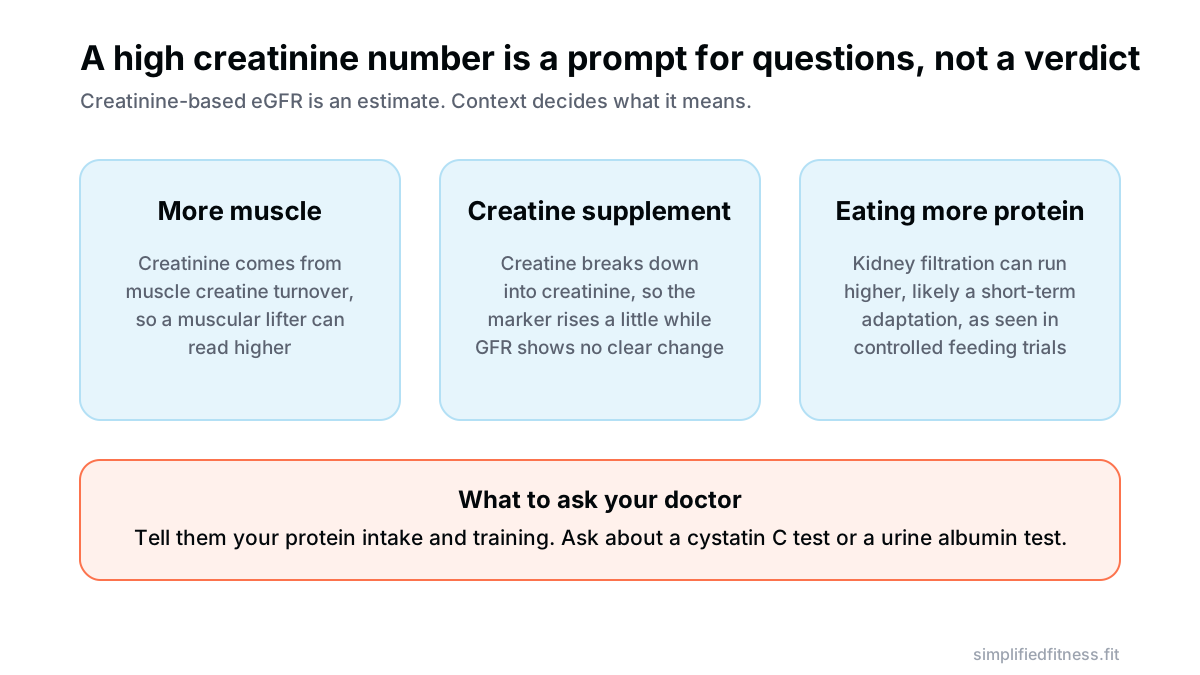
Eat more protein and your kidneys filter more blood per minute. In the OmniHeart feeding trial, 164 healthy adults with prehypertension or stage 1 hypertension ate each of three diets for 6 weeks. The diet with 25% of energy from protein raised cystatin C-based eGFR by about 4 mL/min/1.73 m2 compared with the other two. The authors said that whether long-term consumption leads to kidney disease is uncertain (Juraschek et al., 2013).
A nephrology-led 2024 review in Sports Medicine takes the cautious side. It notes that human studies have suggested high protein can cause intraglomerular hypertension and hyperfiltration, which could lead to progressive loss of function with long-term exposure even in healthy people. It also points out that the series of studies in resistance-trained athletes were designed to evaluate body composition, not to assess safety or kidney outcomes (de Lorenzo et al., 2024).
My cautious takeaway: for a healthy lifter, 1.6-2.2 g/kg is well inside the range with the most evidence behind it. Going to 3-4 g/kg adds expense and unknowns without a muscle-building payoff. If you want to know where your own number lands, use our protein calculator.
Why is my creatinine high on a high-protein diet?
This is where lifters get scared at the clinic, so it is worth understanding.
Creatinine is a waste product from creatine turnover in muscle. Doctors often use it to estimate kidney function (eGFR). The catch is that more muscle can mean more creatinine, and creatine supplements push it up too. A 2025 meta-analysis found creatine produced a small rise in serum creatinine but no significant change in GFR, which suggests the marker moved without kidney function changing (Naeini et al., 2025). We cover that in more depth in creatine, kidney health and blood-test myths.
Protein itself is less consistent. The 2026 meta-analysis above found no significant change in serum creatinine from high-protein diets (Teixeira Silva et al., 2026). Still, a muscular lifter on creatine and a high-protein diet can stack several reasons for a higher number.
Who should be careful with high protein?
A doctor, not a gym article, should decide this. Check in first if any of these apply.
- You have known kidney disease or a low eGFR.
- You have diabetes or high blood pressure, which are common causes of kidney problems.
- A parent or sibling has kidney disease.
- You use anti-inflammatory painkillers often.
- Your blood test showed something you do not understand.
Symptoms are a separate matter. Swelling in your legs or face, foamy urine, blood in the urine, or a big change in how much you pass should send you to a doctor soon, whatever your diet. I cannot diagnose anything through a screen, and neither should a gym article.
What does a sensible high-protein plan look like in India?
Most Indian lifters are not eating 4 g/kg anyway. For a 70 kg person, 1.6-2.2 g/kg is roughly 112-154 g a day. That is a long way below the 3.3 g/kg trial intakes, which would be about 230 g.
Where it comes from matters less than hitting the number consistently. Dal and rice, curd, paneer, soya chunks, eggs, chicken and whey all count. If you eat vegetarian, our guide on plant versus animal protein for hypertrophy covers how to make it work. Drink water through the day, more in a hot summer or a long session.
If you are an older adult, the protein conversation is different again. We cover that in protein requirements for older adults. And since people often worry about bones as well as kidneys, we look at that fear in high-protein diets and bone density.
What are the limits of this evidence?
Be skeptical of anyone, including me, who says this is settled forever.
- Most lifter trials had 12 to 30 participants, mostly young and healthy.
- The longest controlled lifter study here lasted about a year.
- Several trials relied on creatinine-based estimates, which can be influenced by muscle and creatine.
- The meta-analyses are mostly short-term, and they exclude people with kidney disease by design.
- Nothing here applies to people who already have reduced kidney function.
The honest summary is that no harm has shown up in healthy people, at intakes well above what most lifters need, over months to a year. Longer data would make that stronger.
The bottom line
Does high protein damage kidneys? In healthy adults, the trials and meta-analyses reviewed here have not found that it does. Filtration runs a little higher after protein, creatinine can mislead, and the long-term data are thin. None of that is a reason to fear 1.6-2.2 g/kg.
If you have kidney disease, diabetes, high blood pressure or a strange blood result, talk to your doctor before pushing protein up. Everyone else can stop worrying and focus on training. Our free push day plan is a good place to put the protein to work.
Frequently Asked Questions
Does high protein damage kidneys in healthy people?
Current evidence does not show that it does. A 2018 meta-analysis of 28 randomized trials (1,358 adults without kidney disease) found that higher-protein diets did not adversely affect GFR. Trials are mostly short, so if you have any risk factor, get your kidney markers checked before pushing intake up.
How much protein is too much for your kidneys?
No upper limit has been identified for healthy adults in the trials reviewed here. In one small study, resistance-trained men averaged about 3.3 g/kg/day during high-protein phases spread across a year, with no harmful changes in kidney markers. For muscle gain, 1.6-2.2 g/kg is the evidence-based range, so there is rarely a reason to go higher.
Why did my doctor say my kidney numbers are high?
Creatinine is made from muscle creatine turnover, so muscular people and people taking creatine can read higher without kidney damage. Doctors estimate eGFR from creatinine, which is why it can look worse than it is. Tell your doctor your protein intake, training and supplements, and ask whether a cystatin C or urine albumin test makes sense.
Does protein raise creatinine?
Not consistently. A 2026 meta-analysis of 19 trials (1,044 people) found no significant change in serum creatinine on high-protein diets. Creatine supplements are the more common culprit, because creatine converts to creatinine. Tell your doctor about creatine and your training before the test.
What is glomerular hyperfiltration and should I worry?
It means the kidney filters more blood per minute, which happens after higher protein intake. In the OmniHeart trial a 25% protein diet raised cystatin C-based eGFR by about 4 mL/min/1.73 m2 over 6 weeks. Whether years of this matters in healthy people is uncertain, so keep protein purposeful rather than extreme.
Is a high-protein diet safe for kidneys if I take creatine?
In healthy people, a 2025 meta-analysis found creatine raised creatinine slightly without a significant change in GFR. The two together are not known to harm healthy kidneys. Tell your doctor about both before any blood test.
Can high protein cause kidney stones?
This article did not review stone research, so I cannot give you a verdict from the studies cited here. If you have had stones, ask your doctor about protein, fluids and your history before changing your diet. Everyone else should simply drink enough fluid through the day.
Should people with kidney disease avoid high protein?
Yes, they should not set their own protein targets. A Cochrane review of non-diabetic adults with chronic kidney disease found that very low protein diets, compared with low protein diets, probably reduce the number of people with stage 4 or 5 disease who progress to end-stage kidney disease, while low protein versus normal protein may make little difference. Your nephrologist or renal dietitian sets the number.
Does high protein affect kidneys more if I am vegetarian?
The trials reviewed here did not split results by plant versus animal protein, so I cannot claim a difference. Dal, paneer, curd, soya and eggs can all contribute to a high intake. Spread protein across meals and keep fluids up.
How much water should I drink on a high-protein diet?
The studies cited here did not test a specific water target, so there is no evidence-based litre figure. Drink to thirst and to pale-yellow urine, more in hot Indian summers or hard sessions. Dehydration muddies blood tests too, so be well hydrated before testing.
How often should lifters get kidney function tested?
The studies cited here do not set a testing schedule for healthy lifters. Ask your doctor how often a routine panel with creatinine and eGFR makes sense for you, and go sooner if you have symptoms. Share your intake with the doctor so the result is read in context.
Is 2 g/kg of protein safe for healthy adults?
Yes, 2 g/kg sits inside the range tested in trials of healthy adults, and the 2018 meta-analysis defined high protein as 1.5 g/kg or more. Kidney function (GFR) did not worsen in those trials. Use our protein calculator to land on your own number.
Sources & References
Every claim above is checked against peer-reviewed research (PubMed, U.S. National Library of Medicine) or guidance from established health bodies. How we fact-check.
- Antonio J, et al. A High Protein Diet Has No Harmful Effects: A One-Year Crossover Study in Resistance-Trained Males. J Nutr Metab. 2016. PMID: 27807480
- Antonio J, et al. The effects of a high protein diet on indices of health and body composition: a crossover trial in resistance-trained men. J Int Soc Sports Nutr. 2016. PMID: 26778925
- Antonio J, et al. The effects of consuming a high protein diet (4.4 g/kg/d) on body composition in resistance-trained individuals. J Int Soc Sports Nutr. 2014. PMID: 24834017
- Devries MC, et al. Changes in Kidney Function Do Not Differ between Healthy Adults Consuming Higher- Compared with Lower- or Normal-Protein Diets: A Systematic Review and Meta-Analysis. J Nutr. 2018. PMID: 30383278
- Juraschek SP, et al. Effect of a high-protein diet on kidney function in healthy adults: results from the OmniHeart trial. Am J Kidney Dis. 2013. PMID: 23219108
- Teixeira Silva PR, et al. Effects of High-Protein Diets on Renal Function and Body Composition in Adults Without Chronic Kidney Disease: A Systematic Review and Meta-Analysis of Randomised Trials. Diabetes Obes Metab. 2026. PMID: 42289790
- de Lorenzo A, et al. High Protein Diets and Glomerular Hyperfiltration in Athletes and Bodybuilders: Is Chronic Kidney Disease the Real Finish Line? Sports Med. 2024. PMID: 39196487
- Hahn D, et al. Low protein diets for non-diabetic adults with chronic kidney disease. Cochrane Database Syst Rev. 2020. PMID: 33118160
- Naeini EK, et al. Effect of creatine supplementation on kidney function: a systematic review and meta-analysis. BMC Nephrol. 2025. PMID: 41199218

Umair Hazrami · Founder & Head Coach, Simplified Fitness
Umair Hazrami founded Simplified Fitness and the Simplified Lifter channel to cut through fitness noise. With 4+ years of consistent training and 10+ coaching clients, he writes every guide from the peer-reviewed research and links the sources so you can check them. Our editorial standards.
Educational content only, not medical advice. If you have a medical condition, are pregnant, or take medication, talk to a qualified doctor before changing your diet, supplements or training. Full disclaimer.
Keep reading

Nutrition
The Anabolic Window Myth: Do You Really Need a Shake Within 30 Minutes?
The anabolic window myth, debunked: what meta-analyses show about the 30-minute post-workout shake, how wide your real window is, and when timing still matters.
8 min read

Nutrition
Casein Protein: Slow Digestion, Nighttime Satiety and Muscle Growth
Casein protein benefits for muscle growth: how slow digestion works, what pre-bed trials show, casein vs whey, satiety on a cut and a curd pudding recipe.
8 min read

Nutrition
Collagen Protein: Joint and Tendon Support vs Muscle Building Protein
Does collagen protein build muscle? Here is why 20 g of collagen should not count toward your daily protein goal, and where it may help tendons and joints.
8 min read

Nutrition
Protein Distribution: 3 Meals vs 5 Meals and the 'Muscle Full' Effect
Protein distribution throughout the day: do you need 5-6 meals for muscle? See what research says on 3 vs 5 meals, the muscle full effect and grams per meal.
9 min read