Soy Protein and Phytoestrogens: Does Soy Lower Testosterone in Men?
Does soy lower testosterone in men? A 41-study meta-analysis found no effect on testosterone or estrogen. See what soy means for muscle gain and gynecomastia.
TL;DR. The short answer
- No. A 2021 meta-analysis of 41 clinical studies found no significant effect of soy protein or isoflavones on total testosterone, free testosterone, estradiol or estrone in men, at any dose or study length.
- Soy protein supplementation produced similar strength and lean mass gains to whey and other animal proteins in a meta-analysis of 9 resistance training studies (266 participants).
- Soy is not magic. Whey stimulates muscle protein synthesis somewhat more per serving in acute lab studies, so with soy it makes sense to eat enough total protein.
- The scary headlines come from rare case reports of men drinking about 1.2 L of soy milk or more every day. Normal servings of tofu, soya chunks, soy milk or soy protein are a different situation.
- See a doctor if you develop breast tenderness or swelling, low libido or erectile problems, whatever you eat.
Part of our complete guide: Complete Protein Guide: How Much, What Type, and When to Eat It for Muscle Growth
Table of contents
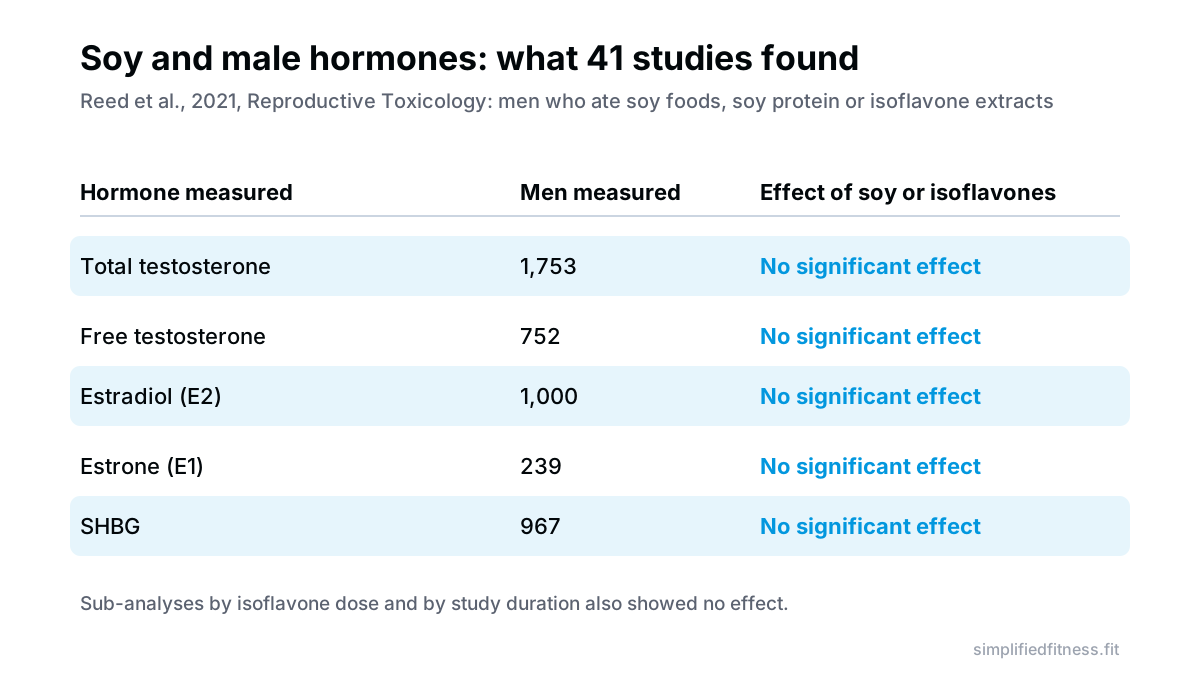
Does soy lower testosterone in men? In the clinical data, no. A 2021 meta-analysis pooling 41 studies found that soy protein and isoflavones had no significant effect on total testosterone, free testosterone, estradiol or estrone in men, whatever the dose or length of study (Reed et al., 2021). So tofu, soya chunks and soy protein can sit in a lifter’s diet without wrecking hormones.
This article is one slice of our complete protein guide for hypertrophy. Here we stick to one fear: that soy feminizes men. We will look at what the trials found, where the scary stories come from, and how soy actually performs for muscle.
Where the soy myth comes from
The logic sounds fair on paper. Soy contains isoflavones, plant compounds with a structure similar to estrogen, which is why they are called phytoestrogens. They can bind estrogen receptors. Estrogen-like plus man equals low testosterone, right?
That jump from a lab mechanism to a real outcome is where it falls apart. Binding a receptor in a dish is not the same as changing hormone levels in a living man. Isoflavones bind estrogen receptors weakly and behave differently from the estrogen your body makes. So the real question is simple: what happens when men actually eat soy? Researchers have asked it directly, many times.
Does soy lower testosterone in men? What the meta-analyses say
The first big pooled analysis, published in 2010, looked at clinical studies in adult men eating soy foods, isolated soy protein or isoflavone extracts. It found no significant effects of soy protein or isoflavone intake on testosterone, SHBG, free testosterone or free androgen index, whichever statistical model was used (Hamilton-Reeves et al., 2010).
Ten years of new research later, the same group updated it. The 2021 analysis included 41 studies. Total testosterone was measured in 1,753 men, free testosterone in 752, estradiol in 1,000, estrone in 239 and SHBG in 967. Again, no significant effect on any outcome, and sub-analyses by isoflavone dose and study duration also showed nothing (Reed et al., 2021).
Does soy raise estrogen or cause man boobs?
The same 41-study analysis found no significant change in estradiol or estrone (Reed et al., 2021). So for the typical lifter, there is no clinical evidence that soy pushes estrogen up.
Then why does the internet have stories? Because rare case reports exist, and they are dramatic. One 60-year-old man had bilateral gynecomastia, erectile dysfunction and low libido, with estrone and estradiol about four times the upper limit of normal. After his doctors found no other cause, he revealed he drank about 3 quarts of soy milk a day. His symptoms and estradiol settled after he stopped (Martinez and Lewi, 2008).
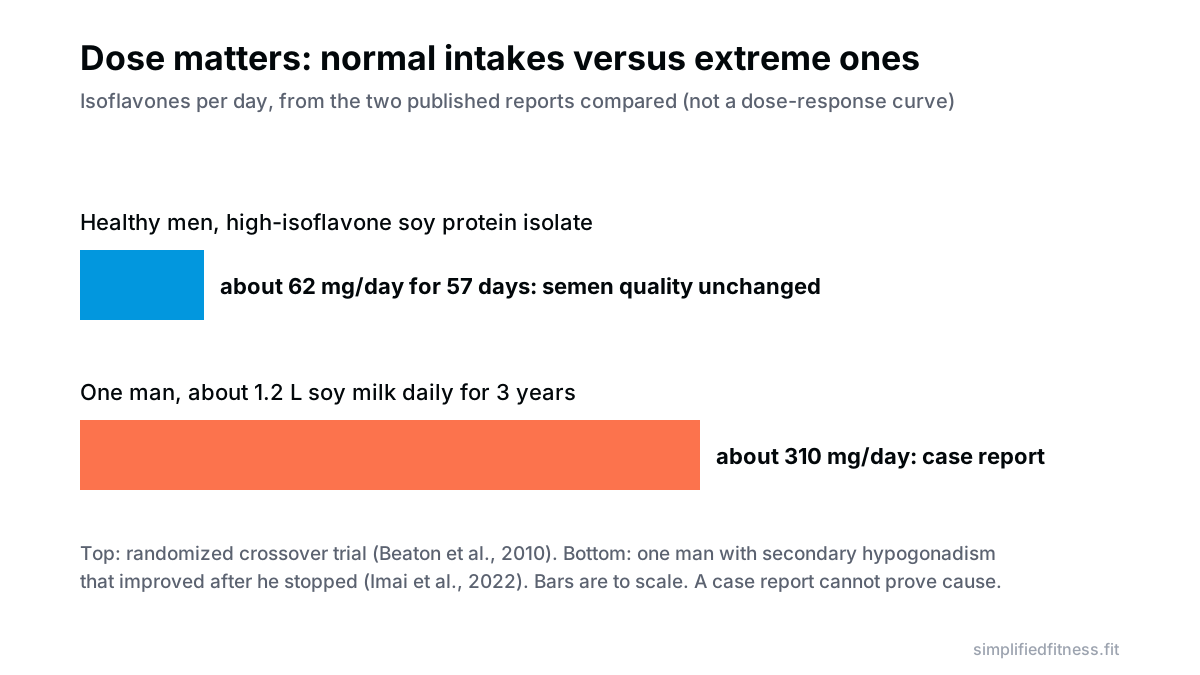
Another report described a 54-year-old man who had been drinking about 1.2 L of soy milk daily for three years, roughly 310 mg of isoflavones a day. He developed erectile dysfunction and gynecomastia, tests showed low testosterone and gonadotropins, and his function improved after he stopped (Imai et al., 2022).
Both are real. Both are also single cases, in middle-aged or older men, at intakes most people will never approach. A case report can show that something is possible. It cannot show how often it happens or whether soy was the only cause.
Dose matters: what the extreme cases look like
To make the gap concrete, compare the two kinds of evidence. In a randomized crossover trial, healthy men took high-isoflavone soy protein isolate providing about 61.7 mg of isoflavones a day for 57 days. The case report above involved around 310 mg a day, about five times higher, from daily soy milk by the litre.
What about fertility and sperm?
Testosterone is not the only worry. Some men also fear soy will hurt sperm. In a randomized crossover trial of healthy adult men (average age about 27.5), each man consumed milk protein isolate, low-isoflavone soy protein isolate and high-isoflavone soy protein isolate for 57 days each, with 28-day washouts. Semen volume, sperm concentration, total count, motility and morphology were not significantly affected by either soy version compared with milk protein (Beaton et al., 2010).
That is one trial in healthy men, so it does not answer every fertility question. If you are trying to conceive and have concerns, a semen analysis and a doctor’s advice are far more informative than any diet article.
Does soy protein build muscle as well as whey?
Hormones aside, will soy actually help you grow? Here the data are reassuring but not identical to whey in every setting.
Long-term training studies. A meta-analysis of 9 studies with 266 participants compared soy protein with animal proteins (whey, beef, milk or dairy protein) in people doing resistance training for 6 weeks or more. Strength rose significantly and lean body mass changes were not different between groups, with no differences for bench press, squat or lean mass (Messina et al., 2018). Their conclusion was that soy gives similar gains to whey in response to resistance exercise.
A plant-based whole-diet trial. In 38 young men (19 vegan, 19 omnivore) training twice weekly for 12 weeks, protein was adjusted to 1.6 g/kg/day using soy for the vegans and whey for the omnivores. Both groups gained leg lean mass and strength, with no between-group differences (Hevia-Larraín et al., 2021). The men were untrained at the start, so we cannot say the same holds for advanced lifters.
Acute lab studies. Here whey comes out ahead. In young men given 10 g of essential amino acids from whey hydrolysate, casein or soy protein isolate, muscle protein synthesis after exercise was about 31% greater with whey than soy, and soy was clearly higher than casein (Tang et al., 2009). Each group had only 6 men, and the authors suggest digestion speed or leucine content may explain it.
Why do these disagree? A short measurement of muscle protein synthesis after one drink is a snapshot. Muscle growth over months depends on total protein, training and recovery, and small per-serving differences seem to wash out when total intake is enough.
What about testosterone right after a workout?
One small study is often quoted by the anti-soy crowd. Ten resistance-trained men took 20 g of whey isolate, soy protein isolate or a maltodextrin placebo each morning for 14 days in a crossover design, then did 6 sets of 10 squats at 80% of their 1RM. The soy condition partially blunted the testosterone response to the workout, while estradiol and SHBG did not differ between conditions (Kraemer et al., 2013).
How should we weigh that? It is a real finding, but it is small (10 men), short (14 days), and measured a single post-exercise hormone response, not resting levels and not muscle gain. The much larger meta-analysis found no effect on resting testosterone. A cautious reading: soy may nudge the acute exercise response in some situations, but there is no evidence this translates into worse muscle growth, and long-term training trials show similar gains to whey.
How to use soy in a lifter’s diet
- Aim for total protein first. Use our protein calculator to get your daily target, then fill it from several sources. Our guide to optimal daily protein intake for hypertrophy covers the numbers.
- Soy as one of several sources. Mix soy with dal, paneer, curd, eggs (if you eat them), roti and rice. Variety matters more than any single food.
- If you are fully plant-based, see how plant versus animal protein compares for hypertrophy and how vegan protein powder blends work.
- Check the quality scores honestly. Protein quality scores depend on the method used, and soy can rank differently under each. Our guide to DIAAS vs PDCAAS explains how they work.
- On a tight budget, see our practical take on soya chunks and compare against whey in our whey protein guide.
When to see a doctor
Food is rarely the cause of hormone problems, and it is easy to blame the wrong thing. Get checked if you notice:
- breast tenderness, swelling or a lump (a lump on one side especially needs examining)
- a drop in sex drive or erectile problems that persist
- changes in testicle size, unexplained fatigue or loss of body hair
A doctor can run the right blood tests. If you drink a large amount of soy milk every day, mention it, since the case reports above came to light only after doctors asked about diet. Soy allergy is a separate issue, so avoid soy if you are allergic.
The bottom line
The question “does soy lower testosterone in men” has been tested many times. Pooled data from 41 clinical studies found no significant effect on testosterone or estrogen in men. Soy protein produces similar gains to animal protein in long-term training studies, though whey looks stronger in short lab measurements. The few alarming reports are single cases at very high intakes.
So use soy if you like it, keep the rest of your protein varied, and spend your worry on the things that really move the needle: training hard, sleeping, and hitting your protein target. If you want a structure for that, start with our free push, pull and legs plans.
Frequently Asked Questions
Does soy lower testosterone in men?
No, not at normal intakes. A 2021 meta-analysis of 41 clinical studies found no significant effect of soy protein or isoflavones on total or free testosterone in men, regardless of dose or study length. Treat soy like any other protein source, and speak to a doctor if you notice symptoms such as low libido or breast changes.
Does soy raise estrogen in men?
Soy has not been shown to raise estrogen in men in controlled trials. The same 41-study meta-analysis found no significant effect on estradiol or estrone. Isoflavones are plant compounds that can bind estrogen receptors, but that does not translate into higher circulating estrogen in the clinical data.
Can soy protein cause gynecomastia (man boobs)?
Controlled trials do not show this, but rare case reports exist. One man drinking about 3 quarts of soy milk a day had gynecomastia and high estrogen; his breast tenderness resolved and estradiol returned to normal after he stopped, and another drinking about 1.2 L a day had low testosterone that improved when he quit. Case reports cannot prove cause, and if you have breast tenderness or swelling, get it checked rather than guessing.
Is soy protein isolate as good as whey for building muscle?
In long-term training studies, they look similar. A meta-analysis of 9 studies (266 participants) found no difference between soy and animal protein for strength or lean mass gains in people lifting weights. Whey does win in short acute lab studies, so hit your total daily protein and you will not be held back.
Does soy hurt sperm count or fertility?
In a randomized crossover trial of healthy men, 57 days of soy protein isolate, even the high-isoflavone version, did not change semen volume, sperm concentration, count, motility or morphology versus milk protein. That is one trial in healthy men, so it does not settle questions for men with existing fertility problems. If you are trying to conceive and worried, ask your doctor for a semen analysis.
How much soy is safe per day?
There is no single proven upper limit. Ordinary food amounts, such as a serving or two of tofu, soya chunks or soy milk, are far below the intakes in the troubling case reports, which involved about 1.2 L or more of soy milk every day. If soy is a large share of everything you eat, keep variety in your diet and mention it to your doctor if symptoms appear.
Is tofu or soy milk safe for male bodybuilders?
Yes, based on the clinical evidence, tofu and soy milk fit fine into a lifter's diet. The hormone meta-analyses included men eating soy foods, soy protein and isoflavone extracts. Use them as one of several protein sources rather than the only one.
Is soy better or worse than whey for testosterone?
Neither has been shown to change resting testosterone in a meaningful way. In a small 14-day crossover study of 10 trained men, soy protein partially blunted the testosterone response to a heavy squat session, while estradiol did not differ. That was a short, acute measurement in few people, and it did not look at muscle gains.
Do I need to avoid soy if I want to build muscle?
No. In a trial of 38 young men on a 12-week training program, a plant-based diet with soy protein isolate gave the same muscle and strength gains as an omnivorous diet with whey, with both groups at 1.6 g/kg of protein. Your protein total and training matter far more than whether it comes from soy.
Is soya chunks the same as soy protein isolate?
They are both made from soybeans but processed differently, and they are not identical foods. Most of the clinical research uses soy protein isolate, soy foods or isoflavone extracts, and the hormone meta-analysis covered all three. Soya chunks were not tested separately, but they are a soy food, so in normal portions the same evidence is the best guide we have.
Should vegetarian men in India worry about soy?
There is no good reason to avoid soy based on current evidence, and it is one of the easier ways to cover protein on a vegetarian budget. Combine it with dal, paneer, curd and roti or rice for variety. Do not make soy your only protein, mainly because variety is useful, not because of hormones.
What are isoflavones and phytoestrogens?
Isoflavones are plant compounds found in soy that have a chemical structure similar to estrogen, which is why they are called phytoestrogens. They can bind to estrogen receptors, but their effects in the body are not the same as human estrogen. The clinical question is what happens in real men, and meta-analyses show no change in hormone levels.
Sources & References
Every claim above is checked against peer-reviewed research (PubMed, U.S. National Library of Medicine) or guidance from established health bodies. How we fact-check.
- Reed KE, et al. Neither soy nor isoflavone intake affects male reproductive hormones: An expanded and updated meta-analysis of clinical studies. Reprod Toxicol. 2021. PMID: 33383165
- Hamilton-Reeves JM, et al. Clinical studies show no effects of soy protein or isoflavones on reproductive hormones in men: results of a meta-analysis. Fertil Steril. 2010. PMID: 19524224
- Messina M, et al. No difference between the effects of supplementing with soy protein versus animal protein on gains in muscle mass and strength in response to resistance exercise. Int J Sport Nutr Exerc Metab. 2018. PMID: 29722584
- Hevia-Larraín V, et al. High-protein plant-based diet versus a protein-matched omnivorous diet to support resistance training adaptations: a comparison between habitual vegans and omnivores. Sports Med. 2021. PMID: 33599941
- Tang JE, et al. Ingestion of whey hydrolysate, casein, or soy protein isolate: effects on mixed muscle protein synthesis at rest and following resistance exercise in young men. J Appl Physiol. 2009. PMID: 19589961
- Kraemer WJ, et al. The effects of soy and whey protein supplementation on acute hormonal responses to resistance exercise in men. J Am Coll Nutr. 2013. PMID: 24015701
- Beaton LK, et al. Soy protein isolates of varying isoflavone content do not adversely affect semen quality in healthy young men. Fertil Steril. 2010. PMID: 19819436
- Imai H, et al. Secondary hypogonadism due to excessive ingestion of isoflavone in a man. Intern Med. 2022. PMID: 35228414
- Martinez J, Lewi JE. An unusual case of gynecomastia associated with soy product consumption. Endocr Pract. 2008. PMID: 18558591

Umair Hazrami · Founder & Head Coach, Simplified Fitness
Umair Hazrami founded Simplified Fitness and the Simplified Lifter channel to cut through fitness noise. With 4+ years of consistent training and 10+ coaching clients, he writes every guide from the peer-reviewed research and links the sources so you can check them. Our editorial standards.
Educational content only, not medical advice. If you have a medical condition, are pregnant, or take medication, talk to a qualified doctor before changing your diet, supplements or training. Full disclaimer.
Keep reading
Nutrition
The Anabolic Window Myth: Do You Really Need a Shake Within 30 Minutes?
The anabolic window myth, debunked: what meta-analyses show about the 30-minute post-workout shake, how wide your real window is, and when timing still matters.
8 min read

Nutrition
Casein Protein: Slow Digestion, Nighttime Satiety and Muscle Growth
Casein protein benefits for muscle growth: how slow digestion works, what pre-bed trials show, casein vs whey, satiety on a cut and a curd pudding recipe.
8 min read
Nutrition
Collagen Protein: Joint and Tendon Support vs Muscle Building Protein
Does collagen protein build muscle? Here is why 20 g of collagen should not count toward your daily protein goal, and where it may help tendons and joints.
8 min read
Nutrition
Protein Distribution: 3 Meals vs 5 Meals and the 'Muscle Full' Effect
Protein distribution throughout the day: do you need 5-6 meals for muscle? See what research says on 3 vs 5 meals, the muscle full effect and grams per meal.
9 min read