Pre-Bed Protein: Does 30-40 g of Casein Before Sleep Build Muscle?
Does pre bed protein build muscle or turn into fat? See what Maastricht trials found on 30-40 g casein before sleep, where results conflict, and how to do it.

TL;DR. The short answer
- Protein eaten about 30 minutes before sleep is digested and absorbed through the night, raising overnight amino acid levels in young and older men and improving whole-body protein balance in young men.
- The muscle-specific result is mixed: a 40 g casein dose raised muscle protein synthesis in older men, but 30 g did not raise myofibrillar synthesis in young men in one trial.
- Reviews of the Maastricht work report that pre-sleep protein, added during long resistance training blocks, helps muscle mass and strength. It is a small extra, not a replacement for enough daily protein.
- Calories decide fat gain, not the clock. About 30-40 g of protein (roughly 120-160 kcal) fits easily inside a daily budget, and small trials show no worse sleep or appetite.
- If you already hit about 1.6 g/kg a day and eat a protein-rich dinner, bedtime protein adds little. Have kidney disease or a medical diet? Ask your doctor first.
Part of our complete guide: Complete Protein Guide: How Much, What Type, and When to Eat It for Muscle Growth
Table of contents
Does pre bed protein actually build muscle, or does it just sit there and turn into fat? The short answer: protein eaten about 30 minutes before sleep is digested and absorbed overnight, and reviews of the research report it can modestly support muscle gains when you train. It does not cause fat gain on its own. Calories do that.
This article is the practical bedtime protocol. For the full picture of daily targets, sources and timing, start with our complete protein guide for hypertrophy. For the digestion science of casein itself, see the casein slow-digestion guide.
Why would protein before sleep matter at all?
You fast for 7-9 hours while you sleep. Muscle is still being remodelled during that time, and it needs amino acids to do it. If your last protein was at 7 pm, the supply thins out long before morning.
Researchers noticed this gap. A review from the Maastricht group notes that overnight muscle protein synthesis appears limited by amino acid availability, and that protein taken before sleep is digested and absorbed during the night (Trommelen & van Loon, 2016).
The logic is neat. Slow-digesting protein, drip-fed through sleep, could fill a window that is otherwise empty.
Neat logic is not proof, though. So here is what the trials actually found.
What did the first pre-sleep protein trial show?
In 2012, Res and colleagues tested 16 healthy young men who lifted in the evening and then received standard recovery nutrition. Thirty minutes before sleep they drank either 40 g of casein or a placebo, with tracers used to follow the protein overnight (Res et al., 2012).
The casein was effectively digested and absorbed during sleep, and amino acid levels stayed elevated through the night. Whole-body protein synthesis was higher (311 vs 246 umol per kg over 7.5 h), and net protein balance moved from slightly negative (-11) to positive (+61).
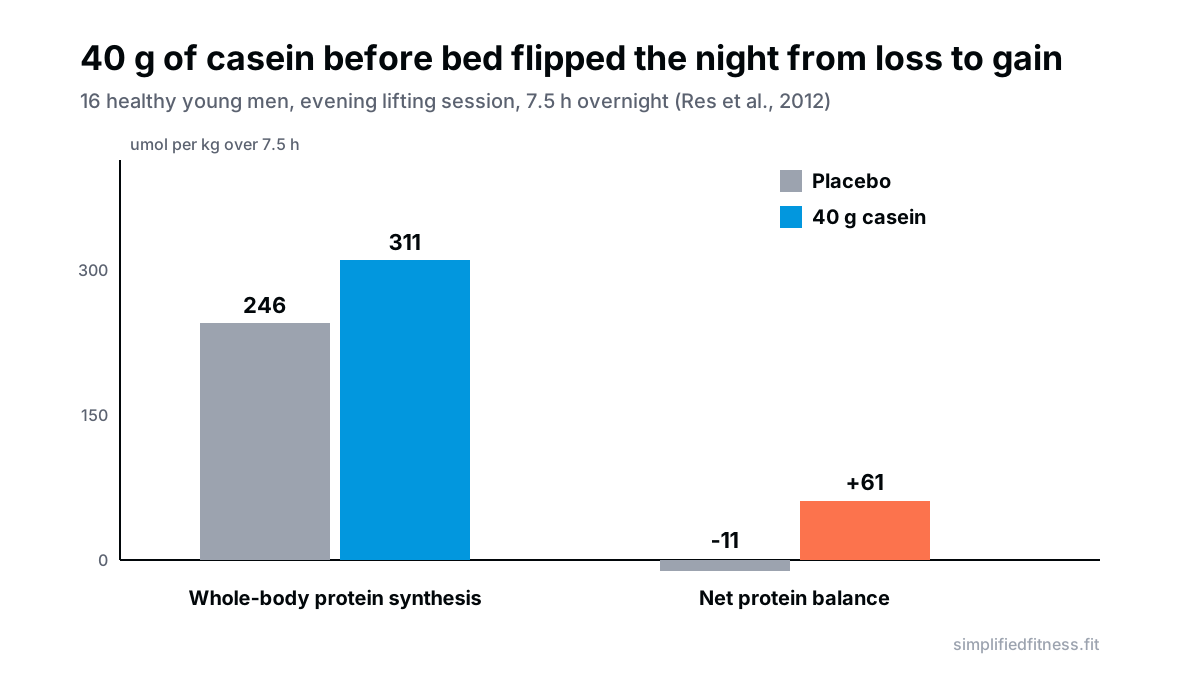
Muscle protein synthesis specifically was about 22% higher with casein, but that result only reached borderline significance (P = 0.05). So the first study was encouraging, not conclusive. Sixteen men, one night, one evening workout.
Do the results conflict? Yes, and here is why
In 2018, Trommelen and colleagues ran a follow-up with 36 young men. They gave 30 g of casein, 30 g of casein plus 2 g of free leucine, or a placebo before sleep after an evening session. Whole-body net protein balance improved, and the protein-derived amino acids were incorporated into muscle protein. But myofibrillar protein synthesis rates did not differ between groups (Trommelen et al., 2018).
So study A (40 g, 2012) saw a borderline rise in muscle synthesis, and study B (30 g, 2018) saw none in the specific myofibrillar fraction. Why might they differ?
- The dose was different (40 g vs 30 g). A 2016 review from the same group had already suggested that at least 40 g seems needed for a clear overnight rise in muscle protein synthesis (Trommelen & van Loon, 2016).
- The measurements were different: mixed muscle protein in 2012, myofibrillar protein in 2018.
- Both were small, single-night studies in young men, so chance plays a role.
Does it work for older lifters?
The most convincing muscle-specific data come from older men. In a randomized, double-blind trial of 48 men (mean age 72), participants had 40 g casein, 20 g casein, 20 g casein plus 1.5 g leucine, or a placebo before sleep. Overnight myofibrillar protein synthesis was 0.033%/h on placebo and 0.044%/h with 40 g, a difference that was statistically significant. The 20 g doses did not clearly separate from placebo (Kouw et al., 2017).
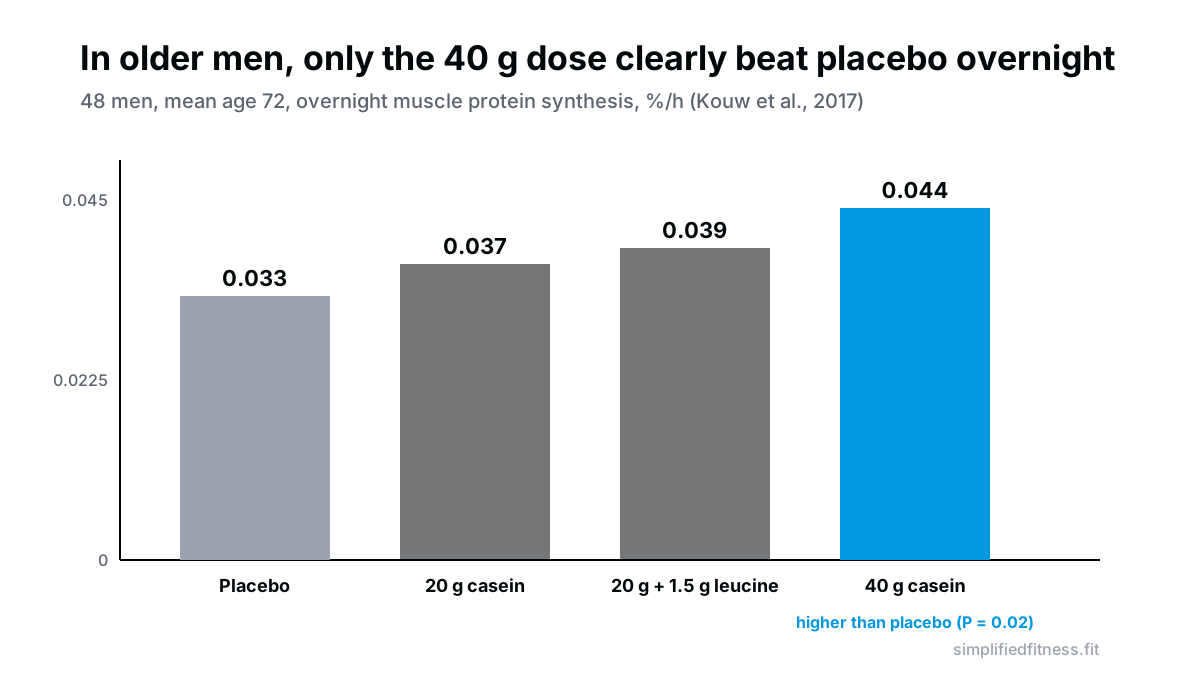
Older muscle tends to respond less to small protein doses, so a bigger serving makes sense. That trial studied men only and measured a short-term process, not muscle size. For more on this group, see our guide to protein needs in older adults.
Does pre bed protein build muscle over months?
This is the question that matters, and the honest answer comes from reviews rather than one big trial. The 2019 Maastricht update states that when applied over a prolonged period of resistance-type training, pre-sleep protein supplementation has a beneficial effect on the increase in muscle mass and strength (Snijders et al., 2019).
Two cautions. First, much of this literature comes from the same research group, as the author lists show. Independent replication in trained lifters would make me more confident. Second, the review itself describes the strategy as supporting the adaptive response to training, not creating growth on its own.
Context helps here. A meta-analysis of 49 trials found protein supplementation overall added about 0.30 kg of fat-free mass during resistance training, with no further gains once total intake passed about 1.62 g/kg a day (Morton et al., 2018). Total protein is the big lever. Timing is a small one.
Does eating protein before bed cause fat gain?
Fat gain comes from a sustained calorie surplus, not from the clock. A serving of 30-40 g of protein carries roughly 120-160 kcal (the 40 g casein used in a 2026 trial was 160 kcal) (Paterson et al., 2026). If it fits inside your daily target, it does not matter that it arrives at 11 pm.
A review of nighttime eating explains where the fear comes from. Negative outcomes were seen with large mixed meals in people who eat most of their food at night. The same review found those outcomes were not consistent with small, nutrient-dense, lower-energy options, and described roughly 150 kcal single-nutrient snacks as not appearing harmful (Kinsey & Ormsbee, 2015).
Then metabolism. In a randomized crossover study of 11 active men, 30 g of casein or whey before sleep raised next-morning resting energy expenditure compared with a placebo, and appetite measures did not differ (Madzima et al., 2014). The Maastricht review, looking across its own trials, reports no change in resting energy expenditure and no reduced breakfast appetite (Snijders et al., 2019).
I could not verify a trial measuring overnight fat oxidation directly, so I will not claim bedtime protein “burns fat”. The fair claim is narrower: in small short-term studies, it did not worsen resting energy use or appetite.
Will it hurt my sleep?
Probably not. A 2026 randomized, double-blind crossover trial in 21 elite female athletes gave 40 g casein, 40 g alpha-lactalbumin, 40 g carbohydrate or a placebo 30 minutes before bed for three nights each. Sleep time, sleep efficiency, resting heart rate, HRV and subjective sleep quality showed no significant differences between treatments (Paterson et al., 2026).
That is three nights per condition in young female athletes wearing a tracker. It does not say much about people with reflux or digestive trouble. If you are prone to reflux, avoid lying flat straight after a thick shake. Finish it, wait a bit, and see how you feel.
What should you eat? An Indian-kitchen protocol
The research used casein drinks. Casein is also the main protein in milk, so dairy foods are the practical route. Whole foods have been tested less than purified casein, so the overnight effect may differ somewhat.
| Option | How to make it | Notes |
|---|---|---|
| Casein or milk-protein powder | 1 scoop in water or milk | Closest to the studies. Check the label for grams of protein. |
| Cottage cheese or paneer | A portion sized to the label | Paneer is calorie-dense, so weigh it if you are cutting. |
| Hung curd or Greek yogurt | A large bowl, add milk powder if needed | Cheap and easy. Protein varies by brand. |
| Whey shake | 1 scoop | Faster digesting and less tested overnight. Fine if it is what you have. |
A simple protocol:
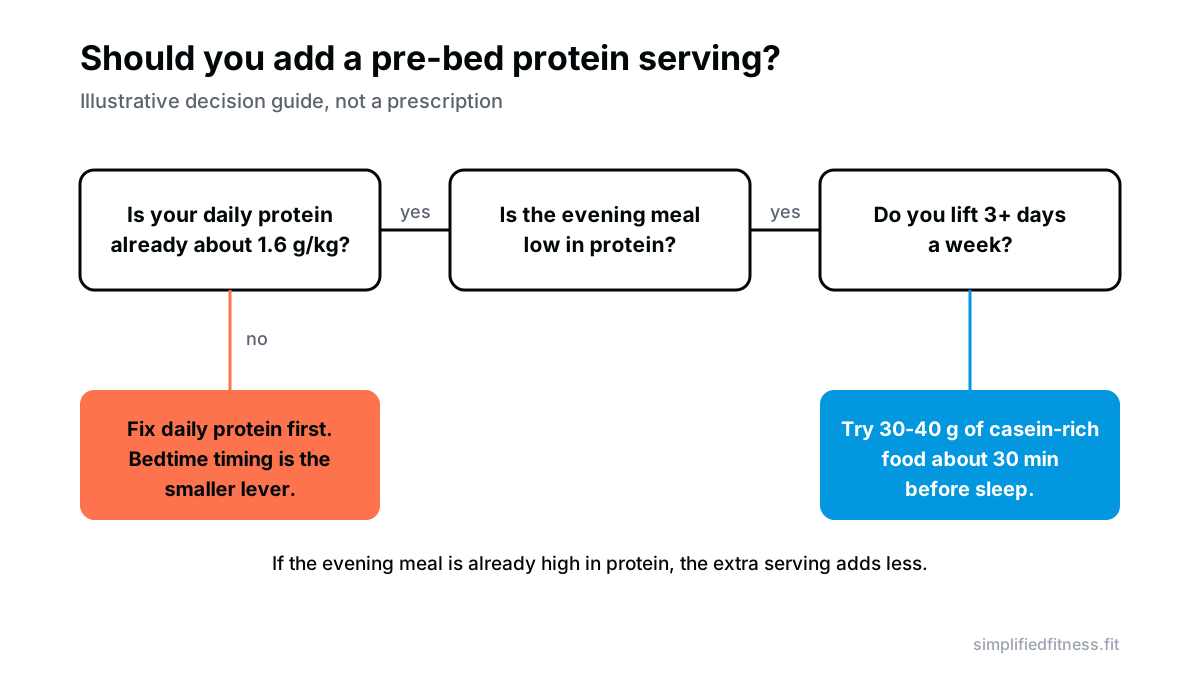
- Check your daily total first. About 1.4-2.0 g/kg is the ISSN range for most exercisers (Jager et al., 2017).
- Aim for 30-40 g, about 30 minutes before sleep.
- Count the calories inside your day, not on top of it.
- Use it on training days first, especially evening sessions.
- If dinner is already protein-heavy, skip it.
Hit the numbers on a consistent plan like our free push pull legs routine. If you want to see where the extra serving fits, try the diet plan builder.
Who should skip it or ask a doctor first?
Everything here comes from healthy adults. Speak to your doctor or a dietitian before adding bedtime protein if you have kidney disease, are on a prescribed protein-restricted diet, have diabetes with medication changes, or get regular reflux. If a late snack leaves you unwell or wakes you at night, move it earlier or stop.
Where bedtime protein fits against other protein questions
If you wonder whether one serving can use more than 30 g, our piece on protein absorption ceilings covers it. For spacing across the day, see 3 vs 5 meals. If a diet is the goal, the high-protein cutting guide shows how to protect muscle in a deficit. And the wider sleep picture, including hunger and recovery, is in the sleep and recovery guide.
The bottom line
Protein before bed is digested overnight, improves protein balance, and in reviews supports gains from lifting. The muscle-specific evidence is mixed at 30 g and stronger at 40 g, and the benefit is small next to total daily protein. It is not a fat-gain trap when counted in your calories. If you like it and it fits, use it. If not, you lose very little.
Frequently Asked Questions
Does eating protein before bed build muscle?
It can help, mainly by keeping amino acids available overnight. Studies show pre-sleep protein is digested during sleep and raises overnight protein balance, and a review of prolonged training trials reports benefits for muscle mass and strength. The effect looks like a modest extra on top of good daily protein, so treat it as a tweak, not a requirement.
Does protein before bed turn into fat?
Not by itself. Body fat changes with your total calories over weeks, not with when a serving lands, and 30-40 g of protein is a small energy load. If it pushes you into a surplus you do not want, drop something else from the day or skip it.
How much protein should I eat before bed?
Research that showed clear overnight effects used about 30-40 g, and one review suggests at least 40 g is needed for a clear rise in muscle protein synthesis. Smaller servings still add protein to your day, just with less certain overnight benefit. Use 30-40 g if it fits your calories and total daily target.
Is casein better than whey before bed?
Casein digests more slowly, which suits an overnight window, and most pre-sleep muscle trials used casein. Whey has been tested far less for overnight muscle building, so casein or casein-rich dairy is the better-supported choice. Pick the one you digest well and will actually take, and see our casein guide for the kinetics.
Can I use cottage cheese, Greek yogurt or paneer instead of casein powder?
Yes, these dairy foods contain casein, though the research mostly used purified casein drinks, so the exact overnight effect of whole foods is less tested. Their protein per serving varies by brand and fat content. Check the label and add up servings until you reach roughly 30-40 g, for example hung curd topped up with milk powder, or a paneer portion if it suits your calories.
How long before sleep should I take pre bed protein?
The trials gave it about 30 minutes before sleep, so that is the best-supported timing. The idea is to have amino acids arriving as you fall asleep and through the first part of the night. Practically, finish it after your last meal and brush your teeth afterwards.
Does protein before bed ruin sleep quality?
Small trials so far suggest it does not. A 2026 crossover trial in 21 elite female athletes found 40 g of casein did not change objective or subjective sleep measures versus placebo. If a late snack gives you reflux or restless nights, move it earlier or reduce the portion.
Does eating before bed slow your metabolism or fat burning?
The studies I could verify point the other way for resting energy use. In a small randomized crossover study of 11 active men, 30 g of casein or whey before sleep raised next-morning resting energy expenditure compared with placebo. I did not find a verified trial measuring overnight fat oxidation here, so do not rely on bedtime protein for fat loss.
Does pre-sleep protein work for older adults?
It showed promise in a trial of 48 men aged about 72, where 40 g of casein raised overnight muscle protein synthesis versus placebo while 20 g did not clearly do so. Older muscle responds less to small protein doses, which is why the higher serving mattered. Older adults with kidney problems should check protein targets with their doctor.
Do I need pre bed protein if I already eat enough protein?
Probably not much. A meta-analysis found extra protein stopped adding lean mass gains beyond about 1.62 g/kg a day, and the ISSN suggests 1.4-2.0 g/kg a day for most exercisers. If you are already there with an even spread of meals, put your effort into training and sleep instead.
Is pre bed protein useful when cutting?
It can be a convenient way to hit a high protein target on low calories, since casein-rich dairy is filling per calorie. The evidence on cutting specifically is thinner, so count it inside your calorie target rather than on top of it. A plain low-fat curd or cottage cheese portion is a cheap option.
Is pre bed protein safe for people with kidney disease?
Healthy people are not known to be harmed by 30-40 g of extra protein, but people with kidney disease often need individual protein limits. The research I reviewed was in healthy adults, so it cannot answer that question. Speak to your doctor or dietitian before adding supplements.
Should I take pre bed protein on rest days?
The strongest overnight data come after an evening workout, and one review notes prior exercise lets more of the protein be used for muscle building during sleep. On rest days the benefit is likely smaller. Use it on training days first and treat rest days as optional.
Sources & References
Every claim above is checked against peer-reviewed research (PubMed, U.S. National Library of Medicine) or guidance from established health bodies. How we fact-check.
- Snijders T, et al. The impact of pre-sleep protein ingestion on the skeletal muscle adaptive response to exercise in humans: an update. Front Nutr. 2019. PMID: 30895177
- Res PT, et al. Protein ingestion before sleep improves postexercise overnight recovery. Med Sci Sports Exerc. 2012. PMID: 22330017
- Trommelen J, et al. Presleep dietary protein-derived amino acids are incorporated in myofibrillar protein during postexercise overnight recovery. Am J Physiol Endocrinol Metab. 2018. PMID: 28536184
- Kouw IW, et al. Protein ingestion before sleep increases overnight muscle protein synthesis rates in healthy older men: a randomized controlled trial. J Nutr. 2017. PMID: 28855419
- Trommelen J, van Loon LJ. Pre-sleep protein ingestion to improve the skeletal muscle adaptive response to exercise training. Nutrients. 2016. PMID: 27916799
- Madzima TA, et al. Night-time consumption of protein or carbohydrate results in increased morning resting energy expenditure in active college-aged men. Br J Nutr. 2014. PMID: 23768612
- Kinsey AW, Ormsbee MJ. The health impact of nighttime eating: old and new perspectives. Nutrients. 2015. PMID: 25859885
- Paterson KGP, et al. Pre-sleep milk-derived proteins do not impair sleep or recovery in elite female athletes. J Int Soc Sports Nutr. 2026. PMID: 42897977
- Morton RW, et al. A systematic review, meta-analysis and meta-regression of the effect of protein supplementation on resistance training-induced gains in muscle mass and strength in healthy adults. Br J Sports Med. 2018. PMID: 28698222
- Jager R, et al. International Society of Sports Nutrition position stand: protein and exercise. J Int Soc Sports Nutr. 2017. PMID: 28642676

Umair Hazrami · Founder & Head Coach, Simplified Fitness
Umair Hazrami founded Simplified Fitness and the Simplified Lifter channel to cut through fitness noise. With 4+ years of consistent training and 10+ coaching clients, he writes every guide from the peer-reviewed research and links the sources so you can check them. Our editorial standards.
Educational content only, not medical advice. If you have a medical condition, are pregnant, or take medication, talk to a qualified doctor before changing your diet, supplements or training. Full disclaimer.
Keep reading

Nutrition
The Anabolic Window Myth: Do You Really Need a Shake Within 30 Minutes?
The anabolic window myth, debunked: what meta-analyses show about the 30-minute post-workout shake, how wide your real window is, and when timing still matters.
8 min read

Nutrition
Casein Protein: Slow Digestion, Nighttime Satiety and Muscle Growth
Casein protein benefits for muscle growth: how slow digestion works, what pre-bed trials show, casein vs whey, satiety on a cut and a curd pudding recipe.
8 min read
Nutrition
Collagen Protein: Joint and Tendon Support vs Muscle Building Protein
Does collagen protein build muscle? Here is why 20 g of collagen should not count toward your daily protein goal, and where it may help tendons and joints.
8 min read

Nutrition
Protein Distribution: 3 Meals vs 5 Meals and the 'Muscle Full' Effect
Protein distribution throughout the day: do you need 5-6 meals for muscle? See what research says on 3 vs 5 meals, the muscle full effect and grams per meal.
9 min read