Plant vs Animal Protein for Hypertrophy: Do Vegans Build Less Muscle?
Plant vs animal protein for hypertrophy: recent trials show vegan and omnivore lifters gain similar muscle when protein is matched. See how to make it work.
TL;DR. The short answer
- In trials where protein was matched (about 1.6-2 g/kg/day) and training was supervised, young vegan and omnivore lifters gained similar lean mass and strength.
- Single plant proteins are usually lower in leucine, lysine or methionine and less digestible, so a plant-based diet needs adequate total protein and some variety to compete.
- Soy and animal-protein supplements (mostly whey) produced similar lean mass and strength gains in a meta-analysis of 9 resistance training studies (266 participants).
- Older adults are the exception to watch: a 2026 trial found a self-selected vegan diet lowered protein intake and muscle mass, and resistance exercise offset part of the loss.
- Practical rule: hit your protein target first, spread sources across the day, and use soya, dal, paneer, curd or a pea-rice powder to get there.
Part of our complete guide: Complete Protein Guide: How Much, What Type, and When to Eat It for Muscle Growth
Table of contents
Plant vs animal protein for hypertrophy is a smaller gap than most gym talk suggests. When total protein is high enough and training is hard, vegan and omnivore lifters have gained similar muscle and strength in the trials run so far. Single plant proteins do look weaker in a lab, which is why the details of your day matter.
This article is the head-to-head review. For the bigger picture of protein types, doses and timing, start with our complete protein guide for hypertrophy. Here we stay on one question: does the source change the result?
Can vegans build as much muscle as meat eaters?
The two best direct comparisons say yes, with caveats.
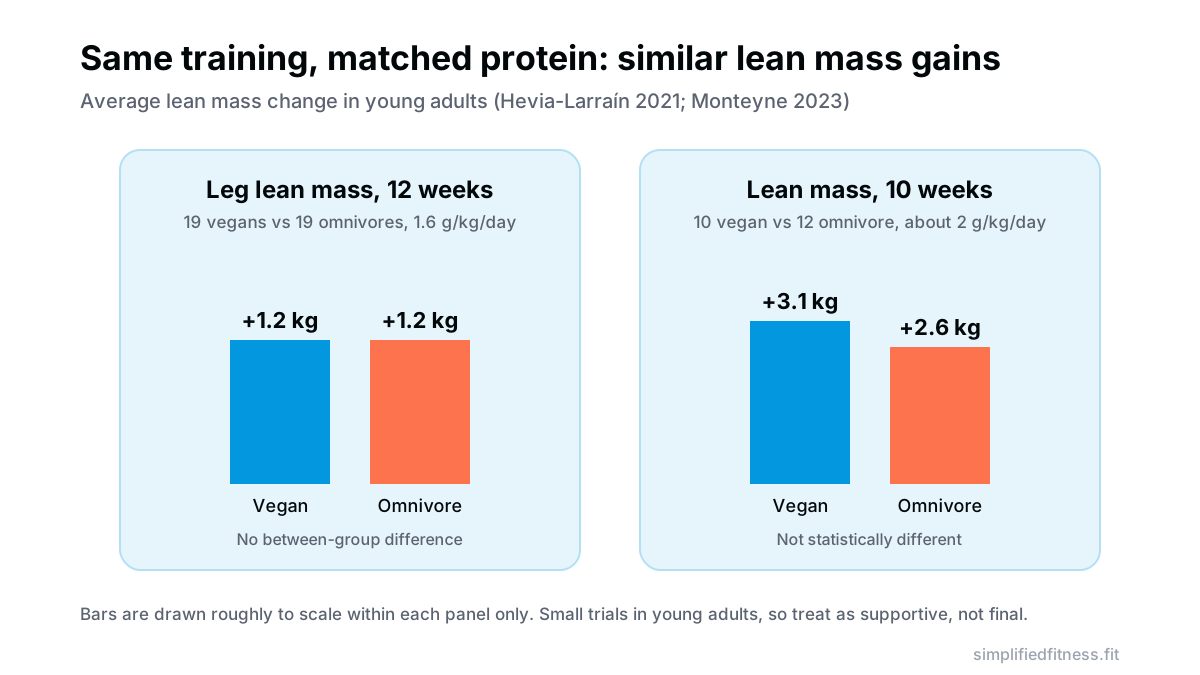
In 2021, researchers recruited 19 habitual vegans and 19 omnivores, all young men, and had them train twice a week for 12 weeks. Everyone’s protein was topped up to 1.6 g/kg/day, with soy protein for the vegans and whey for the omnivores. Leg lean mass rose by 1.2 kg in both groups, and muscle fibre size, whole-muscle size and leg-press strength improved with no significant difference between them (Hevia-Larraín et al., 2021). The participants were untrained men, so we cannot stretch this to advanced lifters.
In 2023, a second trial split 22 young adults (11 men, 11 women) into a vegan or an omnivorous diet at about 2 g/kg/day for 10 weeks of high-volume training, five days a week. Lean mass rose by 3.1 kg (vegan) and 2.6 kg (omnivore), thigh muscle volume rose 8.3% in both, and the groups did not differ statistically (Monteyne et al., 2023). The vegan diet in that study leaned on mycoprotein, which is hard to find in India, so the result is encouraging rather than a recipe.
Why do plant proteins look weaker in the lab?
There is a real reason the myth exists. A review of acute studies explains that soy and wheat protein produced a lower muscle protein synthesis response than several animal proteins. Proposed reasons include lower digestibility, more of the amino acids being diverted to urea production, and lower content of certain essential amino acids, along with lower leucine in most plant proteins (van Vliet et al., 2015).
In plain gym language:
- Leucine is the amino acid that acts like a switch for muscle protein synthesis. Most plant proteins contain less of it per gram. (We cover the trigger idea in the leucine threshold article.)
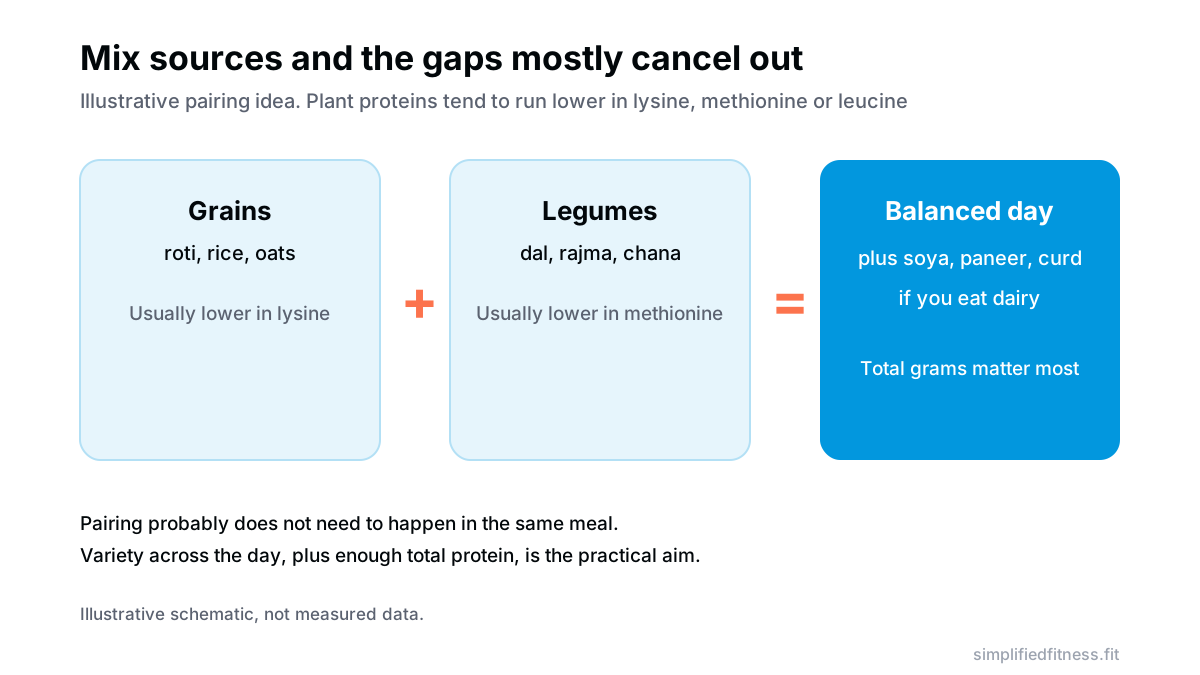
- Lysine and methionine are often the limiting amino acids in single plant foods, with cereals usually lower in lysine and legumes lower in methionine.
- Digestibility is lower for many plant proteins, partly due to fibre and other compounds in the food. How scores like DIAAS compare is in protein quality scores explained.
Those same authors list ways to close the gap: eat larger amounts of plant protein, combine several plant sources, or fortify with the limiting amino acids. They also state that these strategies still needed testing (van Vliet et al., 2015). That is a theory-based fix, so treat any exact “add 10-20%” number you see online with caution.
Soy vs whey protein muscle growth
Soy is the most studied plant protein in this area, so it gives the cleanest comparison.
A meta-analysis pooled 9 studies with 266 participants that supplemented resistance training with soy or animal protein (whey in five, others beef, milk or dairy protein). Strength and lean mass rose, with no difference between soy and animal protein for bench press, squat or lean mass (Messina et al., 2018).
A 12-week randomized trial matched soy and whey for leucine (2 g in each serving, which meant 26 g of soy isolate versus 19 g of whey isolate). Among 48 untrained adults who finished, lean mass rose about 1.5 kg and strength improved in both, with no group difference (Lynch et al., 2020).
A 2026 systematic review of untrained adults also found no significant lean mass difference between plant (soy and pea) and whey supplements. Its authors cautioned that only 5 studies qualified and confidence intervals were wide, so it does not prove the two are identical (Callegari et al., 2026).
Fear about soy and hormones is a separate question, covered in soy protein and testosterone myths.
Plant protein amino acid profile: do you need to combine foods?
You do not need to be anxious about it. You do need variety.
A plant food is “incomplete” only in the sense that one or two essential amino acids are relatively low, not absent. If your day includes roti or rice, dal, some soya or dairy, and a few other foods, the gaps tend to fill each other. There is no strong evidence that this has to happen inside a single meal when total intake is adequate, though that is a reasonable inference rather than something every trial has tested.
Blends also work in studies. In 33 resistance-trained young adults, 25 g of pea protein, mycoprotein or a blend of the two all raised post-exercise muscle protein synthesis to a similar degree, even though pea is often called low in methionine (West et al., 2023). That was a short acute study, not hypertrophy over months. For blend products, see vegan protein powder blends.
Plant vs animal protein: quick comparison
| Question | Plant sources (single) | Animal sources | What to do |
|---|---|---|---|
| Leucine per gram | Usually lower | Usually higher | Slightly larger servings |
| Limiting amino acid | Lysine (cereals), methionine (legumes) | Rarely limiting | Mix grains, legumes, soya |
| Digestibility | Often lower | Often higher | Cook well, vary sources |
| Long-term training results | Similar when protein matched | Similar when protein matched | Hit your total target |
| Practical risk | Falling short on total protein | Less common | Track intake for 1-2 weeks |
What the older-adult trial warns us about
Not every result is reassuring, and it would be dishonest to skip this one. In a 2026 randomized trial, 72 adults aged 65 or older followed a self-selected vegan diet, their habitual omnivorous diet, or a vegan diet plus resistance exercise for 12 weeks. The vegan group’s protein intake fell by roughly 19-28 g/day depending on the week, and thigh muscle volume (-0.61 L) and appendicular lean mass (-1.15 kg) dropped relative to the omnivore group, whose measures were stable. The vegan-with-exercise group lost less (Domić et al., 2026).
The trial’s own conclusion pointed to lower protein intake as part of the story. The takeaway is not “vegan diets cost muscle.” It is that when people switch without planning, protein drops, and older muscle is less forgiving. If you are older, on medication, or have kidney or other medical conditions, speak to your doctor or a registered dietitian before changing protein intake.
How to make plant-based protein work for lifting
- Set your target first. Use the protein calculator and aim for roughly 1.6-2.0 g/kg/day, the range used in the trials above. For a 70 kg lifter, that is about 112-140 g.
- Build 3-4 protein feeds a day. Examples: paneer or tofu bhurji, soya chunk curry, curd with chana, dal with rice, a soy or pea shake.
- Choose bigger portions of lower-leucine foods. Dal and rice is fine, but double the dal.
- Vary across the day. Grains, legumes, soya and nuts or seeds in the same day beats eating one source on repeat.
- Use powder as a gap-filler. A soy or pea-rice powder is a cheaper route than another 200 g of paneer when budget is tight. Look for third-party testing.
- Review in 8-12 weeks. If strength and waist or limb measurements are not moving, raise calories and protein before changing sources.
For a full-day vegetarian layout, our free diet plan is a starting point, and the general numbers sit in the optimal daily protein intake review.
What we still do not know
- The big trials are small (under 40 people) and short (10-12 weeks).
- Most participants were young and either untrained or moderately trained, so advanced lifters on a vegan diet are under-studied.
- Several studies used soy or mycoprotein, which may not match what you actually eat daily.
- The best exact “extra plant protein” amount has not been tested, and I would not trust a precise figure from anyone yet.
The bottom line
Plant vs animal protein for hypertrophy comes down to total protein, training quality and consistency. Plant sources have a lower per-gram amino acid profile, but when people who lift eat enough protein from varied sources, muscle and strength gains have looked similar. If you are vegetarian or vegan, count your protein, lean on soya, dal, dairy (if you eat it) and a decent powder, and keep lifting progressively.
Frequently Asked Questions
Can vegans build as much muscle as meat eaters?
In the trials we have, yes, when protein intake and training are matched. Young vegan and omnivore men gained the same leg lean mass (1.2 kg each) over 12 weeks at about 1.6 g/kg/day. The evidence is mostly short-term and in young adults, so aim for your protein target and train hard.
Is plant protein as good as animal protein for muscle?
Per gram, many single plant proteins are less anabolic in acute studies, mainly due to lower leucine and digestibility. Over weeks of real training with enough total protein, that gap has not shown up in lean mass or strength. Eat a bit more plant protein, vary your sources, and check progress over 8-12 weeks.
Is soy protein as good as whey for building muscle?
A meta-analysis of 9 studies (266 people) found no difference between soy and animal protein supplements for lean mass or strength gains with resistance training. Whey tends to win in single-meal studies, but long-term training results look similar. If you like soy, use it without worry.
What is an incomplete protein?
It is a protein that has a lower amount of one or more essential amino acids relative to what the body needs, such as lysine in many cereals or methionine in many legumes. It does not mean the protein contains none of them. Eating different plant foods across the day usually covers the gaps.
Do I need to combine proteins in the same meal?
There is no strong evidence that pairing has to happen within a single meal for people eating enough total protein. Your body draws on amino acids from a pool built up over the day. Include dal, grains, soya or dairy across your meals and you are very likely fine.
Do vegans need more protein than omnivores?
Some researchers suggest slightly more total plant protein can offset lower digestibility and leucine, but this specific strategy has not been fully tested. The vegan groups in the trials above simply matched omnivore intake and did well. Aiming for the top half of 1.6-2.0 g/kg is a sensible buffer.
Which plant proteins are best for muscle?
Soy, pea and mycoprotein have the most training-related research. Pea and mycoprotein, alone or blended, supported similar post-exercise muscle protein synthesis in resistance-trained adults. Dal and chana are useful and cheap but need larger servings for the same protein.
Can vegetarians in India get enough protein for muscle gain?
Yes, but it takes planning. Paneer, curd, milk, whey (if you use it), soya chunks, dal, chana, rajma and tofu can reach 1.6-2 g/kg when portions are intentional. Use the protein calculator for your target, then build meals around it.
Is leucine really lower in plant protein?
Reviews report that most plant proteins have lower leucine content than animal proteins. Leucine helps trigger muscle protein synthesis, so a small dose may be less effective per meal. In practice, slightly larger servings or blends help compensate.
Does a vegan diet reduce muscle mass in older adults?
In a 2026 randomized trial of adults 65 or older, a self-selected vegan diet lowered protein intake, thigh muscle volume and lean mass over 12 weeks. Adding resistance exercise reduced the loss. Older vegans should monitor protein closely and talk to a doctor or dietitian.
Do I need a protein powder on a plant-based diet?
No, but it often makes hitting your target easier. A soy or pea-based powder gave results similar to whey in training trials. Pick one with third-party testing and use it to fill the gap, not replace meals.
Is mycoprotein good for muscle growth?
Mycoprotein supported muscle protein synthesis comparable to pea protein and a blend in resistance-trained adults, and a mycoprotein-rich vegan diet matched an omnivorous one over 10 weeks. It is not widely sold in India, so treat it as optional. Soya, dal and dairy do the same job locally.
Sources & References
Every claim above is checked against peer-reviewed research (PubMed, U.S. National Library of Medicine) or guidance from established health bodies. How we fact-check.
- Hevia-Larraín V, et al. High-Protein Plant-Based Diet Versus a Protein-Matched Omnivorous Diet to Support Resistance Training Adaptations: A Comparison Between Habitual Vegans and Omnivores. Sports Med. 2021. PMID: 33599941
- Monteyne AJ, et al. Vegan and Omnivorous High Protein Diets Support Comparable Daily Myofibrillar Protein Synthesis Rates and Skeletal Muscle Hypertrophy in Young Adults. J Nutr. 2023. PMID: 36822394
- Messina M, et al. No Difference Between the Effects of Supplementing With Soy Protein Versus Animal Protein on Gains in Muscle Mass and Strength in Response to Resistance Exercise. Int J Sport Nutr Exerc Metab. 2018. PMID: 29722584
- Callegari IOM, et al. Is plant-based protein supplementation as effective as whey protein? A systematic review and meta-analysis in untrained adults undergoing resistance training. J Int Soc Sports Nutr. 2026. PMID: 42954267
- Lynch HM, et al. No Significant Differences in Muscle Growth and Strength Development When Consuming Soy and Whey Protein Supplements Matched for Leucine Following a 12 Week Resistance Training Program in Men and Women: A Randomized Trial. Int J Environ Res Public Health. 2020. PMID: 32486007
- van Vliet S, et al. The Skeletal Muscle Anabolic Response to Plant- versus Animal-Based Protein Consumption. J Nutr. 2015. PMID: 26224750
- West S, et al. Ingestion of mycoprotein, pea protein, and their blend support comparable postexercise myofibrillar protein synthesis rates in resistance-trained individuals. Am J Physiol Endocrinol Metab. 2023. PMID: 37529834
- Domić J, et al. A self-selected vegan diet reduces skeletal muscle mass in healthy older adults: a randomized controlled trial. Am J Clin Nutr. 2026. PMID: 42680254

Umair Hazrami · Founder & Head Coach, Simplified Fitness
Umair Hazrami founded Simplified Fitness and the Simplified Lifter channel to cut through fitness noise. With 4+ years of consistent training and 10+ coaching clients, he writes every guide from the peer-reviewed research and links the sources so you can check them. Our editorial standards.
Educational content only, not medical advice. If you have a medical condition, are pregnant, or take medication, talk to a qualified doctor before changing your diet, supplements or training. Full disclaimer.
Keep reading
Nutrition
The Anabolic Window Myth: Do You Really Need a Shake Within 30 Minutes?
The anabolic window myth, debunked: what meta-analyses show about the 30-minute post-workout shake, how wide your real window is, and when timing still matters.
8 min read

Nutrition
Casein Protein: Slow Digestion, Nighttime Satiety and Muscle Growth
Casein protein benefits for muscle growth: how slow digestion works, what pre-bed trials show, casein vs whey, satiety on a cut and a curd pudding recipe.
8 min read
Nutrition
Collagen Protein: Joint and Tendon Support vs Muscle Building Protein
Does collagen protein build muscle? Here is why 20 g of collagen should not count toward your daily protein goal, and where it may help tendons and joints.
8 min read
Nutrition
Protein Distribution: 3 Meals vs 5 Meals and the 'Muscle Full' Effect
Protein distribution throughout the day: do you need 5-6 meals for muscle? See what research says on 3 vs 5 meals, the muscle full effect and grams per meal.
9 min read