Optimal Daily Protein Intake for Hypertrophy: What the Meta-Analyses Say
Optimal protein intake for muscle growth is about 1.6 g/kg a day, with 2.2 g/kg as a safe upper target. See the Morton meta-analysis and how to set your number.

TL;DR. The short answer
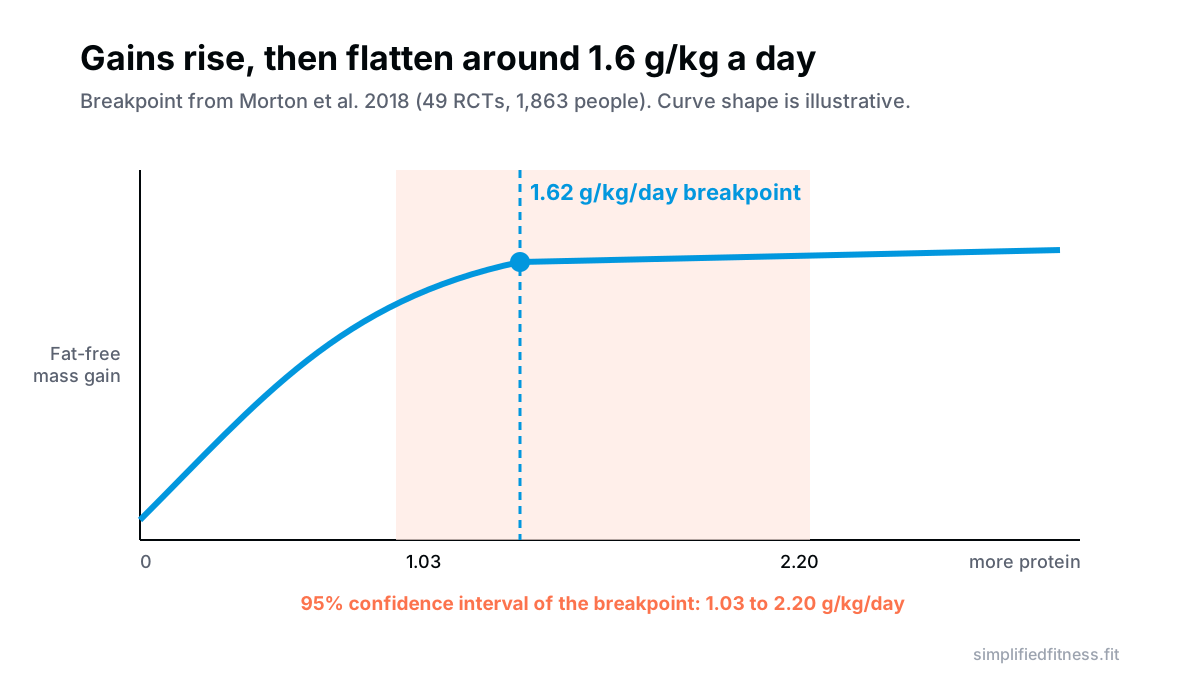
- The best-known meta-analysis (Morton et al., 2018, 49 trials, 1,863 people) found muscle-mass gains from training stopped improving above about 1.62 g of protein per kg body weight per day.
- That breakpoint came with a wide range of uncertainty (1.03 to 2.20 g/kg), which is why 1.6-2.2 g/kg is the practical target zone for most lifters.
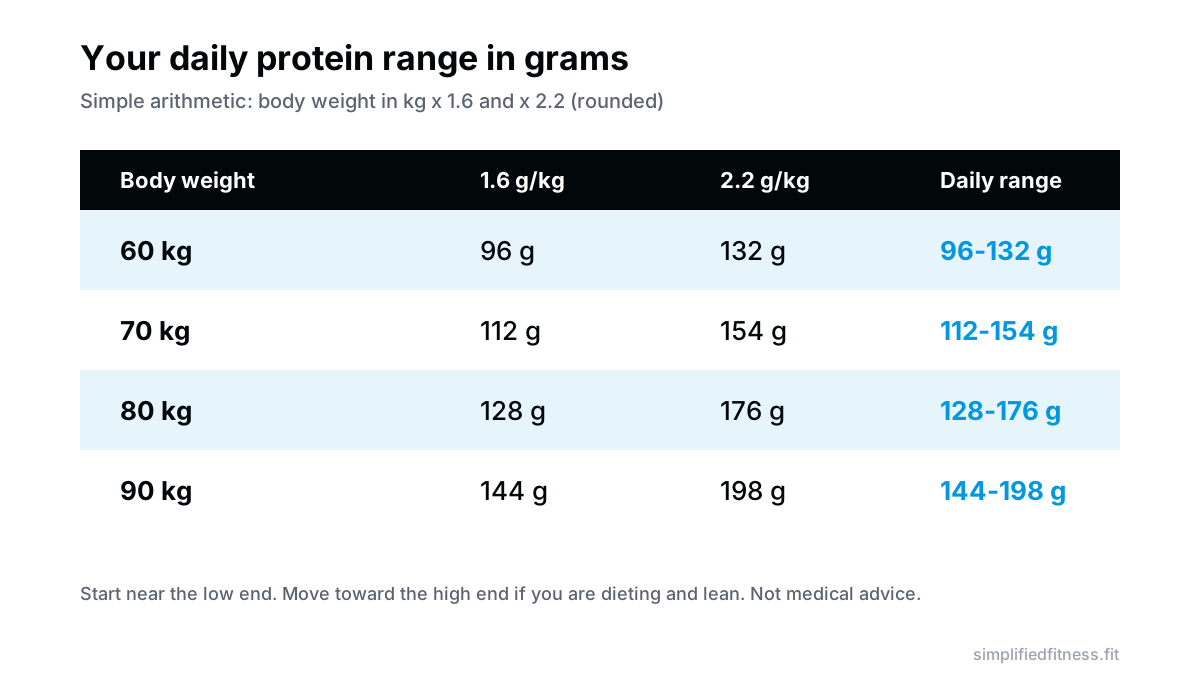
- A 70 kg lifter lands at roughly 112-154 g a day. Start near the low end and only move up if you are dieting, very lean or struggling to progress.
- More protein beyond this zone has not been shown to add muscle in these trials. It mostly adds cost and calories.
- If you have kidney disease or are unsure about your kidneys, check with your doctor before raising protein.
Part of our complete guide: Complete Protein Guide: How Much, What Type, and When to Eat It for Muscle Growth
Table of contents
The optimal protein intake for muscle growth is about 1.6 g per kg of body weight per day, with up to 2.2 g/kg (0.7-1.0 g per lb) as a sensible upper target. That comes mainly from one large meta-analysis, and it is the number most nutrition plans on this site are built around.
This article is the evidence breakdown behind that number. If you want the full picture of protein sources, timing and supplements, start with our complete protein guide for hypertrophy. Here we stay on one question: how many grams, and how sure are we?
What did the Morton protein study actually find?
Morton and colleagues pooled randomized controlled trials where people did resistance training for at least 6 weeks and some groups got extra protein. The final set was 49 studies with 1,863 participants (Morton et al., 2018).
Protein supplementation produced small but statistically significant extra gains:
- strength (1RM): +2.49 kg on average
- fat-free mass: +0.30 kg
- muscle fibre cross-sectional area: +310 µm2
Those are modest numbers. Protein does not replace training, it nudges the result. The analysis also found the benefit for fat-free mass was smaller with increasing age and larger in resistance-trained people (+0.75 kg).
Why do people say 1.6 and 2.2 g/kg?
The 1.62 g/kg figure is the average break point. The paper’s open-access full text reports it with a 95% confidence interval of 1.03 to 2.20 g/kg/day. That interval is the source of the “2.2” in 1.6-2.2.
Think of it this way. The data says the plateau most likely sits near 1.6 g/kg, but it could plausibly sit anywhere from about 1.0 to 2.2 depending on the person and the trial. If you eat 1.6 g/kg you are at the best estimate. If you eat 2.2 g/kg you are covering most of the plausible range.
How much protein per day for hypertrophy, by body weight?
Take your weight in kg and multiply. Here is that arithmetic for common body weights.
Prefer an exact answer for your body? Use our free protein calculator.
Do other studies agree with Morton?
Mostly yes, with some useful differences.
Nunes et al. (2022) pooled 74 randomized trials in healthy, non-obese adults. Among people doing resistance training, increasing protein intake modestly improved lean body mass (SMD 0.22, 62 studies, moderate level of evidence). The effect was significant in younger adults eating 1.6 g/kg or more, and in people 65 and over eating 1.2-1.59 g/kg (Nunes et al., 2022). The authors call the gains “small”.
Tagawa et al. (2022) looked at strength rather than size. Across 82 trials, protein only improved strength when combined with resistance training. Strength gains rose with total protein up to about 1.5 g/kg/day, with no further gain after that (Tagawa et al., 2022). Several authors work for Meiji, a Japanese dairy and food company, which is worth knowing when you weigh the result.
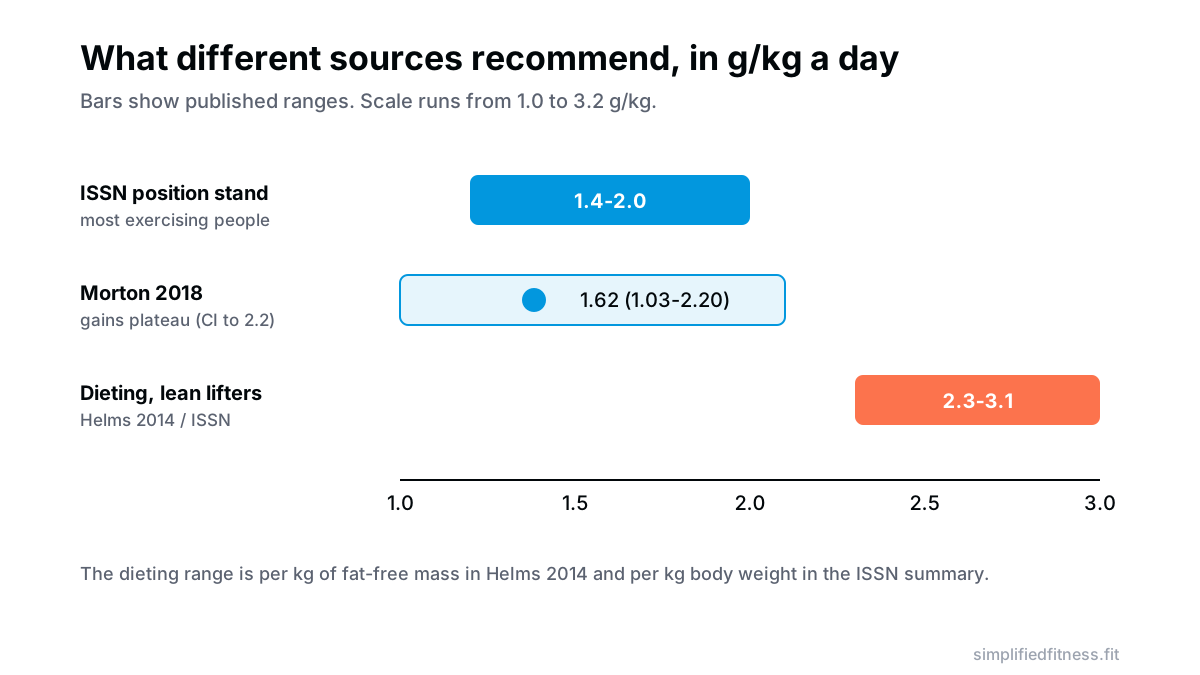
The ISSN position stand says 1.4-2.0 g/kg a day is sufficient for most exercising individuals to build and maintain muscle (Jager et al., 2017).
Four sources land in a similar zone: 1.4-2.0 (ISSN), about 1.5 (Tagawa, strength), 1.62 (Morton) and at least 1.6 for younger adults (Nunes).
Why might the numbers differ slightly?
Each analysis asked a slightly different question. Morton looked at fat-free mass in trials with supplementation, Tagawa at strength, and Nunes at lean mass with a wide range of designs. Trials also differ in training experience, age, calorie intake and how protein was measured.
One more honest caveat. Break points from pooled data are statistical estimates, not biological cliffs. The wide confidence interval around the Morton break point is a reminder that individual needs can sit well away from the average. Treat 1.6 as a starting point you test, not a law.
Is more than 2.2 g/kg useful?
For building muscle in people eating at maintenance or in a surplus, trials in this analysis do not show extra growth above roughly 1.6 g/kg. Going well beyond 2.2 g/kg mostly takes up calories and money you could spend on carbs, which fuel training.
There is one important exception, covered next.
Do you need more protein when cutting?
Probably yes. A systematic review of six studies in lean, resistance-trained, energy-restricted athletes concluded needs are likely 2.3-3.1 g per kg of fat-free mass, scaled upward with the severity of the deficit and leanness (Helms et al., 2014). The review was small, and it used fat-free mass rather than total weight. Our guide to high protein while cutting goes through this properly.
What about age, kidneys and other limits?
Age. Morton found the benefit of supplementation on fat-free mass fell as age rose, and Nunes saw benefits in older adults at lower intakes than younger adults. Older lifters have their own considerations, covered in our article on protein needs in older adults.
Kidneys. In people with healthy kidneys, the intakes discussed here are not known to cause harm, but people with kidney disease should not self-prescribe high protein. See our high-protein diet and kidney safety review, and see a doctor if you have any kidney diagnosis, persistent swelling, or abnormal kidney tests.
Per meal. Total daily protein matters most, though spreading it out is practical. See protein distribution across meals, and the idea of a per-meal absorption ceiling.
How to set your own protein target
- Weigh yourself in kg. Use your goal weight if you carry a lot of body fat.
- Multiply by 1.6 for your starting number.
- Multiply by 2.2 for your ceiling.
- Track your intake for 2 weeks and see where you naturally land.
- Re-check in 6-8 weeks against strength, waist and body weight trend.
Start with the number you can actually repeat. A common trap is hitting 2.2 g/kg for three days, then drifting far lower the rest of the week.
Hitting 1.6 g/kg on an Indian diet
For a 70 kg vegetarian lifter, 112 g is a real stretch if the day is mostly roti and rice. Build each meal around a main protein: dal or rajma with curd, paneer or tofu, soya chunks, eggs if you eat them, plus a glass of milk or a scoop of whey. Soya chunks and eggs are often the cheapest per gram of protein, though prices vary by city.
A shake is a convenience, not a requirement. Your muscles respond to the daily total, whatever source it comes from. Plant proteins tend to be a bit lower in some essential amino acids, so mixing sources and aiming for the upper half of the range can help. For ideas and budgets, see our Indian high-protein nutrition guide and the budget protein diet, and compare plant vs animal protein.
Need a ready-made meal structure? Try our free diet plan.
Common mistakes when applying the meta-analysis
Treating the break point as a cliff. Eating 1.5 g/kg instead of 1.62 g/kg does not cost you your gains. The curve flattens gradually, so a few grams either way is noise.
Ignoring total calories. The Morton trials were resistance training studies where protein was the variable. If you are eating far too little overall, protein alone will not rescue progress. Sort out calories first with our calorie calculator.
Chasing the number with powder only. A scoop of whey is useful, but a day of three shakes and little real food is harder to sustain. Use food first, then fill the gap.
Assuming the studies were all in advanced lifters. Many participants were not highly trained, and most trials last weeks to a few months. We have much less long-term data on how needs change over years of training, so hold the numbers loosely.
A worked example for a 70 kg lifter
Say you weigh 70 kg and want a starting target. At 1.6 g/kg that is 112 g, and at 2.2 g/kg it is 154 g. Aim for about 120-130 g, which sits comfortably in the middle.
A realistic vegetarian day might look like this: curd with breakfast, dal and paneer at lunch, soya chunks or tofu at dinner, milk or a whey shake after training, and a handful of peanuts or roasted chana as a snack. Each of those contributes a meaningful chunk, and four or five protein-anchored meals gets you there without forcing anything. If you eat eggs or chicken, swap them in. Check labels, since protein per serving varies a lot between brands.
If you are heavier or carrying a lot of body fat, using your goal weight instead of your current weight keeps the target realistic and the numbers from ballooning.
The bottom line
The strongest evidence we have says 1.6 g/kg a day is where extra protein stops adding measurable muscle, and 2.2 g/kg is a reasonable ceiling that covers the uncertainty. These are averages from trials, and trials are short. Hit your number most days, train hard, sleep well, and only adjust if your progress tells you to.
Frequently Asked Questions
What is the optimal protein intake for muscle growth?
For most healthy lifters, about 1.6 g/kg of body weight a day is where extra protein stops adding measurable muscle in the main meta-analysis, and up to 2.2 g/kg is a sensible upper target. The Morton 2018 analysis put the breakpoint at 1.62 g/kg with a confidence interval of 1.03 to 2.20. Pick a number inside 1.6-2.2 g/kg and stick with it for several weeks.
How much protein per day do I need for hypertrophy?
Most lifters do well with 1.6-2.2 g per kg body weight, which is 0.7-1.0 g per lb. The ISSN position stand also describes 1.4-2.0 g/kg as sufficient for most exercising people. Multiply your weight in kg by 1.6 or use our protein calculator to get a daily number.
Is 1.6 or 2.2 g/kg better for muscle growth?
The research does not show a clear winner, because 1.6 g/kg is the average plateau and 2.2 g/kg is the top of its uncertainty range. Individuals vary, and being lean, dieting or training hard may push needs higher. Start at 1.6 g/kg, and move toward 2.2 g/kg if you are cutting or want a safety margin.
What did the Morton protein study find?
Morton and colleagues pooled 49 randomized trials with 1,863 participants and found protein supplementation modestly increased fat-free mass, strength and muscle size during resistance training. Gains in fat-free mass did not rise further above total intakes of 1.62 g/kg/day. Treat it as a strong guide, not an exact line for every person.
Does eating more than 2.2 g/kg build more muscle?
In the trials pooled by Morton et al., intakes above about 1.6 g/kg did not produce further fat-free mass gains. Very high intakes may still be useful in specific cases, such as hard dieting, but that is a different question. For a lifter in maintenance or a surplus, extra protein mostly displaces carbs and fat.
Should I use pounds or kilograms for protein targets?
Either works. 1.6-2.2 g/kg equals roughly 0.7-1.0 g per lb of body weight. Use whichever your scale shows, and avoid mixing the two.
Do I count protein per kg of total body weight or lean mass?
Most trials, including Morton's, express intake per kg of total body weight, so that is the simplest method. If you carry a lot of extra fat, a target based on a goal weight is more practical. The result will not differ much for most people.
Do beginners need as much protein as advanced lifters?
Morton et al. found supplementation was more effective in resistance-trained people than in the less trained, and less effective with increasing age. That finding is about how much extra protein added on top of training, not proof that beginners need less. The 1.6 g/kg starting point is a reasonable target for them too, with consistent training as the bigger lever.
Do I need protein powder to reach 1.6 g/kg?
No. The trials tested protein supplementation, but your body cannot tell whether protein came from a shake or from dal, paneer, curd, eggs or chicken. What matters is the total daily number. Use powder only if food alone makes your target hard or expensive.
How much protein do I need while cutting?
Dieting lifters likely need more. A systematic review in lean, resistance-trained athletes suggested 2.3-3.1 g/kg of fat-free mass, scaling up with leanness and the size of the calorie deficit. Read our cutting guide for the full breakdown.
Is a high-protein diet safe for my kidneys?
In healthy people, the intakes discussed here have not been shown to damage the kidneys, but people with existing kidney disease are a different case. Ask your doctor if you have kidney problems, diabetes affecting the kidneys, or a family history. Our kidney safety article covers the evidence.
Do older adults need more protein for muscle growth?
Possibly. Pooled data suggest protein benefits for lean mass in people over 65 at around 1.2-1.59 g/kg a day, though the effect of supplementation shrinks with age in Morton's analysis. If you are older, talk to a doctor or dietitian and read our sarcopenia article.
How long should I track protein to know if my target works?
Give any target 6-8 weeks while keeping training and calories steady. Judge it by strength progress, waist and body weight trend, not one weigh-in. If progress stalls and your intake is already in the range, look at sleep, calories and training before adding more protein.
Sources & References
Every claim above is checked against peer-reviewed research (PubMed, U.S. National Library of Medicine) or guidance from established health bodies. How we fact-check.
- Morton RW, et al. A systematic review, meta-analysis and meta-regression of the effect of protein supplementation on resistance training-induced gains in muscle mass and strength in healthy adults. Br J Sports Med. 2018. PMID: 28698222
- Helms ER, et al. A systematic review of dietary protein during caloric restriction in resistance trained lean athletes: a case for higher intakes. Int J Sport Nutr Exerc Metab. 2014. PMID: 24092765
- Nunes EA, et al. Systematic review and meta-analysis of protein intake to support muscle mass and function in healthy adults. J Cachexia Sarcopenia Muscle. 2022. PMID: 35187864
- Jager R, et al. International Society of Sports Nutrition Position Stand: protein and exercise. J Int Soc Sports Nutr. 2017. PMID: 28642676
- Tagawa R, et al. Synergistic effect of increased total protein intake and strength training on muscle strength: a dose-response meta-analysis of randomized controlled trials. Sports Med Open. 2022. PMID: 36057893

Umair Hazrami · Founder & Head Coach, Simplified Fitness
Umair Hazrami founded Simplified Fitness and the Simplified Lifter channel to cut through fitness noise. With 4+ years of consistent training and 10+ coaching clients, he writes every guide from the peer-reviewed research and links the sources so you can check them. Our editorial standards.
Educational content only, not medical advice. If you have a medical condition, are pregnant, or take medication, talk to a qualified doctor before changing your diet, supplements or training. Full disclaimer.
Keep reading
Nutrition
The Anabolic Window Myth: Do You Really Need a Shake Within 30 Minutes?
The anabolic window myth, debunked: what meta-analyses show about the 30-minute post-workout shake, how wide your real window is, and when timing still matters.
8 min read

Nutrition
Casein Protein: Slow Digestion, Nighttime Satiety and Muscle Growth
Casein protein benefits for muscle growth: how slow digestion works, what pre-bed trials show, casein vs whey, satiety on a cut and a curd pudding recipe.
8 min read
Nutrition
Collagen Protein: Joint and Tendon Support vs Muscle Building Protein
Does collagen protein build muscle? Here is why 20 g of collagen should not count toward your daily protein goal, and where it may help tendons and joints.
8 min read

Nutrition
Protein Distribution: 3 Meals vs 5 Meals and the 'Muscle Full' Effect
Protein distribution throughout the day: do you need 5-6 meals for muscle? See what research says on 3 vs 5 meals, the muscle full effect and grams per meal.
9 min read