Can the Body Absorb More Than 30g of Protein in One Meal? What the Research Shows
Can the body absorb more than 30g of protein in one meal? Yes. See what the 100g Trommelen study and dose-response trials show for big meals.
TL;DR. The short answer
- Yes, your body can absorb more than 30 g of protein in one meal. Absorption has no known fixed ceiling, because a big meal is digested more slowly over several hours instead of being flushed out.
- In a 2023 isotope-tracer trial, 100 g of protein produced a bigger and longer muscle anabolic response (over 12 hours) than 25 g, with negligible effect on amino acid oxidation.
- The 20-40 g figure describes how hard muscle protein synthesis is switched on in the first few hours after one dose, not how much you can absorb or use over the day.
- Older dose-response trials found 20 g near-maximal for an acute burst, while a 2016 trial found 40 g beat 20 g after whole-body training. The ceiling is soft, not a wall.
- For most lifters, total daily protein (around 1.4-2.0 g/kg) matters far more than how you split it. A 50-60 g dinner is fine.
Part of our complete guide: Complete Protein Guide: How Much, What Type, and When to Eat It for Muscle Growth
Table of contents
Can the body absorb more than 30g of protein in one meal? Yes. There is no evidence of a hard absorption ceiling at 30 g. This question belongs to our complete protein guide for muscle growth, and the short answer is below. A larger protein meal is digested over a longer time, and in the best test we have so far, 100 g of protein kept muscle building going for more than 12 hours.
The “30 g limit” survives because two different ideas got merged: how much protein you absorb, and how much muscle protein synthesis (MPS) rises in the first few hours after a dose. Here we deal with just this one question, and how to eat around it.
Where did the 30g protein per meal rule come from?
Gym lore says anything beyond 25-30 g “goes to waste.” The rule traces back to acute lab studies that measured MPS for a few hours after a single dose.
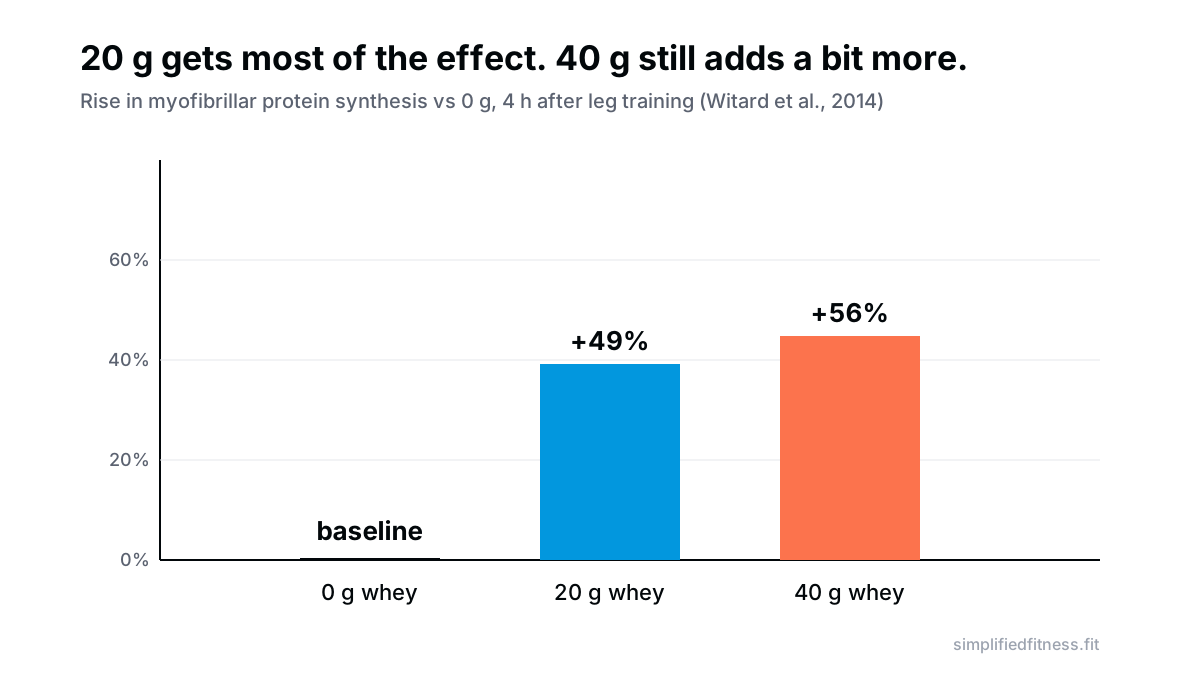
In one study, six young men trained their legs and then drank 0, 5, 10, 20 or 40 g of egg protein. MPS rose with the dose and was maximal at 20 g, and leucine oxidation went up at 20 and 40 g (Moore et al., 2009). In a larger trial of 48 resistance-trained men, 20 g and 40 g of whey raised myofibrillar MPS by 49% and 56% over zero, with nothing extra at 10 g, and 40 g increased amino acid oxidation and urea production (Witard et al., 2014).
Read those carefully. They measured a 4-hour window after one dose. They did not measure what happened to the rest of the protein over the next 8-12 hours. The conclusion “20 g is enough to maximise MPS” quietly became “the body can’t handle more than 30 g.”
Absorption vs muscle protein synthesis: two different questions
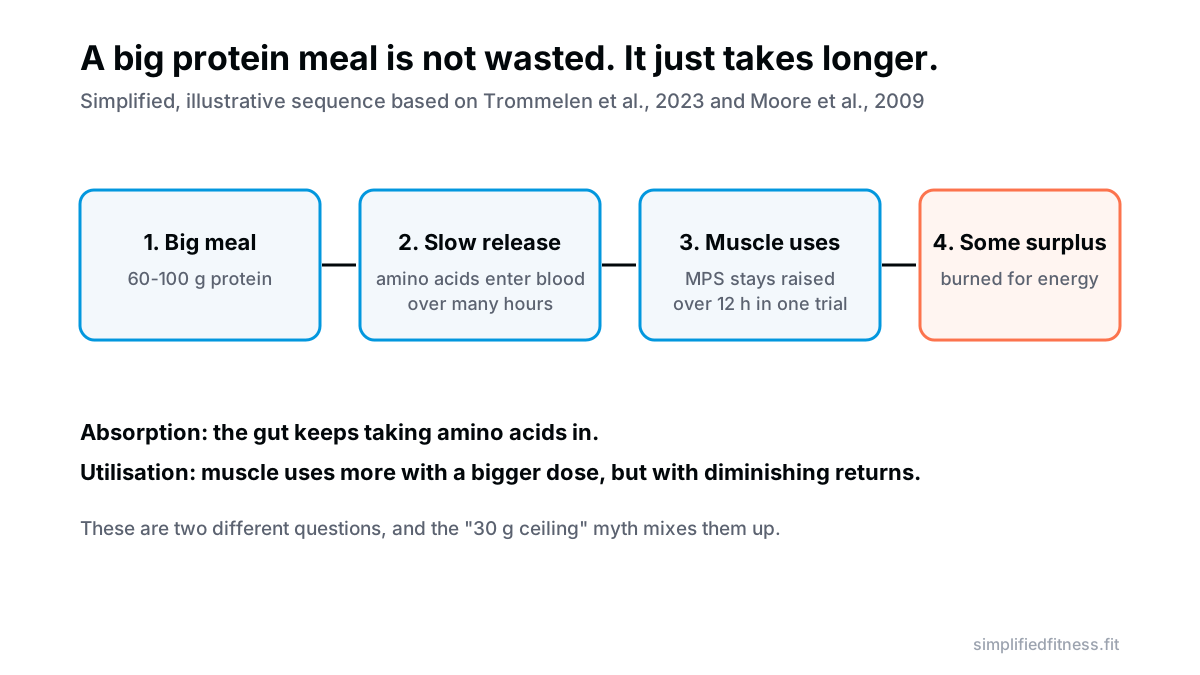
Absorption is whether amino acids from your meal get from your gut into your blood. Utilisation is what your tissues then do with them. The MPS studies above speak mainly to utilisation in a short window.
For absorption, the key point is speed. Protein type changes how fast amino acids arrive. In a classic study, whey caused a sharp, short rise in blood amino acids, while casein produced a lower, prolonged plateau, probably because of slower gastric emptying (Boirie et al., 1997). Slow delivery did not mean lost protein. Net leucine balance over 7 hours was actually more positive with casein. If you want the full speed comparison, see fast vs slow absorbing proteins.
What did the Trommelen 100g protein study actually show?
In 2023 a Maastricht University team tested the “ceiling” idea directly using a quadruple isotope tracer feeding-infusion approach. They compared ingesting 100 g of protein with 25 g during recovery from exercise (Trommelen et al., 2023).
What they reported:
- 100 g produced a greater and more prolonged (more than 12 hours) anabolic response than 25 g.
- There was a dose-response increase in dietary-protein-derived amino acids in the blood and in their incorporation into muscle protein.
- The big dose raised whole-body protein net balance and synthesis rates of mixed-muscle, myofibrillar, muscle connective and plasma proteins.
- Protein breakdown and amino acid oxidation were affected only negligibly.
The authors concluded that the magnitude and duration of the anabolic response to protein is not restricted and had been underestimated.
Do the older studies and the 2023 study contradict each other?
Partly, and the reasons are useful.
What the older trials found: 20 g was near-maximal for a short burst of MPS in young men (Moore et al., 2009), and doses above 20 g raised oxidation (Witard et al., 2014).
What a 2016 trial found: In 30 resistance-trained men, MPS after whole-body resistance exercise was greater with 40 g of whey than 20 g (0.059 vs 0.049 %/h), and body size did not change that result (Macnaughton et al., 2016). So the plateau is not fixed at 20 g. The authors suggest the amount of muscle trained (whole-body here versus legs only in the older trials) may matter, though the study did not compare training types directly.
What the 2023 trial found: a much larger dose kept the response going far longer than the short windows used before.
Why they differ: different windows (4 hours versus 12 plus hours), different training (leg-only versus whole-body), different protein sources and different measurement methods. A short window can show a “plateau” in the rate while the total response continues over a longer time.
Cautious takeaway: there is a point of diminishing returns per dose, roughly 20-40 g for a strong response, but it is soft. Extra protein beyond that is still used, more slowly.
Does it matter how you split protein across the day?
Less than gym culture suggests, though it is not irrelevant. In a 12-hour study of 24 trained men eating 80 g of whey after training, 20 g every 3 hours stimulated MPS more than eight 10 g feeds or two 40 g feeds (Areta et al., 2013). The authors suggest this pattern may be best for stimulating MPS across the day.
That was a short-term mechanistic result. It did not measure muscle gained over months. For training adaptation, the better-supported lever is daily intake: a meta-analysis of 49 trials (1,863 participants) found protein supplementation improved strength and fat-free mass, with no further fat-free mass gains beyond total intakes of about 1.62 g/kg/day (Morton et al., 2018). The ISSN position stand puts 1.4-2.0 g/kg/day as sufficient for most exercising people (Jäger et al., 2017). For the full distribution debate, read protein distribution: 3 vs 5 meals.
| Question | What the evidence says | Confidence |
|---|---|---|
| Is there a hard absorption cap at 30 g? | No evidence of one | Good (tracer data) |
| Does MPS plateau per dose? | Soft plateau around 20-40 g, short-term | Moderate |
| Is a 60 g meal wasted? | Not shown to be | Moderate |
| Does splitting help long-term growth? | Unclear, small at best | Low to moderate |
| Does daily total matter? | Yes, up to about 1.6 g/kg/day | Good |
What does this mean for your plate?
The research is reassuring for anyone who eats two or three large meals a day, which describes plenty of people with office jobs and long commutes. You do not need to carry shakers around to catch a supposed window.
Practical rules that follow from the data:
- Set the daily number first. Use the protein calculator or aim for roughly 1.4-2.0 g/kg/day.
- Aim for 25-40 g at most meals. That is the range where studies show a strong response, and it is easy to hit.
- Do not panic over a big meal. A 50-60 g dinner is fine. Your digestion will simply take longer.
- Skip the 3-hour alarm. If your day works better with three big meals, that is a reasonable pattern.
A rough Indian vegetarian example: 150 g paneer, a bowl of dal and a cup of curd can land well above 30 g of protein in a single sitting. Nothing about that is wasteful. Because plant protein often has less leucine per gram, slightly bigger portions at each meal help. Our guide to the leucine threshold explains why.
Who should be careful with very high protein meals?
Healthy adults have not been shown to be harmed by a large protein meal, but the evidence here is mostly short-term and in young, healthy, trained men. If you have kidney disease, liver disease, or you are on a medically prescribed diet, ask your doctor or a registered dietitian before raising your protein. Older adults may respond differently to protein doses. For kidney questions, see high-protein diets and kidney function, and for timing around training see the anabolic window reality check.
The bottom line
The body does not have a 30 g absorption limit. What it has is a soft, short-term plateau in how strongly muscle protein synthesis is switched on per dose, and a digestive system that slows down to handle bigger meals. Hit your daily total first, make most meals 25-40 g, and stop worrying about one large steak, paneer or dal-and-chicken plate. If you want the training side sorted too, start with our free push day plan.
Frequently Asked Questions
Can the body absorb more than 30g of protein in one meal?
Yes, there is no evidence of a fixed 30 g absorption limit. In a 2023 trial, ingesting 100 g of protein raised amino acid availability in the blood in a dose-dependent way compared with 25 g. Eat your protein in the meals that suit your day and do not split a good dinner just to stay under 30 g.
Is the 30g protein per meal limit a myth?
Mostly, yes, because it confuses absorption with a short-term muscle protein synthesis plateau. Early trials found about 20 g maximised the acute response over roughly 4 hours, but later work showed larger doses keep stimulating muscle for longer. Treat 20-40 g as a good per-meal target, not a hard cap.
What happened in the Trommelen 100g protein study?
Researchers gave participants either 25 g or 100 g of protein after exercise and tracked amino acids with isotope tracers. The 100 g dose produced a greater and more prolonged anabolic response, lasting more than 12 hours, with little change in protein breakdown or amino acid oxidation. It was a short, controlled lab study, so it shows capacity, not that you need 100 g per meal.
How long does it take to digest 60g of protein?
There is no single number, because it depends on the food, your meal size and what else you ate. Larger protein loads appear to be released into the blood over a longer period, which is what the 2023 trial's 12-hour-plus response reflects. Mixed meals with fibre, fat and carbohydrate slow it further, which is useful rather than a problem.
Does excess protein get wasted or turned into fat?
Some surplus amino acids are oxidised for energy, but the 2023 trial found a negligible increase in oxidation even at 100 g. Older trials at 20-40 g did see more amino acid oxidation, so the picture is mixed. Fat gain comes from eating more total calories than you burn, not from one big protein meal.
How much protein can you use for muscle in one sitting?
Muscle protein synthesis was near-maximal at about 20 g of whey or egg protein in two older trials in young men, while a 2016 trial found 40 g gave a greater response than 20 g after whole-body training. So about 20-40 g is a practical range for a strong response. Go above that if it fits your diet, with a small, uncertain extra benefit.
Do I need to eat protein every 3 hours?
No. A short-term study found 20 g every 3 hours beat both smaller frequent feeds and two large boluses for muscle protein synthesis, but that measured a 12-hour lab window, not months of training. Total daily protein matters more, so spread it across 3-4 meals if convenient and do not stress about the clock.
Is it bad to eat 50 or 60g of protein in one meal?
For a healthy person, a 50-60 g protein meal is not known to cause harm and is not wasted. The body slows digestion and keeps using the amino acids over hours. If you have kidney disease, check your protein target with your doctor first.
Is it better to eat protein in small meals or large meals?
Short-term trials suggest moderate, evenly spaced doses stimulate muscle slightly more than very small or very large ones. In practice, hitting your daily total matters more than the pattern. Pick the pattern you can stick to, such as 3-4 meals with 25-40 g each.
What is the maximum protein per meal for muscle growth?
There is no proven maximum, only a point of diminishing returns. Around 20-40 g produces a strong acute response, and bigger meals still feed muscle for longer. Use the dose that gets you to your daily target without forcing it.
Does the 1.6 g/kg limit mean I cannot use more protein?
No, that is a different question. A meta-analysis found that adding protein supplements beyond about 1.6 g/kg/day did not further increase fat-free mass gains from training. That is about the daily total, not a per-meal limit, and it does not mean extra protein is harmful.
How should vegetarians in India hit protein targets with big meals?
Combine dal, paneer, curd, soya chunks, eggs if you eat them, and whey if you use it. Plant proteins are typically lower in leucine, so slightly larger portions at each meal can help. Use our protein calculator to set a daily number first, then split it across meals.
Sources & References
Every claim above is checked against peer-reviewed research (PubMed, U.S. National Library of Medicine) or guidance from established health bodies. How we fact-check.
- Trommelen J, et al. The anabolic response to protein ingestion during recovery from exercise has no upper limit in magnitude and duration in vivo in humans. Cell Rep Med. 2023. PMID: 38118410
- Moore DR, et al. Ingested protein dose response of muscle and albumin protein synthesis after resistance exercise in young men. Am J Clin Nutr. 2009. PMID: 19056590
- Witard OC, et al. Myofibrillar muscle protein synthesis rates subsequent to a meal in response to increasing doses of whey protein at rest and after resistance exercise. Am J Clin Nutr. 2014. PMID: 24257722
- Macnaughton LS, et al. The response of muscle protein synthesis following whole-body resistance exercise is greater following 40 g than 20 g of ingested whey protein. Physiol Rep. 2016. PMID: 27511985
- Areta JL, et al. Timing and distribution of protein ingestion during prolonged recovery from resistance exercise alters myofibrillar protein synthesis. J Physiol. 2013. PMID: 23459753
- Boirie Y, et al. Slow and fast dietary proteins differently modulate postprandial protein accretion. Proc Natl Acad Sci U S A. 1997. PMID: 9405716
- Morton RW, et al. A systematic review, meta-analysis and meta-regression of the effect of protein supplementation on resistance training-induced gains in muscle mass and strength in healthy adults. Br J Sports Med. 2018. PMID: 28698222
- Jäger R, et al. International Society of Sports Nutrition Position Stand: protein and exercise. J Int Soc Sports Nutr. 2017. PMID: 28642676

Umair Hazrami · Founder & Head Coach, Simplified Fitness
Umair Hazrami founded Simplified Fitness and the Simplified Lifter channel to cut through fitness noise. With 4+ years of consistent training and 10+ coaching clients, he writes every guide from the peer-reviewed research and links the sources so you can check them. Our editorial standards.
Educational content only, not medical advice. If you have a medical condition, are pregnant, or take medication, talk to a qualified doctor before changing your diet, supplements or training. Full disclaimer.
Keep reading

Nutrition
The Anabolic Window Myth: Do You Really Need a Shake Within 30 Minutes?
The anabolic window myth, debunked: what meta-analyses show about the 30-minute post-workout shake, how wide your real window is, and when timing still matters.
8 min read

Nutrition
Casein Protein: Slow Digestion, Nighttime Satiety and Muscle Growth
Casein protein benefits for muscle growth: how slow digestion works, what pre-bed trials show, casein vs whey, satiety on a cut and a curd pudding recipe.
8 min read
Nutrition
Collagen Protein: Joint and Tendon Support vs Muscle Building Protein
Does collagen protein build muscle? Here is why 20 g of collagen should not count toward your daily protein goal, and where it may help tendons and joints.
8 min read

Nutrition
Protein Distribution: 3 Meals vs 5 Meals and the 'Muscle Full' Effect
Protein distribution throughout the day: do you need 5-6 meals for muscle? See what research says on 3 vs 5 meals, the muscle full effect and grams per meal.
9 min read