Protein Quality Scores: DIAAS vs PDCAAS Explained for Lifters
DIAAS vs PDCAAS explained: how protein quality is scored, which foods rank highest, and what it means for muscle gain, with dal, paneer and whey examples.
TL;DR. The short answer
- DIAAS (digestible indispensable amino acid score) is the newer FAO protein quality score. It corrects each essential amino acid for ileal digestibility and does not cap scores at 1.0, unlike PDCAAS.
- PDCAAS uses whole-gut (fecal) digestibility and truncates at 100%, so it can overstate quality and cannot tell a good protein from a great one.
- In one dataset, casein, egg, pork and potato protein averaged DIAAS above 100, whey and soy were 75 or above, and pea, rice and oat fell below 75.
- A lower score does not make a plant protein useless. Human data show pea protein digesting almost as well as casein, and a 12-week trial found a soy-pea blend built muscle similarly to whey.
- Practical fix for vegetarians: eat enough total protein, mix sources (dal with rice or roti, soya, curd, paneer) and aim for the higher end of your range.
Part of our complete guide: Complete Protein Guide: How Much, What Type, and When to Eat It for Muscle Growth
Table of contents
DIAAS vs PDCAAS is a question about how we score protein quality. DIAAS (digestible indispensable amino acid score) is the newer FAO method: it rates each essential amino acid after digestion and has no ceiling. PDCAAS is the older one: it uses whole-gut digestibility and caps every score at 1.0. Animal proteins like whey, egg and casein tend to score higher on DIAAS, while many single plant proteins score lower, but the muscle-building gap is much smaller than the numbers suggest when total protein is enough.
This guide is part of our complete protein guide for hypertrophy. Here we stay on the scoring itself: what the numbers mean, where they mislead, and how to use them on an Indian plate.
Why 30 g of lentil protein is not the same as 30 g of whey
The question usually starts in the gym. You see “30 g protein” on a scoop of whey and “30 g protein” worth of dal, and both look equal on a tracker. They are not equal in what your body does with them.
Two things differ. First, amino acid makeup: how much of each essential amino acid the food carries per gram of protein. Second, digestibility: how much of that actually gets absorbed rather than lost. Protein quality scores try to roll both into one number.
That number is useful. It is also easy to over-read. Keep both in mind as we go.
What is PDCAAS and where does it fall short?
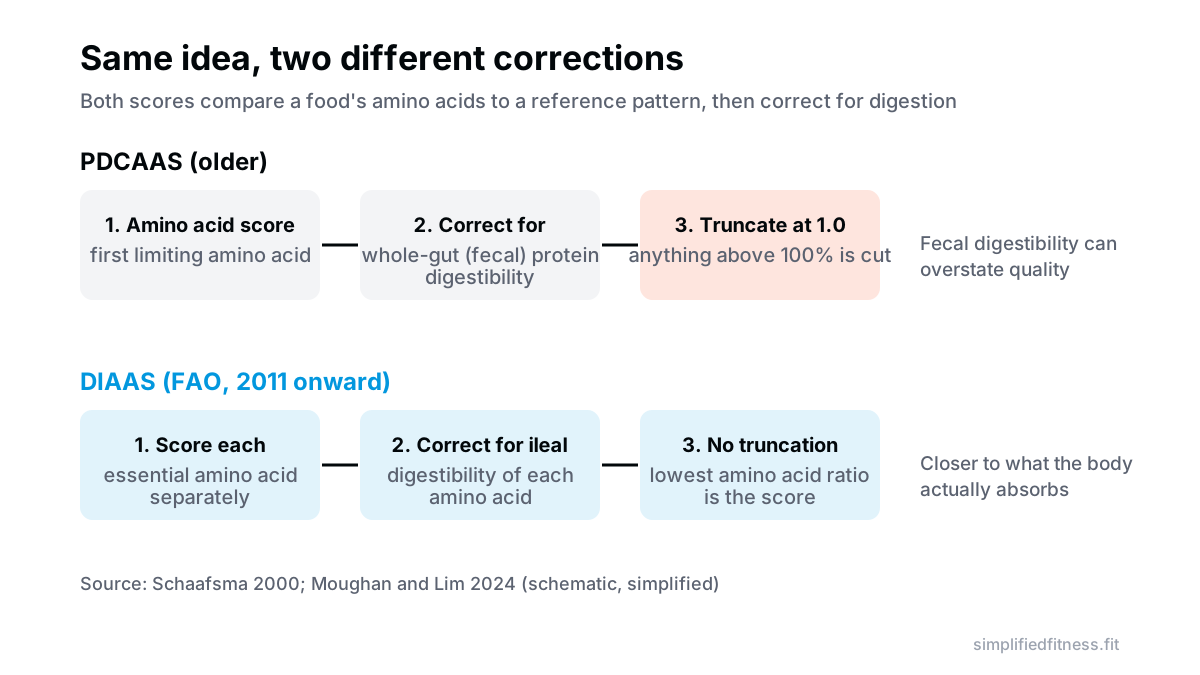
PDCAAS (protein digestibility-corrected amino acid score) was adopted by FAO/WHO as the preferred method for protein value in human nutrition. It compares the first limiting essential amino acid in a food with a reference pattern based on the needs of a preschool child, then corrects for true fecal digestibility (Schaafsma, 2000).
That review raised three problems:
- Fecal digestibility overestimates value. Amino acid nitrogen that reaches the colon is lost for protein synthesis and partly excreted as ammonia, so ileal digestibility (measured at the end of the small intestine) is the better correction.
- Truncation at 100%. Values above 1.0 are cut back, which is defensible only when a protein is the sole protein source in the diet. In mixed diets, truncation hides how much a strong protein can lift a weak one.
- The reference pattern came from limited data on preschool children’s requirements.
Think of it as a school exam where the top mark is capped at 100. A student who got 140 and a student who got 100 look identical.
What is DIAAS and how is it different?
DIAAS came out of a 2011 FAO expert consultation. It keeps the amino acid scoring idea but changes the digestion step. A 2024 review describes the shift: each indispensable amino acid is treated individually, using true ileal digestibility, and scores are not truncated (Moughan and Lim, 2024). The authors conclude DIAAS is currently the most accurate score for routinely rating single-source proteins.
The practical difference shows up most in plant foods. One pig-model study scored four animal and four plant proteins both ways. When the same scoring pattern was used, PDCAAS-like values were higher than DIAAS for skimmed milk powder, pea protein concentrate, soya protein isolate, soya flour and wheat, which suggests the older method may overestimate their quality (Mathai et al., 2017). Whey isolate, whey concentrate and milk protein concentrate had higher ileal digestibility for most essential amino acids than skimmed milk powder and the plant sources tested.
Protein bioavailability ranking: which foods score highest?
Scores vary by study, by the species used for digestibility testing and by the age reference pattern. So treat any ranking as a band, not a fixed number.
One 2020 overview pooled published amino acid and ileal digestibility data for five animal and 12 plant proteins, using the FAO pattern for children aged 0.5-3 years. On average (Herreman et al., 2020):
- Pork meat, casein, egg and potato protein scored above 100 (“excellent”).
- Whey and soy proteins scored 75 or above (“high”).
- Gelatin, rapeseed, lupin, canola, corn, hemp, fava bean, oat, pea and rice proteins scored below 75 (“no quality claim”).
The same paper found considerable variation within the same protein source, so a single food can land in different places depending on the dataset. A caveat on this source: its authors work for a potato protein company, which is worth knowing when reading a result that flatters potato.
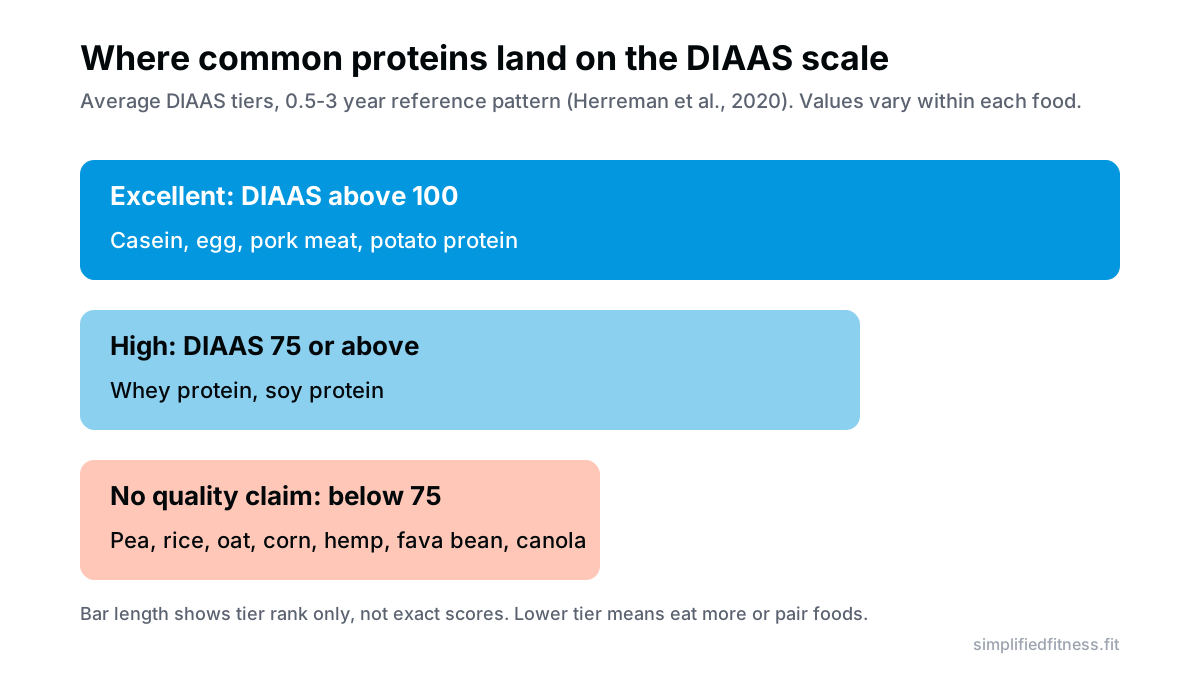
Notice that the “excellent” tier includes a plant (potato protein), and soy sits next to whey. The line is not simply animal versus plant. It is closer to “which specific protein, and how is it processed.”
Does a lower DIAAS mean less muscle?
Not by as much as you would fear. This is where the scoring system meets real training results.
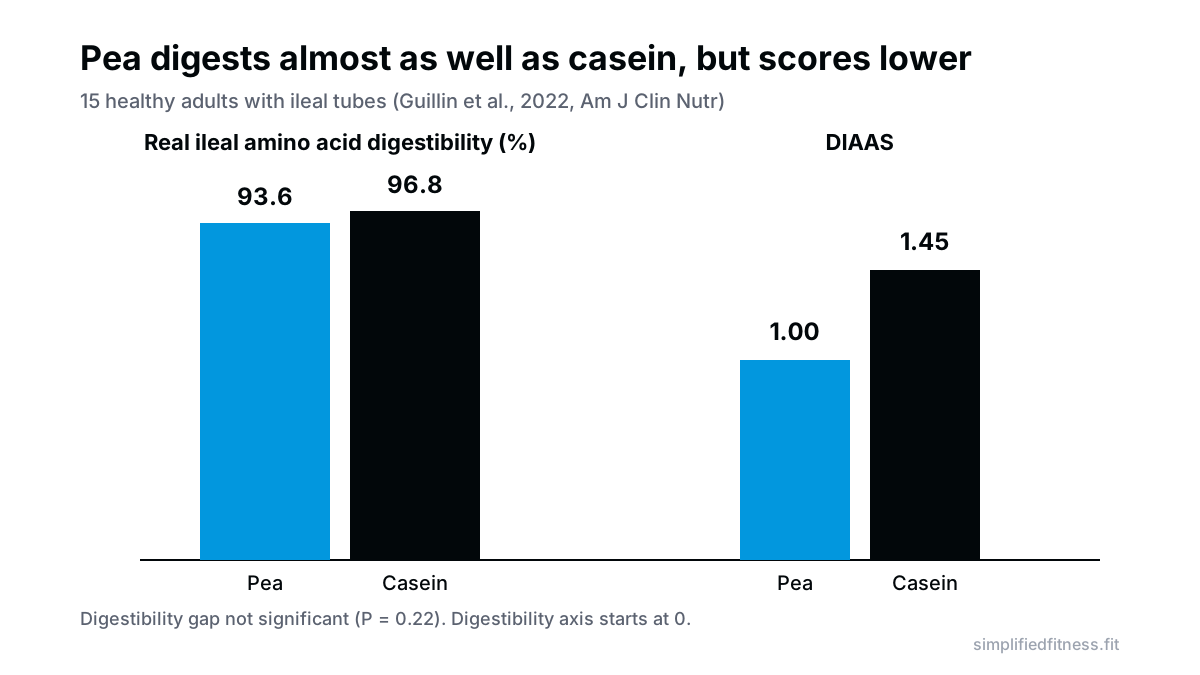
Human digestion data. In a randomized trial with 15 healthy adults fitted with naso-ileal tubes, real ileal amino acid digestibility was 93.6% for pea protein isolate and 96.8% for casein, with no significant difference. Leucine, valine, lysine and phenylalanine were less digestible in pea. The DIAAS was 1.00 for pea and 1.45 for casein, and net postprandial protein utilization was similar (Guillin et al., 2022). One caveat: two co-authors work for Roquette, a pea protein manufacturer, and the study tested a single pea isolate in a small group.
Muscle outcomes. A 2025 meta-analysis of 30 randomized trials found plant protein produced slightly lower muscle mass than animal protein (SMD -0.20, 95% CI -0.37 to -0.03). The effect was larger in adults under 60 and not seen in older adults. Soy versus milk protein showed no difference across 17 trials, while animal protein beat non-soy plant proteins (rice, chia, oat, potato) in 5 trials. Strength and physical performance did not differ. The authors say the effect is small and that a wider range of plant proteins needs testing (Reid-McCann et al., 2025).
A direct training trial. In 44 young, untrained men doing supervised resistance training three times a week for 12 weeks, a soy-and-pea blend (45 g/day) and whey (45 g/day) both improved lean mass, muscle cross-sectional area and leg-press strength, with no between-group differences (Santini et al., 2025). The trial was funded by a plant-based food company, and the participants were untrained, so it may not transfer fully to advanced lifters.
Putting those together: the evidence points to a small edge for animal protein that is clearest against non-soy single plant proteins, and nearly disappears with soy, blends and enough total protein. Because the trials differ in who they studied and which plant proteins they used, treat the exact size of the gap as uncertain.
Are there downsides to DIAAS?
Yes, and a fair article should say so. Critics argue DIAAS has limits, especially for plant-based eating (Craddock et al., 2021):
- It is built mostly on fast-growing animal models (often pigs) rather than humans.
- Many commonly eaten plant foods are not represented in the scoring data.
- It can underrate the improved digestibility of heat-treated or processed plant foods.
- It scores isolated foods, not the food matrix or a whole meal.
- It is sometimes used outside its intended context, including exercise settings.
The reviewers go as far as saying DIAAS should ideally be avoided when studying protein quality in plant-based diets. Others, including the 2024 review above, see it as the best routine tool we have, while noting that cooking and processing effects need more data (Moughan and Lim, 2024).
So what do we do with two opposing views? Use DIAAS as a screening tool for single foods. Do not treat it as a final ruling on a plate.
How vegetarians and plant eaters can close the gap
Here is the practical part. The goal is not to chase a perfect score. It is to cover amino acid gaps and total grams.
- Eat enough total protein first. The simplest compensation for a lower-scoring protein is a bit more of it. Our protein calculator gives a starting number for your body weight and goal, and our optimal daily protein intake meta-analysis explains the range.
- Mix sources. Modelling in the Herreman paper found potato, soy and pea proteins can complement a broad range of other plant proteins and raise the mixture’s DIAAS at specific ratios (Herreman et al., 2020). That is a model, not a trial in lifters, but it matches basic food logic.
- Pair pulses with cereals. Cereals such as rice and wheat tend to be lower in lysine, and pulses tend to be lower in methionine. Dal with rice, rajma with roti, or chana with a curd side covers more ground than any of them alone. You do not need to match them perfectly at one meal.
- Lean on soy and dairy. Soya chunks, tofu, paneer, curd, milk and whey sit at the stronger end for vegetarians. If you eat eggs, they score well too.
- Consider a blend. If you use powder, a soy-pea or similar blend performed like whey in the 12-week trial above. See our guide to vegan protein powder blends for how to pick one.
If you are choosing between whey forms, our whey protein comparison covers concentrate, isolate and hydrolysate. For the direct plant versus animal question in more depth, see plant vs animal protein for hypertrophy. And because amino acid content matters, the leucine threshold explained is a useful companion read.
Quick comparison: PDCAAS vs DIAAS
| Feature | PDCAAS | DIAAS |
|---|---|---|
| Digestibility used | Whole-gut (fecal) protein | Ileal, per amino acid |
| Cap on score | Truncated at 1.0 | No cap |
| Scoring unit | First limiting amino acid | Each essential amino acid scored |
| Tends to overstate quality? | Yes, per reviews and the Mathai data | Less so, but animal-model limits remain |
| Best used for | Legacy labels and regulation | Comparing single proteins |
Mistakes people make with protein quality scores
- Comparing one number across studies. Pig data, human data and different age patterns give different values for the same food.
- Ignoring total protein. Hitting your daily target matters more than shaving points off a score.
- Skipping the plate. DIAAS rates single foods, but you eat meals. Mixed meals behave differently from isolated proteins.
- Panic-buying isolated powders. A varied diet with enough protein covers most people. Powder is for convenience, not a requirement.
When to talk to a doctor or dietitian
If you have kidney disease, are pregnant, are managing a medical condition, or are an older adult with unintentional weight loss, get personalised advice before changing your protein intake significantly. Protein needs differ in those groups, and this article is general education, not medical advice.
The bottom line
DIAAS is a better yardstick than PDCAAS for comparing single proteins, because it uses ileal digestibility and does not cap scores. Animal proteins and some plant proteins like soy and potato score well, while many single plant proteins such as pea, rice and oat score lower. That gap matters most when protein is low, and it shrinks with enough total protein, varied sources and soy or blends. Pick your target, spread your sources, and let the plate do the work. Our free diet plan is a good place to see how that looks in practice.
Frequently Asked Questions
What is the difference between DIAAS and PDCAAS?
PDCAAS corrects a protein's amino acid score using whole-gut (fecal) digestibility and caps the result at 1.0, while DIAAS uses ileal digestibility of each essential amino acid and has no cap. Ileal measurements are closer to what is actually absorbed, because bacteria in the colon alter what comes out the other end. When comparing proteins, look at DIAAS if a value is available.
What does DIAAS stand for?
DIAAS stands for digestible indispensable amino acid score, where indispensable is the technical word for essential. It rates how well a protein supplies each essential amino acid after digestion, compared with a reference requirement pattern. A score of 100 or above means no essential amino acid is limiting for that reference group.
Why did FAO replace PDCAAS with DIAAS?
FAO's 2011 expert consultation recommended DIAAS because fecal digestibility overestimates protein value and truncation hides differences between high-quality proteins. A 2024 review concluded DIAAS is currently the most accurate score for routinely rating single-source proteins. Use it as a guide for single foods, not as a verdict on a whole meal.
Which protein has the highest DIAAS?
It depends on the dataset and the age pattern used, but animal proteins such as casein, egg and pork, plus potato protein, averaged above 100 in one 2020 overview of published data. Whey and soy averaged 75 or above. Treat any single number as a range, because the same food can score differently between studies.
Is whey protein better than plant protein for building muscle?
Slightly better in some analyses, but the gap is small when total protein is adequate. A 2025 meta-analysis of 30 trials found a small muscle mass advantage for animal protein overall, driven mostly by non-soy plant proteins, with no difference between soy and milk protein. If you eat plants, hit your total protein target and favour soy or blends.
Do I need to combine plant proteins at the same meal?
Not strictly at the same meal, but combining helps. Modelling work shows potato, soy and pea proteins can complement other plant proteins and raise the mixture's DIAAS at specific ratios. Eating different protein sources across the day, such as dal with rice, then soya or paneer, covers the gaps in practice.
Is pea protein a complete protein?
Yes, it contains all the essential amino acids, though some are less abundant. In a 2022 human trial, pea protein isolate had a DIAAS of 1.00 versus 1.45 for casein, and total digestibility was not significantly different. It is a decent choice, but you may want slightly more of it than whey.
Does a low DIAAS mean the protein is bad?
No. It means the food is less efficient per gram at supplying essential amino acids, not that it is worthless. A score applies to one food on its own, and real meals mix foods. Compensate with a bit more total protein and a varied plate.
Is DIAAS the right tool for choosing a protein powder?
It is a helpful starting point, but not the final word for muscle gain. Some reviewers argue DIAAS has limits, including its animal-model origins, little data on cooked or processed plant foods, and use outside its intended context. Compare DIAAS with price, taste, digestion and trial results in lifters.
How much protein do vegetarians need compared with meat eaters?
There is no single proven multiplier, but protein quality is one reason some experts suggest vegetarians err toward the higher end of the range. The 2025 studies above point to total protein and the choice of soy or blends as the bigger levers, though none tested a multiplier directly. Start from the number our protein calculator gives you, lean toward the upper end if you are fully plant-based, and adjust by progress.
Are lentils or dal a complete protein?
Dal supplies all essential amino acids but tends to be lower in methionine, while cereals like rice and wheat tend to be lower in lysine. That pairing is why dal with rice or roti works well. Eating both through the day matters more than perfect timing at one meal.
Can DIAAS predict how much muscle a protein builds?
Not on its own. DIAAS measures amino acid supply from digestion, while muscle growth also depends on training, total protein, calories and recovery. A 2025 trial showed a plant blend and whey produced similar gains in young men, so use DIAAS to compare foods, not to forecast muscle.
Sources & References
Every claim above is checked against peer-reviewed research (PubMed, U.S. National Library of Medicine) or guidance from established health bodies. How we fact-check.
- Schaafsma G. The protein digestibility-corrected amino acid score. J Nutr. 2000. PMID: 10867064
- Mathai JK, et al. Values for digestible indispensable amino acid scores (DIAAS) for some dairy and plant proteins may better describe protein quality than values calculated using the concept for protein digestibility-corrected amino acid scores (PDCAAS). Br J Nutr. 2017. PMID: 28382889
- Herreman L, et al. Comprehensive overview of the quality of plant- and animal-sourced proteins based on the digestible indispensable amino acid score. Food Sci Nutr. 2020. PMID: 33133540
- Moughan PJ, et al. Digestible indispensable amino acid score (DIAAS): 10 years on. Front Nutr. 2024. PMID: 39021594
- Craddock JC, et al. Limitations with the Digestible Indispensable Amino Acid Score (DIAAS) with special attention to plant-based diets: a review. Curr Nutr Rep. 2021. PMID: 33409931
- Guillin FM, et al. Real ileal amino acid digestibility of pea protein compared to casein in healthy humans: a randomized trial. Am J Clin Nutr. 2022. PMID: 34665230
- Reid-McCann RJ, et al. Effect of plant versus animal protein on muscle mass, strength, physical performance, and sarcopenia: a systematic review and meta-analysis of randomized controlled trials. Nutr Rev. 2025. PMID: 39813010
- Santini MH, et al. Similar effects between animal-based and plant-based protein blend as complementary dietary protein on muscle adaptations to resistance training: findings from a randomized clinical trial. J Int Soc Sports Nutr. 2025. PMID: 41059835

Umair Hazrami · Founder & Head Coach, Simplified Fitness
Umair Hazrami founded Simplified Fitness and the Simplified Lifter channel to cut through fitness noise. With 4+ years of consistent training and 10+ coaching clients, he writes every guide from the peer-reviewed research and links the sources so you can check them. Our editorial standards.
Educational content only, not medical advice. If you have a medical condition, are pregnant, or take medication, talk to a qualified doctor before changing your diet, supplements or training. Full disclaimer.
Keep reading
Nutrition
The Anabolic Window Myth: Do You Really Need a Shake Within 30 Minutes?
The anabolic window myth, debunked: what meta-analyses show about the 30-minute post-workout shake, how wide your real window is, and when timing still matters.
8 min read

Nutrition
Casein Protein: Slow Digestion, Nighttime Satiety and Muscle Growth
Casein protein benefits for muscle growth: how slow digestion works, what pre-bed trials show, casein vs whey, satiety on a cut and a curd pudding recipe.
8 min read
Nutrition
Collagen Protein: Joint and Tendon Support vs Muscle Building Protein
Does collagen protein build muscle? Here is why 20 g of collagen should not count toward your daily protein goal, and where it may help tendons and joints.
8 min read
Nutrition
Protein Distribution: 3 Meals vs 5 Meals and the 'Muscle Full' Effect
Protein distribution throughout the day: do you need 5-6 meals for muscle? See what research says on 3 vs 5 meals, the muscle full effect and grams per meal.
9 min read