Collagen Protein: Joint and Tendon Support vs Muscle Building Protein
Does collagen protein build muscle? Here is why 20 g of collagen should not count toward your daily protein goal, and where it may help tendons and joints.
TL;DR. The short answer
- Collagen is an incomplete protein: by the PDCAAS scoring method it lacks tryptophan, and it has a low essential amino acid profile overall.
- In a 2023 trial, 30 g of whey raised muscle protein synthesis after lifting versus placebo, while 30 g of collagen did not.
- For hypertrophy, a simple conservative rule is to log collagen as roughly 0 g toward your protein target and fill the target with whey, eggs, paneer, curd, soya, dal or meat.
- Collagen may support tendons and joints, but trials are mixed: one tendon study found a small benefit and another found none.
- If you take collagen, research has used about 5 to 15 g a day, and the one mechanism trial gave vitamin C-enriched gelatin an hour before exercise. Persistent joint pain deserves a doctor or physio.
Part of our complete guide: Complete Protein Guide: How Much, What Type, and When to Eat It for Muscle Growth
Table of contents
Does collagen protein build muscle? Not in the way whey, eggs or paneer do. Collagen is an incomplete protein, and in the best trials we have, 30 g of it after lifting did not raise muscle protein synthesis above placebo. So if you take 20 g of collagen peptides a day, do not count it toward your muscle-building protein target.
That does not make collagen useless. It is studied for tendons, ligaments and joints, and there the story is more interesting, though less certain. This article sits inside our complete protein guide for hypertrophy, and it answers one practical question: where does collagen go in your daily numbers, and what is it actually good for?
Why collagen is not a complete protein
Muscle protein is built from amino acids, and nine of them are essential, meaning your body cannot make them. Protein quality depends on whether a food supplies all nine in useful amounts.
Collagen falls short. By the PDCAAS scoring method, collagen protein lacks one essential amino acid, tryptophan, and is therefore classed as an incomplete protein. It also has a low essential amino acid profile overall (Paul et al., 2019). The same paper makes a fair counterpoint: collagen is rich in glycine and proline, and a modest amount can sit inside a normal mixed diet without breaking amino acid balance. That paper had industry-linked authors, so read it as “small amounts are harmless in a varied diet”, not as “collagen is a muscle food”.
The practical point is simple. Whey, eggs, milk, paneer, curd and soya all supply the full set, with plenty of leucine, the amino acid that most strongly signals muscle to grow. Collagen does not. For the full ranking logic, see our explainer on DIAAS vs PDCAAS protein quality scores.
Does collagen protein build muscle? What the trials show
Theory is one thing. The cleaner test is to measure muscle protein synthesis directly after a lifting session.
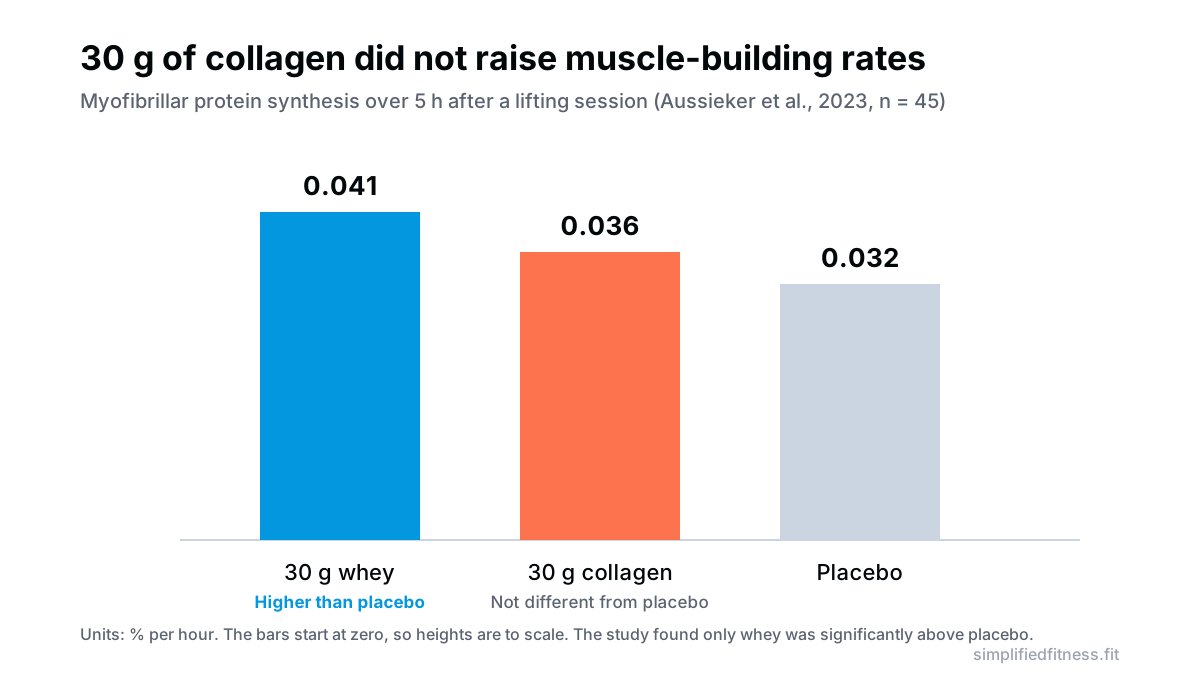
In a 2023 randomised, double-blind trial, 45 young recreational athletes did a resistance session and then drank 30 g of whey, 30 g of collagen, or a noncaloric placebo. Over the next five hours, myofibrillar protein synthesis (the muscle contractile proteins) averaged 0.041, 0.036 and 0.032 % per hour. Only whey was significantly higher than placebo (Aussieker et al., 2023). The rise in blood leucine and essential amino acids was also larger after whey than after collagen.
The same trial asked a second question: could collagen at least stimulate the connective tissue inside muscle? Muscle connective protein synthesis averaged 0.072, 0.068 and 0.058 % per hour for whey, collagen and placebo, with no significant differences between groups (P = 0.09). So even for the thing collagen is supposed to be good at, the early-recovery result was null. That is five hours of data in young people, so it does not rule out slower effects.
What about older adults?
Older muscle is less responsive to protein, which is called anabolic resistance, so the source matters even more.
A 2020 trial in 22 healthy women aged about 69 gave 30 g of whey or collagen twice daily for six days, with two unilateral lifting sessions. Whey raised muscle protein synthesis acutely and over the longer term, while collagen raised it only modestly in the exercised leg acutely and not significantly over the longer term. Whey beat collagen in both measures (Oikawa et al., 2020). The sample is small and the duration short, but it points in the same direction as the younger-adult trial.
If you are older, or training a parent who is, the lesson is not “avoid collagen”. It is “do not let collagen replace the protein that does the muscle job”. Our guide to protein requirements for older adults covers this in depth.
Why collagen doesn’t count for macros (the practical rule)
Here is the practical way to handle it.
Your muscle-building target comes from the research on total protein. A large meta-analysis of 49 trials found that protein supplementation improved gains in strength and fat-free mass during resistance training, with no further gains in fat-free mass above about 1.62 g/kg/day (Morton et al., 2018). For an 80 kg lifter, that is roughly 130 g, and many people aim a little higher, up to about 2.2 g/kg, to leave a margin. You can find your own number with the protein calculator, or read how the range is built in our daily protein intake meta-analysis guide.
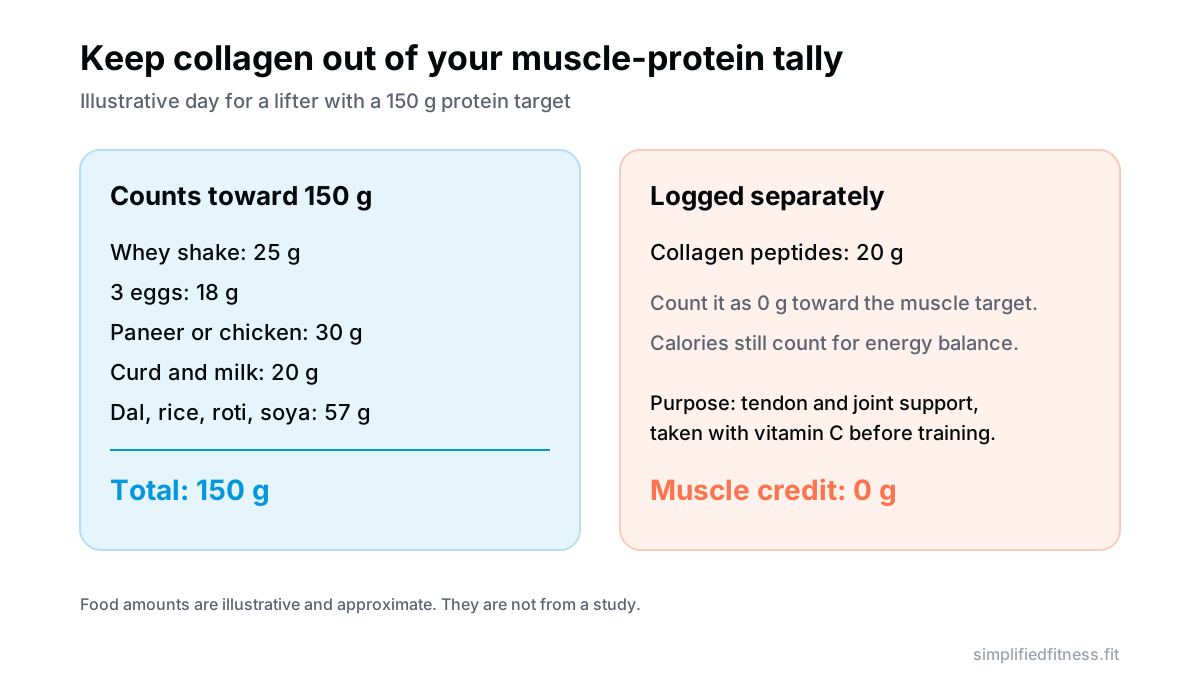
Those figures come from studies that used complete proteins. Collagen was not what the numbers were built on. So the clean way to handle it:
- Hit your target from whey, eggs, paneer, curd, milk, soya chunks, dal combined with rice or roti, fish or chicken.
- Log collagen separately, as roughly 0 g toward the muscle target.
- Still count its calories if you are tracking energy balance.
Collagen vs whey protein at a glance
| Whey protein | Collagen peptides | |
|---|---|---|
| Complete protein? | Yes | No, lacks tryptophan by PDCAAS |
| Muscle protein synthesis after lifting | Raised in young athletes and older women | Not above placebo in young athletes; smaller rise than whey in older women |
| Best use | Hitting your muscle-building protein target | Optional connective tissue experiment |
| Counts toward hypertrophy target? | Yes | Treat as roughly 0 g |
| Vegetarian? | Dairy-based, usually yes | No, animal-derived |
Can collagen help your tendons and joints?
Tendons are mostly collagen, so the idea is reasonable: supply the raw materials, then load the tendon so the body uses them. Whether it works is where the evidence gets mixed.
The mechanism study. In a small 2017 crossover trial of eight men, 15 g of vitamin C-enriched gelatin taken an hour before a rope-skipping session doubled blood levels of a collagen synthesis marker (the amino-terminal propeptide of collagen I) (Shaw et al., 2017). Treating engineered ligaments with serum from those participants also showed higher collagen content and better mechanics. Promising, but eight people and a blood marker is not the same as fewer injuries.
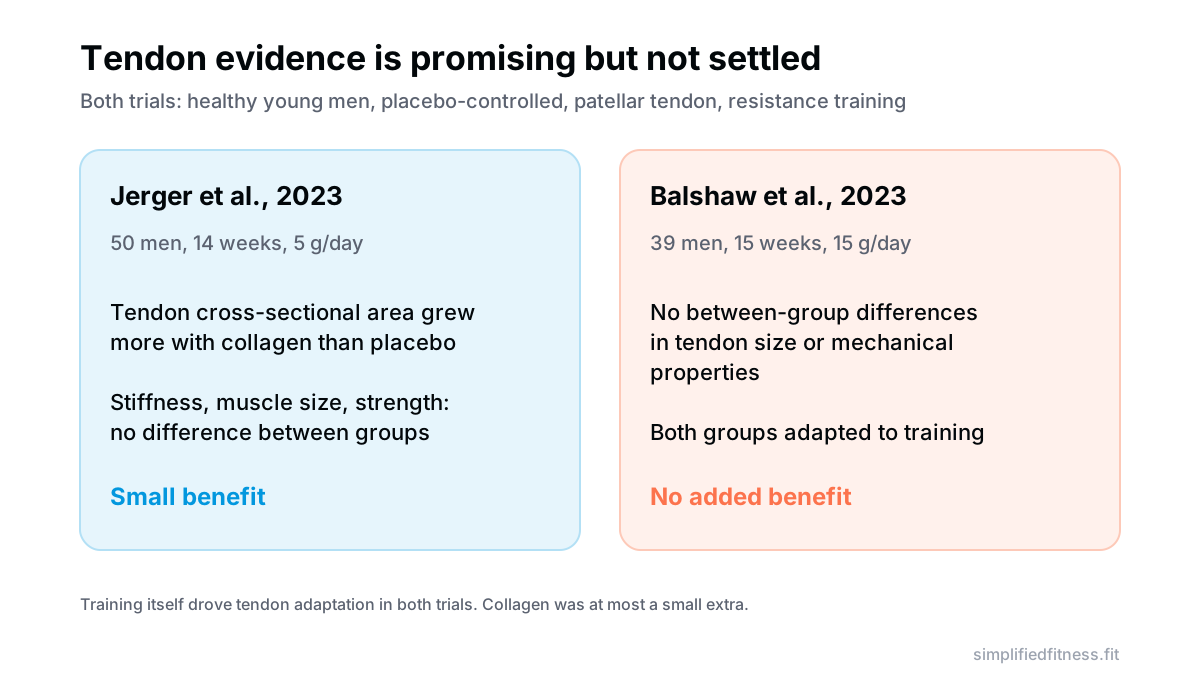
The tendon trials disagree. Both enrolled healthy young men doing resistance training:
- A 14-week trial of 50 men gave 5 g a day of specific collagen peptides. Patellar tendon cross-sectional area grew more than with placebo, though stiffness, muscle size and strength rose similarly in both groups (Jerger et al., 2023).
- A 15-week trial of 39 men gave 15 g a day. It found no between-group differences in tendon size or mechanical properties, and both groups adapted to training (Balshaw et al., 2023).
Why might they differ? Different doses (5 g vs 15 g), different products and training programmes, and different outcome measures. Do not read the gap as a dose effect, since the smaller dose is the one that showed a benefit. The cautious takeaway: any tendon benefit appears small, and loading the tendon with progressive training is what clearly works. For a deeper protocol, see our collagen peptides tendon and joint recovery guide and the explainer on connective tissue adaptation.
What about arthritis and joint pain?
A 2025 systematic review and meta-analysis pooled 11 randomised trials (870 participants) of oral collagen supplements in knee osteoarthritis. It reported improvements in both function and pain scores favouring collagen, but with high heterogeneity between studies (I2 of 75% for function and 88% for pain) (Simental-Mendia et al., 2025). High heterogeneity means the trials disagreed on size, so treat the headline as “may help some people”, not a guaranteed result.
Note the population: this is knee osteoarthritis in patients, not healthy lifters with a sore elbow. If a joint hurts for weeks, swells, locks or wakes you at night, see a doctor or physiotherapist. A powder is not a diagnosis. For how collagen compares with glucosamine and MSM, see our joint health supplements guide.
How to take collagen if you want to try it
Keep it low-stakes. The research above used roughly 5 to 15 g a day, and the mechanism trial gave it about an hour before loading the tendon.
- Dose: 5 to 15 g of collagen peptides or gelatin. More is not shown to help.
- Timing: about an hour before a session that loads the tendons or joints you care about.
- Vitamin C: have it alongside. The 2017 trial used a vitamin C-enriched product, though the tendon trials above did not test vitamin C separately. Amla, guava, orange or lemon water will do the job.
- Judge it slowly: tendon tissue turns over slowly. Give it months, and keep training progression the same so you can tell what is working.
- Budget: collagen is not cheap. If money is tight, spend it on whey, eggs, curd or soya chunks first.
If you are vegetarian, note that collagen is animal-derived (bovine or marine), so it is not an option for you. Your better bet is simply enough complete protein plus vitamin C foods.
The bottom line
Collagen is not a muscle-building protein. It is incomplete, it did not beat placebo for muscle protein synthesis in young athletes, and in older women whey clearly outperformed it. Log it as roughly 0 g toward your hypertrophy target and fill that target with complete proteins you already know, such as whey, eggs, paneer, curd, soya and dal with rice or roti.
As a connective tissue add-on, collagen is a modest, optional experiment with mixed trial results. If you want a ready structure for your protein, our free diet plan shows how to hit a muscle-building target on an Indian budget.
Frequently Asked Questions
Does collagen protein build muscle?
Not on its own, and not like whey or eggs do. In a 2023 trial, 30 g of collagen after resistance exercise did not raise myofibrillar protein synthesis above placebo, while 30 g of whey did. If muscle is the goal, spend your protein budget on complete, leucine-rich sources.
Does collagen count toward my daily protein target?
For hypertrophy, treat it as roughly zero. It has calories and nitrogen, but it is an incomplete protein with a low essential amino acid profile, so it does not do the same job as whey or egg. Log it separately and hit your muscle-building target from other foods.
Is collagen a complete protein?
No. Using the PDCAAS method, collagen lacks the essential amino acid tryptophan and is classed as incomplete. That is why you cannot build a diet on collagen alone, and why it should be a small add-on at most.
Collagen vs whey protein: which is better for muscle?
Whey is clearly better for muscle. Whey beat placebo for muscle protein synthesis in young athletes, while collagen did not, and in older women whey raised it far more than collagen did. Collagen is a different tool, studied for connective tissue rather than muscle growth.
Can collagen help tendons and joints?
Possibly, but the evidence is mixed. One 14-week trial found slightly greater patellar tendon growth with 5 g a day, and another 15-week trial with 15 g a day found no extra benefit. Think of collagen as a low-cost experiment, not a proven repair tool.
Does collagen help with joint pain or osteoarthritis?
A 2025 meta-analysis of 11 randomised trials found oral collagen improved knee osteoarthritis pain and function scores. The studies varied a lot (high heterogeneity), so the size of the benefit is uncertain. See a doctor for persistent joint pain rather than self-treating with powders.
How much collagen should I take?
Research on connective tissue has used roughly 5 to 15 g a day. A larger dose is not shown to work better for muscle, because collagen does not drive muscle protein synthesis. Start low, and judge it over several months rather than a few weeks.
Should I take collagen with vitamin C?
That is how it was done in the best-known mechanistic study. Vitamin C is needed for the body to build collagen, and in a small 2017 trial, 15 g of vitamin C-enriched gelatin an hour before exercise roughly doubled a blood marker of collagen synthesis. A fruit like amla, guava or an orange alongside it is a simple way to cover this.
When should I take collagen, before or after training?
The only timing evidence points to about an hour before loading the tendon. The small 2017 gelatin trial gave it before a skipping session, not after. Whey after training is separate, so taking both is not a conflict.
Can I take collagen and whey together?
Yes, they do different jobs, and you should still count only the whey toward your muscle target. Whey supplies the leucine-rich amino acids that raise muscle protein synthesis. If you add collagen, keep it as an extra rather than a replacement.
Is collagen powder vegetarian?
No. Collagen comes from animal sources such as cow hides and bones or fish skin, so it does not suit vegetarians. Vegetarian lifters can use paneer, curd, milk, whey, soya and dal for muscle protein, and eat vitamin C foods for connective tissue support.
Is collagen worth the money for lifters?
For muscle, no, because the same rupees spent on whey, eggs or soya chunks buy far more usable muscle protein. For tendons, it is an optional extra with mixed evidence. Get your protein target, training and sleep right first.
Sources & References
Every claim above is checked against peer-reviewed research (PubMed, U.S. National Library of Medicine) or guidance from established health bodies. How we fact-check.
- Morton RW, et al. A systematic review, meta-analysis and meta-regression of the effect of protein supplementation on resistance training-induced gains in muscle mass and strength in healthy adults. Br J Sports Med. 2018. PMID: 28698222
- Paul C, et al. Significant amounts of functional collagen peptides can be incorporated in the diet while maintaining indispensable amino acid balance. Nutrients. 2019. PMID: 31096622
- Aussieker T, et al. Collagen protein ingestion during recovery from exercise does not increase muscle connective protein synthesis rates. Med Sci Sports Exerc. 2023. PMID: 37202878
- Oikawa SY, et al. Whey protein but not collagen peptides stimulate acute and longer-term muscle protein synthesis with and without resistance exercise in healthy older women: a randomized controlled trial. Am J Clin Nutr. 2020. PMID: 31919527
- Jerger S, et al. Specific collagen peptides increase adaptions of patellar tendon morphology following 14-weeks of high-load resistance training: a randomized-controlled trial. Eur J Sport Sci. 2023. PMID: 37424319
- Balshaw TG, et al. The effect of specific bioactive collagen peptides on tendon remodeling during 15 wk of lower body resistance training. Med Sci Sports Exerc. 2023. PMID: 37436929
- Shaw G, et al. Vitamin C-enriched gelatin supplementation before intermittent activity augments collagen synthesis. Am J Clin Nutr. 2017. PMID: 27852613
- Simental-Mendia M, et al. Effect of collagen supplementation on knee osteoarthritis: an updated systematic review and meta-analysis of randomised controlled trials. Clin Exp Rheumatol. 2025. PMID: 39212129

Umair Hazrami · Founder & Head Coach, Simplified Fitness
Umair Hazrami founded Simplified Fitness and the Simplified Lifter channel to cut through fitness noise. With 4+ years of consistent training and 10+ coaching clients, he writes every guide from the peer-reviewed research and links the sources so you can check them. Our editorial standards.
Educational content only, not medical advice. If you have a medical condition, are pregnant, or take medication, talk to a qualified doctor before changing your diet, supplements or training. Full disclaimer.
Keep reading

Nutrition
The Anabolic Window Myth: Do You Really Need a Shake Within 30 Minutes?
The anabolic window myth, debunked: what meta-analyses show about the 30-minute post-workout shake, how wide your real window is, and when timing still matters.
8 min read

Nutrition
Casein Protein: Slow Digestion, Nighttime Satiety and Muscle Growth
Casein protein benefits for muscle growth: how slow digestion works, what pre-bed trials show, casein vs whey, satiety on a cut and a curd pudding recipe.
8 min read

Nutrition
Protein Distribution: 3 Meals vs 5 Meals and the 'Muscle Full' Effect
Protein distribution throughout the day: do you need 5-6 meals for muscle? See what research says on 3 vs 5 meals, the muscle full effect and grams per meal.
9 min read

Nutrition
Fast vs Slow Absorbing Proteins: Digestion Rates and Muscle Protein Breakdown
Fast vs slow digesting protein for hypertrophy: how whey and casein differ in amino acid release, what the tracer studies show, and how to combine them.
8 min read