Whole Eggs vs Egg Whites for Muscle Growth: What the Trials Show
Whole eggs vs egg whites for muscle growth: one trial found a bigger muscle protein synthesis response from yolks, but 12-week results differ. See the data.
TL;DR. The short answer
- In one small crossover trial (10 trained men), 18 g of protein from whole eggs stimulated more post-exercise muscle protein synthesis than 18 g from egg whites, even though protein and leucine availability were similar.
- Over 12 weeks of training, two papers from one research group, each reporting on 30 trained men, found no difference in muscle mass between whole eggs and egg whites, though one reported better strength and body fat results with whole eggs.
- Whole eggs are a reasonable default for lifters who are not told to restrict cholesterol. Egg whites remain a fine tool when you need protein with fewer calories.
- Egg consumption raises LDL cholesterol slightly in pooled trials, so people with high cholesterol or heart disease should ask their doctor how many yolks suit them.
Part of our complete guide: Complete Protein Guide: How Much, What Type, and When to Eat It for Muscle Growth
Table of contents
Are whole eggs better than egg whites for muscle growth? Probably a little, in the short term, but the long-term proof is thin. One small trial showed a bigger muscle protein synthesis response after whole eggs. Two 12-week papers then found similar muscle gains either way.
That gap between a single-meal signal and a 12-week result is the story here. If you want the bigger picture on protein targets and sources, start with our complete protein guide for hypertrophy, then come back for the egg specifics.
What did the van Vliet whole egg study actually test?
This is the study behind most “stop throwing away the yolk” posts, so it is worth reading carefully.
Ten resistance-trained young men (average age 21, about 88 kg) did a bout of resistance exercise in a crossover design, meaning each man did both conditions. Afterwards they ate either whole eggs (18 g protein, 17 g fat) or egg whites (18 g protein, 0 g fat). Researchers used labelled amino acids and muscle biopsies to track what happened (van Vliet et al., 2017).
The findings:
- Leucine from egg whites appeared in the blood faster than from whole eggs.
- Over the 300-minute window, total leucine availability was similar (about 68% for whole eggs, 66% for whites), and net leucine balance did not differ.
- Both meals switched on the same anabolic signalling proteins (mTORC1, S6K1, 4E-BP1).
- Even so, whole eggs produced a greater myofibrillar protein synthesis response (P = 0.04).
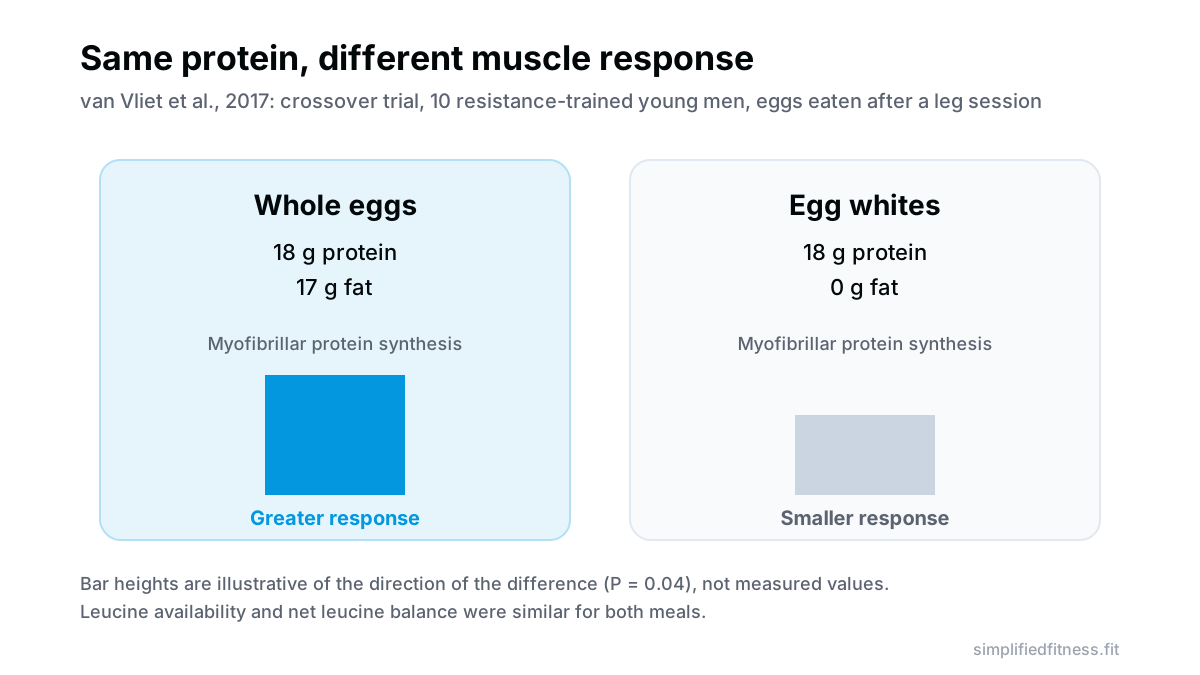
Notice what this does not show. It measured muscle protein synthesis over about five hours in 10 people. It did not measure muscle size.
Why might the yolk matter? The food matrix idea
The authors’ interpretation is that protein-dense whole foods can stimulate muscle differently from the same protein stripped of its other components. A follow-up analysis of the same ten men found that whole eggs, but not egg whites, increased colocalization of mTOR with the lysosome after training, and that this correlated with MPS rates (Abou Sawan et al., 2018). The authors suggest non-protein factors in the yolk influence post-exercise regulation of muscle protein translation.
What those factors are is still a guess. A narrative review lists candidates: the yolk contains microRNAs, vitamins, minerals, lipids, phosphatidic acid and other phospholipids, and it supplies about 40% of an egg’s protein (Santos et al., 2021). The same review is blunt that this rests on very limited evidence.
So when people say yolk cholesterol, phosphatidic acid or choline “builds muscle,” that is a plausible hypothesis, not a demonstrated mechanism in humans. What the data supports is simpler: something in the yolk changed the acute response in one small study.
Does it translate to more muscle after 12 weeks?
This is where the headline cools off.
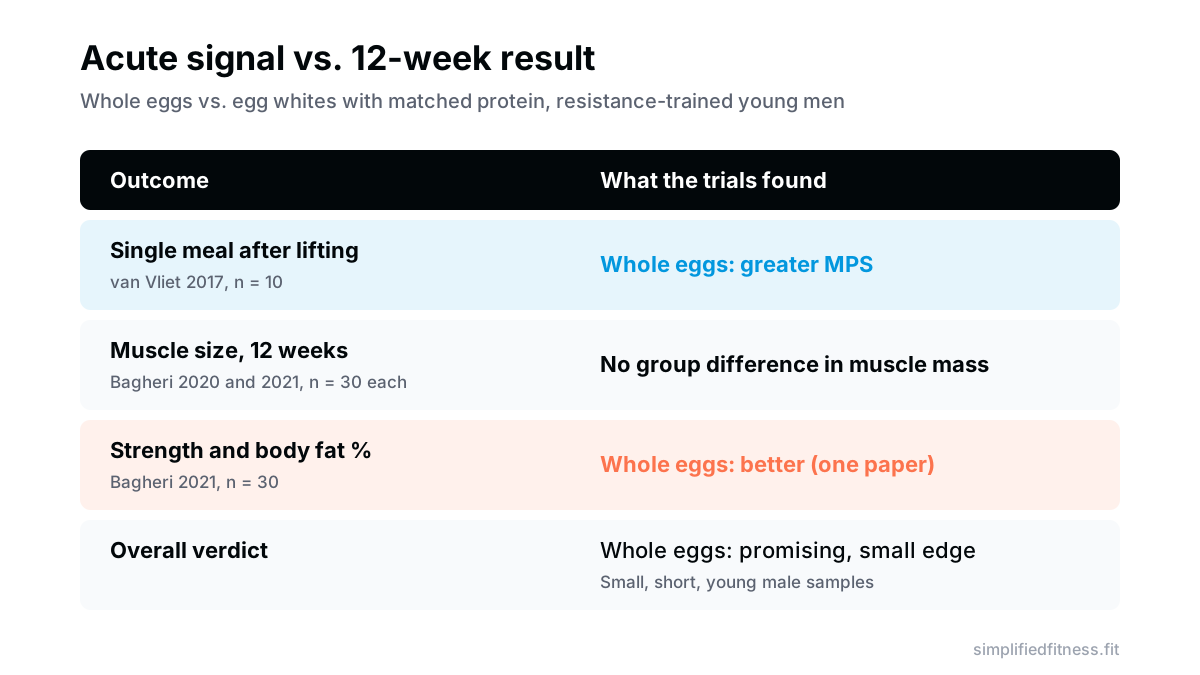
In a 2021 randomized trial, 30 resistance-trained young men trained three times a week for 12 weeks. One group ate 3 whole eggs after training, the other ate 6 egg whites (matched for protein). Muscle mass, cross-sectional area and lean mass rose with time in both groups, with no group difference in muscle mass. Whole eggs did show greater improvements in knee extension and handgrip strength, serum testosterone and body fat percentage, and a trend (P = 0.06) toward a larger change in lean body mass (Bagheri et al., 2021).
A companion paper from the same research group, also with 30 trained men on the same 3 whole eggs versus 6 whites design, looked at muscle regulatory markers and body composition. It found both groups gained skeletal muscle mass (about 2.9 kg whole egg, 2.7 kg whites) and lost fat mass (about 1.9 kg vs 1.1 kg). The authors concluded whole eggs and whites can be used interchangeably for hypertrophy when protein intake is maintained (Bagheri et al., 2020).
Why the studies seem to disagree
They may be asking different questions. The acute study measured a five-hour snapshot of synthesis. The 12-week studies measured outcomes after months of training where total protein, training volume and sleep were all doing heavy lifting. A small edge in one post-workout meal may be swamped by everything else, or it may simply be too small to detect with 30 people.
Both sets of trials also share limits: young, trained men, small samples, and the two 12-week papers come from the same research group. Results may not apply to women, older adults, or beginners.
Is egg yolk cholesterol a problem for muscle building?
Cholesterol is not a muscle-building ingredient you need to chase, and it is not a reason to panic either. The question is about heart health, and the evidence is mixed.
On the cautious side, a meta-analysis of 17 randomized trials in healthy people found that higher egg intake raised LDL cholesterol and the LDL to HDL ratio, with larger effects in longer interventions. The authors note that long-term trials are still needed (Li et al., 2020). A pooled analysis of six US cohorts (29,615 adults) linked each extra half egg per day to higher cardiovascular disease risk (adjusted HR 1.06), but the egg association was no longer significant after adjusting for dietary cholesterol (Zhong et al., 2019). That is observational data, so it cannot prove cause.
On the other side, the American Heart Association’s science advisory says observational studies generally do not show a significant association between dietary cholesterol and cardiovascular risk. It recommends focusing on the overall dietary pattern instead of a specific cholesterol target (Carson et al., 2020).
Why the difference? People respond to dietary cholesterol differently, and eggs travel with other foods (bacon, butter, white bread) that muddy cohort data. The practical reading: for most healthy lifters, a few eggs a day inside a balanced diet is not an alarm bell, but your own LDL numbers are the tiebreaker.
How to choose: whole eggs, whites, or a mix?
Use the goal and the calorie budget, not the hype.
| Situation | Practical choice |
|---|---|
| Lean bulking, calories are easy to hit | Whole eggs, they add energy and taste |
| Cutting, calories are tight | Mix: 1-2 whole eggs plus extra whites |
| Post-workout meal, want max acute response | Whole eggs have the better evidence |
| High LDL or heart disease risk | Ask your doctor, whites are an easy fallback |
| Egg-free vegetarian | Skip it, use paneer, curd, soya and dal |
The whole-egg meal in the main trial carried 17 g of fat. That is energy you may or may not want. During a fat-loss phase, saving those calories can matter more than a possible small anabolic edge, which is where a mix of whole eggs and whites works well. Our guide on high protein while cutting covers how to balance protein and calories in a deficit.
How eggs fit in an Indian diet
Eggs are usually one of the more affordable complete-protein foods in India, which is why they show up in so many budget plans. Anda bhurji with onion and tomato, a masala omelette with roti, or boiled eggs next to a bowl of dal-rice all work well.
A simple pattern: 2 whole eggs plus 2-3 whites at breakfast, then rely on dal, curd, paneer and soya through the day. Hot weather and long gaps between meals are real issues, so carry boiled eggs only if you can keep them cool and eat them the same day. For costs and more recipes, see our guide to eggs in the Indian diet.
If you want to know how much protein you actually need before deciding how many eggs to eat, use the protein calculator. Our optimal daily protein intake guide explains the research behind the targets.
What about leucine and protein quality?
Both whole eggs and whites supply complete protein. In the van Vliet trial, leucine availability over five hours was similar, so the extra MPS response from whole eggs was not explained by leucine alone. If you want to understand why leucine gets so much attention, read our piece on the leucine threshold and mTOR and how protein quality is scored in DIAAS vs PDCAAS.
Practical protocol
- Hit your daily protein target first. Eggs are one tool, not the plan.
- If you eat eggs and have no cholesterol restriction, 2-3 whole eggs after training is a reasonable reference, similar to the 3 eggs used in the 12-week studies.
- Add whites when you want more protein without extra fat calories.
- Cook your eggs thoroughly.
- Get a lipid panel done periodically if you eat eggs daily, and share the results with your doctor.
The bottom line
Whole eggs beat egg whites for acute muscle protein synthesis in one small trial of trained men, and a follow-up suggests nutrients outside the protein may be involved. Twelve-week studies did not show a clear muscle size advantage, though a few secondary outcomes favoured whole eggs. Whole eggs are a good default if your doctor is comfortable with it. Egg whites are still excellent protein when calories or cholesterol are a concern. Either way, eat enough protein, train hard, and track your progress.
Frequently Asked Questions
Are whole eggs better than egg whites for building muscle?
Possibly, but the evidence is thinner than the headlines suggest. One acute trial showed a greater muscle protein synthesis response after whole eggs, while two 12-week papers from one research group found no difference in muscle mass. If you enjoy yolks and your doctor has not told you to limit them, eating whole eggs is a sensible choice.
What did the van Vliet whole egg study find?
Ten resistance-trained young men ate whole eggs (18 g protein, 17 g fat) or egg whites (18 g protein) after leg training in a crossover design. Whole eggs produced a greater increase in myofibrillar protein synthesis, even though leucine availability was similar. It was a single-meal study, so it shows a stronger signal, not proven extra muscle.
Why would egg yolks increase muscle protein synthesis?
Researchers do not know for certain. A follow-up study found whole eggs, but not whites, increased mTOR colocalization with the lysosome, and a review points to yolk fats, phospholipids, vitamins and minerals as candidates. Treat these as hypotheses rather than settled mechanisms.
Do egg yolks build muscle in the long run?
Not clearly. In two 12-week papers from one research group, each with 30 trained men, muscle mass and cross-sectional area rose similarly with whole eggs and egg whites. If your total daily protein is already high, the yolk does not appear to be essential for hypertrophy.
How many whole eggs should I eat a day for muscle gain?
There is no research-backed magic number. The 12-week studies used 3 whole eggs (or 6 whites) after training, which is a practical reference point. Count the eggs toward your daily protein target using our protein calculator, and let your lab results and doctor guide the upper limit.
Is egg yolk cholesterol bad for lifters?
It depends on the person. A meta-analysis of 17 randomized trials found higher egg intake raised LDL cholesterol and the LDL to HDL ratio in healthy people, while the American Heart Association advises focusing on overall dietary pattern. If you have high LDL, diabetes or heart disease, ask your doctor before eating many yolks.
Do egg whites have less protein than whole eggs?
Yes per egg, but not by as much as people assume. A review notes the yolk holds about 40% of an egg's protein, so whites alone give you roughly 60%. That is why the trials compared 3 whole eggs with 6 whites to match protein.
Can I eat only egg whites when cutting?
Yes, it is a legitimate way to save calories. The trial used 17 g of fat in the whole-egg meal versus none in whites, so whites free up calories for other foods. Use our calorie calculator to see whether the saved calories matter for your deficit.
Does eating whole eggs raise testosterone?
One 12-week trial reported a bigger rise in serum testosterone with whole eggs, but this was a small trial in young trained men and the change is not shown to affect muscle mass. Do not expect eggs to work like a hormone booster. Eat them for protein and nutrients, not for a testosterone effect.
Are raw eggs better for muscle protein synthesis?
None of the trials discussed here showed raw eggs to be better, so there is no reason to drink them raw. Raw eggs also carry a food safety risk from bacteria such as salmonella. Cook your eggs through.
How should I fit whole eggs into an Indian vegetarian diet?
If you eat eggs (ovo-vegetarian), they slot in easily as anda bhurji, boiled eggs or an omelette with vegetables. Pair them with dal, paneer or curd to reach your daily protein target. If you avoid eggs, the same logic applies to other whole-food protein sources rather than isolated powders.
Do I need to eat egg yolks to get enough protein?
No. Egg whites alone supply high-quality protein, and total daily protein matters more than whether the yolk is included. The yolk adds fat, calories and non-protein nutrients. Choose based on your calorie budget, taste and cholesterol advice from your doctor.
Sources & References
Every claim above is checked against peer-reviewed research (PubMed, U.S. National Library of Medicine) or guidance from established health bodies. How we fact-check.
- van Vliet S, et al. Consumption of whole eggs promotes greater stimulation of postexercise muscle protein synthesis than consumption of isonitrogenous amounts of egg whites in young men. Am J Clin Nutr. 2017. PMID: 28978542
- Abou Sawan S, et al. Whole egg, but not egg white, ingestion induces mTOR colocalization with the lysosome after resistance exercise. Am J Physiol Cell Physiol. 2018. PMID: 30133322
- Santos HO, et al. The Effect of Whole Egg Intake on Muscle Mass: Are the Yolk and Its Nutrients Important? Int J Sport Nutr Exerc Metab. 2021. PMID: 34504041
- Bagheri R, et al. Whole Egg Vs. Egg White Ingestion During 12 weeks of Resistance Training in Trained Young Males: A Randomized Controlled Trial. J Strength Cond Res. 2021. PMID: 33306586
- Bagheri R, et al. Comparison of whole egg v. egg white ingestion during 12 weeks of resistance training on skeletal muscle regulatory markers in resistance-trained men. Br J Nutr. 2020. PMID: 32576297
- Li MY, et al. Association between Egg Consumption and Cholesterol Concentration: A Systematic Review and Meta-analysis of Randomized Controlled Trials. Nutrients. 2020. PMID: 32635569
- Carson JAS, et al. Dietary Cholesterol and Cardiovascular Risk: A Science Advisory From the American Heart Association. Circulation. 2020. PMID: 31838890
- Zhong VW, et al. Associations of Dietary Cholesterol or Egg Consumption With Incident Cardiovascular Disease and Mortality. JAMA. 2019. PMID: 30874756

Umair Hazrami · Founder & Head Coach, Simplified Fitness
Umair Hazrami founded Simplified Fitness and the Simplified Lifter channel to cut through fitness noise. With 4+ years of consistent training and 10+ coaching clients, he writes every guide from the peer-reviewed research and links the sources so you can check them. Our editorial standards.
Educational content only, not medical advice. If you have a medical condition, are pregnant, or take medication, talk to a qualified doctor before changing your diet, supplements or training. Full disclaimer.
Keep reading
Nutrition
The Anabolic Window Myth: Do You Really Need a Shake Within 30 Minutes?
The anabolic window myth, debunked: what meta-analyses show about the 30-minute post-workout shake, how wide your real window is, and when timing still matters.
8 min read

Nutrition
Casein Protein: Slow Digestion, Nighttime Satiety and Muscle Growth
Casein protein benefits for muscle growth: how slow digestion works, what pre-bed trials show, casein vs whey, satiety on a cut and a curd pudding recipe.
8 min read
Nutrition
Collagen Protein: Joint and Tendon Support vs Muscle Building Protein
Does collagen protein build muscle? Here is why 20 g of collagen should not count toward your daily protein goal, and where it may help tendons and joints.
8 min read

Nutrition
Protein Distribution: 3 Meals vs 5 Meals and the 'Muscle Full' Effect
Protein distribution throughout the day: do you need 5-6 meals for muscle? See what research says on 3 vs 5 meals, the muscle full effect and grams per meal.
9 min read