The Anabolic Window Myth: Do You Really Need a Shake Within 30 Minutes?
The anabolic window myth, debunked: what meta-analyses show about the 30-minute post-workout shake, how wide your real window is, and when timing still matters.
TL;DR. The short answer
- The 30-minute anabolic window is not supported by the best evidence. A meta-analysis of 20+ trials found no significant effect of protein timing on strength or hypertrophy once total protein intake was accounted for.
- The realistic window is several hours wide, and it depends on when you last ate. A protein meal 1-2 hours before or after training is a sensible target for most people.
- Total daily protein is the stronger predictor of muscle gain. Supplemental protein stopped adding lean mass beyond about 1.6 g/kg/day in one large meta-analysis.
- Timing may matter a little more if you train fasted or go many hours between protein meals. Evidence in older adults is mixed, and the one study that favoured early intake was very small.
- You do not need a shaker in your gym bag. A normal meal with dal, paneer, curd, eggs or chicken does the same job.
Part of our complete guide: Complete Protein Guide: How Much, What Type, and When to Eat It for Muscle Growth
Table of contents
The anabolic window myth says you must drink protein within 30 minutes of your last set or you lose your gains. The research does not back that up. The real window is several hours wide, and it depends heavily on what you ate before you trained.
If you have ever sprinted to your locker with a warm shaker in hand, this one is for you. It is part of our complete protein guide for hypertrophy, and it goes through the studies one by one so you can see where the 30-minute rule came from and why it fell apart.
What is the anabolic window?
The idea is simple. After resistance training, your muscles are primed to build new protein. Proponents claimed that there is a short period right after training, often quoted as 30 to 60 minutes, when nutrients are used for muscle repair far better than at any other time. Miss it and, supposedly, your session is partly wasted.
Aragon and Schoenfeld reviewed this in 2013. They note that some researchers had even postulated that timing could matter more than the absolute daily intake of nutrients, and that recent evidence had directly challenged the classical view of post-exercise nutrition (Aragon & Schoenfeld, 2013). They concluded the importance, and even the existence, of a narrow post-exercise window varies with a number of factors.
In plain gym language: the window is real in the sense that eating after training is sensible. It is a myth in the sense that it closes at 30 minutes.
Where the 30-minute rule came from
Early lab studies measured short-term muscle protein metabolism, not months of actual training. One often-cited example had six healthy people each complete two trials, drinking an essential amino acid and carbohydrate drink either just before or just after a leg workout. Net muscle protein uptake was greater when they drank before exercise, mainly because more amino acids were delivered to the leg while it was working (Tipton et al., 2001).
Two things are worth noticing. First, the finding favoured drinking before the workout, not a mad dash afterwards. Second, six people and a few hours of measurement is a biological signal, not proof that your biceps will be bigger in six months. Supplement marketing took the signal and turned it into a stopwatch.
Does the anabolic window exist? What the long-term studies show
Here is where the evidence gets clearer. Schoenfeld and colleagues pooled randomized trials on protein timing. The strength analysis covered 478 subjects in 20 studies, and the hypertrophy analysis covered 525 subjects in 23 studies. A simple pooled analysis showed a small to moderate effect on hypertrophy, but once the model controlled for covariates, there were no significant differences between timing and control for strength or hypertrophy. Total protein intake was the strongest predictor of hypertrophy effect size (Schoenfeld et al., 2013).
That is the key insight behind the whole debate. In many of the trials that seemed to show a timing benefit, the timed group also got more total protein. Once you account for that, the “timing” effect shrinks.
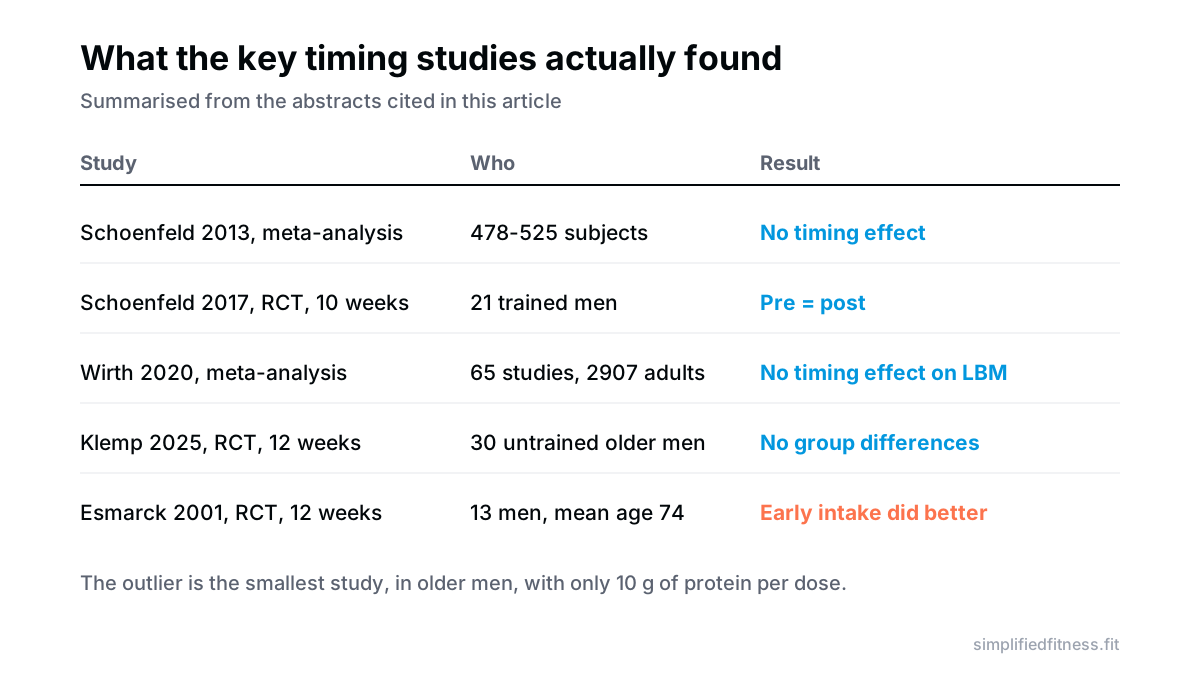
A direct test came in 2017. Twenty-one resistance-trained men did a three-day-a-week full-body program for 10 weeks. One group had 25 g of protein (plus 1 g of carbohydrate) immediately before training and the other had the same supplement immediately after. Strength, muscle size and body composition changes were similar, which the authors say refutes a narrow window and suggests the protein interval may be as wide as several hours or perhaps more, depending on when the pre-workout meal was eaten (Schoenfeld et al., 2017). Note the limits: it was a small trial, 10 weeks long, in young trained men, and one co-author declares he is an employee of Weightology.
A 2020 systematic review of 65 randomized trials with 2,907 adults reached a compatible conclusion. Protein supplementation improved lean body mass independently of intake timing, and subgroup analyses showed no beneficial effect of a specific timing on lean mass or strength. The authors also note that data on muscle protein synthesis were scarce and inconclusive (Wirth et al., 2020).
How long is the real peri-workout window?
Here is the practical reframe. Think of your meals as a buffer around the session, not a single moment.
If you eat a protein-containing meal before training, amino acids from it are still entering your blood during and after your workout. The 2017 authors put it this way: the interval for protein intake may span several hours, depending on the timing of the pre-workout meal. A rough way to picture it is a 4-6 hour zone around the session. Treat that number as a practical rule of thumb, not a measured cutoff, because trials have not pinned down an exact edge.
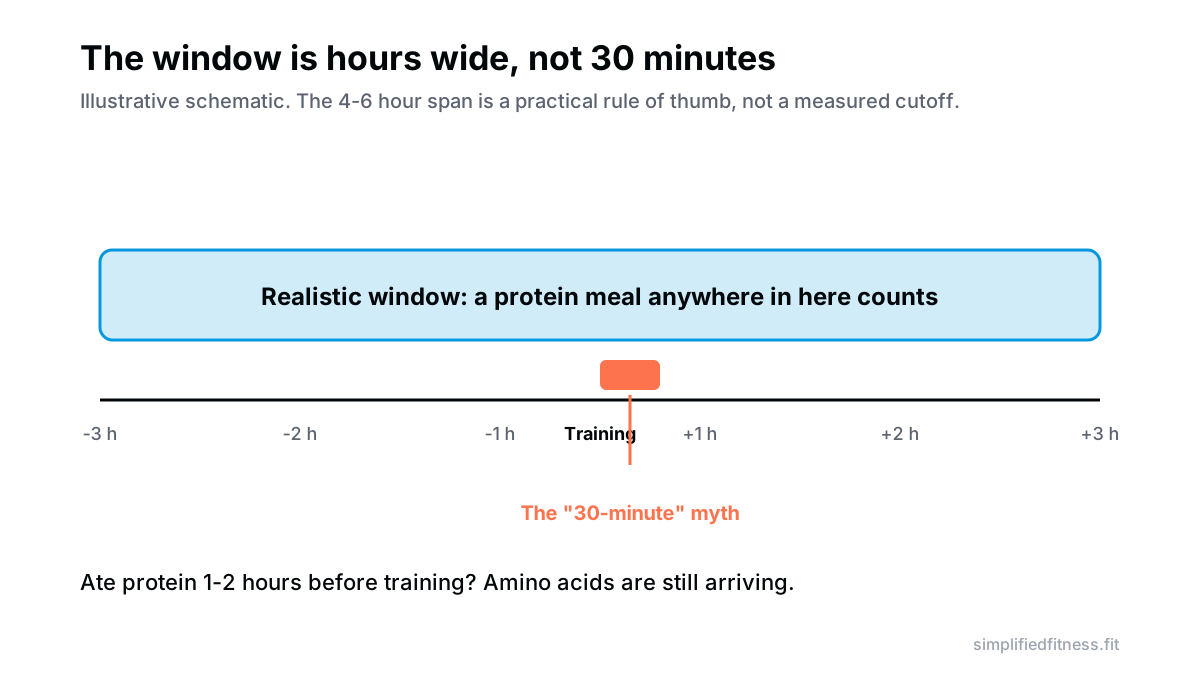
What this means in practice:
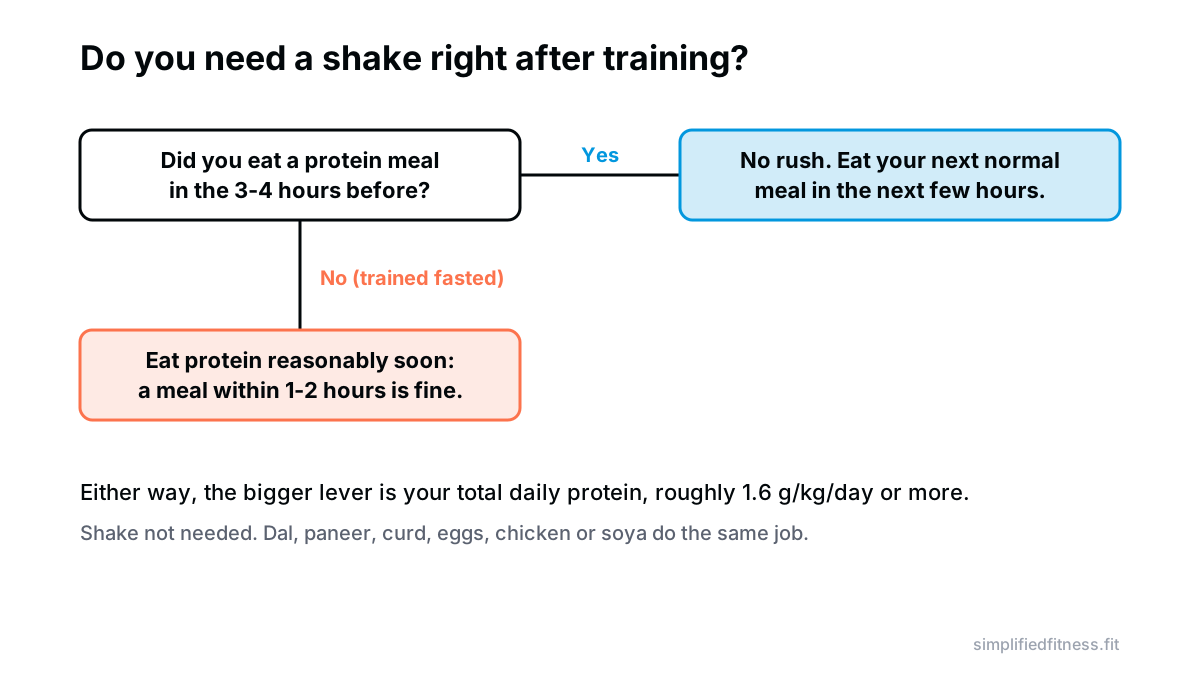
- Ate a protein meal 1-3 hours before training: you are already covered. Your post-workout meal can wait until you get home.
- Trained fasted (early morning, empty stomach): eat a protein-rich meal reasonably soon after. Evidence here is thinner, so this is cautious advice rather than a proven requirement.
- Evening session and a normal dinner: dinner an hour or two later is fine.
Total protein beats timing
If timing is a small lever, what is the big one? Daily protein.
A systematic review and meta-regression of 49 trials with 1,863 participants found that protein supplementation increased strength, fat-free mass and muscle fibre size during prolonged resistance training. The extra benefit stopped at total protein intakes above about 1.62 g/kg/day (Morton et al., 2018). It also found the effect was larger in resistance-trained people and smaller with increasing age. One author reports funding from the US National Dairy Council, which supported some of the trials reviewed, so read the conclusion with that in mind.
That is an average across studies, not a personal prescription. You can estimate your own range with our protein intake calculator, and our guide to optimal daily protein intake explains how to choose a number.
A rough picture for a 70 kg lifter: about 1.6 g/kg is 112 g of protein a day. That might be eggs at breakfast, dal and curd at lunch, paneer or chicken at dinner, plus a glass of milk or a shake if you are short. Hit that consistently for months and you have covered the biggest part of the protein question, regardless of whether your post-workout meal lands at minute 20 or minute 120.
What about older lifters?
This is where the evidence is least settled, and honesty matters more than a clean headline.
In 2001, researchers had 13 men (mean age 74) do 12 weeks of resistance training and take a 10 g protein supplement either immediately after training or 2 hours later. Quadriceps cross-sectional area and muscle fibre area increased in the immediate group but not in the delayed group, and the authors concluded that early intake was important in elderly men (Esmarck et al., 2001). The study was small, and the supplement dose was only 10 g.
A 2025 randomized trial in 30 untrained older men (average age about 66) found something different. Over 12 weeks of twice-weekly training, 40 g of protein taken after exercise or before sleep did not improve muscle thickness or strength beyond training alone. All groups improved, and baseline intake was already at least 1.0 g/kg/day (Klemp et al., 2025). The authors concluded that adherence and meeting daily protein requirements mattered more than timing.
Why might they differ? The studies used different protein doses, different training frequencies, different baseline diets and different comparison groups. Both were small. A cautious takeaway: for older adults, make sure daily protein is adequate first, and consider not leaving long gaps after training. If you have kidney disease or another medical condition, check with your doctor before raising protein intake. For more on this group, see our guide on protein needs and anabolic resistance in older adults.
When timing might still matter
Honest coaching means saying where the myth stops being a myth. Timing is a small lever, but not zero in every situation.
- You train fasted. No recent amino acids on board, so a sooner protein meal is a sensible habit.
- You train twice a day. Less time to recover between sessions makes planning more useful, especially for carbohydrate.
- You go many hours without protein. Spreading protein across the day is a separate question, covered in our guide on protein distribution across meals.
- You are a competitive athlete. The research gives less guidance here, and individual responses vary.
If you are a recreational lifter training 3-5 days a week and eating three protein-containing meals a day, none of these likely apply.
The practical protocol
- Set a daily protein target around 1.6 g/kg or higher using the protein calculator.
- Eat 3-4 protein meals spread across the day, each with a decent serving of dal, paneer, curd, eggs, chicken, fish or soya.
- Have a protein meal in the 1-3 hours before or 1-2 hours after training. Either side is fine.
- Use a shake only for convenience or budget, not because the clock is ticking. A scoop of whey is useful when you are short on protein, not magic.
- Do not rush for carbohydrate unless you train the same muscles hard again within about a day. Our guide to intra-workout carbohydrates covers the exceptions.
Related myths worth dropping
The same logic applies to hormone claims. The idea that you must exploit a post-workout hormone spike is covered in our article on the post-workout hormone spike myth. If you are asking whether your body can even use a big dose at once, see protein absorption ceilings.
The bottom line
The 30-minute anabolic window is a marketing-friendly simplification. Most randomized trials and meta-analyses show that total daily protein, plus consistent training, drives muscle growth, while the minute you drink your shake has little measurable effect in most people. The exceptions, such as fasted training or very long gaps between meals, call for modest planning, not panic.
Eat enough protein, train hard, sleep well, and put the shaker down if it is only making you rush. For a structure to train with, start from our free push pull legs plans.
Frequently Asked Questions
How long after a workout should I drink a protein shake?
There is no strict deadline. A 10-week trial in trained men found that the same 25 g of protein taken immediately before or immediately after training gave similar results. Eat a protein-containing meal within a couple of hours, or earlier if you trained fasted.
Is the anabolic window a myth?
The popular version, a 30-minute window after your last set, is not supported by the evidence. A 2013 meta-analysis of randomized trials found that once total protein intake and other factors were controlled, timing had no significant effect on strength or hypertrophy. A window does exist in a loose sense, but it is hours wide and depends on your previous meal.
What happens if I miss the 30-minute window?
Nothing measurable that the research can detect in the long run. Muscle protein synthesis stays elevated for hours after resistance training, and a pre-workout meal is still digesting while you lift. Just make sure you hit your daily protein target and eat a normal meal after training.
Should I drink protein before or after training?
Both work. The 2017 PeerJ trial in resistance-trained men compared the same dose immediately before and after training and found similar changes in strength, muscle size and body composition. Pick whichever fits your schedule and digestion.
Does the anabolic window matter if I train fasted in the morning?
It may matter somewhat more, because you have no amino acids circulating from a recent meal. The research on this is thinner than on fed training, so this is a cautious inference rather than a proven rule. Eating a protein-rich meal reasonably soon after a fasted session is a simple, low-cost habit.
Is a protein shake better than real food after training?
Not necessarily. Shakes are convenient and digest quickly, but timing studies do not show that a liquid shake beats a solid meal for long-term muscle gain. Dal with roti and curd, paneer bhurji, eggs or chicken with rice are all fine options.
How much protein do I need for muscle growth in a day?
A large meta-analysis of 49 trials found that protein supplementation stopped adding extra fat-free mass beyond total intakes of about 1.62 g/kg/day. That is an average across studies, and many people aim a little higher for safety margin. Use our protein calculator to get a number for your body weight.
Does the anabolic window apply to older adults?
The evidence is mixed. A 2001 study of 13 men aged around 74 found better thickening of the quadriceps when 10 g of protein was taken straight after training than 2 hours later, while a 2025 trial of 30 untrained older men found no group differences between post-exercise, pre-sleep and no extra protein. Older adults should focus on reaching their daily protein target first, then spread it across meals.
Does protein timing matter for strength as well as muscle size?
Mostly no. The Schoenfeld 2013 meta-analysis found no significant effect of protein timing on strength, and a 2020 systematic review found no beneficial effect of a specific timing on lean mass or strength outcomes. Training progression and total protein are far bigger levers.
Do carbs need to be eaten right after training too?
Only if you will train the same muscles hard again within roughly a day, because glycogen restoration is then on a tighter clock. For most people training once a day with normal meals, there is no need to rush. See our guide on intra-workout carbohydrates for the nuance.
Can I just eat my normal dinner after an evening workout?
Yes, for most people that works well. If you ate a decent protein meal in the 3-4 hours before training, your dinner an hour or two later sits comfortably inside the practical window. Add a bowl of curd or a glass of milk if dinner is light on protein.
Why do supplement companies push the 30-minute window?
Partly because the idea sells shakes. Early lab studies using amino acid drinks in a few subjects showed short-term differences in muscle protein metabolism, and marketing stretched that into a rule. Longer training trials did not confirm that the exact minute you drink matters.
Who might still benefit from careful protein timing?
People who train twice a day, train fasted, or go very long stretches without protein may get a small edge from planning. The evidence for competitive athletes and fasted training is limited, so treat it as fine-tuning. For everyone else, consistency beats clock-watching.
Sources & References
Every claim above is checked against peer-reviewed research (PubMed, U.S. National Library of Medicine) or guidance from established health bodies. How we fact-check.
- Aragon AA, et al. Nutrient timing revisited: is there a post-exercise anabolic window? J Int Soc Sports Nutr. 2013. PMID: 23360586
- Schoenfeld BJ, et al. The effect of protein timing on muscle strength and hypertrophy: a meta-analysis. J Int Soc Sports Nutr. 2013. PMID: 24299050
- Schoenfeld BJ, et al. Pre- versus post-exercise protein intake has similar effects on muscular adaptations. PeerJ. 2017. PMID: 28070459
- Schoenfeld BJ, et al. Is there a postworkout anabolic window of opportunity for nutrient consumption? Clearing up controversies. J Orthop Sports Phys Ther. 2018. PMID: 30702982
- Morton RW, et al. A systematic review, meta-analysis and meta-regression of the effect of protein supplementation on resistance training-induced gains in muscle mass and strength in healthy adults. Br J Sports Med. 2018. PMID: 28698222
- Wirth J, et al. The role of protein intake and its timing on body composition and muscle function in healthy adults: a systematic review and meta-analysis of randomized controlled trials. J Nutr. 2020. PMID: 32232404
- Klemp AO, et al. Neither pre-sleep nor post-exercise protein consumption influences resistance exercise training adaptations in older adults. J Int Soc Sports Nutr. 2025. PMID: 40539259
- Esmarck B, et al. Timing of postexercise protein intake is important for muscle hypertrophy with resistance training in elderly humans. J Physiol. 2001. PMID: 11507179
- Tipton KD, et al. Timing of amino acid-carbohydrate ingestion alters anabolic response of muscle to resistance exercise. Am J Physiol Endocrinol Metab. 2001. PMID: 11440894

Umair Hazrami · Founder & Head Coach, Simplified Fitness
Umair Hazrami founded Simplified Fitness and the Simplified Lifter channel to cut through fitness noise. With 4+ years of consistent training and 10+ coaching clients, he writes every guide from the peer-reviewed research and links the sources so you can check them. Our editorial standards.
Educational content only, not medical advice. If you have a medical condition, are pregnant, or take medication, talk to a qualified doctor before changing your diet, supplements or training. Full disclaimer.
Keep reading

Nutrition
Casein Protein: Slow Digestion, Nighttime Satiety and Muscle Growth
Casein protein benefits for muscle growth: how slow digestion works, what pre-bed trials show, casein vs whey, satiety on a cut and a curd pudding recipe.
8 min read
Nutrition
Collagen Protein: Joint and Tendon Support vs Muscle Building Protein
Does collagen protein build muscle? Here is why 20 g of collagen should not count toward your daily protein goal, and where it may help tendons and joints.
8 min read

Nutrition
Protein Distribution: 3 Meals vs 5 Meals and the 'Muscle Full' Effect
Protein distribution throughout the day: do you need 5-6 meals for muscle? See what research says on 3 vs 5 meals, the muscle full effect and grams per meal.
9 min read

Nutrition
Fast vs Slow Absorbing Proteins: Digestion Rates and Muscle Protein Breakdown
Fast vs slow digesting protein for hypertrophy: how whey and casein differ in amino acid release, what the tracer studies show, and how to combine them.
8 min read