Ashwagandha and Cortisol: Does It Lower Stress and Boost Strength in the Gym?
Ashwagandha for lifting: what the trials show on cortisol, stress and strength gains, realistic dose (300-600 mg), who should skip it and how to buy it safely.

TL;DR. The short answer
- Ashwagandha for lifting has real but modest support: small trials in mostly untrained or recreational men found bigger 1RM gains than placebo, but a 2026 meta-analysis rated the certainty low.
- A 2024 meta-analysis of 9 trials (558 people) found lower perceived stress, anxiety and serum cortisol versus placebo, so the stress effect is better supported than the muscle effect.
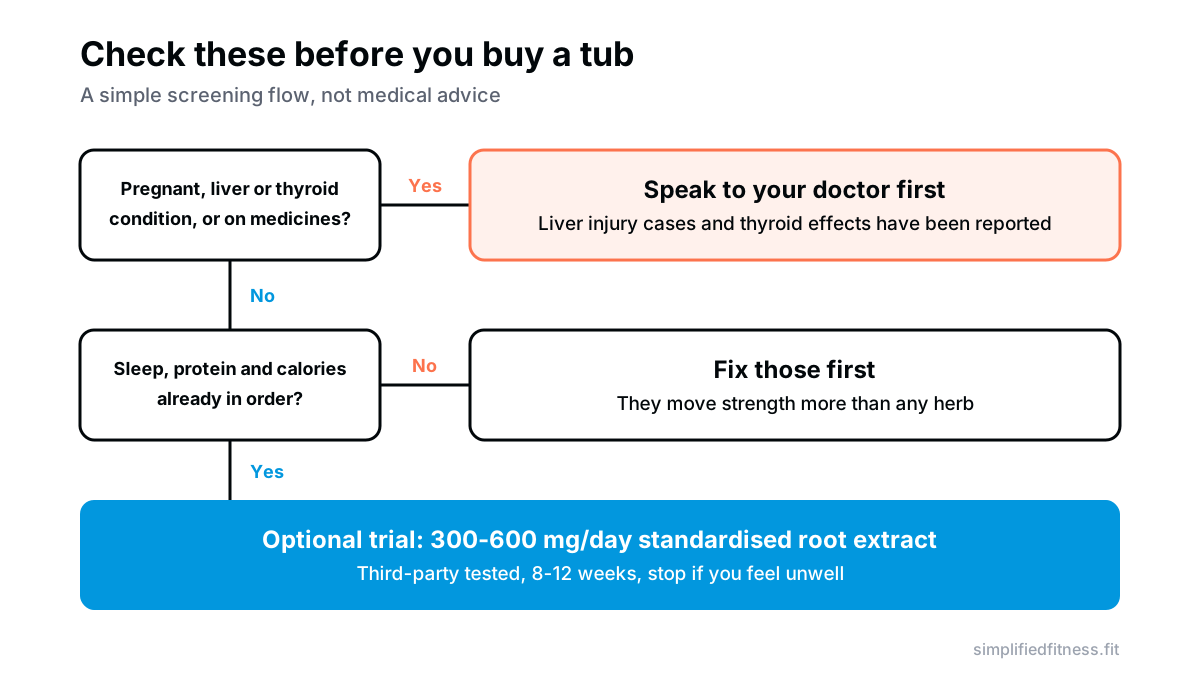
- Trials mostly used 300-600 mg a day of a standardised root extract for 8-12 weeks. There is no good evidence for cycling on and off, and no evidence it helps if sleep and protein are poor.
- Liver injury cases have been reported, some fatal in people with existing liver disease. Skip it, or see a doctor first, if you are pregnant, have liver or thyroid disease, or take regular medicines.
Part of our complete guide: Carbohydrates, Fats, Fibre, Micronutrients and Hydration: The Lifter's Fueling Guide
Table of contents
Ashwagandha for lifting is one of the few herbal ideas with actual resistance-training trials behind it. Those trials favour ashwagandha over placebo for strength, and larger reviews find it lowers perceived stress and cortisol. The catch is that the studies are small and short, and several authors have supplement-industry ties, so the honest answer is “maybe a modest edge, if the basics are already in place.”
This article sits under our carbs, fats and hydration performance guide. It covers what the trials found, what a realistic dose looks like, and who should leave it alone.
What is ashwagandha and why do lifters care about cortisol?
Ashwagandha (Withania somnifera) is a root used in Ayurveda for centuries. In supplements it is sold as a standardised extract, usually graded by withanolide content. Brands like KSM-66 (root extract) and Sensoril (root and leaf, aqueous) are common names you will see on Indian and global labels.
Lifters care because cortisol is the stress hormone. The popular story is that high cortisol wrecks recovery and muscle growth, so lowering it should help. That story is oversimplified. Cortisol rises acutely during hard training and that is normal. We break down the nuance in cortisol and resistance training: acute vs chronic. Ashwagandha is interesting mainly because chronic psychological stress is a different problem, and it is the one this herb has been tested on.
Does ashwagandha lower cortisol and stress?
This is where the evidence is strongest. A 2024 meta-analysis pooled 9 randomized trials with 558 people and found significantly lower Perceived Stress Scale scores, Hamilton Anxiety Scale scores and serum cortisol with ashwagandha than with placebo. Four of those trials reported mild to moderate adverse events, and the authors said long-term safety information was still needed (Arumugam et al., 2024).
A single trial gives some mechanism. In a 60-day study, 60 stressed adults took 240 mg of a standardised extract or placebo. The ashwagandha group had a larger fall in morning cortisol and in DHEA-S, plus a statistically significant drop in Hamilton anxiety scores. The authors suggest an effect through the hypothalamic-pituitary-adrenal axis, and note that larger and more varied samples are needed (Lopresti et al., 2019).
Two cautions. First, most participants were stressed adults, not lifters, so we cannot assume the same cortisol change in someone who sleeps well. Second, you may see claims of “15-28% cortisol reduction” online. Different trials use different assays and extracts, and I could not confirm a single reliable percentage from the abstracts I read, so I will not quote one.
Does ashwagandha improve strength and muscle size?
Two small trials are the ones people usually cite.
Wankhede et al. (2015) randomized 57 men aged 18-50 with little resistance-training experience to 300 mg of root extract twice daily or a starch placebo for 8 weeks. Bench press 1RM rose 46.0 kg in the ashwagandha group versus 26.4 kg on placebo, leg extension 14.5 versus 9.8 kg, arm muscle area 8.6 versus 5.3 cm2, and chest girth 3.3 versus 1.4 cm. Testosterone and creatine kinase also differed in favour of ashwagandha (Wankhede et al., 2015).
Ziegenfuss et al. (2018, the STAR trial) used 38 recreationally active men and 500 mg a day of the aqueous extract Sensoril for 12 weeks on a 4-day split. 1RM squat rose 19.1 versus 10.0 kg and bench 12.8 versus 8.0 kg, and the ashwagandha group alone showed significant gains in some power, time-trial and perceived recovery measures. No other body-composition differences were found, apart from a more favourable android/gynoid ratio (Ziegenfuss et al., 2018).
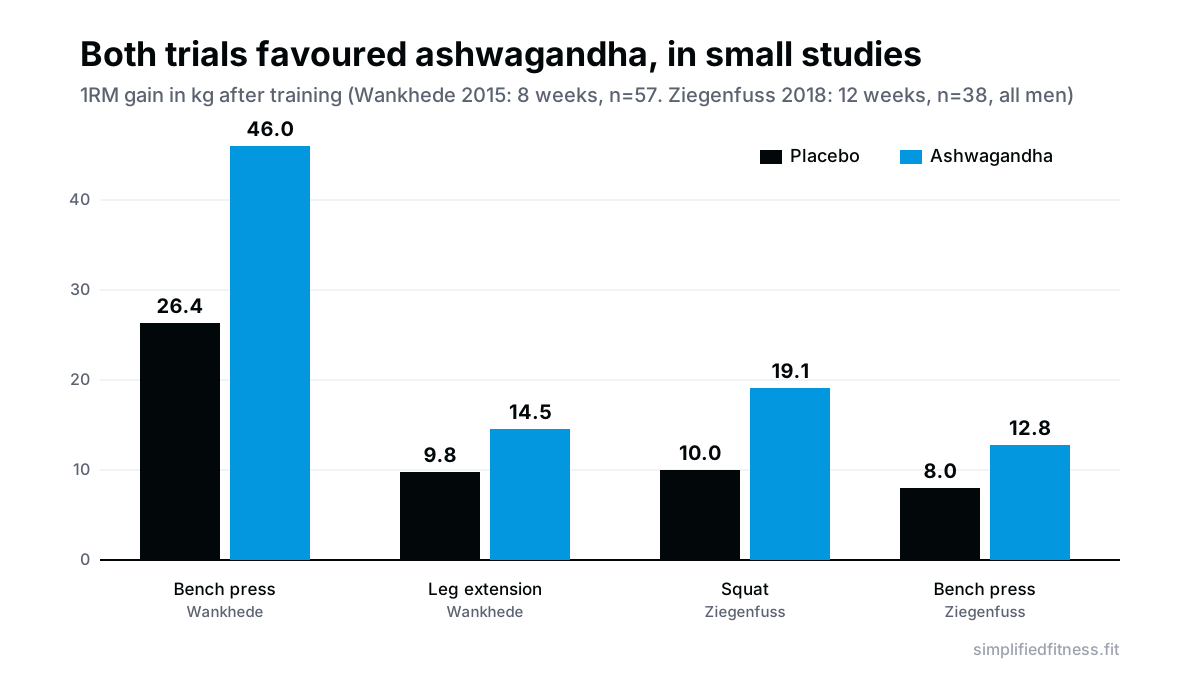
Those are encouraging numbers. They are also the reason to slow down.
How strong is the evidence for ashwagandha strength gains?
Weaker than the headlines. A 2026 systematic review and meta-analysis limited to structured resistance training found four eligible RCTs, three of which (161 people) could be pooled. The pooled effects favoured ashwagandha for bench press 1RM (SMD 0.60, 95% CI 0.20-1.01), lower-body 1RM (0.52) and chest circumference (0.86), but not body fat. Under a more conservative statistical adjustment both strength estimates lost significance, each depended on one influential trial, and certainty was rated low (very low for chest circumference). The authors concluded that current evidence does not establish a meaningful boost to training adaptations (Lee et al., 2026).
Why the disagreement between “significant trial” and “fragile meta-analysis”? Small samples, short durations, trainees who were relatively new or recreational (so almost any added stimulus can look big), and some risk-of-bias concerns. A 2021 Bayesian meta-analysis was more optimistic about physical performance, but it also called for more comparable studies in trained and athletic groups (Bonilla et al., 2021).
How much ashwagandha should I take? KSM-66 dosage and extract choice
The gym trials used 600 mg a day split into two 300 mg doses (root extract) and 500 mg a day (aqueous extract). A dose-response meta-analysis for stress suggested a benefit in the 300-600 mg a day range, with low certainty (Akhgarjand et al., 2022). In practice, a dose on that standardised-extract range is where the evidence sits.
On “ksm 66 dosage muscle growth”: no trial I found compared KSM-66 with other extracts in lifters, so I cannot say it is better. Choose a standardised root extract with a stated withanolide percentage. Because the Indian supplement market has many look-alike products, also read how to spot fake or underdosed supplements and what third-party certifications mean. For a head-to-head on extracts and cycling, see our KSM-66 vs Sensoril guide.
| Question | What the trials used | Confidence |
|---|---|---|
| Daily dose | 300-600 mg standardised extract | Low for stress, low for strength |
| Duration | 8-12 weeks (cortisol study: 60 days) | Short-term only |
| Timing | Once or twice daily, no clear winner | Low |
| Cycling | Not tested | Unknown |
Is it safe? Side effects, liver risk and who should skip
Most healthy adults tolerated it in trials. A 2026 review of 23 trials (2,317 participants, 125-600 mg a day, up to 180 days) found liver, kidney, blood, hormone and cardiovascular markers stayed within normal ranges, and mild effects such as stomach upset, headache and drowsiness occurred in both groups. It also stressed that long-term data beyond 180 days is limited (Coope et al., 2026). Note that some authors have supplement-industry ties.
Case reports tell a different side of the story. A multi-centre Indian case series described cholestatic hepatitis from single-ingredient ashwagandha products, Of the 8 patients, 5 had underlying chronic liver disease, and 3 of them developed acute-on-chronic liver failure and died. In the others the injury was prolonged but resolved (Philips et al., 2023). Chemical analysis found no adulteration or contamination, so this was not simply a dodgy batch. A case series cannot tell you how common this is, but it is why anyone with liver disease should avoid ashwagandha unless their doctor says otherwise.
On the thyroid, a small trial in 50 people with subclinical hypothyroidism found ashwagandha changed TSH, T3 and T4 compared with placebo (Sharma et al., 2018). That is a reason to talk to your doctor if you have a thyroid condition or take thyroid medicine, not a reason to self-treat.
Stop and get medical advice if you develop jaundice, dark urine, severe itching or persistent nausea. Pregnant or breastfeeding, have liver or thyroid disease, or take prescription medicines? Check with your doctor before starting. You may also hear about “anhedonia” or emotional flatness. I could not find this as a measured outcome in the trials I reviewed, so treat it as anecdotal, but stop if your mood changes.
What should realistic expectations look like?
Think small and slow. Even the best-case trials showed modest differences over 8-12 weeks, mostly in newer lifters. Do not expect cortisol to “reset” or your bench to jump 20 kg.
If you try it, run it like an experiment:
- Sort sleep, protein (see our protein calculator) and a progressive plan such as the free training plans.
- Start one product at a time, with third-party testing.
- Use 300-600 mg a day of standardised extract for 8-12 weeks.
- Track sleep, perceived stress and your key lifts.
- If nothing changes, stop. Money is better spent on food.
Ashwagandha belongs in the lower tiers of the supplement hierarchy, well below creatine and protein, and it is only one of the adaptogens like rhodiola. If stress is the real problem, read about psychological stress and muscle repair, and consider changing life, not just capsules.
Bottom line
Ashwagandha probably does lower perceived stress and cortisol, and small trials suggest a modest strength edge in newer lifters. The evidence is low-certainty, the long-term data is thin, and reported liver injury cases mean it is not risk-free. Sleep, food and progressive training stay first. If you try it, use a tested standardised extract, set an 8-12 week window, and see a doctor first if any of the cautions apply to you.
Frequently Asked Questions
Does ashwagandha really build muscle?
Probably only a little, and the evidence is not strong. In an 8-week trial of 57 men new to resistance training, arm muscle area rose 8.6 cm2 on ashwagandha versus 5.3 cm2 on placebo, but a 2026 meta-analysis called the overall evidence low to very low certainty. Treat it as a possible small extra, never a replacement for progressive training and enough protein.
Does ashwagandha lower cortisol?
In most trials, yes, though the size differs between studies. A 2024 meta-analysis of 9 randomized trials found significantly lower serum cortisol than placebo, and a 60-day trial found a bigger fall in morning cortisol on ashwagandha. Most participants were stressed adults rather than lifters, so do not assume the same drop in a well-rested trainee.
How much ashwagandha should I take for strength?
The gym trials used 600 mg a day of root extract (300 mg twice daily) in one case and 500 mg a day of an aqueous extract in another. A stress dose-response analysis pointed to 300-600 mg a day as the useful range. Stay inside the dose on a third-party-tested label rather than chasing bigger numbers.
Is KSM-66 better than other ashwagandha extracts?
There is no head-to-head trial in lifters that proves one branded extract is superior. Strength trials have used different extracts, including a root extract and the aqueous Sensoril extract, and both showed gains over placebo in small samples. Pick a standardised extract with a clear withanolide percentage and independent testing, and compare brands in our KSM-66 vs Sensoril guide.
How long does ashwagandha take to work?
The trials ran 8 to 12 weeks for strength outcomes and about 60 days for cortisol and anxiety. That suggests weeks, not days, so a single dose before training is unlikely to do much. Give it a fixed trial window and judge it by sleep, stress and training logs.
Do I need to cycle ashwagandha?
There is no solid evidence either way. Trials lasted up to a few months, and a 2026 safety review noted limited long-term data beyond 180 days. A sensible approach is a defined 8-12 week block, then a break to check whether you still notice a difference.
Can ashwagandha raise testosterone?
It might in some men, but results are mixed. One 8-week trial reported a bigger testosterone rise on ashwagandha, while a 60-day trial found the male rise was not significant versus placebo. Do not buy it as a testosterone booster, and see our broader guide to natural testosterone boosters.
What are the side effects of ashwagandha?
Mild effects such as stomach upset, headache and drowsiness were infrequently reported in a 2026 review of 23 trials, and also occurred on placebo. Liver injury, mostly cholestatic hepatitis, has been reported in case series, and was fatal in some people who already had liver disease. Stop and see a doctor if you notice yellow eyes or skin, dark urine, itching or unusual tiredness.
Does ashwagandha cause emotional numbness?
I could not find this as a measured outcome in the trials I reviewed, so it is best described as anecdotal. Because ashwagandha is used for stress and anxiety, some people may feel flatter or sleepier. If you notice a change in mood, stop it, and tell your doctor if you take any antidepressant or anxiety medicine.
Who should not take ashwagandha?
Avoid it without medical advice if you are pregnant or breastfeeding, have liver disease, a thyroid condition, or take prescription medicines. Case series link it to liver injury, and a small trial showed it changed thyroid hormone levels in people with subclinical hypothyroidism. A quick conversation with your doctor is cheaper than finding out the hard way.
Can I take ashwagandha with creatine and protein?
There is no known problem with this combination in healthy adults, though no trial tested it directly. Creatine and protein have far stronger evidence for strength and muscle, so they come first. Add ashwagandha last, alone, so you can tell what it is doing.
Is it better to take ashwagandha in the morning or at night?
Trials used both twice-daily and once-daily dosing, and no study I reviewed shows one time is clearly better. Some people feel calmer or sleepier on it, which may suit an evening dose. Take it consistently with food at the time that fits your routine and note how you feel.
Is ashwagandha worth it if I am an Indian vegetarian lifter on a budget?
Usually not before the basics are covered. A month of dal, paneer, curd and soya, plus 7-8 hours of sleep, will usually do more for gains than a herbal supplement. If those are sorted and stress is genuinely high, a tested product is a reasonable experiment.
Sources & References
Every claim above is checked against peer-reviewed research (PubMed, U.S. National Library of Medicine) or guidance from established health bodies. How we fact-check.
- Wankhede S, et al. Examining the effect of Withania somnifera supplementation on muscle strength and recovery: a randomized controlled trial. J Int Soc Sports Nutr. 2015. PMID: 26609282
- Ziegenfuss TN, et al. Effects of an aqueous extract of Withania somnifera on strength training adaptations and recovery: the STAR trial. Nutrients. 2018. PMID: 30463324
- Lee JC, et al. Adjunctive ashwagandha (Withania somnifera) supplementation and resistance-training adaptations in healthy adults: a systematic review and random-effects meta-analysis. Nutrients. 2026. PMID: 42738987
- Arumugam V, et al. Effects of ashwagandha (Withania somnifera) on stress and anxiety: a systematic review and meta-analysis. Explore (NY). 2024. PMID: 39348746
- Akhgarjand C, et al. Does ashwagandha supplementation have a beneficial effect on the management of anxiety and stress? A systematic review and meta-analysis of randomized controlled trials. Phytother Res. 2022. PMID: 36017529
- Lopresti AL, et al. An investigation into the stress-relieving and pharmacological actions of an ashwagandha extract: a randomized, double-blind, placebo-controlled study. Medicine (Baltimore). 2019. PMID: 31517876
- Philips CA, et al. Ashwagandha-induced liver injury: a case series from India and literature review. Hepatol Commun. 2023. PMID: 37756041
- Coope OC, et al. Back to the roots: safety and tolerability of standardised ashwagandha root extract in healthy adults, a systematic review of biomarkers and adverse events. Pharmaceuticals (Basel). 2026. PMID: 42198398
- Bonilla DA, et al. Effects of Ashwagandha (Withania somnifera) on Physical Performance: Systematic Review and Bayesian Meta-Analysis. J Funct Morphol Kinesiol. 2021. PMID: 33670194
- Sharma AK, et al. Efficacy and safety of ashwagandha root extract in subclinical hypothyroid patients: a double-blind, randomized placebo-controlled trial. J Altern Complement Med. 2018. PMID: 28829155

Umair Hazrami · Founder & Head Coach, Simplified Fitness
Umair Hazrami founded Simplified Fitness and the Simplified Lifter channel to cut through fitness noise. With 4+ years of consistent training and 10+ coaching clients, he writes every guide from the peer-reviewed research and links the sources so you can check them. Our editorial standards.
Educational content only, not medical advice. If you have a medical condition, are pregnant, or take medication, talk to a qualified doctor before changing your diet, supplements or training. Full disclaimer.
Keep reading
Nutrition
Alcohol and Muscle Growth: What a Heavy Night Does to MPS, Sleep and Recovery
Alcohol and muscle growth: does a heavy Saturday night wipe out your week? See what research says on MPS, REM sleep and recovery, and how to limit the damage.
7 min read
Nutrition
Caffeine Sensitivity, CYP1A2 Genetics and Caffeine Cycling: Why Pre-Workout Works for Him, Not You
Caffeine sensitivity genetics explain why pre-workout gives your friend PRs and you anxiety. See what CYP1A2 and ADORA2A do, and how to find your dose.
8 min read
Nutrition
Creatine Non-Responders: Why It May Not Be Working and What to Try
Creatine non responder? Learn why roughly 1 in 4 people see little change, how baseline diet matters, and when carbs with creatine help. Studies linked.
7 min read

Nutrition
Dietary Carbohydrates and Hypertrophy: Glycogen, Performance and Training Volume
Do you need carbohydrates for muscle hypertrophy? See what meta-analyses say about glycogen, training volume and daily carb targets per kg, plus Indian foods.
8 min read