Fast vs Slow Absorbing Proteins: Digestion Rates and Muscle Protein Breakdown
Fast vs slow digesting protein for hypertrophy: how whey and casein differ in amino acid release, what the tracer studies show, and how to combine them.

TL;DR. The short answer
- Whey is a fast protein: it floods the blood with amino acids quickly and stimulates muscle protein synthesis more strongly in the first few hours. Casein is a slow protein: it releases amino acids over a longer period and mainly reduces muscle protein breakdown.
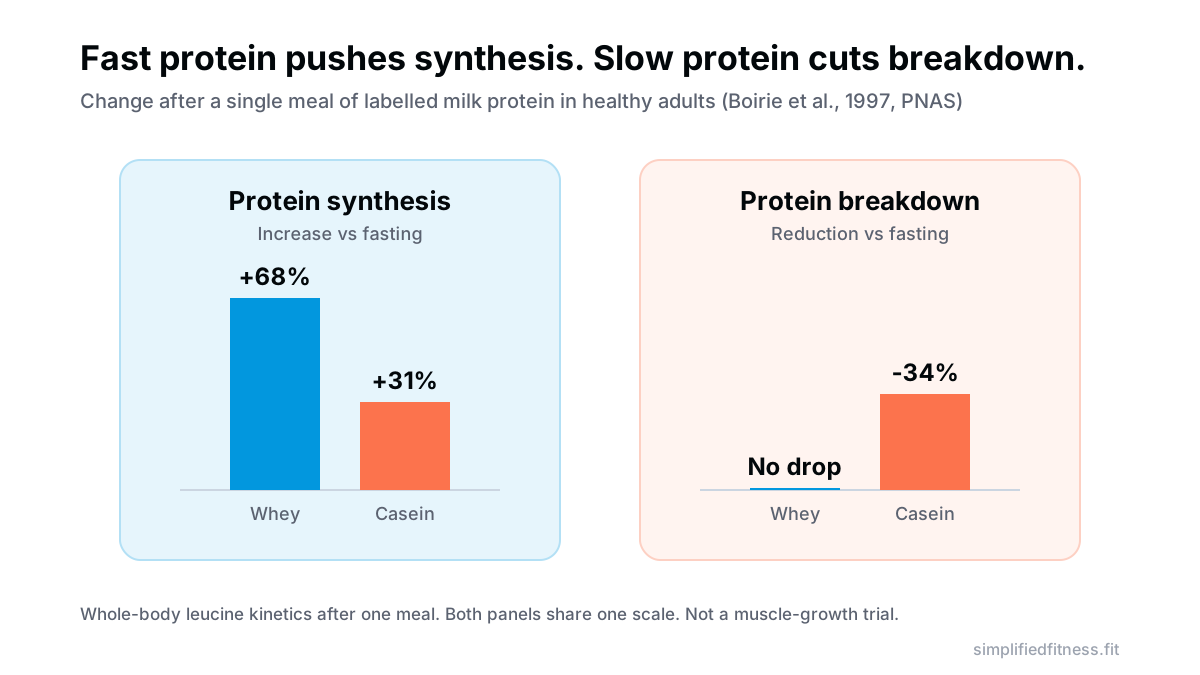
- In one single-meal tracer study, whey raised whole-body protein synthesis by 68% and casein by 31%, while only casein lowered protein breakdown (by 34%).
- No trial shows that fast or slow protein alone builds more muscle over months. Total daily protein (around 1.6 g/kg or more) matters far more than speed.
- Whole foods are not simply slow. In one trial, 30 g of beef protein appeared in the blood faster than 30 g of milk protein.
- Practical default: hit your daily protein across 3-5 meals, use whey around training if convenient, and use a slower option (curd, paneer, casein, a mixed meal) when a long gap is coming.
Part of our complete guide: Complete Protein Guide: How Much, What Type, and When to Eat It for Muscle Growth
Table of contents
Fast vs slow digesting protein is a real difference in physiology, but a small one in practice. Fast proteins like whey spike blood amino acids and switch on muscle protein synthesis hard and early. Slow proteins like casein release amino acids gradually and mainly reduce muscle protein breakdown.
Neither has been shown to build more muscle on its own over months. What matters most is total daily protein, which we cover in the complete protein guide for hypertrophy. Speed is the fine-tuning layer on top, and this article shows how to use it without overthinking it.
What do “fast” and “slow” protein actually mean?
The words describe how quickly amino acids from a protein reach your blood after you eat it. Your stomach empties, your gut breaks the protein into amino acids, and those amino acids enter circulation. How fast that happens depends on the protein itself, the dose, and what else is in the meal.
Two milk proteins show the contrast best. Whey stays dissolved in stomach acid and moves on quickly. Casein is generally described as clotting in stomach acid, and the 1997 authors point to slow gastric emptying as the likely reason for its prolonged release. Same milk, very different timing.
The classic experiment used both proteins labelled with a tracer so researchers could follow the leucine. Whey caused “a dramatic but short increase of plasma amino acids”, while casein caused “a prolonged plateau of moderate hyperaminoacidemia”, probably because of slow gastric emptying (Boirie et al., 1997).
Whey vs casein: how do their digestion rates differ?
Gorissen and colleagues pooled data from 18 randomized trials (602 participants, mean age 53) that used labelled whey, casein or milk protein. Over a 5-hour window, about 45% of casein’s phenylalanine reached the blood, versus 57% for whey and 65% for milk protein (Gorissen et al., 2020).
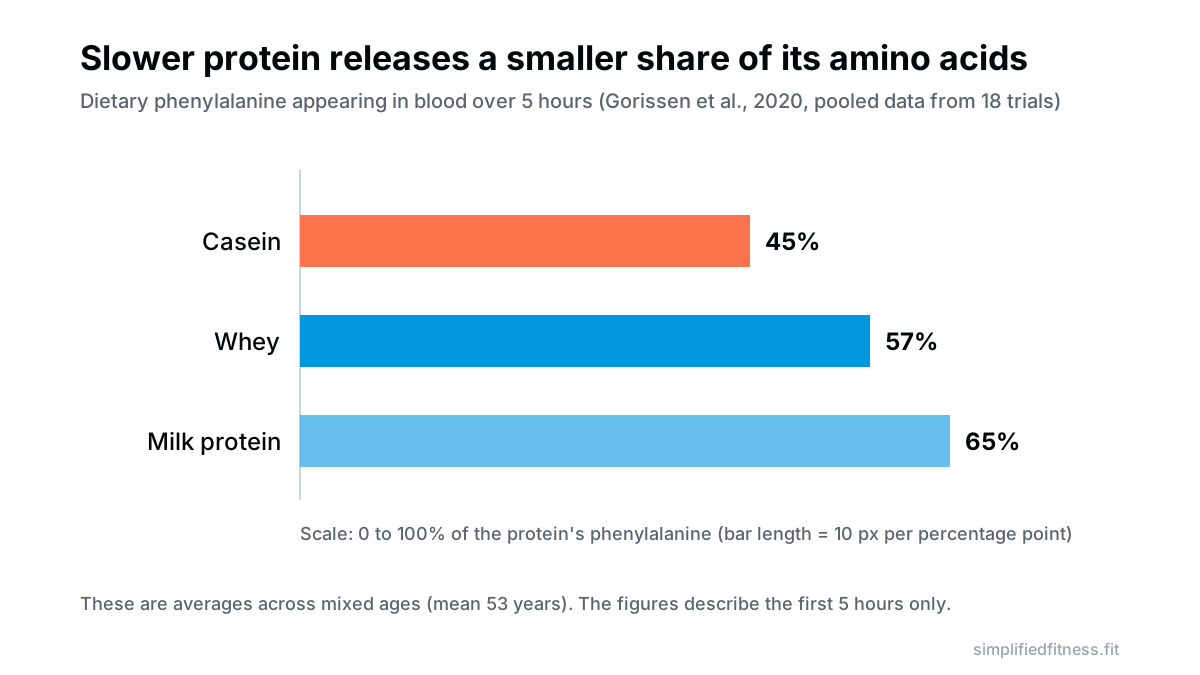
Notice that milk protein, which is mostly casein, released the largest share, so these numbers are not a pure speed ranking. Two more things to read carefully here. First, these figures cover only five hours, so they describe timing, not total quality. Second, the data mix ages and doses, and the same paper reports that protein type, dose and age all change the kinetics. Your own numbers will differ.
What does each speed do to synthesis and breakdown?
Muscle size is a balance: protein synthesis minus protein breakdown. Fast and slow proteins tilt different sides of that equation.
In Boirie’s single-meal study in healthy adults, whey increased whole-body protein synthesis by 68% and casein by 31%. But whole-body protein breakdown fell by 34% after casein and not at all after whey. Over the following 7 hours, leucine oxidation was lower with casein, and net leucine balance was more positive with casein than whey, with the same leucine intake in both meals (Boirie et al., 1997).
Does faster protein build more muscle after training?
In the short term, it often looks that way. Tang and colleagues gave young men 10 g of essential amino acids as whey hydrolysate, micellar casein or soy isolate (6 men per group). After resistance exercise, muscle protein synthesis was about 122% greater with whey than with casein, and 31% greater than with soy. The authors note the gap may relate to digestion speed or to small differences in leucine content (Tang et al., 2009). For how leucine fits in, see the leucine threshold explained.
Notice the limits: small groups, young men, one acute measurement. A higher spike in a lab window is not the same as more muscle after 12 weeks.
Is a slow, steady release better because it lasts longer?
This is where the evidence adds nuance to the simple story. Whey’s boost to synthesis is described as short-lived because its amino acids appear and clear quickly. A protein with a more gradual, meal-like release behaves differently: when 7 young men ate 38 g of milk protein concentrate, muscle protein synthesis was elevated by about 75% in the first 2 hours and still by about 86% between 2 and 5 hours (van Vliet et al., 2019).
A mixed approach has support too. In 19 young adults, about 19 g of a soy-dairy blend kept muscle protein synthesis elevated in the late (2-4 h) period after exercise, while whey alone did not. Early on, both were similar (Reidy et al., 2013). Again: short term, small trial.
Are whole foods like beef slow proteins?
Not necessarily. In a crossover trial, 12 young men ingested 30 g of protein from beef or milk after resistance exercise. Beef protein-derived phenylalanine appeared in the blood more rapidly than milk’s. Milk raised myofibrillar protein synthesis more in the first two hours, but the 5-hour response did not differ significantly (Burd et al., 2015).
So “slow vs fast” depends on the specific food. A mixed Indian plate (dal, roti, curd) usually digests more slowly than a shake because of fibre and other foods, but do not assume that for every whole food.
Does a slow protein before a long gap help?
Pre-sleep is the obvious case. A 2019 review concluded that protein taken before sleep is digested and absorbed overnight, raises overnight muscle protein synthesis, and, over prolonged resistance training, has a beneficial effect on muscle mass and strength (Snijders et al., 2019). Details and doses are in our guides to pre-bed protein and casein protein.
Does any of this beat just eating enough protein?
No. A meta-analysis of 49 trials (1,863 participants) found that protein supplementation modestly improved lean mass and strength during resistance training, and that gains in fat-free mass did not increase further beyond a total intake of about 1.62 g/kg/day (Morton et al., 2018). One of its authors discloses support from the US National Dairy Council for trials in the analysis, which is worth knowing, though the finding itself is widely echoed.
Use our protein calculator to set a daily target for your body weight.
How to combine fast and slow protein in a day
You do not need a spreadsheet. A sensible pattern for most lifters:
| Situation | Practical pick | Why |
|---|---|---|
| Right after training, light stomach | Whey shake, or a meal with eggs, chicken or paneer | Quick amino acid rise, easy to digest |
| Regular meals | Dal plus curd, paneer bhurji, eggs, chicken with roti or rice | Mixed meals digest more slowly by nature |
| Long gap ahead (work, travel) | Curd, paneer or a mixed meal | Slower release |
| Before bed | Curd, milk, or casein if you use powder | Longer release overnight (see pre-bed guide) |
Vegetarian? Curd, paneer and milk already give you casein and whey, and soya and dal add plant protein. Spread protein over 3-5 meals; the daily protein distribution guide covers how to do it. If you are curious how powder types differ, see whey concentrate vs isolate vs hydrolysate. And if you worry about timing around workouts, the anabolic window myth is worth a read. For a ready-made menu, use the diet plan builder.
Which one should you actually use? A few real-world scenarios
Abstract numbers are fine, but most people want to know what to do on a Tuesday. Here is how I would think about it, using ordinary Indian food and a standard gym schedule.
You train at 6 pm and eat dinner at 9 pm. A whey shake after training is convenient, and dinner (say paneer or chicken with dal and roti) provides the slower, mixed delivery. You do not need two scoops or a special timing trick.
You train at 6 am fasted and skip breakfast until 11. This is where a faster, easily digested protein can be handy, since a heavy meal before a morning session may not sit well. Eggs, curd or a shake all work. The bigger issue is whether you reach your total by the end of the day.
You have a 7-8 hour gap in a work day. A mixed meal with some protein at lunch and a snack (roasted chana, curd, a boiled egg or two) does more for you than any powder choice. This is the real use case for slower-digesting foods.
Budget is tight. Fast vs slow digesting protein is not worth a price premium. Milk, curd, eggs, dal and soya chunks cover both speeds cheaply. Powder is a convenience, not a requirement. If you want to know how a protein-rich vegetarian plate stacks up, our guide on top high-protein vegetarian foods lists macros per serving.
What the research cannot tell you yet
Be wary of anyone who sells timing with certainty. Most of the tracer work above is acute: it measures a few hours after a single dose. Participants were mostly healthy young men, and several groups were very small (6 to 12 people). Older adults, women, and people eating mixed meals are less well represented in these specific trials, and Gorissen’s pooled data show that age and dose change the kinetics.
Long-term outcomes such as 12-week muscle growth are driven mainly by training and total protein. Whether the early differences in synthesis between whey and casein translate into extra muscle over months has not been clearly demonstrated by the studies cited here. If a future trial changes that picture, the practical advice would shift too.
The bottom line
Fast proteins are better at flicking the synthesis switch early. Slow proteins are better at dampening breakdown across a long window. Studies are mostly short, small and in young men, so treat speed as fine-tuning, not a rule. Eat enough total protein, spread it out, and use whichever mix fits your budget and routine.
Frequently Asked Questions
Is fast or slow digesting protein better for building muscle?
Neither has been shown to win on its own over months of training. Fast proteins such as whey stimulate muscle protein synthesis more in the first hours, while slow proteins such as casein reduce breakdown for longer. Focus on total daily protein first, then use both types across the day.
What is the difference between whey and casein digestion?
Whey stays dissolved in the stomach and moves on quickly, so amino acids spike in the blood and fall within a few hours. Casein is generally described as clotting in stomach acid, which likely slows gastric emptying and produces a lower, longer plateau of amino acids. Choose whey when you want a quick hit after training and casein when a long gap is ahead.
Does slow digesting protein suppress muscle protein breakdown?
In a classic 1997 tracer study, casein reduced whole-body protein breakdown by 34% while whey did not. That was a single meal in healthy adults and it measured the whole body, not only muscle. Treat it as a mechanism, not proof of extra muscle.
How long does whey protein take to digest?
Blood amino acids from whey peak early and fall back within a few hours, which is why it is called a fast protein. Exact timing depends on dose, whether you take it with food, and your age. A shake on an empty stomach is faster than the same shake with a full meal.
How long does casein take to digest?
Casein releases amino acids more slowly, with a moderate, prolonged plateau of blood amino acids rather than a sharp spike. Larger doses and mixed meals slow it further. That is why it is often used before a long gap such as overnight.
Is a whole food meal a slow protein?
Usually it is slower than a shake because fat, fibre and other foods slow stomach emptying, but protein type matters too. In one trial, beef protein actually reached the blood faster than milk protein. Do not assume 'whole food' means 'slow' without checking the source.
Should I take whey after a workout or casein?
Either works if you reach your daily protein target. Whey fits the post-workout slot because it is quick and convenient, but there is no strict window you must hit. If your next meal is far away, a slower protein or a mixed meal is a sensible choice.
Can I mix whey and casein in one shake?
Yes. Mixing gives an early amino acid rise from whey and a longer tail from casein. A soy-dairy blend sustained muscle protein synthesis longer than whey alone in one small trial of 19 young adults, though it is not proven to produce more muscle over months. Use a blend if it is cheaper or you like the texture.
Is the protein absorption speed relevant for vegetarians in India?
Yes, because curd, paneer and milk contain casein and whey while dal, soya and roti are plant proteins with their own digestion profiles. A mix of dairy and plant protein across the day covers fast and slow release naturally. Aim for a protein source at every meal rather than relying on one powder.
Do slow proteins make you gain less muscle in the first hours?
In one small study with matched essential amino acid doses, muscle protein synthesis after resistance exercise was lower with casein than with whey hydrolysate. That is a short-term measure with only 6 men per group. It does not mean casein builds less muscle over months of training.
Do I need both fast and slow protein?
No, you do not need both, because total daily protein is the main driver of results. Using both can make it easier to spread protein across the day and feel full between meals. Start with food, add a supplement only if you struggle to reach your target.
Does protein digestion speed matter if I eat enough protein?
Much less. A meta-analysis of 49 trials found that gains in fat-free mass plateaued once total protein intake reached about 1.62 g/kg/day. Speed is a fine-tuning detail you adjust after the basics are met.
Sources & References
Every claim above is checked against peer-reviewed research (PubMed, U.S. National Library of Medicine) or guidance from established health bodies. How we fact-check.
- Boirie Y, et al. Slow and fast dietary proteins differently modulate postprandial protein accretion. Proc Natl Acad Sci U S A. 1997. PMID: 9405716
- Tang JE, et al. Ingestion of whey hydrolysate, casein, or soy protein isolate: effects on mixed muscle protein synthesis at rest and following resistance exercise in young men. J Appl Physiol. 2009. PMID: 19589961
- Reidy PT, et al. Protein blend ingestion following resistance exercise promotes human muscle protein synthesis. J Nutr. 2013. PMID: 23343671
- Burd NA, et al. Differences in postprandial protein handling after beef compared with milk ingestion during postexercise recovery: a randomized controlled trial. Am J Clin Nutr. 2015. PMID: 26354539
- Gorissen SHM, et al. Protein type, protein dose, and age modulate dietary protein digestion and phenylalanine absorption kinetics and plasma phenylalanine availability in humans. J Nutr. 2020. PMID: 32069356
- Morton RW, et al. A systematic review, meta-analysis and meta-regression of the effect of protein supplementation on resistance training-induced gains in muscle mass and strength in healthy adults. Br J Sports Med. 2018. PMID: 28698222
- Snijders T, et al. The impact of pre-sleep protein ingestion on the skeletal muscle adaptive response to exercise in humans: an update. Front Nutr. 2019. PMID: 30895177
- van Vliet S, et al. Time-dependent regulation of postprandial muscle protein synthesis rates after milk protein ingestion in young men. J Appl Physiol. 2019. PMID: 31725358

Umair Hazrami · Founder & Head Coach, Simplified Fitness
Umair Hazrami founded Simplified Fitness and the Simplified Lifter channel to cut through fitness noise. With 4+ years of consistent training and 10+ coaching clients, he writes every guide from the peer-reviewed research and links the sources so you can check them. Our editorial standards.
Educational content only, not medical advice. If you have a medical condition, are pregnant, or take medication, talk to a qualified doctor before changing your diet, supplements or training. Full disclaimer.
Keep reading
Nutrition
The Anabolic Window Myth: Do You Really Need a Shake Within 30 Minutes?
The anabolic window myth, debunked: what meta-analyses show about the 30-minute post-workout shake, how wide your real window is, and when timing still matters.
8 min read

Nutrition
Casein Protein: Slow Digestion, Nighttime Satiety and Muscle Growth
Casein protein benefits for muscle growth: how slow digestion works, what pre-bed trials show, casein vs whey, satiety on a cut and a curd pudding recipe.
8 min read
Nutrition
Collagen Protein: Joint and Tendon Support vs Muscle Building Protein
Does collagen protein build muscle? Here is why 20 g of collagen should not count toward your daily protein goal, and where it may help tendons and joints.
8 min read

Nutrition
Protein Distribution: 3 Meals vs 5 Meals and the 'Muscle Full' Effect
Protein distribution throughout the day: do you need 5-6 meals for muscle? See what research says on 3 vs 5 meals, the muscle full effect and grams per meal.
9 min read