High Protein While Cutting: How Much You Need to Keep Muscle
How much protein while cutting? Research on lean lifters points to 2.3-3.1 g/kg of fat-free mass. Get the numbers, a worked example and Indian food tips.
TL;DR. The short answer
- Lean, resistance-trained lifters in a calorie deficit likely need about 2.3-3.1 g of protein per kg of fat-free mass, which works out to roughly 2.0-2.6 g/kg of total body weight for someone around 15% body fat (Helms et al., 2014).
- The leaner you are and the harder you cut, the higher in that range you should sit. If you are carrying more body fat or cutting gently, the lower end or less usually works.
- In a 4-week trial of young men in a hard deficit with heavy training, 2.4 g/kg protein led to a 1.2 kg lean mass gain versus 0.1 kg, and about 1.3 kg more fat loss, than 1.2 g/kg.
- Extra protein also helps with fullness and burns more energy during digestion, but it does not replace lifting. Heavy training is what tells your body to keep the muscle.
- Healthy kidneys have not been shown to be harmed by high protein in reviews of healthy adults. If you have kidney disease, check with your doctor before raising intake.
Part of our complete guide: Complete Protein Guide: How Much, What Type, and When to Eat It for Muscle Growth
Table of contents
Lean and cutting? You probably need more protein than the building range in our complete protein guide. The best-supported answer to “how much protein while cutting” for lean, trained lifters is about 2.3-3.1 g per kg of fat-free mass per day, which is roughly 2.0-2.6 g per kg of total body weight at around 15% body fat (Helms et al., 2014).
This article is the cutting-specific piece: why the number rises, who needs the high end, and how to hit it on an Indian diet without wrecking your budget or your hunger.
One honest caveat before we start. This is not a settled, exact number. It is a sensible recommendation built on a small body of research in lean, trained people, and I will flag where the evidence is thin.
Why does protein need go up in a calorie deficit?
When you eat less than you burn, your body makes up the gap from stored energy. Body fat is the main source, but some protein gets burned too. The leaner you are, the less fat there is to draw from, and the more likely it is that muscle takes a hit.
A commonly proposed explanation is that, with energy restricted, more amino acids get diverted toward making glucose and fuel rather than being kept for muscle repair. I want to be clear that this is a mechanism offered to explain the pattern, and not every study in the literature measured it directly. What the data does show is the pattern itself: protein needs seem to rise with leanness and with the severity of the deficit.
The Helms systematic review pulled together six studies of adults who were resistance-trained for over 6 months and relatively lean (men at 23% body fat or below, women at 35% or below). Body fat fell in every group, and fat-free mass fell in nine of the 13 groups, by 0.3-2.7 kg. Six groups gained, held or lost only non-significant amounts of fat-free mass, and five of those six were higher in body fat, in a smaller deficit, or doing a new training stimulus (Helms et al., 2014).
The one group in that better-off set that was not high in body fat, was in a big deficit, and was not doing anything novel in training also ate the most protein of all groups: 2.5-2.6 g/kg. From that, the authors concluded that needs are likely 2.3-3.1 g/kg of fat-free mass, scaled upward with the severity of restriction and leanness.
So how much protein should you eat while cutting?
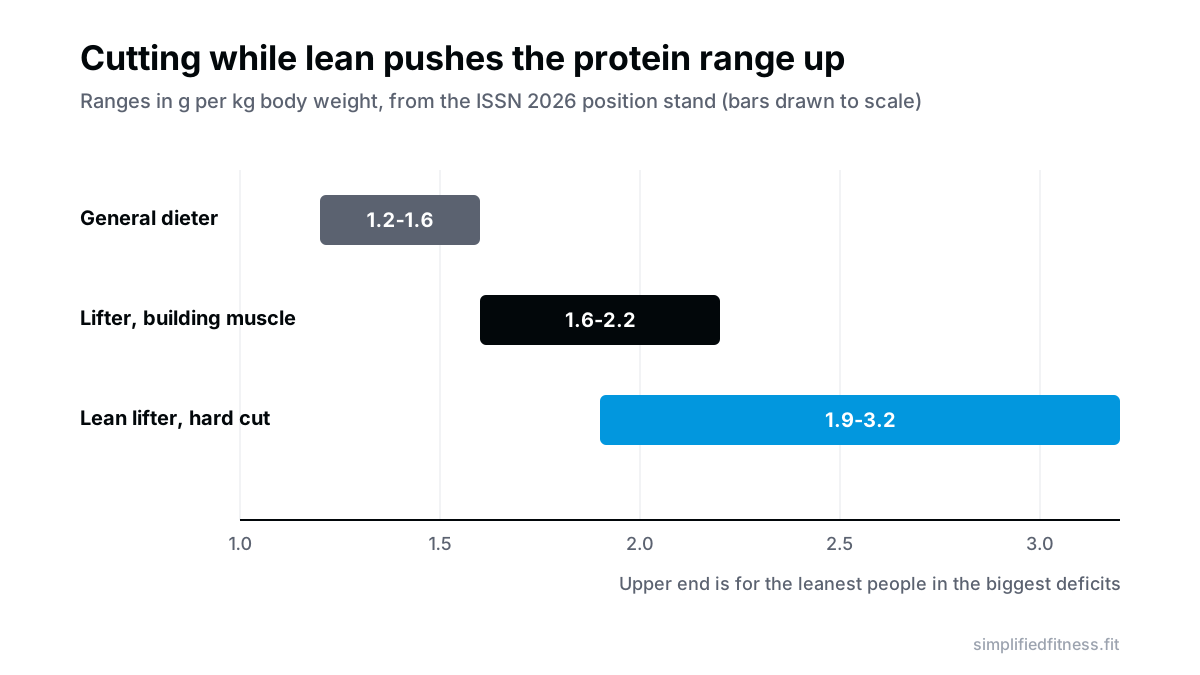
Here is how the main recommendations compare. Note that they use different reference points, so I have shown the unit each one uses.
| Situation | Recommended protein | Source |
|---|---|---|
| General dieter, not especially lean | 1.2-1.6 g/kg body weight | ISSN position stand, 2026 |
| Building muscle with resistance training | 1.6-2.2 g/kg body weight | ISSN position stand, 2026 |
| Lean, resistance-trained, in a deficit | 1.9-3.2 g/kg body weight | ISSN position stand, 2026 |
| Lean contest-style cut | 2.3-3.1 g/kg lean body mass | Helms et al., 2014 |
The ISSN reached its range by saying that, in lean, resistance-trained people sustaining a deficit, intakes of 1.9-3.2 g/kg body weight can maximize lean mass retention (Aragon et al., 2026). The two ranges are close once you convert units, which is reassuring.
How to calculate it from your fat-free mass
Fat-free mass (FFM) is everything that is not fat: muscle, bone, organs, water. It is a better base than total weight for lean people, because fat tissue has little protein requirement. The catch is that you need a body fat estimate, and a scale, a caliper or a smartwatch can easily be off by a few points. Our body fat calculator gives a rough starting figure.
- Estimate FFM: body weight x (1 minus body fat as a decimal).
- Pick a range: 2.3 g/kg FFM at the low end, 3.1 g/kg at the high end.
- Convert to grams and round: choose a target you can actually hit every day.
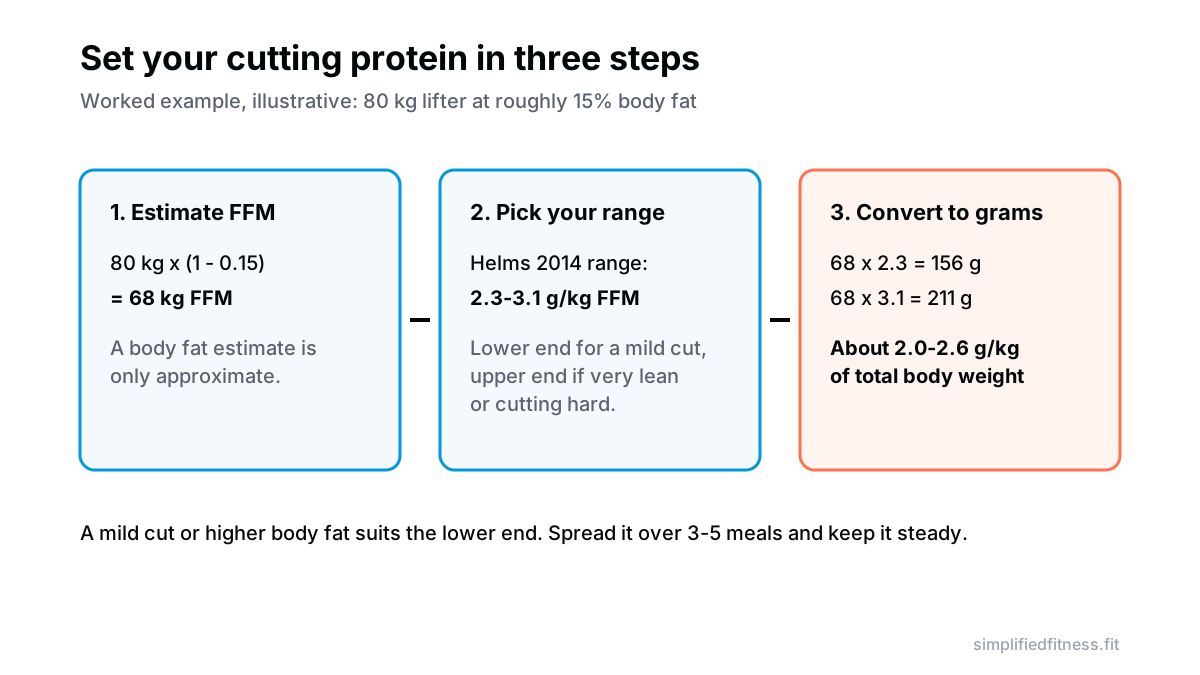
That example is illustrative. If you do not want to do the maths, the protein calculator will do it for you.
What does the evidence say about protein and muscle loss in a deficit?
The cleanest test of the idea comes from McMaster University. Forty young men, all training six days a week with resistance exercise plus high-intensity intervals, ate a diet about 40% below their needs for four weeks. Half ate 1.2 g/kg of protein a day, and half ate 2.4 g/kg (Longland et al., 2016).
The higher-protein group gained 1.2 kg of lean body mass, versus 0.1 kg in the lower-protein group. They also lost more fat: 4.8 kg versus 3.5 kg. Exercise performance improved equally in both.
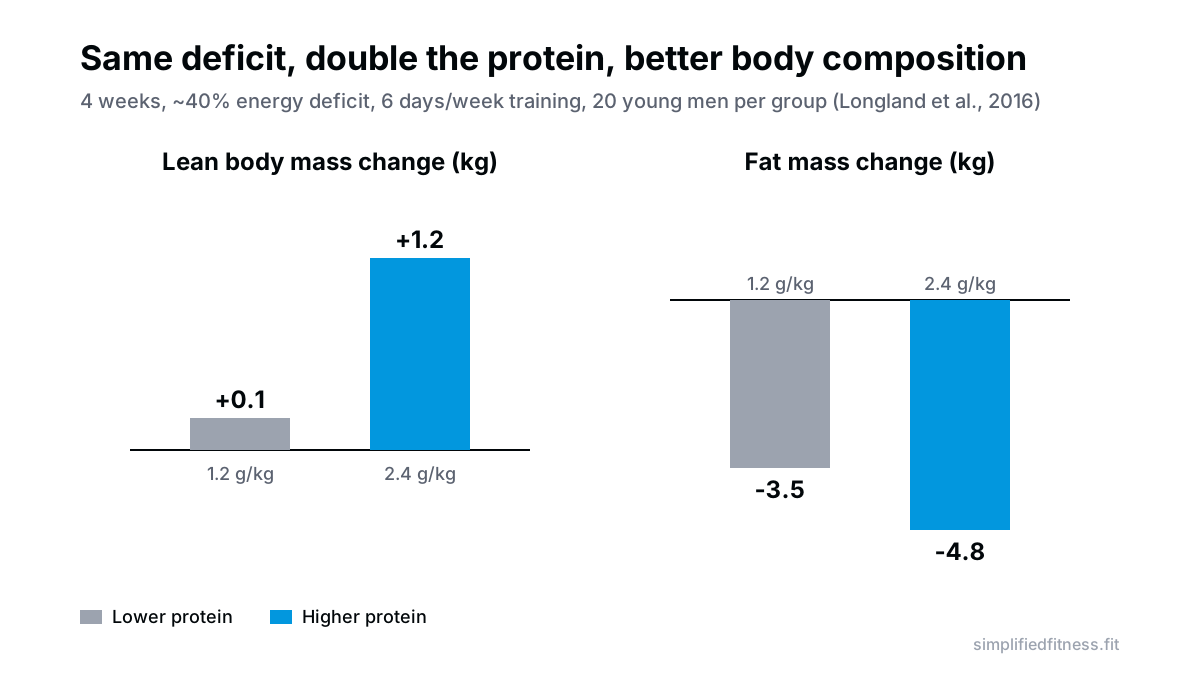
A note on how far to stretch this. These were young men, the trial lasted only four weeks, and the training load was very high. A group at 1.2 g/kg also kept their muscle reasonably well. So the finding is that more protein did better, not that anything lower than 2.4 g/kg will make you shrink.
A broader meta-analysis of 24 trials (1,063 adults, mostly not athletes) found that, versus standard-protein diets, high-protein energy-restricted diets mitigated the loss of fat-free mass by about 0.43 kg and cut fat mass by about 0.87 kg more over an average of 12 weeks (Wycherley et al., 2012). The effect is modest, and it is seen in people who were not necessarily lifting, which is why I treat it as supportive rather than central.
Why high protein also makes cutting easier
Muscle protection is the main reason, but two side benefits are worth knowing about.
Fullness. In the Wycherley meta-analysis, greater satiety was reported with higher protein in 3 of 5 studies that measured it. Reviews describe higher protein as increasing fullness signals and reducing food intake, with gut hormones such as GLP-1 and cholecystokinin involved (Moon et al., 2020). The effect is not guaranteed for everyone, but many people find a protein-first plate keeps evening hunger quieter. We dig into this in our guide to satiety and the thermic effect of protein.
Energy cost of digestion. Protein raises diet-induced thermogenesis, an effect linked to its role in satiety and energy balance (Westerterp-Plantenga, 2008). Protein has a markedly higher thermic effect than carbohydrate or fat, and by helping preserve fat-free mass it helps maintain resting energy expenditure during weight loss (Moon et al., 2020). In the Wycherley analysis, resting energy expenditure fell by roughly 595 kJ a day less on higher protein. That is a small bonus, not a way to eat more.
Protein is not a substitute for lifting
This is a common cutting mistake. People raise protein, drop the weights to “tone”, and wonder why they look flat. The ISSN position stand calls resistance training and sufficient protein “indispensable mitigators” of lean mass loss in a sustained deficit, regardless of the diet type (Aragon et al., 2026). Both are needed.
Keep the loads heavy, keep your key lifts, and adjust volume if recovery drops. Our guide to volume adjustments during cutting covers how to do that. If you do not have a plan yet, start with the free push pull legs programme.
How fast should you cut to keep muscle?
Protein works best alongside a sensible pace. A review of natural bodybuilding contest preparation recommended setting calories to produce body weight losses of roughly 0.5-1% per week to maximise muscle retention, and suggested 15-30% of calories from fat with the remainder from carbohydrate (Helms et al., 2014). The same review suggested 3-6 meals a day with protein around 0.4-0.5 g/kg of body weight before and after resistance training, while noting that meal timing and frequency had little effect on fat loss or lean mass retention.
The ISSN agrees that total daily protein is of primary importance and distribution is secondary, though at least three protein-rich meals may help in active people in a sustained deficit (Aragon et al., 2026). For choosing your deficit, see moderate vs aggressive caloric deficits. For the muscle-building side, our article on optimal daily protein intake covers the non-cutting range.
How to hit a high protein target on an Indian diet
Getting to 2 g/kg or more is easy with eggs, chicken and whey. It is harder if you are vegetarian or on a tight budget. A few practical moves:
- Anchor each meal. Build every meal around a protein source: paneer, eggs, chicken, fish, soya chunks, dal with curd, or a thick Greek-style curd.
- Do not rely on dal and roti alone. They contribute, but you will usually fall short of cutting targets without adding a more concentrated source.
- Use a shake as a gap-filler. A scoop of whey or a plant protein is often the cheapest way to cover the last 20-30 g, not a replacement for meals.
- Prep in batches. Boiled eggs, grilled paneer and sprouts make protein easy when you are tired and hungry. Our high-protein meal prep guide covers costs, and the Indian high-protein nutrition guide lists foods by budget.
- Track for one week. Guesses about protein intake are often off. A week of honest tracking tells you whether you actually need to change anything.
Our diet plan page has meal structures you can adapt.
Is a high-protein diet safe?
For healthy adults, reviews have not reported harm to kidney function or bone density from high-protein diets, though trials lasting beyond 12 months are limited (Moon et al., 2020). That is reassuring, but it is not a green light for everyone.
See a doctor before raising protein if you have kidney disease, reduced kidney function, diabetes with kidney involvement, or you take medication that affects the kidneys. Also speak to a professional if your cut is pushing you toward very low calories, constant fatigue, missed periods or an unhealthy relationship with food. Aesthetic sports carry an increased risk of eating and body image disorders (Helms et al., 2014), and no protein target fixes that.
The bottom line
If you are lean and in a meaningful deficit, aim for roughly 2.3-3.1 g/kg of fat-free mass, or about 2.0-2.6 g/kg of body weight, scaled up as you get leaner or cut harder. If you have more body fat or a gentle cut, the lower end is usually enough. Keep lifting heavy, lose weight at a moderate pace, and spread protein over a few meals.
For the full picture across bulking, maintenance and cutting, head back to the complete protein guide.
Frequently Asked Questions
How much protein should I eat while cutting?
Lean lifters in a real deficit are likely best served by about 2.3-3.1 g of protein per kg of fat-free mass per day, or roughly 2.0-2.6 g/kg of total body weight. This range comes from a systematic review of resistance-trained, lean athletes in energy restriction, and it scales up as you get leaner or cut harder. Start near the lower end and move up only if you are very lean or your deficit is steep.
Do I need more protein when cutting than when bulking?
Probably yes, if you are lean. In a deficit your body has less spare energy to build and protect muscle, and research on lean, trained people suggests higher protein helps limit lean mass loss. If you are carrying a lot of body fat and cutting gently, you may not need to push the intake much beyond your normal muscle-building range.
What is 2.3-3.1 g/kg FFM in normal grams?
Multiply your fat-free mass by 2.3 for the low end and by 3.1 for the high end. An 80 kg lifter at about 15% body fat has roughly 68 kg of fat-free mass, so that is about 156-211 g a day. Treat your body fat estimate as approximate and pick a number you can actually hit.
Is fat-free mass or total body weight better for calculating protein?
Fat-free mass is more logical, because fat tissue does not need much protein, but it relies on a body fat estimate that can be off by several points. Total body weight is simpler and works fine for most people who are not very lean or very overweight. If you use total weight, about 2.0-2.6 g/kg covers the same range for a lifter around 15% body fat.
Will high protein really stop me losing muscle in a deficit?
It helps, but it does not guarantee that you keep every gram of muscle. In the studies reviewed, fat-free mass fell in 9 of 13 groups. The one group that was fairly lean, in a large deficit and not starting a new training program, yet avoided a significant loss, ate the most protein of any group. Pair high protein with heavy lifting and a moderate rate of weight loss for the best odds.
Why does protein need go up when calories are low?
When energy is restricted your body leans more on its stores, and amino acids can be used for energy and glucose instead of being kept for muscle repair. This is a commonly proposed explanation rather than something every study here measured directly. The practical answer is the same: eat more protein than usual and keep lifting.
Does protein make you feel fuller while cutting?
Often, yes. A meta-analysis of energy-restricted diets found greater satiety with higher protein in 3 of 5 studies that measured it, so the effect is real but not universal. Build meals around a protein source such as dal with curd, paneer, eggs or chicken, and see if your hunger becomes easier to manage.
Do I burn more calories digesting protein?
Yes, protein has a higher thermic effect than carbohydrate or fat, and a high-protein diet can help limit the drop in resting energy expenditure that comes with weight loss. The effect is modest, so it is a bonus rather than a fat-loss trick. The main reason to eat it is to protect muscle.
Can I eat 3 g/kg of protein on a cut?
It is within the researched range for lean lifters, though the upper end is for the leanest people in the hardest cuts. Above what you need, extra protein mostly takes up calories you could have spent on carbs that fuel training. Start at 2.0-2.4 g/kg of body weight and only go higher if you are lean and struggling to hold muscle.
Is a high-protein diet bad for my kidneys?
Reviews of healthy adults have not reported harm to kidney function from high-protein diets, though trials longer than 12 months are limited. Your kidneys filter what your body does not use, which is normal and not damage. If you have known kidney disease or a family history, speak to your doctor and get blood work before raising protein.
How should I spread protein across the day while cutting?
The ISSN position stand says total daily protein matters most, and that at least three protein-rich meals may help lean mass retention in active people in a deficit. Aim for roughly 0.4-0.5 g/kg of body weight per meal across 3-5 meals. Use our linked guide on protein distribution if you want to fine-tune it.
How fast should I lose weight while keeping muscle?
A pace of roughly 0.5-1% of body weight per week was recommended in a natural bodybuilding review to maximise muscle retention. Faster than that, and protein plus training have to work harder to protect lean mass. Slow down if your lifts are dropping quickly week to week.
Do vegetarians in India need more protein while cutting?
The same targets apply, but hitting them is harder without eggs or meat. Combine dal, curd, paneer, soya chunks and a whey or plant protein if your budget allows. Track your protein for a week with our protein calculator to see where you really land.
Sources & References
Every claim above is checked against peer-reviewed research (PubMed, U.S. National Library of Medicine) or guidance from established health bodies. How we fact-check.
- Helms ER, et al. A systematic review of dietary protein during caloric restriction in resistance trained lean athletes: a case for higher intakes. Int J Sport Nutr Exerc Metab. 2014. PMID: 24092765
- Helms ER, et al. Evidence-based recommendations for natural bodybuilding contest preparation: nutrition and supplementation. J Int Soc Sports Nutr. 2014. PMID: 24864135
- Longland TM, et al. Higher compared with lower dietary protein during an energy deficit combined with intense exercise promotes greater lean mass gain and fat mass loss: a randomized trial. Am J Clin Nutr. 2016. PMID: 26817506
- Aragon AA, et al. International Society of Sports Nutrition position stand: diets for body weight reduction. J Int Soc Sports Nutr. 2026. PMID: 42867412
- Wycherley TP, et al. Effects of energy-restricted high-protein, low-fat compared with standard-protein, low-fat diets: a meta-analysis of randomized controlled trials. Am J Clin Nutr. 2012. PMID: 23097268
- Westerterp-Plantenga MS. Protein intake and energy balance. Regul Pept. 2008. PMID: 18448177
- Moon J, et al. Clinical evidence and mechanisms of high-protein diet-induced weight loss. J Obes Metab Syndr. 2020. PMID: 32699189

Umair Hazrami · Founder & Head Coach, Simplified Fitness
Umair Hazrami founded Simplified Fitness and the Simplified Lifter channel to cut through fitness noise. With 4+ years of consistent training and 10+ coaching clients, he writes every guide from the peer-reviewed research and links the sources so you can check them. Our editorial standards.
Educational content only, not medical advice. If you have a medical condition, are pregnant, or take medication, talk to a qualified doctor before changing your diet, supplements or training. Full disclaimer.
Keep reading
Nutrition
The Anabolic Window Myth: Do You Really Need a Shake Within 30 Minutes?
The anabolic window myth, debunked: what meta-analyses show about the 30-minute post-workout shake, how wide your real window is, and when timing still matters.
8 min read

Nutrition
Casein Protein: Slow Digestion, Nighttime Satiety and Muscle Growth
Casein protein benefits for muscle growth: how slow digestion works, what pre-bed trials show, casein vs whey, satiety on a cut and a curd pudding recipe.
8 min read
Nutrition
Collagen Protein: Joint and Tendon Support vs Muscle Building Protein
Does collagen protein build muscle? Here is why 20 g of collagen should not count toward your daily protein goal, and where it may help tendons and joints.
8 min read

Nutrition
Protein Distribution: 3 Meals vs 5 Meals and the 'Muscle Full' Effect
Protein distribution throughout the day: do you need 5-6 meals for muscle? See what research says on 3 vs 5 meals, the muscle full effect and grams per meal.
9 min read