Protein Distribution: 3 Meals vs 5 Meals and the 'Muscle Full' Effect
Protein distribution throughout the day: do you need 5-6 meals for muscle? See what research says on 3 vs 5 meals, the muscle full effect and grams per meal.

TL;DR. The short answer
- Three to five protein-containing meals a day work about equally well for muscle. An 8-week trial in trained men found similar lean mass and strength gains with 3 versus 5 protein-rich meals when total protein matched.
- A sensible per-meal target is about 0.4 g/kg body weight (roughly 24-36 g for a 60-90 kg lifter) across at least four meals, with up to 0.55 g/kg per meal if your daily total is higher.
- The 'muscle full' effect is real in short lab studies: muscle protein synthesis rises, then falls back to baseline within a few hours even while amino acids are still in the blood. It does not mean extra protein is wasted.
- Skewing most of your protein into dinner looks worse than eating it evenly (25% lower 24-hour muscle protein synthesis in one small crossover study), but the long-term effect on muscle size is unproven.
- Eating every 2-3 hours is not required. Pick 3-4 meals you can actually stick to, put a real protein source in each, and hit your daily total first.
Part of our complete guide: Complete Protein Guide: How Much, What Type, and When to Eat It for Muscle Growth
Table of contents
Protein distribution throughout the day matters a little, but eating protein every two hours does not. Three to five meals, each with a proper serving of protein, build muscle about equally well as long as your daily total is right.
Somewhere along the way, gym culture decided that muscle needs a feeding every 2-3 hours or it starts “going catabolic.” The research does not support that. It does suggest that spreading protein across the day beats cramming most of it into dinner. This article is a cluster of our complete protein guide for hypertrophy, and it covers what the studies show, what the “muscle full” effect really is, and how to set up your own meals.
Does protein distribution throughout the day actually matter?
Yes, a little, and mostly in the extremes. The two sides of the argument both have real data behind them, so here is each one.
The case for spreading it out. Muscle protein synthesis (MPS) is the process of building new muscle protein. A meal containing enough protein switches it on for a few hours. Eat protein a few times a day and you get a few of those windows. In a 2014 crossover study of 8 healthy adults, researchers fed everyone the same total protein two ways: evenly (about 30 g at each of three meals) or skewed (about 11 g, 16 g and 63 g). The 24-hour MPS rate was 25% higher on the even pattern (Mamerow et al., 2014).
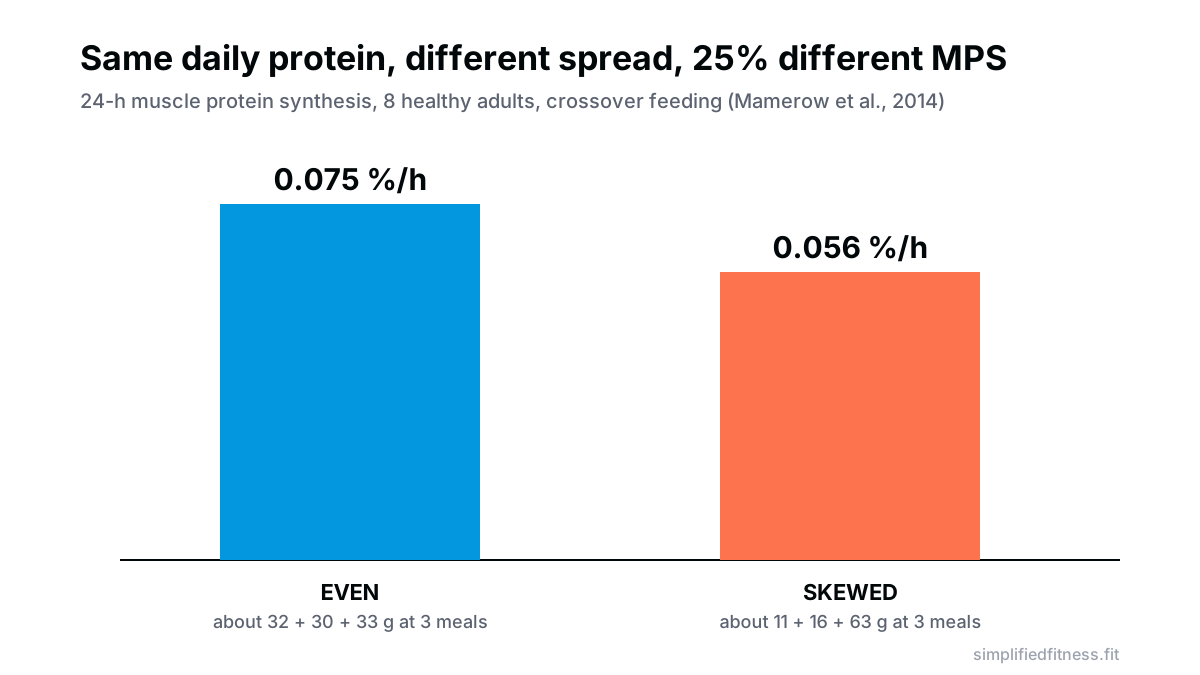
The case against obsessing. That study measured MPS, not muscle size, and it had only 8 people over a short period. When researchers measure actual growth, the picture is far less dramatic. We get to that next.
3 meals vs 5 meals: what happens to actual muscle?
The most direct test I found is a 2025 randomized trial in 32 young resistance-trained men who followed the same training for 8 weeks. One group ate three protein-rich meals a day (PRO3x), the other five (PRO5x), with similar total protein (Tavares et al., 2025).
Both groups improved. Lean mass rose by about 1.15 kg in the 3-meal group and 0.63 kg in the 5-meal group, but the groups did not differ significantly on lean mass, muscle cross-sectional area or knee extension strength. The authors concluded that eating protein three or five times a day is equally effective, provided energy and per-meal amounts are adequate.
Two honest caveats. Only 18 of the 32 men completed the study, and it was labelled non-controlled, so it is a useful signal rather than the last word. Still, it points the same way as the broader meal-frequency literature. A meta-analysis of 15 studies on meal frequency and body composition first suggested a benefit from more frequent eating, but a sensitivity analysis showed the result came from a single study, and the authors said the findings should be read with circumspection (Schoenfeld et al., 2015). That review looked at fat and lean mass broadly, not protein timing specifically.
What is the “muscle full” effect?
This is where the 2-3 hour myth gets its fuel, and it has a real scientific root.
Researchers noticed that when you flood muscle with amino acids, MPS shoots up, peaks, and then drops back toward baseline even while amino acids are still elevated in the blood. That plateau is called the muscle full effect. The muscle has responded and is, for the moment, not asking for more.
A clean human example comes from a 2017 study of 16 men around 70 years old. After a 15 g essential amino acid feed, MPS rose from about 0.05% per hour to about 0.085% per hour in the 90-180 minute window, then returned to baseline after 180 minutes. Giving 3 g of extra leucine at 90 minutes kept amino acids in the blood higher for longer, but did not keep MPS elevated (Mitchell et al., 2017). The authors concluded muscle is refractory to further nutrient-driven stimulation during that postprandial period.
Two limits to keep in mind. Participants were older men, and the stimulus was a modest 15 g amino acid dose, not a full mixed meal. Younger lifters eating a normal meal may behave differently.
Does muscle full mean extra protein is wasted?
No, and this is where people overcorrect. “Muscle full” is about how long MPS stays high. It is not a claim that the gut or muscle can only handle 20-30 g.
A 2023 tracer study gave young men either 25 g or 100 g of protein after exercise. The 100 g dose produced a greater and more prolonged anabolic response (beyond 12 hours) than 25 g, with a negligible effect on amino acid oxidation (Trommelen et al., 2023). So bigger servings are not simply flushed away. We dig into this in protein absorption ceilings: can you absorb more than 30 g?.
Notice what this does and does not tell you. It shows a large serving can be used. It does not show that one giant meal beats several moderate ones for gaining muscle over months. For the underlying time course, see our muscle protein synthesis timeline.
So what pattern is best? The 3-hour middle path
Put the acute studies together and a middle path emerges. In 24 trained men, researchers gave 80 g of whey over 12 hours after a workout in three patterns: 8 doses of 10 g every 1.5 hours (PULSE), 4 doses of 20 g every 3 hours (INT), or 2 doses of 40 g every 6 hours (BOLUS). All three raised MPS, but the 20 g every 3 hours pattern gave 31-48% greater MPS than the other two (Areta et al., 2013).
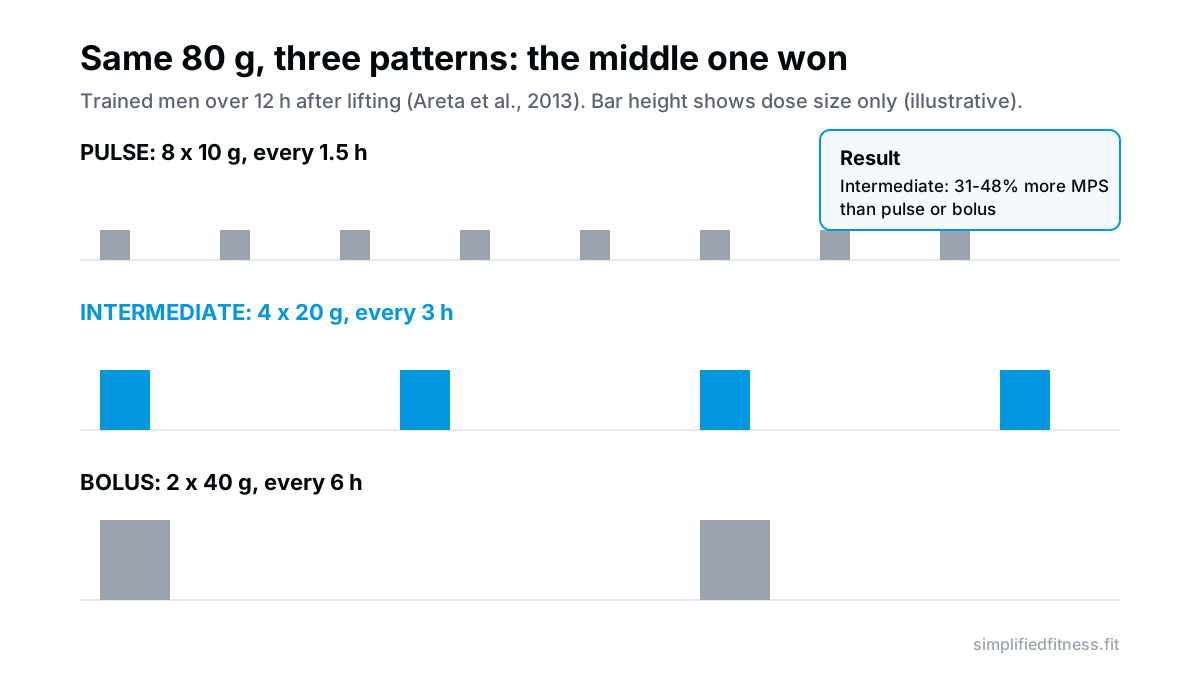
That fits the muscle full idea. Constant small doses (close to the 2-hour bodybuilder routine) may never push MPS high enough, while very infrequent large ones leave long gaps. The study only tested 1.5, 3 and 6 hour spacing, so spacing meals roughly 3-5 hours apart is a reasonable reading rather than a tested rule. Again, this was an acute study using whey, with MPS as the outcome.
How many grams of protein per meal?
The most practical guideline comes from a 2018 review by Schoenfeld and Aragon. They concluded that to maximise anabolism, you should eat about 0.4 g/kg body weight per meal across at least four meals, which reaches a minimum of 1.6 g/kg/day. If you use the upper daily intake of 2.2 g/kg/day across four meals, that works out to a maximum of 0.55 g/kg per meal (Schoenfeld & Aragon, 2018).
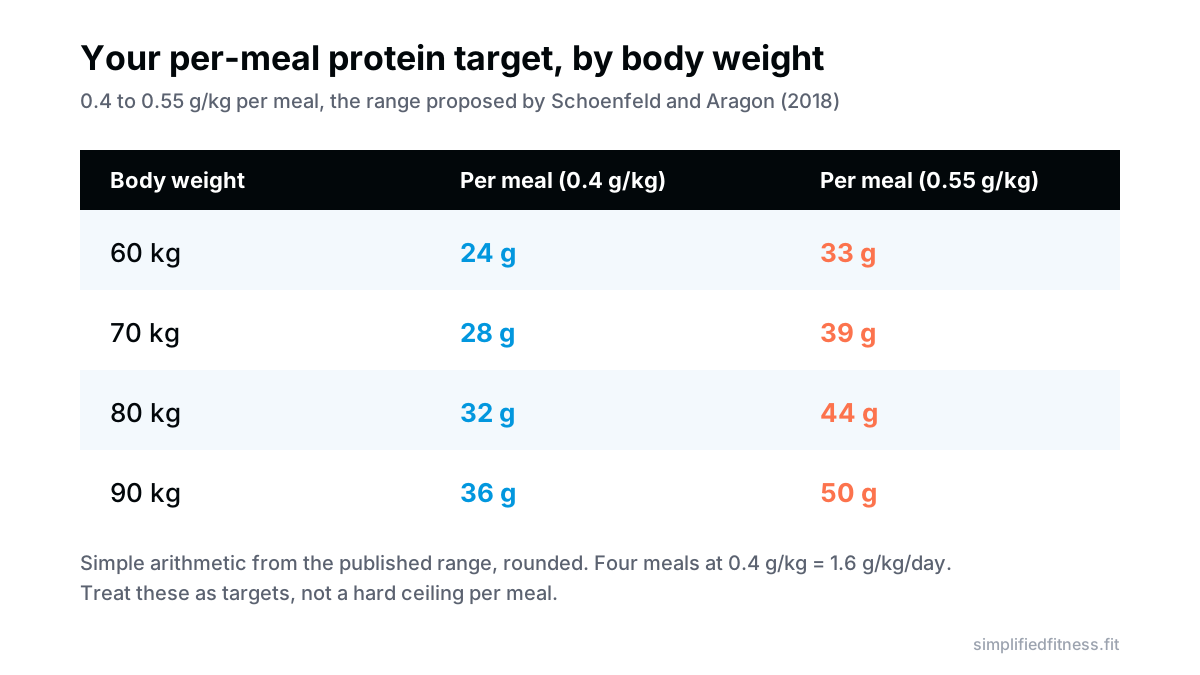
Note that the review proposes four meals as a minimum for that exact maths, while the 2025 trial shows three protein-rich meals can work too. Both can be true: three bigger meals simply need to be bigger. A 70 kg lifter eating 1.6 g/kg (112 g) in three meals needs about 37 g each. Work out your own daily number with the protein calculator.
Does the pattern change in older adults?
Older people often need more protein per sitting to switch on MPS, a concept covered in our article on protein needs in older adults. That said, the evidence on distribution is not clear-cut. A 2024 systematic review of 38 trials in adults aged 65+ found protein supplementation improved muscle mass in community-dwelling older adults, but the effect did not differ by dose, frequency or timing subgroups (Hettiarachchi et al., 2024). Data in hospitalised and institutionalised groups were limited.
If you are an older lifter, the safe move is a solid protein serving at every meal. If you have kidney disease or another medical condition, check your protein target with your doctor before raising it.
A practical Indian day of eating
Many Indian days start with a carb-heavy, low-protein breakfast and load protein (if any) into dinner, close to the skewed pattern the Mamerow team described as common. Here is what a 70 kg vegetarian-plus-eggs lifter aiming at about 112 g could do over four meals of roughly 25-35 g each (amounts are approximate and vary by portion and brand):
- Breakfast: 3 whole eggs plus a moong dal chilla, or 2 rotis with paneer bhurji. (See high-protein Indian breakfast ideas.)
- Lunch: a big bowl of dal, 200 g curd, 2 rotis and sabzi, topped up with about 30 g dry soya chunks (roughly 15 g protein) if you can.
- Evening snack: a whey scoop in milk. Roasted chana with a glass of milk is cheaper but closer to 15 g, so make lunch or dinner bigger if you go that route.
- Dinner: 150 g chicken, fish or 150 g paneer, with rice or roti and veg.
Three meals also work. Just scale each up to roughly 35-40 g. A non-vegetarian lifter can swap in chicken or fish at lunch and dinner.
Common mistakes with protein distribution
- Chasing the clock. Alarms every 2 hours add stress and no proven muscle. Consistency beats precision.
- Saving all protein for dinner. It works to a degree, but you leave a long daytime gap with little signal.
- Forgetting total intake. All of this is a refinement. Daily total comes first, and our guide to daily protein intake for hypertrophy covers that number.
- Ignoring the last meal. If you finish eating early, a protein-rich snack before bed fills the overnight gap (see pre-bed protein ingestion).
- Overthinking the post-workout window. Distribution matters more than a stopwatch around the workout. Our article on the anabolic window myth explains why.
The bottom line
Protein distribution throughout the day is a second-order lever. First, hit your daily protein. Second, spread it across three to five meals, aiming for roughly 0.4 g/kg per meal (about 25-40 g for most lifters). Third, make breakfast count if it is currently empty.
The muscle full effect is real but modest, and it argues for spacing your protein, not for eating every 2 hours. Choose the schedule you can repeat for years, and spend your attention on training and total protein. If you have a medical condition or are unsure what protein level is right for you, speak to a doctor or registered dietitian.
Frequently Asked Questions
Do I need to eat protein every 2-3 hours to build muscle?
No, eating protein every 2-3 hours is not required to build muscle. A 2025 randomized trial in trained men found that 3 protein-rich meals and 5 protein-rich meals produced similar gains in lean mass, muscle size and strength over 8 weeks when daily protein matched. Aim for 3-4 meals with a decent protein serving each and stop stressing about the clock.
How many meals a day is best for muscle growth?
Three to five meals a day all work, and the best number is the one you can sustain. Reviews suggest at least four feedings of about 0.4 g/kg protein reach 1.6 g/kg/day, but trials show 3 meals can do equally well when each is protein-rich. Choose the pattern that fits your schedule and appetite, then keep daily protein consistent.
What is the muscle full effect?
The muscle full effect describes how muscle protein synthesis rises after a protein meal and then returns to baseline even though amino acids are still circulating. In a study of older men, synthesis peaked 90-180 minutes after an amino acid feed and was back at baseline after 180 minutes, and an extra leucine dose at 90 minutes did not extend it. In practice, this is a reason to space protein feedings across the day rather than to eat constantly.
Is the muscle full effect the same as a protein absorption limit?
No, they are different ideas. Muscle full refers to how long muscle protein synthesis stays switched on, while an absorption limit would mean your gut cannot take up more than a set amount. A 2023 tracer study found that 100 g of protein produced a larger and longer anabolic response than 25 g, so large servings are not simply wasted. See our guide on protein absorption ceilings for the full picture.
How much protein should I eat per meal?
A practical target is about 0.4 g/kg per meal, rising to as much as 0.55 g/kg if your daily intake is near 2.2 g/kg. That is roughly 24-36 g for a 60-90 kg lifter at the lower end, according to a 2018 review by Schoenfeld and Aragon. Use the protein calculator to get your daily total, then divide it by the number of meals you eat.
Is it bad to eat most of my protein at dinner?
It is probably not ideal, but it is not a disaster. In a small crossover study, 24-hour muscle protein synthesis was 25% higher with an even spread (about 30 g at each of three meals) than with a dinner-heavy pattern (about 63 g at dinner), though that study measured synthesis rather than long-term muscle gain. If your breakfast is just chai and a biscuit, adding eggs, curd or paneer is the easiest fix.
Can I eat my protein in one or two big meals?
You can, and you will still build muscle if total daily protein is adequate. Intermittent-fasting-style eating compresses protein into fewer sittings, and the acute research suggests very large servings still drive a strong anabolic response, but evidence on long-term muscle growth with one or two meals is limited. If you eat two meals, make each one a proper 40 g or more protein serving and consider a protein snack.
Does protein timing matter more than total protein?
No, total daily protein matters more than timing or distribution. Distribution is a refinement that may help at the margins, particularly if you eat very little protein at breakfast and lunch. Fix the daily total first, then spread it sensibly.
Is eating 6 small meals better for fat loss or muscle?
Probably not. A meta-analysis of 15 studies found that higher meal frequency looked beneficial for body composition at first, but the result depended on a single study, so the authors urged caution. If you like six small meals they work, but they are not a metabolic advantage.
Does the muscle full effect apply to older adults?
It was demonstrated in older men (about 70 years) in the key amino acid study, but the practical advice for older adults is similar: spread decent protein servings across the day. A 2024 meta-analysis of 38 trials in adults aged 65 and over found muscle gains from protein supplementation, but no clear difference by dose, frequency or timing. Older lifters should focus on reaching their daily total and including protein at every meal.
Do I need a protein shake to make each meal count?
No, a shake is a convenience, not a requirement. Whole foods such as eggs, dal with curd, paneer, chicken, fish and soya chunks can all deliver 20-40 g of protein per meal. Use a shake when a meal would otherwise fall short, for example after a morning workout when you have no time to cook.
What should I do if I only eat two meals because of Ramadan or fasting?
Fasting windows limit how many meals you can fit, but muscle can still be maintained or built if total protein and training are adequate. Evidence on protein spread within shortened eating windows is limited, so it is hard to be precise. Split your protein across the meals you have, for example iftar, a late snack and suhoor, and keep servings protein-rich.
Does eating protein before bed count as another meal?
Yes, a protein-rich last meal or snack counts toward your distribution and helps cover the long overnight gap. It is a useful addition when your last meal is early or small. Our guide to pre-bed protein covers the evidence and food choices.
Sources & References
Every claim above is checked against peer-reviewed research (PubMed, U.S. National Library of Medicine) or guidance from established health bodies. How we fact-check.
- Schoenfeld BJ, et al. How much protein can the body use in a single meal for muscle-building? Implications for daily protein distribution. J Int Soc Sports Nutr. 2018. PMID: 29497353
- Areta JL, et al. Timing and distribution of protein ingestion during prolonged recovery from resistance exercise alters myofibrillar protein synthesis. J Physiol. 2013. PMID: 23459753
- Mamerow MM, et al. Dietary protein distribution positively influences 24-h muscle protein synthesis in healthy adults. J Nutr. 2014. PMID: 24477298
- Tavares H, et al. Effects of daily protein intake frequency during 8 weeks of resistance training on lean mass and strength adaptations: a randomized non-controlled clinical trial. J Sports Med Phys Fitness. 2025. PMID: 40673785
- Trommelen J, et al. The anabolic response to protein ingestion during recovery from exercise has no upper limit in magnitude and duration in vivo in humans. Cell Rep Med. 2023. PMID: 38118410
- Mitchell WK, et al. Human skeletal muscle is refractory to the anabolic effects of leucine during the postprandial muscle-full period in older men. Clin Sci (Lond). 2017. PMID: 28982725
- Schoenfeld BJ, et al. Effects of meal frequency on weight loss and body composition: a meta-analysis. Nutr Rev. 2015. PMID: 26024494
- Hettiarachchi J, et al. The effect of dose, frequency, and timing of protein supplementation on muscle mass in older adults: a systematic review and meta-analysis. Ageing Res Rev. 2024. PMID: 38830547

Umair Hazrami · Founder & Head Coach, Simplified Fitness
Umair Hazrami founded Simplified Fitness and the Simplified Lifter channel to cut through fitness noise. With 4+ years of consistent training and 10+ coaching clients, he writes every guide from the peer-reviewed research and links the sources so you can check them. Our editorial standards.
Educational content only, not medical advice. If you have a medical condition, are pregnant, or take medication, talk to a qualified doctor before changing your diet, supplements or training. Full disclaimer.
Keep reading

Nutrition
The Anabolic Window Myth: Do You Really Need a Shake Within 30 Minutes?
The anabolic window myth, debunked: what meta-analyses show about the 30-minute post-workout shake, how wide your real window is, and when timing still matters.
8 min read

Nutrition
Casein Protein: Slow Digestion, Nighttime Satiety and Muscle Growth
Casein protein benefits for muscle growth: how slow digestion works, what pre-bed trials show, casein vs whey, satiety on a cut and a curd pudding recipe.
8 min read
Nutrition
Collagen Protein: Joint and Tendon Support vs Muscle Building Protein
Does collagen protein build muscle? Here is why 20 g of collagen should not count toward your daily protein goal, and where it may help tendons and joints.
8 min read

Nutrition
Fast vs Slow Absorbing Proteins: Digestion Rates and Muscle Protein Breakdown
Fast vs slow digesting protein for hypertrophy: how whey and casein differ in amino acid release, what the tracer studies show, and how to combine them.
8 min read