Carbohydrates, Fats, Fibre, Micronutrients and Hydration: The Lifter's Fueling Guide
Carbohydrates for lifting performance, dietary fat and testosterone, hydration, sodium and micronutrients: what the research shows and what to do about it.
TL;DR. The short answer
- Carbohydrates for lifting performance matter less than gym lore claims. A 2022 review of 49 trials found carb intake rarely changed strength performance in sessions of up to about 10 sets per muscle, though very high volume or fasted training may benefit.
- Ketogenic diets have neutral to negative effects on athletic performance in the ISSN position stand, and in one trial of natural bodybuilders lean mass rose only on the regular diet.
- Very low fat intake appears to lower testosterone modestly. A meta-analysis of 6 trials (206 men) found lower total testosterone on low-fat diets, but more trials are needed.
- In a small study of seven trained men, dehydration of about 2.5% body mass or more reduced work done in later squat sets. Effects on single maximal efforts are inconsistent across studies.
- Sodium does not directly build a pump. Hydrate, eat normal-salt meals, and see a doctor if you have high blood pressure or kidney disease before changing salt intake.
Table of contents
Carbohydrates for lifting performance matter, but far less than the “no carbs, no pump, no gains” crowd claims. For most people training once a day, carbs mainly keep the last few sets of a high-volume session strong. They are not a switch that turns muscle growth on.
Protein gets all the attention. This guide covers the rest of your plate: carbs, dietary fat, fibre, micronutrients, water and salt. We will go through what the research actually shows, where it is shaky, and what to eat in a normal Indian kitchen. (Calories come first, so start with energy balance for fat loss, bulking and recomposition, and protein is covered in the complete protein guide for hypertrophy.)
Do carbohydrates for lifting performance actually matter?
Sometimes. The honest answer depends on how much work you do in a session.
A 2022 systematic review pooled 49 trials that changed carbohydrate intake and then measured strength, resistance training performance or power. Most participants were strength trainees or athletes. When carbs were given acutely, they did not improve performance in 13 studies and improved it in six, mostly where the comparison group was fasted and the workout had more than 10 sets per muscle group. There was no evidence of a dose-response effect. In the 17 longer-term studies, performance was not influenced by carb intake in 15, with one favouring higher carbs and one favouring lower carbs (Henselmans et al., 2022).
The authors’ conclusion is worth reading slowly. Carbohydrate intake per se is unlikely to affect strength training performance in a fed state in workouts of up to 10 sets per muscle group. Higher volumes may benefit, but more studies with proper controls are needed.
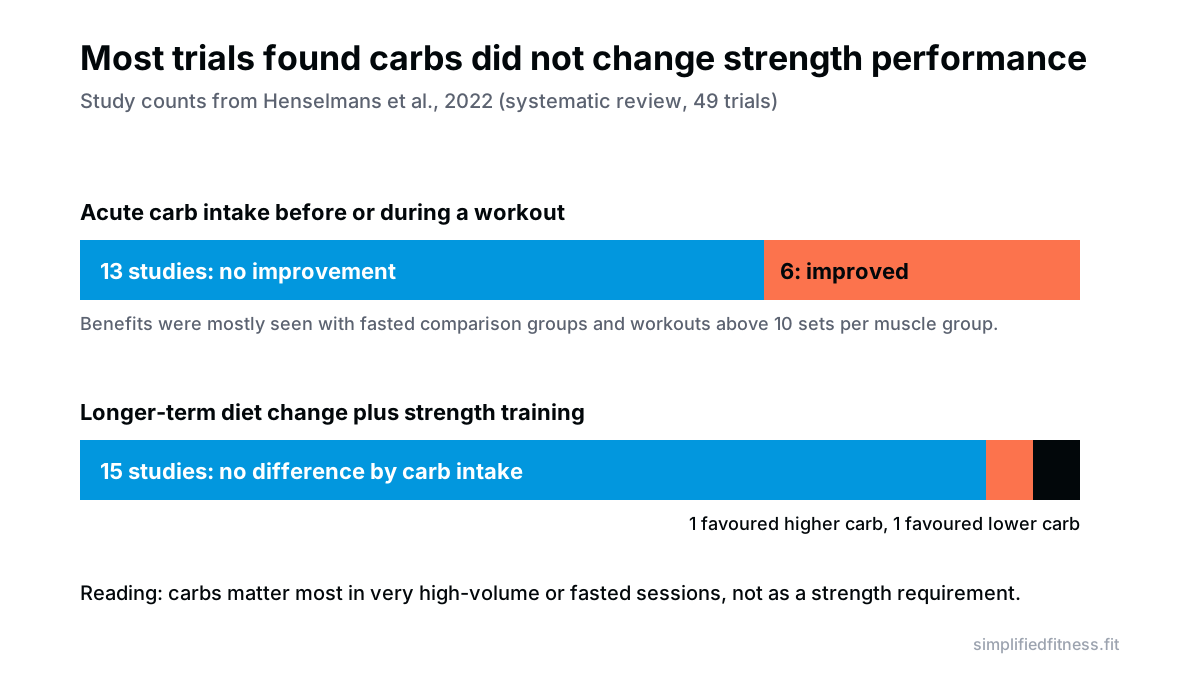
That does not mean carbs are useless. It means the effect is conditional, and the condition is training volume and timing. If you do 6 hard sets for chest and 6 for triceps, a rice-versus-no-rice debate is mostly noise. If you stack 18 sets for legs in one sitting, your fuel tank is more likely to matter.
Two things to keep in mind. First, most of these trials are short, and a short trial cannot tell you what months of low intake does to training quality, mood or adherence. Second, a result that says “no difference in performance” does not say “no difference in how you feel.” Some people simply train better, and enjoy training more, with a decent amount of carbs.
What happens to muscle glycogen when you lift?
Glycogen is the form your muscles store carbohydrate in. Running hard sets draws it down.
A 2025 meta-analysis of 20 studies (168 men and 12 women) found a significant drop in vastus lateralis (outer quad) glycogen after a single resistance session. The drop was larger with more sets and longer sessions, and smaller with higher intensity. Depletion was greater with varied intensity than fixed intensity, and, in these studies, slightly greater in untrained than trained participants (Hamidvand et al., 2025).
Note what this does and does not say. It says a session depletes glycogen, and volume drives it. It does not say how low is too low for performance, and it measured the quads only. Be wary of anyone quoting a neat “you lose 40% of your glycogen” figure as if every muscle and every workout behaves the same.
Practically, here is how it plays out:
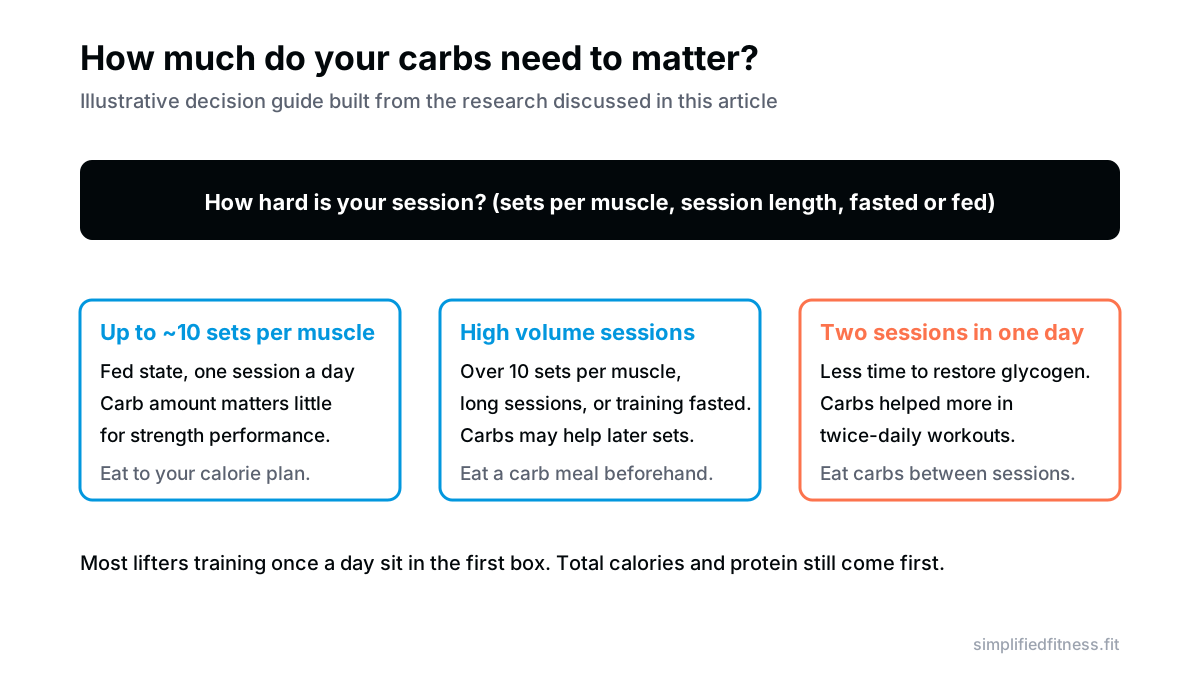
- Short, heavy sessions (a few hard sets per muscle): glycogen dips, but usually not enough to limit you.
- Long, high-set sessions (say 15-20 or more sets for one big muscle group): later sets are where a carb shortfall tends to show up as faster fatigue.
- Two sessions in one day: you have less time to restore glycogen, and this is where the reviewed studies were most supportive of carbs.
If you want the deeper breakdown of glycogen, resynthesis and carb quantities, see our guide on dietary carbohydrates, hypertrophy and glycogen. Speed and food choice get their own article in glycemic index versus glycemic load, and whether sipping carbs mid-session is worthwhile is covered in intra-workout carbohydrates.
Low-carb and keto diets for lifters
Keto is popular because it often works for scale weight. The question here is lifting.
The International Society of Sports Nutrition (ISSN) position stand defines a ketogenic diet as generally under about 50 g of carbohydrate a day. It concludes that a ketogenic diet has largely neutral or detrimental effects on athletic performance compared with a higher-carb, lower-fat diet. On strength, it tends to have similar effects on maximal strength or strength gains from resistance training, though a minority of studies favour non-ketogenic comparators. It also notes that keto may cause greater losses in body weight, fat mass and fat-free mass, likely because of differences in calories, protein and fluid shifts (Leaf et al., 2024).
One trial gets quoted a lot. Nineteen competitive natural bodybuilders were randomly assigned to a ketogenic diet or a Western diet for two months. Fat mass fell in the keto group, and lean mass rose significantly only in the Western diet group. Maximal strength rose similarly in both groups. The authors cautioned that the hypertrophic response could be blunted (Paoli et al., 2021). It is a small trial, so treat it as a signal rather than proof.
So who might still choose low-carb? People who like it, feel full on it and can hold their calories and protein steady. If that is you, the practical advice is to keep training volume realistic, track lean mass or strength rather than only scale weight, and speak to a doctor if you have diabetes or take medication. We cover this properly in low-carb and ketogenic diets for lifters.
How to set carbs in an Indian diet
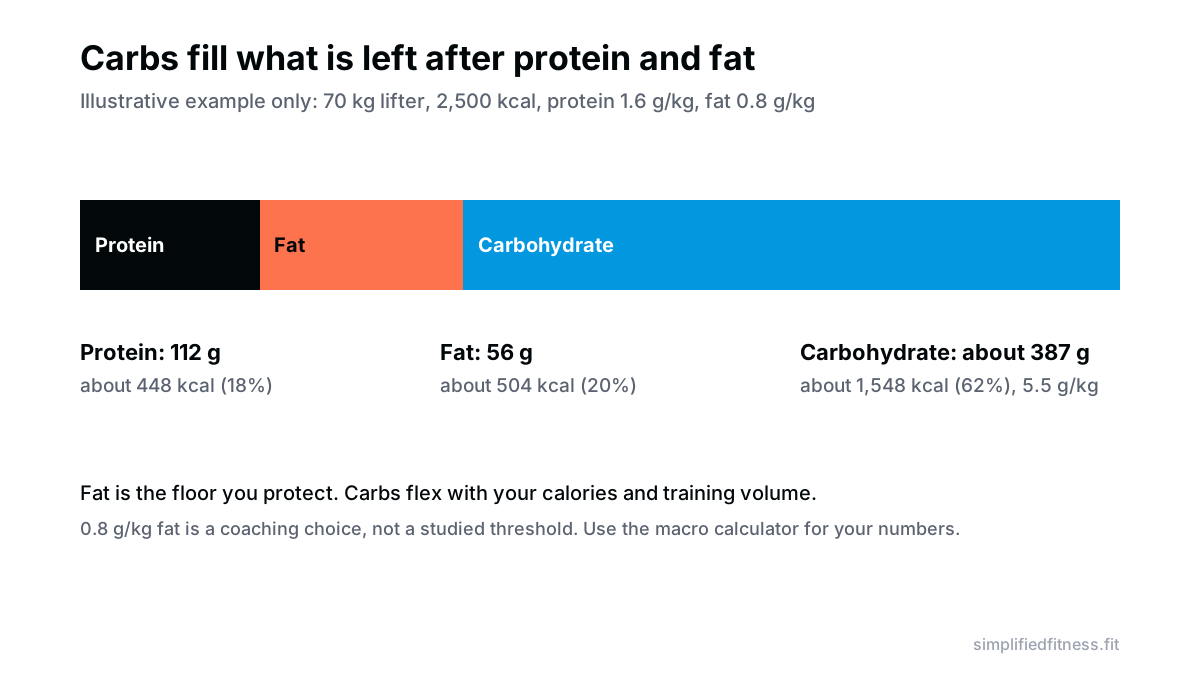
Here is the simple approach. Set protein, set fat, and let carbs take the remaining calories. Then adjust.
Say a 70 kg lifter eats 2,500 kcal. Protein at 1.6 g/kg is about 112 g. Fat at 0.8 g/kg is 56 g. That leaves roughly 387 g of carbs, or about 5.5 g/kg. This is an illustration, not a prescription. The 1.6 and 0.8 are practical coaching choices, and your own numbers will differ.
Use the macro calculator to get a version for your own weight and goal, or look at the free Indian diet plan for how this looks on a plate.
Carb sources that fit most budgets and kitchens:
- Rice and roti: cheap, easy to scale up or down with your calories.
- Poha, upma, oats, idli, dosa: good pre-training breakfasts that are not heavy.
- Potato, sweet potato, banana: simple, portable and fast to digest.
- Dal, rajma, chana, chole: carbs plus protein plus fibre, a three-for-one.
- Fruit and curd: easy extras that also add potassium.
There is no need to eat carbs in a perfect pre- or post-workout window if you are fed and training once a day. If you train very early on an empty stomach and your last sets fall off, a banana or a small bowl of poha 30-45 minutes earlier is a reasonable, cheap test. Keep the meal low in fibre and fat so it sits comfortably.
Dietary fat and testosterone: how low is too low?
Fat is where most hormone myths live. Here is the evidence, with the limits attached.
A 2021 systematic review and meta-analysis looked at intervention studies comparing low-fat with higher-fat diets in men. Six studies with 206 participants were eligible. Total testosterone, free testosterone, urinary testosterone and dihydrotestosterone were all significantly lower on low-fat diets, while luteinising hormone and sex hormone binding globulin did not differ significantly. The authors concluded that low-fat diets appear to decrease testosterone, but that further randomized trials are needed (Whittaker and Wu, 2021).
An older observational study of eight strength athletes and ten active non-athletes found that basal testosterone correlated positively with fat intake and negatively with protein intake. The authors suggested diets with insufficient fat or excessive protein may compromise the anabolic hormonal environment (Sallinen et al., 2004). That is a small correlation study, so it cannot prove cause. We mention it because it shows why people worry about very low-fat, very high-protein diets.
What do these add up to? A reasonable, hedged read is that very low fat intake can nudge testosterone down, and that “enough fat” is a sensible default. They do not show that adding more fat on top of a moderate intake keeps raising testosterone, and a small shift in blood testosterone within the normal range has not been shown to change how much muscle a healthy lifter builds.
Fat types are their own topic. See dietary fats, hormone production and the minimum fat threshold and saturated versus unsaturated fats and lipid profiles.
Where do omega-3s fit?
Omega-3 fatty acids (EPA and DHA) are popular in muscle-building circles. The evidence for muscle gain is thin.
A 2026 systematic review and meta-analysis of randomized placebo-controlled trials in healthy adults without obesity pooled four studies for fat-free mass and eight for strength. It found no clear evidence of an effect on fat-free mass (SMD 0.26, 95% CI -1.14 to 1.66) or on strength (SMD -0.02, 95% CI -0.38 to 0.34), and graded the certainty of evidence as very low (Silva et al., 2026).
The honest reading: omega-3 is not a proven muscle builder, and the evidence base is small. If you eat fish a couple of times a week, or take a supplement for general health, fine. Do not buy it expecting extra size. Dosing and general benefits are covered in omega-3 fatty acids, EPA and DHA dosing.
How much fibre do lifters need?
Fibre is the macro-adjacent nutrient most lifters under-eat, especially on high-protein, low-vegetable diets.
The NHS says government guidelines recommend 30 g of fibre a day for adults (NHS). A 2024 meta-analysis of 64 prospective cohort studies (3,512,828 people) found that higher total fibre intake was associated with 23% lower all-cause mortality, 26% lower cardiovascular mortality and 22% lower cancer mortality (Ramezani et al., 2024). These are observational associations, so fibre may partly be a marker of an overall healthier diet.
Good Indian sources are already on your plate: dal, rajma, chana, whole wheat roti, vegetables, fruit, oats, nuts and seeds. Swap some white rice for a mix of rice and dal, add a salad or sabzi to lunch and dinner, and snack on fruit or roasted chana.
Two practical notes. Raise fibre gradually, or your gut will complain. And keep your pre-workout meal low in fibre. Our dietary fibre guide covers soluble versus insoluble fibre, and the gut microbiome article covers bloating.
Does hydration affect strength?
Yes, but the effect is smaller and messier than “drink more water for more strength” suggests.
In a small study, seven resistance-trained men completed resistance sessions while euhydrated, about 2.5% body mass dehydrated and about 5% dehydrated. Vertical jump height, peak power and peak force did not differ significantly. But total work fell in later sets of a six-set back squat protocol, from sets 2-3 in the 2.5% trial and sets 2-5 in the 5% trial (Judelson et al., 2007).
A 2024 systematic review of 23 studies in healthy adults called the literature inconsistent, with very different ways of causing dehydration. It found some evidence that acute dehydration does not affect maximal strength during isometric or moderate-speed isokinetic contractions, but does reduce maximal strength during slow-speed isokinetic contractions and fatigue resistance in endurance tasks. The effects appeared to be at the muscle level rather than in the brain or spinal cord (Francisco et al., 2024).
So where do those conflicting results leave you? One-rep maximum attempts may be fairly resistant to mild dehydration, while repeated sets, long sessions and hot conditions are where it shows. In a humid Indian gym in May, that is the situation most of us are in.
Practical numbers differ by sweat rate and body size. The water intake calculator gives a daily baseline. For the research on body water and strength, see hydration and strength: body water deficit and performance.
Electrolytes, sodium and the gym pump
Does salt give you a pump? We could not find trial evidence that it does.
The idea comes from sodium’s role in holding fluid in the blood and around cells. That is true physiology, but “holds fluid” and “makes your biceps look bigger in the mirror” are different claims, and the research we reviewed does not test the second one. A pump is mostly blood flow and fluid shifting into working muscle during higher-rep sets.
What the evidence does say about sodium is more about need. A modelling study of sodium requirements found that replacing sodium during exercise was unnecessary in all realistic scenarios modelled for a soccer match and elite marathon. Only prolonged exercise combined with aggressive fluid replacement and high sweat sodium concentration made targeted replacement necessary (McCubbin, 2023). Nobody has modelled a gym session this way, but a typical hour of lifting is unlikely to produce more total sweat loss than a 90-minute soccer match, so most lifters probably sit in the “season to taste” zone. This is a model, not a lifting trial, so treat it as a reasonable inference rather than proof.
If you sweat heavily in summer, a salty meal after training is enough: dal and rice with a pinch of salt, buttermilk, or curd with roti.
Sodium and blood pressure matter on the other side. A 2021 dose-response meta-analysis of 85 trials found an approximately linear relationship between achieved sodium intake and blood pressure, with no flattening at either the lowest or highest intakes (Filippini et al., 2021). Potassium is the partner: a 2020 meta-analysis of 32 trials found a U-shaped relationship, with benefits weakening above modest supplemental doses and blood pressure rising at very high doses in people already on blood pressure medication. The authors caution that estimates at high doses are uncertain (Filippini et al., 2020).
Related deep dives: electrolytes for gym performance, pre-workout sodium strategy and pumps, and salt and blood pressure in active trainees.
Alcohol and muscle growth
Alcohol does not need to be banned. But it is not neutral.
In a randomized crossover trial, eight physically active men did leg extensions plus cycling and then drank whey protein, alcohol (1.5 g/kg body mass, roughly 12 standard drinks) with protein, or alcohol with an energy-matched carbohydrate drink. Muscle protein synthesis rates rose in all conditions, but compared with protein alone, there was a 24% reduction with alcohol plus protein and a 37% reduction with alcohol plus carbohydrate (Parr et al., 2014).
The caveats are important. Eight men is a small sample, the dose was very large, and the study measured protein synthesis over hours, not muscle growth over months. We do not know exactly what a couple of drinks does. A reasonable takeaway is that heavy drinking right after training blunts the anabolic response even with protein on board, so eat first and keep it modest. More in our article on alcohol and muscle growth.
Micronutrients: where lifters actually fall short
Most lifters do not need a shelf of pills. Some do need to check a few things.
Iron is the clearest example. A systematic review and meta-analysis of 17,519 athletes from 122 references found that about 53.9% of student-athletes had ferritin below 50 mcg/L, and 23.0% had absolute iron deficiency, defined as ferritin below 20 mcg/L (Thompson et al., 2025). That is a collegiate-athlete population, so it will not map exactly to every gym-goer. But for vegetarians, women with heavy periods, and anyone who feels flat for no reason, it is worth asking a doctor about a blood test before buying iron tablets. Taking iron you do not need is not harmless.
Other nutrients worth knowing about:
- Vitamin D: low levels are possible even in sunny countries if you spend most of the day indoors or covered up. Get a blood test rather than guessing a dose, and follow your doctor’s advice.
- Zinc and magnesium: found in nuts, seeds, legumes, whole grains and dairy. Deficiencies are more likely when diets are narrow.
- Vitamin B12: mainly from animal foods and fortified products, so strict vegetarians should be especially careful.
Our micronutrient deficiencies article on zinc, magnesium and iron and the guide to vitamin D3 and serum targets go further, and if you are in a long deficit see micronutrient support in deep calorie deficits.
Putting it together: a simple fueling checklist
- Calories and protein first. Fuel comes after the basics in energy balance and protein.
- Fat above a sensible floor. Around 0.6-1 g/kg is a common practical range.
- Carbs fill the remainder. Raise them for high-volume weeks, fasted sessions and two-a-days.
- Fibre toward 30 g a day. Build up slowly.
- Hydrate before you need to. Heat matters more than the number on a bottle.
- Salt to taste, not to hack a pump. See a doctor if you have blood pressure issues.
- Alcohol modest, food first.
- Test before you supplement. Iron, vitamin D and B12 are the usual suspects.
Supplements sit on top of all this. For the ones with real evidence, see the evidence-based supplements guide and the creatine, protein powders and caffeine guide.
Who should check with a doctor first
Talk to a doctor or a registered dietitian before changing your diet substantially if you:
- have diabetes or take glucose-lowering medication (carb and keto changes can affect dosing)
- have high blood pressure, kidney disease or heart disease (salt and potassium)
- are pregnant or breastfeeding
- have a history of disordered eating
- take medication, including diuretics
- have persistent fatigue, cramps or unexplained symptoms, which can have causes other than diet
Nothing here is medical advice. It is a map of the research, written to help you ask better questions.
Go deeper: every guide in this topic
- Alcohol and Muscle Growth: What a Heavy Night Does to MPS, Sleep and Recovery
- Ashwagandha and Cortisol: Does It Lower Stress and Boost Strength in the Gym?
- Caffeine Sensitivity, CYP1A2 Genetics and Caffeine Cycling: Why Pre-Workout Works for Him, Not You
- Creatine Non-Responders: Why It May Not Be Working and What to Try
- Dietary Carbohydrates and Hypertrophy: Glycogen, Performance and Training Volume
- Dietary Fats and Hormone Production: How Low Can Fat Go on a Cut? (0.6-0.8 g/kg)
- Dietary Fibre Guidelines: Soluble vs Insoluble Fibre for Gut Health, Digestion, and Fullness
- Electrolytes for Gym Performance: Sodium, Potassium and Magnesium Explained
- Glycemic Index (GI) vs Glycemic Load (GL): Does Carb Speed Matter for Body Composition?
- Gut Microbiome and Nutrient Absorption: Why a High Protein Diet Causes Bloating and How to Fix It
- Hydration and Strength: How Much Does a 2-3% Water Deficit Really Cost Your Lifts?
- Can You Build Muscle on Keto? What Trials Show for Lifters
- Micronutrient Deficiencies in Lifters: Zinc, Magnesium, Iron and B-Vitamins
- Multivitamin During a Cutting Deficit: Do You Need One? What the Evidence Says
- Omega-3 Fatty Acids (EPA/DHA): Joint Pain, Muscle Growth and How Much to Take
- Is Salt Bad for Lifters' Blood Pressure? Sodium-to-Potassium Ratio vs Salt Phobia
- Saturated vs Unsaturated Fats: Lipid Profiles, Heart Health, and Testosterone Production
- Vitamin D3 for Lifters: What a Low Result (18 ng/mL) Means for Strength
Frequently Asked Questions
Do you need carbs to build muscle?
Carbohydrates are not strictly required for muscle growth, but a low-carb diet makes hard, high-volume training harder for many people. Carbs refill muscle glycogen, which a resistance session depletes in proportion to the number of sets. Eat enough carbs that your last working sets stay strong, and adjust from there.
How many carbs should a lifter eat per day?
There is no single studied number, because carb needs depend on calories, protein, fat and training volume. In practice, carbs are the flexible macro that fills calories left after protein and fat are set. Use our macro calculator, then raise or lower carbs based on how your final sets and energy feel.
Does low carb kill your gains?
Not necessarily, but it rarely helps. The ISSN position stand says ketogenic diets have largely neutral or detrimental effects on athletic performance and similar effects on strength gains in most studies. A trial in natural bodybuilders found lean mass rose only on the regular diet, so hypertrophy may be blunted.
Do you need carbs before a workout?
Often not, if you are fed and training up to about 10 sets per muscle group. A systematic review found carbs improved performance mainly in fasted comparisons and higher-volume sessions. If you train early and fasted, a small carb snack such as a banana or poha is a cheap fix.
What happens to muscle glycogen during weight training?
Glycogen falls during a session, and it falls more with more sets and longer sessions. A 2025 meta-analysis of 20 studies found significant depletion in the vastus lateralis, with higher intensity linked to less depletion. Spread your volume sensibly and eat carbs across the day if you train twice.
Is a ketogenic diet good for lifters?
It can lower body fat, but it is not better for performance. The ISSN says it may cause greater losses in body weight, fat mass and fat-free mass, though differences in calories, protein and fluid shifts probably explain part of that. If you want to try it, track strength and lean mass honestly and talk to a doctor first if you have a medical condition.
How much dietary fat do I need for hormones?
There is no proven exact threshold, but very low fat intakes seem to risk lower testosterone. A meta-analysis of six trials found lower total and free testosterone on low-fat diets compared with higher-fat diets. A practical floor many coaches use is around 0.6-1 g per kg of body weight, which is a convention rather than a research-derived cut-off.
Does eating more fat raise testosterone?
Going from very low to moderate fat may help, but there is no evidence that going higher keeps raising it. The meta-analysis compared low-fat with higher-fat diets, not moderate with very high. Once you are past a moderate intake, put the extra calories into carbs and protein for training.
Does omega-3 build muscle?
Current evidence says no clear effect in healthy adults. A 2026 meta-analysis of randomized trials found no clear benefit for fat-free mass or muscle strength, with very low certainty of evidence. Eat fish or take omega-3 for general health if you like, but do not expect extra muscle.
How much fibre should I eat per day?
The NHS cites a UK government guideline of 30 g of fibre a day for adults. Fibre comes from dal, rajma, chana, vegetables, fruit, oats and whole grains, and it is linked in observational research to lower mortality risk. Raise it gradually over a couple of weeks and drink water as you do.
Can too much fibre hurt my lifting?
Very large fibre meals right before training can cause bloating and a heavy stomach for some people. Fibre slows digestion, which is useful across the day but not ideal immediately before a session. Move high-fibre foods away from your pre-workout meal and keep that meal simpler.
Does dehydration reduce strength?
It can, but the evidence is mixed. In seven trained men, being 2.5% or 5% dehydrated did not change jump height or peak force, but total work fell in later squat sets. A 2024 systematic review found inconsistent results overall, with reduced strength at slow isokinetic speeds and in fatigue resistance.
How much water should I drink during training?
There is no single number, because sweat rates vary with climate and body size. Start sessions well hydrated, drink to thirst, and sip more in hot gyms. Use our water intake calculator for a daily baseline.
Do electrolytes improve gym pumps?
No trial in this article shows that sodium or electrolytes create a bigger pump. A pump comes mainly from blood flow and fluid shifting into the working muscle during higher-rep sets. Normal salt in your food plus good hydration is enough for most lifters.
Do I need an electrolyte drink for normal gym sessions?
Usually not. A modelling study found targeted sodium replacement was unnecessary in realistic soccer-match and elite marathon scenarios, and a typical lifting session usually involves less total sweat than those. After a long, hot, sweaty session, a salty meal with dal, curd or buttermilk covers it.
Is salt bad for lifters with high blood pressure?
Sodium intake and blood pressure are linked, and training does not remove that link. A dose-response meta-analysis of 85 trials found an approximately linear relationship between sodium intake and blood pressure. If you have high blood pressure, see your doctor before using salt-loading tricks.
Does potassium matter for athletes?
Yes, potassium is part of blood pressure control, but more is not always better. A meta-analysis of 32 trials found a U-shaped relationship, with benefits weakening and possibly reversing at very high supplement doses. Get potassium from food such as banana, potato, spinach and curd, and avoid potassium supplements unless a doctor advises them.
How does alcohol affect muscle growth?
Heavy drinking after training reduces muscle protein synthesis. In eight active men, about 12 standard drinks after exercise cut myofibrillar protein synthesis by 24% even with protein and by 37% with carbohydrate. If you drink, keep it modest and eat your protein and carbs first.
Are lifters more likely to be low in iron?
Iron deficiency is common in athletes, particularly student-athletes. A meta-analysis of 17,519 athletes found about 53.9% had ferritin below 50 mcg/L and 23.0% below 20 mcg/L. If you feel unusually tired, ask a doctor for a blood test before supplementing.
Do vegetarian lifters need to worry about micronutrients?
They should pay attention to iron, zinc, vitamin B12 and omega-3, which are harder to cover without meat and fish. Plant iron is absorbed less readily, and B12 is mainly found in animal foods and fortified products. A blood test and a short chat with a doctor or dietitian is better than guessing.
Should I take a multivitamin while cutting?
A multivitamin does not replace food, but it is a low-risk cheap safety net when calories are low. Deep deficits can narrow food variety, which makes gaps in vitamins and minerals more likely. Prioritize dal, vegetables, fruit, curd and eggs first, and see a doctor about unusual symptoms.
Should I take vitamin D?
Only if your levels are low or your doctor recommends it. We have not reviewed evidence in this guide showing that vitamin D builds strength in people whose levels are already adequate, and too much can be harmful. Get a blood test and follow medical advice on the dose.
Is it safe to cut carbs or fat to lose weight faster?
Either can work for weight loss, but neither is magic. Total calories decide fat loss, while carb and fat levels decide how you feel and train. Pick the split you can sustain, keep protein high, and see a doctor first if you have diabetes or other medical conditions.
Sources & References
Every claim above is checked against peer-reviewed research (PubMed, U.S. National Library of Medicine) or guidance from established health bodies. How we fact-check.
- Henselmans M, et al. The Effect of Carbohydrate Intake on Strength and Resistance Training Performance: A Systematic Review. Nutrients. 2022. PMID: 35215506
- Hamidvand A, et al. Acute effects of resistance exercise on skeletal muscle glycogen depletion: A systematic review and meta-analysis. Physiol Rep. 2025. PMID: 41420384
- Leaf A, et al. International society of sports nutrition position stand: ketogenic diets. J Int Soc Sports Nutr. 2024. PMID: 38934469
- Paoli A, et al. Effects of Two Months of Very Low Carbohydrate Ketogenic Diet on Body Composition, Muscle Strength, Muscle Area, and Blood Parameters in Competitive Natural Body Builders. Nutrients. 2021. PMID: 33530512
- Whittaker J, et al. Low-fat diets and testosterone in men: Systematic review and meta-analysis of intervention studies. J Steroid Biochem Mol Biol. 2021. PMID: 33741447
- Silva AMF, et al. Omega-3 supplementation shows no clear benefit for fat-free mass or muscle strength in healthy adults: a systematic review and meta-analysis of randomized controlled trials. Nutrition. 2026. PMID: 42735611
- Ramezani F, et al. Dietary fiber intake and all-cause and cause-specific mortality: An updated systematic review and meta-analysis of prospective cohort studies. Clin Nutr. 2024. PMID: 38011755
- Judelson DA, et al. Effect of hydration state on strength, power, and resistance exercise performance. Med Sci Sports Exerc. 2007. PMID: 17909410
- Francisco R, et al. Does acute dehydration affect the neuromuscular function in healthy adults? A systematic review. Appl Physiol Nutr Metab. 2024. PMID: 39047298
- McCubbin AJ, et al. Modelling sodium requirements of athletes across a variety of exercise scenarios. Eur J Sport Sci. 2023. PMID: 35616504
- Filippini T, et al. Blood Pressure Effects of Sodium Reduction: Dose-Response Meta-Analysis of Experimental Studies. Circulation. 2021. PMID: 33586450
- Filippini T, et al. Potassium Intake and Blood Pressure: A Dose-Response Meta-Analysis of Randomized Controlled Trials. J Am Heart Assoc. 2020. PMID: 32500831
- Parr EB, et al. Alcohol ingestion impairs maximal post-exercise rates of myofibrillar protein synthesis following a single bout of concurrent training. PLoS One. 2014. PMID: 24533082
- Thompson C, et al. The Global Prevalence of Iron Deficiency in Collegiate Athletes: A Systematic Review and Meta-Analysis. Pediatr Blood Cancer. 2025. PMID: 39530537
- Sallinen J, et al. Relationship between diet and serum anabolic hormone responses to heavy-resistance exercise in men. Int J Sports Med. 2004. PMID: 15532008
- NHS. How to get more fibre into your diet. Live Well. nhs.uk

Umair Hazrami · Founder & Head Coach, Simplified Fitness
Umair Hazrami founded Simplified Fitness and the Simplified Lifter channel to cut through fitness noise. With 4+ years of consistent training and 10+ coaching clients, he writes every guide from the peer-reviewed research and links the sources so you can check them. Our editorial standards.
Educational content only, not medical advice. If you have a medical condition, are pregnant, or take medication, talk to a qualified doctor before changing your diet, supplements or training. Full disclaimer.
Keep reading
Nutrition
Alcohol and Muscle Growth: What a Heavy Night Does to MPS, Sleep and Recovery
Alcohol and muscle growth: does a heavy Saturday night wipe out your week? See what research says on MPS, REM sleep and recovery, and how to limit the damage.
7 min read

Nutrition
The Anabolic Window Myth: Do You Really Need a Shake Within 30 Minutes?
The anabolic window myth, debunked: what meta-analyses show about the 30-minute post-workout shake, how wide your real window is, and when timing still matters.
8 min read

Nutrition
Ashwagandha and Cortisol: Does It Lower Stress and Boost Strength in the Gym?
Ashwagandha for lifting: what the trials show on cortisol, stress and strength gains, realistic dose (300-600 mg), who should skip it and how to buy it safely.
7 min read
Nutrition
Body Recomposition: Who Can Lose Fat and Build Muscle at the Same Time?
How to do body recomposition: who can lose fat and build muscle at once, what the trials show, and a protein, training and calorie protocol you can start today.
8 min read