Protein Requirements for Older Adults: Beating Anabolic Resistance
Protein requirements for older adults with sarcopenia: why 0.8 g/kg is a floor, what the research says about 1.2-1.6 g/kg, per-meal doses and Indian food ideas.
TL;DR. The short answer
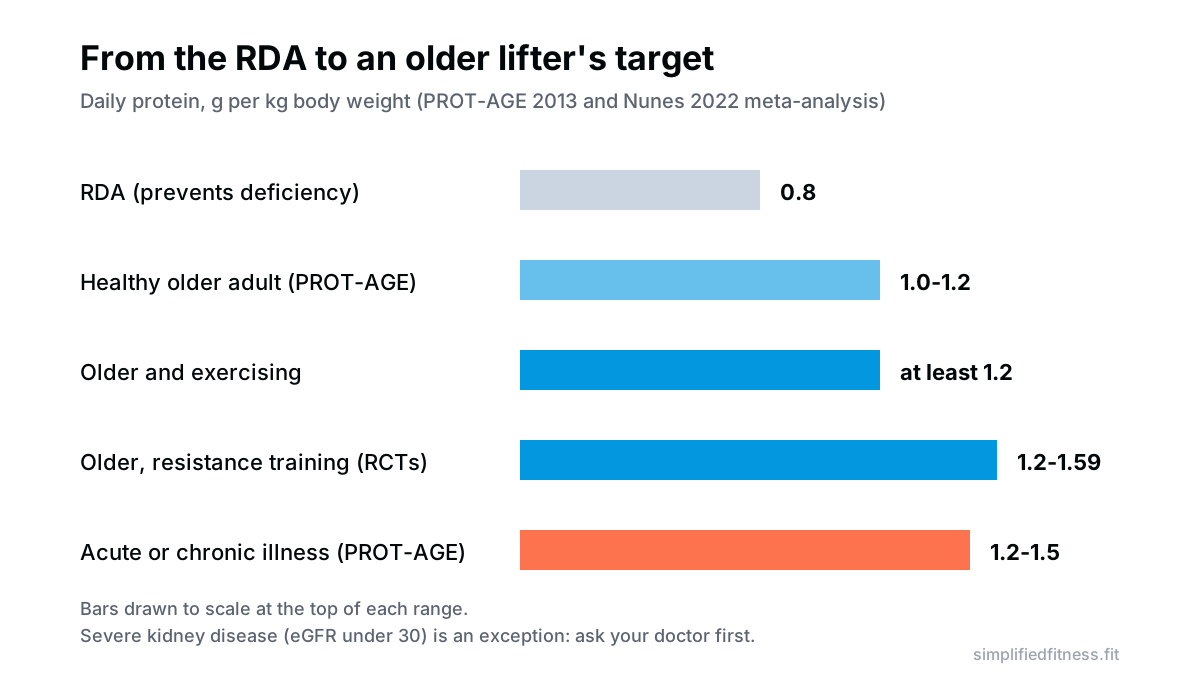
- The 0.8 g/kg RDA is set to prevent deficiency, not to protect muscle. For healthy people over 65, the PROT-AGE expert group recommends at least 1.0-1.2 g/kg a day, and at least 1.2 g/kg if you also exercise.
- In trials of older adults who lifted weights, extra protein built lean mass when total intake sat around 1.2-1.59 g/kg a day, so about 1.2-1.6 g/kg is a sensible target for an older lifter.
- Older muscle responds less to small protein doses. In one analysis, healthy older men needed about 0.40 g/kg in a meal to max out muscle protein synthesis, versus about 0.24 g/kg in younger men (roughly 28 g versus 17 g at 70 kg).
- Leucine may help, but a leucine-enriched supplement did not improve muscle in a 24-week trial. Hit your total daily protein and train first, then worry about leucine.
- Have kidney disease, especially an eGFR below 30? Do not raise protein on your own. Speak to your doctor or a dietitian first.
Part of our complete guide: Complete Protein Guide: How Much, What Type, and When to Eat It for Muscle Growth
Table of contents
The official 0.8 g/kg protein RDA is not a muscle-building number. It is a floor, and for many people over 50 it is probably too low if the goal is to keep strength and independence. For protein requirements in older adults with sarcopenia (age-related muscle loss), expert groups suggest 1.0-1.2 g/kg a day at minimum, and about 1.2-1.6 g/kg if you also lift.
This article is the older-adult blueprint inside our complete protein guide for hypertrophy. It covers how much, how to split it across meals, what leucine can and cannot do, and where the research disagrees with the loud claims you see online.
Why 0.8 g/kg is a floor, not a target
The RDA was built to stop deficiency in a typical, mostly sedentary adult. That is a different goal from preserving muscle at 65 or building it at 55.
The PROT-AGE Study Group, an international expert panel, reviewed this in 2013. Their position: older people need more protein than younger adults to support health, recovery from illness and function, partly because of age-related changes in protein metabolism. They recommend an average of at least 1.0-1.2 g/kg a day for people over 65, at least 1.2 g/kg for those who exercise, and about 1.2-1.5 g/kg for most people with acute or chronic disease (Bauer et al., 2013).
Note what this is. A consensus position paper, not a controlled trial. It is good guidance, but it is guidance.
There is a real disagreement here, and it is worth knowing. A 2009 review by Rennie concluded that modern nitrogen-balance data suggest the basic protein requirements of older people are not increased, even though muscle shows anabolic resistance (Rennie, 2009). Why the split? Nitrogen balance measures whether you avoid losing body protein. It does not measure whether you keep muscle mass and function over years. PROT-AGE leans on the second goal. For a lifter who wants to stay strong, the higher range is the more practical bet, and it is not risky in healthy people.
What is anabolic resistance, and what does it mean for older lifters?
Anabolic resistance means older muscle responds less to the same stimulus. A small serving of protein that fires up muscle protein synthesis in a 25-year-old may do less in a 70-year-old. Rennie describes the dose-response curve between amino acids and synthesis as shifted down and to the right with ageing, and says it is not simply fixed by pushing extra amino acids (Rennie, 2009).
Two mechanisms get cited often. One is blunted signalling through the mTOR pathway after feeding. The other is higher splanchnic extraction, where the gut and liver keep a bigger share of the amino acids from a meal before they reach muscle. PROT-AGE lists high splanchnic extraction among the age-related changes. But the evidence is mixed. In an older study, first-pass splanchnic extraction of phenylalanine was higher in elderly volunteers, yet amino acid delivery to the leg rose equally and muscle protein synthesis rose similarly in young and old (Volpi et al., 1999).
So here is the honest version: older muscle does look less sensitive, especially to small doses and to low-intensity exercise, but it can still respond well when the dose and the stimulus are big enough. That is the whole strategy.
How much protein do older adults need per meal?
This is where the internet gets overconfident. You will see “35-45 g every meal” stated as fact. I could not find a study that shows that exact number is required.
What does exist: a retrospective analysis of lab studies in healthy older (~71 years) and younger (~22 years) men who ate 0-40 g of high-quality protein in a single bolus. Muscle protein synthesis plateaued at about 0.40 g/kg body mass in older men and 0.24 g/kg in younger men (p = 0.055 for body mass, so just short of statistical significance). Relative to lean mass it was 0.60 versus 0.25 g/kg (p < 0.01). The authors concluded older men are less sensitive to low protein intakes and need a larger relative dose per meal (Moore et al., 2015).
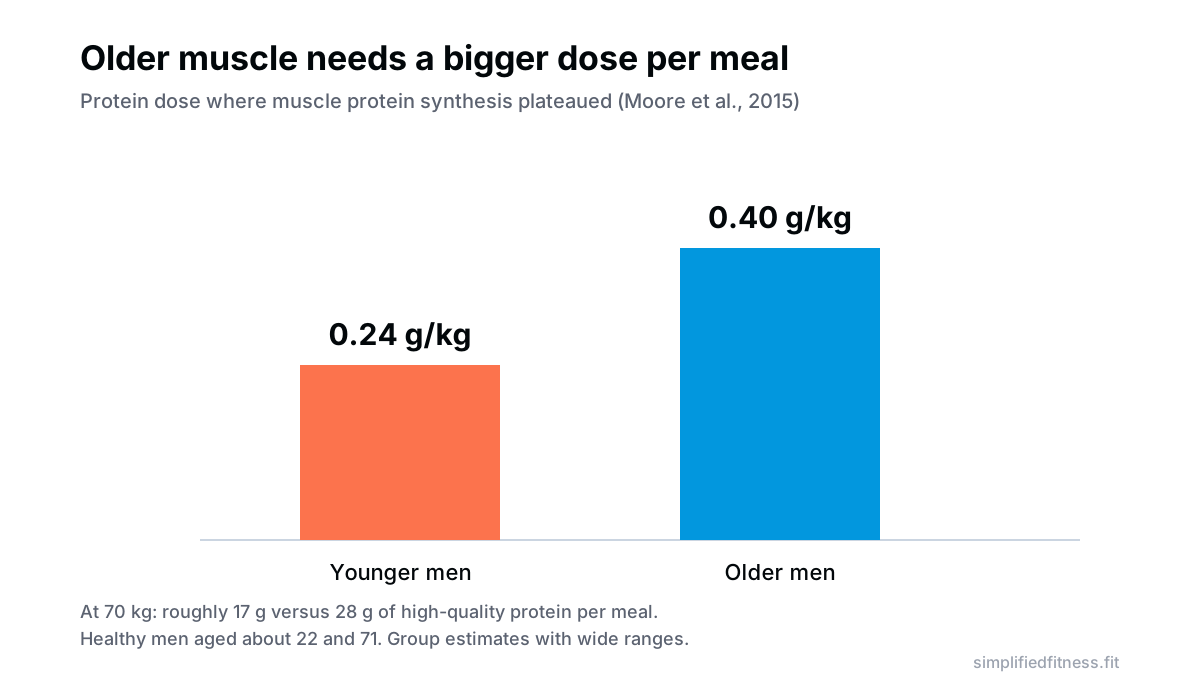
At 70 kg, 0.40 g/kg is 28 g. At 85 kg it is 34 g. That is why 25-40 g per meal is a reasonable range. Treat it as a rough target. These were healthy men, the confidence intervals were wide, and nobody followed them for months.
The practical rule: three or four meals that each contain a proper protein serving, rather than a tiny breakfast, a modest lunch and everything at dinner. If you want to go deeper on spreading it out, see 3 vs 5 meals for protein distribution.
What does the research say about 1.2-1.6 g/kg and muscle?
A 2022 meta-analysis of 74 randomized trials in healthy, non-obese adults looked at whether eating more protein helps lean mass, strength and function. Among people doing resistance exercise, more protein gave small but real gains in lean body mass. In people 65 or older, the effect was significant when intake was 1.2-1.59 g/kg a day. In younger adults, it took 1.6 g/kg or more (Nunes et al., 2022). The same paper found only marginal effects on tests of physical function, and the evidence for strength was rated low.
That fits the practical picture. Over 65 and lifting, 1.2-1.6 g/kg sits inside the range where extra protein was linked to better lean mass gains in these trials. It does not mean older adults need less than younger lifters; it means this is the range the older-adult trials actually tested.
Quick numbers for a healthy 70 kg person:
- 0.8 g/kg: 56 g a day
- 1.2 g/kg: 84 g a day
- 1.6 g/kg: 112 g a day
Note that the Nunes analysis mostly tested added protein alongside training. It does not say protein alone preserves muscle. Our strength training for older adults guide covers the lifting side, and the anabolic resistance guide goes deeper on training variables.
Does low protein intake cause sarcopenia?
It is linked, but the data do not prove cause. A systematic review of observational studies in people aged 60 or older (3,353 community-dwelling adults, mean age about 73) found older adults with sarcopenia ate significantly less protein than peers without it. The authors concluded inadequate protein might be associated with sarcopenia (Coelho-Junior et al., 2022). Only a handful of studies went into the pooled analysis, and most were cross-sectional. People with sarcopenia may also simply eat less overall because of poor appetite or frailty.
Still, low intake and low muscle often travel together. That is a reason to check your intake, not a reason to panic.
Does leucine matter for older lifters?
Possibly. The theory is that older muscle needs a stronger leucine “signal” to switch on synthesis. A controlled study fed elderly and young people 6.7 g of essential amino acids with either 26% or 41% leucine. In the elderly, the 26% leucine mix did not raise muscle protein synthesis significantly, but the 41% mix did. In young people both worked (Katsanos et al., 2006).
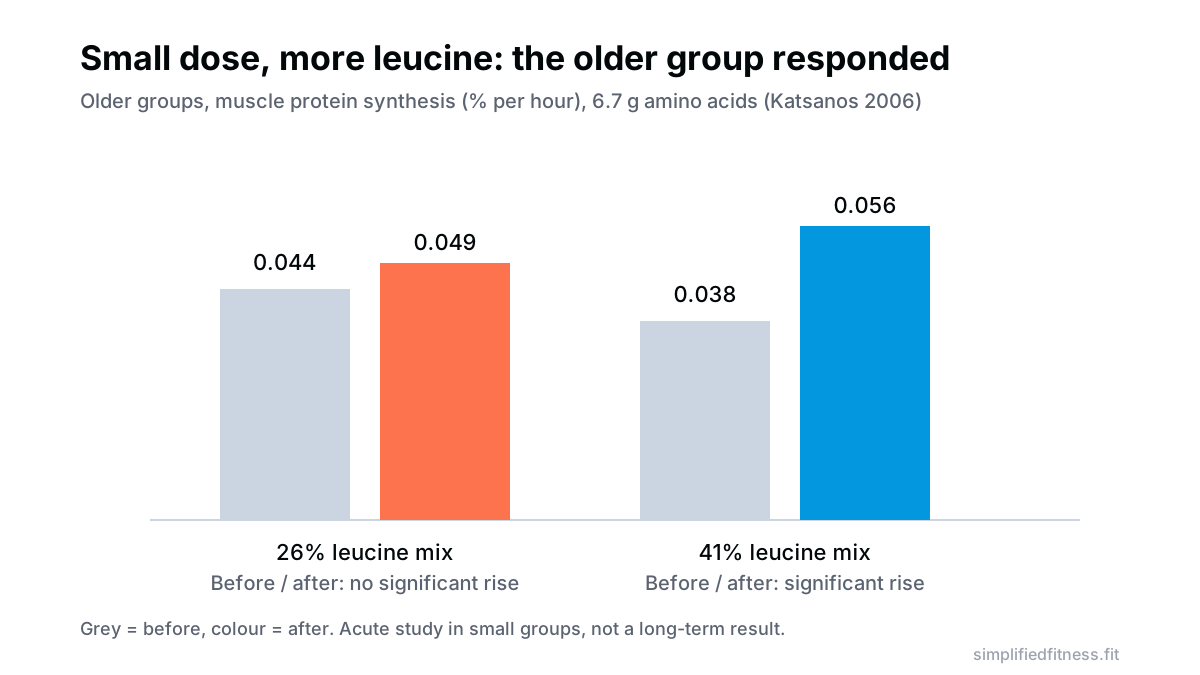
That is a short-term lab result in small groups. What happens over months? A 24-week randomized trial in 107 adults aged 65 or older at risk of sarcopenia gave 3 g of leucine with 10 g of protein twice daily. It found no effect on appendicular lean mass, handgrip, leg strength, physical performance or muscle protein synthesis versus the control (Murphy et al., 2021). The participants were generally well nourished, which may be why a small extra dose changed little.
Why might the two studies differ? One was acute and tested a small amino acid dose in a lab. The other was long, in free-living people already eating a decent diet. A cautious takeaway: leucine-rich protein sources are sensible, but do not buy a leucine supplement expecting a rescue. For more, see our leucine threshold explainer.
What does this look like on an Indian plate?
A common problem with older vegetarians: a katori of dal is roughly 6-8 g of protein, and roti and rice add little. Hitting 28-35 g a meal from dal alone means eating a lot of dal.
Build each meal around one protein anchor:
- Breakfast: besan chilla with curd, eggs if you eat them, moong dal cheela with paneer, or oats cooked in milk with a scoop of protein powder
- Lunch: dal or rajma plus a large serving of curd, paneer bhurji or soya chunks curry
- Evening: a glass of milk or lassi, roasted chana, or a whey shake if appetite is low
- Dinner: fish, chicken, paneer or tofu with dal on the side
The easiest wins: add curd or a glass of milk to meals you already eat, and make breakfast a protein meal instead of a carb-only one. For a full list, see our high-protein vegetarian foods guide.
Do you need powder? Not strictly. A 2023 meta-analysis of seven trials (591 participants) in older people with sarcopenia found whey during resistance training gave small gains in appendicular muscle mass and handgrip strength compared with training alone or with placebo. The effects were small, did not exceed the minimal clinically important difference, and the evidence quality was low to very low (Cuyul-Vasquez et al., 2023). So powder is a convenience tool, not a requirement.
Kidney safety: when to see a doctor first
For healthy people, current guidance does not treat higher protein as dangerous. PROT-AGE notes one clear exception: older people with severe kidney disease (eGFR under 30 mL/min/1.73 m2) who are not on dialysis may need to limit protein (Bauer et al., 2013).
Get your kidney function checked, and talk to your doctor or a registered dietitian, before raising protein if you have kidney disease, diabetes with kidney involvement, or unexplained swelling or changes in urination. Also check in if you are on medication or have another chronic condition. This article is general information, not personal medical advice. Our kidney safety evidence review covers healthy-kidney data in more detail.
A simple plan for older lifters
- Set your daily target. Start at 1.2 g/kg and work up toward 1.6 g/kg if you lift regularly and your doctor is fine with it. Use the protein calculator to get your number.
- Split it. Three or four meals, each around 0.4 g/kg (roughly 25-40 g for most people).
- Lift. Two to three sessions a week, with loads heavy enough to feel hard. Our guide for lifters over 40, 50 and 60 shows how.
- Fix the weakest meal. Usually breakfast.
- Use powder only to fill gaps.
- Recheck every few months. Strength, walking speed and chair-stand ability tell you more than the scale.
The bottom line
The RDA tells you how to avoid deficiency. It does not tell you how to keep muscle at 65. A target of about 1.2-1.6 g/kg a day, spread across meals that each hit roughly 0.4 g/kg, backed by regular resistance training, is the best-supported practical plan for healthy older lifters. The evidence is solid for the general direction and weaker on exact numbers, especially for leucine and per-meal targets.
If you want a lifting program to pair with this, start with our free training plans.
Frequently Asked Questions
How much protein do older adults need per day?
A good working range for most healthy adults over 65 is 1.0-1.2 g/kg a day, rising to at least 1.2 g/kg if you exercise and about 1.2-1.5 g/kg with illness, according to the PROT-AGE group. These figures come from an expert position paper rather than a single trial, so treat them as evidence-informed guidance. Work out your own number with our protein calculator and adjust with your doctor if you have a medical condition.
Is 0.8 g/kg of protein enough for seniors?
It is enough to avoid deficiency in many sedentary people, but not necessarily enough to keep or build muscle with age. Some researchers argue that older people's N-balance requirements are not higher, while others recommend more because of blunted anabolic responses, so the science is not fully settled. If you lift, a target of 1.2 g/kg or a little more is a reasonable, low-risk place to start for a healthy person.
What is anabolic resistance in older adults?
It means older muscle responds less to the same dose of protein or exercise than young muscle does. Studies show the dose-response curve for muscle protein synthesis is shifted down and to the right with age. The practical fix is more protein per meal and, above all, regular resistance training.
Can you build muscle after 60 with enough protein?
Yes, older adults can gain lean mass with resistance training, and extra protein seems to add a small boost on top. A meta-analysis found extra protein enhanced lean mass gains in people 65 or older eating about 1.2-1.59 g/kg a day while training. Protein alone does little, so pair it with two to three weekly lifting sessions.
How much protein per meal for older adults?
A reasonable aim is about 0.4 g/kg per meal, which is roughly 25-35 g for most older adults. That figure comes from a pooled analysis of healthy older men, in which synthesis plateaued around 0.40 g/kg. Spread protein over three or four meals instead of saving it for dinner.
How much leucine do older adults need per meal?
There is no firmly proven number. Researchers often cite roughly 2.5-3 g of leucine per meal, but this is a hypothesis built mostly from short-term studies. A 24-week trial giving older adults a supplement with 3 g of leucine and 10 g of protein twice daily did not improve muscle, so focus on total protein from quality sources first.
Is 35-45 g of protein per meal necessary for seniors?
No study I reviewed shows that you must hit 35-45 g in every meal. The per-meal analysis found a plateau near 0.40 g/kg, and the range is wide, so some older people may need more and many will do fine on less. Aim for 25-40 g depending on body size, and do not stress over the exact gram.
What is sarcopenia?
Sarcopenia is the age-related loss of muscle mass and strength that raises the risk of falls and loss of independence. Meta-analysis of observational studies found that older adults with sarcopenia ate less protein than those without it. That is an association, not proof of cause, so resistance training and enough protein work best together.
Can older vegetarians in India get enough protein?
Yes, but it takes planning because dal, roti and rice alone often fall short of 1.2 g/kg. Add paneer, curd, milk, soya chunks, eggs if you eat them, or a whey or plant protein powder to bring each meal up to a useful dose. Check our list of high-protein vegetarian foods and build each meal around one protein anchor.
Is high protein bad for older people's kidneys?
For people with healthy kidneys, the PROT-AGE group treats intakes of 1.0-1.5 g/kg as appropriate, but it says people with severe kidney disease (eGFR below 30, not on dialysis) may need to limit protein. If you have diabetes, high blood pressure or a family history of kidney problems, get your kidney function checked first. Never raise protein sharply without medical advice if you already have a diagnosis.
Does eating protein before bed help older adults?
It might help, but I could not confirm strong evidence in older adults from the studies reviewed here, and total daily protein matters more. Make sure dinner has a proper protein serving, and consider curd or milk in the evening if you struggle to reach your total.
Do I need a protein supplement as an older adult?
Not necessarily, but powders are a practical way to reach a target when appetite is low. A 2023 meta-analysis found whey during resistance training gave small gains in muscle mass and handgrip in older people with sarcopenia, though the evidence quality was low to very low. Use a powder to fill gaps, not to replace meals.
How does exercise change older adults' protein needs?
Resistance exercise makes muscle more responsive to protein, and PROT-AGE advises higher intake, at least 1.2 g/kg, for people who are active. Older muscle shows blunted synthesis after lifting too, so intensity and consistency matter. Lift two to three times a week with heavy-enough loads and eat protein within a few hours of training.
Sources & References
Every claim above is checked against peer-reviewed research (PubMed, U.S. National Library of Medicine) or guidance from established health bodies. How we fact-check.
- Bauer J, et al. Evidence-based recommendations for optimal dietary protein intake in older people: a position paper from the PROT-AGE Study Group. J Am Med Dir Assoc. 2013. PMID: 23867520
- Moore DR, et al. Protein ingestion to stimulate myofibrillar protein synthesis requires greater relative protein intakes in healthy older versus younger men. J Gerontol A Biol Sci Med Sci. 2015. PMID: 25056502
- Nunes EA, et al. Systematic review and meta-analysis of protein intake to support muscle mass and function in healthy adults. J Cachexia Sarcopenia Muscle. 2022. PMID: 35187864
- Coelho-Junior HJ, et al. Protein Intake and Sarcopenia in Older Adults: A Systematic Review and Meta-Analysis. Int J Environ Res Public Health. 2022. PMID: 35886571
- Katsanos CS, et al. A high proportion of leucine is required for optimal stimulation of the rate of muscle protein synthesis by essential amino acids in the elderly. Am J Physiol Endocrinol Metab. 2006. PMID: 16507602
- Murphy CH, et al. Does supplementation with leucine-enriched protein alone and in combination with fish-oil-derived n-3 PUFA affect muscle mass, strength, physical performance, and muscle protein synthesis in well-nourished older adults? A randomized, double-blind, placebo-controlled trial. Am J Clin Nutr. 2021. PMID: 33871558
- Rennie MJ. Anabolic resistance: the effects of aging, sexual dimorphism, and immobilization on human muscle protein turnover. Appl Physiol Nutr Metab. 2009. PMID: 19448702
- Volpi E, et al. Oral amino acids stimulate muscle protein anabolism in the elderly despite higher first-pass splanchnic extraction. Am J Physiol. 1999. PMID: 10484364
- Cuyul-Vasquez I, et al. Effectiveness of Whey Protein Supplementation during Resistance Exercise Training on Skeletal Muscle Mass and Strength in Older People with Sarcopenia: A Systematic Review and Meta-Analysis. Nutrients. 2023. PMID: 37571361

Umair Hazrami · Founder & Head Coach, Simplified Fitness
Umair Hazrami founded Simplified Fitness and the Simplified Lifter channel to cut through fitness noise. With 4+ years of consistent training and 10+ coaching clients, he writes every guide from the peer-reviewed research and links the sources so you can check them. Our editorial standards.
Educational content only, not medical advice. If you have a medical condition, are pregnant, or take medication, talk to a qualified doctor before changing your diet, supplements or training. Full disclaimer.
Keep reading
Nutrition
The Anabolic Window Myth: Do You Really Need a Shake Within 30 Minutes?
The anabolic window myth, debunked: what meta-analyses show about the 30-minute post-workout shake, how wide your real window is, and when timing still matters.
8 min read

Nutrition
Casein Protein: Slow Digestion, Nighttime Satiety and Muscle Growth
Casein protein benefits for muscle growth: how slow digestion works, what pre-bed trials show, casein vs whey, satiety on a cut and a curd pudding recipe.
8 min read
Nutrition
Collagen Protein: Joint and Tendon Support vs Muscle Building Protein
Does collagen protein build muscle? Here is why 20 g of collagen should not count toward your daily protein goal, and where it may help tendons and joints.
8 min read

Nutrition
Protein Distribution: 3 Meals vs 5 Meals and the 'Muscle Full' Effect
Protein distribution throughout the day: do you need 5-6 meals for muscle? See what research says on 3 vs 5 meals, the muscle full effect and grams per meal.
9 min read