Whey Protein Comparison: Whey Concentrate vs Whey Isolate vs Whey Hydrolysate
Whey protein isolate vs concentrate vs hydrolysate: what each type is, who needs the pricier tub, and a rupee-per-gram sum to pick the right one for you.

TL;DR. The short answer
- For most lifters who tolerate dairy, whey concentrate is the best-value tub. The muscle-building ingredient, whey protein, is the same across all three types.
- Isolate is filtered further, so it carries less lactose and fat per scoop. It earns its price if concentrate upsets your stomach or you are dieting hard and counting every gram.
- Hydrolysate is whey broken into smaller peptides. It tastes more bitter and costs the most, and no study I found shows it builds more muscle than other whey in people training regularly.
- Compare tubs by price per 25 g of protein, not price per kilo. A 90% protein tub and a 75% tub are not the same value at the same rupee-per-kg.
- Whey makes a modest, real difference to muscle gain, mainly by helping you reach your daily protein target. Protein total beats protein type.
Part of our complete guide: Complete Protein Guide: How Much, What Type, and When to Eat It for Muscle Growth
Table of contents
Whey protein isolate vs concentrate vs hydrolysate is mostly a question of stomach and wallet, not muscle. All three are whey, so the amino acids are the same. Concentrate is the best value for most people, isolate is worth it if dairy bothers you, and hydrolysate is rarely worth the premium.
If you are standing at a supplement shelf with three tubs at three prices, that is the short answer. The rest of this article is the reasoning, so you can check it. (For where whey fits in your whole protein plan, start with our complete protein guide for hypertrophy.)
What is the difference between concentrate, isolate and hydrolysate?
Whey is the watery part of milk left over when cheese is made. It gets filtered and dried into powder. How hard the manufacturer filters it, and whether it is chopped up afterwards, decides which tub you are holding.
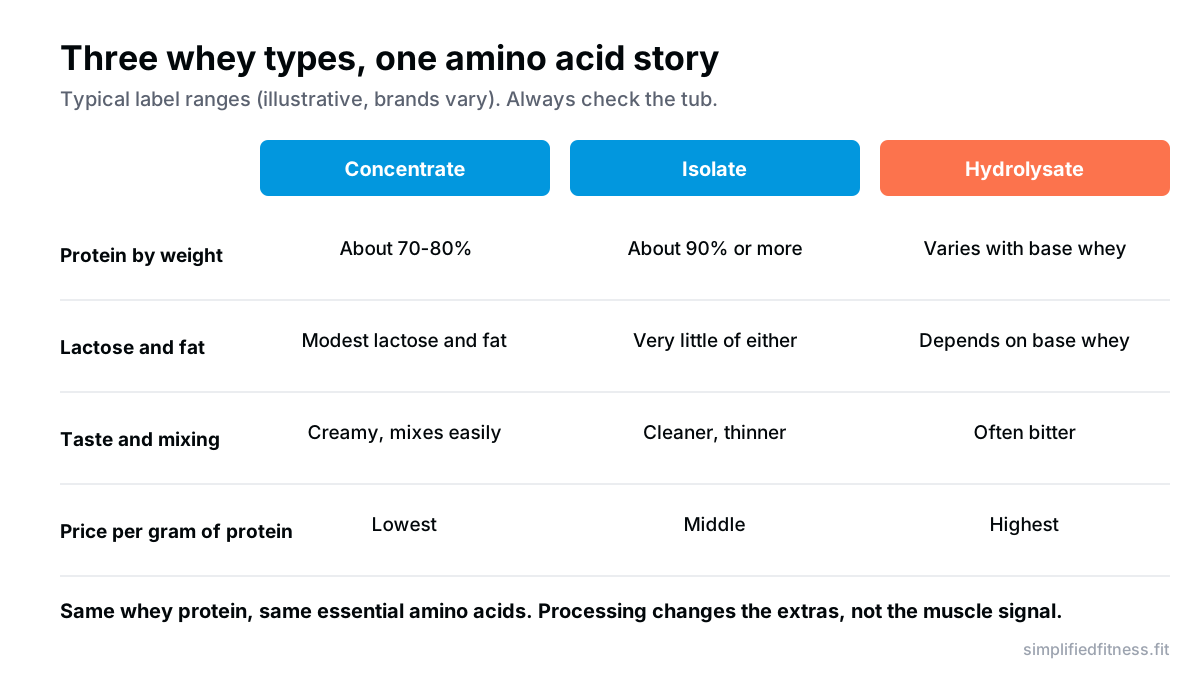
- Whey concentrate: filtered the least. Typically labelled around 70-80% protein by weight, with some lactose and fat left in. Creamy, mixes easily, cheapest.
- Whey isolate: filtered further. Typically 90% protein or more, with very little lactose and fat. Thinner, cleaner taste, mid-priced.
- Whey hydrolysate: whey that has been pre-digested with enzymes into shorter peptides. Usually bitter, usually the most expensive. How much lactose it carries depends on whether the base was concentrate or isolate.
Those percentages are typical label ranges, not guarantees. Brands differ, and “proprietary blend” tubs can hide the split. Read the nutrition panel.
Does the type of whey change muscle growth?
Not in any way I could find evidence for. Here is what the research does show.
A 2018 meta-analysis of 49 trials and 1,863 participants found that protein supplementation during resistance training modestly increased strength, fat-free mass and muscle size (Morton et al., 2018). Gains in fat-free mass stopped growing once total protein intake went past about 1.62 g/kg/day. The same review found the benefit was smaller with increasing age and larger in resistance-trained people. Note the question it answers: protein supplement versus none, not one whey type versus another.
A 2019 meta-analysis of 21 whey trials (837 participants, about 13 weeks of training) reported improved lean mass, fat mass and strength with whey versus placebo in healthy people, though the lean-mass gain was small (about 0.46 kg) and its confidence interval dipped just below zero (Li and Liu, 2019). Again, whey against placebo.
So the evidence supports “whey helps you hit your protein target.” It does not rank concentrate, isolate and hydrolysate against each other for hypertrophy.
Is whey hydrolysate worth it?
This is where the marketing gets loudest. “Pre-digested, absorbs faster, builds more.” Let me separate what is known from what is implied.
What the data show. In a small 2009 study, 18 healthy young men (6 per group) drank 10 g of essential amino acids from whey hydrolysate, casein or soy after leg exercise. Whey hydrolysate raised blood amino acids more and produced a higher muscle protein synthesis rate than casein or soy (Tang et al., 2009). It beat casein clearly and soy after exercise. Useful, but it did not include regular whey concentrate or isolate, so it cannot tell you hydrolysate beats them.
A 12-week trial in 24 people found whey hydrolysate plus carbohydrate produced more hypertrophy than an equal-calorie carbohydrate drink (7.3% vs 3.4%) (Rahbek et al., 2014). Same limitation: it proves protein beats carbs, not hydrolysate beats other whey.
On recovery, 20 physically active women took hydrolysate or an isoenergetic carbohydrate drink for 4 days after a repeated-sprint session. The hydrolysate group kept a higher reactive strength index through recovery, had a bigger drop in creatine kinase at 48 hours, and regained flexibility by 72 hours while the carbohydrate group had not (Brown et al., 2018). That is a small, short study in active women, not lifters, and carbohydrate was the comparison.
A fair summary. Hydrolysate is a decent whey and may have a small recovery angle. The “builds more muscle” claim has no direct support I could verify. In the illustrative price sums below it costs about 1.7 times as much as concentrate per gram of protein, so it is a luxury. Our hydrolyzed whey deep dive goes further into the absorption claims.
Is whey isolate worth the extra money?
Sometimes. The question is whether you are buying something you need.
Isolate makes sense when:
- Concentrate gives you gas, cramps or loose stools.
- You are in a hard cut and want the lowest fat and lactose per 25 g of protein.
- You drink two or three scoops a day, so the small lactose from each adds up.
Isolate is mostly wasted money when:
- You digest milk, curd and paneer without trouble.
- Your protein shortfall is only one scoop a day.
- Your budget is tight and the price gap would be better spent on real food like eggs, dal or soya chunks.
How much lactose is in whey concentrate, and will it bother you?
Concentrate carries some lactose, though the amount varies by brand and flavour. Check the carbohydrate and sugar lines on the label. A scoop of any whey with a couple of grams of sugar is a small fraction of the lactose in a cup of milk.
The research on lactose tolerance is more reassuring than most people expect. A systematic review of 36 randomised trials concluded that most individuals with presumed lactose intolerance or malabsorption can tolerate 12 to 15 g of lactose, about a cup of milk (Shaukat et al., 2010). A review citing a meta-analysis reached a similar number: almost all lactose-intolerant people tolerate 12 g in one intake and roughly 18 g across the day, and the prevalence and severity of intolerance are probably overestimated by the public (Corgneau et al., 2017).
There is a nuance. In a small trial of 13 lactose maldigesters, abdominal pain increased at 12 g of lactose in water after fasting, and flatulence at 20 g (Hertzler et al., 1996). A fasted shake in plain water is a harsher test than a shake with a meal. Individual tolerance clearly differs.
Practical read: a scoop of concentrate will be fine for many lactose-sensitive lifters, especially taken with food. If it is not fine for you, isolate is a sensible next step.
Lactose intolerance is not milk allergy. Intolerance causes gut symptoms. Allergy involves the immune system, with hives, swelling, wheeze or vomiting. If you suspect allergy, do not experiment with any whey, hydrolysate included. See a doctor.
Which whey is cheapest per gram of protein?
Concentrate, almost always. But the gap is smaller than the shelf price suggests, because a higher-protein tub gives you more protein per scoop.
The formula: price per kg, divided by (protein % x 1000), times 25 g. The prices below are illustrative, so swap in your own.
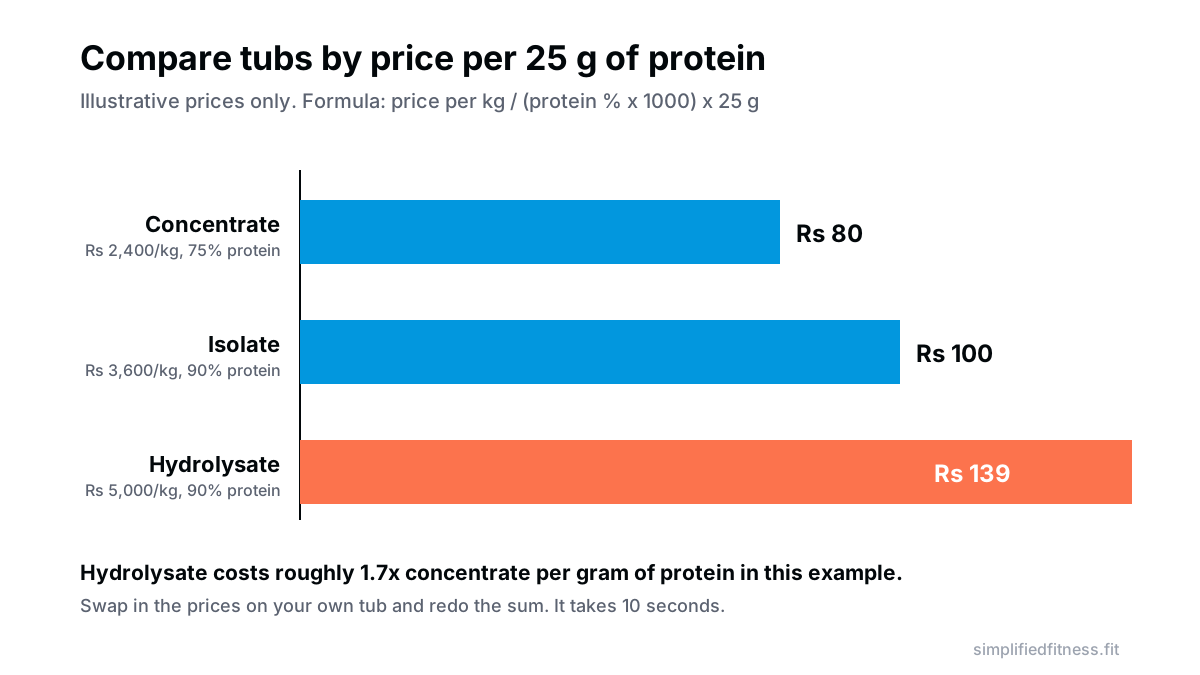
| Type | Illustrative price per kg | Protein share | Cost per 25 g protein |
|---|---|---|---|
| Concentrate | Rs 2,400 | 75% | Rs 80 |
| Isolate | Rs 3,600 | 90% | Rs 100 |
| Hydrolysate | Rs 5,000 | 90% | Rs 139 |
Over a month of one scoop a day, the gap between concentrate and isolate in this example is about Rs 600. Whether that is worth smoother digestion is your call. It is a real call, not a trick question.
Two small habits help. First, ignore “scoop” claims and look at grams of protein per serving. Second, check batch testing or third-party certification where available, since protein powders are an area where label accuracy varies.
Which tub should you buy?
Use the flowchart. It lines up with the evidence, not with what is on special.
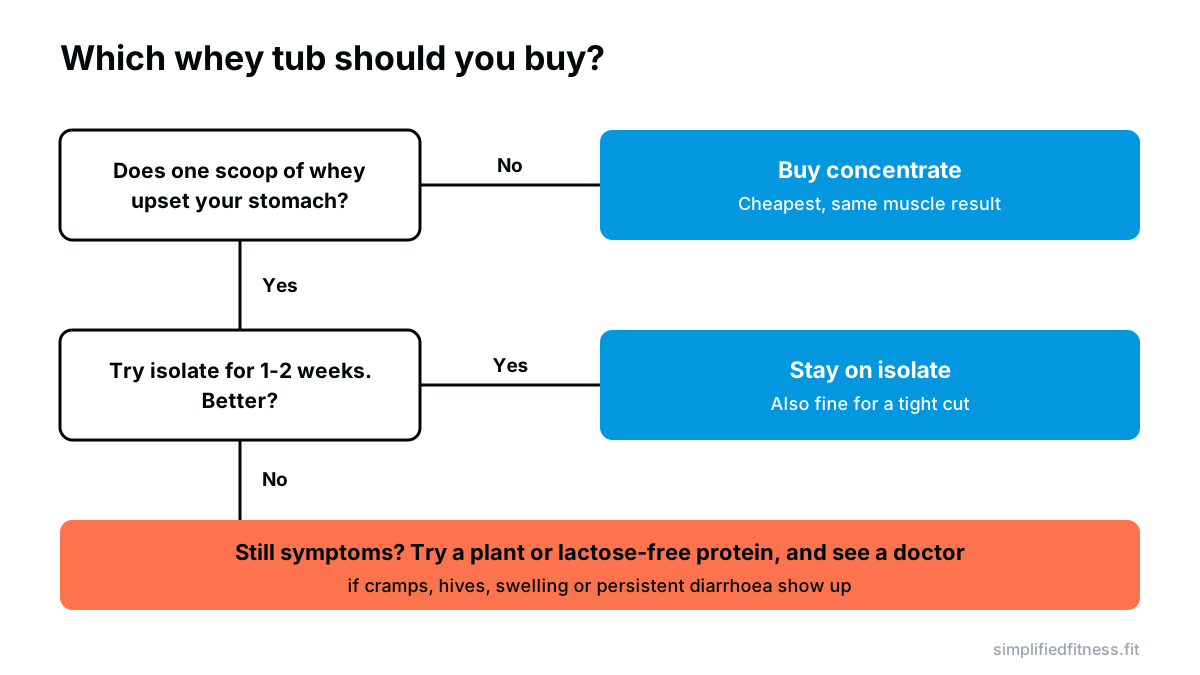
Here is how that looks in practice:
- No dairy problems, normal budget: concentrate.
- Gas or cramps on concentrate: isolate for 1-2 weeks, with the shake alongside food. If it helps, stay.
- Hard cut, tight calories: isolate is reasonable, since it trims a little fat and lactose per scoop. The difference is small.
- Curious about hydrolysate: fine, but treat it as a preference, not an upgrade.
- Vegetarian who avoids dairy entirely: look at plant options in our vegan protein powder blends guide.
How many scoops do you actually need?
Fewer than the tub label implies. Whey is a top-up, not the base of the diet. Work out your daily target first with the protein calculator, then count what dal, paneer, eggs, curd, chicken or soya already gives you. Whatever is left is your scoop count, often one.
For the range most lifters are aiming for, see optimal daily protein intake for hypertrophy. For how protein “quality” is scored across foods, there is a separate explainer on DIAAS vs PDCAAS. And if you wonder whether shakes digest too fast or too slow, fast vs slow absorbing proteins goes through it. Our dedicated isolate vs concentrate lactose guide looks at the lactose angle in more depth.
Hot weather note for Indian lifters: opened tubs in humid kitchens clump and can go off. Keep the lid tight, use the dry scoop, and store it away from the stove.
When to see a doctor
Speak to a doctor if you get hives, swelling of lips or face, wheezing or vomiting after whey, which may point to milk allergy rather than lactose intolerance. See one too if gut symptoms are severe, persistent, or come with blood in the stool or unexplained weight loss. Anyone with kidney disease should check protein targets with their doctor before adding a supplement.
Bottom line
Concentrate if you tolerate dairy. Isolate if you do not, or if you want leaner macros on a cut. Hydrolysate only if you like it and can afford it. Whichever you pick, protein total across the day matters more than the grade in the tub.
Frequently Asked Questions
Is whey isolate worth the extra money?
For most people who digest dairy fine, no. Isolate has less lactose and fat per scoop, but the muscle-building protein is whey either way, and the research on protein supplements measures total protein rather than the processing grade. Buy isolate if concentrate gives you gas, cramps or loose stools, or if you want the leanest macros on a tight cut.
What is the difference between whey concentrate, isolate and hydrolysate?
They are the same milk protein processed to different degrees. Concentrate is filtered less and keeps more lactose and fat, isolate is filtered further to raise protein share, and hydrolysate is pre-digested into shorter peptides. The practical outcome is differences in protein percentage, taste, price and stomach tolerance, so choose the tub on those, not on hype.
Which whey protein is best for building muscle?
There is no good evidence that one whey type builds more muscle than another when daily protein is matched. The strongest data compare protein supplements with placebo, and show modest gains in strength and lean mass. Pick the type you will drink consistently, and fix your total daily protein first.
How much lactose is in whey concentrate?
It is modest but not zero, and it varies by brand, so check the label for sugars or carbohydrate per scoop. Reviews of lactose intolerance suggest most intolerant adults handle about 12-15 g of lactose in one sitting, which is more than a typical scoop is likely to contain. If you react anyway, switch to isolate or lactose-free options and see how you feel.
Is whey isolate lactose free?
Not guaranteed. Isolate contains very little lactose, but 'very little' is not the same as none, and labels differ between brands. If you have a true milk allergy rather than lactose intolerance, whey in any form can be unsafe, so speak to a doctor before trying it.
Is whey hydrolysate better than isolate?
Not for muscle growth, based on what I could find. Hydrolysate gets absorbed fast and one small study found quicker recovery in active women, but isolate and concentrate are also fast proteins. The extra cost and bitter taste are rarely justified for ordinary training.
Does whey hydrolysate speed up recovery?
Possibly a little, in small short studies. A trial of 20 active females found better flexibility and reactive strength over 72 hours with hydrolysate than with carbohydrate, but it did not compare against regular whey. Treat it as an interesting lead rather than a reason to pay double.
Is whey concentrate bad for lactose intolerance?
It can be a problem for some people, though many lactose-intolerant adults tolerate a scoop fine. Because amounts of lactose vary by product, the practical test is to try one scoop with food and watch your gut for a few days. If symptoms show up, move to isolate.
Why is whey isolate more expensive than concentrate?
It takes extra filtering to strip out more lactose and fat, and that processing adds cost. You also pay for a higher protein percentage per scoop, so the real gap per gram of protein is smaller than the gap per kilo. Work out price per 25 g of protein to see what you are really paying.
How much whey protein should I take a day?
One or two scoops usually closes the gap between food and your target. A large meta-analysis found extra protein stopped adding lean mass gains beyond about 1.6 g/kg/day of total intake. Use our protein calculator to see how many scoops you actually need after dal, paneer, eggs and curd.
Can I use whey protein if I am vegetarian in India?
Yes if you eat dairy, since whey is a milk product. Check the label for the green dot to confirm vegetarian status. If you avoid dairy completely, a soy or pea blend is the alternative.
Does whey protein cause stomach problems besides lactose?
Sometimes, from sweeteners, thickeners or simply drinking a big shake too quickly. Gas and bloating can have causes other than lactose, so isolate will not always fix it. Try a smaller serving, mix it with water slowly, and speak to a doctor if symptoms are severe or persistent.
Sources & References
Every claim above is checked against peer-reviewed research (PubMed, U.S. National Library of Medicine) or guidance from established health bodies. How we fact-check.
- Morton RW, et al. A systematic review, meta-analysis and meta-regression of the effect of protein supplementation on resistance training-induced gains in muscle mass and strength in healthy adults. Br J Sports Med. 2018. PMID: 28698222
- Li M, et al. Effect of whey protein supplementation during resistance training sessions on body mass and muscular strength: a meta-analysis. Food Funct. 2019. PMID: 31041966
- Tang JE, et al. Ingestion of whey hydrolysate, casein, or soy protein isolate: effects on mixed muscle protein synthesis at rest and following resistance exercise in young men. J Appl Physiol. 2009. PMID: 19589961
- Rahbek SK, et al. Effects of divergent resistance exercise contraction mode and dietary supplementation type on anabolic signalling, muscle protein synthesis and muscle hypertrophy. Amino Acids. 2014. PMID: 25005782
- Brown MA, et al. Whey protein hydrolysate supplementation accelerates recovery from exercise-induced muscle damage in females. Appl Physiol Nutr Metab. 2018. PMID: 29106812
- Corgneau M, et al. Recent advances on lactose intolerance: Tolerance thresholds and currently available answers. Crit Rev Food Sci Nutr. 2017. PMID: 26713460
- Shaukat A, et al. Systematic review: effective management strategies for lactose intolerance. Ann Intern Med. 2010. PMID: 20404262
- Hertzler SR, et al. How much lactose is low lactose? J Am Diet Assoc. 1996. PMID: 8613657

Umair Hazrami · Founder & Head Coach, Simplified Fitness
Umair Hazrami founded Simplified Fitness and the Simplified Lifter channel to cut through fitness noise. With 4+ years of consistent training and 10+ coaching clients, he writes every guide from the peer-reviewed research and links the sources so you can check them. Our editorial standards.
Educational content only, not medical advice. If you have a medical condition, are pregnant, or take medication, talk to a qualified doctor before changing your diet, supplements or training. Full disclaimer.
Keep reading
Nutrition
The Anabolic Window Myth: Do You Really Need a Shake Within 30 Minutes?
The anabolic window myth, debunked: what meta-analyses show about the 30-minute post-workout shake, how wide your real window is, and when timing still matters.
8 min read

Nutrition
Casein Protein: Slow Digestion, Nighttime Satiety and Muscle Growth
Casein protein benefits for muscle growth: how slow digestion works, what pre-bed trials show, casein vs whey, satiety on a cut and a curd pudding recipe.
8 min read
Nutrition
Collagen Protein: Joint and Tendon Support vs Muscle Building Protein
Does collagen protein build muscle? Here is why 20 g of collagen should not count toward your daily protein goal, and where it may help tendons and joints.
8 min read

Nutrition
Protein Distribution: 3 Meals vs 5 Meals and the 'Muscle Full' Effect
Protein distribution throughout the day: do you need 5-6 meals for muscle? See what research says on 3 vs 5 meals, the muscle full effect and grams per meal.
9 min read