The Leucine Threshold: How 2.5-3.0 g of Leucine Signals Muscle Protein Synthesis via mTORC1
The leucine threshold for muscle protein synthesis explained: what 2.5-3 g per meal means, how mTORC1 senses leucine, and which Indian foods get you there.
TL;DR. The short answer
- The leucine threshold is a rule of thumb: roughly 2.5-3 g of leucine in a meal, which is about 25-30 g of a high-quality animal protein. It is a useful target, not a proven switch.
- At the cell level, leucine binds a sensor called Sestrin2, which releases its brake on mTORC1, the pathway that signals muscle protein synthesis to ramp up.
- Human data are mixed. Leucine dose predicted the muscle response in older adults, but not clearly in younger adults, and the trigger idea fits isolated proteins better than whole foods.
- Plant proteins usually carry less leucine per gram, so vegetarians often need a larger serving, a blend, or a leucine-richer source to reach the same dose.
- Total daily protein (about 1.6 g/kg) still matters more than hitting 3 g of leucine at every single meal.
Part of our complete guide: Complete Protein Guide: How Much, What Type, and When to Eat It for Muscle Growth
Table of contents
The leucine threshold for muscle protein synthesis is the idea that a meal needs roughly 2.5-3 g of leucine, about 25-30 g of a high-quality animal protein, to switch muscle building on strongly. It is a useful target, but the research says it is a rule of thumb rather than a hard cutoff.
This guide stays on the food side: why leucine is special, what human studies say about a per-meal threshold, and which everyday foods get you there. If you are weighing free leucine powder or adding leucine to a low-protein meal, our leucine trigger hypothesis guide covers the supplement side. It sits inside our complete protein guide for hypertrophy, which covers the bigger picture of how much, how often and what kind.
Why is leucine singled out from the other amino acids?
Muscle is built from 20 amino acids. Nine of them are essential, meaning you have to eat them. Leucine is one of the three branched-chain amino acids, and it is the one with a second job: it acts as a signal as well as a building block.
Think of it as a foreman. Protein gives you bricks. Leucine tells the crew to start laying them.
That signal runs through mTORC1, a protein complex that cells use to decide whether conditions are good enough to grow. When mTORC1 is on, the machinery that makes new protein speeds up. When it is off, it does not.
How does leucine switch on mTORC1?
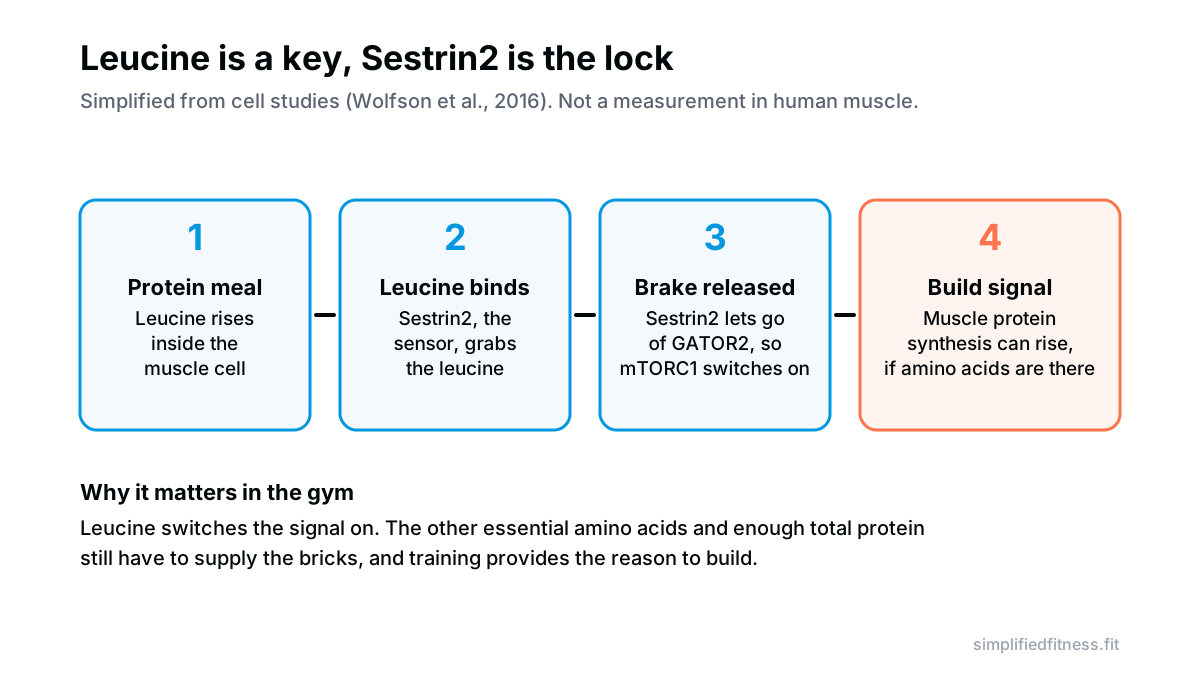
Here is the mechanism in plain terms. Inside a cell, a protein called Sestrin2 sits on the mTORC1 pathway and acts as a brake by binding a partner called GATOR2. In cell experiments, leucine (but not arginine) binds Sestrin2 and breaks up the Sestrin2-GATOR2 link. Leucine binds Sestrin2 with a dissociation constant of about 20 micromolar, which matches the leucine concentration that half-maximally activates mTORC1 (Wolfson et al., 2016).
So: leucine in → Sestrin2 binds it → brake released → mTORC1 on.
Is there really a leucine threshold in humans?
Sort of. The “leucine threshold” and the “leucine trigger” are related but different ideas. The threshold says a meal needs a certain leucine dose. The trigger says the size and speed of the rise in blood leucine drives the muscle response.
Two systematic reviews tested these ideas, and their findings are worth reading side by side.
What Wilkinson and colleagues found (2023). Pooling studies of healthy adults who lifted and then ate protein, they found the leucine dose was associated with the muscle protein synthesis response in older adults, but not in younger adults. They also found no single blood leucine measure that predicted the response well in either group, and no clear threshold in older adults (Wilkinson et al., 2023).
What Zaromskyte and colleagues found (2021). Of 29 eligible studies, 16 supported the leucine trigger hypothesis. Most of those (13) were in older adults, and 14 used isolated proteins rather than whole foods (Zaromskyte et al., 2021).
Why the mixed picture? Plausible reasons: younger people respond strongly to almost any decent protein dose, so leucine has little room to add; older adults show a blunted response (anabolic resistance), so leucine matters more; and whole foods digest slowly and contain other nutrients that blur the leucine effect.
What happens when you add leucine to a small protein dose?
This is the experiment that made the leucine idea famous. In a 2014 trial, 40 young men did leg exercise and then drank one of several beverages. One group got 25 g of whey (3.0 g leucine). Others got only 6.25 g of whey, with or without added leucine up to 3.0 g or 5.0 g in total.
Over 1.5-4.5 hours, muscle protein synthesis was highest after the 25 g whey drink (about 267% above baseline) and the 6.25 g whey drink with 5.0 g total leucine (about 220%). The authors concluded a low-protein drink can be as effective as a high-protein dose when it is supplemented with a high amount of leucine (Churchward-Venne et al., 2014).
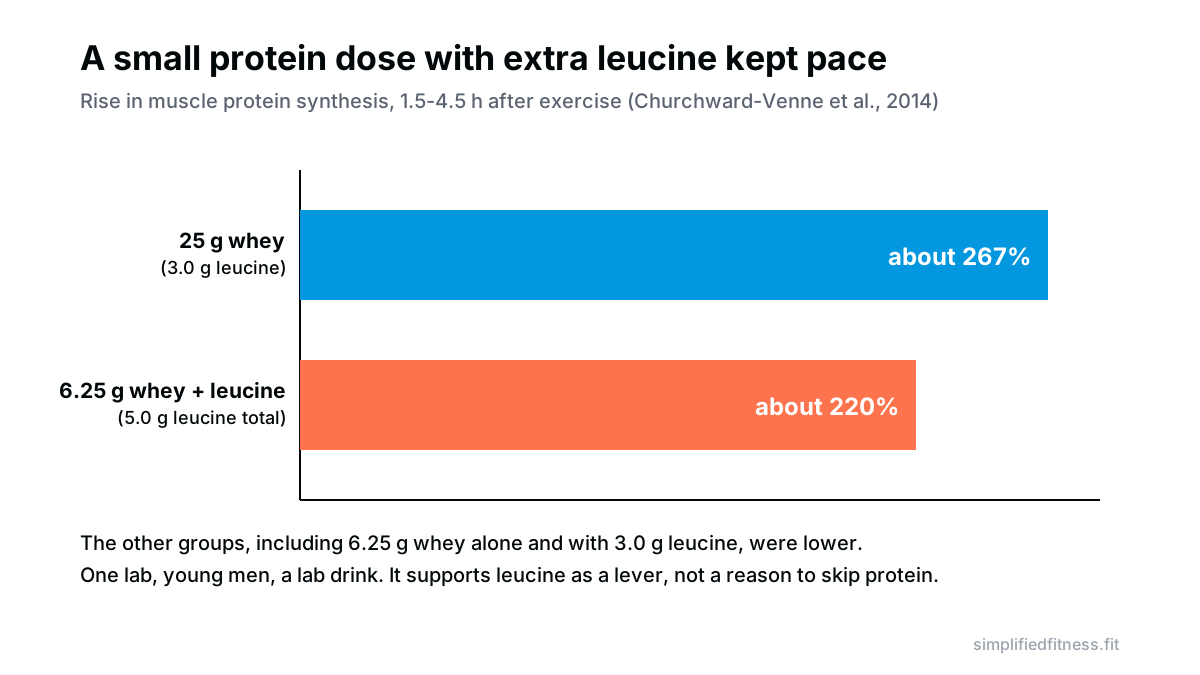
Read that carefully, though. This was a short lab trial measuring synthesis over hours, not muscle gained over months. It also does not mean you should swap protein for leucine. The sensible lesson is that leucine is a lever, and a meal with too little protein leaves that lever with nothing to pull.
A second trial, in older women, points the same way. Ten grams of milk protein with 3 g of leucine produced increases in acute and integrated myofibrillar protein synthesis over six days similar to a 25 g whey dose that also supplied 3 g of leucine. It was small (11 women per group), several co-authors worked for PepsiCo, and the authors note longer trials are needed (Devries et al., 2018). For when free leucine is actually worth buying, see our leucine trigger hypothesis guide.
How much leucine do common foods give you?
Here is where the practical part begins. Protein sources differ in how much of their protein is leucine. One analysis of protein isolates found leucine made up about 9.0% of milk protein, 7.0% of egg and 7.6% of human muscle protein. Plant isolates varied a lot, from 5.1% for hemp to 13.5% for corn (Gorissen et al., 2018).
Do the sum: 30 g of protein × leucine share = grams of leucine.
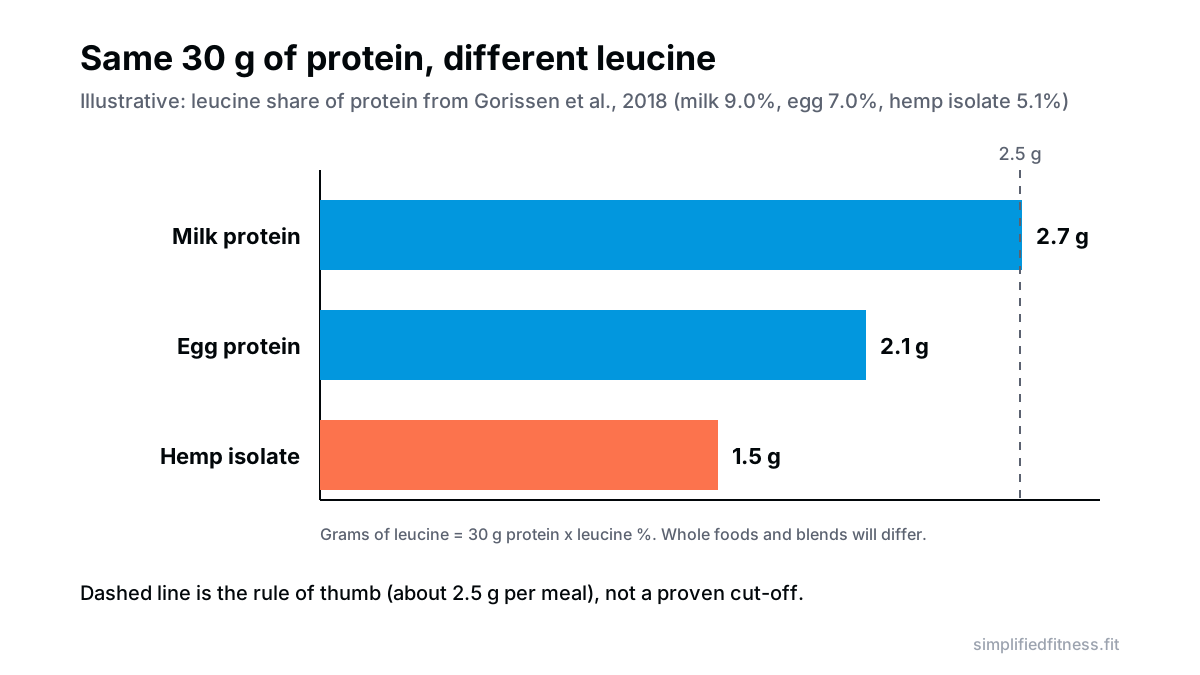
A few cautions. These are isolated proteins, not dal or paneer as served on your plate. Whole foods carry fibre, fat and other nutrients that change digestion. And per-food leucine numbers vary between databases and brands, so check the label on any powder.
With that said, the direction is consistent: dairy and eggs are leucine-dense, and most plant proteins are leaner in leucine per gram.
| Meal anchor | What helps you reach about 2.5-3 g leucine |
|---|---|
| Whey shake | Roughly 25 g whey gave 3.0 g leucine in trials |
| Milk, curd, paneer | Milk protein is leucine-rich, so a portion with 25-30 g protein is a reasonable aim |
| Eggs, chicken, fish | Egg protein is about 7% leucine, so you may need a slightly larger serving than with dairy |
| Dal, rajma, chana, soya | Plant protein is usually leaner in leucine, so a bigger portion or a mix of sources helps |
| Plant powder | Check the label, or pick a blend with added leucine |
Does the leucine target change for vegetarians and vegans?
It does, a little, but the gap is closable.
Plant proteins tend to be lower in essential amino acids overall, and some are low in leucine specifically. The same analysis found methionine and lysine are also typically lower in plant proteins, and it concluded that combining plant isolates, or blending animal and plant proteins, can give a profile closer to animal protein (Gorissen et al., 2018). Practical strategies are eating more of the plant protein, mixing sources, or fortifying with leucine.
The best direct test I found: in 2024, young men and women took a plant blend, the same blend with added leucine (matched to whey), or whey. The plain plant blend raised muscle protein synthesis less than the leucine-fortified version or whey, while the leucine-fortified blend and whey did not differ significantly, though the comparison was close to the cutoff (P = 0.052) (Lim et al., 2024). It was a single acute study in young adults, and the senior author discloses industry research funding, so hold it loosely.
For Indian vegetarians, this is less dramatic than it sounds. Curd, paneer, milk and eggs (if you eat them) are leucine-rich anchors. If you are fully plant-based, a bigger serving of soya chunks or tofu plus dal, or a pea-rice powder, is the practical fix. We cover the wider comparison in plant vs animal protein for hypertrophy and the blend question in vegan protein powder blends.
Does hitting 3 g of leucine at every meal build more muscle?
Nobody has shown that. The signal studies measure hours of synthesis. Growth happens over months, and it follows total protein and training far more than the arithmetic of any single meal.
A large meta-analysis of 49 randomized trials (1,863 people) found protein supplementation increased fat-free mass during resistance training, and that intakes above about 1.62 g/kg/day gave no further gains in fat-free mass (Morton et al., 2018). Notice that this is a daily total, not a per-meal leucine number.
Spreading protein sensibly still makes sense, and we compare the options in protein distribution across 3 vs 5 meals. The per-meal ceiling question is covered in protein absorption ceilings.
Do I need leucine or BCAA supplements?
For most lifters, no. If your protein is adequate and you eat dairy, eggs or meat, you are already getting the leucine. Free leucine is a niche tool: low-protein meals, older adults, or strict plant-based diets where a portion would otherwise be large.
BCAAs are a separate question, because they leave out the other essential amino acids that the muscle needs as raw material. We cover that fully in why BCAAs are mostly a waste of money.
A simple way to put the leucine threshold to work
Skip the spreadsheet. Use this order of operations:
- Set your daily protein, about 1.6 g/kg to start. The protein calculator gives a number for your body weight.
- Build each main meal around 25-40 g of protein from a leucine-rich anchor (curd, paneer, eggs, chicken, fish, whey).
- If you are plant-based, make portions bigger and mix sources, or choose a powder with a leucine content on the label.
- Include a protein-rich meal in the hours after training, but do not stress about the clock.
- Older than about 60? Lean toward the top of the range per meal, and ask a doctor or dietitian if you have kidney problems.
Need a ready-made template? Our free diet plan puts protein anchors in each meal, and our guide to top high-protein vegetarian foods and their leucine lists portions.
When to see a doctor
If you have kidney disease, liver disease, or any metabolic condition, or you are pregnant, check with a doctor or registered dietitian before raising protein sharply or using amino acid supplements. This article is general education, not medical advice.
The bottom line
Leucine is a real molecular signal: in cells, it binds Sestrin2 and helps switch on mTORC1. In people, the picture is messier. A 2.5-3 g per meal target is a sensible rule of thumb, strongest in older adults and with isolated proteins, and weaker in young lifters eating whole foods.
Get your daily protein right, anchor meals with leucine-rich foods, and treat the 3 g number as a target you hit when it is easy. That is it.
Frequently Asked Questions
What is the leucine threshold for muscle protein synthesis?
It is the idea that a meal needs about 2.5-3 g of leucine to switch muscle protein synthesis on strongly. That amount sits inside roughly 25-30 g of high-quality animal protein such as whey, milk or egg. Treat it as a practical target, because a 2023 systematic review found no clear threshold in older adults.
How much leucine per meal do I need to trigger mTOR?
A common target is 2.5-3 g per meal, though the exact number is not settled. Trials that used 3 g of leucine, for example inside 25 g of whey, produced strong muscle protein synthesis responses in young and older people. If your meals contain 25-30 g of good-quality protein, you are probably in range.
How does leucine activate mTORC1?
Inside cells, leucine binds a protein called Sestrin2, which normally restrains mTORC1 by holding onto a partner called GATOR2. When leucine binds, Sestrin2 releases GATOR2 and mTORC1 can switch on. This was shown in cell experiments, so it explains the mechanism rather than proving a gym result.
Is leucine the most important amino acid for muscle growth?
It is the best-studied signal, but not the only thing that matters. Muscle protein synthesis also needs the other essential amino acids as raw material, and growth needs training and enough total protein over weeks. Leucine switches the signal on, but it cannot build muscle out of thin air.
Which foods are highest in leucine?
Animal proteins carry more leucine per gram than most plant proteins. Milk protein averaged about 9% leucine in one analysis, egg about 7%, and plant isolates ranged from about 5% (hemp) to 13.5% (corn). In practice, whey, milk, curd, paneer, eggs, chicken and fish are your reliable leucine sources.
Do vegetarians get enough leucine?
Usually yes, if total protein is adequate and meals are built carefully. Dairy and eggs are leucine-rich, and a larger portion or a blend of plant proteins can close the gap. If you eat vegan, a pea-rice blend or a plant powder with added leucine is one option, and one acute 2024 lab study found a leucine-fortified blend stimulated muscle protein synthesis similarly to whey.
Do I need to hit 3 g of leucine at every meal?
No. Evidence does not show that missing the number once in a while costs you muscle. Total daily protein, around 1.6 g/kg for most lifters, explains most of the benefit, and the per-meal target is a refinement. Aim for it when it is easy, such as at breakfast and after training.
Should I take a leucine supplement?
Most lifters do not need one. If your protein is adequate and you eat dairy, eggs or meat, you are already getting the leucine. Free leucine is a niche tool for low-protein meals, older adults or strict plant-based diets, and a protein powder usually does the job for less money.
Is leucine better than BCAAs?
Leucine is the part of BCAAs that drives the mTORC1 signal, but neither replaces complete protein. Muscle needs all nine essential amino acids as raw material, and BCAAs supply only three. Spend the money on protein foods first.
Does leucine work the same in older adults?
Leucine appears to matter more as you age. Reviews found its dose tracked muscle protein synthesis in older adults but not clearly in younger ones, which fits the idea of anabolic resistance. Older lifters can sensibly aim for the upper end of 25-40 g of good protein per meal, and should see a doctor or dietitian first if they have kidney disease.
Is it safe to eat a lot of leucine?
Leucine from normal food is not a concern for healthy people. The evidence here covers doses in the low grams per meal, not megadoses from supplements. If you have kidney or liver disease, talk to your doctor before raising protein or taking amino acid products.
How many grams of whey give 3 g of leucine?
About 25 g of whey protein, based on trials where 25 g whey supplied 3.0 g of leucine. Note that is 25 g of protein, not 25 g of powder, and a typical scoop of powder holds less protein than its weight. Products vary, so check the label for leucine per serving.
Sources & References
Every claim above is checked against peer-reviewed research (PubMed, U.S. National Library of Medicine) or guidance from established health bodies. How we fact-check.
- Wolfson RL, et al. Sestrin2 is a leucine sensor for the mTORC1 pathway. Science. 2016. PMID: 26449471
- Wilkinson K, et al. Association of postprandial postexercise muscle protein synthesis rates with dietary leucine: A systematic review. Physiol Rep. 2023. PMID: 37537134
- Zaromskyte G, et al. Evaluating the Leucine Trigger Hypothesis to Explain the Post-prandial Regulation of Muscle Protein Synthesis in Young and Older Adults: A Systematic Review. Front Nutr. 2021. PMID: 34307436
- Churchward-Venne TA, et al. Leucine supplementation of a low-protein mixed macronutrient beverage enhances myofibrillar protein synthesis in young men: a double-blind, randomized trial. Am J Clin Nutr. 2014. PMID: 24284442
- Devries MC, et al. Leucine, Not Total Protein, Content of a Supplement Is the Primary Determinant of Muscle Protein Anabolic Responses in Healthy Older Women. J Nutr. 2018. PMID: 29901760
- Gorissen SHM, et al. Protein content and amino acid composition of commercially available plant-based protein isolates. Amino Acids. 2018. PMID: 30167963
- Lim C, et al. Muscle Protein Synthesis in Response to Plant-Based Protein Isolates With and Without Added Leucine Versus Whey Protein in Young Men and Women. Curr Dev Nutr. 2024. PMID: 38846451
- Morton RW, et al. A systematic review, meta-analysis and meta-regression of the effect of protein supplementation on resistance training-induced gains in muscle mass and strength in healthy adults. Br J Sports Med. 2018. PMID: 28698222

Umair Hazrami · Founder & Head Coach, Simplified Fitness
Umair Hazrami founded Simplified Fitness and the Simplified Lifter channel to cut through fitness noise. With 4+ years of consistent training and 10+ coaching clients, he writes every guide from the peer-reviewed research and links the sources so you can check them. Our editorial standards.
Educational content only, not medical advice. If you have a medical condition, are pregnant, or take medication, talk to a qualified doctor before changing your diet, supplements or training. Full disclaimer.
Keep reading

Nutrition
The Anabolic Window Myth: Do You Really Need a Shake Within 30 Minutes?
The anabolic window myth, debunked: what meta-analyses show about the 30-minute post-workout shake, how wide your real window is, and when timing still matters.
8 min read

Nutrition
Casein Protein: Slow Digestion, Nighttime Satiety and Muscle Growth
Casein protein benefits for muscle growth: how slow digestion works, what pre-bed trials show, casein vs whey, satiety on a cut and a curd pudding recipe.
8 min read
Nutrition
Collagen Protein: Joint and Tendon Support vs Muscle Building Protein
Does collagen protein build muscle? Here is why 20 g of collagen should not count toward your daily protein goal, and where it may help tendons and joints.
8 min read

Nutrition
Protein Distribution: 3 Meals vs 5 Meals and the 'Muscle Full' Effect
Protein distribution throughout the day: do you need 5-6 meals for muscle? See what research says on 3 vs 5 meals, the muscle full effect and grams per meal.
9 min read