Pea and Rice Protein Blend Ratio: What a Good Vegan Powder Formula Looks Like
Pea and rice protein blend ratio explained: what the 70:30 claim gets right, what trials show against whey, and how to pick a vegan powder with clean lab tests.
TL;DR. The short answer
- A pea and rice protein blend fills in each ingredient's weak spot, because plant isolates are lower on average in lysine and methionine than animal protein. The popular 70:30 ratio is a marketing number, not a proven match to whey.
- In one small crossover trial, a pea, brown rice and canola blend (about 40:40:20) raised muscle protein synthesis after leg training as much as whey, even though blood amino acids were about 44% lower.
- Over 12 weeks of training, pea protein and whey groups did not differ for muscle thickness in one 161-man trial, and long-term plant versus animal supplement trials show no clear difference when total protein is adequate.
- Pick a powder with two or more plant sources, 25-30 g protein per scoop, and published third-party tests for lead, cadmium and arsenic.
- In one 2026 analysis of 30 products, plant-based powders averaged more lead and cadmium than dairy ones, and a brown rice product was the worst outlier. Buy tested brands and do not stack several scoops a day without reason.
Part of our complete guide: Complete Protein Guide: How Much, What Type, and When to Eat It for Muscle Growth
Table of contents
The pea and rice protein blend ratio you see on tubs, usually 70:30 pea to rice, is built on a real idea: each protein covers the other’s weak spot. But no study I could find proves that exact ratio “matches whey.” What the research does show is that a well-built plant blend can stimulate muscle protein synthesis about as well as whey in trained lifters. This article sits under our complete protein guide for hypertrophy and covers the formulation, the evidence and how to pick a tub.
Why plant protein powders need blending at all
Most plant protein isolates are lower in the amino acids that matter most for building muscle. A Maastricht University team analysed a large set of commercial isolates and found plant ones typically had lower methionine and lysine (about 1.0% and 3.6% of protein) than animal proteins (about 2.5% and 7.0%), and than human muscle protein (2.0% and 7.8%) (Gorissen et al., 2018).
Leucine varied wildly. It ranged from 5.1% of protein in hemp to 13.5% in corn, against 9.0% in milk. Same word on the label, very different tubs.
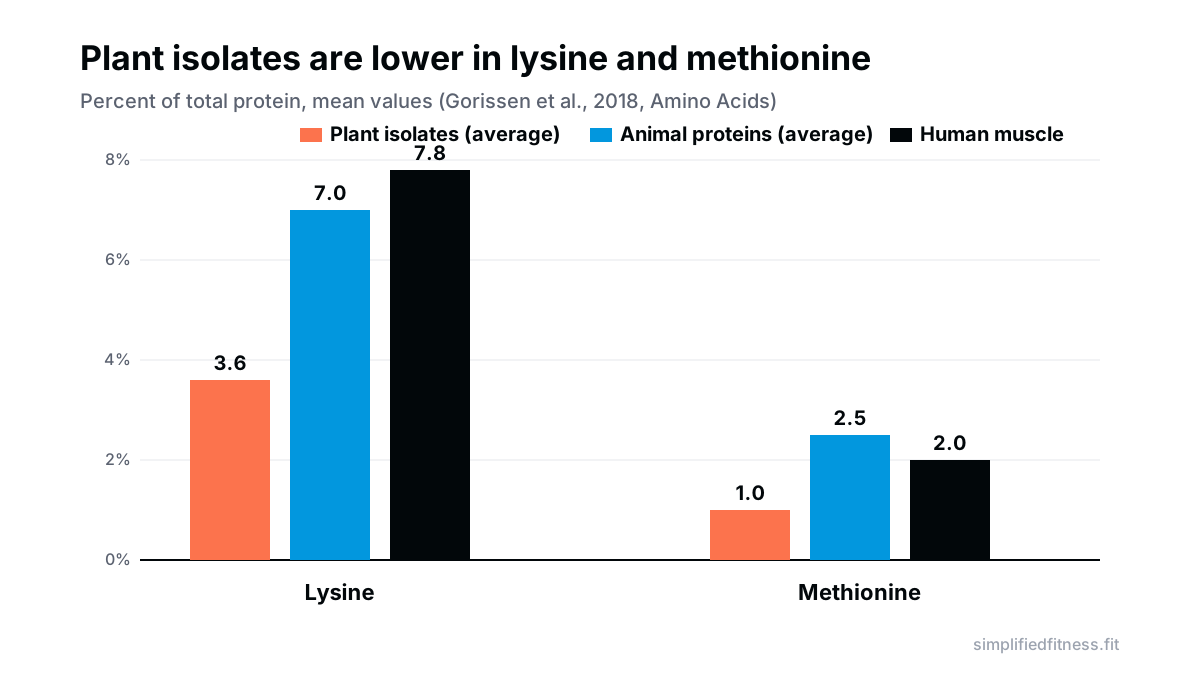
The authors concluded that combining plant isolates, or blending plant and animal proteins, can give a profile that closely reflects animal protein. That is the entire case for blends.
What is the pea and rice protein blend ratio, and is 70:30 special?
The usual story: pea protein is stronger in lysine and weaker in sulphur amino acids (methionine and cysteine), while rice is the reverse. Mix them and the gaps close. The 70:30 figure is the commonly marketed split.
Here is where I would slow down. The abstract-level evidence I could verify does not name 70:30 as optimal, and it does not prove a whey match. A 2020 review calculated DIAAS (a protein quality score that includes digestibility) for 12 plant and 5 animal proteins. Pea and rice were each classed below 75 on their own, whey and soy at 75 or above. It also modelled that certain plant mixtures at specific ratios could score higher (Herreman et al., 2020). That supports complementarity. It does not confirm 70:30, and the authors work for a potato-protein company.
If you want a deeper explanation of how DIAAS works, see our guide to DIAAS versus PDCAAS protein quality scores.
Does a plant blend build muscle like whey?
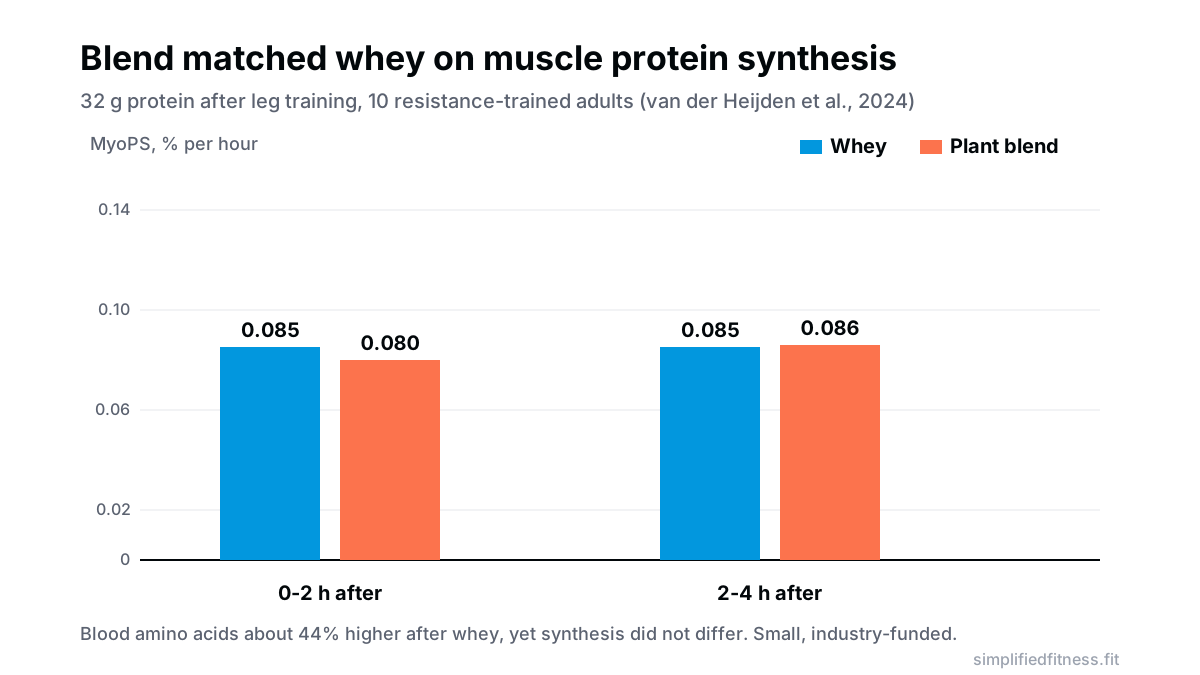
Here is the most relevant trial. Ten resistance-trained adults (8 men, 2 women, average age 26) did bilateral leg training, then drank 32 g of protein from whey or a blend of 39.5% pea, 39.5% brown rice and 21% canola, in a randomized, double-blind crossover (van der Heijden et al., 2024).
Blood essential amino acid availability over four hours was about 44% higher after whey. Yet muscle protein synthesis rates did not differ at 0-2 hours (0.085 vs 0.080% per hour) or 2-4 hours (0.085 vs 0.086% per hour).
Longer trials point the same way, with caveats. In 161 men aged 18-35 doing 12 weeks of upper-limb training on 25 g of pea protein, whey or placebo twice a day, pea and whey did not differ for biceps thickness or strength (Babault et al., 2015). Across the whole sample the group difference was only a trend (P = 0.09); among the weakest starters pea beat placebo while whey did not differ from either. Note that this trial tested pea alone, not a blend. Our plant-based protein powder review walks through these trials in more depth.
One more piece: a 2026 meta-analysis of 18 randomized trials (1,893 adults, at least 6 months) found no significant differences between plant and animal protein supplements for lean mass, fat mass or strength, though the plant products were largely soy (Yimam et al., 2026). The authors noted that results hold as long as enough protein is eaten. That is the same conclusion we reach in plant versus animal protein for hypertrophy.
How the evidence fits together
The studies disagree a little, and that is fine. The blood amino acid data favour whey. The muscle synthesis and long-term data say it often does not matter. A likely explanation is that the dose, total daily protein and the training you do swamp small differences in absorption.
Blend or whey: which fits your situation
| Factor | Whey | Pea and rice blend |
|---|---|---|
| Evidence for muscle gain | Largest evidence base | Smaller, but promising trials |
| Amino acid profile | Higher in EAA, strong leucine | More variable, check the label |
| Dairy-free | No | Yes |
| Digestion | Fine for most, lactose in concentrate | Some people get gas from fibre or gums |
| Metal content | Dairy products lower on average in one 2026 analysis | Plant products higher on average in that analysis |
If you are lactose intolerant or vegan, the blend is the obvious choice. If you can digest dairy and want the most-studied option, whey concentrate, isolate and hydrolysate are compared in a separate article.
Practical powder selection for a vegan lifter
A common mistake is picking a tub by the front-of-pack claim. Read the back.
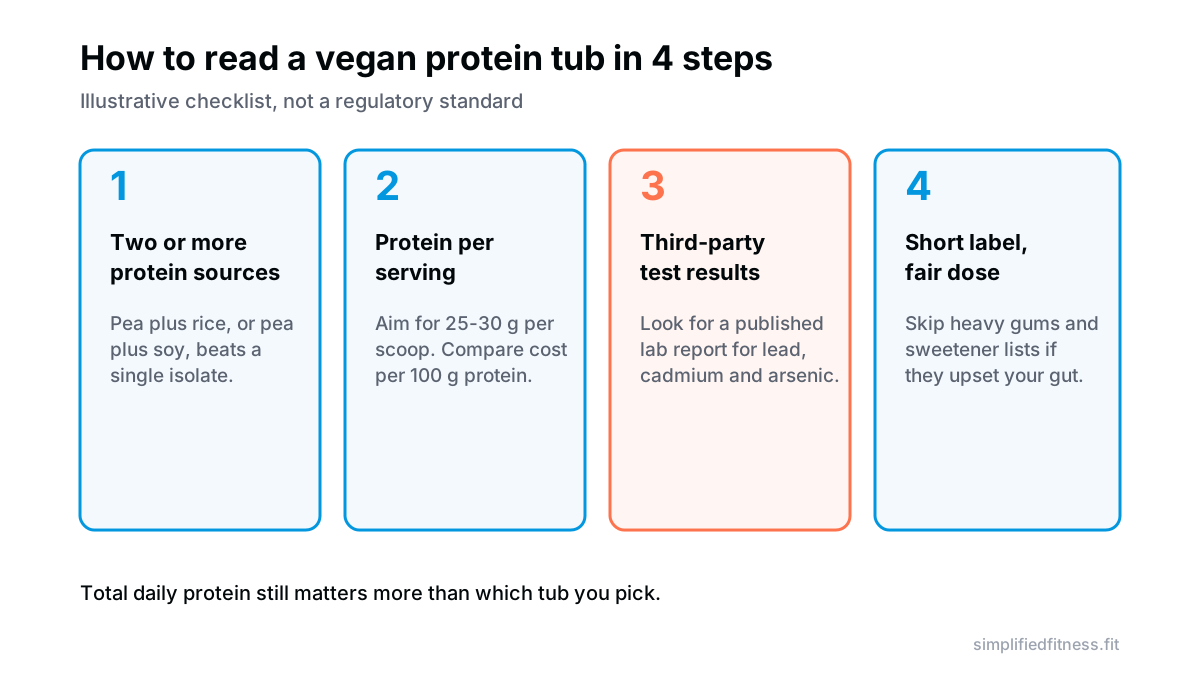
- Two or more protein sources. Pea plus rice, or pea plus soy.
- 25-30 g protein per scoop. Divide the price by grams of protein, not by weight of powder.
- Third-party tests. Look for a lab report that includes lead, cadmium and arsenic.
- A short label. Gums and sweeteners cause gut trouble for some people.
For lifters worried about leucine, use a slightly larger scoop. Our explainer on the leucine threshold covers why, and its limits.
Digestibility: is plant protein powder absorbed as well?
Digestibility is the weak point of the “exact match” claim. The DIAAS review above builds its scores on measured ileal digestibility, and it found considerable variation within the same protein source (Herreman et al., 2020). Two pea powders can behave differently depending on how they were processed.
In the gym this looks like one brand sitting fine and another causing gas. That is individual and brand specific. If a tub bloats you, try half a scoop with food, or a different brand, before blaming plant protein as a category.
Heavy metals in plant protein powders: should you worry?
A 2026 study tested 30 sports protein products sold in China for arsenic, cadmium, lead and mercury. All samples contained at least one metal. Plant-derived products had higher average lead (0.18 vs 0.06 mg/kg) and cadmium (0.05 vs 0.01 mg/kg) than dairy-derived ones, and a brown rice and cocoa product stood out as the highest (Chen et al., 2026).
The risk modelling gave a hazard index of 0.45 at 30 g a day and 0.90 at 90 g a day, with a 95th-percentile value of 1.28 under high-use conditions. The authors argue for consumption-scenario-based risk evaluation, especially for high-consumption users.
What that means for you:
- One scoop a day from a reputable brand is a different situation from three scoops a day.
- This is one study of 30 products in one market, so it does not tell you about a specific Indian brand.
- Rice grown in some soils takes up more arsenic and cadmium, which is a general plant-science point rather than something this study measured.
Do you even need a blend on an Indian vegetarian diet?
Often you already make one. Dal with rice, rajma chawal, chana with roti, and curd or paneer alongside are the original complementary blend. Soya chunks add to the mix, and our piece on high-protein Indian vegetarian meal prep shows how to put it together.
A scoop earns its place when your meals fall short or you are short on time. Use our free protein calculator to get a daily target, then fill only the gap with powder.
A simple way to use this
- Work out your daily protein target and plan food first.
- Choose a blend with at least two plant sources and a tested label.
- Use one scoop, 25-30 g protein, after training or with a meal.
- Increase the scoop slightly only if your blend looks low in leucine.
- Judge it by progress over 8-12 weeks, not by the tub.
Plant blends are not magic and they are not second-rate. They are a tool that works when total protein and training are right.
Frequently Asked Questions
What is the best pea and rice protein blend ratio?
There is no single proven ratio. Blends sold as 70:30 pea to rice are common, but the only whey-matching trial I found used roughly 40% pea, 40% brown rice and 20% canola. Exact ratios matter less than combining sources and hitting your daily protein total.
Is pea and rice protein as good as whey for muscle growth?
It can be close. A 2024 crossover trial found equal muscle protein synthesis after 32 g of a plant blend or whey in resistance-trained adults, though it was small and short-term. If you eat enough total protein, plant blends are a reasonable choice and results from one trial should not be stretched too far.
Why do you need to combine pea and rice protein?
Single plant isolates are, on average, lower in lysine and methionine than animal proteins. Combining sources lets one cover the other's shortfall, which is the idea behind complementary blends. You get the same effect at the end of the day by eating dal, rice, soya and curd across meals.
Is pea protein better than whey?
Not better, but possibly comparable for muscle size in some settings. In a 12-week trial of 161 young men, pea protein and whey did not differ significantly for biceps thickness. Across the whole group no supplement clearly beat placebo; only among the weakest starters did pea beat placebo. Whey still has the stronger evidence base overall, so choose on diet, digestion and budget.
Does pea protein have all nine essential amino acids?
Yes, pea protein contains all nine, but the amounts of some are low compared with animal protein. Pea is usually described as short of methionine, while rice is short of lysine. That is why a blend, or a varied vegan diet, makes the profile more even.
What is DIAAS and do pea and rice reach whey's score?
DIAAS is a protein quality score that combines amino acid content with how well it is digested. A 2020 review calculated that pea and rice proteins scored below 75 on their own, while whey and soy scored 75 or higher, and it modelled that mixtures can score higher. I would not trust any label claiming an exact whey match without a published calculation.
Are vegan protein powders safe from heavy metals?
Most are probably fine at normal use, but levels vary. A 2026 analysis of 30 protein products found all contained at least one trace metal, with plant-based products higher in lead and cadmium than dairy ones. Choose brands that publish third-party results and avoid several large servings a day without a reason.
Is brown rice protein worse for heavy metals than pea protein?
The evidence is thin. In that 2026 study, one brown rice and cocoa product was the outlier on lead, cadmium and arsenic, but the study did not rank pea against rice in a way that proves a rule. Check the lab report of the specific tub, not the ingredient alone.
How much vegan protein powder should I take?
Think of it as a top-up, not the foundation. A meta-analysis found extra protein stopped adding muscle once total intake passed about 1.6 g/kg/day. Use a scoop to close the gap between your food and your target, and work out the number with our protein calculator.
Is vegan protein powder digestible?
Usually, though individual tolerance varies, and some people get gas or bloating from added fibres or gums. Digestibility also changes with processing, so the numbers for isolates are not the same as for whole peas or rice. If a powder upsets you, try half a scoop with food or switch brands.
Do I need protein powder on a vegan or vegetarian Indian diet?
Not necessarily. Dal, chana, rajma, soya chunks, tofu, paneer and curd can cover your target if you plan for it. Powder is a convenient way to add 20-30 g in one go, especially when meals are carb heavy.
Should I take more vegan protein to match whey's leucine?
It is a plausible idea, though I did not find a trial that tests it directly. Plant isolates vary a lot in leucine, from about 5% to 13.5% of protein in one analysis, so check the label of your blend. If it looks low, a slightly larger scoop with a meal is a cheap, low-risk adjustment.
Sources & References
Every claim above is checked against peer-reviewed research (PubMed, U.S. National Library of Medicine) or guidance from established health bodies. How we fact-check.
- Gorissen SHM, et al. Protein content and amino acid composition of commercially available plant-based protein isolates. Amino Acids. 2018. PMID: 30167963
- van der Heijden I, et al. Plant protein blend ingestion stimulates postexercise myofibrillar protein synthesis rates equivalently to whey in resistance-trained adults. Med Sci Sports Exerc. 2024. PMID: 38537270
- Babault N, et al. Pea proteins oral supplementation promotes muscle thickness gains during resistance training: a double-blind, randomized, placebo-controlled clinical trial vs. whey protein. J Int Soc Sports Nutr. 2015. PMID: 25628520
- Herreman L, et al. Comprehensive overview of the quality of plant- and animal-sourced proteins based on the digestible indispensable amino acid score. Food Sci Nutr. 2020. PMID: 33133540
- Yimam MA, et al. Long-term effects of plant vs. animal protein supplementation on body composition, muscle strength, physical performance, and cardiometabolic risk factors in adults: a systematic review and meta-analysis of randomized controlled trials. Front Nutr. 2026. PMID: 41994089
- Chen M, et al. Heavy metal and microplastic exposure from sports protein supplements: integrated health risk modeling and scenario analysis. Environ Res. 2026. PMID: 41655677
- Morton RW, et al. A systematic review, meta-analysis and meta-regression of the effect of protein supplementation on resistance training-induced gains in muscle mass and strength in healthy adults. Br J Sports Med. 2018. PMID: 28698222

Umair Hazrami · Founder & Head Coach, Simplified Fitness
Umair Hazrami founded Simplified Fitness and the Simplified Lifter channel to cut through fitness noise. With 4+ years of consistent training and 10+ coaching clients, he writes every guide from the peer-reviewed research and links the sources so you can check them. Our editorial standards.
Educational content only, not medical advice. If you have a medical condition, are pregnant, or take medication, talk to a qualified doctor before changing your diet, supplements or training. Full disclaimer.
Keep reading
Nutrition
The Anabolic Window Myth: Do You Really Need a Shake Within 30 Minutes?
The anabolic window myth, debunked: what meta-analyses show about the 30-minute post-workout shake, how wide your real window is, and when timing still matters.
8 min read
Nutrition
Casein Protein: Slow Digestion, Nighttime Satiety and Muscle Growth
Casein protein benefits for muscle growth: how slow digestion works, what pre-bed trials show, casein vs whey, satiety on a cut and a curd pudding recipe.
8 min read
Nutrition
Collagen Protein: Joint and Tendon Support vs Muscle Building Protein
Does collagen protein build muscle? Here is why 20 g of collagen should not count toward your daily protein goal, and where it may help tendons and joints.
8 min read
Nutrition
Protein Distribution: 3 Meals vs 5 Meals and the 'Muscle Full' Effect
Protein distribution throughout the day: do you need 5-6 meals for muscle? See what research says on 3 vs 5 meals, the muscle full effect and grams per meal.
9 min read