Casein Protein: Slow Digestion, Nighttime Satiety and Muscle Growth
Casein protein benefits for muscle growth: how slow digestion works, what pre-bed trials show, casein vs whey, satiety on a cut and a curd pudding recipe.

TL;DR. The short answer
- Casein forms a gel in stomach acid and empties slowly, so amino acids reach your blood over several hours instead of in a short spike. In one tracer study, a casein meal cut whole-body protein breakdown by 34%, while whey did not.
- Casein is not a better muscle builder than whey in general. Whey stimulated more muscle protein synthesis in older men after a 20 g dose, and after training both proteins gave similar muscle protein balance.
- Pre-bed protein has real support: 12 weeks of 27.5 g before sleep added more thigh muscle size and strength than placebo in young men. Evidence for casein specifically beating other proteins at night is thin.
- For satiety, casein extended fullness by about 17 minutes versus a carb snack, but whey did the same. Total daily protein matters far more than the type.
- If your day already hits roughly 1.6 g/kg of protein, a pre-bed casein shake is optional. Curd, milk or paneer before bed does a similar job on a budget.
Part of our complete guide: Complete Protein Guide: How Much, What Type, and When to Eat It for Muscle Growth
Table of contents
The casein protein benefits for muscle growth are real, but narrower than supplement labels suggest. Casein is a slow-digesting milk protein that releases amino acids over hours, which makes it a sensible pre-bed or long-gap option. It is not a stronger muscle builder than whey (see our complete protein guide for hypertrophy for the basics).
This article is the deep dive on casein: what it does in your stomach, what the pre-bed trials actually found, where it loses to whey, and how to use it without wasting money.
What makes casein a slow-digesting protein?
Milk protein comes in two families. Whey stays liquid in the stomach and moves on quickly. Casein, which makes up most of the protein in milk, does the opposite. Stomach acid makes it clump into a gel (a curd), and your gut then releases it gradually.
That is the whole trick. Same amino acids, very different delivery speed.
The classic tracer study fed healthy adults a single meal of labelled casein or whey, with identical leucine intake. Whey caused a dramatic but short rise in blood amino acids. Casein caused a prolonged plateau of moderate levels, probably because of slow gastric emptying (Boirie et al., 1997).
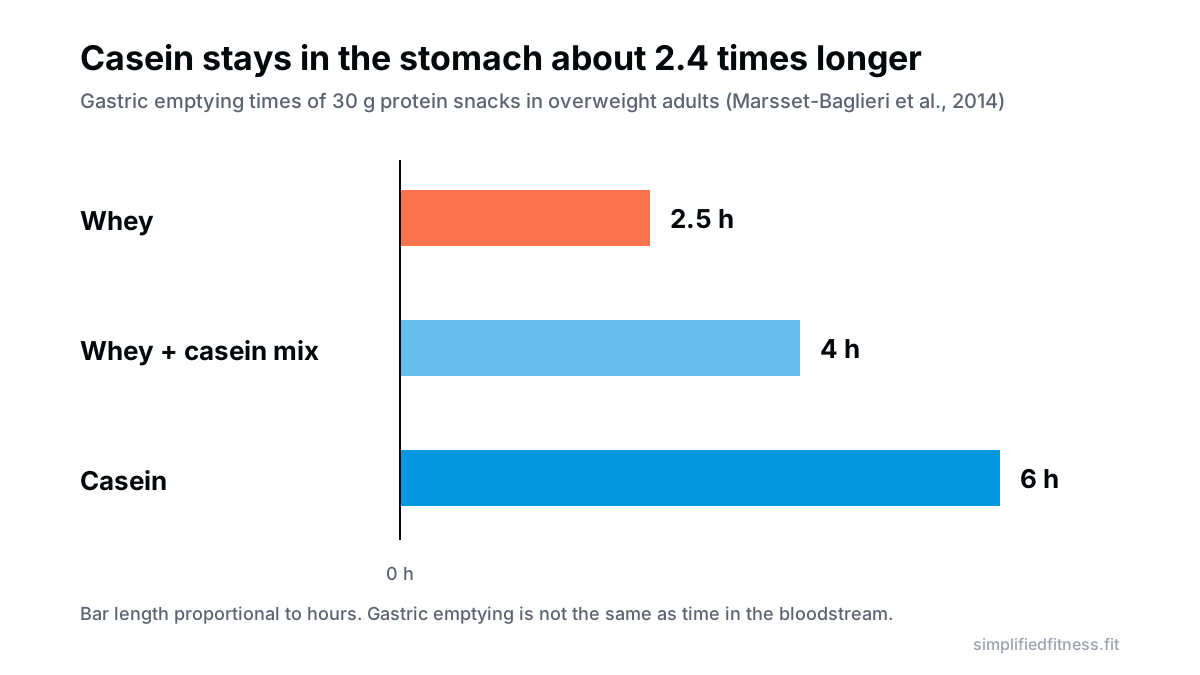
A later trial in overweight adults measured gastric emptying times of about 2.5 hours for whey, 4 hours for a whey-casein mix and 6 hours for casein (Marsset-Baglieri et al., 2014).
Does slow digestion reduce muscle protein breakdown?
Partly, and the nuance matters. In the 1997 study, whole-body protein breakdown was inhibited by 34% after casein but not after whey. Whey instead stimulated protein synthesis more (+68%) than casein (+31%). Over the following 7 hours, net leucine balance was more positive with casein, because less leucine was burned for fuel (Boirie et al., 1997).
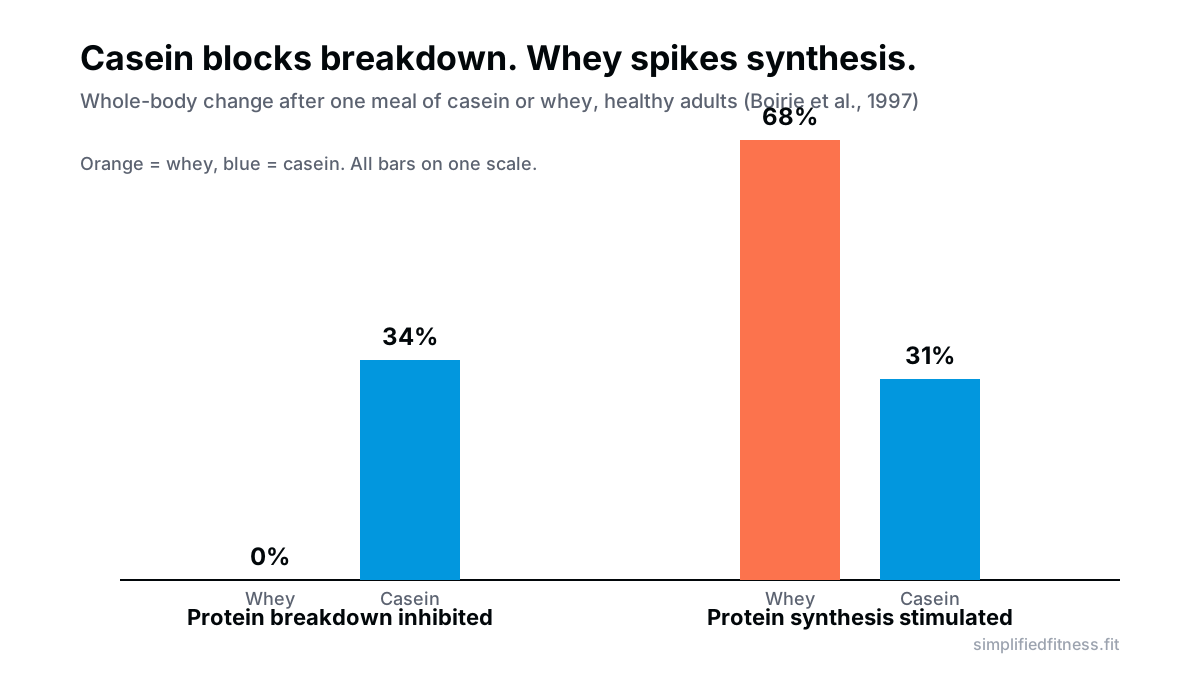
Two caveats. These were whole-body measurements, not muscle biopsies, and they followed a single meal in a lab. Suppressing breakdown sounds appealing, but we do not have long-term proof that “anti-catabolic” casein, on its own, builds more muscle than a normal protein intake spread across the day.
Does casein before bed build muscle?
The pre-sleep research is where casein earns its reputation. It deserves a fair read.
The overnight study. Sixteen healthy young men trained in the evening, had a standard recovery drink, then drank either 40 g of casein or a placebo 30 minutes before sleep. The casein was digested and absorbed during sleep, amino acids stayed raised through the night, and whole-body protein balance improved (61 vs -11 micromol/kg over 7.5 hours). Mixed muscle protein synthesis was about 22% higher, though that result only reached borderline significance (P = 0.05) (Res et al., 2012).
The 12-week training study. Forty-four young men did progressive resistance training. One group took 27.5 g of protein (plus 15 g of carbohydrate) every night before sleep, the other took a non-caloric placebo. The protein group gained more strength (+164 kg vs +130 kg on 1RM testing) and more thigh muscle area (+8.4 vs +4.8 cm2), and showed bigger growth in type II fibres (Snijders et al., 2015).
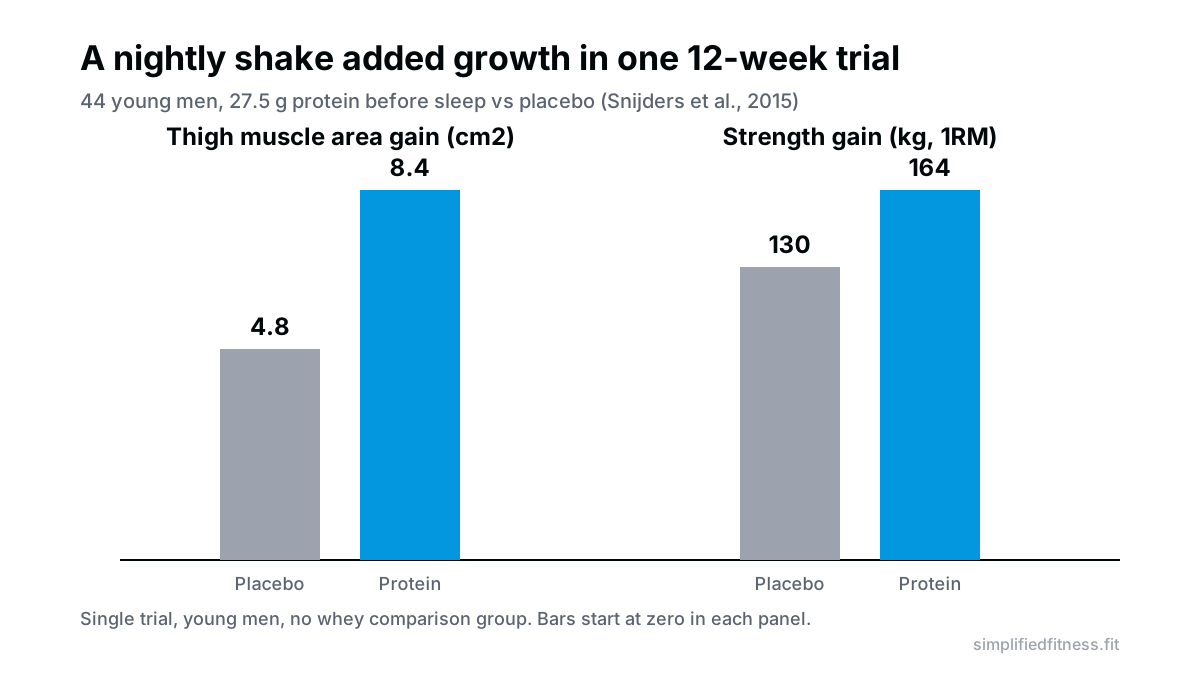
Notice what the comparison was. The placebo group got no protein at that time of day. That tells us protein before bed can help when your intake is otherwise limited. It does not prove that casein at night beats the same protein eaten at 6 pm.
The authors of a 2019 review conclude that pre-sleep protein is an effective strategy to raise overnight muscle protein synthesis and to support adaptation to resistance training, and that it does not appear to reduce next-morning appetite or change resting energy expenditure (Snijders et al., 2019). For the full timing question, see our dedicated piece on pre-bed protein and overnight anabolism.
What about conflicting results?
Not everything is positive, and it should not be.
One small trial gave 18 resistance-trained men 40 g of casein or placebo before sleep after an evening workout. There were no differences in next-morning strength or muscle damage markers. The casein group reported lower hunger that approached, but did not reach, statistical significance (Ormsbee et al., 2022).
Why the difference from the 12-week trial? They asked different questions. One looked at 12 weeks of training adaptations; the other at a single next-morning test. A one-night, small-sample trial is simply not built to detect a slow, cumulative effect. A fair reading is that pre-sleep protein probably helps over months when protein is on the low side, and does little for next-day performance.
Casein vs whey protein: which is better?
Neither wins everywhere. The honest answer depends on timing and context.
| Whey | Casein | |
|---|---|---|
| Digestion | Fast, short amino acid peak | Slow, long plateau |
| Gastric emptying (overweight adults) | About 2.5 h | About 6 h |
| Leucine content | Higher | Lower |
| After a single meal (whole-body) | Bigger synthesis rise (+68%) | Bigger drop in breakdown (-34%) |
| Muscle synthesis in older men, 20 g | Higher | Lower |
| Net muscle balance after leg exercise | Similar | Similar |
| Best use | Around training, daytime | Before bed, long gaps |
In older men given 20 g of each protein, whey produced a higher muscle protein synthesis rate than casein (0.15 vs 0.08%/h), which the authors link to faster digestion and more leucine (Pennings et al., 2011). But after leg exercise in healthy volunteers, 20 g of either protein turned net muscle protein balance positive, with similar phenylalanine uptake (Tipton et al., 2004).
So whey after training is a perfectly good default, and casein before bed is a perfectly good complement. If you want to go deeper on whey types, read our whey concentrate vs isolate vs hydrolysate comparison. The wider speed question is covered in fast vs slow absorbing proteins.
Does casein help with satiety when you are cutting?
A bit. In 82 overweight adults, a snack with 30 g of protein (casein, whey or a mix) extended the time before the next meal was requested by about 17 minutes compared with a carbohydrate snack. There was no difference between casein, whey or the mix, and lunch energy intake was unchanged (Marsset-Baglieri et al., 2014).
So the satiety benefit seems to come from protein itself, not from casein’s slow kinetics. Slowing digestion did not add fullness on top. If you are dieting, the practical point is that a high-protein evening snack can help you stay in your calorie target, and a thick, spoonable casein pudding can feel like dessert. More on this in our high protein cutting guide and our explainer on protein, satiety and the thermic effect.
How much does protein supplementation actually add?
Keep perspective. A 2018 meta-analysis of 49 randomized trials (1,863 participants) found that protein supplementation during resistance training increased fat-free mass by about 0.30 kg on average, with larger gains in trained people. Beyond a total intake of about 1.62 g/kg/day, extra protein did not add further fat-free mass gains (Morton et al., 2018).
That ceiling is your first filter. If your total protein is already around 1.6 g/kg, switching to casein at night is unlikely to change your physique. If you are under, a pre-bed shake is an easy way to close the gap. Work out your target with the protein calculator, and see our guide on how much protein you need for muscle growth.
Who should consider a pre-bed casein shake?
Think of it as a convenience tool for specific situations:
- You train in the evening and dinner was early or light.
- You find it hard to hit your protein target with food alone.
- You wake up hungry at night when dieting.
- You are a hard gainer who struggles to eat enough by bedtime.
- You are a vegetarian who eats dairy and wants a simple top-up.
Skip it if you are already at or above your protein target and happy with your sleep and hunger. Avoid it if you have a milk allergy. If you have kidney disease or a condition that limits protein intake, check with your doctor before adding supplements.
Budget options in India: casein powder vs dairy foods
Micellar casein powder is usually pricier than whey and harder to find locally. You may not need it. Dairy foods are casein-rich, even though the specific trials above used purified protein, not food.
- A glass of milk gives you a modest dose.
- Thick or hung curd (dahi) gives a spoonable, high-protein option.
- Paneer cubes or a small paneer bhurji gives a denser dose.
If you do buy powder, check the label says micellar casein, not just “casein.” Pair it with your plan from our free diet plan and adjust portions to your calorie target.
Casein pudding: a simple pre-bed recipe
Casein thickens when you use less liquid. That makes pudding easy.
- Put one scoop (25-30 g protein) of micellar casein in a bowl.
- Add about 80-100 ml of cold milk or water and stir with a fork.
- Wait two to three minutes. It thickens as it sits.
- Add a pinch of cinnamon, cocoa or a few chopped nuts.
- Chill it for 10 minutes if you want a mousse feel.
In summer, keep it in the fridge until you eat it. Add curd instead of milk if you want it tangier and thicker.
The bottom line
Casein is a slow-digesting milk protein that delivers amino acids over hours, which suits the overnight fast. Trials show pre-sleep protein can raise overnight muscle protein synthesis and, over 12 weeks, add to muscle and strength gains in young men. It does not clearly beat whey, and the benefit shrinks if your daily protein is already adequate.
Hit your total protein first, train hard, and sleep well. Then, if a bedtime shake or a bowl of curd helps you get there, use it. If you want a structured plan, start with our free push day workout.
Frequently Asked Questions
Does casein protein build more muscle than whey?
Not on current evidence. Whey digests faster and is richer in leucine, and in older men 20 g of whey produced a higher muscle protein synthesis rate than 20 g of casein. After resistance exercise, though, casein and whey gave similar increases in net muscle protein balance, so pick on convenience, taste and price.
Is micellar casein before bed worth it?
It can be a useful habit if you struggle to reach your daily protein target. A 12-week trial in 44 young men found 27.5 g of protein before sleep added muscle size and strength beyond placebo, but it was a single trial. If you already eat enough protein across the day, the extra benefit is likely small.
How long does casein take to digest?
In overweight adults, gastric emptying took about 6 hours for casein versus 2.5 hours for whey. This reflects how casein clots in stomach acid and is released slowly. Plan on a gradual amino acid supply over several hours rather than a precise number.
What is the difference between micellar casein and calcium caseinate?
Micellar casein is the form closest to what is found in milk, with intact casein micelles that clot in the stomach. Caseinate is processed with alkali and has different physical properties. The studies in this article used casein from milk, so micellar casein is the safer bet if you want the slow-release behaviour.
Does casein protein help you feel full when cutting?
A little. In overweight adults, protein snacks extended satiety by about 17 minutes compared with a carbohydrate snack, with no difference between casein, whey or a mix. Use it as one tool for hunger, alongside plenty of vegetables, dal and fibre.
Does casein stop muscle breakdown overnight?
It reduces protein breakdown after a single meal. In the 1997 Boirie study, whole-body protein breakdown fell 34% after casein and was unchanged after whey. That was whole-body, not muscle-specific, and in a lab after a single meal, so treat it as a mechanism, not a guarantee.
Can I take casein protein in the morning or during the day?
Yes. Casein is just a milk protein, and a slower release suits long gaps between meals as well as sleep. Taking it before bed is a convenience choice rather than a requirement.
How much casein should I take before bed?
Trials commonly used 27.5 to 40 g of protein before sleep. A scoop that gives 25-30 g is a reasonable starting point for most lifters. Count it toward your daily total instead of adding it on top of an already high intake.
Can I get the same benefit from curd, paneer or milk?
Probably much of it. Milk protein is mostly casein, and curd, hung curd and paneer are dairy foods rich in it, though those foods were not the ones tested in the trials here. A bowl of thick curd or a glass of milk before bed is a cheap, practical alternative to powder.
Does eating protein before bed make you fat?
No food makes you fat on its own. Fat gain depends on total calories over weeks, and a pre-bed shake only matters if it pushes you over your target. Subtract it from your daily calories, not add it on top.
Is casein protein safe, and who should avoid it?
For healthy adults, casein is a normal milk protein. Avoid it if you have a milk allergy, and be careful if you are lactose intolerant, since some products contain lactose. If you have kidney disease or any medical condition that limits protein intake, speak to your doctor before adding supplements.
Does pre-bed casein improve next-day performance?
Not reliably. In resistance-trained men, 40 g of pre-sleep casein did not improve next-morning strength or muscle damage markers versus placebo in a small trial of 18 men. There was a hint of lower hunger the next morning, but it did not reach significance.
Sources & References
Every claim above is checked against peer-reviewed research (PubMed, U.S. National Library of Medicine) or guidance from established health bodies. How we fact-check.
- Boirie Y, et al. Slow and fast dietary proteins differently modulate postprandial protein accretion. Proc Natl Acad Sci U S A. 1997. PMID: 9405716
- Res PT, et al. Protein ingestion before sleep improves postexercise overnight recovery. Med Sci Sports Exerc. 2012. PMID: 22330017
- Snijders T, et al. Protein ingestion before sleep increases muscle mass and strength gains during prolonged resistance-type exercise training in healthy young men. J Nutr. 2015. PMID: 25926415
- Snijders T, et al. The impact of pre-sleep protein ingestion on the skeletal muscle adaptive response to exercise in humans: an update. Front Nutr. 2019. PMID: 30895177
- Morton RW, et al. A systematic review, meta-analysis and meta-regression of the effect of protein supplementation on resistance training-induced gains in muscle mass and strength in healthy adults. Br J Sports Med. 2018. PMID: 28698222
- Marsset-Baglieri A, et al. Milk protein fractions moderately extend the duration of satiety compared with carbohydrates independently of their digestive kinetics in overweight subjects. Br J Nutr. 2014. PMID: 24968280
- Ormsbee MJ, et al. Pre-sleep protein supplementation after an acute bout of evening resistance exercise does not improve next day performance or recovery in resistance trained men. J Int Soc Sports Nutr. 2022. PMID: 35599912
- Tipton KD, et al. Ingestion of casein and whey proteins result in muscle anabolism after resistance exercise. Med Sci Sports Exerc. 2004. PMID: 15570142
- Pennings B, et al. Whey protein stimulates postprandial muscle protein accretion more effectively than do casein and casein hydrolysate in older men. Am J Clin Nutr. 2011. PMID: 21367943

Umair Hazrami · Founder & Head Coach, Simplified Fitness
Umair Hazrami founded Simplified Fitness and the Simplified Lifter channel to cut through fitness noise. With 4+ years of consistent training and 10+ coaching clients, he writes every guide from the peer-reviewed research and links the sources so you can check them. Our editorial standards.
Educational content only, not medical advice. If you have a medical condition, are pregnant, or take medication, talk to a qualified doctor before changing your diet, supplements or training. Full disclaimer.
Keep reading

Nutrition
The Anabolic Window Myth: Do You Really Need a Shake Within 30 Minutes?
The anabolic window myth, debunked: what meta-analyses show about the 30-minute post-workout shake, how wide your real window is, and when timing still matters.
8 min read
Nutrition
Collagen Protein: Joint and Tendon Support vs Muscle Building Protein
Does collagen protein build muscle? Here is why 20 g of collagen should not count toward your daily protein goal, and where it may help tendons and joints.
8 min read

Nutrition
Protein Distribution: 3 Meals vs 5 Meals and the 'Muscle Full' Effect
Protein distribution throughout the day: do you need 5-6 meals for muscle? See what research says on 3 vs 5 meals, the muscle full effect and grams per meal.
9 min read

Nutrition
Fast vs Slow Absorbing Proteins: Digestion Rates and Muscle Protein Breakdown
Fast vs slow digesting protein for hypertrophy: how whey and casein differ in amino acid release, what the tracer studies show, and how to combine them.
8 min read