Alcohol and Muscle Growth: What a Heavy Night Does to MPS, Sleep and Recovery
Alcohol and muscle growth: does a heavy Saturday night wipe out your week? See what research says on MPS, REM sleep and recovery, and how to limit the damage.
TL;DR. The short answer
- One very heavy session (about 12 standard drinks after training) lowered muscle protein synthesis by 24% even with protein, and by 37% with carbohydrate (Parr et al., 2014, 8 active men). That is one small study at an extreme dose.
- Sleep is hit at much lower doses than muscle protein synthesis: a 2025 meta-analysis found REM sleep was already reduced at about two standard drinks.
- Other studies are mixed. Strength and power recovery were unchanged in some trials and worse in others, and one study found higher post-workout testosterone with alcohol, so 'alcohol kills testosterone' is too simple.
- No trial has tested what a regular 1-2 drink habit does to long-term muscle size in trained people, so treat that as uncertain, not proven harmless.
- Practical rule: keep drinks few, eat protein and a proper meal first, drink water, and protect your sleep window. Heavy drinking, medication, or a family history of alcohol problems is a conversation for your doctor.
Part of our complete guide: Carbohydrates, Fats, Fibre, Micronutrients and Hydration: The Lifter's Fueling Guide
Table of contents
Alcohol and muscle growth do not mix well, but a heavy night does not “ruin your whole week” either. The clearest harm in the research comes from heavy drinking right after training, and from what drinking does to sleep. Small, occasional amounts look far less worrying, though the long-term trials in lifters have not been done.
This is a practical look at what the studies found, where they disagree, and how to enjoy a Saturday night without wasting Monday’s session. It sits inside our wider guide to carbs, fats and hydration for performance.
Does alcohol kill gains? The short answer
Gains are built over months from training, protein, enough food and sleep. One bad night nudges those inputs the wrong way. It does not delete them.
The more honest question is dose and timing. Four or five beers on a Saturday, a long way from your last session, is a different problem from a dozen drinks right after leg day. And a regular habit is different again from an occasional one.
Here is what the research can and cannot tell us.
Alcohol and muscle protein synthesis: the Parr study
The study everyone quotes is from 2014. Eight physically active men did leg extensions plus cycling, then drank in three separate trials: whey protein only, alcohol with protein, or alcohol with carbohydrate. The alcohol dose was 1.5 g per kg of body weight, about 12 standard drinks, split between straight after training and 4 hours later (Parr et al., 2014).
Muscle protein synthesis (MPS) still rose after exercise in every trial. But compared with protein alone, it was 24% lower with alcohol plus protein and 37% lower with alcohol plus carbohydrate. mTOR signalling, a key switch for building muscle, was also lower with alcohol at 2 hours.
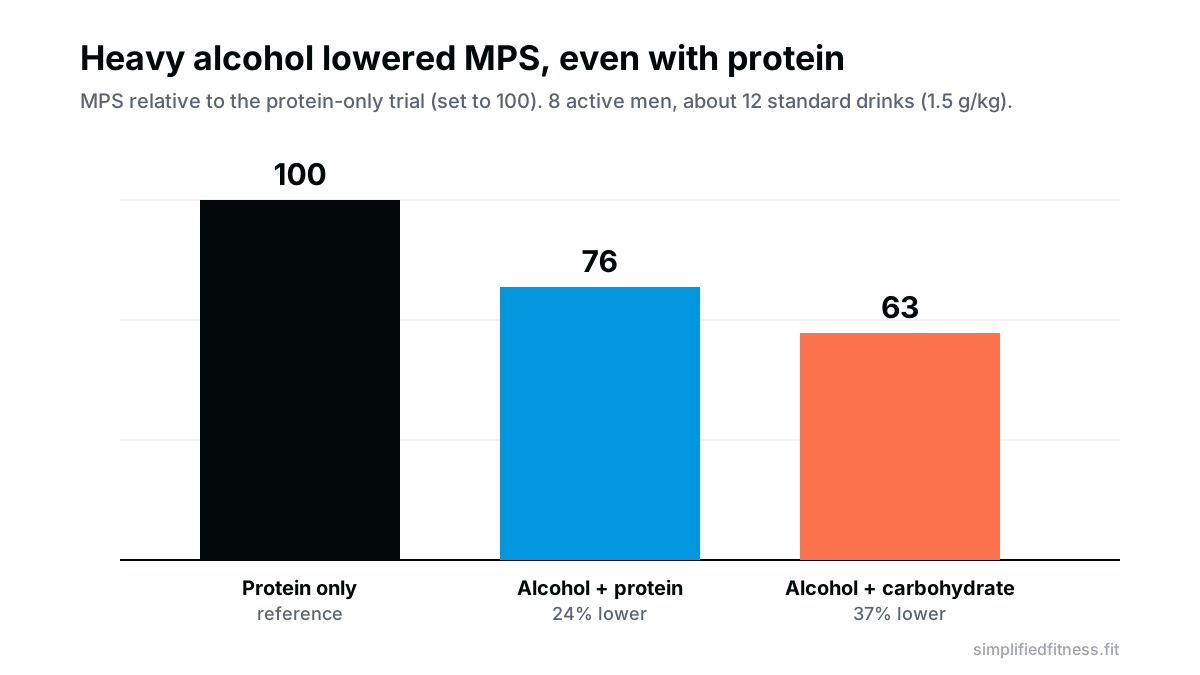
Read that carefully, because it gets quoted loosely.
- Small: 8 active men, not trained bodybuilders.
- Extreme: about 12 drinks. That is binge territory, not a couple of beers.
- Mixed exercise: lifting plus cycling, not lifting alone.
- Short window: it measured hours after one session, not muscle size after months.
Does the effect show up in lifting-only studies?
Partly. Trained men and women did heavy Smith machine squats and then drank alcohol or a placebo. Three hours later, mTOR and S6K1 phosphorylation was higher with placebo than alcohol in men. In women there was no such drop (Duplanty et al., 2017). It was signalling, not measured muscle growth, and 19 people is a small sample.
A 2022 narrative review sums up the field: acute alcohol tends to impair mTORC1 signalling, but the effect varies with sex, feeding, training status and dose, and many questions remain open (Levitt et al., 2022). An animal study went the other way. Mice drinking moderate alcohol still grew their overloaded muscles normally (Steiner et al., 2015), but mice are mice.
So the cautious takeaway: heavy alcohol straight after lifting is where the clearest signal of harm sits, and it is also the timing nearly every study tested. Moderate alcohol is less clear.
What alcohol does to sleep and recovery
This is where I would worry first, because it happens at far lower doses.
A 2025 meta-analysis pooled 27 studies of alcohol and sleep in healthy adults. It found a later start to REM sleep and less REM overall. The REM disruption appeared at about 0.5 g per kg, roughly two standard drinks, and got worse as the dose increased. At around 0.85 g per kg or more (about five standard drinks), people fell asleep faster, which the authors say likely worsens REM disruption later in the night (Gardiner et al., 2025). Total sleep time and sleep efficiency were too uncertain to call.
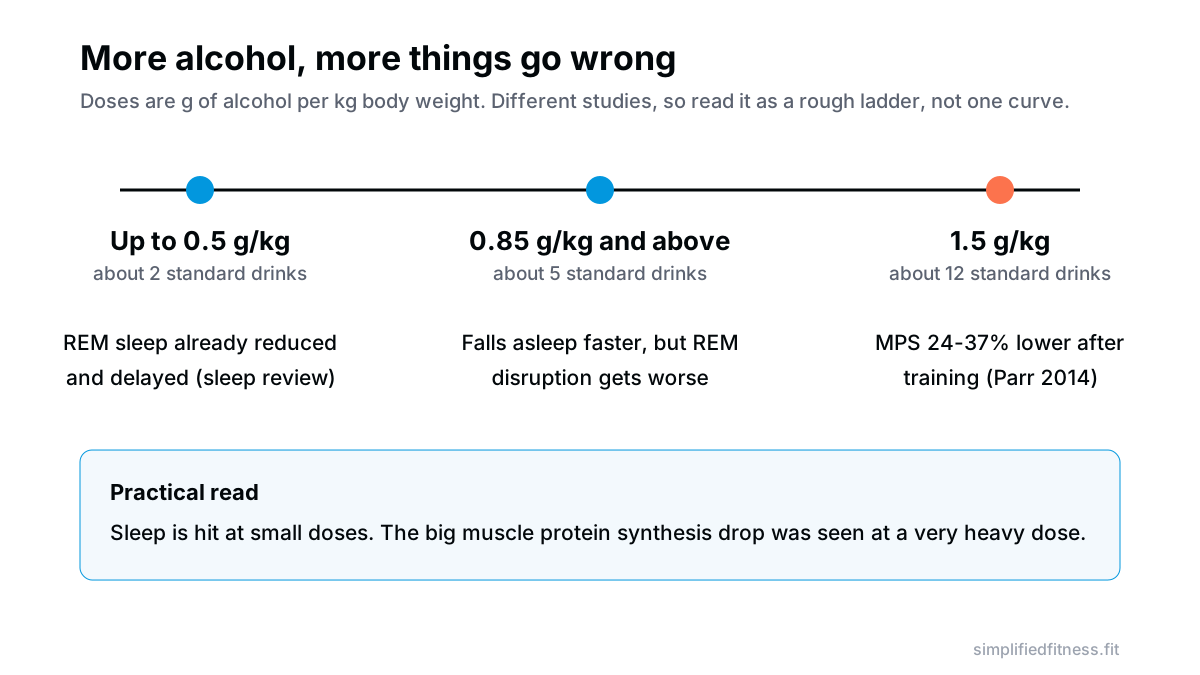
That matters for training because a rough night tends to mean a flat Sunday or Monday. If you want the deeper picture on why sleep matters for lifters, read our piece on sleep architecture and recovery, and our sleep hygiene checklist for lifters.
Soreness, strength and testosterone: the mixed evidence
The research here does not agree with itself, so let me lay out both sides.
Strength after muscle damage. In one study, 11 healthy men did 300 maximal eccentric quad contractions, then drank 1 g/kg of alcohol or juice. At 36 hours, peak strength losses were 34%, 40% and 34% (isometric, concentric, eccentric) with alcohol, versus 12%, 28% and 19% with juice (Barnes et al., 2010). A later trial in 10 recreationally trained men used heavy eccentric squats and a slightly lower alcohol dose (1.09 g per kg of fat-free mass). It found no effect on jump power, sprinting, change of direction or soreness at 24 and 48 hours (Levitt et al., 2020).
Why the gap? The second study used a non-novel exercise bout (the repeated-bout effect protects against damage), and the performance measures differ. Both are small. A systematic review of 12 studies found force, power, endurance and soreness were generally unmodified by alcohol, while testosterone, amino acids and MPS decreased and cortisol rose (Lakicevic, 2019).
Testosterone. This one gets oversold. A separate trial in 8 resistance-trained men found total and free testosterone were actually higher 140-300 minutes after squatting when they drank alcohol, with no difference in cortisol or estradiol (Vingren et al., 2013). So the review and the trial point different ways. I would not build a plan around “alcohol crushes testosterone”. The better-supported problems are anabolic signalling and sleep.
What about dehydration?
Alcohol makes you pass more urine, and a night out in an Indian summer without water is a bad idea. But I did not find a study in my reading for this article that quantifies how dehydration from alcohol affects lifting, so I will not invent a number. For what water loss does to strength in general, see hydration and strength.
A realistic Saturday: four or five beers
Say you drink four or five beers on a Saturday night, hours after your last session, with dinner in you. On the evidence above, the likeliest cost is poorer sleep and a flatter Sunday, not a collapse in muscle protein synthesis. The Parr dose was far higher, and it was taken right after training.
Where it gets worse is the stacking: drinking straight after a heavy leg day, skipping food, and sleeping four hours. If your gym day is Saturday morning, move the drinks later or keep them to one or two. And if you do this every weekend, the cumulative effect is unstudied in trained lifters, so I would not call it harmless.
How to drink and still make progress: harm-reduction rules
None of this means you must never drink. It means treat it as a cost and keep the bill small.
- Separate it from training. Do not drink in the hours straight after a hard session. That is the window studied.
- Eat first. A protein-rich meal beforehand (paneer, eggs, chicken, dal with curd) means you are not drinking on an empty stomach. In the Parr trial, protein looked better than carbohydrate, though neither fully protected.
- Cap the drinks. One or two is a much lower risk zone than five or more. Watch size: a large 650 ml bottle of 5% beer holds about 26 g of alcohol, roughly two and a half standard drinks of 10 g, and strong beers carry more.
- Water between drinks. Simple, and it helps in hot weather.
- Protect sleep. Stop earlier, and keep your wake-up time roughly the same.
- Hit protein the next day. Use the protein calculator for your target and do not “make up” for drinks by skipping meals.
- Adjust the next session. If you slept badly, drop a set or two instead of grinding through. See our guide to muscle soreness and recovery.
Calories and fat loss: an easy one to miss
Alcohol also carries calories that do not fill you up. If you are cutting, a few beers can eat a chunk of your daily budget, and drunk-you tends to order the biryani. Check where your maintenance sits with the calorie calculator, and read how this fits into MPS timing so you know what the recovery window is for.
Who should avoid alcohol or talk to a doctor
Skip it, or check with a doctor first, if you:
- are pregnant or trying to conceive
- take medication that interacts with alcohol (some painkillers, antibiotics, sedatives, diabetes drugs)
- have liver disease, high blood pressure, or a history of alcohol problems
- find you cannot stop at one or two, or drink most days
If drinking is affecting your health, mood or relationships, a doctor is the right first stop. This guide is general education, not a diagnosis.
The bottom line
Heavy drinking straight after training blunted muscle protein synthesis in a small, extreme-dose trial, and sleep suffers at much lower doses. Other outcomes (strength, soreness, testosterone) are mixed. For occasional light drinking, the evidence says “probably small”, not “proven harmless”.
So the plan is boring and effective. Drink less, not right after lifting, with food, with water, and without wrecking your sleep. Then get back to the training and protein that actually build muscle, starting with our free push, pull and legs plans.
Frequently Asked Questions
Does alcohol kill gains?
Heavy drinking can slow recovery, but one night does not erase a week of training. In a small trial, about 12 standard drinks after a hard session lowered muscle protein synthesis by 24-37% for that recovery window. The sensible move is to keep the damage small: fewer drinks, protein and food first, and a normal sleep schedule.
Does alcohol reduce muscle protein synthesis?
At high doses, yes. Parr and colleagues found that alcohol after concurrent training reduced myofibrillar protein synthesis by 24% when taken with protein and 37% when taken with carbohydrate, compared with protein alone. That trial had only 8 active men and an extreme dose, so do not assume the same drop from one or two drinks.
Is it bad to drink beer after lifting?
Post-workout drinking is the timing the studies tested, and it is when muscle signalling for repair is switched on. A trial in trained men and women found post-workout alcohol blunted mTOR signalling in men, though not in women. If you do drink, eat a protein-rich meal first and keep the drinks few.
How many drinks is too many for muscle growth?
There is no proven safe number, because the long-term trials have not been done. Sleep disruption showed up at about two standard drinks in a 2025 meta-analysis, while the large muscle protein synthesis drop was seen at about twelve. Staying at one or two drinks, occasionally, keeps you well below the dose behind the big MPS drop, though even two drinks can trim REM sleep.
Does alcohol lower testosterone?
The evidence is mixed. A systematic review reported lower testosterone after post-exercise alcohol, but one trial in resistance-trained men found higher total and free testosterone several hours after training with alcohol. Testosterone is not the main story here; reduced anabolic signalling and poor sleep are better supported.
How does alcohol affect sleep and recovery?
Alcohol reduces and delays REM sleep, even at low doses. A 2025 meta-analysis of 27 studies found REM disruption from about two standard drinks, worsening as the dose rose. Since sleep is when much of your recovery happens, a drink-heavy night can leave you flat in the next session.
Does alcohol make muscle soreness and strength loss worse?
Results conflict. One study found strength losses after eccentric exercise were bigger with alcohol (about 34-40% versus 12-28% at 36 hours), while a later trial found power and soreness recovery unchanged. If you train legs hard the next day, expect that the alcohol may not help and might hurt.
Does alcohol dehydrate you and hurt performance?
Alcohol makes you urinate more, and heavy drinking in a hot climate is a poor mix. I could not confirm a specific performance cost from the studies I read for this article, so I will not give a number. Drink water alongside, and see our guide on hydration and strength for what dehydration actually does to lifting.
Does eating protein with alcohol protect muscle?
It helps a little but does not fully protect. In Parr et al., alcohol with protein lowered MPS by 24%, versus 37% with carbohydrate. A follow-up analysis of the same trial found protein softened some markers of cell stress, though signs of cell damage rose with alcohol either way. Eat a proper protein meal before and during drinking, but do not treat it as a free pass.
Is moderate drinking fine for muscle growth?
Probably small, but not proven. A mouse study found moderate alcohol did not stop overload-induced muscle growth, yet mice are not lifters and we lack long-term human trials. Treat one or two drinks occasionally as low risk for muscle, and keep protein and sleep intact around it.
How long after drinking should I wait to train?
There is no tested cut-off. Training with a hangover mostly comes down to sleep loss and how you feel, so lower the load or volume if you are wrecked. Do not train while still intoxicated, since coordination and judgement under a barbell are poor.
When should I see a doctor about my drinking?
See a doctor if you cannot stop at one or two, drink most days, feel withdrawal symptoms, or take medication that interacts with alcohol. Heavy regular drinking carries health risks well beyond muscle. This article is not medical advice and cannot diagnose anything.
Sources & References
Every claim above is checked against peer-reviewed research (PubMed, U.S. National Library of Medicine) or guidance from established health bodies. How we fact-check.
- Parr EB, et al. Alcohol ingestion impairs maximal post-exercise rates of myofibrillar protein synthesis following a single bout of concurrent training. PLoS One. 2014. PMID: 24533082
- Gardiner C, et al. The effect of alcohol on subsequent sleep in healthy adults: a systematic review and meta-analysis. Sleep Med Rev. 2025. PMID: 39631226
- Duplanty AA, et al. Effect of acute alcohol ingestion on resistance exercise-induced mTORC1 signaling in human muscle. J Strength Cond Res. 2017. PMID: 27135475
- Vingren JL, et al. Postresistance exercise ethanol ingestion and acute testosterone bioavailability. Med Sci Sports Exerc. 2013. PMID: 23470309
- Barnes MJ, et al. Acute alcohol consumption aggravates the decline in muscle performance following strenuous eccentric exercise. J Sci Med Sport. 2010. PMID: 19230764
- Levitt DE, et al. Alcohol after resistance exercise does not affect muscle power recovery. J Strength Cond Res. 2020. PMID: 29385007
- Lakicevic N. The effects of alcohol consumption on recovery following resistance exercise: a systematic review. J Funct Morphol Kinesiol. 2019. PMID: 33467356
- Levitt DE, et al. Alcohol, resistance exercise, and mTOR pathway signaling: an evidence-based narrative review. Biomolecules. 2022. PMID: 36671386
- Steiner JL, et al. Moderate alcohol consumption does not impair overload-induced muscle hypertrophy and protein synthesis. Physiol Rep. 2015. PMID: 25780086
- Smiles WJ, et al. Protein coingestion with alcohol following strenuous exercise attenuates alcohol-induced intramyocellular apoptosis and inhibition of autophagy. Am J Physiol Endocrinol Metab. 2016. PMID: 27677502

Umair Hazrami · Founder & Head Coach, Simplified Fitness
Umair Hazrami founded Simplified Fitness and the Simplified Lifter channel to cut through fitness noise. With 4+ years of consistent training and 10+ coaching clients, he writes every guide from the peer-reviewed research and links the sources so you can check them. Our editorial standards.
Educational content only, not medical advice. If you have a medical condition, are pregnant, or take medication, talk to a qualified doctor before changing your diet, supplements or training. Full disclaimer.
Keep reading
Nutrition
Ashwagandha and Cortisol: Does It Lower Stress and Boost Strength in the Gym?
Ashwagandha for lifting: what the trials show on cortisol, stress and strength gains, realistic dose (300-600 mg), who should skip it and how to buy it safely.
7 min read
Nutrition
Caffeine Sensitivity, CYP1A2 Genetics and Caffeine Cycling: Why Pre-Workout Works for Him, Not You
Caffeine sensitivity genetics explain why pre-workout gives your friend PRs and you anxiety. See what CYP1A2 and ADORA2A do, and how to find your dose.
8 min read
Nutrition
Creatine Non-Responders: Why It May Not Be Working and What to Try
Creatine non responder? Learn why roughly 1 in 4 people see little change, how baseline diet matters, and when carbs with creatine help. Studies linked.
7 min read
Nutrition
Dietary Carbohydrates and Hypertrophy: Glycogen, Performance and Training Volume
Do you need carbohydrates for muscle hypertrophy? See what meta-analyses say about glycogen, training volume and daily carb targets per kg, plus Indian foods.
8 min read