Body Recomposition: Who Can Lose Fat and Build Muscle at the Same Time?
How to do body recomposition: who can lose fat and build muscle at once, what the trials show, and a protein, training and calorie protocol you can start today.
TL;DR. The short answer
- Yes, you can lose fat and build muscle at the same time. It is fastest in beginners, people returning after a break, and people carrying extra body fat, and slower but still possible in trained lifters.
- Three things drive it: high protein (around 2.0-2.4 g/kg), hard progressive resistance training, and calories at maintenance or a small deficit (roughly 0-15% below).
- The bigger the deficit, the more it works against muscle. A 2022 meta-analysis found deficits of about 500 kcal a day were enough to cancel out lean mass gains.
- Judge a recomp by waist, strength and photos over 8-12 weeks, not by the scale, because the scale can sit still while your body changes.
- If you are already lean and advanced, a focused bulk then cut usually builds more muscle per month than a recomp.
Part of our complete guide: The No-BS Guide to Energy Balance, Fat Loss, Bulking & Body Recomposition
Table of contents
Yes, body recomposition works: you can lose fat and build muscle at the same time, but how fast depends mostly on who you are. Beginners, people returning after a break and people with extra body fat get the best results. Experienced lean lifters can still recomp, just far more slowly.
The old rule says you must bulk to gain muscle, then cut to lose fat. That is a useful default for advanced lifters, but it is not a law of physics. This guide covers who can recomp, what the research does and does not show, and a simple protein, training and calorie protocol. For the bigger picture on energy balance, see our complete guide to fat loss, bulking and recomposition.
Can you build muscle and lose fat simultaneously?
Muscle growth needs a training stimulus, enough protein and enough recovery. It does not strictly need a calorie surplus. Your body can pay for new muscle by drawing on stored fat while protein supplies the building blocks.
The evidence is real but uneven. Several trials show lean mass rising while fat falls. They also tend to be short, small and run in beginners or people with higher body fat. A 2026 trial in resistance-trained adults found that both a high-protein maintenance diet and a moderate deficit raised fat-free mass over 10 weeks versus a control group (Vargas-Molina et al., 2026). That was only 30 people, so treat it as encouraging rather than settled.
Who can recomp? The honest ranking
Think of recomp as a spectrum, not a yes or no.
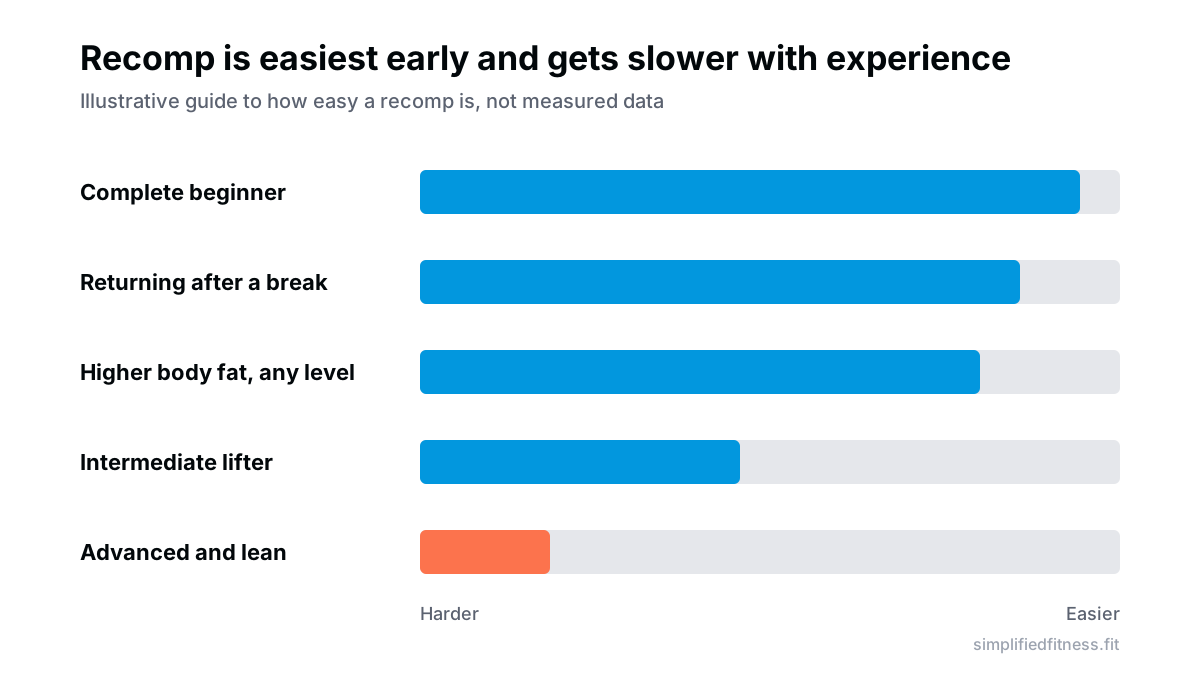
- Complete beginners. Almost any sensible program produces a big muscle response, so there is a lot of room to grow while eating a bit less.
- Returning lifters. Strength and size often come back faster than they were first built. The reason is debated (see below).
- People with higher body fat. More stored energy means less conflict between losing fat and feeding muscle, though the leanest people in this group have less room.
- Intermediate lifters. Recomp is possible but slow, and the trials in this group are small.
- Advanced and lean. Both muscle gain and fat loss run slowly. A planned bulk and cut usually gets more done.
The muscle memory question
Does “muscle memory” explain fast regrowth after a break? The evidence conflicts. One study trained people, had them stop, then retrain, and found no extra response in the previously trained leg (Psilander et al., 2019). A later study found muscle fibres kept their extra nuclei after training stopped, but retraining did not clearly produce more growth than in the untrained arm (Cumming et al., 2024). The first study’s authors noted that training did not raise myonuclear number in the first place, so it was not a rigorous test. Both studies were small (19 and 12 people). So muscle memory may be real at the cell level, yet its practical payoff is still unclear. If you are coming back, treat it as a bonus and ramp up gradually.
How to do body recomposition: the three pillars
Every recomp protocol rests on the same three levers.
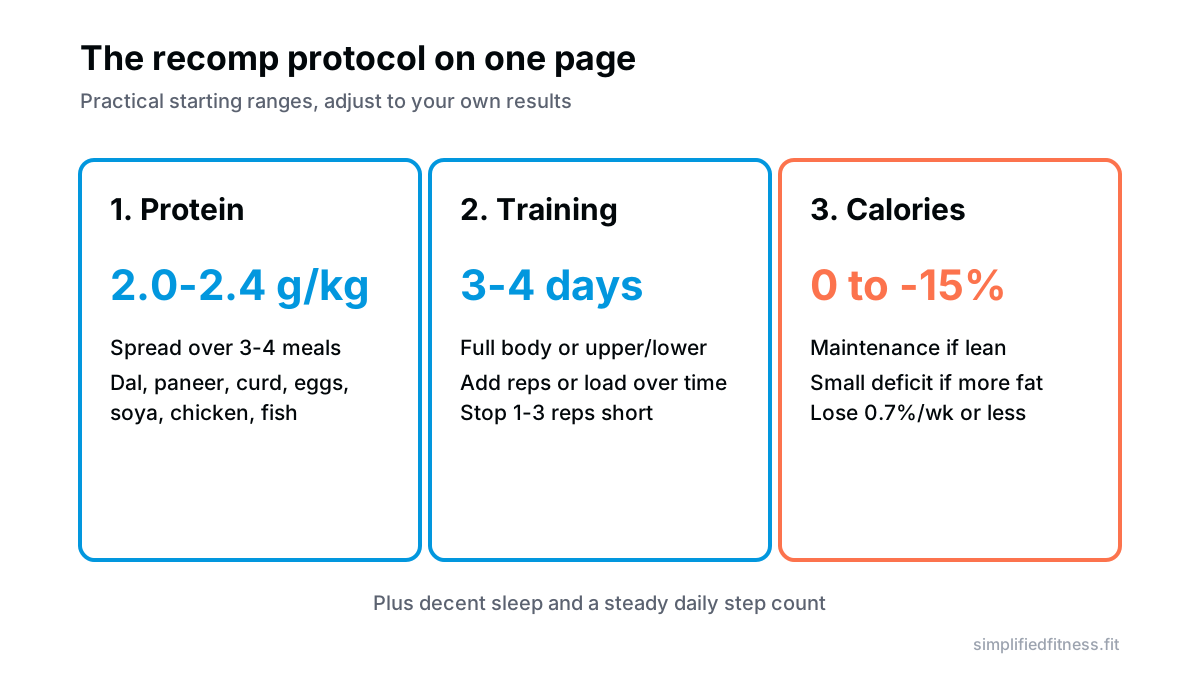
1. Protein: around 2.0-2.4 g/kg
Protein is the lever that makes recomp work when calories are limited. In a 4-week trial, young men ate about 40% fewer calories than needed and trained hard six days a week. The group on 2.4 g/kg protein gained 1.2 kg of lean mass and lost 4.8 kg of fat. The group on 1.2 g/kg gained 0.1 kg and lost 3.5 kg (Longland et al., 2016).
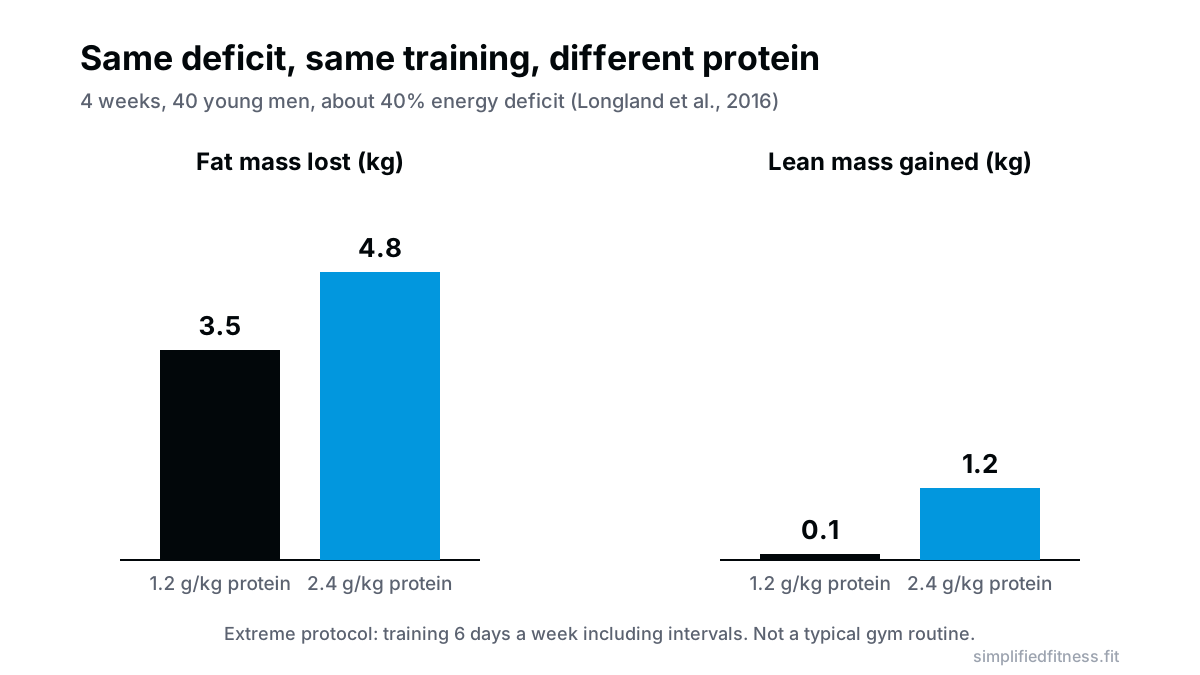
Be careful with that result. It was 4 weeks, the training load was extreme, and the participants were young men, so it does not map neatly onto a typical office-going lifter. A systematic review of lean, resistance-trained athletes in a deficit suggested higher intakes are likely needed, roughly 2.3-3.1 g/kg of fat-free mass, scaled up with leanness and the size of the deficit (Helms et al., 2014). That review covered only six studies. Going by body weight, 2.0-2.4 g/kg is a sensible working range.
For a 70 kg lifter, that is about 140-170 g a day. In Indian terms, a katori of cooked dal gives roughly 6-10 g, 100 g paneer about 18 g, a bowl of regular curd about 5-7 g (more if hung or Greek style), 50 g soya chunks around 25 g (dry weight) and a whey scoop about 20-25 g. These are typical values, so check your packet labels. Use our protein calculator for your own number.
2. Progressive overload, close to but not at failure
Recomp fails if the training signal is weak. Your body only keeps muscle when it has a reason to. Use a plan with the main lifts, add reps or weight when you can, and stop most sets about 1-3 reps short of failure. A meta-analysis found no evidence that going to absolute failure beats stopping short for hypertrophy (Refalo et al., 2023). That is useful in a deficit, since sets taken to failure are generally thought to be more fatiguing.
Three or four sessions a week works for most people. Our free push, pull and leg plans are a simple template. If you are unsure how close to failure you are, try the RIR and RPE calculator and read our guide on calibrating true RIR.
3. Calories: maintenance or a small deficit
A practical range is 0-15% below maintenance. The trade-off is simple: a bigger deficit burns fat faster but costs muscle.
A 2022 meta-analysis of resistance training in an energy deficit found lean mass gains were impaired compared with training at maintenance, while strength gains were comparable. Its meta-regression suggested a deficit of about 500 kcal a day prevented lean mass gains (Murphy et al., 2022). That does not mean a smaller deficit never works. It means that the bigger the deficit, the less muscle you should expect to gain.
How fast you lose also matters. In a trial of athletes, a slower loss of about 0.7% of body weight a week was linked to lean mass gains, while a faster loss of about 1% a week left lean mass unchanged (Garthe et al., 2011). Those were 24 elite athletes, so treat it as a direction rather than a rule. Our calorie calculator gives you a starting maintenance figure, and our guide to setting a moderate versus aggressive deficit goes deeper.
| Situation | Calories | Why |
|---|---|---|
| Beginner, normal body fat | Maintenance to 10% below | Fast muscle response, little need for a large deficit |
| Higher body fat | 10-15% below | Stored fat covers the gap, protein protects muscle |
| Returning lifter | Maintenance to 10% below | Regain size without a large energy debt |
| Lean intermediate | Maintenance | A deficit may stall muscle gain |
| Advanced and lean | Consider bulking | Recomp is slow, a surplus builds more |
How to track a recomp
The scale is a poor judge. If you gain a bit of muscle and lose a bit of fat, your weight may barely move.
- Measure your waist at the navel once a week, same time of day.
- Take photos every 2-4 weeks in the same light.
- Log your main lifts. Rising strength with a flat or shrinking waist means it is working.
- Use the body fat calculator for rough trends, not precise numbers.
Give the plan 8-12 weeks before deciding. Daily weight swings from salt, water and meals will mislead you in the meantime.
A sample weekly recomp setup
Here is a simple structure for a 70 kg beginner or returning lifter. Adjust numbers to your own body.
- Protein: about 150 g a day across 3-4 meals.
- Calories: start at your estimated maintenance, then trim by about 5-10% after two weeks if your waist is not moving and you have extra fat to lose.
- Training: 3-4 sessions a week, mostly compound lifts, working sets 1-3 reps from failure, with a small weight or rep increase each week when you can.
- Daily movement: keep steps steady so your activity does not drift down as calories drop.
- Sleep: protect it. Poor sleep hurts both training quality and appetite control.
Hot-climate tip: in an Indian summer, the same training volume can feel harder. If sessions drag, drop a set or two instead of cutting calories further.
When recomp is the wrong choice
Recomp is not always the best plan. If you are already lean and have 3 or more years of serious training, muscle gain per month on a recomp may be small. A planned bulk, such as the lean bulk approach, may build more muscle, followed by a cut. If you are unsure which route fits, our guide to the skinny fat dilemma walks through the decision. For the energy and hypertrophy science behind this, see calorie deficit vs surplus for hypertrophy.
Who should check with a doctor first
Talk to a doctor or registered dietitian before starting if you:
- have a medical condition such as diabetes, kidney disease or heart disease
- are pregnant or breastfeeding
- take regular medication
- have a history of disordered eating, since tracking and deficits can be a trigger
- are under 18
The bottom line
You can lose fat and build muscle together, especially if you are new, returning or carrying extra fat. Keep protein high (around 2.0-2.4 g/kg), train hard with progressive overload, and keep calories at maintenance or a small deficit. Be patient: a recomp is measured in months, and it works best when judged by waist, strength and photos rather than the scale.
The research behind it is encouraging but modest, with small and short trials, so treat the numbers here as starting points to adjust to your own results.
Frequently Asked Questions
Can you really lose fat and build muscle at the same time?
Yes, it is possible, and it is most often reported in beginners and people with higher body fat. Stored fat can supply energy while protein and training signal muscle to grow, so the two do not have to take turns. The rate depends heavily on training experience, so expect faster results the newer you are to lifting.
Who can do a body recomp?
Beginners, lifters coming back after a layoff, and people with a higher body fat percentage have the best odds. They have the most room to grow and the most stored energy to draw on. Intermediate and advanced lifters can recomp too, but progress is slower and a bulk and cut cycle may suit them better.
How much protein do I need for body recomposition?
A practical target is about 2.0-2.4 g per kg of body weight per day. In a 4-week trial of young men in a large deficit, 2.4 g/kg produced more lean mass gain and more fat loss than 1.2 g/kg. Spread it over 3-4 meals, and use our protein calculator to get your number.
Should I eat in a deficit, at maintenance or in a surplus to recomp?
Maintenance or a small deficit (roughly 0-15% below) is a sensible choice. A recent 10-week trial found both a high-protein maintenance diet and a moderate deficit produced fat-free mass gains in resistance-trained people. Pick the small deficit if you carry extra fat, and maintenance if you are already fairly lean.
How long does body recomposition take?
Expect to wait 8-12 weeks before changes are obvious in the mirror and in your measurements. Changes are slow because you are gaining a small amount of muscle while losing a small amount of fat, so the scale barely moves. Track waist, strength and photos every 2-4 weeks.
Why is my weight not changing during a recomp?
Because muscle gain and fat loss can roughly cancel out on the scale. A lean mass gain of around a kilo and a similar fat loss looks like nothing on the scale but a lot on the waist. Use a tape measure, progress photos and your lift numbers instead of daily weigh-ins.
Can trained lifters recomp, or is it only for beginners?
Trained lifters can, but the effect is smaller and slower. Research in resistance-trained people shows fat-free mass can rise on a moderate deficit or at maintenance with high protein, though the trials are short and small. If you have 3 or more years of serious training and are lean, a bulk may add muscle faster.
Does muscle memory help me recomp after a break?
Probably a little, but the science is mixed. Human studies show muscle fibres keep extra myonuclei after training, yet two trials found no clearly faster regrowth in the previously trained muscle. Still, many lifters returning after a break regain size quickly, so start moderate and build back over a few weeks.
Is a recomp better than bulking and cutting?
It is better for beginners, returning lifters and anyone who dislikes the bulk and cut cycle. Bulking gives your muscles more energy and is generally thought to build muscle faster in advanced lifters, though direct comparisons are scarce. If your goal is maximum muscle in the shortest time and you are already lean, bulk first and cut later.
How hard should I train during a recomp?
Train most working sets within about 1-3 reps of failure and add reps or weight over time. A 2023 meta-analysis found no clear hypertrophy advantage for training to absolute failure versus stopping short, so you can keep a rep or two in reserve. This also protects recovery when calories are tight.
What should I eat on a vegetarian recomp in India?
Build each meal around a protein anchor such as paneer, curd, dal, soya chunks, eggs or whey. Staples like dal and curd carry less protein per calorie than chicken or fish, so you may need a scoop of whey or a bowl of curd to hit your target. Pair with roti or rice for energy rather than cutting carbs too hard.
When should I see a doctor about my diet and training plan?
See a doctor before starting if you have a medical condition, are pregnant, take medication, or have a history of disordered eating. A calorie deficit with intense training is not appropriate for everyone. A doctor or registered dietitian can set safe targets for you.
Sources & References
Every claim above is checked against peer-reviewed research (PubMed, U.S. National Library of Medicine) or guidance from established health bodies. How we fact-check.
- Longland TM, et al. Higher compared with lower dietary protein during an energy deficit combined with intense exercise promotes greater lean mass gain and fat mass loss: a randomized trial. Am J Clin Nutr. 2016. PMID: 26817506
- Murphy C, et al. Energy deficiency impairs resistance training gains in lean mass but not strength: A meta-analysis and meta-regression. Scand J Med Sci Sports. 2022. PMID: 34623696
- Helms ER, et al. A systematic review of dietary protein during caloric restriction in resistance trained lean athletes: a case for higher intakes. Int J Sport Nutr Exerc Metab. 2014. PMID: 24092765
- Vargas-Molina S, et al. Comparison of two nutritional protocols in body re-composition of resistance-trained participants. Eur J Appl Physiol. 2026. PMID: 41940947
- Garthe I, et al. Effect of two different weight-loss rates on body composition and strength and power-related performance in elite athletes. Int J Sport Nutr Exerc Metab. 2011. PMID: 21558571
- Psilander N, et al. Effects of training, detraining, and retraining on strength, hypertrophy, and myonuclear number in human skeletal muscle. J Appl Physiol. 2019. PMID: 30991013
- Cumming KT, et al. Muscle memory in humans: evidence for myonuclear permanence and long-term transcriptional regulation after strength training. J Physiol. 2024. PMID: 39159314
- Refalo MC, et al. Influence of resistance training proximity-to-failure on skeletal muscle hypertrophy: a systematic review with meta-analysis. Sports Med. 2023. PMID: 36334240

Umair Hazrami · Founder & Head Coach, Simplified Fitness
Umair Hazrami founded Simplified Fitness and the Simplified Lifter channel to cut through fitness noise. With 4+ years of consistent training and 10+ coaching clients, he writes every guide from the peer-reviewed research and links the sources so you can check them. Our editorial standards.
Educational content only, not medical advice. If you have a medical condition, are pregnant, or take medication, talk to a qualified doctor before changing your diet, supplements or training. Full disclaimer.
Keep reading

Nutrition
Breaking Fat Loss Plateaus: Check Fluid, Hidden Calories and NEAT
How to break a fat loss plateau: a 3-step check of water masking, hidden calories and lower daily steps, plus the exact fix to restart steady fat loss.
8 min read

Nutrition
How to Calculate Macros: Step-by-Step Grams per Kilogram Formula for Protein, Fat and Carbs
How to calculate macros in grams per kg: set protein, set fat, fill the rest with carbs. Worked examples for 70, 80 and 90 kg lifters on a cut or a bulk.
9 min read
Nutrition
Daily Scale Weight Fluctuations: Sodium, Bowels, Glycogen and Water
Daily scale weight fluctuations are mostly water, glycogen and gut contents, not fat. Learn why your weight jumps overnight and how a 7-day average fixes it.
8 min read
Nutrition
Diet Breaks vs Refeeds: Do Hormones, Glycogen and Sanity Really Matter?
Diet breaks vs refeeds: which one helps a long cut? See what MATADOR, ICECAP and other trials found on fat loss, metabolism and hunger, and how to schedule one.
9 min read