The Principle of Specificity (SAID): Do You Really Need Low Reps (1-5) for Maximal Strength?
Principle of specificity strength explained: what SAID means, why heavy 1-5 rep sets help your 1RM, and what the research says about 10-15 reps alone.
TL;DR. The short answer
- The SAID principle says your body adapts to the specific demands you impose. A one-rep max is a skill performed under near-maximal load, so heavy practice is the most direct way to train it.
- In a 2017 meta-analysis of 21 studies, 1RM gains were significantly greater with high loads (above 60% of 1RM) than low loads, while muscle growth was similar.
- Training only in the 10-15 rep range can still raise your 1RM, especially early on, but the evidence suggests it is not the most efficient route for peak strength.
- A practical split is heavy sets of 1-5 for the main lift, then lighter back-off sets of 6-12 and accessories for muscle size.
- Evidence is mixed at the edges. A small 2025 trial in trained people found similar multi-joint 1RM gains from 3-5 reps and 20-25 reps, so low reps are useful, not magic.
Part of our complete guide: Maximal Strength, Neuromuscular Adaptations & Powerlifting Science for General Lifters
Table of contents
Short answer on the principle of specificity strength question: yes, heavy sets of roughly 1-5 reps are the most direct way to train a one-rep max, because strength at heavy loads is a skill you get better at by practising it. No, they are not strictly mandatory. Muscle size and general strength can come from many rep ranges, but the research leans toward heavier loads when the goal is the biggest possible 1RM.
This article sits inside our complete guide to maximal strength and powerlifting science. Here we zoom in on one rule, SAID, and on the real question behind it: can you reach a world-class max by training only in the 10-15 rep range?
What does SAID mean in resistance training?
SAID stands for Specific Adaptations to Imposed Demands. Your body gets better at what you repeatedly ask of it, and mostly in the way you ask.
Run and your legs get better at running. Squat 200 kg for a single and your nervous system gets better at squatting 200 kg for a single. The more your training looks like the thing you want to improve, the more directly it transfers.
For a lifter, specificity has a few layers:
- Load. Moving near-maximal weight feels and behaves differently from moving a light weight, even on the same exercise.
- Movement. The exact lift (barbell back squat, competition bench) carries over better than a machine version.
- Speed and effort. Heavy loads move slowly no matter how hard you try, and your body learns to produce force under those conditions.
- Bracing and technique. Holding your torso tight under a load that wants to fold you in half is practised, not assumed.
That last part is why maximal strength is not just “big muscles.” A 1RM is a coordination event.
Why do low reps build strength?
Think of strength as two ingredients: how much muscle you have, and how well you can use it. Higher reps with lighter loads can grow muscle well, as we cover in our guide to the hypertrophy rep spectrum. Heavy sets add the second ingredient.
There is direct evidence on the “use it” side. In a 2017 trial, 26 men trained their leg extensors to failure three times a week for 6 weeks, at either 80% or 30% of 1RM. Muscle thickness grew similarly in both groups, but 1RM and maximal isometric strength rose more at 80%. Voluntary activation, a measure of how fully the nervous system drives the muscle, was also greater in the 80% group at week 6 (Jenkins et al., 2017). The authors suggest greater neural adaptations may explain the strength difference despite similar hypertrophy.
Two cautions. That study used a single-joint exercise (leg extension) in young men, so it is not a squat study. And voluntary activation is an indirect measure, so I would not pin everything on one mechanism. If you want the deeper neural story, see our article on the neuromuscular foundations of maximal strength.
What does the research say about heavy vs light loads?
Start with the biggest summary. A 2017 systematic review and meta-analysis of 21 studies compared low-load (60% of 1RM or less) with high-load (above 60%) training, all sets taken to failure and lasting at least 6 weeks. Gains in 1RM were significantly greater with high loads. Isometric strength did not differ, and muscle hypertrophy was similar between conditions (Schoenfeld et al., 2017).
That pattern shows up in well-trained men too. In an 8-week trial of 18 experienced lifters, a group doing 8-12 reps per set was compared with a group doing 25-35 reps. Muscle thickness grew similarly (quadriceps 9.3% vs 9.5%), but back squat 1RM rose 19.6% in the heavier group versus 8.8% in the lighter group (Schoenfeld et al., 2015).
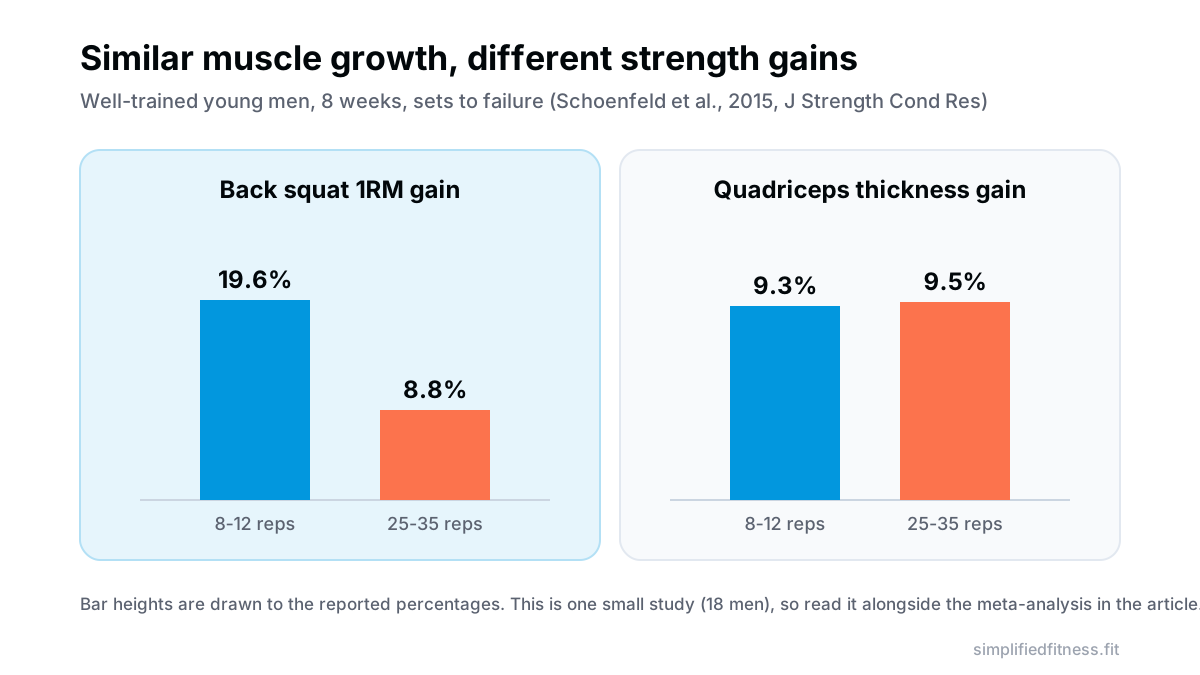
Notice that this trial compared 8-12 with 25-35 reps, not 10-15 with 1-5. It supports “heavier is better for strength” but does not test the exact question in the title. I would read it as a signal in the right direction, not a measured answer for a 1-5 rep range.
An earlier 2016 meta-analysis, with fewer studies, found a trend toward greater strength and hypertrophy with heavier loads that did not reach statistical significance, and noted that loads of 50% of 1RM or less still produced substantial gains in untrained people (Schoenfeld et al., 2016). This is a useful reminder that beginners respond to almost anything.
Can I get strong training only in the 10-15 rep range?
Partly. Here is how I would summarise it:
- As a beginner, yes, for a while. Untrained people gain strength on light and moderate loads, and a lot of early progress is learning the movement.
- As an intermediate, you can keep progressing, but your squat, bench and deadlift technique at heavy loads stays under-practised.
- If you are aiming for a very high max, heavier practice appears to give you an edge, because the skill of grinding a near-limit rep is trained mainly by doing it.
There is also an important counterpoint. A 2025 within-person trial had 14 resistance-trained people train one leg with 3-5 reps and the other with 20-25 reps, all sets to failure, for 9 weeks. Multi-joint 1RM improved by a similar amount (about 21%) with both approaches, though for single-joint movements the heavy-load leg was better. Muscle thickness also rose similarly (Cumming et al., 2025).
So the studies disagree a little. The 2015 and 2017 work found heavier loads gave larger 1RM gains; the 2025 trial found comparable multi-joint gains. Plausible reasons include small sample sizes (14 people), a within-person design where one leg’s training may carry over to the other, differences in what exercise was tested, and the fact that sets to failure at 20-25 reps are brutally hard and still involve high effort. A 2021 review goes further and argues that the traditional “repetition continuum” is too rigid, because strength and size can improve across a wide range of loads (Schoenfeld et al., 2021).
My practical reading: heavy work is a safe bet for maximal strength, light work to failure can do more than people assume, and the best plan uses both.
Do I need to lift at 90% or more?
No. You do not need to live at 90-100% of your max to benefit from specificity. A review of the minimum effective dose found that a single set of 6-12 reps at about 70-85% of 1RM, taken to failure, 2-3 times a week for 8-12 weeks produced significant, if suboptimal, gains in squat and bench 1RM in resistance-trained men. It was less clear whether the same held for the deadlift, women or highly trained strength athletes (Androulakis-Korakakis et al., 2020).
That fits how many coaches program: a lot of strength practice happens around 75-90% of 1RM, in sets that leave a rep or two in the tank. That range is coaching convention rather than a tested cutoff. A broader review also points out that training to failure may not be necessary for maximum strength gains, and that combining heavy and light loads may help (Suchomel et al., 2018).
What does specificity look like in an actual week?
Here is a simple way to combine skill, size and support on a lift day. It is illustrative, not a proven formula, and it assumes you can already perform the lift with safe technique.
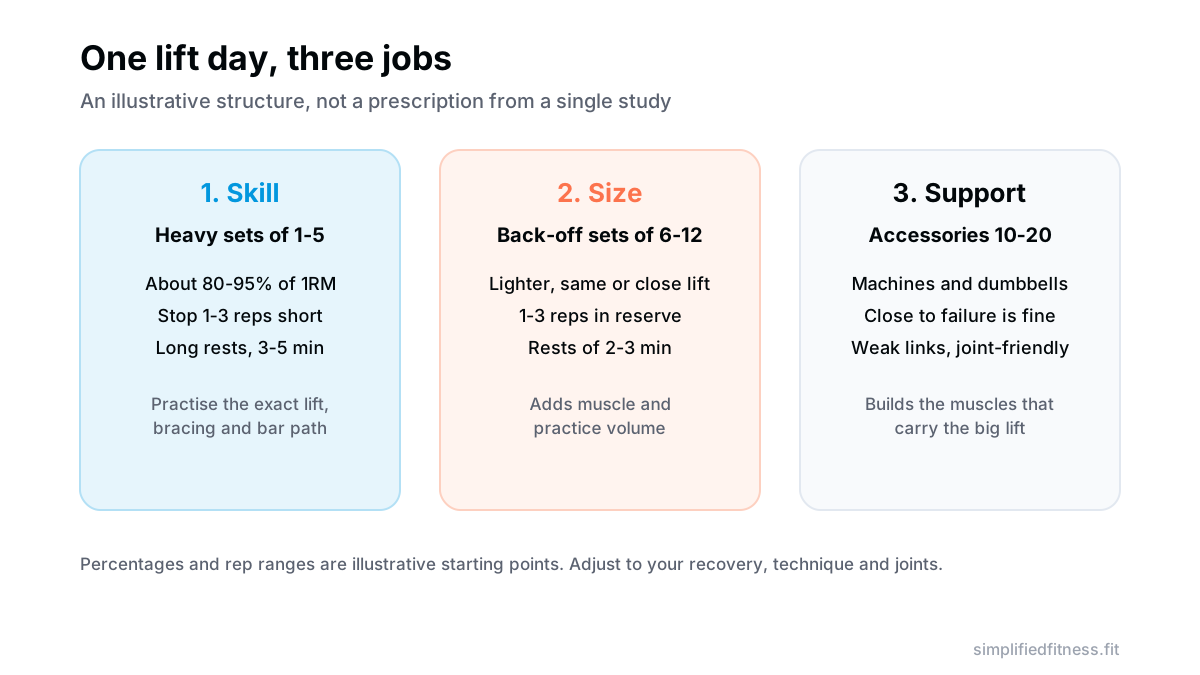
1. Heavy skill work (sets of 1-5). Work up to one or two top sets at roughly 80-95% of 1RM, stopping a rep or two short. Rest 3-5 minutes. Focus on bracing, bar path and bar speed rather than on grinding.
2. Back-off sets (6-12 reps). Drop the weight and do two to four sets at a lighter load, keeping one to three reps in reserve. This adds muscle and extra practice. The ideas behind this are covered in our guide to RPE-based top singles and back-off sets, and you can use the RIR and RPE calculator to check effort.
3. Accessories (10-20 reps). Use machines and dumbbells for the muscles that limit your lift. The extra size supports your strength ceiling, as we discuss in muscle cross-sectional area and the strength ceiling.
If you prefer to rotate heavy, medium and light days across the week instead, look at daily undulating periodization. For a ready-made structure, try our free push, pull, legs plan.
Who should be careful with heavy low-rep training?
Heavy loads leave less room for error. Be cautious if you:
- are new to the lifts and still learning technique (build a base of moderate loads first)
- have a current injury, joint pain, or tendon trouble
- have high blood pressure or a heart condition, since very heavy efforts and breath-holding raise blood pressure transiently
- are returning after a long break
If any of these apply, speak with a doctor or physiotherapist before loading heavy. Use warm-up sets, safeties and a spotter, and stop a set if your form breaks down.
The bottom line
SAID is simple: you get better at what you practise. Because a 1RM is a skill done under near-maximal load, heavy sets of roughly 1-5 reps are the most direct training for it, and meta-analytic data show larger 1RM gains from heavier loads with similar muscle growth. But specificity does not mean “only low reps.” Trained people have gained multi-joint strength on lighter loads too, and muscle size matters.
Take the practical middle road. Keep one or two heavy top sets on the lifts you care about, back them with moderate-rep volume and accessories, and let the heavy sets be fast, clean and a rep short of failure. That gives you the skill, the muscle and a lower injury cost.
Frequently Asked Questions
What is the SAID principle in resistance training?
SAID stands for Specific Adaptations to Imposed Demands, meaning your body adapts in the direction of the stress you place on it. Lift heavy and practise a given movement and you improve at that movement, load and speed. In the gym, it means the way you train should look like the result you want.
Do I need to train with 1-5 reps to get stronger?
No, you can get stronger with a wide range of reps, especially as a beginner. A 2017 meta-analysis did find that heavier loads produced greater 1RM gains than lighter ones, so low reps help when your goal is a bigger max. If maximal strength matters to you, include some heavy sets rather than relying on high reps alone.
Can I build a big squat, bench or deadlift with only 10-15 reps?
You can improve, but you may leave strength on the table. In one 8-week trial of well-trained men, an 8-12 rep group gained 19.6% on back squat versus 8.8% for a 25-35 rep group. That trial did not test 10-15 reps against 1-5, so it only hints that heavier loads help strength. Add some heavy sets on the lifts you want to peak.
Why do heavy weights build strength more than light weights if muscle growth is similar?
Strength depends on muscle size plus neural factors and skill. A 2017 trial found 80% of 1RM training raised voluntary activation and 1RM more than 30% of 1RM training, despite similar muscle growth. Heavy sets let you practise recruiting muscle and coordinating the lift at the loads you want to move.
Does lifting 1-5 reps build muscle?
Yes, it can. A 2025 trial in trained people found similar muscle thickness gains from 3-5 reps and 20-25 reps when sets were taken to failure. Heavy low-rep work is just less forgiving on joints and often involves fewer total reps per set, so most lifters pair it with moderate-rep sets.
Is the repetition continuum (1-5 strength, 6-12 size, 15+ endurance) accurate?
Only partly. A 2021 review argued that adaptations can be obtained across a wide range of loads and that the strict zones are not well supported, though heavy loads remain the best bet for maximal strength. Treat the zones as guidelines, not rules.
What percentage of 1RM counts as heavy?
Many coaches treat about 80-95% of 1RM as the heavy zone for strength, which usually means sets of 1-5 reps. This is a common practice range, not a sharp scientific cutoff. Use our 1RM calculator to estimate your numbers, then check them with how fast the bar actually moves.
Do I need to train at 90% or more to get strong?
Not all of your work. Research on minimum effective dose found that a single set of 6-12 reps at roughly 70-85% of 1RM, taken to failure 2-3 times a week, produced significant 1RM gains in trained men. Heavier singles are about specificity and practice, so use them in measured amounts.
Should I train to failure on heavy sets?
Usually not. A 2018 review concluded that training to failure may not be necessary for maximal strength gains, and grinding failed reps at near-maximal loads adds fatigue and makes technique breakdown more likely. Stop a rep or two short on heavy work and save near-failure effort for back-off sets.
How many heavy sets should I do per week?
There is no single proven number, and the research is limited. A minimum-dose review found one hard set, 1-3 times a week, was enough to raise 1RM in trained men, while a 2018 review noted that multiple sets generally appear to beat single sets. Start with 3-6 heavy sets per lift per week and add only if your technique and recovery stay solid.
Do low reps work for women and older lifters?
They can, but the specific research is limited. Several of the studies cited here were in young men, so the findings may not transfer perfectly. Older lifters, people with joint problems and women can use the same logic with sensible loads, and anyone with a medical condition should check with a doctor first.
How do I combine heavy singles with hypertrophy work?
Do one or two heavy sets of 1-5 on the main lift, then lighter back-off sets of 6-12 and accessories. The heavy sets give technique practice and neural drive, while the volume at moderate loads adds muscle without piling on joint stress. Our weekly structure figure gives a starting template.
Is it safe to train with low reps and heavy loads?
For healthy lifters with good technique, it can be, but the margin for error is smaller at heavy loads. Use warm-up sets, safeties or spotters, and avoid grinding failed reps. Anyone with pain, a heart or blood pressure condition or a recent injury should speak to a doctor or physio first.
Sources & References
Every claim above is checked against peer-reviewed research (PubMed, U.S. National Library of Medicine) or guidance from established health bodies. How we fact-check.
- Schoenfeld BJ, et al. Strength and hypertrophy adaptations between low- vs. high-load resistance training: a systematic review and meta-analysis. J Strength Cond Res. 2017. PMID: 28834797
- Schoenfeld BJ, et al. Effects of low- vs. high-load resistance training on muscle strength and hypertrophy in well-trained men. J Strength Cond Res. 2015. PMID: 25853914
- Jenkins NDM, et al. Greater neural adaptations following high- vs. low-load resistance training. Front Physiol. 2017. PMID: 28611677
- Cumming KT, et al. Divergent strength gains but similar hypertrophy after low-load and high-load resistance exercise training in trained individuals: many roads lead to Rome. J Appl Physiol. 2025. PMID: 40827709
- Schoenfeld BJ, et al. Loading recommendations for muscle strength, hypertrophy, and local endurance: a re-examination of the repetition continuum. Sports (Basel). 2021. PMID: 33671664
- Schoenfeld BJ, et al. Muscular adaptations in low- versus high-load resistance training: a meta-analysis. Eur J Sport Sci. 2016. PMID: 25530577
- Androulakis-Korakakis P, et al. The minimum effective training dose required to increase 1RM strength in resistance-trained men: a systematic review and meta-analysis. Sports Med. 2020. PMID: 31797219
- Suchomel TJ, et al. The importance of muscular strength: training considerations. Sports Med. 2018. PMID: 29372481

Umair Hazrami · Founder & Head Coach, Simplified Fitness
Umair Hazrami founded Simplified Fitness and the Simplified Lifter channel to cut through fitness noise. With 4+ years of consistent training and 10+ coaching clients, he writes every guide from the peer-reviewed research and links the sources so you can check them. Our editorial standards.
Educational content only, not medical advice. If you have a medical condition, are pregnant, or take medication, talk to a qualified doctor before changing your diet, supplements or training. Full disclaimer.
Keep reading
Strength & Cardio
1-Rep Max Testing vs 1RM Formulas: Which Is More Accurate and What Does Each Cost You?
1RM testing vs calculation: how accurate are Epley and Brzycki, when a true max is worth the risk, and a safe protocol if you do test. Studies linked.
9 min read

Strength & Cardio
Accommodating Resistance: Do Bands and Chains Really Match the Squat and Bench Strength Curve?
Accommodating resistance with bands and chains makes the top of a lift heavier. See what trials show on power and strength, and how to set it up safely.
9 min read
Strength & Cardio
Competition Bench Press Technique: Arch, Leg Drive, Lats and Bar Path Explained
Competition bench press technique explained: scapular setup, leg drive, lat tension, bar path and pause commands, plus what the research does and does not show.
10 min read
Strength & Cardio
Conventional vs Sumo Deadlift: Which Suits Your Hips, Limbs and Back?
Conventional vs sumo deadlift biomechanics: what the studies show on muscle demand, bar path and back load, plus a simple test to pick the style for your body.
10 min read