Muscle Size vs Strength Ceiling: How Cross-Sectional Area Sets Your Long-Term Max
Muscle size vs strength ceiling explained: how cross-sectional area and fibre arrangement cap force, and why powerlifters need dedicated hypertrophy blocks.

TL;DR. The short answer
- Muscle size is a major determinant of how much force you can eventually produce. In a 2025 study of 39 previously untrained men, muscle growth correlated very strongly with strength gains within each person (r = 0.89-0.92).
- Size and strength are not the same thing. Skill, neural drive and fibre arrangement all matter, so a bigger muscle raises your potential without guaranteeing a bigger lift.
- Short-term, strength can climb without much growth. Long-term, the room to keep getting stronger depends increasingly on adding contractile tissue.
- Powerlifters can use dedicated hypertrophy blocks of moderate loads, higher volume and close-to-failure sets, then return to heavy, specific work. Evidence in elite lifters is limited, so treat this as sound reasoning rather than proof.
- The size-strength link is strongest across people and training phases. It is imperfect for any single lifter on any single day.
Part of our complete guide: Maximal Strength, Neuromuscular Adaptations & Powerlifting Science for General Lifters
Table of contents
Why can a bodybuilder who rarely touches a heavy single turn up at a meet and pull something huge? Because the muscle size vs strength ceiling is real: contractile tissue volume sets a large part of how much force you can ever produce, and skill decides how much of it you access on the day.
That is the physical story behind a lot of “how did he get so strong?” moments. If you are working through the wider picture, our maximal strength and powerlifting science guide covers the full system. This article zooms in on one piece: why a strength athlete who ignores size will eventually run into a wall.
Muscle size vs strength ceiling: what the research says
A muscle makes force by pulling with many tiny units working side by side. More units in parallel, more potential force. That is the whole idea of cross-sectional area (CSA): slice the muscle across, and the area of contractile tissue in that slice tells you something about how hard it can pull.
The human data agree. In a 1984 comparison, 35 untrained men produced a mean knee-extension force of 742 N, while 8 weight-trained men produced 992 N. Knee-extensor CSA was 81.6 cm2 versus 104.1 cm2. Within the untrained group, strength and CSA were significantly correlated (r = 0.56) (Maughan et al., 1984).
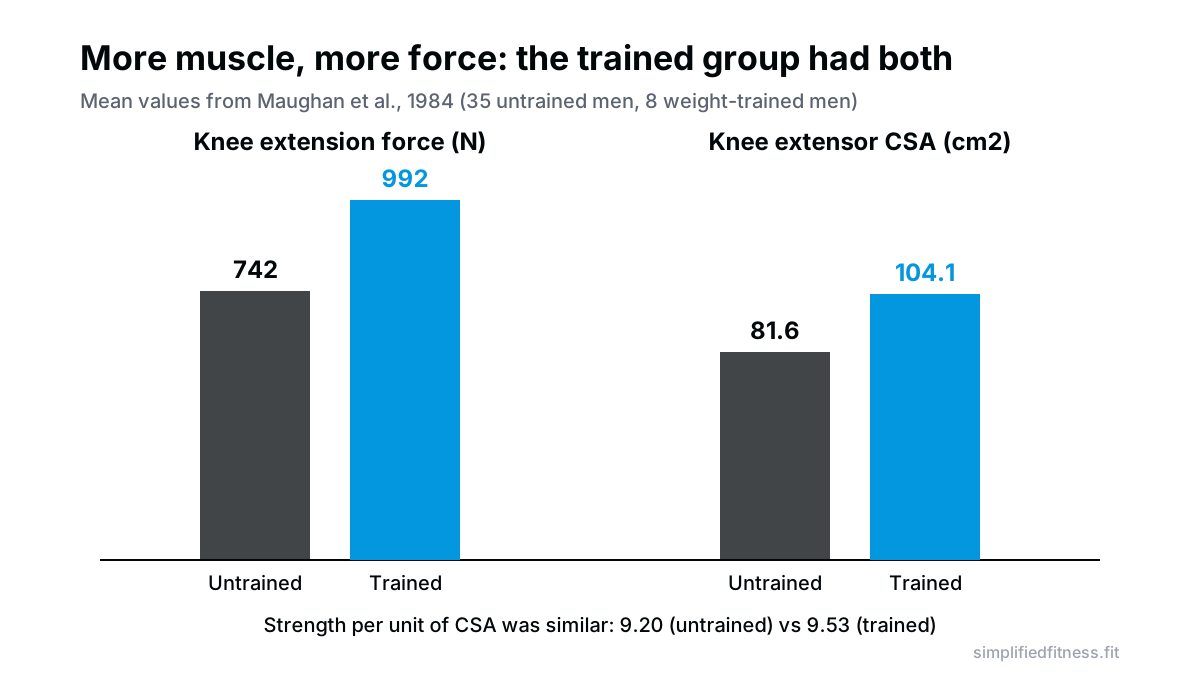
Look at the last line of that study. Strength per unit of CSA was 9.20 in the untrained group and 9.53 in the trained group. Close. The extra force in trained men was largely explained by more muscle, not by a magic quality that makes each square centimetre stronger. (It is a small group of 8 trained men, so hold the conclusion loosely.)
Why are bigger muscles stronger?
Three things stack on top of each other.
More fibres in parallel. A thicker muscle usually contains more contractile material pulling at once. That raises the force it can produce.
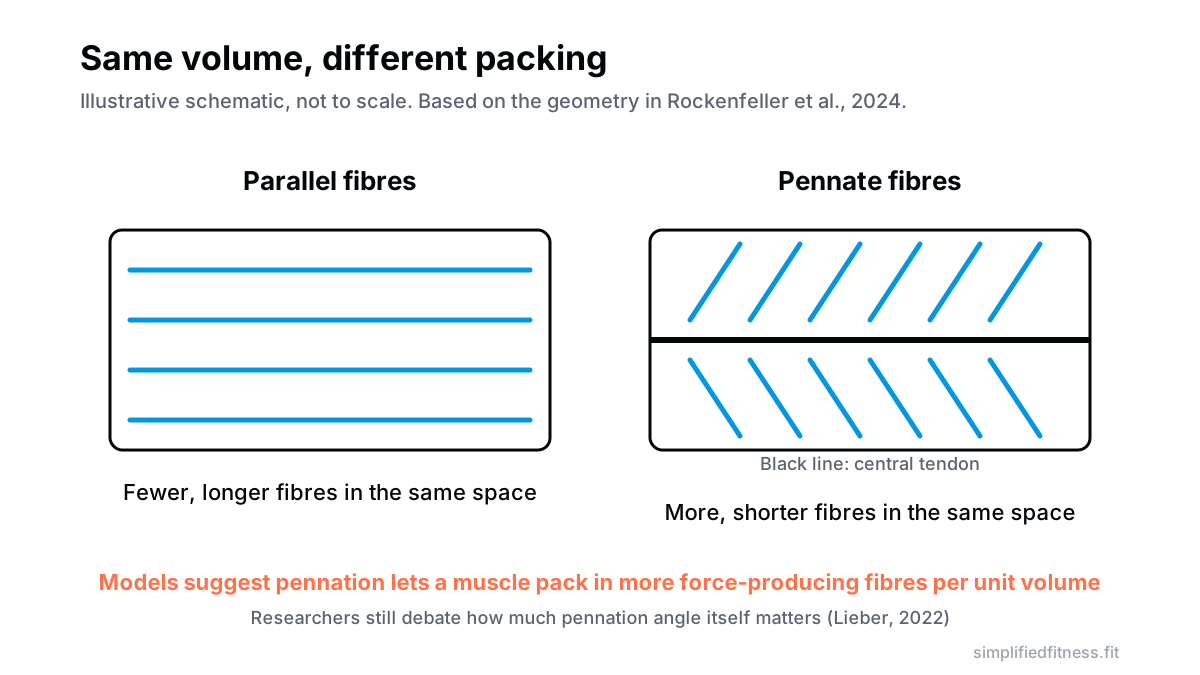
Fibre arrangement. Many muscles are pennate, meaning fibres run at an angle to the tendon. Geometric models in a 2024 paper suggest that this lets a muscle pack more fibres into the same volume, producing up to six times more isometric force than a non-pennate muscle of the same volume (Rockenfeller et al., 2024). That is a model-based result, not a training experiment.
Nervous system access. Your brain decides how much of that tissue is switched on. That is a separate lever, and it is covered in our guide to neuromuscular foundations of maximal strength.
Does pennation angle actually matter?
Not everyone agrees. One biomechanist argues pennation has little if any functional significance and is best seen as a way of packing short fibres into a limited volume (Lieber, 2022). The two views are less opposed than they sound. Both treat the packing of fibres as important, and they differ on whether the angle number itself explains performance.
The practical takeaway is modest. You cannot train your pennation angle on purpose. What you can train is total muscle size, and fibre architecture comes along for the ride.
How strongly does muscle growth drive strength gains?
Earlier studies often reported non-significant or only weak to moderate links between how much people grew and how much they gained. A 2025 study used a more sensitive method, repeated-measures correlations that track each person against themselves over time. In 39 previously untrained young men who trained their lower body three times a week for 15 weeks, muscle growth correlated very strongly with strength gains (r = 0.92 for isometric strength, 0.89 for 1RM). Changes in muscle activation correlated moderately (r = 0.58 and 0.56). Statistically, growth contributed more than five times as much as activation (Marques et al., 2025).
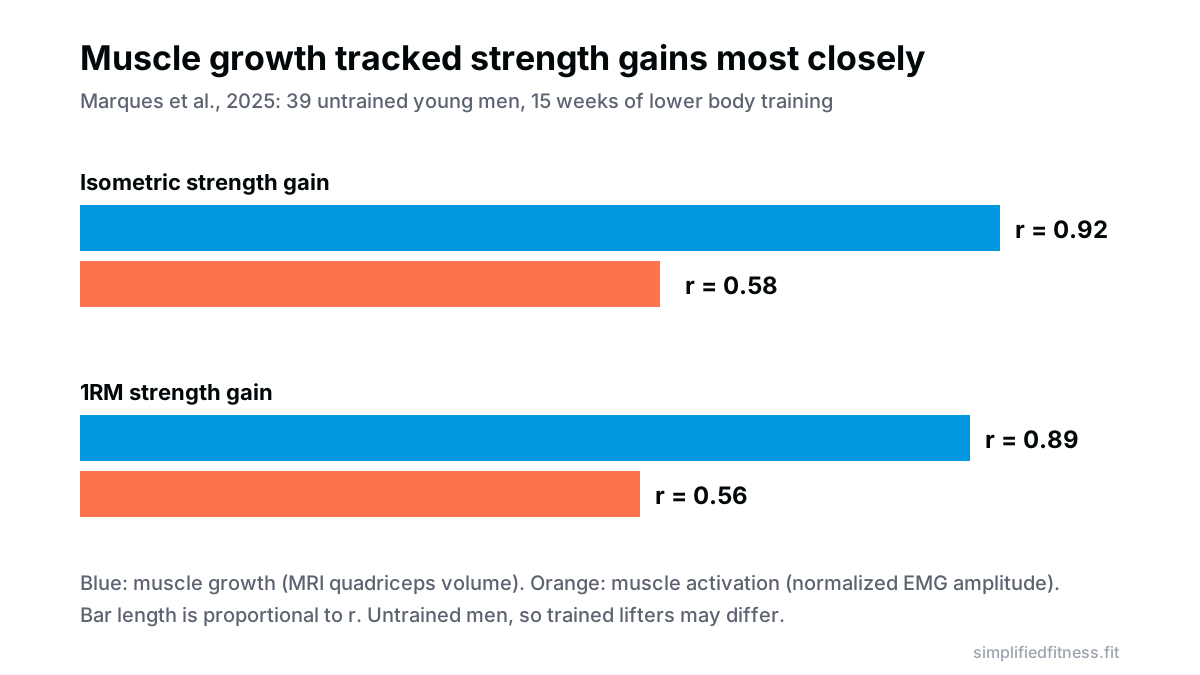
Two honest caveats. The participants were untrained, and neural gains are usually largest early in training. Experienced lifters may lean differently. Second, a correlation inside a person shows the two move together, not that growth alone causes every kilo.
Another group found the link holds across measurement methods. In 24 healthy men, bench-press 1RM correlated at r = 0.84 with pectoralis major muscle volume and r = 0.832 with a three-slice CSA measure (Lanza et al., 2022). Good, but note the small sample, and that these were correlations in one group at one time.
If size matters so much, why do my numbers go up without much growth?
Because early gains are often skill. You learn the groove, brace better, and get better at recruiting what you already have. The 2019 trial in trained men shows how the two can diverge. After 8 weeks of training three times a week, groups doing 1, 3 or 5 sets per exercise gained similar strength. Muscle size rose more with higher volume at several sites (Schoenfeld et al., 2019). In short, strength can go up with a modest dose while size keeps responding to more work.
A 2026 meta-regression of 67 studies (2,058 participants) found strength and size both rise with volume, but strength showed considerably more pronounced diminishing returns (Pelland et al., 2026).
Put those together and you get the powerlifter’s plateau: practice gets you most of the way quickly, then the next kilo has to come from somewhere else. That somewhere is tissue.
Hypertrophy for powerlifters: how to use a growth block
Here is the logic, with the limits stated up front. Direct trials in elite powerlifters running hypertrophy blocks are scarce, so what follows is reasoning built from the studies above, not a proven protocol.
If size sets the ceiling and heavy practice cashes it in, the plan is to alternate. Build tissue, then convert it.
| Phase | Typical focus | Why |
|---|---|---|
| Growth block (about 4-8 weeks) | Moderate loads, higher weekly sets, sets near failure | Hypertrophy shows a graded dose-response with volume |
| Conversion block (about 6-10 weeks) | Heavy sets of 1-5, lower volume, competition lifts | Heavy loads give bigger 1RM gains and train skill |
| Peak and test | Low volume, heavy singles | Express the strength you built |
The week ranges are coaching judgement, not numbers from a trial.
Do you need heavy loads to grow?
Not necessarily. A meta-analysis of 21 studies found 1RM gains were greater with high-load training, while muscle hypertrophy was similar between low- and high-load protocols when sets were taken to failure (Schoenfeld et al., 2017). The same research group argues that muscle adaptations can occur across a wide range of loading zones, challenging the classic “repetition continuum” (Schoenfeld et al., 2021).
That is good news for a growth block. You can use moderate loads that your joints and recovery tolerate and still build muscle. But the same meta-analysis is the reason you do not abandon heavy work: it is where the 1RM benefit lived. For why, see the principle of specificity.
How many sets in a growth block?
A 2017 meta-regression of 15 studies found each additional weekly set was associated with a 0.37% increase in muscle gain, and higher volumes beat lower ones (Schoenfeld et al., 2017). The three-level comparison (fewer than 5, 5-9, 10+ sets per muscle) only showed a trend, so there is no hard threshold.
In the gym, that means adding a few hard sets per muscle per week over what your powerlifting block used, not doubling everything overnight. For a deeper framework, see volume landmarks.
Where this fits with neural gains
None of this makes the nervous system irrelevant. The 2025 study found activation changes were moderately related to strength gains too. The cleaner way to hold both ideas is that neural factors often move quickly and size moves slowly, and both are needed. We untangle this properly in strength gains vs muscle growth: neural vs size.
For programming that blends both, see daily undulating periodization. If you lose size during time off, detraining timelines explain what to expect, and muscle memory biology explains why regaining is usually faster.
Practical setup for Indian lifters
Growth blocks need food. Eating enough protein across the day matters more than any single meal, and dal, paneer, curd, soya chunks, eggs and chicken all work. Use the protein intake calculator for a daily target.
In hot weather, long high-volume sessions feel worse. Shorter sessions with more frequent sets, plenty of water and adequate sleep keep quality high.
Track the result. The 1RM calculator gives an estimate from submaximal sets, so you can follow strength through a growth block without testing true maxes. If you want a ready-made structure for the muscle-building side, our free training plans are a starting point.
When to speak to a professional
Persistent joint pain, numbness or tingling, chest pain or unusual breathlessness during training are reasons to stop and see a doctor, not to grind through a block. If you have a health condition or take medication, check with your doctor before sharply raising training volume.
Frequently Asked Questions
Does a bigger muscle mean a stronger muscle?
Usually, yes, but not perfectly. In untrained men, knee-extension strength correlated with muscle cross-sectional area (r = 0.56) in a classic 1984 study, and a 2025 study found muscle growth tracked strength gains very strongly. Skill, neural drive and fibre arrangement also matter, so use size as a guide to potential rather than a guarantee.
What is muscle cross-sectional area (CSA)?
CSA is the area of a muscle if you sliced straight through it, usually measured with MRI or ultrasound. A larger area means more contractile tissue working in parallel, which raises the muscle's capacity to produce force. If you cannot get scans, tape measurements and bodyweight trends are a rough, imperfect stand-in.
What is the difference between anatomical and physiological cross-sectional area?
Anatomical CSA is a slice perpendicular to the muscle's long axis, while physiological CSA (PCSA) tries to account for how fibres are angled, so it better reflects total fibre area. Researchers have historically treated PCSA as one of the best predictors of a muscle's force capacity, though the interpretation is debated. For lifters, the practical point is that size and architecture both contribute.
Why can bodybuilders get strong quickly when they train for strength?
Bigger muscles give them a larger ceiling, and the remaining gap is mostly skill and neural drive, which can improve in weeks. In a 2025 study of untrained men, muscle growth contributed far more to strength gains than changes in muscle activation, though neural factors still played a real role. If you are a size-focused lifter, a block of heavy, specific practice is a sensible way to turn that size into numbers, though how quickly it converts varies.
Do powerlifters need to do hypertrophy training?
Most benefit from some, because strength per unit of muscle has limits and adding muscle raises the long-term ceiling. Meta-analyses show hypertrophy follows a dose-response with weekly volume, while strength gains show more pronounced diminishing returns. A few weeks of higher-volume work between heavy phases is a sensible way to use that.
How long does it take for muscle growth to improve strength?
Strength often rises first from skill and neural adaptation, and muscle growth adds more as training continues. In a 15-week study of untrained men, muscle growth explained much more of each person's strength gain than changes in muscle activation did. Hypertrophy blocks of roughly 4-8 weeks are a common coaching choice rather than a tested number, so judge them over months, not sessions.
Is training with light weights enough to build muscle for strength?
Light loads can build similar muscle size when sets go close to failure, but heavy loads still give bigger one-rep max gains. A 2017 meta-analysis found 1RM gains favoured heavy training while hypertrophy was similar across loads. Use moderate loads for growth blocks and keep heavy singles and triples in your plan for specificity.
Does more training volume always build more strength?
No. A trained-men trial found higher volume produced more muscle growth but similar strength gains over 8 weeks. A 2026 meta-regression found volume helps both, with much stronger diminishing returns for strength. Add volume for growth blocks, but do not expect proportional strength jumps.
What is pennation angle and does it matter for strength?
Pennation angle is the angle between muscle fibres and the tendon's line of pull. Geometric models suggest pennate designs let a muscle pack more fibres into the same volume and produce more force, but at least one biomechanist argues pennation has little functional significance on its own. Treat it as an interesting detail you cannot meaningfully train in isolation.
Can I be strong without being big?
Yes, within limits. Skill, leverages, technique and neural efficiency let lighter or smaller lifters move heavy weight, especially early on. Over the long run, your absolute ceiling still rises with muscle mass, so many lifters move up a weight class or add size to keep progressing.
Will I lose strength if I gain muscle with higher reps?
It is unlikely if you keep heavy practice in the mix. Muscle gained in a growth block gives you more potential, and specific heavy work turns it into 1RM. Keep singles or triples at moderate effort during the block so the skill stays sharp.
How many sets per week should I do for hypertrophy as a powerlifter?
There is no single magic number, since the research shows a graded dose-response rather than a threshold. A 2017 meta-regression estimated each extra weekly set per muscle was associated with about 0.37% more muscle gain, with a trend for 10+ sets to beat fewer. Start near the lower end of what you recover from and add sets slowly.
Do vegetarians need to worry about building muscle for strength?
Not inherently. Muscle growth depends mainly on training and total protein, and dal, paneer, curd, soya, tofu and milk can cover it for most people, plus eggs if you eat them. Spread protein across meals and use our protein calculator to set a daily target.
Sources & References
Every claim above is checked against peer-reviewed research (PubMed, U.S. National Library of Medicine) or guidance from established health bodies. How we fact-check.
- Marques EA, et al. Muscle Growth Is Very Strongly Correlated with Strength Gains after Lower Body Resistance Training: New Insight from Within-Participant Associations. Med Sci Sports Exerc. 2025. PMID: 40680785
- Maughan RJ, et al. Muscle strength and cross-sectional area in man: a comparison of strength-trained and untrained subjects. Br J Sports Med. 1984. PMID: 6487941
- Lanza MB, et al. Muscle volume vs. anatomical cross-sectional area: Different muscle assessment does not affect the muscle size-strength relationship. J Biomech. 2022. PMID: 35033973
- Rockenfeller R, et al. Rethinking the physiological cross-sectional area of skeletal muscle reveals the mechanical advantage of pennation. R Soc Open Sci. 2024. PMID: 39678384
- Lieber RL. Can we just forget about pennation angle? J Biomech. 2022. PMID: 35074689
- Schoenfeld BJ, et al. Resistance Training Volume Enhances Muscle Hypertrophy but Not Strength in Trained Men. Med Sci Sports Exerc. 2019. PMID: 30153194
- Pelland JC, et al. The Resistance Training Dose Response: Meta-Regressions Exploring the Effects of Weekly Volume and Frequency on Muscle Hypertrophy and Strength Gains. Sports Med. 2026. PMID: 41343037
- Schoenfeld BJ, et al. Strength and Hypertrophy Adaptations Between Low- vs. High-Load Resistance Training: A Systematic Review and Meta-analysis. J Strength Cond Res. 2017. PMID: 28834797
- Schoenfeld BJ, et al. Dose-response relationship between weekly resistance training volume and increases in muscle mass: A systematic review and meta-analysis. J Sports Sci. 2017. PMID: 27433992
- Schoenfeld BJ, et al. Loading Recommendations for Muscle Strength, Hypertrophy, and Local Endurance: A Re-Examination of the Repetition Continuum. Sports (Basel). 2021. PMID: 33671664

Umair Hazrami · Founder & Head Coach, Simplified Fitness
Umair Hazrami founded Simplified Fitness and the Simplified Lifter channel to cut through fitness noise. With 4+ years of consistent training and 10+ coaching clients, he writes every guide from the peer-reviewed research and links the sources so you can check them. Our editorial standards.
Educational content only, not medical advice. If you have a medical condition, are pregnant, or take medication, talk to a qualified doctor before changing your diet, supplements or training. Full disclaimer.
Keep reading
Strength & Cardio
1-Rep Max Testing vs 1RM Formulas: Which Is More Accurate and What Does Each Cost You?
1RM testing vs calculation: how accurate are Epley and Brzycki, when a true max is worth the risk, and a safe protocol if you do test. Studies linked.
9 min read

Strength & Cardio
Accommodating Resistance: Do Bands and Chains Really Match the Squat and Bench Strength Curve?
Accommodating resistance with bands and chains makes the top of a lift heavier. See what trials show on power and strength, and how to set it up safely.
9 min read

Strength & Cardio
Competition Bench Press Technique: Arch, Leg Drive, Lats and Bar Path Explained
Competition bench press technique explained: scapular setup, leg drive, lat tension, bar path and pause commands, plus what the research does and does not show.
10 min read
Strength & Cardio
Conventional vs Sumo Deadlift: Which Suits Your Hips, Limbs and Back?
Conventional vs sumo deadlift biomechanics: what the studies show on muscle demand, bar path and back load, plus a simple test to pick the style for your body.
10 min read