RPE-Based Powerlifting Programming: Top Singles and Back-Off Sets Explained
Learn RPE powerlifting programming: how to run a top single at RPE 8, pick back-off set loads, and adjust for bad days, with the research behind it.
TL;DR. The short answer
- A top single at RPE 8 means one rep with about 2 reps left in the tank. You use it to find today's working max, then drop the load for back-off sets.
- Back-off sets commonly run about 5-20% lighter than the top single, for sets of 3-6 reps. Lighter drops let you do more volume, heavier drops give you less.
- RPE-based autoregulation has beaten fixed percentages in small studies of athletes, but the trials are short and use mostly young trained men.
- RPE guesses are less accurate far from failure. Heavy singles and doubles are the easiest place to judge it, which is why top singles work well.
- Beginners should lean on fixed loads and simple progression first, and use bar speed or a coach to calibrate RPE before trusting it.
Part of our complete guide: Maximal Strength, Neuromuscular Adaptations & Powerlifting Science for General Lifters
Table of contents
RPE powerlifting programming works like this: you build up to one heavy rep at RPE 8 (about 2 reps left in the tank), then drop the bar weight and do your volume as back-off sets. The single tells you how strong you are today, and the back-off sets do the work of building strength. It is a way of letting the day’s performance set your loads instead of a spreadsheet written three weeks ago.
This article covers the practical mechanics. For the wider science of heavy lifting, see our complete guide to maximal strength and powerlifting.
What is a top single at RPE 8?
A top single is one rep, taken after your warm-ups, with a load that feels like RPE 8. On the scale used in lifting research, RPE 10 means no reps left, 9 means one rep left and 8 means two reps left. The scale was built around reps in reserve (RIR) and tested against bar speed (Zourdos et al., 2016).
Why a single and not a set of five? Because heavy singles are where this scale is easiest to read. I will come back to the accuracy data below, but the short version is that judging effort is easier close to failure and on low-rep sets.
Many lifters talk about RPE 8 as roughly 90-92% of the day’s max. That figure is a rule of thumb from RPE charts, not a result from a trial, and it moves with the lifter, the lift and how fresh you are. Treat it as a starting guess.
If you want a quick conversion between effort scores and reps left, use our RIR and RPE calculator. For the full scale explained, read the RIR and RPE scale guide.
How do back-off sets work after a top single?
Back-off sets are the volume you do after the single, at a lighter load. They give you quality reps without the fatigue of repeated heavy attempts.
A typical layout looks like this.
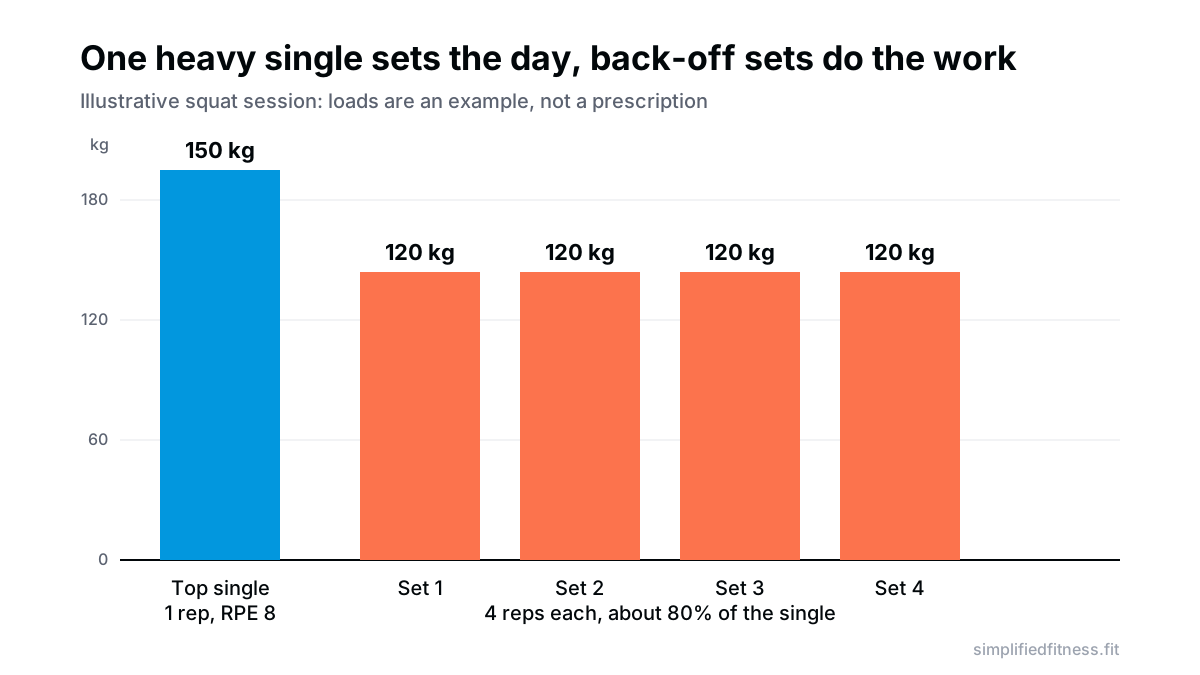
The brief for this style is often something like “4x4 at about 80% of the single.” That is one common pattern, not a law. Back-off sets in practice run from a small drop up to around 20%, with the rep count rising as the load falls.
Here is how the choice usually plays out.
| Back-off drop from top single | Typical reps per set | What it tends to give you |
|---|---|---|
| About 5% | 2-3 | Heavy practice, low volume, lower fatigue per rep |
| About 10% | 3-5 | Strength volume with good bar speed |
| About 15-20% | 5-6 | More total reps, closer to hypertrophy work |
The table is a coaching rule of thumb, not data from a single study. The research supports the direction of the trade-off though. In a 3-week study of 12 nationally qualified powerlifters, the lifters did a top set, then back-off sets at a reduced load until they hit the target RPE. A 6% drop produced more weekly volume than a 2% drop (relative volume load of 114.4 versus 74.6) (Helms et al., 2018). A bigger drop buys you more sets before you hit the target RPE.
That study was short and small, and it measured how much work lifters did, not how much stronger they got. So read it as “the drop size controls your volume,” not “6% is best.”
How do I run a session, step by step?
Here is the process I would give a lifter who has never used it.
- Warm up with ramped sets. Work up in jumps that get smaller as the weight gets heavier. Keep the last warm-up at a load you could move for 3 or more reps.
- Pick a first single. Use last week’s top single or a load you expect to land near RPE 8.
- Take the single and rate it. Rate it straight after the rep, while the memory is fresh. Bar speed helps here, since slower bar speed goes with higher RPE.
- Adjust. Felt like a 6 or 7? Add 2.5-5 kg and go again. Felt like a 9? You are done going up. Take a little off for the back-offs.
- Calculate back-off load. Take your chosen percentage of the single and round to plates you own.
- Do the back-off sets. Stop early if reps slow sharply or form breaks. Many lifters use an RPE stop, ending the work when a set hits the target RPE.
- Log everything. Weight, reps, the RPE you called and how you felt. Over weeks this is what makes the method work.
What does the research say about autoregulated strength programming?
The evidence is encouraging but not strong enough to call RPE a clear winner.
What supports it. A 2021 meta-analysis pooled 8 studies (166 athletes with at least a year of training) and found that autoregulation beat fixed loading for maximal strength, with an effect size of 0.64 (Zhang et al., 2021). A 2025 network meta-analysis agreed that RPE, velocity-based and APRE methods all beat fixed percentages for 1RM (Huang et al., 2025). Both reviews rank the APRE protocol, a rep-based autoregulation method, ahead of RPE. We cover it in APRE rules for autoregulated overload.
What limits it. The Zhang review included only 5-10 week interventions, and its subgroup results were heterogeneous (I squared of 54% for squat and 62% for bench). The 2025 review found no moderate or large effect differences between interventions for back squat 1RM. In bench press the RPE group did not clearly differ from APRE, with a wide confidence interval.
RPE versus bar speed. In a crossover trial, 20 amateur rugby players did two 6-week blocks, one with velocity-based loads and one with RPE-based loads. Both improved squat and bench. The velocity block did better, with squat gains of about 7.5% versus 3.5% (Shattock & Tee, 2022). These were amateur rugby players, not powerlifters, and the study used magnitude-based decisions rather than conventional significance tests.
Why might the results differ? Fixed percentages assume your max is the same every day, which it is not. RPE adjusts for that, but only as well as your ratings are accurate. Velocity removes the guesswork but needs a device. A review of monitoring methods concluded that RIR-based RPE and barbell velocity are practical, reliable options with preliminary evidence for improving performance (Helms et al., 2020).
My cautious take: autoregulation is a reasonable approach for trained lifters, and the best method is probably the one you will actually follow and log honestly.
How accurate is RPE, really?
This is the weak point of the system, so it deserves a close look.
In 25 trained men, researchers had lifters call out when they hit RPE 5, 7 and 9 during a squat set at 70% of 1RM, then carry on to failure. The average miss was 5.15 reps at RPE 5, 3.65 at RPE 7 and 2.05 at RPE 9 (Zourdos et al., 2021).
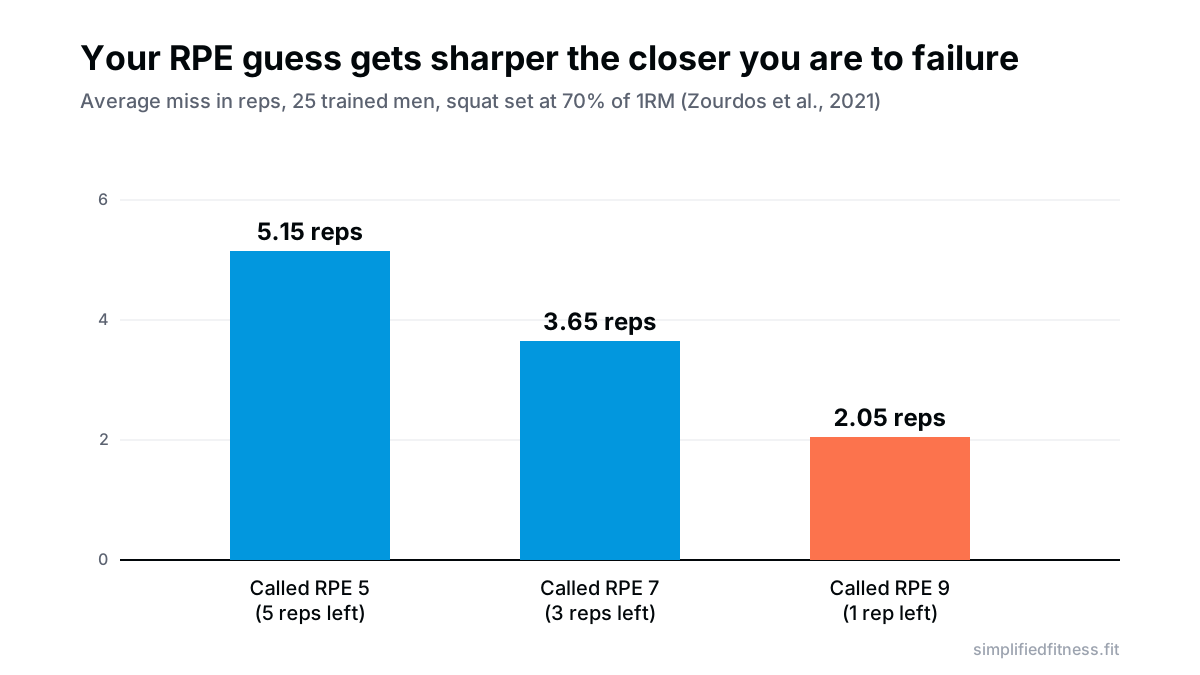
Two practical points follow. First, far from failure, your gut is poor. A set that feels like “5 left” might have 10 left. Second, in that study more reps per set meant worse guesses. That is the best argument for the top single: low reps, high effort, the zone where ratings are most reliable.
Experience matters, but not simply. In squat and bench studies, experienced lifters gave higher RPE at their 1RM and moved the bar slower at or near their max than novices, and in both groups RPE tracked bar speed closely (r around -0.88 in experienced squatters, -0.77 in novices) (Zourdos et al., 2016). In bench press, experienced lifters rated their 1RM at 9.86 versus 9.35 for novices, which hints that novices may rate a true max as less hard than experienced lifters do (Ormsbee et al., 2019). The bench study used only college-aged men and the squat study used young adults, so we do not know how well this carries over to women or older lifters.
For ways to sharpen your calibration, see calibrating true RIR in the gym and how accurately lifters gauge RIR.
How do I adjust for sleep, stress and a bad day?
This is the main attraction. If you slept four hours or had a rough week, a weight that was RPE 8 last Monday may feel like a 9 today. With a fixed percentage plan, you would grind through anyway. With RPE, the single tells you the day is off, and you lower the load before it costs you a failed rep.
The cleanest rule I know: let the top single decide, then keep the back-off drop the same. If the single is lighter than usual, everything after it is lighter automatically.
A few cautions. No study I found tested sleep loss specifically in this top-single model, so the sleep link is practical experience and common sense, not a trial result. And one bad day is not a trend. If your top single falls short week after week, look at food, total training load and recovery rather than just lowering the bar. If you have persistent fatigue, unexplained weakness or pain with lifting, see a doctor or physiotherapist.
Common mistakes with top singles and back-off sets
- Testing a max every week. A top single is not a 1RM attempt. If it is RPE 9-10 every time, you will accumulate fatigue and stop progressing. For true max testing, see 1RM testing versus estimation equations.
- Chasing PRs on RPE days. If a single at RPE 8 is a record, great, take it. Do not add weight to make it one.
- Back-off drop too small. A tiny drop means the back-off sets are nearly as hard as the single, and you stop early or fail reps.
- Skipping the log. Without notes, you cannot spot the trend that matters.
- Using it for every lift. It suits the big three. For machine and accessory work, simple rep targets are fine.
Who should (and should not) use this approach?
It suits intermediate and advanced lifters who have a feel for effort, and who train the squat, bench and deadlift regularly. It also fits competitors building towards a meet, where it pairs with peaking and tapering and with daily undulating periodization.
If you are new to lifting, start with fixed loads and small weekly jumps, and use our free 1RM calculator to set starting weights. Heavy singles also need safety pins or a spotter, which matters in a home or budget gym.
If you want a plan built around this model with your sleep, work and diet in mind, a coach can set it up, but you can run the basics yourself with a barbell, a log and honest ratings.
Frequently Asked Questions
What is a top single in powerlifting?
A top single is one heavy rep, usually at RPE 8, that you work up to after warm-ups. It tells you what a good load is for the day without the cost of a max attempt. You then use that number to set lighter back-off sets.
What does RPE 8 mean in powerlifting?
RPE 8 means you could have done about 2 more reps with the same load and good form. On the repetitions-in-reserve scale used in lifting research, RPE 10 is 0 reps left, 9 is 1 rep left and 8 is 2 reps left. The bar usually moves slower than a warm-up but not like a grinder.
How do I choose back-off set weight after a top single?
A common starting point is 5-20% below the top single, depending on the reps you want. Lighter back-off loads allow more reps and sets, and heavier ones allow fewer. One study of powerlifters found that a bigger drop (6% versus 2%) produced more total weekly volume, so pick the drop based on how much volume you need.
How many back-off sets should I do after a top single?
Most lifters do 2-5 sets, often 3-6 reps each, depending on how heavy the day is and how the top single felt. A set-by-set RPE stop can decide for you: keep going until the set reaches your target RPE. Cut sets early if bar speed drops hard or form breaks down.
Is RPE better than percentages for strength?
In small trials with athletes, autoregulated methods tended to beat fixed percentage loading, but the studies were short and varied in design. A 2021 meta-analysis of 8 studies and 166 subjects found an effect size of 0.64 favouring autoregulation. Use percentages as a plan, and RPE to adjust them on the day.
Can beginners use RPE for powerlifting?
Beginners can try it, but accuracy is the problem. Novices often underrate how close a set is to failure, especially early in a set, so their numbers can mislead them. Start with fixed loads and add small weights each week, and use RPE as a rough guide until your sense of effort improves.
How accurate is RPE for estimating reps in reserve?
It is much better close to failure than far from it. In 25 trained men squatting at 70% of 1RM, the average miss was about 2 reps at RPE 9, 3.65 reps at RPE 7 and 5 reps at RPE 5. So trust your RPE most on heavy, low-rep sets, and be sceptical on light high-rep ones.
What do I do if my top single feels like RPE 9 or 10?
Stop adding weight and treat that load as the day's top. Take a bit more off for the back-off sets or cut a set or two, and note why: poor sleep, stress or heat can all matter. Do not try to make up the day by grinding a heavier single.
What if my top single feels easy, like RPE 6 or 7?
Add weight in small jumps (2.5-5 kg) and take another single until it lands near RPE 8. Do not chase a new max in training, the point is a repeatable benchmark. Then run your back-off sets off that heavier single.
Does sleep and stress change my top single?
They can, which is the point of autoregulation. Many lifters find that a given weight feels harder after a bad night or a stressful week, and RPE captures that. Research here is mostly on performance and perceived effort, so treat the pattern as practical experience, not a fixed rule.
How often should I do a top single?
Many lifters do a top single once or twice a week per lift, usually on the heavy day. More often than that adds fatigue without much new information. If you train a lift three times a week, keep the other days lighter or volume-focused.
Can I use RPE-based top singles in a home or budget gym?
Yes, because it needs only a barbell, plates and honest effort. Start with an empty bar and a rack, and set safety pins or have a spotter for singles. If you lift alone, stay conservative at RPE 7-8 and skip heavy singles on bench without safeties.
Is RPE the same as RIR?
Not quite, but in lifting the two are linked. The commonly used scale maps RPE 10 to 0 reps in reserve, RPE 9 to 1 rep in reserve and so on, which is how researchers have tested it. You can use our RIR and RPE calculator to convert between them.
Sources & References
Every claim above is checked against peer-reviewed research (PubMed, U.S. National Library of Medicine) or guidance from established health bodies. How we fact-check.
- Zourdos MC, et al. Novel Resistance Training-Specific Rating of Perceived Exertion Scale Measuring Repetitions in Reserve. J Strength Cond Res. 2016. PMID: 26049792
- Ormsbee MJ, et al. Efficacy of the Repetitions in Reserve-Based Rating of Perceived Exertion for the Bench Press in Experienced and Novice Benchers. J Strength Cond Res. 2019. PMID: 28301439
- Zourdos MC, et al. Proximity to Failure and Total Repetitions Performed in a Set Influences Accuracy of Intraset Repetitions in Reserve-Based Rating of Perceived Exertion. J Strength Cond Res. 2021. PMID: 30747900
- Helms ER, et al. Rating of Perceived Exertion as a Method of Volume Autoregulation Within a Periodized Program. J Strength Cond Res. 2018. PMID: 29786623
- Zhang X, et al. Auto-Regulation Method vs. Fixed-Loading Method in Maximum Strength Training for Athletes: A Systematic Review and Meta-Analysis. Front Physiol. 2021. PMID: 33776802
- Zijing Huang, et al. Autoregulated resistance training for maximal strength enhancement: A systematic review and network meta-analysis. J Exerc Sci Fit. 2025. PMID: 40791980
- Shattock K, et al. Autoregulation in Resistance Training: A Comparison of Subjective Versus Objective Methods. J Strength Cond Res. 2022. PMID: 32058357
- Helms ER, et al. Methods for Regulating and Monitoring Resistance Training. J Hum Kinet. 2020. PMID: 33312273

Umair Hazrami · Founder & Head Coach, Simplified Fitness
Umair Hazrami founded Simplified Fitness and the Simplified Lifter channel to cut through fitness noise. With 4+ years of consistent training and 10+ coaching clients, he writes every guide from the peer-reviewed research and links the sources so you can check them. Our editorial standards.
Educational content only, not medical advice. If you have a medical condition, are pregnant, or take medication, talk to a qualified doctor before changing your diet, supplements or training. Full disclaimer.
Keep reading
Strength & Cardio
1-Rep Max Testing vs 1RM Formulas: Which Is More Accurate and What Does Each Cost You?
1RM testing vs calculation: how accurate are Epley and Brzycki, when a true max is worth the risk, and a safe protocol if you do test. Studies linked.
9 min read
Strength & Cardio
Accommodating Resistance: Do Bands and Chains Really Match the Squat and Bench Strength Curve?
Accommodating resistance with bands and chains makes the top of a lift heavier. See what trials show on power and strength, and how to set it up safely.
9 min read
Strength & Cardio
Competition Bench Press Technique: Arch, Leg Drive, Lats and Bar Path Explained
Competition bench press technique explained: scapular setup, leg drive, lat tension, bar path and pause commands, plus what the research does and does not show.
10 min read
Strength & Cardio
Conventional vs Sumo Deadlift: Which Suits Your Hips, Limbs and Back?
Conventional vs sumo deadlift biomechanics: what the studies show on muscle demand, bar path and back load, plus a simple test to pick the style for your body.
10 min read