Strength Peaking and Tapering: How to Cut Volume and Peak Maximal Strength for Meet Day
Peaking and tapering for a powerlifting meet: how much volume to cut, what to keep heavy, a week-by-week timeline and how to pick attempts, with the research.
TL;DR. The short answer
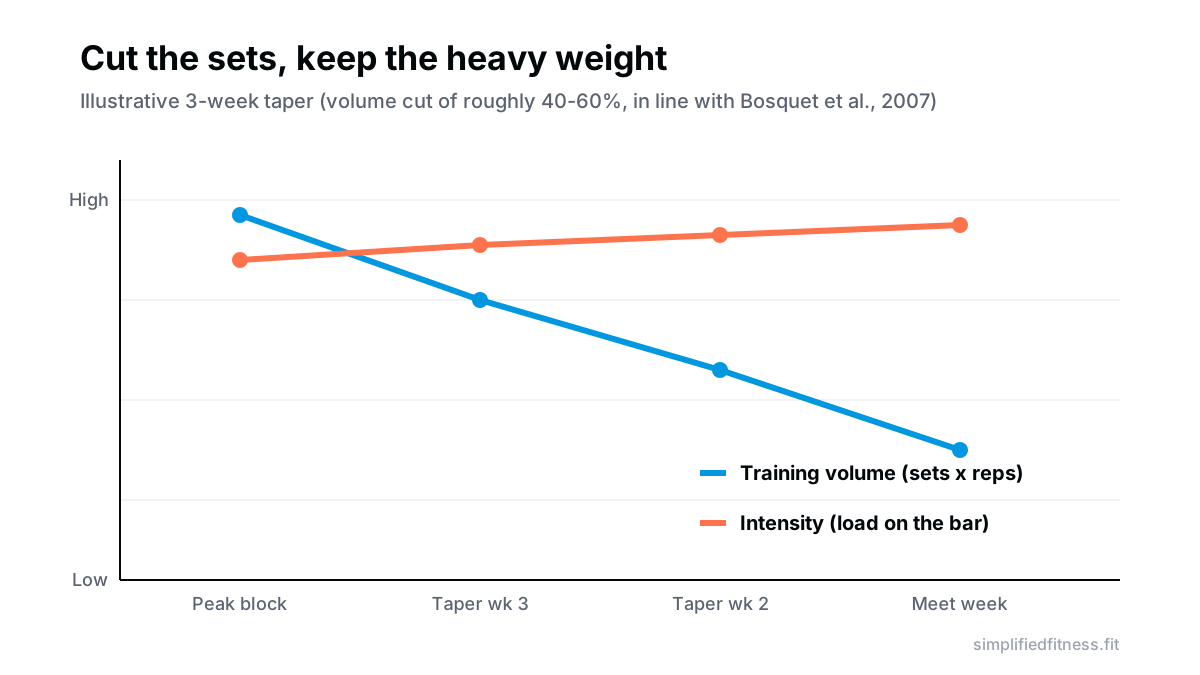
- A taper means cutting training volume by roughly 40-60% over about 2 weeks while keeping the bar heavy. A 2007 meta-analysis of 27 studies in competitive athletes found this pattern gave the biggest performance gains.
- Surveyed champion Croatian powerlifters cut volume by about 50% and did their last session about 3 days before the meet. Most strength research on tapering is small or survey-based, so treat the numbers as a starting range.
- Keep intensity and frequency roughly unchanged. In a small crossover trial, a taper with slightly heavier loads tended to do better than one with lighter loads, though the difference was not statistically significant.
- On meet day, a sensible ladder is an opener you could hit for a clean triple, a second you are sure of, and a third that is a real reach. Squat openers in a large Australian dataset averaged about 92% of the lifter's best lift on the day.
- If you have chest pain, dizziness or a lingering injury as the meet nears, see a doctor or physio instead of testing it on the platform.
Part of our complete guide: Maximal Strength, Neuromuscular Adaptations & Powerlifting Science for General Lifters
Table of contents
Peaking and tapering for a powerlifting meet comes down to one trade: do fewer sets, keep the weight heavy. Most research points to cutting volume by roughly 40-60% over about 1-3 weeks, with intensity and frequency left mostly alone, so fatigue clears while strength stays. This is the final stage of the maximal strength and powerlifting science guide, applied to one goal: your best single on one day.
Here is the catch. Most lifters know they should “rest before the meet.” Few know how much to cut, what to keep, and how to avoid the two classic errors: tapering too little and arriving tired, or tapering so much that the bar feels foreign.
What does tapering actually do?
A taper is a planned drop in training load before a competition. Mujika and Padilla define it as a progressive nonlinear reduction of training load, aimed at reducing the stress of daily training and optimizing performance, without compromising adaptations (Mujika & Padilla, 2003). The aim is to minimise accumulated fatigue without losing fitness.
Think of it as two bars. Fitness builds slowly and fades slowly. Fatigue builds fast and clears fast. Cut the volume and fatigue falls quicker than fitness does, so the gap between them, your readiness, opens up. A later review described taper-related changes in neuromuscular function, hormones, mood and sleep, and noted that models of the taper describe it as restoring previously impaired capacities (Mujika et al., 2004).
Mujika and Padilla reported that performance usually improves by about 3% (usual range 0.5-6.0%) (Mujika & Padilla, 2003). That is a review across sports, not a promise for your squat. For strength specifically, the evidence is smaller and weaker, which we will be honest about below.
How much should you cut volume before a meet?
The best-known answer comes from a meta-analysis of 27 studies in competitive athletes. It found the most effective strategy was a 2-week taper where volume dropped exponentially by 41-60%, without changing intensity or frequency (Bosquet et al., 2007). Exponential means the cut is steepest first, then flattens.
Lifters seem to land in a similar place. Ten Croatian open-class champion powerlifters reported cutting volume by about 50% using a step or fast-decay exponential taper, with intensity maintained or raised (Grgic & Mikulic, 2017). A survey of 146 competitive weightlifters reported a mean volume reduction of about 43% over a taper of roughly 8 days (Winwood et al., 2023).
Note the limits. Surveys tell you what athletes do, not what works best. Champions may also taper well because they are good at everything else. Still, three separate sources landing between 40% and 60% is a decent anchor.
Step taper or gradual taper?
Two small trials give a hint, but not a verdict.
In 14 recreationally trained men, a step taper (a 54% volume cut straight away) was compared with a two-phase gradual taper (38% cut for week one, 70% for week two) after an 8-week block. Both raised squat 1RM, but the step group gained more, about 3.4% versus 1.7% (Seppänen & Häkkinen, 2022). The authors note the step approach seemed more favourable when the taper follows an overreaching period.
Mujika and Padilla’s review reached a different conclusion for athletes in general: progressive nonlinear tapers were more beneficial than step tapers (Mujika & Padilla, 2003).
Why might they differ? The strength study was small, ran two weeks, and used non-competitors after a deliberately hard block. The review pooled many sports. Because the data conflict, the practical takeaway is modest: either shape is reasonable. If you arrive at the taper beaten up, a decisive first-week cut makes sense. If you are fairly fresh, a gentler slope is fine.
Should you keep the weight heavy?
Yes, as a default. The meta-analysis found no extra benefit from changing intensity or frequency during the taper (Bosquet et al., 2007). The champion powerlifters kept intensity maintained or increased, hit their highest intensity about 8 days out, and kept their sessions highly specific, using competition equipment (Grgic & Mikulic, 2017).
One crossover trial gives mild support. Eleven strength-trained men did a taper week with volume down about 70% and either slightly higher or slightly lower intensity. There were no significant differences between tapers, but the higher-intensity version showed small effect-size gains in strength and jump measures that the lower-intensity version did not show for strength (Pritchard et al., 2019). That is eleven young men and one week. Suggestive, not settled.
Week-by-week powerlifting peaking timeline
This is an illustrative template built from the ranges above, not a prescription. Adjust it to your recovery and your coach’s advice.
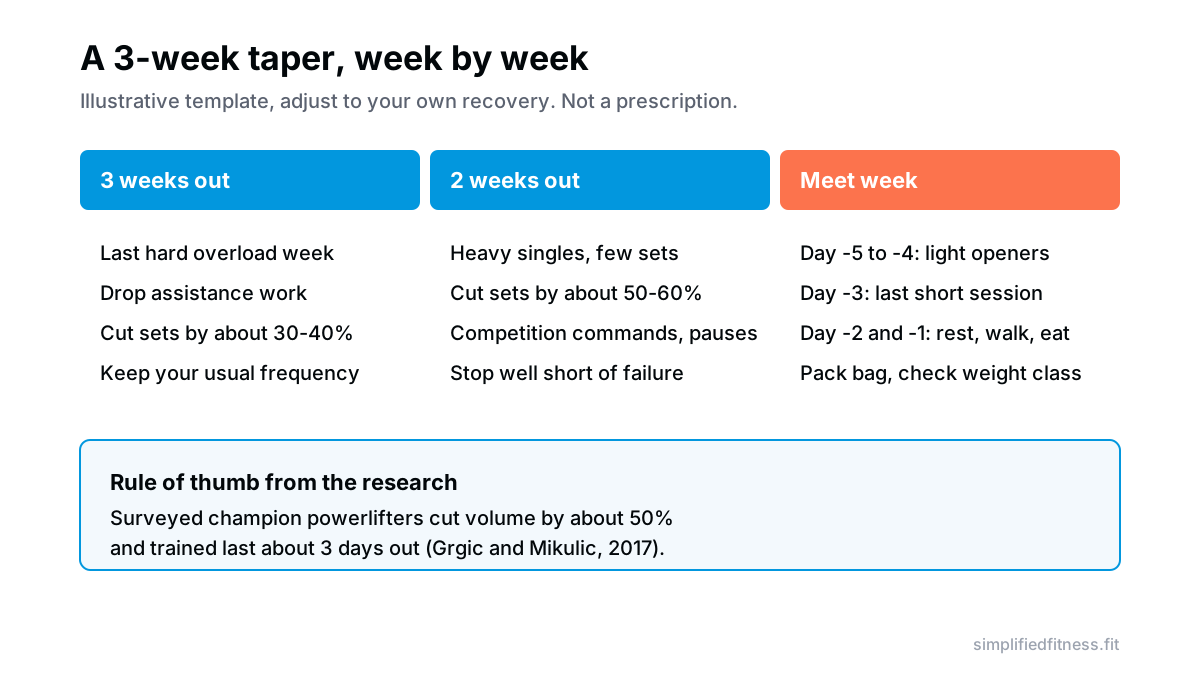
Weeks before the taper (peak block). Your last real hard weeks. Work up to heavy singles around RPE 8-9 on the competition lifts. If you use effort-based loading, our guide to RPE-based top singles and back-off sets covers it.
3 weeks out. Last heavy overload week. Drop assistance work, trim sets by about 30-40%, keep your usual number of sessions.
2 weeks out. Volume down to about half of peak. Do a few heavy singles per lift, using the same pauses and commands as the meet. Stop well short of failure.
1 week out. Heaviest session about 7-10 days out, then short, light sessions. The champion lifters in the Croatian survey did their last session about 3 days before the meet (Grgic & Mikulic, 2017). Weightlifters in the larger survey stopped about 1.5 days out (Winwood et al., 2023). So there is a range; pick based on how you feel.
Last 2 days. Rest. Walk. Eat normally. Sleep as much as you can.
If you want to understand why fatigue behaves differently for the nervous system versus the muscle, see central vs peripheral fatigue. For deloads that happen in ordinary training weeks, our deload science guide is the better fit, and so is mesocycle architecture for how a whole block fits together. This article is specifically about one single-day peak.
Peaking block: is a hard last block worth it?
The taper only works on top of something. A taper after a soft block just gives you a rested lifter with nothing to express. Mujika’s review calls out that the aim is to reduce fatigue without compromising adaptations, which assumes you built the adaptations first (Mujika & Padilla, 2003).
Is there an alternative? A pilot study of 10 competitive powerlifters compared 10 weeks of low-volume single-set RPE 9-9.5 “daily max” work with higher-volume periodized training plus a taper. Results varied between individuals, and three of the five daily max lifters finished with a lower total. The authors concluded it may suit some beginner-intermediate lifters but could hurt others (Androulakis-Korakakis et al., 2018). With ten people, treat that as an idea, not a program.
How to taper if you have no meet, just a test day
Same principles, shorter. Over 5-7 days, cut sets by about half, keep a few heavy singles in the first half of the week, and rest the last 2 days. Use the 1RM calculator to plan a sensible top set, and read our piece on 1RM testing protocols versus estimation equations so your test is fair.
Warm-up and attempt selection on meet day
Warm-up timing is a place where lifters overthink. Aim to finish your last warm-up roughly in line with when you are called to the platform, and rehearse this at your last heavy training session. Our guide to ramping warm-up sets explains how to prepare without leaving anything in the tank. Meet flights run to a schedule, so practise your timing in the final weeks and have a plan for a delay.
For attempts, the data are descriptive. Howells and colleagues analysed 10,672 entries from Australian raw powerlifting meets (2008-2019). On average, lifters opened squats at about 92% of their achieved maximum on the day, and 93.5% went on to improve on that opener. Winners’ first squat attempts were about 7.0 kg heavier than non-winners’ (Howells et al., 2022). This describes association, not cause. Stronger lifters win and also open heavier.
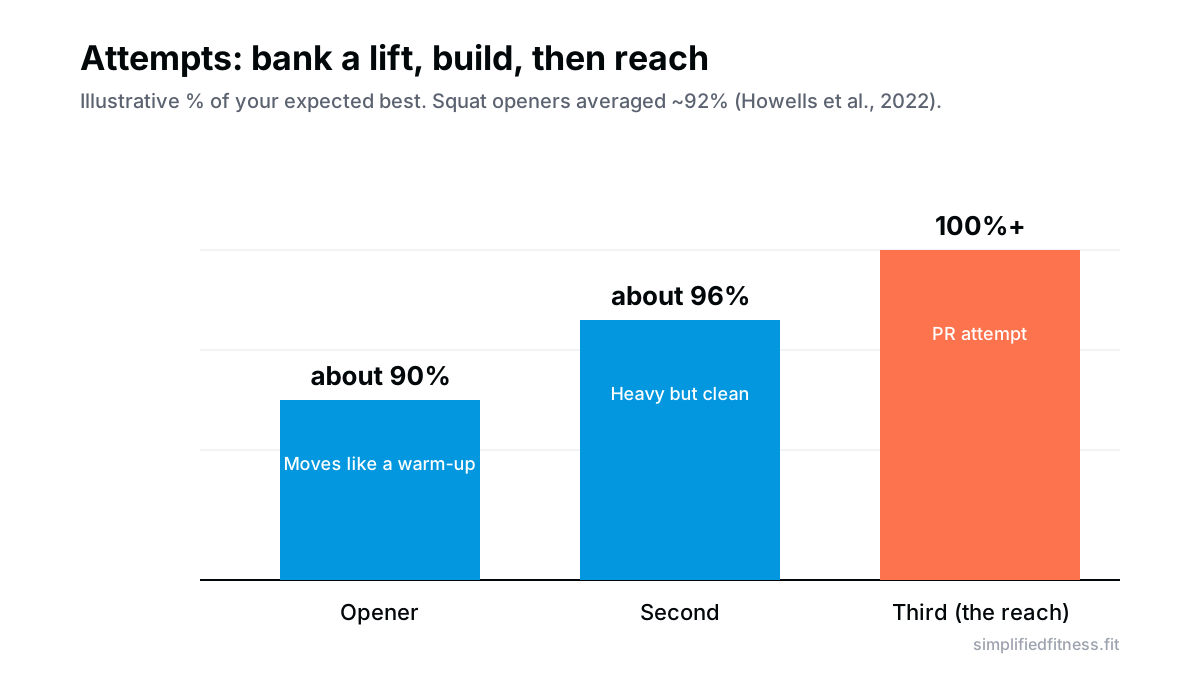
A common coaching framing is an opener near 90% of your expected best, a second near 96%, and a third that is a real reach. Treat these percentages as a starting point, not a rule from the studies. Choose your opener so a bad day still gives you a clean lift.
What about food, sleep and nerves in the final week?
Surveyed champion powerlifters reported giving extra attention to nutrition, foam rolling, static stretching and massage during the taper (Grgic & Mikulic, 2017). Those are self-reports, so we cannot say which helped. Eating enough, keeping carbs normal (rice, roti, potatoes and idli are all fine), staying hydrated in hot weather, and sleeping well are low-risk things to prioritise. For more on sleep, see our sleep and recovery guide.
Meet-day nerves are normal. Our article on psychological readiness and arousal for max lifting goes deeper.
If you are making weight, plan the cut early and conservatively. Last-minute dehydration is a risk, particularly in warm weather.
When to see a doctor
A taper is for healthy lifters. If you have chest pain, fainting, unusual breathlessness, numbness, or joint pain that is getting worse, stop and get checked before you compete. The same applies to a fever or illness in the final week. A coach can adjust attempts; a doctor can tell you whether it is safe to lift.
Bottom line
Cut volume by roughly 40-60% over 1-3 weeks. Keep intensity and frequency about the same. Rest in the last 2-3 days. Choose an opener that guarantees a clean lift, then build.
The evidence is strong for tapering in general and thinner for powerlifting specifically, so use these numbers as a starting range and learn from your own logs. If you need a base program before your next meet block, browse our free training plans, then come back to this article about 4 weeks before the meet.
Frequently Asked Questions
What is a taper in powerlifting?
A taper is a planned reduction in training load before a competition so fatigue drops while strength is kept. Mujika and Padilla describe it as a progressive nonlinear reduction of training load meant to reduce the stress of daily training without compromising adaptations. In practice you do fewer sets and keep the weights heavy.
How long should I taper for a powerlifting meet?
About 1-3 weeks is the usual range. A meta-analysis of competitive athletes found a 2-week taper worked best, and surveyed champion powerlifters tapered in a similar window. If your block was very hard, lean toward 2-3 weeks; if it was moderate, 7-10 days is often enough.
How much should I cut volume before a meet?
Roughly 40-60% less than your peak block, spread over the taper. The meta-analysis found 41-60% exponential reduction looked most effective, and surveyed champion powerlifters reported about 50%. Cut sets first, not the weight on the bar.
Should I keep lifting heavy during a taper?
Yes, mostly. Reducing volume while keeping intensity is the standard recommendation, and the meta-analysis found no benefit from dropping intensity. Heavy singles at moderate effort keep your nervous system practised at the loads you will lift, without the fatigue of many sets.
Do I lose strength if I rest for a week?
Not meaningfully over a short taper in trained lifters. Tapering studies generally show maintained or improved strength and power after a short volume reduction. What you lose is accumulated fatigue, which is the point.
When should I do my last heavy session before the meet?
Around 7-10 days out for your heaviest work. Croatian champion powerlifters reported peak intensity about 8 days before the meet and their last session about 3 days out. Treat that as a reference point and adjust based on how fresh you feel.
Should I train the day before a powerlifting meet?
Most lifters rest completely. The surveyed champions finished training about 3 days out, and surveyed competitive weightlifters stopped about 1.5 days out. If you do move, keep it to a short walk or very light mobility work.
How do I choose my attempts?
Pick an opener you can hit for a confident triple, a second attempt that is heavy but clean, and a third that is a real reach based on how the first two moved. In a study of 10,672 Australian entries, squat openers averaged about 92% of the lifter's achieved maximum and most lifters improved on them. A missed opener is far harder to recover from than a slightly conservative one.
Is it normal to feel weak or flat during a taper?
Yes, many lifters feel sluggish or restless in the first days. Reduced training can feel odd after weeks of fatigue, and nerves add to it. Trust your logged numbers and warm-up weights rather than how you feel on day 3.
Can I use a taper for a gym 1RM test instead of a meet?
Yes, a shorter version works. A 5-7 day volume cut with a few heavy singles is a reasonable approach for a non-competitive test day. Our 1RM calculator can help you plan your top set.
Should I cut calories or water to make weight during the taper?
Avoid aggressive cuts in the last week if you can. Big water or calorie drops can leave you weak on the platform, so treat this as general caution rather than a tested protocol. If you are close to the class limit, plan the cut with an experienced coach and a doctor if you have any medical condition.
How long before a meet should I stop adding weight to the bar?
Your last true overload usually happens 2-3 weeks out. After that the goal is to confirm readiness, not build it. Testing a new max in the final week mostly adds fatigue.
What if I get sick or injured during the taper?
Do not train through a fever or sharp joint pain just to keep the plan. Resting costs you far less than an infection or an aggravated injury. See a doctor if symptoms persist, and talk to your coach about adjusting attempts or withdrawing.
Sources & References
Every claim above is checked against peer-reviewed research (PubMed, U.S. National Library of Medicine) or guidance from established health bodies. How we fact-check.
- Bosquet L, et al. Effects of tapering on performance: a meta-analysis. Med Sci Sports Exerc. 2007. PMID: 17762369
- Mujika I, et al. Scientific bases for precompetition tapering strategies. Med Sci Sports Exerc. 2003. PMID: 12840640
- Mujika I, et al. Physiological changes associated with the pre-event taper in athletes. Sports Med. 2004. PMID: 15487904
- Grgic J, et al. Tapering Practices of Croatian Open-Class Powerlifting Champions. J Strength Cond Res. 2017. PMID: 27806009
- Winwood PW, et al. The Tapering Practices of Competitive Weightlifters. J Strength Cond Res. 2023. PMID: 35976755
- Pritchard HJ, et al. Higher- Versus Lower-Intensity Strength-Training Taper: Effects on Neuromuscular Performance. Int J Sports Physiol Perform. 2019. PMID: 30204523
- Stina S (Seppänen S), Häkkinen K. Step vs. Two-Phase Gradual Volume Reduction Tapering Protocols in Strength Training: Effects on Neuromuscular Performance and Serum Hormone Concentrations. J Strength Cond Res. 2022. PMID: 33337705
- Androulakis-Korakakis P, et al. Reduced Volume 'Daily Max' Training Compared to Higher Volume Periodized Training in Powerlifters Preparing for Competition: A Pilot Study. Sports (Basel). 2018. PMID: 30158433
- Howells RJ, et al. Impacts of squat attempt weight selection and success on powerlifting performance. J Sports Med Phys Fitness. 2022. PMID: 33721983

Umair Hazrami · Founder & Head Coach, Simplified Fitness
Umair Hazrami founded Simplified Fitness and the Simplified Lifter channel to cut through fitness noise. With 4+ years of consistent training and 10+ coaching clients, he writes every guide from the peer-reviewed research and links the sources so you can check them. Our editorial standards.
Educational content only, not medical advice. If you have a medical condition, are pregnant, or take medication, talk to a qualified doctor before changing your diet, supplements or training. Full disclaimer.
Keep reading
Strength & Cardio
1-Rep Max Testing vs 1RM Formulas: Which Is More Accurate and What Does Each Cost You?
1RM testing vs calculation: how accurate are Epley and Brzycki, when a true max is worth the risk, and a safe protocol if you do test. Studies linked.
9 min read
Strength & Cardio
Accommodating Resistance: Do Bands and Chains Really Match the Squat and Bench Strength Curve?
Accommodating resistance with bands and chains makes the top of a lift heavier. See what trials show on power and strength, and how to set it up safely.
9 min read
Strength & Cardio
Competition Bench Press Technique: Arch, Leg Drive, Lats and Bar Path Explained
Competition bench press technique explained: scapular setup, leg drive, lat tension, bar path and pause commands, plus what the research does and does not show.
10 min read
Strength & Cardio
Conventional vs Sumo Deadlift: Which Suits Your Hips, Limbs and Back?
Conventional vs sumo deadlift biomechanics: what the studies show on muscle demand, bar path and back load, plus a simple test to pick the style for your body.
10 min read