Conventional vs Sumo Deadlift: Which Suits Your Hips, Limbs and Back?
Conventional vs sumo deadlift biomechanics: what the studies show on muscle demand, bar path and back load, plus a simple test to pick the style for your body.
TL;DR. The short answer
- Sumo is not cheating. Both styles move the same load from the floor to lockout, and a 2019 study of 47 deadlift beginners found no significant difference in 1RM between them.
- Conventional loads the hip extensors, hamstrings and spinal erectors more. Sumo uses a wider stance, a more upright trunk and a shorter bar path, with more quadriceps involvement and larger sideways demands at the hip and knee.
- Anatomy matters, but the evidence is thin. Torso length showed only a weak link to which style a beginner pulled more with, so hip comfort in a wide stance and your own testing are better guides than any measurement.
- Neither style has been shown to be safer for the lower back. No study here measured spinal shear directly, so pick the style you can brace and repeat well, and see a clinician for pain that persists.
Part of our complete guide: Maximal Strength, Neuromuscular Adaptations & Powerlifting Science for General Lifters
Table of contents
Sumo is not cheating, and conventional is not the “real” deadlift. The two styles move the same weight from the floor to lockout, they just load your body in different places. This guide covers conventional vs sumo deadlift biomechanics, what research can and cannot say about your hips and limb lengths, and how to pick a style. It sits inside our maximal strength and powerlifting science guide.
One honest warning up front. A lot of what gets said online about hip sockets, femur ratios and spinal shear is confident and thinly supported. I will flag where the evidence runs out.
Is the sumo deadlift cheating?
No. The rules of powerlifting treat both as legal deadlifts, and the physics is the same. The bar starts on the floor, ends at lockout and carries the same plates.
The “cheating” story comes from one real difference. Sumo shortens the distance the bar travels. In a three-dimensional analysis of 12 sumo and 12 conventional lifters at a national powerlifting championship, vertical bar distance, mechanical work and predicted energy expenditure were about 25-40% greater in the conventional group (Escamilla et al., 2000).
Less work sounds like an easier lift. It is not that simple. Lifters in a wide stance have to produce force from a position that is awkward for many people, and strength in each style is trained and learned separately.
The strength data agrees. In 47 deadlift beginners, 1RM did not differ significantly between sumo and conventional (Cholewa et al., 2019). In 11 resistance-trained women, 3RM loads were 103 kg conventional and 102 kg sumo, within a few kilograms (Gundersen et al., 2025).
Conventional vs sumo deadlift biomechanics: what actually differs
Set up both and the first thing you notice is the stance.
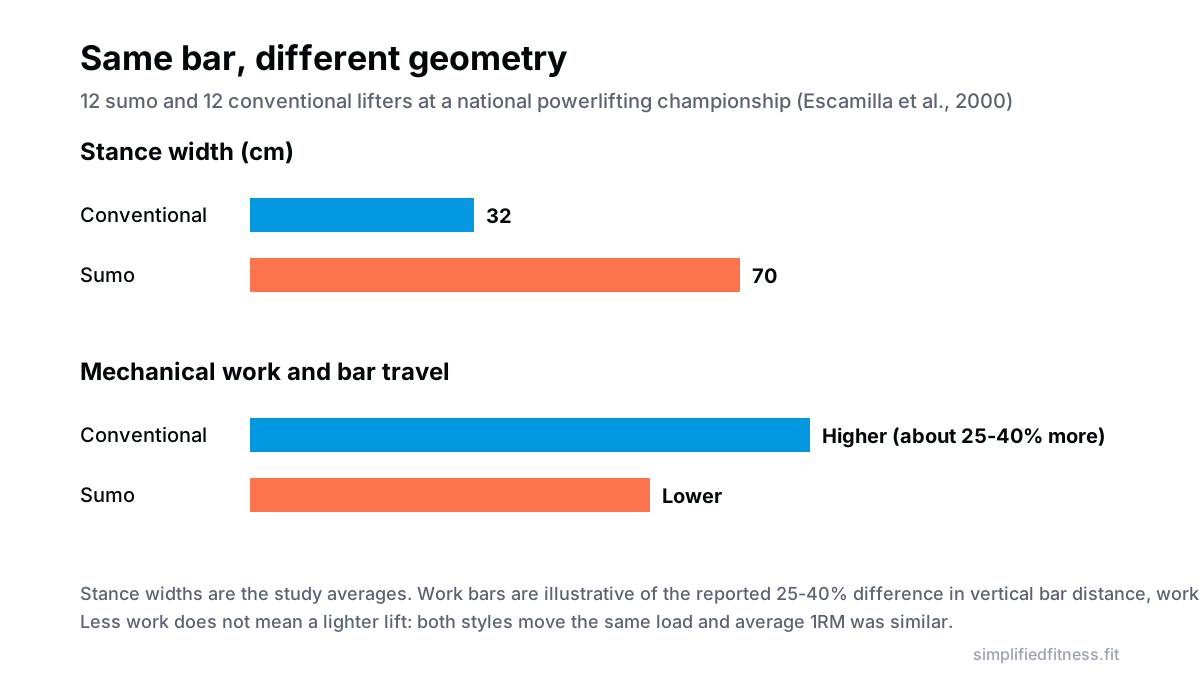
In the powerlifting championship study, sumo lifters used a stance about 70 cm wide with feet turned out around 42 degrees. Conventional lifters averaged 32 cm and 14 degrees. Sumo lifters also kept a more upright trunk, by roughly 5-10 degrees, and gripped the bar closer together (Escamilla et al., 2000).
Joint loading differed too. In that study, the hip and ankle moments told different stories: hip extensor moments and moment arms were not significantly different between styles, while ankle and knee moments and moment arms were. This is worth sitting with, because it contradicts a popular claim.
You will hear that sumo “removes the hips” or that conventional has a much longer lever arm on the hips. This study did not find a significant hip moment difference between styles. The trunk was more vertical in sumo, which plausibly changes how the spine is loaded, but hip moment alone does not show it.
Which muscles work harder in each style?
Here the studies point in a broadly similar direction, with a few disagreements.
A 2025 study put 30 experienced male lifters through both styles at 85% of 1RM. Conventional produced higher hip extension moments and greater biceps femoris activation, and the erector spinae thoracis was more active in conventional during the second phase of the lift. Sumo showed greater peak vastus lateralis activation in the first phase, plus larger frontal and transverse plane moments at the hip and knee (Hanen et al., 2025). The authors concluded conventional targets the posterior chain and hip extensors more, while sumo emphasizes the anterior chain and mediolateral stability.
An earlier EMG study of 13 football players at a 12-rep-max intensity found greater vastus medialis, vastus lateralis and tibialis anterior activity in sumo, and greater medial gastrocnemius activity in conventional (Escamilla et al., 2002).
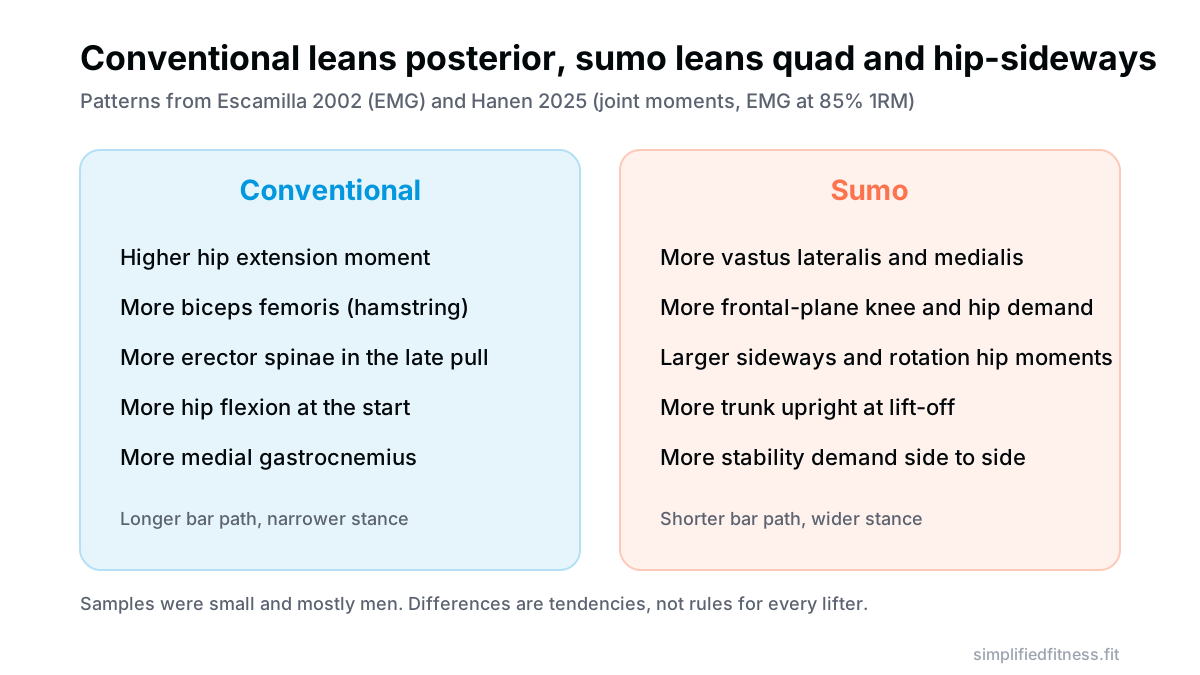
Notice the one clash. The 2002 study found more tibialis anterior activity in sumo, while the 2025 study found more in conventional in phase 1. Different lifters, different intensities, different ways of splitting the lift. When studies disagree on a muscle this small, I would not build a decision on it.
The takeaway is emphasis, not exclusion. Both styles work the glutes, quads, hamstrings and spinal erectors hard. If you want extra hamstring and back work, conventional (or an RDL) leans that way. If your quads are a weak link, sumo asks more of them.
What about spinal shear and the lower back?
This is the section most articles overstate, so I will be careful.
The popular claim: conventional has a longer lever to the lumbar spine, sumo a shorter one, so sumo is easier on the back. There are pieces of evidence that fit loosely. Sumo gives a more vertical trunk (Escamilla et al., 2000), and conventional showed greater erector spinae thoracis activation in the late pull (Hanen et al., 2025).
But none of the studies I reviewed measured spinal shear or compression directly, and EMG activity is not spinal load. So “sumo is proven safer for your back” is not something the evidence supports, and neither is the reverse.
What do we know about injuries in general? A systematic review of weightlifters and powerlifters found the spine, shoulder and knee were the most common injury sites, with 1.0-4.4 injuries per 1000 training hours in powerlifting. Most included studies were of low methodological quality, and only one analyzed possible risk factors (Aasa et al., 2017). Another review found weight-training sports have relatively low injury rates compared with common team sports, with the lower back among the commonly injured areas (Keogh and Winwood, 2017). Neither compared deadlift styles.
For the broader back question, read are deadlifts bad for your lower back, and for bracing, our piece on weightlifting belts and intra-abdominal pressure.
Speed and the sticking point
Barbell speed differs between styles, and it tells you something about the lift.
In 24 men and women, bar travel was shorter in sumo at every load from 30% to 100% of 1RM. Average concentric velocity at 1RM was identical (0.25 m/s for both), but sumo was slower at several submaximal loads, for example 0.35 vs 0.40 m/s at 80-89% of 1RM (Kasovic et al., 2019). Velocity in the two styles was not well correlated at most loads.
Two practical points follow. First, if you use velocity tracking, do not borrow a load-velocity chart from the other style. Second, where the bar slows tells you which style is limited by what. Slow off the floor often points at legs and setup, slow near the knees or lockout at hips and back. Our guide to fixing sticking points in the big three goes through this.
Does hip anatomy decide your deadlift style?
Probably less than the internet thinks.
The theory is that hip socket orientation and femoral neck angle set how much external rotation and abduction you can use before bone hits bone, and that this decides who is a natural sumo lifter. It is reasonable. Hip structure does vary between people, and some people simply cannot get their knees out in a wide stance without pinching.
The problem is evidence. I found no study that linked a specific hip structure, such as socket or femur angle, to deadlift style performance. So there is no validated “anteversion screen” that tells you what to pull. What you can say is practical: if a wide, turned-out stance is pain-free and natural, sumo is a candidate. If you feel a pinch at the front of the hip, or your knees will not track over your toes, conventional is the safer bet. The same logic applies to squat stance, which we cover in hip flexion depth and adductor magnus.
Do limb lengths and torso length matter?
A little, in one study, weakly.
In 47 deadlift beginners (28 men, 19 women), researchers measured arm, hand, thigh and lower leg length, seated height and more. The only significant link to the sumo-to-conventional strength ratio was with sitting height relative to total height (r = 0.297, p = 0.043). The authors suggested sumo may be slightly advantageous for people with longer torsos, and conventional for shorter torsos (Cholewa et al., 2019). The abstract itself describes the correlation as inverse while drawing that conclusion, which is one more reason not to lean on it.
Read that carefully. These were deadlift beginners, not elite lifters. The correlation is small. It explains only a sliver of the variation, and no other limb measure was significant. The old advice that long arms mean conventional and short arms mean sumo was not supported here.
If your build matches the pattern, treat it as a tiebreaker. A short-torsoed lifter with a sore hip in a wide stance should not force sumo because of a ratio.
Conventional vs sumo at a glance
| Factor | Conventional | Sumo |
|---|---|---|
| Stance | Narrow (about 32 cm in one study) | Wide (about 70 cm) |
| Trunk position | More inclined | More upright |
| Bar path | Longer, more work | Shorter, less work |
| Hip extensors and hamstrings | Higher demand | Lower relative demand |
| Quadriceps | Lower relative demand | Higher demand |
| Sideways hip and knee demand | Lower | Higher |
| Hip mobility needed | Hip flexion, hamstring length | Hip abduction and external rotation |
| Typical max strength | Similar on average | Similar on average |
The averages hide individuals. Some lifters pull noticeably more in one style.
How to choose: test both
Anthropometric rules are weak, so a simple test beats them.
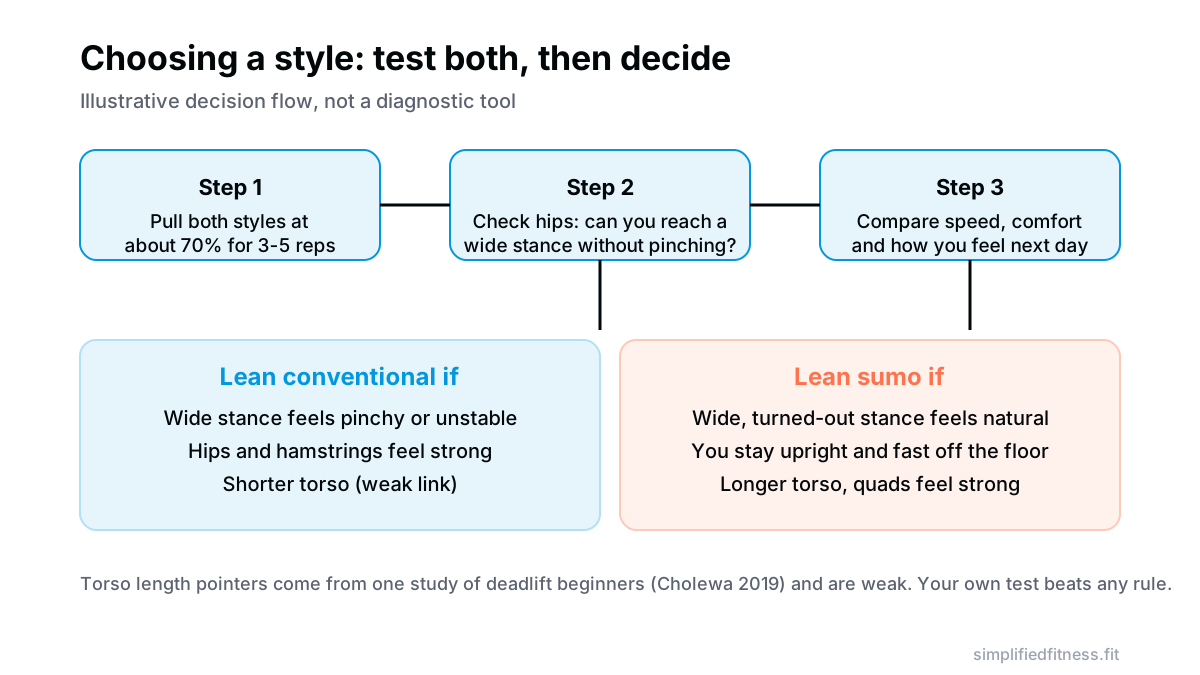
- Learn both properly. Give each style several sessions at light weight. Judging sumo after one awkward set is unfair.
- Compare at moderate loads. About 70% of your best, for 3-5 reps. Watch bar speed, how stable you feel and where it gets hard.
- Check the hips. Does a wide stance feel natural, or pinchy and unstable?
- Look at next-day feel. Not just the lift. Sore quads and groin with good low back, or sore low back and hamstrings, tells you which area each style taxes for you.
- Estimate maxes, then test one. Our 1RM calculator gives a starting figure, but remember velocity and technique differ between styles, so do not assume the same percentages carry across.
- Decide for a block, not a week. Run one style for 6-8 weeks before judging.
Compete? Pick your meet style early and put most top sets there.
Training both: a practical setup
If you are not competing, there is no rule against using both. Many lifters pull one style heavy and the other as a lighter accessory. A simple split is conventional or sumo for your main top set, then Romanian deadlifts for hamstrings or leg press for quad volume.
Hot gym tip: a wide sumo stance on a slick floor in sweaty conditions can slide. Wear flat, firm shoes or deadlift in socks, and wipe the floor. Chalk your hands in humid weather, because grip often fails first when you are sweating.
Pair either style with a lower body day from our free leg day plan so you are not stacking heavy pulls on tired legs.
Common mistakes
- Switching styles every session. You never get good at either.
- Forcing sumo with tight hips. If your knees cave or the hip pinches, back off the width.
- Treating sumo as an excuse to skip back work. It still loads the spinal erectors, just differently. If back size is a goal, see our conventional deadlift back hypertrophy analysis.
- Chasing the “safer for the back” label. The evidence does not back it either way.
- Ignoring pain. Persistent or sharp symptoms need a professional, not a style change.
The bottom line
Conventional and sumo deadlifts are two valid ways to move the same weight. Conventional leans on the hip extensors, hamstrings and spinal erectors, while sumo uses a wider stance, a more upright trunk and a shorter bar path, with more quadriceps and sideways joint demand. Neither is cheating, and neither has been shown to be safer for your back.
Anatomy plays a part, but the research on hip structure and limb lengths is thin, so test both and let comfort, speed and next-day feel decide. For the wider picture on getting strong, head back to the maximal strength guide.
Frequently Asked Questions
Is the sumo deadlift cheating?
No. Sumo is a legal competition style, and the bar still has to travel from the floor to full lockout carrying the same weight. A 2019 study of 47 deadlift beginners found no significant difference between conventional and sumo 1RM, and a 2024 study of trained women found 3RM loads within a few kilograms of each other. Pull the style you can do best, and judge a lift by the load and the control, not the stance.
Is sumo easier than conventional deadlift?
Sumo has a shorter bar path, so total mechanical work is lower, but easier is the wrong word. A study of powerlifters reported about 25-40% more bar travel, work and estimated energy cost in the conventional group, yet the sumo group still has to produce force from a wide, externally rotated stance. For some people sumo is faster off the floor, for others it feels awkward, so test both.
Which deadlift style is better for the lower back?
Neither has been proven safer. Sumo lifters keep a more vertical trunk, while conventional lifting showed higher erector spinae activity in the late pull in a 2025 study of 30 experienced men, but none of the studies reviewed here measured spinal shear or compression directly. Choose the style you can brace and hold neutral in, and do not switch just to avoid a sore back.
Which muscles does sumo work more than conventional?
Sumo shows more quadriceps activity, with higher vastus medialis and vastus lateralis EMG in one study and higher vastus lateralis peak activation in another. It also creates larger sideways and rotational demands at the hip and knee. These are tendencies in small samples, so treat them as emphasis rather than an exclusive muscle split.
Which muscles does conventional work more than sumo?
Conventional produces higher hip extension moments, more biceps femoris activity and more erector spinae activity late in the pull in a 2025 study of 30 lifters. It also showed more medial gastrocnemius activity in a 2002 EMG study. If your goal is posterior chain work, conventional or Romanian deadlifts are the better fit.
Do long arms or a short torso favor conventional?
Possibly, but the evidence is weak. In 47 deadlift beginners, the only significant link was between the sitting-height-to-height ratio and the sumo-to-conventional strength ratio (r = 0.297), suggesting sumo may suit longer torsos slightly better. A correlation that small cannot predict your best style, so use it as a tiebreaker only.
How do I know if my hip anatomy suits sumo?
The practical sign is whether a wide, turned-out stance feels natural and pain-free at the bottom. Hip socket shape and femur angle differ between people, but we found no study linking a specific hip structure to deadlift style, so there is no validated screen. Try a wide stance with light weight, and if you feel pinching at the front of the hip or cannot get your knees out, conventional may suit you better.
Can I train both conventional and sumo deadlifts?
Yes. Strength in the two styles is related but not identical, and a 2019 study found load-velocity profiles for the two did not track each other closely at most loads. If you compete, put most of your top sets in your meet style and use the other as an accessory. If you do not compete, rotating them is a sensible way to vary stress.
Should I switch from conventional to sumo to break a plateau?
Only if sumo suits you, because switching resets your technique and a new style needs weeks of practice. A plateau usually reflects a weak point, programming or recovery rather than the stance. Identify where the bar slows down first, then decide whether a style change helps.
Is sumo deadlift safer for beginners?
There is no good evidence that either style is safer. Injury reviews in weightlifting sports find the lower back, shoulder and knee are commonly affected, but they do not compare deadlift styles. A beginner should pick the style they can learn to brace and control with light loads, ideally with a coach checking form.
How wide should my sumo stance be?
The sumo lifters in a national championship study averaged a 70 cm stance with feet turned out about 42 degrees, compared with 32 cm and 14 degrees in the conventional group. Those are averages, not targets. Find the width where your knees track over your toes and your shins are close to vertical, then keep it consistent.
Does sumo deadlift work the same back muscles as conventional?
Less so in the late pull, according to one study. A 2025 comparison at 85% of 1RM found higher erector spinae thoracis activation in conventional, although sumo still loads the back and needs good bracing. If back hypertrophy is the goal, see our analysis of conventional deadlifts for back growth.
Should I see a doctor if deadlifts hurt my hips or back?
Yes, if pain is sharp, persistent, spreads into the leg, or comes with numbness or weakness. Pinching in the hip when you squat or sumo-stance could be mechanical, but only an assessment can say. Stop pulling through pain and get a physiotherapist or doctor to check it.
Sources & References
Every claim above is checked against peer-reviewed research (PubMed, U.S. National Library of Medicine) or guidance from established health bodies. How we fact-check.
- Escamilla RF, et al. A three-dimensional biomechanical analysis of sumo and conventional style deadlifts. Med Sci Sports Exerc. 2000. PMID: 10912892
- Escamilla RF, et al. An electromyographic analysis of sumo and conventional style deadlifts. Med Sci Sports Exerc. 2002. PMID: 11932579
- Cholewa JM, et al. Anthropometrical determinants of deadlift variant performance. J Sports Sci Med. 2019. PMID: 31427866
- Hanen NC, et al. Biomechanical analysis of conventional and sumo deadlift. Front Bioeng Biotechnol. 2025. PMID: 40497251
- Kasovic J, et al. Kinematic differences between the front and back squat and conventional and sumo deadlift. J Strength Cond Res. 2019. PMID: 31567791
- Gundersen AH, et al. A biomechanical comparison between conventional, sumo, and hex-bar deadlifts among resistance trained women. J Strength Cond Res. 2025. PMID: 39705135
- Aasa U, et al. Injuries among weightlifters and powerlifters: a systematic review. Br J Sports Med. 2017. PMID: 27707741
- Keogh JW, et al. The epidemiology of injuries across the weight-training sports. Sports Med. 2017. PMID: 27328853

Umair Hazrami · Founder & Head Coach, Simplified Fitness
Umair Hazrami founded Simplified Fitness and the Simplified Lifter channel to cut through fitness noise. With 4+ years of consistent training and 10+ coaching clients, he writes every guide from the peer-reviewed research and links the sources so you can check them. Our editorial standards.
Educational content only, not medical advice. If you have a medical condition, are pregnant, or take medication, talk to a qualified doctor before changing your diet, supplements or training. Full disclaimer.
Keep reading
Strength & Cardio
1-Rep Max Testing vs 1RM Formulas: Which Is More Accurate and What Does Each Cost You?
1RM testing vs calculation: how accurate are Epley and Brzycki, when a true max is worth the risk, and a safe protocol if you do test. Studies linked.
9 min read

Strength & Cardio
Accommodating Resistance: Do Bands and Chains Really Match the Squat and Bench Strength Curve?
Accommodating resistance with bands and chains makes the top of a lift heavier. See what trials show on power and strength, and how to set it up safely.
9 min read
Strength & Cardio
Competition Bench Press Technique: Arch, Leg Drive, Lats and Bar Path Explained
Competition bench press technique explained: scapular setup, leg drive, lat tension, bar path and pause commands, plus what the research does and does not show.
10 min read

Strength & Cardio
Daily Undulating Periodization (DUP) for Concurrent Strength and Hypertrophy
A powerbuilding program with DUP: heavy, moderate and volume days in one week, with the research, a 12-week template and a rule for ordering lifts.
8 min read