Neuromuscular Adaptations in Strength Training: How Your Nervous System Builds a Bigger 1RM
Neuromuscular adaptations in strength training explained: rate coding, motor unit synchronization and Golgi tendon myths, with what the studies actually found.

TL;DR. The short answer
- Neuromuscular adaptations are the nervous system changes that let you express more force from the muscle you already have. They are generally thought to explain why beginners get stronger within weeks while their muscles barely change size.
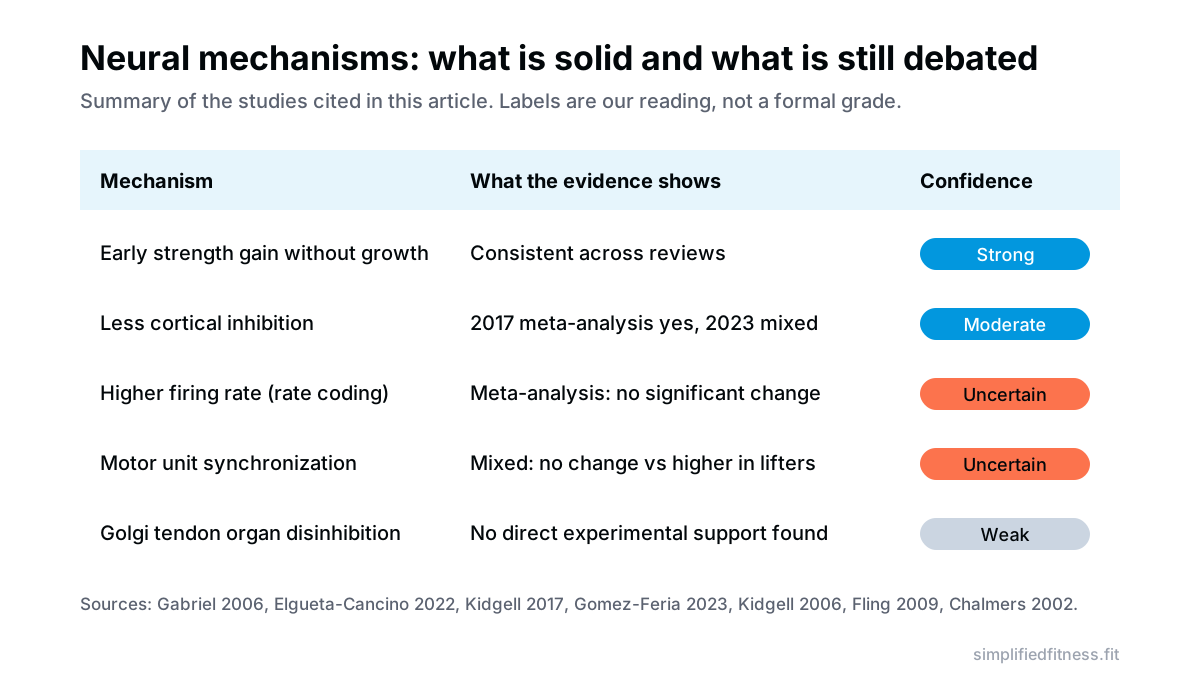
- Changes in the motor cortex have the most direct support. A 2017 meta-analysis in untrained people found training lowered short-interval intracortical inhibition and shortened the cortical silent period, though a 2023 meta-analysis did not confirm the inhibition finding.
- Rate coding and motor unit synchronization are plausible but unproven. A 2022 meta-analysis found no significant change in motor unit discharge rate, and synchronization results are mixed.
- The popular idea that training switches off your Golgi tendon organ safety brake is not supported by direct evidence. A critical review found none.
- Practise heavy, specific lifts with fresh, well-rested sets. That trains the skill side of strength, and adding muscle raises the ceiling.
Part of our complete guide: Maximal Strength, Neuromuscular Adaptations & Powerlifting Science for General Lifters
Table of contents
Neuromuscular adaptations in strength training are the changes in your nervous system that let you produce more force from the muscle you already have. They explain why a beginner’s squat jumps in a month while thigh size barely moves, and why a lean lifter can out-lift someone far bigger. It is one piece of our maximal strength and powerlifting science guide.
This article covers the neural side of the story: what the research supports, what is still debated, and what to do about it. For the full picture of programming a heavy single, see our guide to maximal strength and powerlifting science.
What are neuromuscular adaptations in strength training?
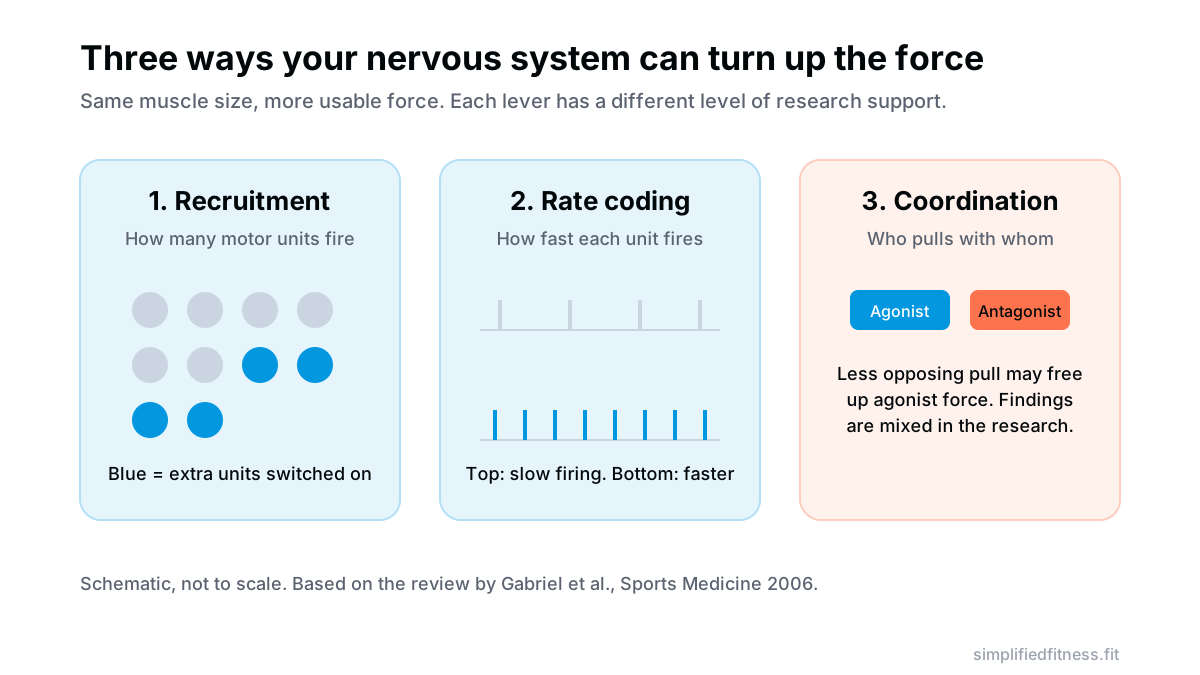
Your muscle does nothing until a motor neuron tells it to. One motor neuron plus the muscle fibres it controls is a motor unit. A big lift asks your nervous system to do three jobs well:
- Switch on enough motor units (recruitment).
- Fire them fast enough (rate coding).
- Coordinate the right muscles at the right time, including keeping opposing muscles quiet when that helps.
A well-known review of the field puts it plainly: it is generally accepted that neural factors play an important role in strength gains, and strength gain without noticeable muscle growth is the first line of evidence for neural involvement (Gabriel et al., 2006).
Neural drive and maximal strength: what we know
Researchers often use surface EMG, which records electrical activity from the muscle, as a rough index of neural drive. Early strength gains tend to come with higher EMG amplitude, which has been read as more efferent output from the central nervous system. The same review notes that EMG is a global measure, so it cannot tell you exactly what changed underneath (Gabriel et al., 2006).
A good training study shows how this can look. In 15 men, 14 weeks of heavy quadriceps training (38 sessions) raised maximal isometric strength from about 291 to 339 N.m, and increased how quickly force rose in the first 200 ms. EMG in that early phase rose too, which the authors interpreted as enhanced neural drive (Aagaard et al., 2002). That is a small group of men, but it is a nice example of strength and explosiveness changing together. We go deeper in rate of force development and explosive training.
Does rate coding actually increase with training?
This is where the neat textbook story gets messy. In theory, firing each motor unit faster should raise force. Some studies have reported transient increases in firing rate, and training has been linked with more doublet firing (very short intervals between spikes at contraction onset) (Gabriel et al., 2006).
But when a 2022 systematic review pooled the data, the picture was less convincing. It found seven trials with 167 participants. The meta-analysis of four studies showed that motor unit discharge rate did not change significantly (P = 0.43), with very high heterogeneity (I2 = 91). The authors concluded there is a lack of high-quality evidence for the effect of resistance training on motor unit firing properties (Elgueta-Cancino et al., 2022).
Why might studies disagree? Different muscles, force levels, training lengths and recording methods all change what you see. Recording single motor units is also technically hard, so sample sizes are small.
Practical takeaway: rate coding is a reasonable mechanism, not a settled one. You do not need to train for it specifically. Heavy, intentional lifting covers the likely bases.
Motor unit synchronization: helpful or hype?
Synchronization means motor units firing together more often than chance would predict. The idea is that synchronized firing could add up forces more efficiently, especially in early, fast contractions. The evidence is genuinely split.
- Evidence for: a 2009 study compared strength-trained and untrained men and found more synchronization in the trained group on one measure (CIS), but not on the other two. The authors called the evidence “a bit equivocal” (Fling et al., 2009).
- Evidence against: in a 2006 study, five people trained a hand muscle for 4-8 weeks and their strength rose 54%, yet synchronization did not change. The authors suggested it may not be important for expressing strength (Kidgell et al., 2006). Note the tiny sample, with only five trained and three control participants.
A cross-sectional comparison cannot prove training caused the difference, and a very small longitudinal study may miss one. Gabriel and colleagues also said synchronization “has yet to be definitely demonstrated” as a strength mechanism (Gabriel et al., 2006).
Golgi tendon organs: is there a safety brake you can switch off?
You will hear this in gym circles: Golgi tendon organs (GTOs) sit in your tendons, sense tension and shut your muscle down when force gets dangerous (autogenic inhibition). Strength training supposedly dials that brake down, so you can lift more.
It is a tidy story. A critical review in 2002 looked for the evidence and was not impressed. Animal studies show wide variability in GTO autogenic effects, data under voluntary maximal activation are lacking, and the review could not find experimental evidence that strength training reduces GTO-mediated inhibition (Chalmers, 2002). Gabriel and colleagues are more open, saying changes in sensory receptors “may lead to disinhibition,” while noting that peripheral involvement is much more uncertain than central adaptations (Gabriel et al., 2006).
So: possible, never convincingly shown in humans. Fair reading is that the textbook version is overstated.
What does the brain do? Cortical inhibition and drive
The most directly measured neural changes sit higher up. Transcranial magnetic stimulation lets researchers probe the motor cortex in living people. A 2017 meta-analysis of 19 studies found strength training raised strength (SMD 0.84) and, in untrained healthy participants, reduced short-interval intracortical inhibition (SMD -1.00) and shortened the cortical silent period (SMD -0.66). Overall corticospinal excitability showed only a borderline increase (Kidgell et al., 2017).
A 2023 meta-analysis added nuance. Corticospinal excitability rose after metronome-paced training and correlated with strength gains, but not after self-paced or isometric training. The cortical silent period shortened but did not predict strength changes, and unlike the 2017 analysis, it found no significant effect on short-interval intracortical inhibition (Gomez-Feria et al., 2023).
Put together: training seems to change how the motor cortex behaves, but how much that explains your actual strength is not clear, and the type of training seems to matter. These studies are mostly in untrained people over short periods, so they tell us less about an experienced lifter’s last 20 kg.
Cross-education: strength that crosses to the other side
One of the odder findings is that training one limb raises strength in the untrained limb. A 2017 meta-analysis pooled 31 studies and 785 people and found an average 11.9% gain in the untrained limb (95% CI 9.1-14.8), with larger effects in lower limbs (16.4%) than upper limbs (9.4%). The authors flagged a high risk of bias across the included studies (Manca et al., 2017).
Since the untrained muscle did not get trained, it points toward nervous system involvement. The magnitude should be taken cautiously given the bias risk. It may be useful when one limb is injured or immobilized, but ask your physio before leaning on it.
Neural vs muscle size: how they fit together
Neural factors do not replace muscle. Early strength gains lean heavily on neural change. Over months, muscle size becomes a larger part of the story, and size sets a higher ceiling for what your nervous system can then use. We cover that side in muscle cross-sectional area and the strength ceiling and the early-phase split in neural adaptations vs muscle growth in early training.
A recent review also argues that neural adaptations such as motor unit synchronization and reduced antagonist co-contraction distinguish elite from recreational athletes, while noting gaps in elite data (Aslam et al., 2025). That is a narrative review, so it is a hint, not proof.
How to train the neural side of a bigger 1RM
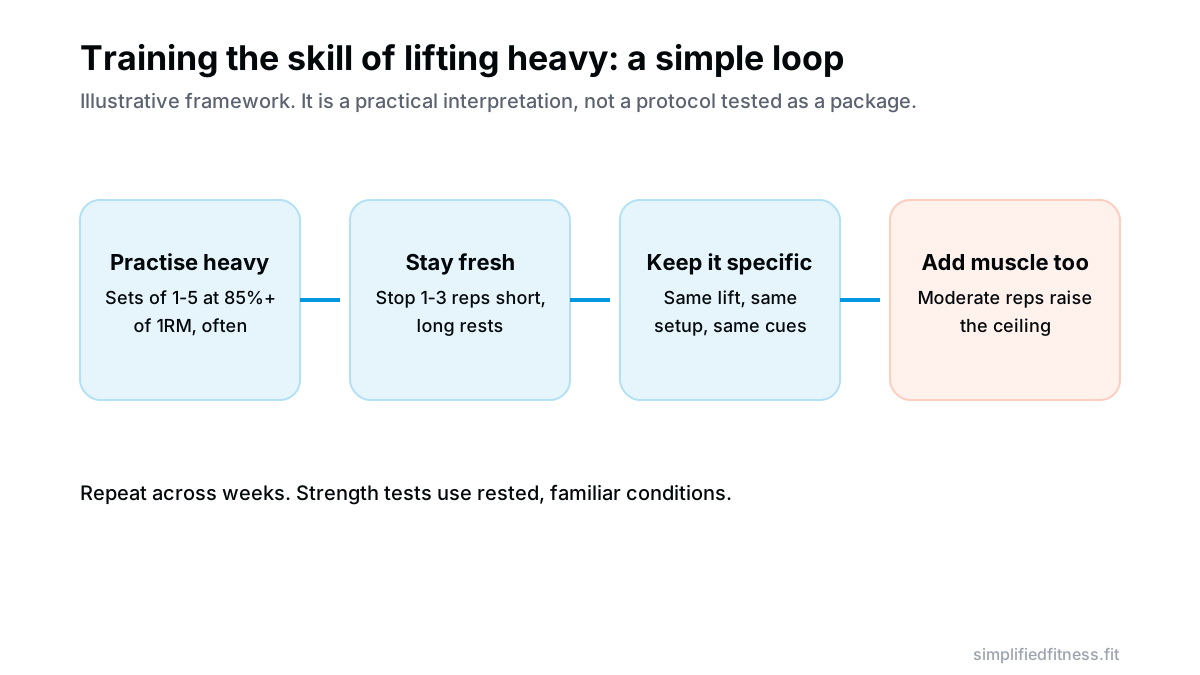
Given what the research does and does not show, here is a sensible reading. It is a practical interpretation, not a tested protocol.
- Practise heavy, often. Sets of 1-5 at high loads rehearse the exact skill of grinding a heavy bar. The principle behind it is explained in the specificity principle for strength.
- Stay fresh. Stop a rep or two short of failure on most heavy sets and rest 3-5 minutes, so every rep is high quality. The RIR / RPE calculator helps you pick loads.
- Keep the lift specific. Same stance, same bar path, same cues. Skill transfers best to the movement you practise.
- Do not abandon moderate-rep work. Muscle size raises your ceiling, and our free push, pull and legs plans cover that volume.
- Test sensibly. A true max is a performance, not training. Compare estimates against reality with the 1RM calculator, and read about test methods in 1RM testing vs estimation.
Indian lifter notes: when neural gains stall
Plenty of lifters in India train on a budget with a basic barbell setup and a shared rack, and that is fine. Consistency with the same lifts, adequate sleep and enough protein from dal, paneer, curd, eggs or soya support the recovery that lets you do high quality heavy work. In hot gyms, long rests and hydration help you stay sharp for heavy sets. These are general recovery habits, not neural-specific findings.
When to see a professional
See a doctor or qualified physiotherapist before heavy testing if you have joint pain, a heart or blood pressure condition, dizziness during lifting, or you are returning from injury. Nothing here is medical advice, and the cross-education findings in particular should be discussed with a clinician if you are injured.
The bottom line
Neuromuscular adaptations in strength training are real, but the neat textbook mechanisms are less proven than gym lore suggests. Early gains without growth and changes in cortical inhibition have the best support, though even the cortical findings differ between meta-analyses. Rate coding, synchronization and GTO changes remain plausible but unconfirmed.
The practical answer does not change: practise heavy, specific lifts with good recovery, and build muscle alongside. For the full programming context, head back to the maximal strength and powerlifting guide.
Frequently Asked Questions
What are neuromuscular adaptations to strength training?
They are changes in how your brain, spinal cord and nerves drive the muscle, rather than changes in the muscle itself. Reviews describe higher neural drive, altered motor unit firing and changes in cortical inhibition as the likely contributors. In practice this means practising heavy lifts makes you better at producing force with the muscle you have.
How long do neural adaptations take?
Neural changes are generally thought to dominate the first weeks of training, which is why novices gain strength with little visible growth. A review of motor unit research notes that neural changes are thought to be responsible for early strength gains, though exact timelines are not well pinned down. Expect fast progress early, then slower gains as you train for months.
What is rate coding in muscle?
Rate coding is how often a motor unit fires per second. Faster firing produces more force from the same fibres. Direct evidence that training raises it is thin, since a meta-analysis found no significant change, so treat it as a plausible mechanism rather than a proven one.
What is motor unit synchronization?
It is when two or more motor units fire at nearly the same moment, more often than chance would predict. Strength-trained men showed more synchronization on one index in a 2009 study, but a 2006 training study found no change after weeks of practice. Do not build a program around it; just train heavy and consistently.
Do Golgi tendon organs stop me lifting heavier?
There is no good evidence that they do. A critical review found that evidence for Golgi tendon organ inhibition at maximal voluntary effort is lacking and found no experimental support that strength training reduces it. Focus on technique, practice and progressive overload instead of trying to switch off a reflex.
Can you get stronger without getting bigger?
Yes, particularly early on or when training heavy for low reps. Strength gains without noticeable hypertrophy are the first line of evidence for neural involvement. Over the long run, bigger muscles still raise your strength ceiling, so most lifters benefit from some of both.
Why am I stronger in the gym than at a test?
Skill, setup and arousal all affect how much force you express. A rested, familiar, well-practised attempt usually beats an unfamiliar one. Rehearse your test lift in competition-like conditions before you try a true max.
What is cross-education of strength?
It is the finding that training one limb can raise strength in the untrained limb. A 2017 meta-analysis of 31 studies and 785 people found an average 11.9% gain in the untrained limb. That points to nervous system involvement, and it can be useful when one side is injured, but check with your physio first.
Does heavy lifting rewire the brain?
Training changes how the motor cortex and spinal pathways behave, which is why researchers call it plasticity. A 2017 meta-analysis of 19 studies found reduced intracortical inhibition and a shorter cortical silent period after strength training in untrained people, although a 2023 meta-analysis found no significant effect on that inhibition measure. How much of your strength gain these changes explain is still unclear.
Is low rep training better for neural adaptations?
Heavy loads are the most specific practice for maximal strength, but the research on the exact rep range for neural change is not settled. Muscle size and neural factors both contribute, so lifters often mix heavy sets with moderate rep work. The linked specificity article covers the load details.
Does antagonist co-contraction matter?
Possibly. Reviews note that both decreases and increases in antagonist coactivation have been reported after training, so the effect is not consistent. Lower coactivation could free up agonist force, but the body may also keep it for joint stability. Practise good technique and do not try to consciously relax opposing muscles.
Is it safe to max out often to train my nervous system?
Frequent true maxes carry fatigue and injury risk, and there is no evidence you need them to build neural drive. Most of the skill practice can come from heavy sets that leave a rep or two in reserve. If you have joint pain, a heart condition or are new to heavy lifting, see a doctor or qualified coach before testing.
Sources & References
Every claim above is checked against peer-reviewed research (PubMed, U.S. National Library of Medicine) or guidance from established health bodies. How we fact-check.
- Gabriel DA, et al. Neural adaptations to resistive exercise: mechanisms and recommendations for training practices. Sports Med. 2006. PMID: 16464122
- Elgueta-Cancino E, et al. The Effect of Resistance Training on Motor Unit Firing Properties: A Systematic Review and Meta-Analysis. Front Physiol. 2022. PMID: 35295567
- Chalmers G. Do Golgi tendon organs really inhibit muscle activity at high force levels to save muscles from injury, and adapt with strength training? Sports Biomech. 2002. PMID: 14658379
- Kidgell DJ, et al. Corticospinal responses following strength training: a systematic review and meta-analysis. Eur J Neurosci. 2017. PMID: 28921683
- Gomez-Feria J, et al. Corticospinal adaptations following resistance training and its relationship with strength: A systematic review and multivariate meta-analysis. Neurosci Biobehav Rev. 2023. PMID: 37353049
- Kidgell DJ, et al. Motor unit synchronization measured by cross-correlation is not influenced by short-term strength training of a hand muscle. Exp Brain Res. 2006. PMID: 17051382
- Fling BW, et al. Motor unit synchronization in FDI and biceps brachii muscles of strength-trained males. J Electromyogr Kinesiol. 2009. PMID: 18691906
- Manca A, et al. Cross-education of muscular strength following unilateral resistance training: a meta-analysis. Eur J Appl Physiol. 2017. PMID: 28936703
- Aslam S, et al. Neuromuscular adaptations to resistance training in elite versus recreational athletes. Front Physiol. 2025. PMID: 40551899
- Aagaard P, et al. Increased rate of force development and neural drive of human skeletal muscle following resistance training. J Appl Physiol. 2002. PMID: 12235031

Umair Hazrami · Founder & Head Coach, Simplified Fitness
Umair Hazrami founded Simplified Fitness and the Simplified Lifter channel to cut through fitness noise. With 4+ years of consistent training and 10+ coaching clients, he writes every guide from the peer-reviewed research and links the sources so you can check them. Our editorial standards.
Educational content only, not medical advice. If you have a medical condition, are pregnant, or take medication, talk to a qualified doctor before changing your diet, supplements or training. Full disclaimer.
Keep reading

Strength & Cardio
1-Rep Max Testing vs 1RM Formulas: Which Is More Accurate and What Does Each Cost You?
1RM testing vs calculation: how accurate are Epley and Brzycki, when a true max is worth the risk, and a safe protocol if you do test. Studies linked.
9 min read

Strength & Cardio
Accommodating Resistance: Do Bands and Chains Really Match the Squat and Bench Strength Curve?
Accommodating resistance with bands and chains makes the top of a lift heavier. See what trials show on power and strength, and how to set it up safely.
9 min read

Strength & Cardio
Competition Bench Press Technique: Arch, Leg Drive, Lats and Bar Path Explained
Competition bench press technique explained: scapular setup, leg drive, lat tension, bar path and pause commands, plus what the research does and does not show.
10 min read
Strength & Cardio
Conventional vs Sumo Deadlift: Which Suits Your Hips, Limbs and Back?
Conventional vs sumo deadlift biomechanics: what the studies show on muscle demand, bar path and back load, plus a simple test to pick the style for your body.
10 min read