Paused Squats, Spoto Press and Deficit Deadlifts: Do They Work?
Paused squats, Spoto press and deficit deadlifts explained: what pauses and deficits actually train, what the research says, and how to program them.
TL;DR. The short answer
- A pause removes most of the rebound off the bottom, so the muscles have to produce force from a near dead stop. In one 10-week trial of 26 men, 2-second paused squats gave larger strength effect sizes than normal squats.
- Pause variations are mainly useful as a technique and positional tool: they expose rushed reps and weak positions. Direct evidence that the Spoto press or deficit deadlift beats the regular lift is thin, so treat them as coaching tools, not proven shortcuts.
- Deficit deadlifts increase the distance the bar travels, so as a coaching rule of thumb they are best kept small (about 2.5 cm) and used only if your back position stays the same as your normal pull.
- Full range of motion beat partial range for strength (effect size 0.56) and lower-limb muscle growth (0.88) in a 2021 meta-analysis, so keep variations as a block, not your whole program.
- A sensible dose is one paused or deficit variation per session at around 70-85% of your normal training load, for 4-8 weeks, then cycle back to the competition lift.
Part of our complete guide: Maximal Strength, Neuromuscular Adaptations & Powerlifting Science for General Lifters
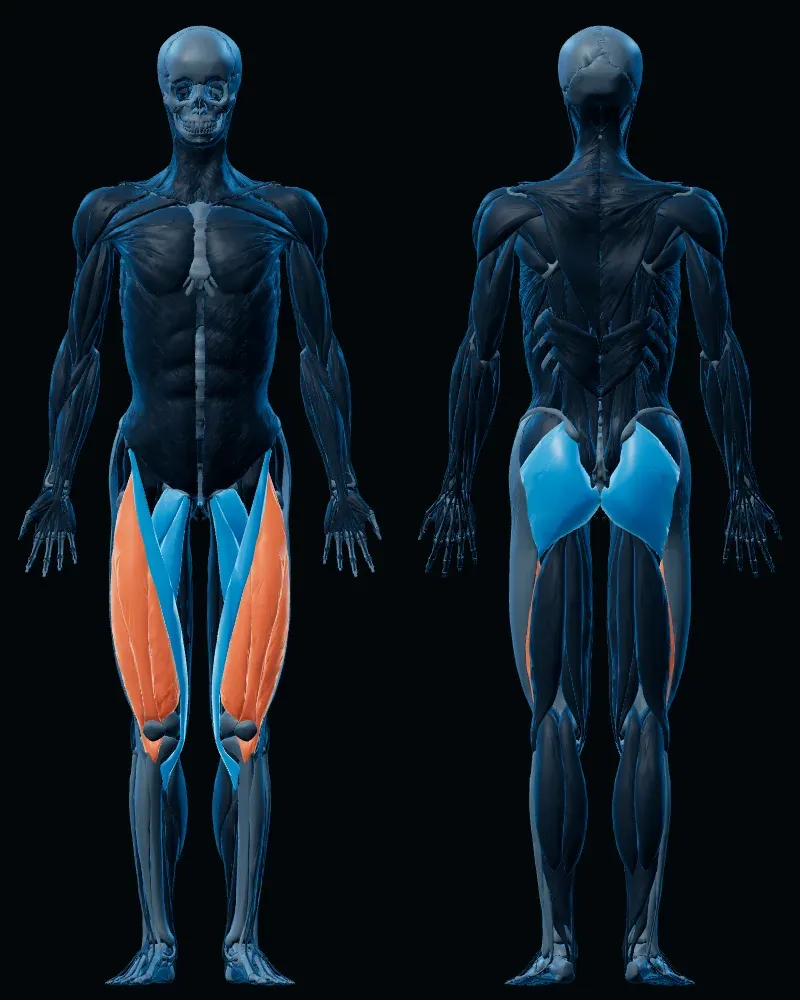
Muscles worked: quads
Main movers: rectus femoris and the three vasti
Assisting: adductors, sartorius and glutes
Table of contents
Paused squats, Spoto press and deficit deadlifts all do the same job: they take away your easy part of the rep and make the hard part harder. A pause removes most of the rebound off the bottom. A deficit makes the bar travel further before it reaches the usual start. Used as a short training block, both can help you build strength where you are weakest, but the direct research is thinner than gym lore suggests.
This guide sits inside our complete guide to maximal strength and powerlifting science. If you are not sure where you actually fail a lift, read sticking point analysis first, because choosing the wrong variation is an easy mistake to make.
What do paused reps actually change?
In a normal rep you lower the bar, hit the bottom, and part of that downward energy comes back as a bounce. Tendons and muscle store a bit of elastic energy on the way down and return it on the way up. That is the stretch-shortening cycle, and we cover it in tendon stiffness and elastic energy.
Add a 2-second pause and most of that stored energy fades. The bar sits still, and your muscles have to start the movement mostly from scratch. That is why a paused squat feels so much heavier than a touch-and-go one at the same weight.
Two things follow from that.
- You find out quickly if you were relying on the bounce.
- You cannot rush the bottom position, so slack in your setup shows up.
Do paused squats build more strength?
One trial gives a hint, not a verdict. In a 10-week velocity-based programme, 26 men were randomised to squat with a roughly 2-second pause (n = 13) or normal rebound (n = 13). Both groups improved, but the paused group showed larger effect sizes on neuromuscular tests (0.76-1.12) than the rebound group (0.45-0.92). Jump height and the 10-20 m sprint split improved more in the rebound group, while Wingate and 0-20 m sprint changes leaned towards the paused group without reaching significance, and the authors suggest pause suits concentric-dominant tasks while rebound suits stretch-shortening tasks (Martinez-Cava et al., 2021).
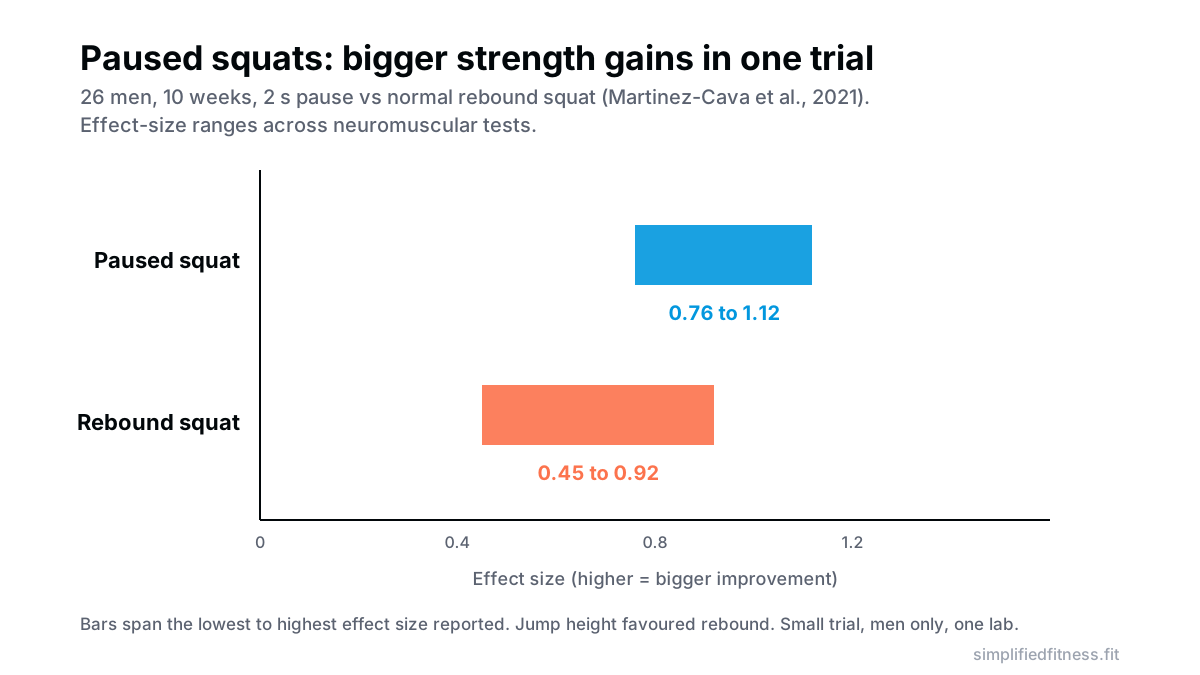
Why might the results differ by test? A max squat is slow and grinds through the bottom, so being strong from a dead stop helps. A jump is fast and elastic, so you train it with bounce. Caveat: this was 26 men, one lab, and the programme used velocity-based loads, so the result may not transfer to your gym week.
Paused squat form: how to do the 2-second pause
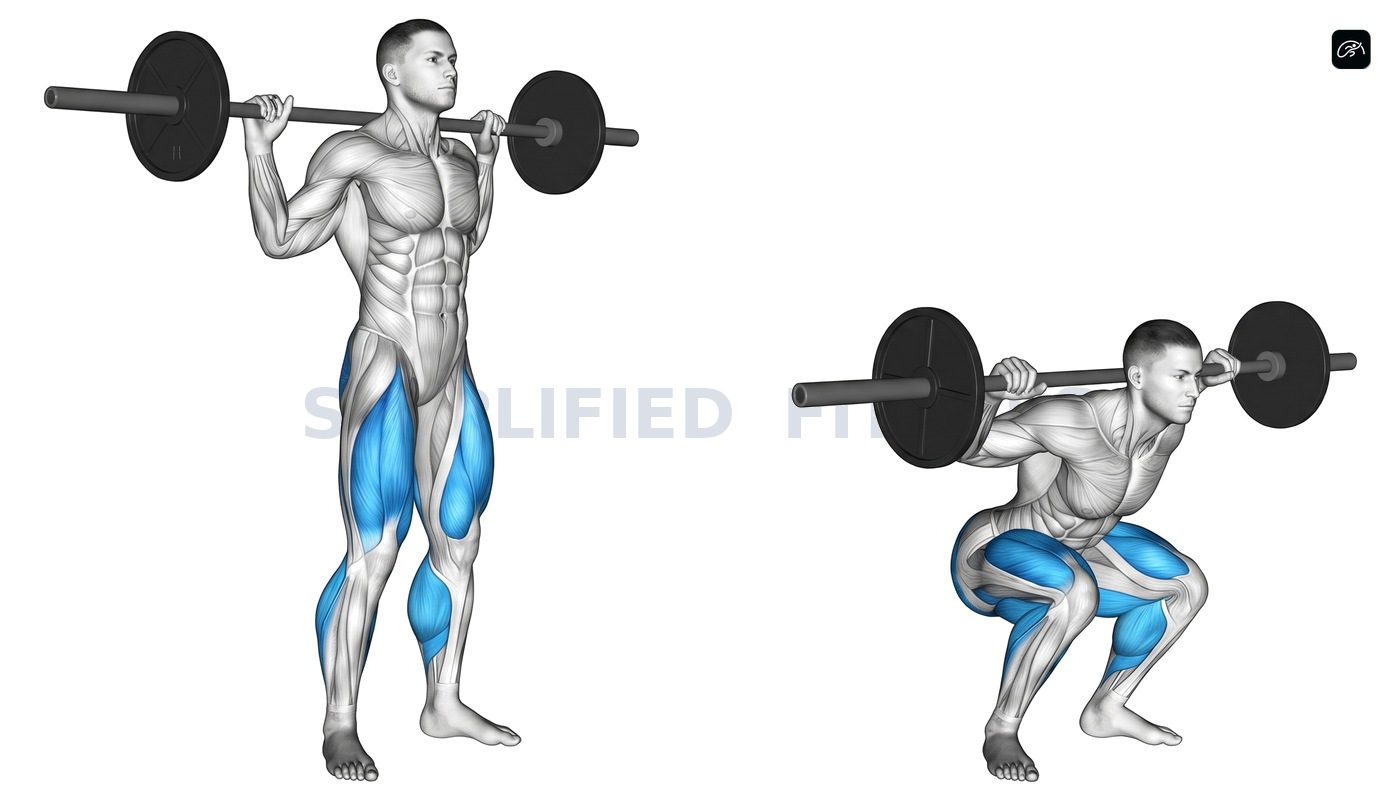
- Set up exactly as normal. Same stance, same bar position, same brace.
- Descend under control to your usual depth.
- Hold for 2 seconds with your torso tight. Do not relax into your hips, and do not sag the chest.
- Drive up by pushing the floor away, with no extra dive or bounce.
Start with 70-80% of your usual working weight for sets of 3-5. This is a coaching starting point rather than a research number. If your depth rises or your chest folds in the pause, the weight is too heavy.
What is the Spoto press?
The Spoto press is a bench press where the bar stops just above your chest (about 2.5 cm) for a pause and then goes back up, without touching. It is named after the powerlifter Eric Spoto. The purpose is to keep your muscles loaded through the part of the press where most lifters stall, with no chest bounce and no rest on the sternum.
How it differs from a paused bench: in a paused bench the bar sits on your chest, so the chest takes some weight. In a Spoto press, you hold the bar in the air, which is harder. Start at around 70-80% of your usual bench weight.
An honest note: I could not find a trial that compared the Spoto press with regular benching. The case for it is coaching logic (time under load in the weak range), not proven superiority. If your problem is that you lose tightness at the chest, it is a sensible tool. If you fail at lockout, it will not help much. For bench basics, see competition bench press technique.
How do deficit deadlifts work?
A deficit deadlift is performed standing on a low plate or platform so the bar starts lower than its normal height. That means more knee and hip bend at the start, and the bar travels further. In practice it is a way to train the first few centimetres harder.
- Use a small deficit. Start with about 2.5 cm. Most lifters should not go beyond 5 cm.
- Use lighter weight than your normal deadlift. Plan on about 70-85% of your usual pull as a rule of thumb.
- Check your start position. If your lower back rounds to reach the bar, the deficit is too big for you today.
- Keep the same pull you use from the floor: lats on, slack out, bar close.
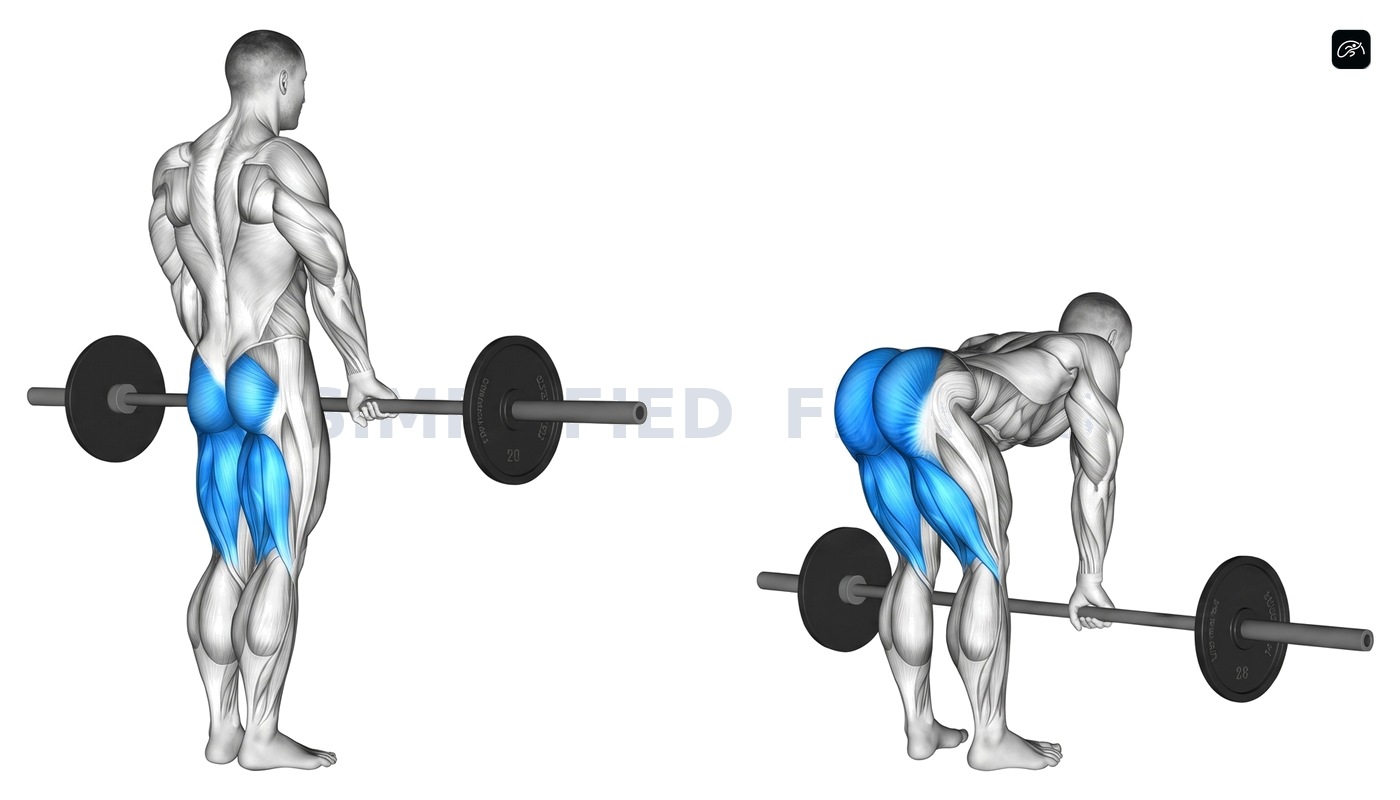
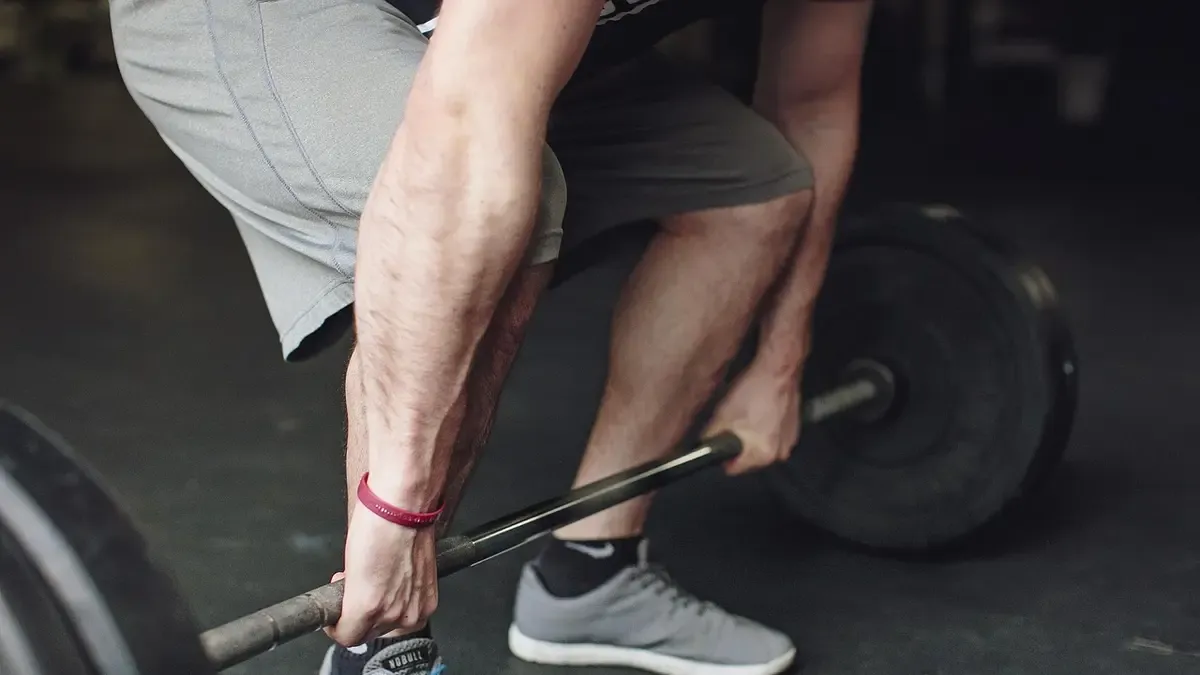
The photo shows a hinge with a neutral back, the position you want to preserve in any deadlift variation. For the sumo versus conventional question, see conventional vs sumo deadlift biomechanics.
Again the direct evidence is thin. What we do know is that range of motion matters in general: in a meta-analysis of 16 studies, full range training beat partial range for strength (effect size 0.56) and lower-limb hypertrophy (0.88) (Pallares et al., 2021). A deficit makes the range longer than normal, which is a different question, so do not read that as “more range is always better”.
What does the range-of-motion research say?
Two reviews are worth knowing. A systematic review of six studies (n = 135, mostly men) concluded that full range of motion benefits lower-body hypertrophy compared with partial range, while evidence for the upper limbs is limited and conflicting (Schoenfeld & Grgic, 2020). The 2021 meta-analysis agreed on strength and lower-limb size, and found no significant difference in muscle thickness, pennation angle or fascicle length.
Newer work complicates the picture. In 30 resistance-trained people, partial reps in the lengthened position produced similar arm muscle growth and lat pulldown 10-rep strength to full range over 8 weeks (Wolf et al., 2025). A Bayesian meta-analysis of 12 studies in young adults also found similar regional hypertrophy at shorter and longer muscle lengths, with the authors urging caution because the length differences were small (Varovic et al., 2025).
So what do you take from it? Full range is a safe default for strength and leg size. Stretched-position work matters. Pauses and deficits are tools you can add on top, not replacements for the full lift.
Which variation fits which problem?
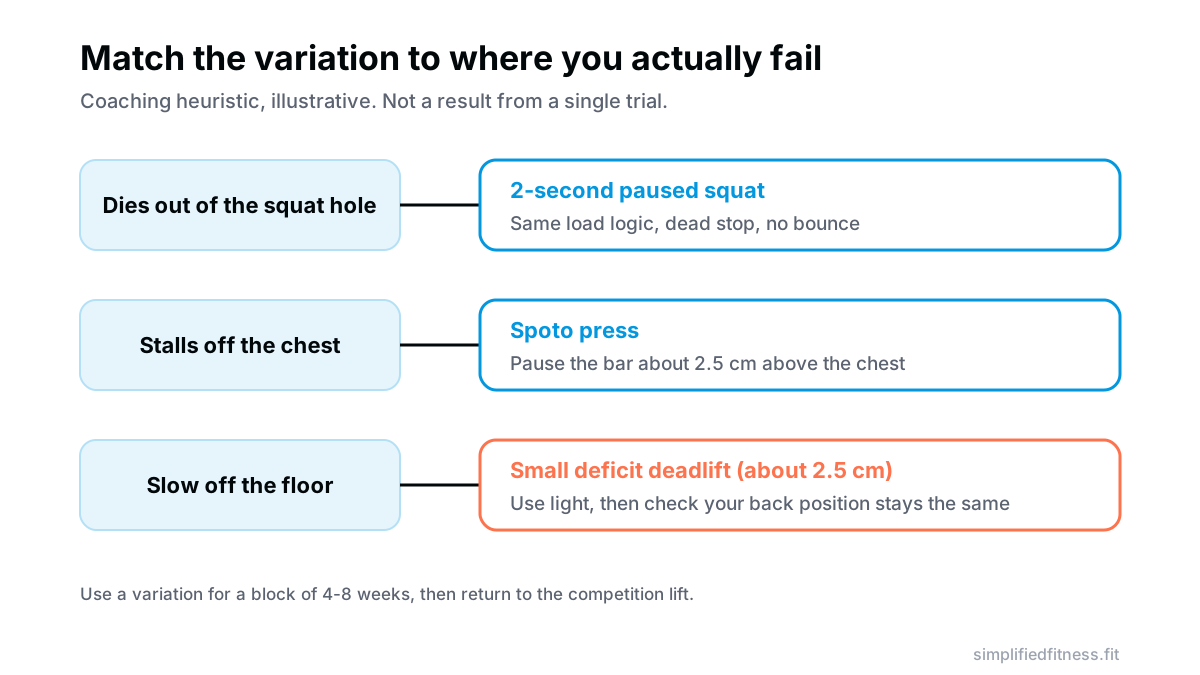
| Variation | What it targets | Starting load (rule of thumb) | Main risk |
|---|---|---|---|
| 2-second paused squat | Strength out of the hole, bracing | 70-80% of usual squat | Relaxing in the bottom |
| Paused bench | Bar speed off the chest | 75-85% of usual bench | Losing tightness |
| Spoto press | Tension in the sticking region | 70-80% of usual bench | Shoulder irritation if too heavy |
| Deficit deadlift (about 2.5 cm) | Speed off the floor | 70-85% of usual pull | Rounding the back |
Percentages are coaching rules of thumb, not research findings. Adjust by how the bar feels, using our RIR and RPE calculator if you want a number.
How to program paused and deficit work
Keep it simple. One variation per lift, once a week.
- Placement: use it as the main lift for strength-focused weeks or a second lift after your competition-style sets.
- Reps: 2-5 reps per set, 3-5 sets. Stop the set when the pause or the position gets sloppy.
- Block length: 4-8 weeks, then go back to the competition lift and see if the sticking point has moved.
- Test with a real number: estimate your new max using the 1RM calculator and compare it with the earlier one.
If you want a ready-made split to slot variations into, our push day, pull day and leg day templates give you a base. For how bounce and bar speed fit in, see rate of force development and accommodating resistance.
Who should be careful?
Pause and deficit work is not special, but it is heavy and slow. If you have a current back, hip or shoulder injury, or pain that gets worse with the position, see a doctor or physiotherapist before loading these. Stop a set when you feel sharp pain, tingling or numbness, not just effort.
Beginners should learn the regular lift first. Paused work is useful for technique, but only once you can reach depth with a braced torso without it.
The bottom line
Pauses take away the bounce and deficits add range. Both can be good tools for the weak part of a lift. The best direct data is one small trial for paused squats; Spoto presses and deficit deadlifts rest mostly on coaching experience. Run them for a few weeks, aim at a real sticking point, keep the position clean, and then go back to the lift you actually compete or train for.
Frequently Asked Questions
What are the benefits of paused reps in lifting?
Paused reps remove most of the elastic rebound and make you prove strength from a dead stop. A 10-week trial in 26 men found larger strength effect sizes with a 2-second paused squat than with a normal rebound squat. Use them to clean up rushed reps and weak bottom positions, with lighter loads than your regular sets.
Do paused squats build more strength than regular squats?
They may, but the evidence is limited to a small trial. In that 10-week study, the paused group improved 1RM and bar speed with effect sizes of 0.76-1.12 versus 0.45-0.92 for normal squats, while jump height favoured the rebound group. Rotate both rather than replacing one with the other.
How long should I pause in a paused squat?
About 2 seconds is the duration used in the research discussed here. It is long enough to take away most of the bounce without you losing tension or position. Stay tight in the hole, do not relax, and count it on the clock for a few sessions.
What is the Spoto press?
The Spoto press is a bench press where you lower the bar and pause it just above your chest (about 2.5 cm), without touching, before pressing. This keeps the muscles under load through the sticking region with no chest bounce. Start with about 70-80% of your usual bench working weight and keep your upper back tight.
Is the Spoto press better than a paused bench press?
No research has compared them head to head, so nobody can say. The Spoto keeps tension off the chest, the paused bench lets the bar rest on the chest and is closer to competition. Pick the one that fixes your problem and keep the other in your back pocket.
What is a deficit deadlift and who needs it?
A deficit deadlift is pulled while standing on a low platform, so the bar starts below its normal height and travels further. It suits lifters who are slow off the floor and who keep a flat back at the start. If your lower back rounds in the deficit, drop the deficit height or skip it.
How high should the deficit be?
A small deficit of about 2.5 cm is a sensible starting point, and 5 cm is the upper range most lifters use. Larger deficits change hip and back angles enough that they stop resembling your normal pull. Choose the height at which your start position still looks like your usual one.
Can deficit deadlifts hurt my lower back?
They can if you let your back round to reach the bar, because the longer range raises the demand at the start. No trial shows they injure healthy lifters, but the evidence is thin either way. Use lighter loads, keep a braced neutral spine, and stop the set when the position slips.
How often should I do pause and deficit work?
One variation per main lift, once a week, is plenty for most lifters. Use it in the lower-rep, higher-quality part of the session or as a second lift after the main one. Run it for 4-8 weeks, then switch back to the competition lift.
What weight should I use for paused squats?
Expect to use roughly 10-20% less than your regular squat for the same reps, since there is no rebound. This is a coaching rule of thumb, not a research number. Use a 1RM estimate from our calculator and start conservatively.
Are paused reps good for beginners?
Yes, they are useful for technique, as long as the load is light enough to keep good form. Pausing slows the rep and makes position errors obvious. Beginners should learn the regular lift first and add pauses to a few sets.
Do pauses help muscle growth?
The research on pauses and hypertrophy is limited, so no strong claim is possible. What we know is that range of motion matters more: full range beat partial range for lower-limb growth in a meta-analysis. Use pauses for strength and technique, and keep the range full.
Do deficits and pauses work for powerlifting only?
No, they can help any lifter who wants better control and strength out of the bottom position. Powerlifters use them most because they compete on a pause or from a dead start. General gym lifters can use them for a few weeks to clean up technique.
Sources & References
Every claim above is checked against peer-reviewed research (PubMed, U.S. National Library of Medicine) or guidance from established health bodies. How we fact-check.
- Martinez-Cava A, et al. Effect of Pause Versus Rebound Techniques on Neuromuscular and Functional Performance After a Prolonged Velocity-Based Training. Int J Sports Physiol Perform. 2021. PMID: 33561819
- Pallares JG, et al. Imposing a pause between the eccentric and concentric phases increases the reliability of isoinertial strength assessments. J Sports Sci. 2014. PMID: 24575723
- Pallares JG, et al. Effects of range of motion on resistance training adaptations: A systematic review and meta-analysis. Scand J Med Sci Sports. 2021. PMID: 34170576
- Schoenfeld BJ, et al. Effects of range of motion on muscle development during resistance training interventions: A systematic review. SAGE Open Med. 2020. PMID: 32030125
- Wolf M, et al. Lengthened partial repetitions elicit similar muscular adaptations as full range of motion repetitions during resistance training in trained individuals. PeerJ. 2025. PMID: 39959841
- Varovic D, et al. Does Muscle Length Influence Regional Hypertrophy? A Systematic Review and Meta-Analysis. Int J Sports Med. 2025. PMID: 40570881

Umair Hazrami · Founder & Head Coach, Simplified Fitness
Umair Hazrami founded Simplified Fitness and the Simplified Lifter channel to cut through fitness noise. With 4+ years of consistent training and 10+ coaching clients, he writes every guide from the peer-reviewed research and links the sources so you can check them. Our editorial standards.
Educational content only, not medical advice. If you have a medical condition, are pregnant, or take medication, talk to a qualified doctor before changing your diet, supplements or training. Full disclaimer.
Keep reading
Strength & Cardio
1-Rep Max Testing vs 1RM Formulas: Which Is More Accurate and What Does Each Cost You?
1RM testing vs calculation: how accurate are Epley and Brzycki, when a true max is worth the risk, and a safe protocol if you do test. Studies linked.
9 min read
Strength & Cardio
Accommodating Resistance: Do Bands and Chains Really Match the Squat and Bench Strength Curve?
Accommodating resistance with bands and chains makes the top of a lift heavier. See what trials show on power and strength, and how to set it up safely.
9 min read
Strength & Cardio
Competition Bench Press Technique: Arch, Leg Drive, Lats and Bar Path Explained
Competition bench press technique explained: scapular setup, leg drive, lat tension, bar path and pause commands, plus what the research does and does not show.
10 min read
Strength & Cardio
Conventional vs Sumo Deadlift: Which Suits Your Hips, Limbs and Back?
Conventional vs sumo deadlift biomechanics: what the studies show on muscle demand, bar path and back load, plus a simple test to pick the style for your body.
10 min read