Lifting Belts Science: Do Belts Weaken Your Core and Who Needs One?
Does a weightlifting belt weaken your core? See what EMG and pressure studies show, who benefits, lever vs prong belts, and where to position it.
TL;DR. The short answer
- There is no good evidence that wearing a belt weakens your core. In the lab studies we have, abdominal muscle activity stayed the same or went up with a belt, but nobody has run a long-term trial on belt users.
- A belt gives your abdomen something to push against. In one study of six lifters, intra-abdominal pressure rose from 99 to 120 mmHg with a belt, about 21%.
- Belts help performance more than they help 'safety'. In trained lifters a belt added reps (6.5 to 8.1 in one 2026 study) and roughly 5 kg to squat 1RM in another.
- Belts are most useful for near-maximal squats and deadlifts. For lighter sets, learn to brace without one.
- Lever or prong, 10 mm or 13 mm: the research does not rank them. Pick the one that fits snugly and that your federation allows.
Part of our complete guide: Maximal Strength, Neuromuscular Adaptations & Powerlifting Science for General Lifters
Table of contents
Does a weightlifting belt weaken your core? Based on the studies we have, no. A belt gives your abdominal muscles a firm wall to push against, which raises the pressure inside your trunk, and in lab work abdominal muscle activity stayed the same or went up while wearing one. The caveat is that we have no long-term trials on people who wear belts for years.
This sits inside the bigger picture of maximal strength and powerlifting science, and it builds on how you brace and use the Valsalva manoeuvre. Here we cover what a belt does, who gets something out of it, how to choose between lever and prong, and where to put it on.
How do lifting belts work? The intra-abdominal pressure story
Your trunk is a pressurised cylinder when you brace well. The diaphragm sits on top, the pelvic floor underneath, and the abdominal wall around the front and sides. Take a big breath, tighten everything, and the air and organs inside become a firm column that helps keep your spine from folding under load.
A belt does not do the bracing for you. It adds a stiff outer wall that your abdomen can push into. More resistance to push against means more pressure, and that is the whole idea.
Here is what the data show. In a 1990 study, six lifters squatted 72.7 to 90.9 kg with and without a weightlifting belt. Every lifter had higher intra-abdominal pressure (IAP) with the belt: 99 mmHg without, 120 mmHg with (McGill et al., 1990). That is about 21% higher. Holding the breath also raised IAP, with or without the belt, so the breath matters at least as much as the belt.
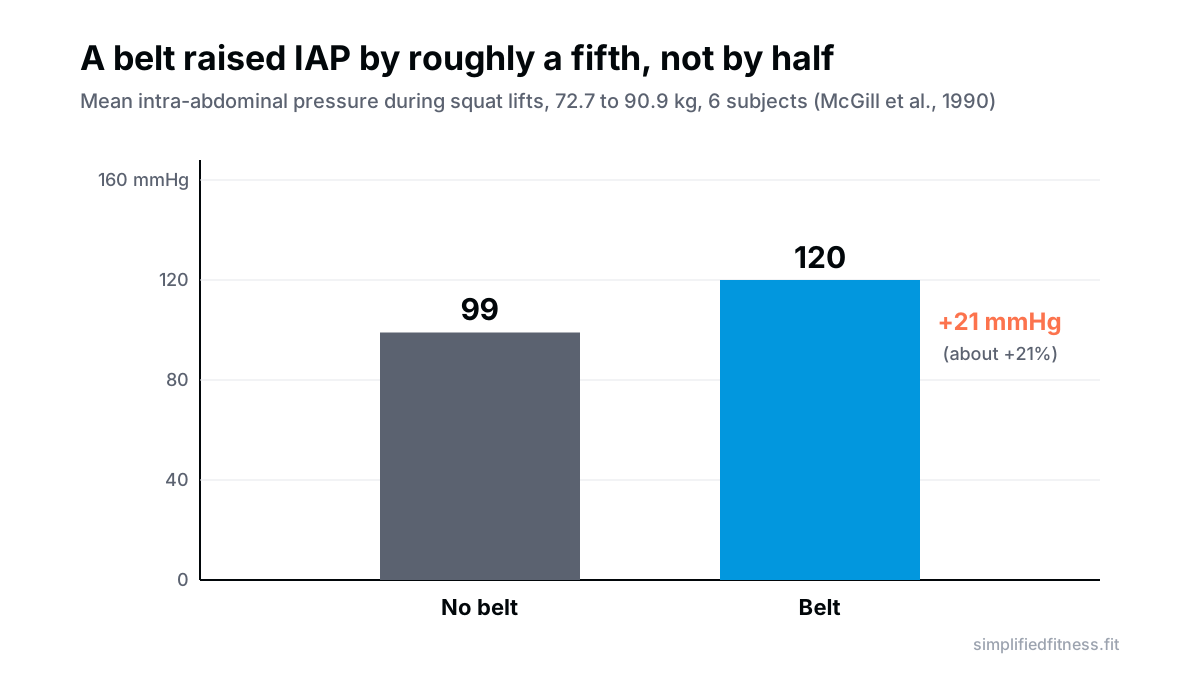
You may see claims online that belts raise IAP by 25-40%. We did not find that range in the studies we checked, and with only six subjects in this one, treat any exact percentage as a rough guide.
Does a weightlifting belt weaken your core?
This is the gym myth that never dies: “wear a belt and your abs and spinal erectors go to sleep.” Here is what studies actually measured, and what they did not.
Short-term muscle activity. In 11 men doing paced squat lifts, a belt lowered erector spinae activity by 8-11% of maximum and lat activity by 15-21%, while rectus abdominis rose by about 4% and external oblique by 3-5% (Lee & Kang, 2002). Their abdominals worked more, not less. Another study found rectus abdominis EMG rose with a belt during Valsalva and isometric leg lifts, and pressure inside the erector spinae muscles went up, although peak IAP and maximum isometric lifting capacity did not change (Miyamoto et al., 1999). In 14 men squatting at 90% of 1RM, no EMG differences appeared for any muscle measured, including erector spinae (Zink et al., 2001).
What nobody has shown. All of these are single-session studies. They tell us the belt does not switch your abs off on the day. They do not tell us what happens if you wear one for every set across five years. Honest answer: probably fine, not proven.
If you want a practical safeguard, keep warm-ups and lighter work belt-free. You rehearse the brace on your own, then the belt adds to it on the heavy sets. That is coaching logic, not a trial result.
Does a belt protect your back?
Careful here. Feeling stable is not the same as being safer.
In nine experienced weightlifters lifting up to 75% of body weight, a stiff belt reduced spine compression by about 10%, but only when the lifter inhaled before the lift. The researchers concluded this came from a moment generated by the belt itself rather than from IAP (Kingma et al., 2006). So even the mechanism is debated: it may be less about pressure and more about the belt acting as a stiff brace.
For injury prevention, a systematic review of back belts in material handlers found no conclusive evidence they prevent or reduce lost time from low back pain, partly due to conflicting results and few high-quality trials (Ammendolia et al., 2005). That is workers, not lifters, so it does not translate cleanly to the squat rack.
Takeaway: a belt is not proof against back pain. For the broader question of whether heavy pulling hurts the spine, read our piece on whether deadlifts are bad for your lower back.
Do belts help you lift more?
This is where the evidence is clearest.
In a 2026 study of 29 men and 20 women, lifters did squats to failure at their beltless 6RM load, with and without a belt. They got more reps with the belt (8.1 vs 6.5), and the concentric phase was faster, in both men and women, experienced or not (Veltzke et al., 2026). Interesting twist: lifters felt more stable, but force-plate sway did not objectively improve. So the benefit was not explained by better balance.
Another 2026 study of 25 resistance-trained athletes found squat 1RM was higher with a belt, 119.2 vs 114.0 kg, which is about 5 kg (Huang et al., 2026). Bar speed was higher with the belt at the same submaximal weights, though slightly lower at 85 to 100% of each condition’s own 1RM. In 14 men squatting at 90% of 1RM, belted squats were completed faster too (Zink et al., 2001).
These are small samples, mostly squats, and mostly short-term. The direction is consistent, though: a belt tends to help you move more weight or more reps.
If you track your max, our 1RM calculator helps, but note that a belted max and a beltless max are two different numbers. Log which one you tested.
Who actually needs a weightlifting belt?
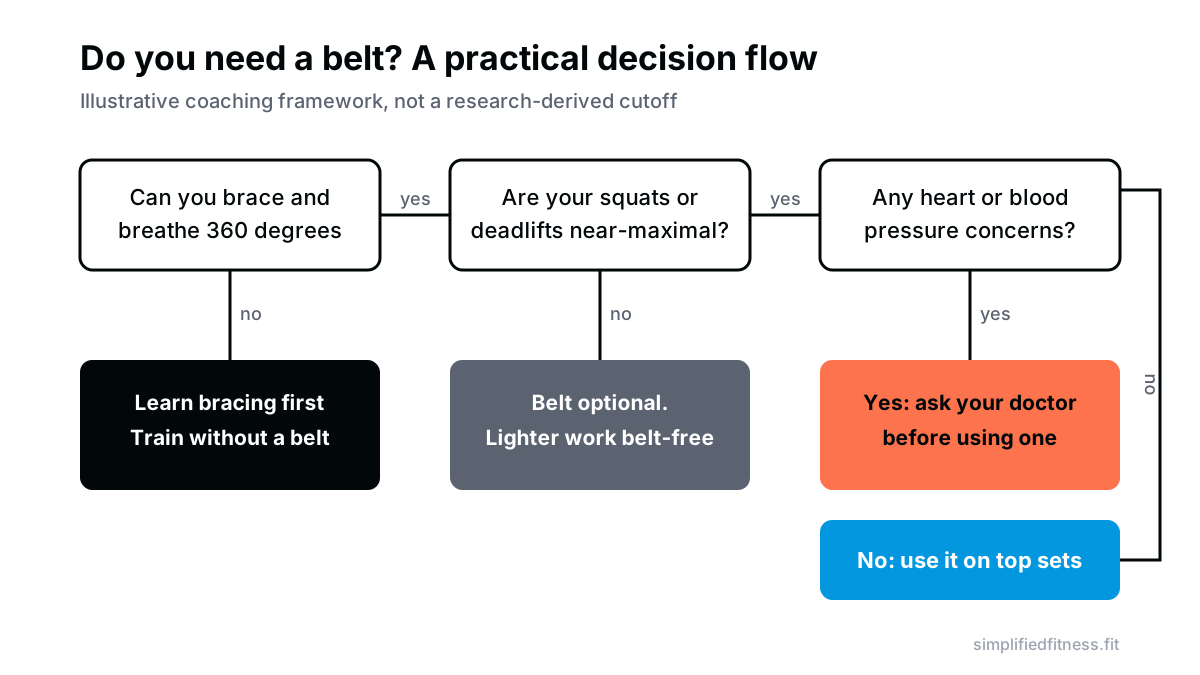
Nobody needs one. A belt is a tool, not a requirement. Here is a simple way to think about it.
Good candidates:
- Lifters grinding through heavy squats and deadlifts, roughly the top sets above 85% of 1RM. That figure is a gym rule of thumb, not a research cutoff.
- Powerlifters peaking toward a meet, where an extra few kilos or a faster rep matters.
- Lifters who already brace well and want a little more.
Probably skip it:
- Beginners. Loads are rarely heavy enough for a belt to matter, and the first priority is learning to brace. Our guide to low bar squat technique is a better first spend of attention.
- Anyone using it to compensate for a core that feels weak. Fix the brace.
- Lighter hypertrophy sets, where you have reps in reserve.
The most common mistake is wearing a belt for the whole session, including warm-ups, then feeling lost the day it is not on. Belt for the top sets, bare for the rest.
Prong vs lever belt: which one should you buy?
No trial compares them. So this comes down to practical differences, not science.
| Feature | Prong belt | Lever belt |
|---|---|---|
| Adjustment | Fine, hole by hole; easy to change mid-session | Set with a screwdriver, then flip on and off |
| Consistency | Depends on which hole you use | Same tightness every time |
| Speed on and off | Slower | Fast |
| Cost | Usually cheaper | Usually pricier |
| Best for | Lifters who want flexibility or are on a budget | Competitors who want repeatable tension |
Neither is magic. If budget matters, a prong belt does the same job.
Two details matter more than the buckle:
- Fit. The belt should reach the full space between your ribs and hip bones without digging into either when you sit or hinge. A narrow torso with a wide belt will pinch.
- Stiffness. A belt that folds when you brace is not giving you a wall.
Belt thickness: 10 mm or 13 mm?
Also unresearched, as far as we found. A thicker belt is stiffer, so it gives a firmer wall, but it can be harder to break in and may press into your ribs or hips if your torso is short. A thinner belt is easier to get on and may feel more comfortable.
Most powerlifting federations set a maximum thickness for competition, and the commonly quoted figure is around 13 mm, but rules differ, so check your own federation’s rulebook before buying a competition belt. If you do not compete, buy the belt that fits you well and feels firm when you brace.
For lifters in India, where gym floors can be hot and humid, a leather belt may need a break-in period and will sweat. Wipe it down and let it air out. A cheaper nylon belt can work for training if it is stiff enough, but it will not mimic a leather competition belt.
How to position a lifting belt
Start here, then adjust for your torso:
- Place it between your lower ribs and top of your hip bones, centred on your navel line.
- Squat: many lifters sit it a bit lower, so it does not jam the ribs when they drop into the hole.
- Deadlift: many wear it a touch higher, so it does not block the hip hinge.
- Tighten with a breath. Set it snug, take a deep belly breath, brace, and push into the belt. If you cannot expand, loosen a notch. If it slides, tighten.
- Test it. Do a few reps at a medium weight. You should feel firm resistance on every rep, and no pinching in the ribs or hips.
The ideal fit is a bit different for everyone, which is why trying one on before buying is worth the effort. See how it sits when you hinge as in a conventional or sumo deadlift, since belt position can interact with your stance.
Safety and when to see a doctor
Heavy lifting with a held breath raises blood pressure. A belt may add to that: in 20 healthy men, wearing an abdominal belt raised diastolic pressure in every task tested, though systolic pressure and heart rate did not change significantly (Rafacz & McGill, 1996). That study used a general abdominal belt, not a modern lifting belt, so the size of the effect in lifters is uncertain.
Speak to your doctor before lifting heavy with a belt if you have:
- high blood pressure or heart disease
- a history of stroke or an aneurysm
- a hernia, or abdominal or pelvic surgery
- pregnancy
Stop and get checked for chest pain, severe headache, dizziness or fainting during or after lifting. This article is general information and does not replace medical advice.
What belts do not replace
A belt sits on top of the basics. It does not substitute for a brace you can do on your own, sensible load progression, or good technique. The same goes for other kit: if you are weighing up knee sleeves versus wraps, ask the same question. Does it help you lift more, and does it stand in for something you should be building yourself?
The bottom line
The evidence we have says a belt does not make your core weak. It gives your abdomen a firm wall to push against, it raised IAP by about 21% in one small study, and in trained lifters it increased reps and squat 1RM. It has not been shown to protect your back, and nobody has tested what a decade of belt use does.
Use it for heavy squats and deadlifts, brace without it on lighter work, pick a prong or lever belt that fits well, and see a doctor first if you have heart or blood pressure concerns. For a structured way to apply this, try our free leg day plan.
Frequently Asked Questions
Does a weightlifting belt weaken your core?
There is no evidence that it does. In lab studies, rectus abdominis and oblique activity was unchanged or higher with a belt, and erector spinae activity was unchanged or lower. No study has followed belt users for years, so the long-term question is unproven, but the short-term data do not support the myth.
How does a lifting belt increase intra-abdominal pressure?
A belt gives your abdominal wall a rigid surface to push into, and that resistance raises pressure inside the trunk. In McGill's 1990 study, six lifters averaged 99 mmHg without a belt and 120 mmHg with one. The practical step is to breathe into your belly and push out into the belt rather than just cinching it tight.
Does a belt protect your lower back from injury?
Not proven. A systematic review of back belts in workers found no conclusive evidence that they prevent low back pain, and a lifting study found the belt only cut spine compression by about 10% when the lifter inhaled first. Treat a belt as a performance tool, and keep technique and load progression as your real protection.
Who actually needs a weightlifting belt?
Nobody needs one, but it is most useful for people lifting heavy (roughly 85% of 1RM and above, a coaching rule of thumb rather than a research cutoff) in squats and deadlifts. Trained lifters in studies lifted more reps and moved the bar faster with a belt. If your bracing is poor, fix that first.
Should beginners wear a lifting belt?
Usually not for the first few months. Beginners benefit from learning to brace on their own, and loads are rarely heavy enough for a belt to matter. Once you are grinding through heavy sets, you can add one to your top sets.
Should I wear a belt for every set?
No. Keep warm-ups and lighter sets belt-free so you practise bracing on your own, then put the belt on for the heavy work. This is a coaching approach rather than something tested in long-term trials. It gives you the benefit of the belt without leaning on it for everything.
Lever belt or prong belt: which is better?
Neither has research showing it is better. Prong belts are easy to adjust and cheaper, while lever belts lock to the same tightness every time and are quicker to take on and off. Choose based on convenience and how consistently you want the fit to be.
Is a 10 mm or 13 mm belt better?
There are no trials comparing thickness. A thicker, stiffer belt gives a firmer wall but can dig in at the ribs and hips, especially for shorter torsos. Check your federation's maximum thickness if you compete, and try a belt on before buying if you can.
Where should a lifting belt sit?
Position it around your waist so it covers the area between your lower ribs and hip bones, sitting roughly on your navel line. Many lifters wear it a little lower for squats and a touch higher for deadlifts, but this varies with torso length. The test is whether you can still take a full belly breath and push against it without it pinching.
How tight should a lifting belt be?
Tight enough that you feel firm resistance when you inhale, but loose enough to get a full breath. If you cinch it so tight you cannot expand, you lose the pressure benefit. A common approach is to set it snug, take your brace and push out, then adjust a notch if needed.
Does a belt raise blood pressure?
An older study of 20 healthy men found that wearing an abdominal belt raised diastolic blood pressure across tasks, with no significant change in systolic pressure or heart rate. Heavy lifting with a held breath also raises pressure. If you have high blood pressure, heart disease or a history of stroke, ask your doctor before lifting heavy with a belt.
Can I wear a belt for deadlifts and bench press?
Belts are mainly used in squats and deadlifts. We did not find strong trial data on belts in the bench press, so there is little evidence of a benefit there. If you like the feel, it will not hurt, but it is not the place to spend money first.
Can a belt hide a weak core or bad technique?
It can make a poorly braced lift feel steadier, but the research here is on stability perception. In a 2026 study, lifters felt more stable with a belt, yet force-plate measures did not show better stability. Build your brace first, then use the belt to add to it.
Sources & References
Every claim above is checked against peer-reviewed research (PubMed, U.S. National Library of Medicine) or guidance from established health bodies. How we fact-check.
- McGill SM, et al. The effect of an abdominal belt on trunk muscle activity and intra-abdominal pressure during squat lifts. Ergonomics. 1990. PMID: 2141312
- Miyamoto K, et al. Effects of abdominal belts on intra-abdominal pressure, intra-muscular pressure in the erector spinae muscles and myoelectrical activities of trunk muscles. Clin Biomech. 1999. PMID: 10619094
- Lee YH, et al. Effect of belt pressure and breath held on trunk electromyography. Spine. 2002. PMID: 11805693
- Kingma I, et al. Effect of a stiff lifting belt on spine compression during lifting. Spine. 2006. PMID: 17047531
- Zink AJ, et al. The effects of a weight belt on trunk and leg muscle activity and joint kinematics during the squat exercise. J Strength Cond Res. 2001. PMID: 11710410
- Veltzke F, et al. A weight lifting belt increases squat performance and subjectively perceived but not objectively measured postural stability. J Strength Cond Res. 2026. PMID: 41860443
- Huang Y, et al. The effect of weightlifting belt on the relative load-velocity relationship and one-repetition maximum prediction accuracy in the free-weight back squat. J Strength Cond Res. 2026. PMID: 42112965
- Ammendolia C, et al. Back belt use for prevention of occupational low back pain: a systematic review. J Manipulative Physiol Ther. 2005. PMID: 15800513
- Rafacz W, et al. Wearing an abdominal belt increases diastolic blood pressure. J Occup Environ Med. 1996. PMID: 8877843

Umair Hazrami · Founder & Head Coach, Simplified Fitness
Umair Hazrami founded Simplified Fitness and the Simplified Lifter channel to cut through fitness noise. With 4+ years of consistent training and 10+ coaching clients, he writes every guide from the peer-reviewed research and links the sources so you can check them. Our editorial standards.
Educational content only, not medical advice. If you have a medical condition, are pregnant, or take medication, talk to a qualified doctor before changing your diet, supplements or training. Full disclaimer.
Keep reading
Strength & Cardio
1-Rep Max Testing vs 1RM Formulas: Which Is More Accurate and What Does Each Cost You?
1RM testing vs calculation: how accurate are Epley and Brzycki, when a true max is worth the risk, and a safe protocol if you do test. Studies linked.
9 min read
Strength & Cardio
Accommodating Resistance: Do Bands and Chains Really Match the Squat and Bench Strength Curve?
Accommodating resistance with bands and chains makes the top of a lift heavier. See what trials show on power and strength, and how to set it up safely.
9 min read
Strength & Cardio
Competition Bench Press Technique: Arch, Leg Drive, Lats and Bar Path Explained
Competition bench press technique explained: scapular setup, leg drive, lat tension, bar path and pause commands, plus what the research does and does not show.
10 min read
Strength & Cardio
Conventional vs Sumo Deadlift: Which Suits Your Hips, Limbs and Back?
Conventional vs sumo deadlift biomechanics: what the studies show on muscle demand, bar path and back load, plus a simple test to pick the style for your body.
10 min read