Strength Training for Older Adults: Halting Sarcopenia, Dynapenia, and Bone Density Loss
Strength training for older adults can slow muscle loss, protect bones and cut falls. See what the trials show and how to start safely after 50, step by step.
TL;DR. The short answer
- Strength training for older adults is one of the best-supported ways to slow sarcopenia (muscle loss) and dynapenia (strength loss). In a network meta-analysis of 42 trials, resistance exercise gave the largest quality-of-life gains in people with sarcopenia.
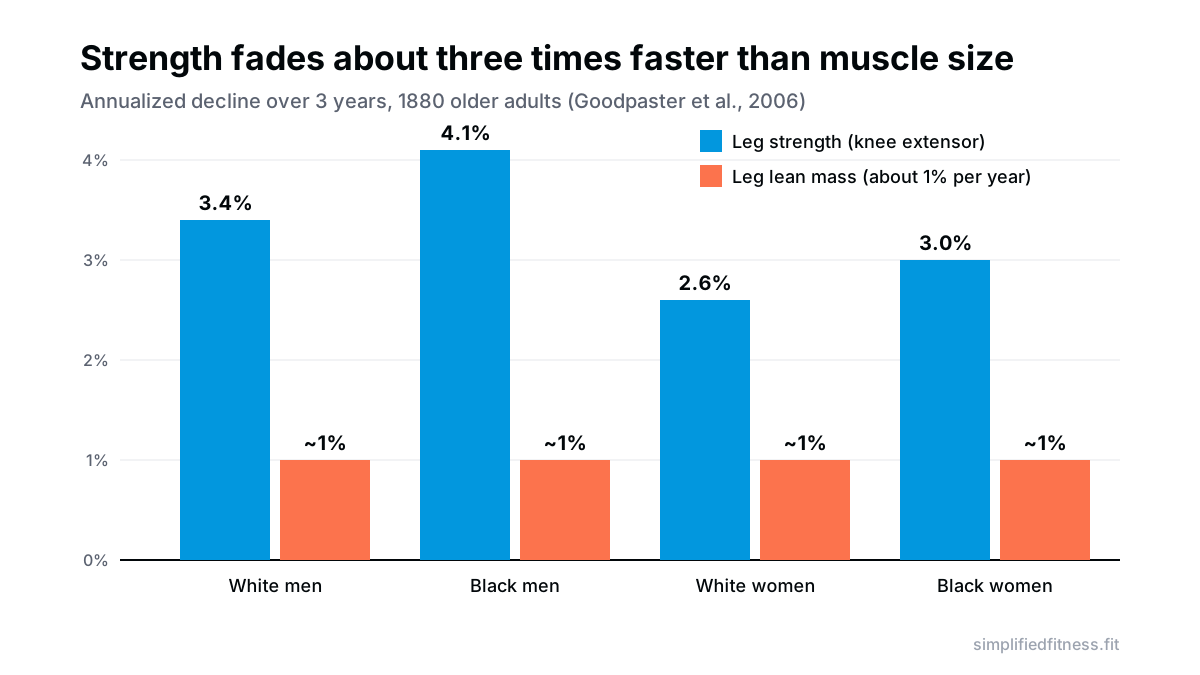
- Strength drops faster than muscle size. In 1,880 older adults, leg strength fell about 2.6-4.1% a year while leg lean mass fell about 1%, so training has to target force, not just size.
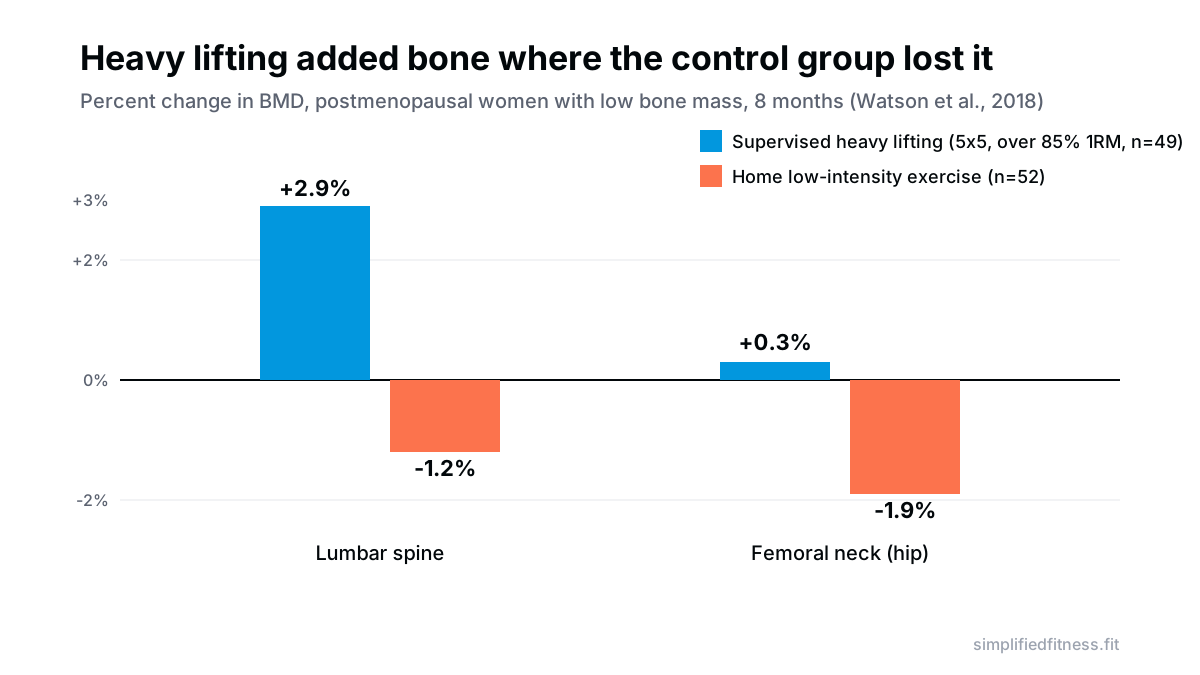
- Heavy, supervised lifting can improve bone density. In the LIFTMOR trial, women with low bone mass who lifted heavy twice a week for 8 months gained lumbar spine BMD (+2.9%) while the comparison group lost (-1.2%).
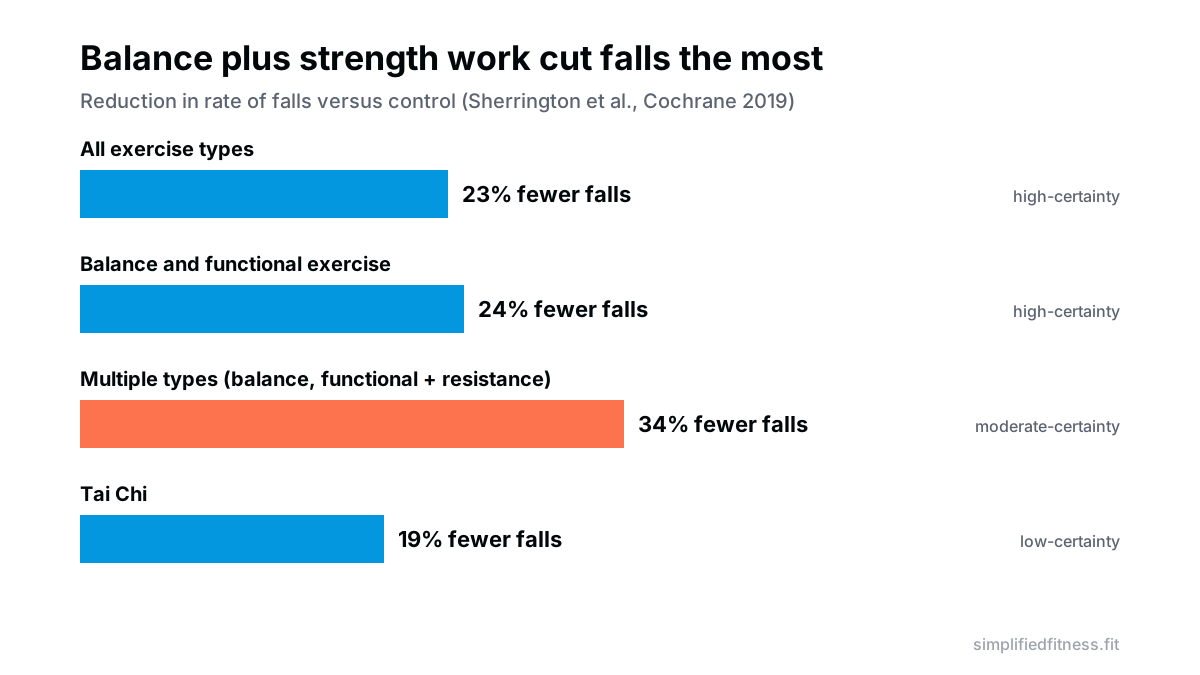
- Exercise cuts falls: a Cochrane review found 23% fewer falls overall, and about 34% fewer when balance, functional and resistance work were combined.
- Start light, learn the movements, add load slowly, and see your doctor first if you have osteoporosis, heart disease, uncontrolled blood pressure, or new pain.
Part of our complete guide: Maximal Strength, Neuromuscular Adaptations & Powerlifting Science for General Lifters
Table of contents
Strength training for older adults is not a nice extra. It is the main tool we have against the slow loss of muscle, strength and bone that makes everyday life harder after 50. The trials are not perfect, and some are short, but they point the same way: lifting, done sensibly, helps you stay strong, steady and independent.
This article is a practical branch of our guide to maximal strength and powerlifting science. Here the goal is not a bigger squat. It is keeping the force you need to climb stairs, get off a low sofa and catch yourself when you trip. If you want a deeper look at joint comfort while lifting, our guide to joint-friendly hypertrophy pairs well with this one.
What are sarcopenia and dynapenia?
Sarcopenia is the age-related loss of skeletal muscle mass. Dynapenia is the age-related loss of muscle strength that is not explained by a nerve or muscle disease (Clark and Manini, 2012). The name comes from Greek words for “poverty of strength”.
They overlap, but they are not the same thing. You can lose strength faster than you lose size, and that is the part people miss.
The best long-term data comes from the Health, Aging and Body Composition Study. Over 3 years in 1,880 older adults, annual leg strength loss was 3.4% in white men, 4.1% in black men, 2.6% in white women and 3.0% in black women. Leg lean mass fell only about 1% a year, so strength declined roughly three times as fast (Goodpaster et al., 2006).
Why strength matters more than most people think
Grip strength is a handy marker. In a 5-year Brazilian cohort of 322 adults aged 60 and over, those with low grip strength and long daily sitting time had a higher risk of death (hazard ratio 2.46, 95% CI 1.01-5.97) than those with neither (Silva et al., 2022). The sample was small and only 55 people died, so the interval is wide. It is an association, not proof that training extends life.
What it does tell you: weak and sedentary is a bad combination. The good news is that both are trainable.
Does strength training for older adults actually slow sarcopenia?
The best summary comes from a 2023 network meta-analysis of 42 randomized trials with 3,728 participants who already had sarcopenia (median age 72.9, 73.3% women, median follow-up 12 weeks). High or moderate certainty evidence showed that resistance exercise, with or without nutrition, and resistance combined with aerobic and balance training gave the biggest quality-of-life gains versus usual care (Shen et al., 2023).
The functional numbers are worth knowing:
- Resistance and balance exercise plus nutrition improved handgrip by 4.19 kg (the minimally important difference is 5 kg)
- Resistance and balance exercise, with or without nutrition, improved gait speed by 0.16 m/s (important change is 0.1 m/s)
- Resistance with aerobic or balance work improved the five-repetition chair stand by 1.72 to 2.28 s (important change is 2.3 s)
Notice the pattern. Gains are real but often sit near the threshold for a change you can feel. Adding nutrition lifted grip strength more than exercise alone, with a similar effect on other function tests.
If protein feels confusing, our guides on protein needs in older adults and overcoming anabolic resistance go deeper. Use the protein calculator for a starting figure.
Can lifting weights improve bone density and osteoporosis risk?
Bone responds to mechanical load. Muscles pull on bone, and heavy loading through the spine and legs gives it a reason to stay dense. The effect in trials is real but modest, so think of it as slowing loss and adding a little, not reversing osteoporosis.
A 2025 meta-analysis of 17 randomized trials (690 postmenopausal women) found resistance training improved bone density at the lumbar spine (SMD 0.88), femoral neck (SMD 0.89) and total hip (SMD 0.30), but not significantly at the trochanter. Subgroups suggested training at 70% of 1RM or more helped the total hip and femoral neck, and three sessions a week helped at all four sites (Zhao et al., 2025). The authors flag high heterogeneity (I2 of 91% and 87% at spine and neck), so the pooled numbers are shaky.
An earlier meta-analysis of 17 trials, all at least 6 months long, also found benefits (SMD 0.54 spine, 0.22 neck, 0.48 hip), but reported the opposite on frequency: fewer than 2 sessions a week gave bigger changes at the spine and hip than 2 or more, and it concluded it could not derive firm exercise recommendations (Shojaa et al., 2020).
Why do these two reviews disagree?
They pooled different sets of trials, split subgroups differently, and both had few studies per subgroup. Frequency also tends to travel with other things, like load and programme length. The cautious takeaway: lift regularly for months, two or three days a week, progress the load gradually, and do not trust any single “optimal” number.
What did the heavy-lifting trial show?
The LIFTMOR trial randomized 101 postmenopausal women with low bone mass (average age 65) to 8 months of twice-weekly, 30-minute supervised heavy lifting (5 sets of 5 reps at over 85% of 1RM) or a home-based low-intensity programme. The lifting group (n=49) improved lumbar spine BMD by 2.9% while the comparison group (n=52) lost 1.2%. Femoral neck BMD changed by +0.3% versus -1.9% (Watson et al., 2018).
Only one adverse event was reported in the lifting group, a minor lower back spasm. The authors also note the women were otherwise healthy and the sessions were highly supervised.
What about men? The bone numbers above are for postmenopausal women, and I have not cited male trials here. Men with low bone density should still talk to their doctor about load and technique.
Can strength training prevent falls?
Balance matters as much as strength when it comes to falls. A Cochrane review of 108 trials with 23,407 community-dwelling people (average age 76, 77% women) found exercise lowered the rate of falls by 23% (rate ratio 0.77, high-certainty evidence) and the number of people who fell by 15% (Sherrington et al., 2019).
Type of exercise mattered. Balance and functional exercises cut the fall rate by 24%. Multiple types, mostly balance and functional work plus resistance, probably cut it by 34% (moderate certainty). Tai Chi may cut it by 19% (low certainty). Exercise may also reduce fall-related fractures (RR 0.73), but that evidence is low certainty.
The review also noted adverse events were mostly non-serious and musculoskeletal, though most trials did not monitor them closely. Start easy so you are not the one reporting a sore knee in week two.
Should older adults train for power, not just strength?
Rate of force development is the ability to produce force quickly, which is what you lean on when you catch a stumble. Power training means lifting the weight fast with intent and lowering it slowly.
A 2022 meta-analysis of 20 trials (566 healthy community-living adults aged 60 and over) found power training was linked to a modest improvement in physical function compared with traditional strength training (SMD 0.30, 95% CI 0.05-0.54), but the evidence was low certainty because of risk of bias and imprecision (Balachandran et al., 2022).
Fast-twitch (type II) fibres are often described as the ones that shrink most with age, which is one reason fast, forceful reps are popular in geriatric research. I would not lean on that claim without direct trial evidence. A better practical rule: build a base first, then add a few crisp, controlled-fast reps. For more on the physiology, see our piece on rate of force development.
How should older adults start strength training?
Here is a simple starting plan. Adjust it with your doctor or a qualified coach. If you already lift and want to tune volume and recovery as you age, our guide for masters lifters over 40, 50 and 60 goes further.
| Element | Starting point | Progression |
|---|---|---|
| Frequency | 2 non-consecutive days a week | Add a third day if recovery is easy |
| Exercises | 6-8 big movements: sit-to-stand or squat, hip hinge, row, press, step-up, carry | Swap in harder variations |
| Sets and reps | 1-2 sets of 8-12 reps | Add a set, then load |
| Effort | Finish with 2-3 reps left in the tank | Move toward 1-2 reps left |
| Tempo | 2 seconds up, 3 seconds down | Add a fast lift for power |
| Balance work | Single-leg stand, heel-to-toe walk | Eyes closed, unstable surface |
Use the RIR and RPE calculator if “reps left in the tank” is new to you, and read our guide to warm-up protocols before the first heavy set.
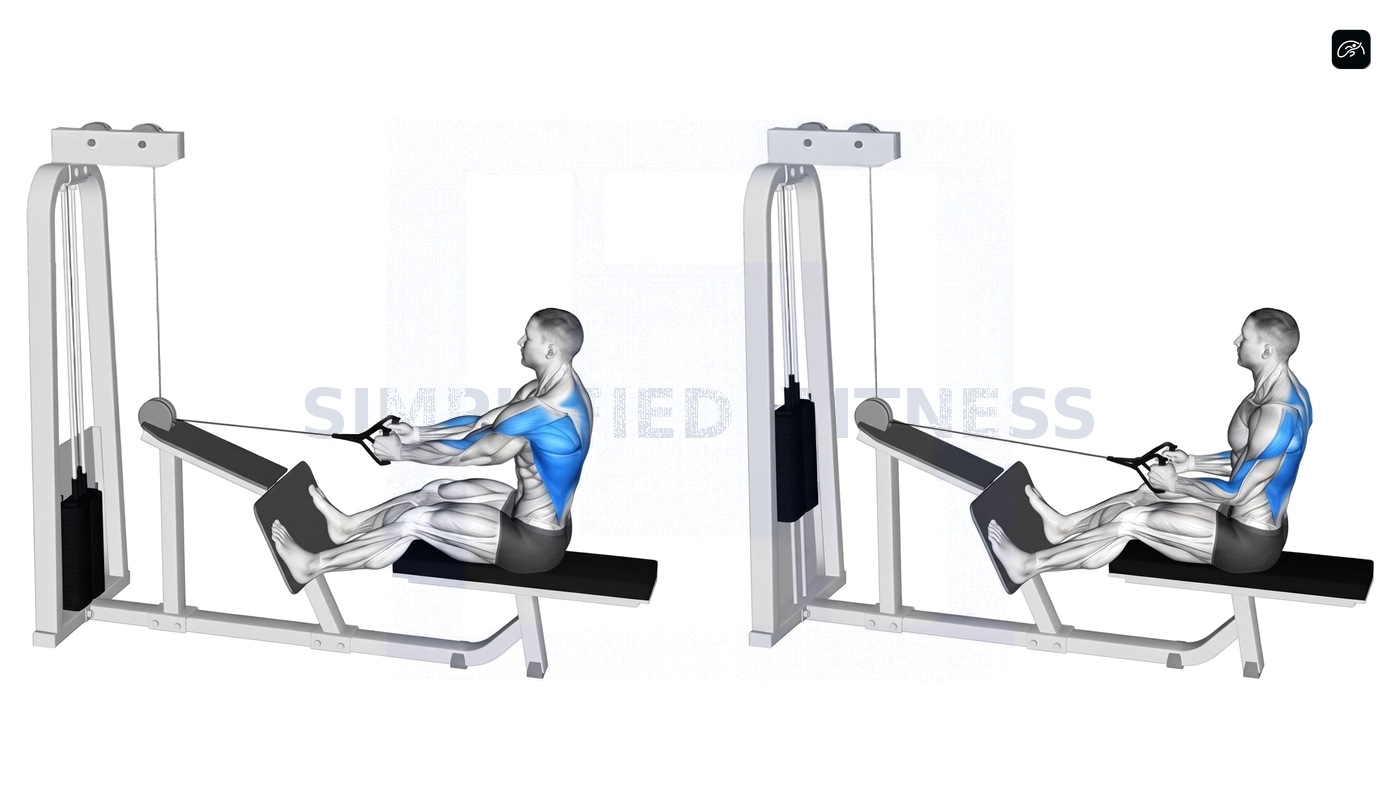
A seated row is a good example of a low-risk movement for a first month: the machine fixes the path, your back is supported and you can add small increments of weight.
What the first 12 weeks can look like
- Weeks 1-3: Learn the movements with light loads. Stop each set well before form breaks
- Weeks 4-8: Add a second set. Increase load by the smallest step you can
- Weeks 9-12: Raise the load and drop reps toward 6-8 on lower body lifts if form is solid
Think months, not weeks. Strength gains in the trials above came over 12 weeks to 8 months.
What to eat and what about the Indian diet?
Protein deserves attention because older muscle tends to respond less to each meal. In the 2023 network meta-analysis, adding nutrition to resistance and balance exercise gave a larger handgrip gain (4.19 kg) than exercise alone (Shen et al., 2023). That trial did not tell you what to eat, but practical Indian options are easy: dal or sambar at two meals, a bowl of curd, 100 g paneer or tofu, eggs if you eat them, soya chunks, or fish. Spread protein across the day rather than loading it all at dinner.
Calcium and vitamin D matter for bones, but I have not cited trials on them here, so ask your doctor about testing and supplements rather than guessing. Our calcium and vitamin D guide covers that side. For more on protein and bones, see high-protein diets and bone mineral density.
Heat is another real factor. In a hot Indian summer, train in the early morning or evening, drink water before and after, and cut a session short if you feel dizzy.
When to see a doctor first
Get medical clearance before starting if you have:
- Chest pain, pressure or unexplained breathlessness
- A heart condition or uncontrolled blood pressure
- Osteoporosis, a previous fracture or a spinal condition
- Dizziness, fainting or poor balance
- New joint pain that does not ease
Stop and seek care if you get chest pain, fainting, sudden severe pain or a new swelling during exercise. This article is education, not a diagnosis, and it cannot replace advice from someone who has examined you.
The practical bottom line
Strength declines faster than muscle size, so training has to target force. Resistance exercise paired with balance work and enough protein has the best-supported results. Bone gains are modest and best seen with supervised, progressively heavy lifting, and fall prevention improves when you combine strength with balance.
If you want a ready structure, try our push, pull and leg day plans and scale the loads down. You do not need a perfect programme. You need to show up twice a week for a long time.
Frequently Asked Questions
Is it too late to start lifting weights at 60 or 70?
No. The trials in this area enrolled people with an average age in the 60s and 70s, and they improved strength and physical function. Muscle and nerves still adapt to load at any age, though progress is usually slower. Start with light loads, get good form coached, and build gradually.
How often should older adults strength train?
Two to three non-consecutive days a week is a sensible target. A 2025 meta-analysis in postmenopausal women found three sessions a week looked best for bone density, but an earlier analysis found fewer than two sessions a week did better at the spine and hip, so the evidence is mixed. Begin with two sessions and add a third once recovery feels easy.
What is the difference between sarcopenia and dynapenia?
Sarcopenia is the age-related loss of muscle mass, while dynapenia is the age-related loss of muscle strength not caused by a nerve or muscle disease. Dynapenia matters because strength can fall faster than size, and nervous system changes seem to play a part. Training that uses heavy-ish loads and fast intent targets both.
Can lifting weights increase bone density after menopause?
Yes, modestly. A 2025 meta-analysis of 17 trials (690 women) found resistance training improved bone density at the lumbar spine, femoral neck and total hip. Heavier loading (70% of 1RM or more) looked more useful at the hip, so progress load carefully and, if you have osteoporosis, ask your doctor first.
Is heavy lifting safe if I have osteoporosis?
It can be, but only with screening and supervision. In the LIFTMOR trial, supervised heavy lifting in women with low bone mass produced one minor adverse event, a lower back spasm. Do not copy that protocol alone at home, and get your doctor or a qualified trainer to set limits, especially for spinal flexion and twisting.
How many reps and sets should a 55 or 65 year old do?
A reasonable start is 1-2 sets of 8-12 controlled reps on 6-8 exercises, ending with 2-3 reps left in the tank. Moderate sets teach technique and are easier on joints than max efforts. As you adapt, add a third set or heavier loads, and a coach can show you how to approach lower rep, heavier work safely.
Do older adults need to lift heavy to get results?
Not at first, but load does matter over time. Bone trials that found benefits often used 70% of 1RM or more (LIFTMOR used over 85%, under close supervision), while many strength gains come from moderate loads taken close to hard effort. Progress when you can finish every set with good form, and never grind through pain.
What is power training and should older adults do it?
Power training means lifting the weight fast with intent and lowering it under control. A 2022 meta-analysis of 20 trials in healthy older adults found a small improvement in physical function over traditional strength training, but the evidence was low certainty. It is a reasonable add-on once you have a base of strength and good form.
Does strength training really prevent falls?
It helps, especially when combined with balance work. The Cochrane review found exercise lowered the rate of falls by 23%, and programmes mixing balance, functional and resistance exercise lowered it by about 34%. Do your strength sessions alongside balance practice such as single-leg stands.
How much protein do older adults need alongside lifting?
Older muscle tends to respond less to each protein meal, so protein intake deserves attention. In people with sarcopenia, adding nutrition to resistance and balance exercise gave the biggest handgrip gains in one network meta-analysis. Spread dal, curd, paneer, eggs, soya or fish across meals, and use our protein calculator for a starting figure.
Can I do strength training at home without a gym?
Yes. Chair sit-to-stands, wall or counter push-ups, resistance bands and a pair of dumbbells or water bottles cover the basics. Load is what drives adaptation, so you need to make it progressively harder over weeks. If you plan to go heavy, a gym with machines is safer than improvised weights.
When should I see a doctor before starting?
See a doctor first if you have chest pain, unexplained breathlessness, uncontrolled blood pressure, a known heart condition, osteoporosis or a past fracture, dizziness, or new joint pain. They can tell you which limits to keep. Stop and get checked if you get chest pain, fainting or sudden sharp pain during a session.
Does grip strength matter for health in older age?
Grip strength is widely used as a simple marker of overall strength. In a 5-year cohort of 322 Brazilian adults aged 60 and over, low grip strength combined with long sitting time carried the highest risk of death. That is an association, not proof grip training extends life, but it is another reason to keep strength training and sit less.
Sources & References
Every claim above is checked against peer-reviewed research (PubMed, U.S. National Library of Medicine) or guidance from established health bodies. How we fact-check.
- Goodpaster BH, et al. The loss of skeletal muscle strength, mass, and quality in older adults: the health, aging and body composition study. J Gerontol A Biol Sci Med Sci. 2006. PMID: 17077199
- Clark BC, et al. What is dynapenia? Nutrition. 2012. PMID: 22469110
- Shen Y, et al. Exercise for sarcopenia in older people: a systematic review and network meta-analysis. J Cachexia Sarcopenia Muscle. 2023. PMID: 37057640
- Zhao F, et al. Optimal resistance training parameters for improving bone mineral density in postmenopausal women: a systematic review and meta-analysis. J Orthop Surg Res. 2025. PMID: 40420105
- Shojaa M, et al. Effects of dynamic resistance exercise on bone mineral density in postmenopausal women: a systematic review and meta-analysis with special emphasis on exercise parameters. Osteoporos Int. 2020. PMID: 32399891
- Watson SL, et al. High-intensity resistance and impact training improves bone mineral density and physical function in postmenopausal women with osteopenia and osteoporosis: the LIFTMOR randomized controlled trial. J Bone Miner Res. 2018. PMID: 28975661
- Sherrington C, et al. Exercise for preventing falls in older people living in the community. Cochrane Database Syst Rev. 2019. PMID: 30703272
- Balachandran AT, et al. Comparison of power training vs traditional strength training on physical function in older adults: a systematic review and meta-analysis. JAMA Netw Open. 2022. PMID: 35544136
- Silva RR, et al. Dynapenia in all-cause mortality and its relationship with sedentary behavior in community-dwelling older adults. Sports Med Health Sci. 2022. PMID: 36600974

Umair Hazrami · Founder & Head Coach, Simplified Fitness
Umair Hazrami founded Simplified Fitness and the Simplified Lifter channel to cut through fitness noise. With 4+ years of consistent training and 10+ coaching clients, he writes every guide from the peer-reviewed research and links the sources so you can check them. Our editorial standards.
Educational content only, not medical advice. If you have a medical condition, are pregnant, or take medication, talk to a qualified doctor before changing your diet, supplements or training. Full disclaimer.
Keep reading
Strength & Cardio
1-Rep Max Testing vs 1RM Formulas: Which Is More Accurate and What Does Each Cost You?
1RM testing vs calculation: how accurate are Epley and Brzycki, when a true max is worth the risk, and a safe protocol if you do test. Studies linked.
9 min read
Strength & Cardio
Accommodating Resistance: Do Bands and Chains Really Match the Squat and Bench Strength Curve?
Accommodating resistance with bands and chains makes the top of a lift heavier. See what trials show on power and strength, and how to set it up safely.
9 min read
Strength & Cardio
Competition Bench Press Technique: Arch, Leg Drive, Lats and Bar Path Explained
Competition bench press technique explained: scapular setup, leg drive, lat tension, bar path and pause commands, plus what the research does and does not show.
10 min read
Strength & Cardio
Conventional vs Sumo Deadlift: Which Suits Your Hips, Limbs and Back?
Conventional vs sumo deadlift biomechanics: what the studies show on muscle demand, bar path and back load, plus a simple test to pick the style for your body.
10 min read