1-Rep Max Testing vs 1RM Formulas: Which Is More Accurate and What Does Each Cost You?
1RM testing vs calculation: how accurate are Epley and Brzycki, when a true max is worth the risk, and a safe protocol if you do test. Studies linked.
TL;DR. The short answer
- A true 1RM test is repeatable: a 2020 systematic review of 32 studies found a median test-retest CV of 4.2%. It is the reference standard, not a guess.
- Rep-based formulas (Epley, Brzycki) work best from sets of about 10 reps or fewer, and for most people a hard set of 3-5 reps gives a usable estimate. Expect an error of a few percent, not a perfect number.
- The popular claim that estimates land 'within 1-3%' is too tidy. Accuracy varies by lift, person and reps, so treat an estimate as a working number and round down.
- Direct evidence on how long a max attempt leaves you fatigued is thin. The popular '7-10 days' figure is not backed by the studies we found, so judge recovery by performance and how you feel.
- Test a true max only when there is a reason (a meet, a benchmark, a coach's request), with a proper warm-up, few attempts and safety setup.
Part of our complete guide: Maximal Strength, Neuromuscular Adaptations & Powerlifting Science for General Lifters
Table of contents
For most lifters, 1RM testing vs calculation is not a fair fight: a hard set of 3-5 reps run through a formula gets you a usable number at a fraction of the effort and risk. A true max test is more direct and, when repeated, quite reliable. It just rarely needs to be your default.
This article sits under our maximal strength and powerlifting science guide and covers the testing side: how accurate the formulas really are, what a max attempt costs, and how to do one sensibly when you need it.
One thing up front. You will often see claims that estimates land “within 1-3%” of a true max, and that a max attempt wipes you out for 7-10 days. We looked for the studies behind both and could not verify either number. The honest picture is messier, and more useful.
Is a true 1RM test actually reliable?
Yes, and this surprises people who assume a max is a noisy, mood-dependent number.
A 2020 systematic review pooled 32 studies (1,595 participants) on test-retest reliability. Intra-class correlations had a median of 0.97, and the median coefficient of variation (CV) was 4.2%, with individual studies ranging from 0.5% to 12.1%. The authors concluded the test has good to excellent reliability regardless of training experience, number of familiarization sessions, exercise, body region, sex or age (Grgic et al., 2020).
So if you test twice under similar conditions, you will usually land close to the same number. A median CV of 4.2% on a 150 kg squat is roughly 6 kg of day-to-day wobble. That is the “noise floor” every other method gets compared against.
How do 1RM formulas work?
Every rep-based formula rests on one observation: as the reps you can do at a weight go up, the weight you can lift for one rep goes down in a fairly predictable way. Do a hard set, count the reps, and work backwards.
The two you will meet most often:
| Formula | Equation | Notes |
|---|---|---|
| Epley | weight x (1 + reps / 30) | Simple, tends to give higher values at low reps |
| Brzycki | weight x 36 / (37 - reps) | Becomes unstable above about 10 reps |
| Wathan | 100 x weight / (48.8 + 53.8 x e^(-0.075 x reps)) | Curved fit, lands close to Epley at 3-8 reps |
Here is the same set run through both of the first two, as a worked example with a 100 kg bar:
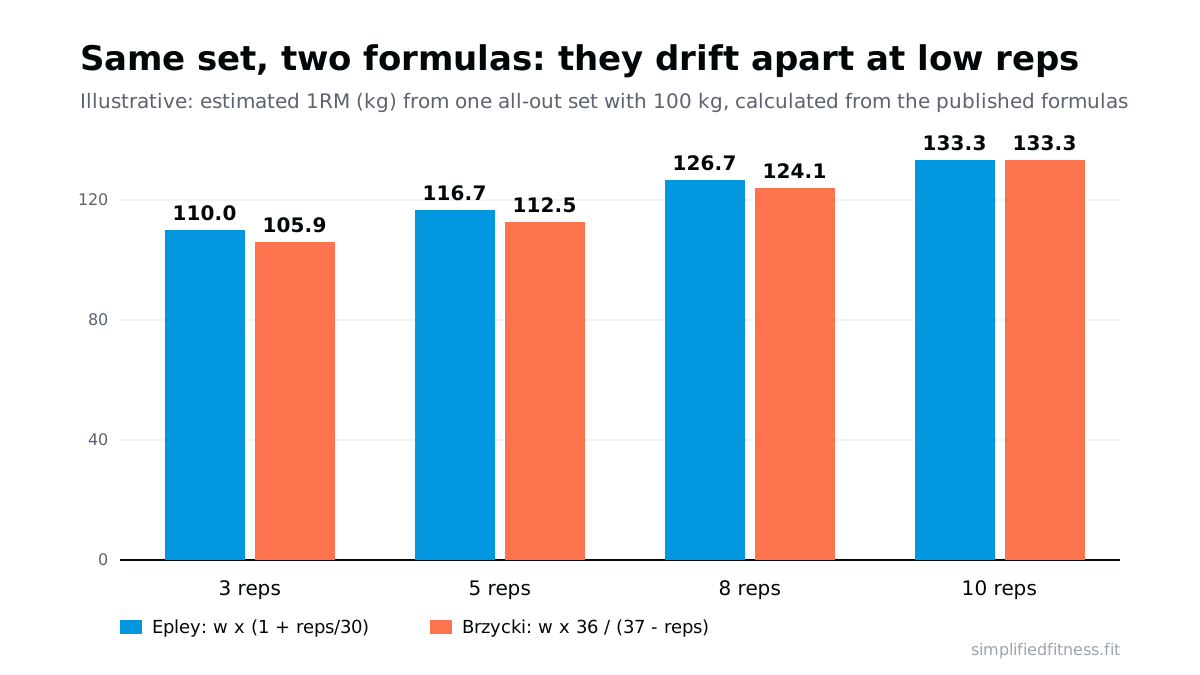
Notice what this says. At 3 reps, Epley gives 110 kg and Brzycki 105.9 kg. Same set, same lifter. Neither is “wrong”. They are different curves fit to different data, which is why comparing your number to someone else’s calculator output is pointless.
You can run your own numbers in our free 1RM calculator.
How accurate are Epley and Brzycki?
Less exact than the internet suggests, but good enough for programming.
In a study of 220 men across several groups (untrained students, resistance-trained students, wrestlers, soccer and football players, and middle-aged trained men), six relative-endurance equations correlated with measured bench 1RM at r = 0.82 to 0.98. For sets of 10 reps or fewer, three equations significantly overpredicted and two significantly underpredicted, and the Brzycki equation was the most accurate. The authors cautioned that averaging two equations might reduce error (Mayhew et al., 1995).
A study in 70 adults aged 18-69 compared 1, 5, 10 and 20RM on the chest press and leg press. Prediction accuracy was best from the 5RM (R-squared of 0.993 on the chest press and 0.974 on the leg press), and the authors advised using no more than 10 reps in linear equations (Reynolds et al., 2006).
So where does “1-3%” come from? Probably from correlation values being misread as percentage error. A high correlation says the ranking of lifters is preserved. It does not say each person’s estimate is within 3% of their max. The same Reynolds study reported a standard error of about 3 kg on the chest press and about 16 kg on the leg press, in absolute terms. That is a useful reminder that error scales with the lift and with the person.
Do formulas work the same for women, trained lifters and different exercises?
Broadly yes, with caveats.
In 103 young women, bench press 1RM and repetitions to fatigue were measured before and after 12 weeks of training. 1RM rose 28% on average, but prediction equations were more accurate in both conditions when fewer than 10 reps were used. The authors concluded that training may alter the strength-endurance relationship without compromising the accuracy of predicting maximal strength (Mayhew et al., 2008).
For exercise choice, a 2024 meta-regression pooled 952 repetitions-to-failure tests from 7,289 people. It found little influence of sex, age or training status on how many reps are possible at a given percentage of 1RM, but more reps were possible on the leg press than on the bench press across the loading range (Nuzzo et al., 2024). The authors noted that more data are needed for other exercises, and that includes the squat and deadlift.
That last point matters for powerlifters. Most formula validation is bench and leg press. On squat and deadlift, the estimate is usually fine, but hold it a bit more loosely.
In the gym, the most common mistake is feeding a formula a “set of 5” where the last two reps were grinders with the hips shooting up or the bar bouncing off the chest. Count only reps you would show a judge.
What about velocity-based 1RM estimates?
Bar-speed devices are popular, so it is fair to ask whether they beat a simple rep formula. The evidence says not clearly.
A 2023 systematic review and meta-analysis of load-velocity 1RM prediction (26 studies, 20 with data in the meta-analysis, 434 participants) found moderate predictive validity, with a pooled standard error of the estimate of 9.8% (95% CI 7.4% to 12.2%). Predictions tended to overestimate, by about 4.5 kg or 3.7% of measured 1RM. The authors recommended direct 1RM assessment wherever possible, while allowing that velocity estimates may help with trend monitoring (Greig et al., 2023).
A 2024 study in 16 recreationally trained people reached a similar conclusion for the free-weight bench press. Most load-velocity regression equations were less accurate than an actual 1RM test, and including more loads, from light (around 20% 1RM) to heavy (80-90%), improved accuracy (Cabarkapa et al., 2024).
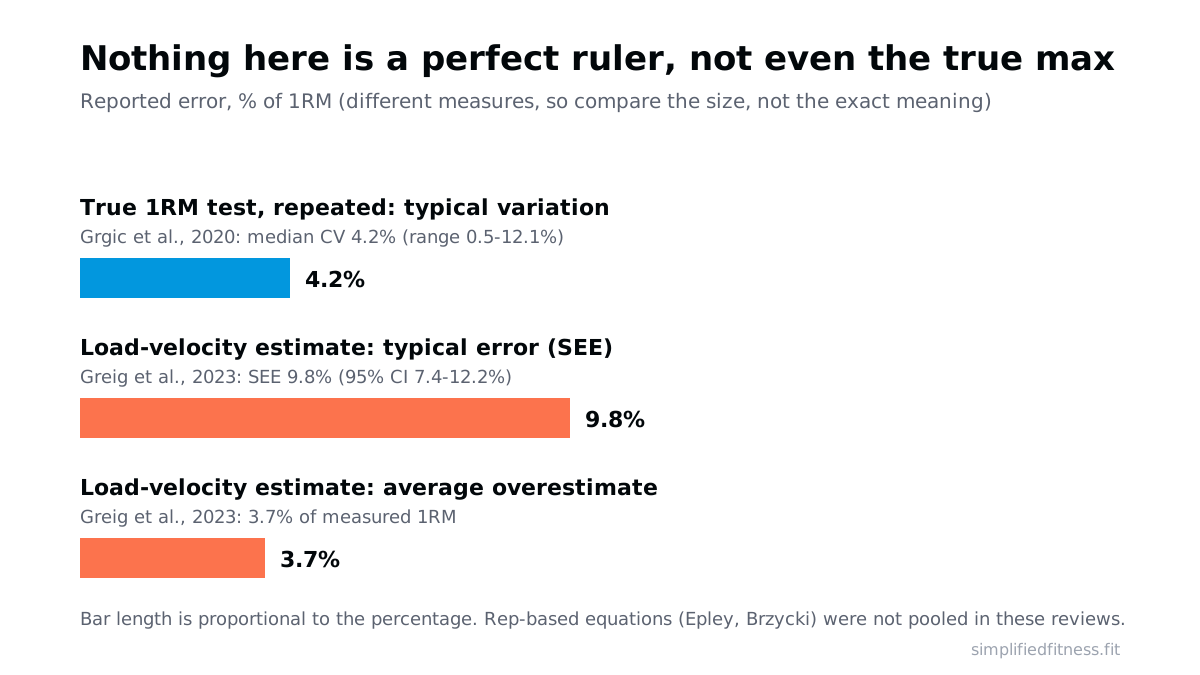
If you do not own a sensor, you are not missing anything essential.
What is the fatigue cost of 1RM testing?
This is the part of the question we can answer least firmly, so let’s be straight about it.
A near-max single is neurologically and mentally demanding, and anyone who has missed a heavy attempt knows a max day can feel flat afterwards. But we searched for controlled studies that tracked how long performance stays depressed after a true 1RM test in trained lifters, and did not find one we could verify. The popular claim of “7-10 days of systemic nervous fatigue” is not supported by a source we could check, so we are not repeating it as fact.
What we can say with more confidence:
- A max attempt is a high-effort, low-rep set. Total volume is small, so it is a very different stress from a long, hard training session.
- Powerlifters rated their 1RM attempts at about 9.6-9.7 on the RPE scale across squat, bench and deadlift (Helms et al., 2017). That is near-limit effort by definition.
- More attempts means more accumulated fatigue and more exposure. Keeping the attempt count low is the one lever fully in your control.
Individual response will vary with training age, the lift, sleep, food and stress. If you have just tested, keep your next session or two lighter and let performance, not a calendar, decide when to push again.
When is a true 1RM test worth it?
A true test makes sense when you need the real number, or when the lift itself is the goal.
- A meet is coming. You need to pick openers and know what you can do.
- A benchmark you care about. A once-or-twice-a-year check on a lift you want to track.
- A coach or programme asks for it. Some percentage-based programmes assume an accurate max.
- You are returning after a long break. Be cautious here: your old number is probably stale, so start well below it.
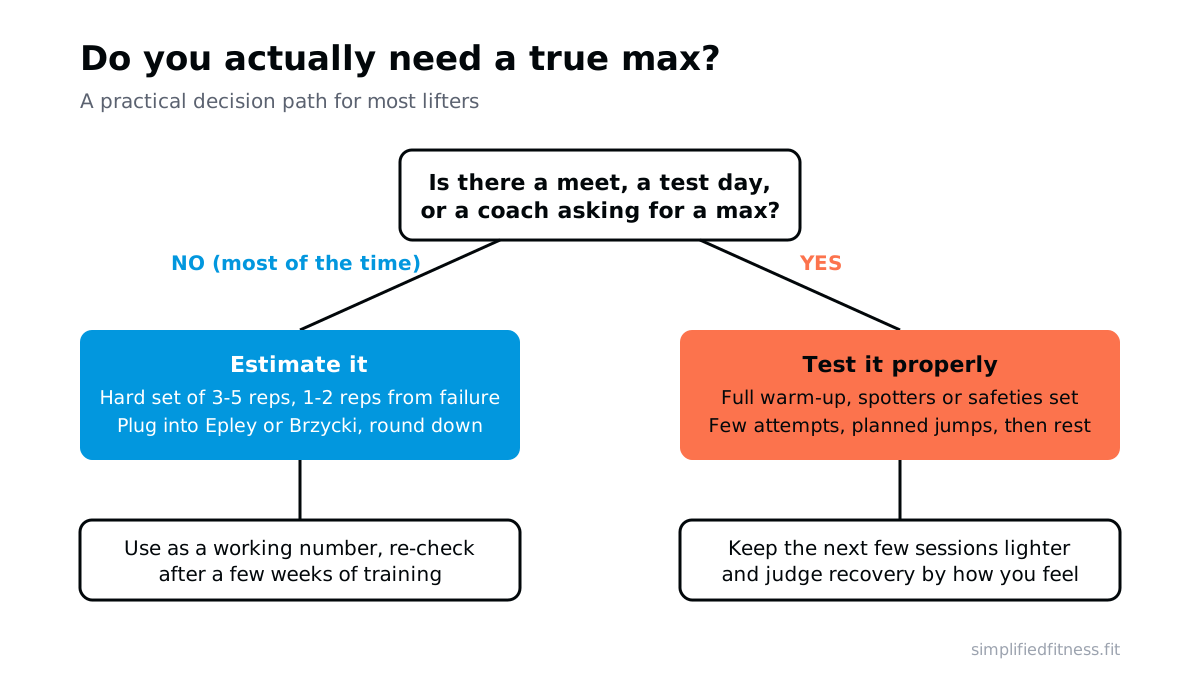
For everything else (a hypertrophy block, general strength, working out how heavy to go on Tuesday), a 3-5 rep set or an RIR-based top set does the job. Our guides on the RIR and RPE scale and on RPE-based top singles and back-off sets show how to train off effort instead of a fixed max. And if you wonder how well people judge effort, see how accurately lifters gauge RIR.
How to test a 1RM more safely
We did not find injury-rate data specific to 1RM tests in the studies we checked, so this is practical coaching advice rather than a research-proven protocol. The aim is to get an accurate number with as few heavy attempts as possible.
- Pick the lift and keep conditions steady. Same bar, same time of day, same footwear and equipment as your previous test.
- Warm up in a climbing sequence. Start with the empty bar, then climb in steps with fewer reps as the weight rises: for example 5 reps, 3 reps, 2 reps, then singles at roughly 70%, 85% and 92% of your best guess.
- Rest properly between heavy attempts. Several minutes, not 90 seconds.
- Plan the jumps before you start. Smaller jumps as you near the limit. Guessing in the moment is how people take a 10 kg jump they should not.
- Cap it at about three max attempts. A fourth and fifth attempt are where technique tends to degrade.
- Set up safety. A spotter, or safety arms in the rack for squat and bench. Learn how to bail before you need to.
- Stop when form breaks. A grinder with a rounded back is not a PR, it is a risk.
Mental readiness matters more than people admit. Our piece on psychological readiness and arousal for max lifts covers the head side, and if you are building toward a meet, see the peaking and tapering guide.
Health note: if you have a heart or blood-pressure condition, are recovering from injury, or feel chest pain, dizziness or sharp joint pain when lifting heavy, see a doctor before testing maxes. Straining under maximal loads raises blood pressure, and this is a case where a number on a calculator is the better choice.
A realistic everyday workflow
Here is a simple way to combine both methods without overthinking it.
Week to week: do your normal top set at a load that leaves 1-2 reps in the tank. Log the reps. Once a month, run that set through your formula of choice and note the trend.
Every 6-12 weeks: do a 3-5 rep hard set on the main lifts and re-estimate.
Once or twice a year, or for a meet: test a true max.
If you train in an Indian commercial gym with crowded racks and no safety arms, this matters even more. When nobody is around to spot, the 3-5 rep set is the better choice almost every time. And if you want a ready-made structure to run these sets in, our free push, pull and leg day plans are a starting point.
Frequently Asked Questions
Is it better to test your 1RM or calculate it?
For most lifters, calculating is better most of the time, and testing is for when a true number is needed. A true 1RM is the reference standard and is reliable when repeated, but it costs more effort and carries more risk than a 3-5 rep set. Use a formula for regular programming and test only for a meet, a benchmark or a coach's request.
How do I calculate my 1 rep max?
Do a hard set of 3-5 reps, then use a formula such as Epley (weight x (1 + reps/30)) or Brzycki (weight x 36 / (37 - reps)). Both rest on the idea that the load you can lift falls in a predictable way as reps rise, and the estimate is more stable from lower reps. Our free 1RM calculator does the maths, and you should round the result down slightly.
Which is more accurate, Epley or Brzycki?
Neither wins every time. In a study of 220 men on the bench press, the Brzycki equation was the most accurate for sets of 10 or fewer reps, though several other equations over- or under-predicted. Pick one, use it consistently, and compare against yourself rather than against someone else's number.
How many reps give the most accurate 1RM estimate?
Fewer reps are generally better. A study of 70 adults found 5RM data gave the best prediction accuracy, and the authors advised using no more than 10 reps in linear equations for the chest press and leg press. Aim for a hard 3-5 rep set when you want an estimate.
Why is my estimated 1RM higher than what I can actually lift?
Formulas are built on average data, so any individual can land above or below the line. Some people hold reps better than average at a given percentage, and technique, fatigue and grinding sets all change the result. If you miss your estimate, trust the bar and adjust your working number downward.
Are 1RM calculators accurate for squat and deadlift?
They are usable, but most validation data comes from bench press and leg press, so be more cautious on the squat and deadlift. A meta-regression found more reps are possible on the leg press than on the bench press at the same percentage of 1RM, which shows exercise choice changes the relationship. Treat squat and deadlift estimates as approximate and re-check with a heavier set.
How long does it take to recover from a 1RM test?
There is no single proven number. We did not find a good study that tracked recovery after a true 1RM test in trained lifters, and the often-quoted '7-10 days' figure is not supported by sources we could verify. Recovery depends on how many attempts you took, the lift, and how you slept and ate, so watch your next sessions rather than the calendar.
How many attempts should a 1RM test take?
Keep it short: a few warm-up singles that climb in planned jumps, then roughly three attempts at the true max. The reliability review found 1RM tests were reliable with or without separate familiarization sessions, so you do not need a long run-up of practice days to get a valid number. Fewer attempts also means less accumulated fatigue and less exposure to heavy loads.
Is testing 1RM dangerous?
It is a heavier, higher-stakes set than most training, so risk is real but manageable. We did not find injury-rate data for 1RM tests in the studies we checked, so we cannot give a figure. Use safeties or a spotter, a full warm-up, and stop if technique breaks down.
How often should I test my 1RM?
Most lifters need a true test only a few times a year, if at all. Between those, estimate from a hard 3-5 rep set or an RIR-based top set, which costs far less. If you are not peaking for a meet, a re-check every 6-12 weeks is plenty.
Can beginners use a 1RM calculator?
Yes, but with caution. A study in 103 young women found that bench 1RM rose 28% over 12 weeks of training, so a beginner's number goes stale quickly. Re-estimate every few weeks and do not chase the old number.
Do velocity-based estimates beat rep-based formulas?
Not clearly. A 2023 meta-analysis found load-velocity estimates had moderate validity and tended to overestimate 1RM, and a 2024 study found most load-velocity equations were less accurate than an actual bench 1RM test. They can still be useful for tracking trends if you own a bar sensor, but they are not a free upgrade.
Should I use RPE or RIR instead of a 1RM?
For many lifters, yes. Powerlifters in one study rated 1RM attempts at about 9.6-9.7 on the RPE scale, and RPE tracked percentage of 1RM closely (r = 0.88-0.91), so effort ratings can stand in for exact percentages. Learn the scale in our RIR and RPE guide and use a top set instead of a max.
Sources & References
Every claim above is checked against peer-reviewed research (PubMed, U.S. National Library of Medicine) or guidance from established health bodies. How we fact-check.
- Grgic J, et al. Test-Retest Reliability of the One-Repetition Maximum (1RM) Strength Assessment: a Systematic Review. Sports Med Open. 2020. PMID: 32681399
- Mayhew JL, et al. Muscular endurance repetitions to predict bench press strength in men of different training levels. J Sports Med Phys Fitness. 1995. PMID: 7500624
- Reynolds JM, et al. Prediction of one repetition maximum strength from multiple repetition maximum testing and anthropometry. J Strength Cond Res. 2006. PMID: 16937972
- Mayhew JL, et al. Accuracy of prediction equations for determining one repetition maximum bench press in women before and after resistance training. J Strength Cond Res. 2008. PMID: 18714230
- Nuzzo JL, et al. Maximal Number of Repetitions at Percentages of the One Repetition Maximum: A Meta-Regression and Moderator Analysis of Sex, Age, Training Status, and Exercise. Sports Med. 2024. PMID: 37792272
- Greig L, et al. The Predictive Validity of Individualised Load-Velocity Relationships for Predicting 1RM: A Systematic Review and Individual Participant Data Meta-analysis. Sports Med. 2023. PMID: 37493929
- Cabarkapa DV, et al. Are Load-Velocity Estimates of Bench Press Maximal Strength as Accurate as Actual 1-Repetition Maximum Testing? J Strength Cond Res. 2024. PMID: 39074242
- Helms ER, et al. RPE and Velocity Relationships for the Back Squat, Bench Press, and Deadlift in Powerlifters. J Strength Cond Res. 2017. PMID: 27243918

Umair Hazrami · Founder & Head Coach, Simplified Fitness
Umair Hazrami founded Simplified Fitness and the Simplified Lifter channel to cut through fitness noise. With 4+ years of consistent training and 10+ coaching clients, he writes every guide from the peer-reviewed research and links the sources so you can check them. Our editorial standards.
Educational content only, not medical advice. If you have a medical condition, are pregnant, or take medication, talk to a qualified doctor before changing your diet, supplements or training. Full disclaimer.
Keep reading
Strength & Cardio
Accommodating Resistance: Do Bands and Chains Really Match the Squat and Bench Strength Curve?
Accommodating resistance with bands and chains makes the top of a lift heavier. See what trials show on power and strength, and how to set it up safely.
9 min read
Strength & Cardio
Competition Bench Press Technique: Arch, Leg Drive, Lats and Bar Path Explained
Competition bench press technique explained: scapular setup, leg drive, lat tension, bar path and pause commands, plus what the research does and does not show.
10 min read
Strength & Cardio
Conventional vs Sumo Deadlift: Which Suits Your Hips, Limbs and Back?
Conventional vs sumo deadlift biomechanics: what the studies show on muscle demand, bar path and back load, plus a simple test to pick the style for your body.
10 min read

Strength & Cardio
Daily Undulating Periodization (DUP) for Concurrent Strength and Hypertrophy
A powerbuilding program with DUP: heavy, moderate and volume days in one week, with the research, a 12-week template and a rule for ordering lifts.
8 min read