Low-Bar Squat Biomechanics: Bar Placement, Torso Lean and Hip Drive
Low bar squat technique guide: where the bar sits, how much to lean, how wide to stand and how to drive with your hips, with the research on why it moves more.
TL;DR. The short answer
- The low-bar squat puts the bar on the rear delts and upper back, a few centimetres below the high-bar spot. That moves the load further behind your hips, so you lean forward more and the hips do more of the work.
- In trained lifters the low bar tends to shift load from the knees to the hips. One study found hip moments of 324 Nm in low-bar powerlifters versus 230 Nm in high-bar weightlifters, though these were different people.
- Low-bar squats allowed slightly heavier 3RM loads in some studies (about 3% in one), but a 2024 study found no difference once stance was standardised. Expect a small edge at most, not a guaranteed 5-10%.
- Torso lean is not a flaw here. Research suggests hip-dominant squatting appears once the trunk leans more than the shin does, so aim for a consistent, balanced-over-mid-foot lean.
- If low-bar hurts your shoulders, elbows or wrists, the high bar is a legitimate alternative. Pain that persists is a reason to see a physio or doctor.
Part of our complete guide: Maximal Strength, Neuromuscular Adaptations & Powerlifting Science for General Lifters
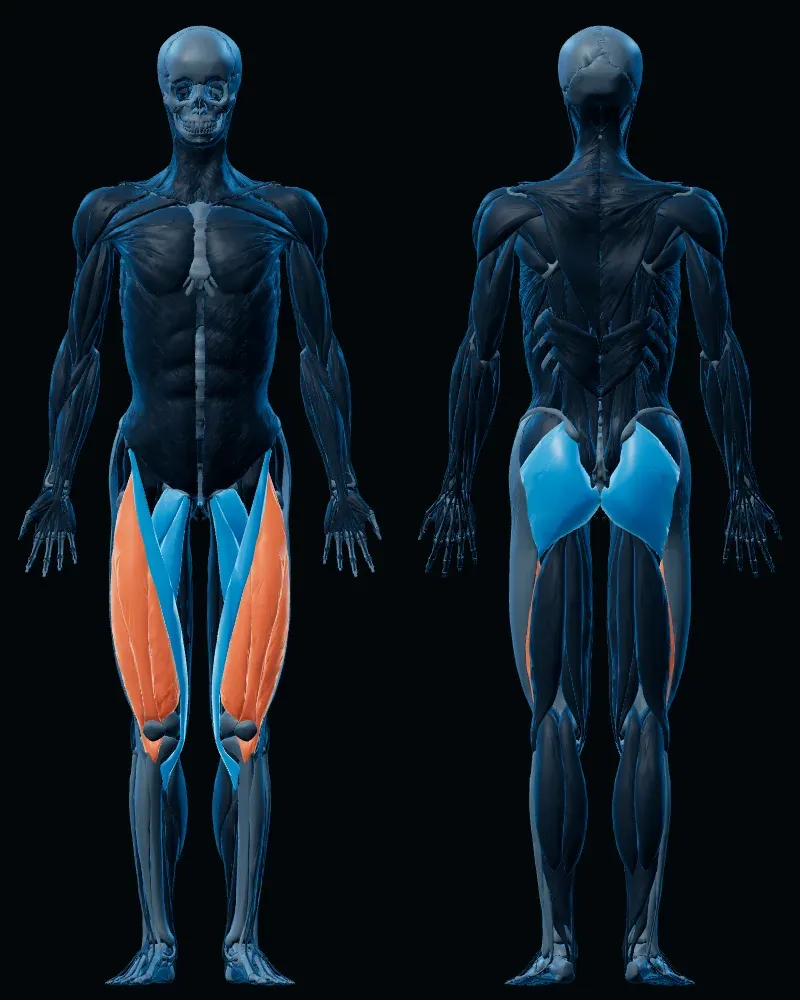
Muscles worked: quads
Main movers: rectus femoris and the three vasti
Assisting: adductors, sartorius and glutes
Table of contents
This low bar squat technique guide starts with one idea: the bar goes lower on your back, so your hips do more of the work. That is the whole trade. You accept a bigger forward lean and a more demanding setup, and in return the hips (glutes, adductors, hamstrings, spinal erectors) share more of the load with your quads.
Does that mean you will squat 10% more? Probably not, and we will go through the studies so you can see why. For the full strength picture, see our maximal strength and powerlifting science guide. If you only want the side-by-side comparison with the high bar, we cover that in high-bar vs low-bar squat biomechanics. This article is about execution: how to actually set up and perform the lift.
What is a low-bar squat, and what changes?
In the high-bar squat, the bar rests on the upper trapezius. In the low-bar squat, it sits lower, across the rear delts and the upper back. That small shift changes where the load acts relative to your hips and knees.
A review of the research describes the knock-on effects. The high-bar squat shows more knee flexion, less hip flexion, a more upright torso and a deeper squat. The low-bar squat shows more hip flexion and therefore a greater forward lean. Both strategies are ways of keeping your center of mass over your base of support (the middle of your foot) so you do not fall over (Glassbrook et al., 2017).
Think of it as balance first, muscle second. The bar is heavy and it sits behind you, so your torso tips forward to counterbalance it. The bar and your body together need to stay over mid-foot.
Why does the bar position shift load to the hips?
Joint “moment” is just torque: the weight times the horizontal distance from the joint. A more horizontal torso with the bar further behind the hips means a longer lever at the hip, so the hip extensors work harder. The knee, meanwhile, can stay a bit further back.
The classic data shows this. When national-class powerlifters used low-bar squats and national-class weightlifters used high-bar squats at 65% of their 1RM, the powerlifters’ mean peak hip moment was 324 Nm at deep depth, compared with 230 Nm for the weightlifters. At the knee, it was the other way round: 139 Nm for the powerlifters versus 191 Nm for the weightlifters (Wretenberg et al., 1996).
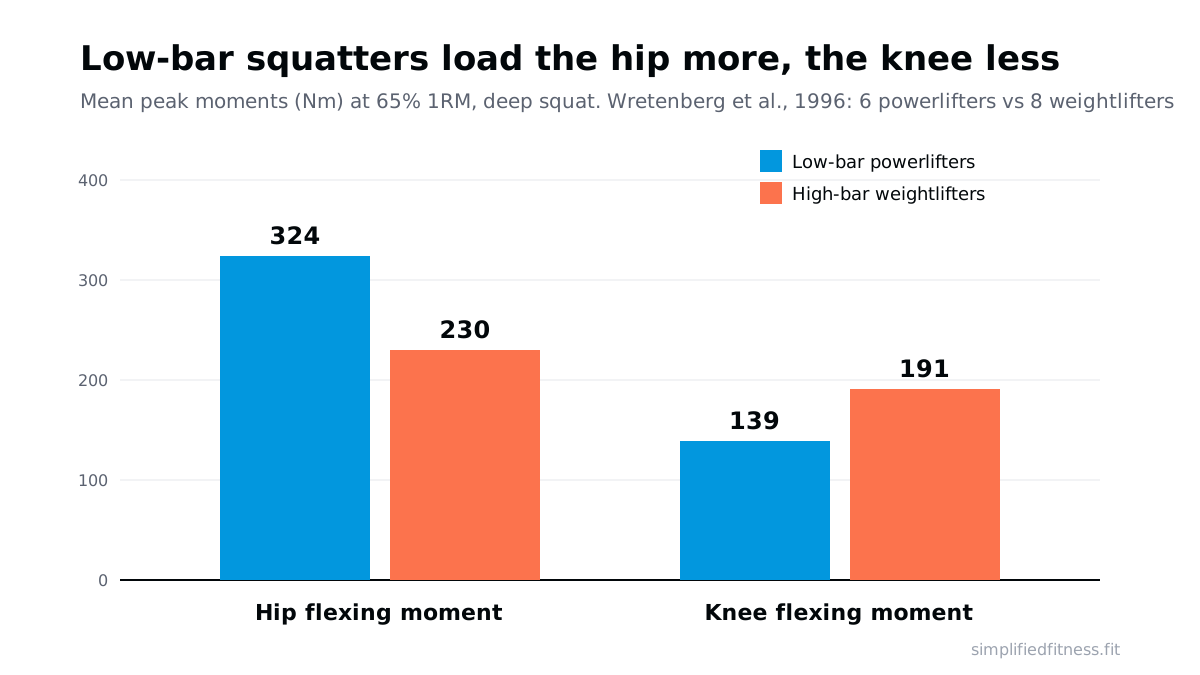
A caution: these were two different groups of athletes, not the same people switching bars. Their training history, limb proportions and depth differ too. It fits the story, but it does not prove the bar alone caused the difference.
A more recent study put it in numbers you can use. It found that the hip-to-knee moment ratio was driven mainly by the difference between trunk and shin inclination. When the trunk was inclined more than the shin by about 2.2 degrees or more, squatting became hip-biased. Average hip-to-knee ratios ranged from about 0.3 in knee-dominant squats to about 2.2 in highly hip-dominant squats, in 16 healthy people (Straub et al., 2025).
In plain gym terms: if your torso is more upright than your shins, the knees do more of the work. If the two are roughly parallel, the load is shared fairly evenly. If your torso leans noticeably more than your shins, the hips take over, which is where a low-bar squat usually lives.
How to find the bar position (rear delts and upper back)
This is where most people go wrong. The bar should not sit on the bone at the base of your neck, and it should not perch on soft tissue and slide.
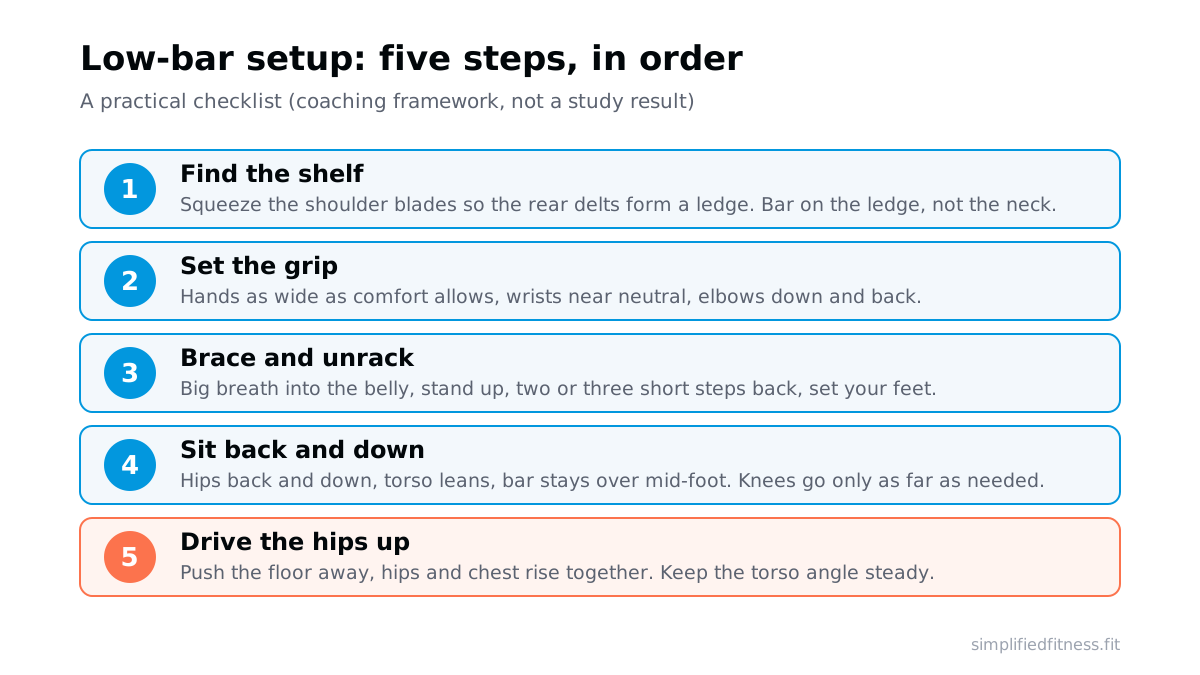
- Grab the bar with both hands and duck under it. Place it roughly across the middle of your upper back.
- Pull your shoulder blades together and down. This tightens the upper back and creates a shelf of muscle (rear delts and traps) for the bar to rest on.
- Lock the bar in. It should feel like a firm bar-on-muscle contact, not a pinch on the spine.
- Check it with a light set. If the bar rolls toward your neck on the way down, it is too high. If it slides down your back as you lean, it is too low or your upper back is not tight.
Grip, wrists and elbows without the pain
The low-bar position pulls the shoulders into more external rotation, and a narrow grip can turn into elbow and wrist pain. We do not have good controlled trials on wrist pain with different grips, so what follows is standard coaching practice, not a research finding.
- Widen your hands until your wrists are close to neutral and your shoulders are comfortable.
- Let the bar sit on your back, not in your palms. Hands are there to keep the bar from moving, not to hold it up.
- Point your elbows down and back, not straight up.
- Use a thumbless or thumb-over grip, whichever lets your wrists stay straighter.
- Warm up your shoulders and triceps with a few arm circles or band pull-aparts.
If a wide grip is still painful, a high-bar or safety-bar squat is a reasonable fallback. Persistent elbow, wrist or shoulder pain is not something to push through. See a physio or doctor if it does not settle.
Torso lean and balance: keep the bar over mid-foot
Your center of mass, with the bar, should stay over the middle of your foot. If it drifts toward your toes, you will feel your weight shift forward and your heels try to lift. If it drifts to your heels, you will fall back.
A good visual check: film from the side and watch the bar. It should travel in a roughly vertical line over mid-foot. The simplest way to keep it there is to sit back and down at the same time. Hips go back, torso leans, knees travel forward only as far as they need to.
The most common mistake here is “chasing” an upright chest. Trying to stay upright with a low bar fights the lever you are trying to use, and it usually ends with the bar sliding down your back.
Hip drive: how to come out of the hole
“Hip drive” sounds mystical, but it is simple. The hips and chest should rise together. The common mistake is letting the hips shoot up while the chest stays low, which turns the lift into a good morning and shifts the load to your lower back.
Cues that tend to work:
- Push the floor apart and away, as if spreading it with your feet.
- Lead with your chest and hips together. Think of the chest rising at the same rate as the hips.
- Keep your upper back tight. It holds the bar in place and keeps the torso angle from changing.
- Drive up without changing your lean. A big change in angle halfway up usually signals a weakness. Our guide to fixing sticking points in squat, bench and deadlift goes through the common causes.
Bracing matters here. A big breath into the belly before you descend helps keep the trunk stiff under the bar. We go deeper in our guide to intra-abdominal pressure and the Valsalva maneuver.
Which muscles work harder in a low-bar squat?
The glutes, adductors and spinal erectors are the main ones. The review mentioned above found greater activity of the erector spinae, adductors and gluteal muscles in the low-bar squat, and greater quadriceps activity in the high bar (Glassbrook et al., 2017).
Here is where it gets nuanced. A 2021 study of 18 lifters found that a high-bar narrow stance gave greater knee contributions, higher vastus lateralis and lower gluteus maximus activity, while a low-bar wide stance gave larger hip contributions (Larsen et al., 2021). So stance width is a lever as well as bar position.
And a 2024 study of 12 recreationally trained men found no significant differences in net joint moments, muscle forces or muscle-specific moments between high and low bar when stance width was standardized. The authors concluded that barbell placement plays a minor role and that choice should come down to comfort (Larsen et al., 2024).
Why the disagreement? Different participants and training backgrounds, standardized or free stance, and modelled muscle forces versus measured EMG. The practical takeaway: the low bar is a tool that may shift emphasis to the hips, especially in lifters who have practiced it. In people new to the position, the difference may be smaller.
Stance width for low-bar squats
Stance width alters the hip-to-knee balance on its own. In 14 amateur rugby athletes squatting to femur-parallel depth, a wide stance (1.5 times trochanter width) produced higher hip-to-knee extension moment ratios than a narrow stance (1 times) (Lahti et al., 2019).
For a low-bar squat, a stance around shoulder width to slightly wider, with toes turned out about 15-30 degrees, is a common starting point (this is practical guidance, not a study result). Then adjust:
- Knees caving or heels lifting? Widen a bit or turn toes out a bit more.
- Hips pinching at the bottom? Try a slightly wider stance and more toe-out.
- Leaning too far? A slightly narrower stance can shift emphasis back toward the knees.
Everyone’s hip sockets and femur lengths differ, so treat these numbers as a starting point.
Does the low bar let you lift more weight?
This is the claim that sells low bar. Here is the evidence.
- Six international-level powerlifters, six national-level Olympic weightlifters, and six recreationally trained athletes were studied up to 100% 1RM. The authors suggest that the low-bar may be preferable when the goal is to lift the greatest load possible (Glassbrook et al., 2019).
- In 14 recreationally trained men and women, low-bar squats allowed the greatest loads, then high-bar, then safety-bar (Kristiansen et al., 2021).
- In 18 lifters, 3RM loads were 102.5 kg (low-bar narrow), 99.2 kg (high-bar narrow), 97.1 kg (low-bar wide) and 92.9 kg (high-bar wide) (Larsen et al., 2021).
- In 12 men, 3RM was 130.2 kg low-bar versus 129.1 kg high-bar, not significantly different (Larsen et al., 2024).
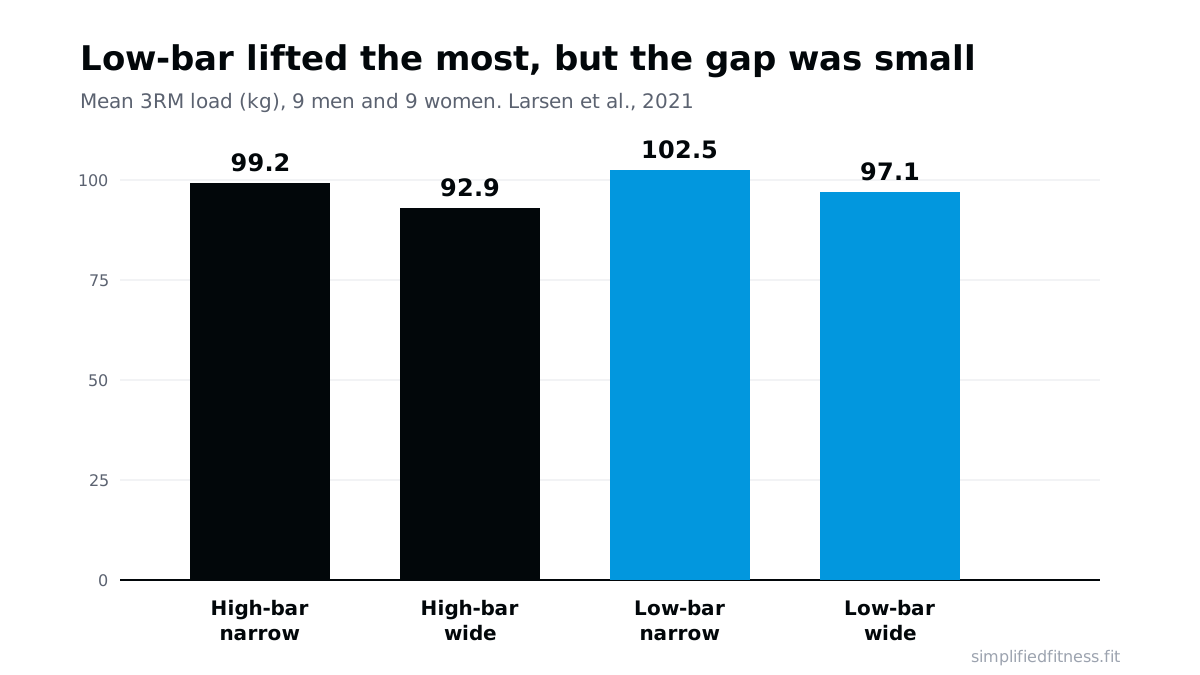
The common claim that low bar adds 5-10% is not well supported by these numbers. The 3RM difference in the 2021 study was roughly 3%, and the 2024 study found essentially none. Studies are small, recreational lifters dominate, and practice time in each style is rarely controlled. So treat any gain as an individual experiment, not a rule.
Should you switch to low bar at all?
That is a different question from how to do it well, and we answer it in full in our high-bar vs low-bar comparison. The short version: if your shoulders, elbows and wrists tolerate the position and your goal is the heaviest possible squat, low bar is worth a proper trial. If the grip hurts, or you want more quad emphasis, a high bar is a perfectly good squat. The best squat is the one you can repeat, reach depth with and progress on.
How to test low-bar for yourself
- Use a load around 70% of your current best for 5 reps with both bars.
- Do each bar for 4-6 weeks, same stance, same depth.
- Track the top set each week. Our 1RM calculator helps compare estimated maxes, and the plate calculator saves loading mistakes.
- Keep the bar that moves the most weight with the cleanest technique.
If you find yourself fighting knee, hip or back pain, or shoulder numbness, stop and see a doctor or physiotherapist.
Frequently Asked Questions
How do you low bar squat properly?
Set the bar on the shelf formed by your rear delts and upper back, grip as wide as comfort allows, brace, then sit back and down with the bar staying over mid-foot. This keeps the balance point stable while letting the hips take more of the load, which is why the torso leans forward. Start with an empty bar and film one set from the side to check the bar travels in a near-vertical line.
Where should the bar sit on a low bar squat?
It sits across the rear delts and the spine of the scapula, below the bony bump at the base of your neck. That lower position moves the load further behind your hips, which changes how you balance and increases hip involvement. Pull your shoulder blades together first so the shelf is solid, and adjust a centimetre at a time rather than guessing.
Is low bar squat better than high bar for strength?
It may allow a little more weight, but the evidence is not uniform. One study found 3RM loads of 102.5 kg low-bar versus 99.2 kg high-bar with a narrow stance, while a 2024 study found 130.2 kg versus 129.1 kg, which was not significantly different. If your goal is a one-rep max, test both bars for a few weeks and keep the one you lift more with.
Does low bar squat work glutes more?
A review of the biomechanics literature reports greater erector spinae, adductor and gluteal activity in the low-bar squat, with more quadriceps activity in the high bar. Other studies show small or inconsistent muscle activation differences, so the effect is not guaranteed. If hip extensors are your priority, a low bar with a slightly wider stance is a reasonable thing to try.
How far forward should you lean in a low bar squat?
More than in a high-bar squat, but the exact angle depends on your limb lengths. A 2025 study found hip-dominant squatting appeared when trunk inclination exceeded shin inclination by about 2 degrees or more. A practical check is that your shoulders stay roughly over mid-foot and the bar path looks vertical on video.
Why do my wrists and elbows hurt when I low bar squat?
The low-bar grip asks for shoulder external rotation and wrist extension, and a narrow grip or a bar held mostly in the hands can overload both. Keep the bar on your back rather than gripping it hard, widen your hands a little, and keep your wrists close to neutral. If pain continues beyond a few sessions, switch to a high bar or a safety-bar variation and see a physio.
What stance width is best for a low bar squat?
Roughly shoulder width to a bit wider with toes turned out slightly is a common starting point. One study found a low-bar wide stance gave the largest hip contribution to the total moment, and another found hip-to-knee moment ratios were higher with a wider stance. Choose the width where you can reach depth without your knees caving or your heels lifting.
Is the low bar squat bad for your back or shoulders?
There is no good evidence that it is inherently more dangerous, but it does demand shoulder and wrist mobility and a strong, braced trunk. A forward lean raises the demand on the hips and lower back muscles, which are meant to handle it when you brace well. If you have existing shoulder, elbow or back pain, talk to a doctor or physiotherapist before loading heavy.
Can beginners learn the low bar squat?
Yes, but they should treat it as a skill. Beginners often take longer to find a bar position that feels stable, and the research on technique differences mostly comes from trained lifters. Learn it with light weights, film your sets, and give it four to six weeks before deciding it does not suit you.
Is the low bar squat the same as a powerlifting squat?
Many powerlifters use a low-bar position, but it is a choice rather than a rule. Competition rules require the bar on the back and a certain depth, and plenty of lifters use a mid or high bar. Pick the position that lets you hit depth, stay balanced and move the most load.
How low should the bar go?
As low as you can hold it without it rolling or hurting your shoulders. A bar placed too low slides down your back and puts strain on the elbows, while too high turns it into a high-bar squat. Small changes matter, so find a spot you can repeat every set.
Does low bar squatting make you lean over and good-morning the weight?
It can if the hips shoot up faster than the chest on the way out of the hole. The fix is to lead with your hips and chest together and keep the bar over mid-foot. If your hips rise first on every heavy rep, drop the load, add paused squats and check our guide to sticking-point fixes.
Should I wear a belt or sleeves for low bar squats?
They are optional, and the effect on a maximal lift depends on the lifter. A belt gives your trunk something to brace against, and sleeves keep the knees warm. Learn the technique without them first, then add them if you are chasing heavy singles.
Sources & References
Every claim above is checked against peer-reviewed research (PubMed, U.S. National Library of Medicine) or guidance from established health bodies. How we fact-check.
- Glassbrook DJ, et al. A Review of the Biomechanical Differences Between the High-Bar and Low-Bar Back-Squat. J Strength Cond Res. 2017. PMID: 28570490
- Glassbrook DJ, et al. The High-Bar and Low-Bar Back-Squats: A Biomechanical Analysis. J Strength Cond Res. 2019. PMID: 28195975
- Wretenberg P, et al. High- and low-bar squatting techniques during weight-training. Med Sci Sports Exerc. 1996. PMID: 8775157
- Larsen S, et al. Effects of Stance Width and Barbell Placement on Kinematics, Kinetics, and Myoelectric Activity in Back Squats. Front Sports Act Living. 2021. PMID: 34541522
- Larsen S, et al. A Biomechanical Comparison Between a High and Low Barbell Placement on Net Joint Moments, Kinematics, Muscle Forces, and Muscle-Specific Moments in 3 Repetition Maximum Back Squats. J Strength Cond Res. 2024. PMID: 38900172
- Kristiansen E, et al. A Biomechanical Comparison of the Safety-Bar, High-Bar and Low-Bar Squat around the Sticking Region among Recreationally Resistance-Trained Men and Women. Int J Environ Res Public Health. 2021. PMID: 34444101
- Straub RK, et al. Targeting the hip and/or knee extensors during the back squat in males and females: A repeated measures decision tree analysis using the relative difference in trunk and tibia inclination and knee flexion angle. Phys Ther Sport. 2025. PMID: 40157154
- Lahti J, et al. Effects of barbell back squat stance width on sagittal and frontal hip and knee kinetics. Scand J Med Sci Sports. 2019. PMID: 30230052

Umair Hazrami · Founder & Head Coach, Simplified Fitness
Umair Hazrami founded Simplified Fitness and the Simplified Lifter channel to cut through fitness noise. With 4+ years of consistent training and 10+ coaching clients, he writes every guide from the peer-reviewed research and links the sources so you can check them. Our editorial standards.
Educational content only, not medical advice. If you have a medical condition, are pregnant, or take medication, talk to a qualified doctor before changing your diet, supplements or training. Full disclaimer.
Keep reading
Strength & Cardio
1-Rep Max Testing vs 1RM Formulas: Which Is More Accurate and What Does Each Cost You?
1RM testing vs calculation: how accurate are Epley and Brzycki, when a true max is worth the risk, and a safe protocol if you do test. Studies linked.
9 min read
Strength & Cardio
Accommodating Resistance: Do Bands and Chains Really Match the Squat and Bench Strength Curve?
Accommodating resistance with bands and chains makes the top of a lift heavier. See what trials show on power and strength, and how to set it up safely.
9 min read
Strength & Cardio
Competition Bench Press Technique: Arch, Leg Drive, Lats and Bar Path Explained
Competition bench press technique explained: scapular setup, leg drive, lat tension, bar path and pause commands, plus what the research does and does not show.
10 min read
Strength & Cardio
Conventional vs Sumo Deadlift: Which Suits Your Hips, Limbs and Back?
Conventional vs sumo deadlift biomechanics: what the studies show on muscle demand, bar path and back load, plus a simple test to pick the style for your body.
10 min read