Aerobic Conditioning and Hypertrophy: How Work Capacity Improves Inter-Set Recovery
Does better cardio help you recover between sets? See what work capacity resistance training research says, where theory outruns data, and what to do.
TL;DR. The short answer
- Between hard sets, your muscles rebuild ATP and phosphocreatine mostly through oxygen-using (aerobic) metabolism, so aerobic fitness plausibly helps you repeat quality sets.
- The direct evidence is weaker than the theory. In 28 resistance-trained adults, VO2max was only weakly related to fatigue within a set and recovery between sets (Lundberg et al., 2024).
- Concurrent aerobic and strength training does not appear to reduce overall muscle growth or maximal strength in a 43-study meta-analysis, so easy cardio is unlikely to cost you size.
- Hard interval running right before lifting can cost reps (about 2.7 fewer bench reps in total across four sets in one small study), while steady running did not.
- A practical engine for lifters is 2-3 easy sessions a week of 20-40 minutes, kept away from your hardest leg sessions, plus full 2-3 minute rests on heavy compounds.
Part of our complete guide: Cardio and Concurrent Training: Build Endurance Without Losing Muscle (The Interference Effect)
Table of contents
You finish a hard set of squats and your lungs feel like they are on fire. Your legs are fine. Your breathing is the problem. So does better cardio actually help, and does work capacity resistance training translate into more muscle?
Short answer: probably, a little, through a real mechanism. But the direct evidence is thinner than most gym advice admits. This article is one piece of our wider guide on cardio and the interference effect, and it focuses on what happens inside a single session.
What actually happens during your rest interval
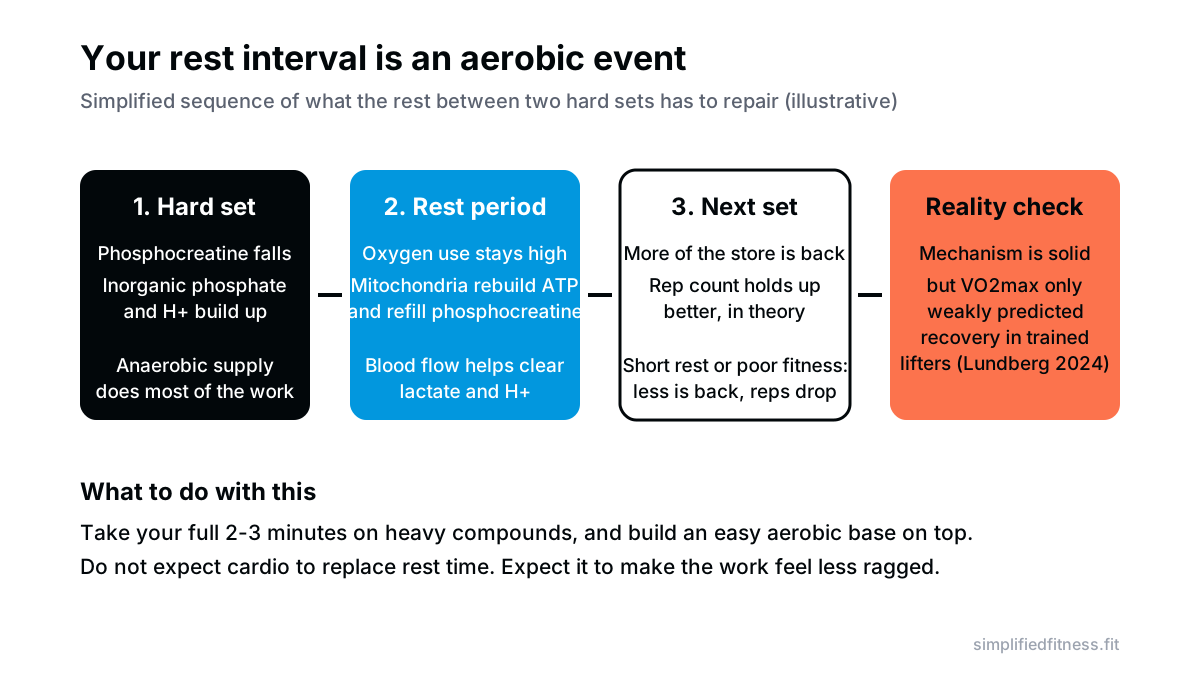
A hard set of 6-12 reps drains your fast energy supply. ATP gets burned, and phosphocreatine, the quick backup store, drops. Byproducts such as inorganic phosphate and hydrogen ions (H+) pile up inside the muscle.
Then you sit on the bench and scroll for two minutes. Your muscle does not rest during that time. It is busy rebuilding.
During a single short sprint of 5 to 6 seconds, ATP comes mainly from anaerobic sources, with a small (under 10%) aerobic contribution. During recovery, oxygen uptake stays elevated to restore the muscle, including resynthesizing phosphocreatine and clearing phosphate (Glaister, 2005). Both phosphocreatine resynthesis and phosphate removal are oxygen-dependent. That is the aerobic link, and it is why the rest between sets is where your “engine” earns its keep.
Does better cardio fitness improve recovery between sets?
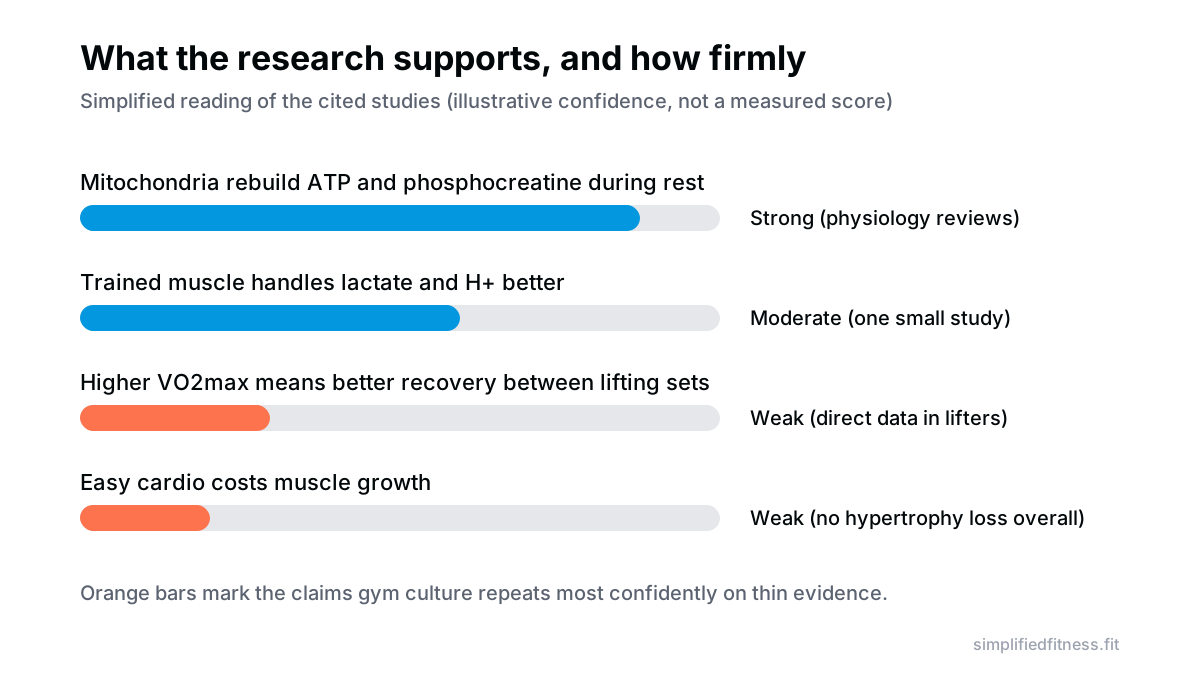
A review of the literature on repeated high-intensity exercise concluded that aerobic fitness enhances recovery from this kind of work through a bigger aerobic response, improved lactate removal and faster phosphocreatine regeneration (Tomlin and Wenger, 2001). It also noted that the relationship is not clean. Phosphocreatine resynthesis after one single hard effort did not always track VO2max, and the link looked stronger when large muscle groups were involved. For lifters, that last point matters, because squats and deadlifts use a lot of muscle.
Glaister was similarly careful. The theory is “compelling”, he wrote, but the corroborating research is “far from substantive” (Glaister, 2005).
Now the study closest to your actual situation. Researchers tested 28 resistance-trained adults (14 men, 14 women) on parallel squats, 3 sets at 70% of 1RM to failure with 90 seconds rest, plus knee extensions. VO2max was only weakly related to fatigue within a set and recovery between sets, in both sexes (Lundberg et al., 2024). Women also tended to recover better between sets than men.
So what do we make of this?
- Study A (physiology reviews): aerobic fitness plausibly speeds up recovery from repeated hard efforts.
- Study B (Lundberg, 2024): in trained lifters doing squats and knee extensions, the relationship was weak.
- Why they might differ: the reviews draw mainly on sprint-type and intermittent sport work, and on mechanisms. The lifting study was small, used one specific protocol, and its participants were already resistance-trained, so the range of aerobic fitness may have been narrow.
Cautious takeaway: aerobic fitness is a plausible helper, not a proven lever. If your rest periods are fine and your reps hold up, you probably are not being limited by your engine.
How lactate and hydrogen ions fit in
Lactate gets blamed for the burn. It is better thought of as a marker of metabolic stress, while H+ buildup (acidity) is one of several contributors to fatigue.
Hard interval training can change how muscle handles these. In one small study, six people trained one leg for 7-8 weeks with fifteen 1-minute high-intensity bouts a day, and the other leg stayed untrained. The trained leg lasted longer in an incremental test (10.6 vs 8.2 minutes) and showed higher density of lactate and H+ transport proteins, better blood flow, and greater systemic lactate and H+ clearance (Juel et al., 2004).
Two honest caveats. Six subjects is tiny, and it was one-legged knee extension, not a squat session. Still, it shows that the machinery for moving acid out of a working muscle is trainable.
Heart rate recovery between sets: a practical read
Many lifters want a number: “I will start the next set at 120 bpm.” I am not aware of research giving lifters a validated target like that, so do not take advice that sounds too precise.
A more useful approach is a three-point check before each heavy set:
- Can you breathe calmly enough to brace properly?
- Does the load feel like it will move at your target reps?
- Has the rest been long enough that the last set’s difficulty has faded?
If the answer is no, wait. Rushing the next set is how you lose reps and then blame your lungs.
Why rest length matters more than most lifters think
If you ever wanted proof that incomplete recovery costs you something, look at rest intervals. In an 8-week trial, 21 resistance-trained men did the same program, with either 1-minute or 3-minute rests. The 3-minute group gained more strength on squat and bench press and more quadriceps thickness (Schoenfeld et al., 2016). Upper-body muscle endurance improved in both groups with no difference.
That is one trial in young trained men, so it will not settle everything. But it points to a simple idea: recovery between sets is a training variable. We cover it in detail in rest intervals for hypertrophy: 2 to 3 minutes vs short rest.
The bigger point: cardio does not replace rest. If you hope that fitness lets you cut rests to 45 seconds on heavy squats, the evidence does not back you.
Can a bigger engine let you do more weekly volume?
This is the claim people really care about. More aerobic fitness, more tolerable volume, more growth.
The middle step is supported. In 34 resistance-trained men, muscle growth in the elbow flexors and thigh followed a dose-response with volume, favouring higher-volume groups (1, 3 or 5 sets per exercise, 8 weeks), while strength gains were similar across groups (Schoenfeld et al., 2019). If you can finish more good sets, that may help growth.
The first step is the problem. I could not find a study showing that adding cardio lets lifters complete and recover from more weekly sets. So this is a reasonable hypothesis, not a result.
How would you know if it applies to you? Look at why your sessions go badly.
| What stops you | Likely limiter | Reasonable response |
|---|---|---|
| Legs feel fine, lungs are the issue | Aerobic fitness, pacing | Easy cardio base, longer rests |
| Muscle burns and form fails | Local muscular fatigue | Lower reps, more rest, check load |
| Whole body feels flat for days | Sleep, calories, total stress | Fix recovery before adding anything |
| Dizzy, chest pain, palpitations | Possible medical issue | Stop and see a doctor |
You can check your volume against a target with our training volume calculator.
Will cardio cost you muscle?
The reason many lifters avoid cardio is the interference effect. The big picture from a 43-study meta-analysis is reassuring: concurrent training did not compromise muscle hypertrophy or maximal strength compared with strength training alone. Explosive strength gains were somewhat attenuated, especially when both were done in the same session (Schumann et al., 2022). Results did not differ by running vs cycling, frequency or age.
That is whole-muscle size. We go deeper into the mechanisms in the AMPK and mTOR interference effect and into the loss question in whether cardio can cause muscle loss. The topic is still debated at the muscle-fibre level, so treat this as a good-enough answer, not a closed case.
For a lifter, the practical point is this: easy aerobic work added in moderation is unlikely to hurt growth, and it has plausible upside for how you feel in the gym.
The timing trap: hard cardio right before lifting
Here is where cardio does cost you. In 17 young men, eight 40-second interval sprints on a treadmill before bench press cut total repetitions across four sets at 80% of 1RM to failure, from 21.4 reps to 18.7. A 30-minute steady run at moderate intensity did not change performance (20.6 reps) (Andrade et al., 2021).
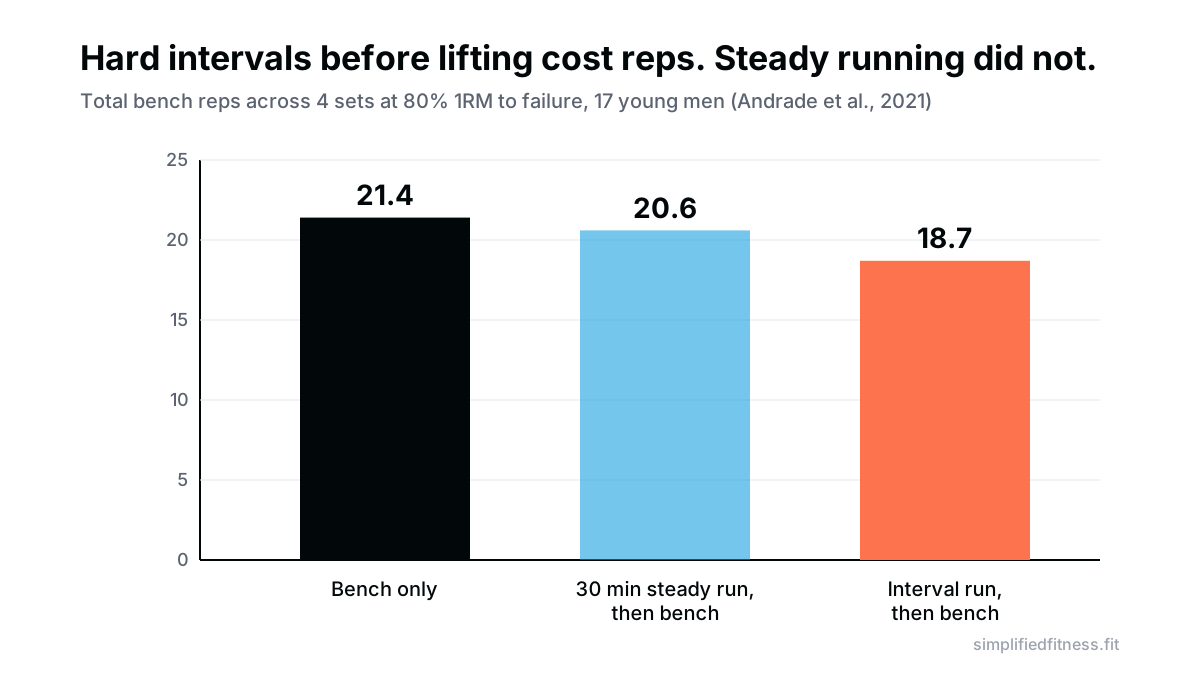
Small sample, young men, one exercise. Still, it matches what most coaches see: do not smash a HIIT session before heavy squats. Put hard conditioning after lifting or on a separate day, and read more in our guide on timing cardio and weights.
How to build an aerobic base without wrecking your lifting
This is a starting framework, not a researched prescription. Adjust it to how your lifting performance responds.
- Frequency: 2-3 easy sessions a week.
- Duration: 20-40 minutes each, building up slowly.
- Intensity: conversational pace. Our heart rate zone calculator gives you a starting range.
- Placement: after lifting, or on non-lifting days. Keep it away from the day before your hardest leg session if your legs are slow to recover.
- Modality: incline walking, cycling or a brisk walk are all fine. If running leaves your legs flat, choose cycling.
If you are new to this, zone 2 cardio for lifters is the easiest entry point. If you prefer short hard sessions, see LISS vs HIIT for muscle preservation.
Indian context for hot weather: in a humid summer, a gym without AC makes everything feel harder, and heat alone raises heart rate. Walk early or late, hydrate, and use fan cooling between sets before blaming your fitness. A 40-minute brisk walk on the road or an incline walk on a basic treadmill costs nothing extra and fits most budgets.
Who should check with a doctor first
Cardio is safe for most healthy adults, but see a doctor before increasing intensity if you have known heart or lung disease, high blood pressure that is not controlled, or a family history of early heart problems. Chest pain, faintness, or an unusually fast or irregular heartbeat during training are reasons to stop and get checked. Persistent breathlessness that seems out of proportion to the effort, especially if it is new, also deserves a medical opinion. Nothing here is a diagnosis.
The bottom line
The theory is neat. Hard sets run on anaerobic fuel, rests run on aerobic repair, so a better engine should give better sets. The real-world data is less tidy: in resistance-trained lifters, VO2max was only weakly related to between-set recovery.
So keep it simple. Rest properly on heavy lifts, build a modest base of easy cardio you can recover from, keep hard intervals away from heavy leg work, and judge it by your rep counts, not by theory. Start from a structured routine like our free push pull legs plans and let your own numbers tell you whether the engine is the limiter.
Frequently Asked Questions
Does cardio help you recover between sets?
Probably a little, but the evidence is not as strong as gym culture suggests. Rest-interval recovery relies heavily on aerobic metabolism, and reviews link aerobic fitness to better recovery from repeated high-intensity efforts. However, one 2024 study in resistance-trained adults found VO2max only weakly related to between-set recovery, so treat cardio as a modest helper, not a fix for short rests.
Why do I get so out of breath between sets of squats?
Big leg exercises use a lot of muscle mass, which pushes breathing and heart rate high and keeps oxygen use elevated during the rest period. Your body is paying back the oxygen cost of rebuilding ATP and clearing by-products. If it feels extreme, rest a full 2-3 minutes, check your pacing on the first set, and build a base of easy cardio over several weeks.
What is work capacity in resistance training?
Work capacity is how much quality training you can complete and recover from in a session and across a week. It depends on aerobic fitness, strength, technique, sleep and food, not on one single quality. A simple way to track it is whether your reps and loads hold up across all your sets and from week to week.
Does better aerobic fitness mean more muscle growth?
Not directly. Muscle growth follows training volume and effort, and a 2019 trial in resistance-trained men found larger hypertrophy with higher volumes. Aerobic fitness may help you tolerate more good volume, but no study here shows that cardio fitness alone builds muscle. Use it as support for your lifting, not as a growth tool.
How long should I rest between sets for hypertrophy?
For heavy compound lifts, around 2-3 minutes is a sensible default. In one 8-week trial of 21 trained men, 3-minute rests produced greater strength and quadriceps thickness than 1-minute rests with the same program. Use shorter rests on small isolation lifts if time is tight.
Does cardio kill gains?
Easy to moderate cardio is unlikely to kill gains. A 2022 meta-analysis of 43 studies found no meaningful effect of adding aerobic training on muscle size or maximal strength, though explosive strength gains were somewhat smaller. Keep your protein and calories adequate, and avoid doing hard cardio right before heavy leg work.
Is running worse than cycling for lifters?
The 2022 meta-analysis of 43 studies found no difference in muscle size or maximal strength outcomes between running and cycling as the aerobic mode. Running is more impact-heavy, so it can leave your legs flatter for the next session. If your knees and legs are already beaten up, cycling or incline walking is a reasonable choice.
Should I do cardio before or after weights?
After weights, or on a separate day, is the safer choice if lifting is your priority. One study found that interval running before bench press cut reps, while 30 minutes of steady running did not. Our guide on timing cardio and weights covers the full trade-offs.
What heart rate should I recover to before the next set?
There is no research-backed target number for lifters, so use feel and performance instead. Start your next set when breathing is calm enough to brace properly and you expect to hit your target reps. If you want a reference, find your zones with a heart rate zone calculator for your easy cardio days.
How much cardio does a bodybuilder need for a good aerobic base?
Two to three easy sessions of about 20-40 minutes is a practical starting point, not a researched prescription. Keeping it modest is sensible because explosive strength gains were somewhat smaller with concurrent training in the 2022 meta-analysis, especially in the same session. Add time slowly and watch whether your lifting performance holds.
Can poor cardio fitness limit my training volume?
It can feel that way, especially in high-rep leg training or short-rest circuits, though direct proof is thin. Higher volumes do drive more growth in trained men, so anything that lets you complete more quality sets could help. If sessions end because of breathlessness rather than muscle fatigue, a bit more easy cardio is worth trying.
Does creatine or caffeine replace the need for cardio?
No, they target different problems. Creatine supports the phosphocreatine store used in short, hard efforts, while cardio improves the aerobic machinery that refills it. They can be used together, but neither one builds an aerobic base.
When should I see a doctor about breathlessness?
See a doctor if you get chest pain, dizziness, fainting, an irregular heartbeat or breathlessness that is out of proportion to the effort. These are not normal training fatigue and should be checked before you push on. Stop the session and get advice, especially if symptoms are new.
Sources & References
Every claim above is checked against peer-reviewed research (PubMed, U.S. National Library of Medicine) or guidance from established health bodies. How we fact-check.
- Lundberg TR, et al. Relationship between maximal oxygen uptake, within-set fatigue and between-set recovery during resistance exercise in resistance-trained men and women. BMC Sports Sci Med Rehabil. 2024. PMID: 38347629
- Tomlin DL, et al. The relationship between aerobic fitness and recovery from high intensity intermittent exercise. Sports Med. 2001. PMID: 11219498
- Glaister M. Multiple sprint work: physiological responses, mechanisms of fatigue and the influence of aerobic fitness. Sports Med. 2005. PMID: 16138786
- Juel C, et al. Effect of high-intensity intermittent training on lactate and H+ release from human skeletal muscle. Am J Physiol Endocrinol Metab. 2004. PMID: 14559724
- Schoenfeld BJ, et al. Longer interset rest periods enhance muscle strength and hypertrophy in resistance-trained men. J Strength Cond Res. 2016. PMID: 26605807
- Andrade LS, et al. High-intensity interval running impairs subsequent upper limb strength performance. J Sports Med Phys Fitness. 2021. PMID: 34110119
- Schumann M, et al. Compatibility of concurrent aerobic and strength training for skeletal muscle size and function: an updated systematic review and meta-analysis. Sports Med. 2022. PMID: 34757594
- Schoenfeld BJ, et al. Resistance training volume enhances muscle hypertrophy but not strength in trained men. Med Sci Sports Exerc. 2019. PMID: 30153194

Umair Hazrami · Founder & Head Coach, Simplified Fitness
Umair Hazrami founded Simplified Fitness and the Simplified Lifter channel to cut through fitness noise. With 4+ years of consistent training and 10+ coaching clients, he writes every guide from the peer-reviewed research and links the sources so you can check them. Our editorial standards.
Educational content only, not medical advice. If you have a medical condition, are pregnant, or take medication, talk to a qualified doctor before changing your diet, supplements or training. Full disclaimer.
Keep reading
Strength & Cardio
Can Cardio Cause Muscle Loss? The Calorie and Volume Thresholds Behind the Fear
Does cardio cause muscle loss? Not at normal doses. See what the meta-analyses say about deficits, protein and running volume, and how to protect your muscle.
9 min read

Strength & Cardio
Cardio During a Cut: How Much You Need and When to Stop Adding
How much cardio during cutting phase? Learn the food-first rule, a walking base, sample weekly schedules and signs you are doing too much. Every study linked.
7 min read

Strength & Cardio
Cycling vs Running for Lifters: Which Protects Muscle and Squat Strength?
Cycling vs running for lifters: Wilson's meta-analysis found running, not cycling, blunted gains. We compare it with newer reviews and give a bike plan.
8 min read

Strength & Cardio
Fasted Cardio vs Fed Cardio: Does Skipping Breakfast Burn More Fat?
Fasted cardio vs fed cardio for fat loss: what the trials show on fat burn, muscle loss and cortisol, plus what to eat before a 6am session. Every study linked.
9 min read