Tendon Stiffness and the Stretch-Shortening Cycle: How Tendons Store and Release Energy
Tendon stiffness and athletic performance explained: how the stretch-shortening cycle stores elastic energy and how heavy lifting and plyometrics change it.

TL;DR. The short answer
- Tendons act like springs in series with your muscles. During the stretch-shortening cycle (SSC) they lengthen, store strain energy, and give some of it back when you push up.
- Heavy resistance training and plyometrics both raise tendon stiffness. Meta-analyses report moderate effects (about 0.55 to 0.74 standard deviations), mostly from changes in tendon material quality rather than size.
- Slow SSC movements (squats, countermovement jumps) take longer and bend the joints more. Fast SSC movements (pogo hops, sprinting, depth jumps) have short ground contacts and demand more from the tendon.
- More stiffness is not always better. Reviews link stiffness with better jumping, sprinting and running, but its link with injury is mixed, so the best level depends on the athlete and the sport.
- Tendons adapt slowly. Build loading over weeks, keep jump volume modest, and see a doctor or physio for pain that lingers in the Achilles or knee tendon.
Part of our complete guide: Maximal Strength, Neuromuscular Adaptations & Powerlifting Science for General Lifters
Table of contents
Tendon stiffness matters for athletic performance (part of our maximal strength and powerlifting science guide) because tendons work like springs. They stretch as you lower into a jump or squat, store some of that energy, and give part of it back as you drive up. Training can make tendons stiffer, mainly with heavy lifting and plyometrics, and that tends to help force transfer. It is not a free lunch though, because the right amount varies by person and sport.
What is the stretch-shortening cycle (SSC)?
This is the connective-tissue side of explosive strength. The neural side lives in our piece on rate of force development.
The stretch-shortening cycle is the stretch, switch, push sequence behind most athletic movement. Think of the dip before a vertical jump. You lower, you pause for a split second, and you explode up.
Three phases make it up:
- Stretch (eccentric): the muscle-tendon unit is lengthened under load.
- Switch (amortization): a brief turnaround from down to up.
- Shorten (concentric): the muscle shortens and the tendon recoils.
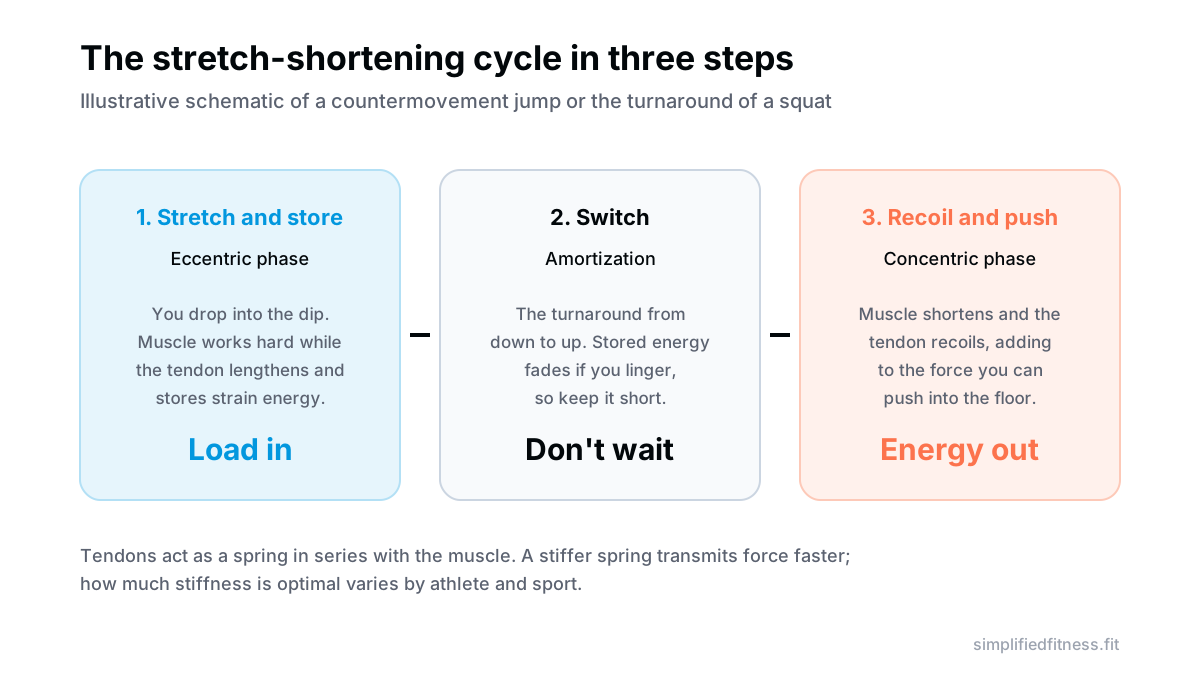
The cycle shows up everywhere. Squat bounce, touch-and-go bench reps, running, throwing, a skipping rope. If you have ever felt a rep feel easier out of the hole than from a dead stop, that is part of this.
How do tendons store and release elastic energy?
A tendon is a rope of collagen sitting in series between muscle and bone. When force pulls on it, it lengthens a little and stores strain energy. When the force drops, it springs back. That recoil returns part of the energy, rather than the muscle producing every newton from scratch.
Here is a wrinkle that textbooks often skip. In a study of nine highly trained jumping athletes performing maximal single-leg hops, researchers found a stretch-shortening cycle at the joint, the whole muscle-tendon unit and the tendon, but not at the muscle fibres of the medial gastrocnemius (Aeles et al., 2019). In plain terms, the tendon did the stretching and recoiling, while the muscle fibres did not show that same stretch-then-shorten pattern. That is a small sample in one calf muscle, so do not generalise it to every muscle. It does fit the spring picture.
You will sometimes read that this works through muscle spindles and reflexes, or purely through collagen cross-links. The evidence I could verify for this article does not neatly support either as the main story, so I will stay with what the human studies measure: stiffness, material quality and size.
What is tendon stiffness, and why does it matter?
Tendon stiffness is how much force it takes to stretch a tendon by a certain length. Stiffer means less stretch for the same load. A stiffer tendon passes force to the bone sooner, which is helpful when you need to produce force fast.
A 2019 review summarised that higher lower-limb stiffness is associated with better performance in hopping, jumping, throwing, endurance running, sprinting and changing direction (Brazier et al., 2019). The same review says the link to injury is less conclusive, because both excessive and insufficient limb stiffness have been proposed to raise risk. In other words, the “optimal” level depends on the athlete’s build, abilities and sport.
One more point to keep in mind. These are mostly associations. A stiff-tendoned sprinter may be a good sprinter for a dozen reasons, and tendon stiffness is only one of them.
Does heavy resistance training increase tendon stiffness?
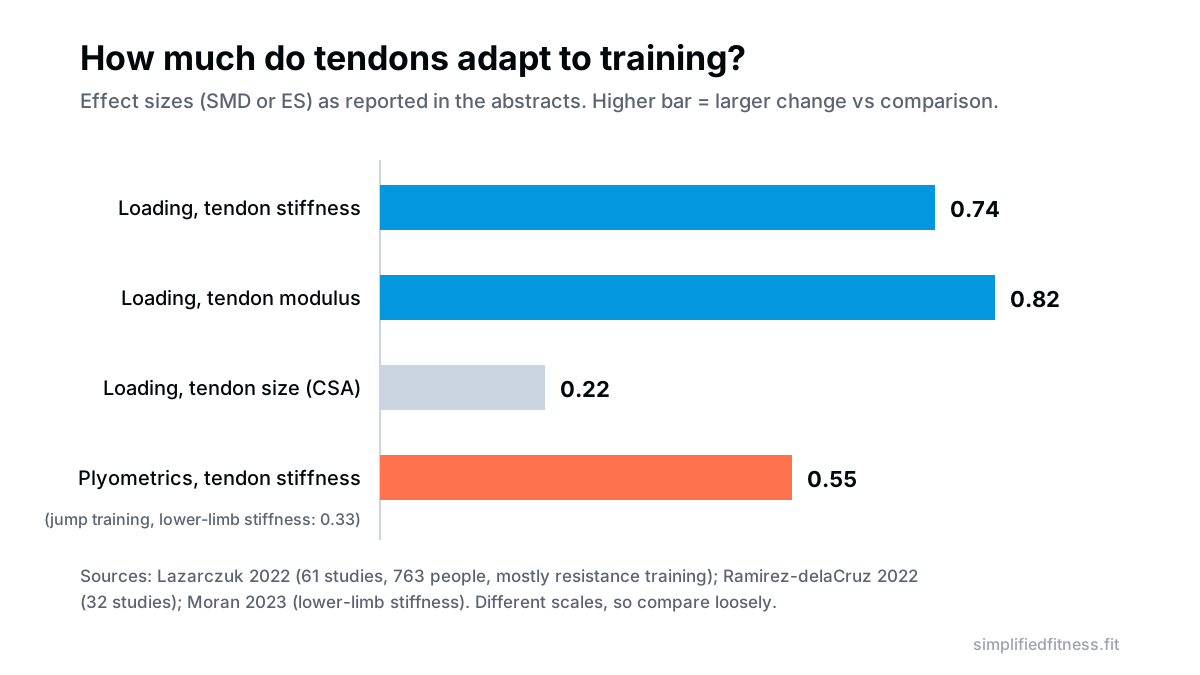
Yes, on average. The best single source is a 2022 systematic review and meta-analysis of 61 studies with 763 participants, mostly on the Achilles and patellar tendons, and mostly resistance training interventions. Mechanical loading produced moderate increases in stiffness (SMD 0.74), large increases in modulus (SMD 0.82) and small increases in tendon cross-sectional area (SMD 0.22) (Lazarczuk et al., 2022).
Modulus is the material quality of the tendon tissue itself, independent of its size. So the stiffness gain came mainly from the tendon becoming a better material, not from the tendon getting much thicker. The same paper found higher-strain resistance training gave greater increases in stiffness (SMD 1.04) than low-strain protocols.
What does this mean in the gym? Light work that never challenges the tendon does less than loads that are genuinely heavy for you. That fits the long-standing advice to train heavy as part of a maximal strength program.
Is this true for trained athletes?
There is some direct evidence. In a 12-week randomized trial, 18 well-trained triathletes were split between adding strength training three times a week or doing endurance training only. In the strength group, Achilles tendon stiffness rose by about 39% and patellar tendon stiffness by about 16%, even though they kept doing high-volume endurance work (Jacobs et al., 2025). The sample is small and these are endurance athletes, so treat the percentages as one example rather than a promise. The direction still matches the larger reviews.
What happens in older lifters?
A 12-month randomized trial in adults aged 62-70 compared heavy and moderate resistance training with a control group. Tendon stiffness fell in the control and moderate-load groups but was maintained in the heavy-load group, even though tendon size increased similarly in both training groups (Eriksen et al., 2019). Biopsies showed no change in collagen content, fibril shape or measured cross-links with training. That last finding is a useful reality check on the claim that heavy training works by building more cross-links. In this study at least, it did not show up.
Do plyometrics increase tendon stiffness?
Often, though with some caveats. A 2022 meta-analysis of 32 studies in healthy adults (programs of at least eight sessions) reported a moderate effect of plyometric training on tendon stiffness (SMD 0.55), alongside moderate improvements in jumping and strength (Ramirez-delaCruz et al., 2022).
A different meta-analysis looked at lower-limb stiffness more broadly and found a smaller effect (ES 0.33). The effect was larger in untrained people (0.46) than trained (0.15, not significant), and programs of more than 7 weeks did better than shorter ones (Moran et al., 2023).
Why do these two differ? They measure slightly different things. One focuses on tendon stiffness, the other on whole lower-limb stiffness, which includes muscle and joint behaviour. They also pooled different studies. The shared message is that plyometrics help, with a moderate effect at best.
How many jumps is enough?
The surprising part of the Moran meta-analysis is the dose. Programs with fewer than 250 jumps per week had the larger effect (ES 0.50), 250-500 jumps had 0.36, and programs above 500 jumps per week showed no benefit (ES -0.22, with a wide confidence interval crossing zero). Programs of two sessions a week or fewer also did better than those with more.
That does not prove that more jumping hurts. The confidence intervals are wide and the studies differ in design. It does suggest that you do not need to flood your week with jumps. Small doses, done well, over months looks like the pattern.
Slow SSC vs fast SSC: what is the difference?
The split is mostly about time on the ground and how much the joints bend.
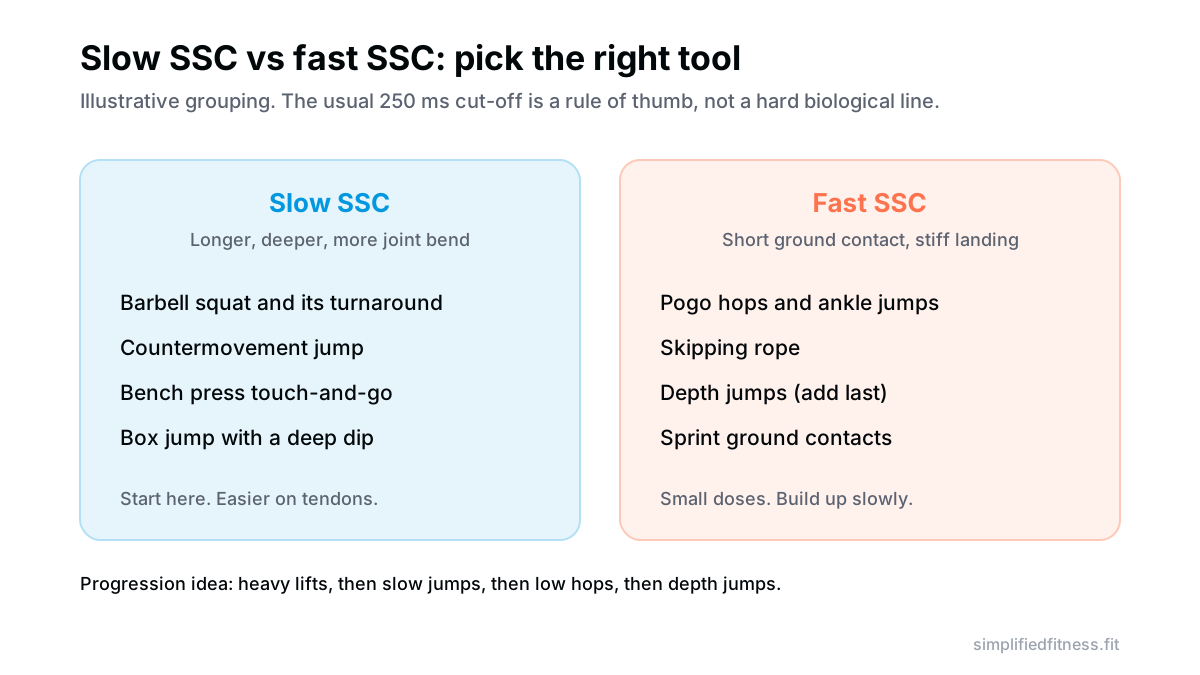
| Slow SSC | Fast SSC | |
|---|---|---|
| Movement time | Longer | Short ground contact |
| Joint bend | Larger | Small, stiff landing |
| Examples | Squat, countermovement jump, touch-and-go bench | Pogo hops, skipping, depth jump, sprinting |
| Tendon demand | Moderate | High per contact |
| Where to start | Here | After a base of strength |
Fast SSC is often defined as ground contact under roughly 250 ms. A 2026 review points out that this cut-off was applied loosely in the literature and has no confirmed biological boundary behind it. Its authors suggest treating 250 ms as an operational rule of thumb, not a hard line (Li et al., 2026). So use “slow” and “fast” as helpful labels, not strict categories.
How to train tendon stiffness: a simple plan
You do not need a special tendon program. You need heavy lifting, a small amount of jumping, and patience.
- Lift heavy 2-3 times a week. Squats, hip thrusts and stiff-leg deadlifts at loads that are genuinely challenging. Our leg day plan is a reasonable base.
- Add low-dose jumping 1-2 times a week. Start with 2-3 sets of 5-8 low box jumps or countermovement jumps, and keep the total number of ground contacts low.
- Progress to faster work later. Add pogo hops or short skipping sets once your base is solid. A review suggests a developmental sequence with increasing eccentric demand (Brazier et al., 2019). Our guide to jump rope for lifters covers the easiest entry point.
- Be patient. In the Moran meta-analysis, jump programs longer than 7 weeks beat shorter ones, and the trials above ran 12 weeks to 12 months. Judge it in months.
- Track your heavy lifts. Use our 1RM calculator to monitor strength progress, since tendon changes cannot be measured at home.
If your goal is to understand why tendons and muscles adapt on different timelines, read our deeper piece on tendon versus muscle adaptation. For older lifters, our guide on strength training for older adults covers the loading side in more detail.
Can tendon training prevent injuries?
The honest answer is that nobody can promise that. The evidence on stiffness and injury is mixed. The 2019 review mentioned earlier says relationships with injury are less conclusive, and that both excessive and insufficient stiffness have been proposed as risk factors (Brazier et al., 2019).
What is reasonable is this. Gradual, progressive loading builds tendon capacity, and sudden big jumps in volume are a common way to irritate a tendon. If you keep increases small and stay consistent, you are working with the biology.
When to see a doctor
Tendon pain should not be ignored. See a doctor or physio if:
- pain lasts more than a couple of weeks
- the first steps in the morning hurt
- there is swelling, warmth or a sudden sharp pain
- pain wakes you at night
Pushing through tendon pain tends to prolong it. This article is education, not a diagnosis.
The bottom line
Tendons are not passive cables. They stretch, store energy and return some of it, and that is part of why you bounce out of the bottom of a squat. Heavy lifting and modest, progressive jumping both raise tendon stiffness on average, mostly by improving tissue quality rather than size.
The details are less tidy than the marketing. Effect sizes are moderate, trained athletes often respond less, and the best stiffness level depends on the person and the sport. So lift heavy, add a little jumping, be patient, and listen to pain.
Frequently Asked Questions
What is the stretch-shortening cycle (SSC)?
The SSC is a sequence where a muscle-tendon unit is stretched, pauses briefly, then shortens. It happens in a countermovement jump, the bounce out of a squat, and every running step. The stretch phase loads the tendon like a spring, and the shortening phase gets a boost from that stored energy.
How do tendons store elastic energy?
When the muscle-tendon unit is stretched under load, the tendon lengthens and stores strain energy in its collagen structure, a bit like stretching a rubber band. When the load reverses, the tendon recoils and returns part of that energy. Research in jumping athletes suggests the SSC shows up clearly at the tendon, even when the calf muscle fibres themselves do not go through the same stretch-then-shorten pattern.
What is tendon stiffness?
Tendon stiffness is how much force it takes to stretch a tendon by a given length. A stiffer tendon stretches less for the same load and passes force to the bone faster. Researchers measure it in the lab with ultrasound and a dynamometer, so you cannot read it off a gym scale.
Does lifting heavy weights make tendons stiffer?
Usually, yes. A 2022 meta-analysis of 61 studies found loading produced moderate increases in tendon stiffness, with higher-strain resistance training giving the biggest gains. Train with loads you can handle with good form and recover between sessions, since tendons adapt more slowly than muscle.
Do plyometrics increase tendon stiffness?
On average, yes, though the effect is moderate. A 2022 meta-analysis of 32 studies reported a moderate effect on tendon stiffness, and another meta-analysis found a small effect that was larger in untrained people. Start with a few low-impact jumps and add volume gradually.
What is the difference between slow and fast SSC?
Slow SSC actions, like squats and countermovement jumps, have longer movement times and larger joint angle changes. Fast SSC actions, like pogo hops and sprinting, have short ground contacts. The commonly quoted 250 ms cut-off is a convention rather than a proven biological boundary, so treat it as a rough guide.
Is a stiffer tendon always better for performance?
No. A 2019 review found higher lower-limb stiffness is associated with better hopping, jumping, sprinting and running, but the best level depends on the athlete and the sport. Both too much and too little limb stiffness have been proposed to raise injury risk. Focus on a balanced program of strength and jumping rather than chasing a number.
How long does it take to change tendon stiffness?
In one meta-analysis, jump training programs longer than 7 weeks had a larger effect on lower-limb stiffness than shorter ones. A 2025 trial in triathletes found Achilles tendon stiffness rose after 12 weeks of strength training three times a week. Plan on months of consistent training, not weeks.
Does the stretch-shortening cycle help you lift more?
It can. The small rebound out of the bottom of a bounced squat or a touch-and-go bench press borrows from SSC, which is why pausing the rep usually feels harder. If you compete in a pause-based sport, train the paused version as well so you are not relying on a bounce you cannot use.
Can I do plyometrics if I only lift weights?
Most healthy lifters can, if they build up slowly. Begin with 2 sessions a week of low-impact jumps and keep contacts low, since a meta-analysis found gains with under 250 jumps a week. If you have pain in your knees or Achilles, check with a physio first.
Do tendons get stiffer or weaker as we age?
Without enough loading, tendon stiffness can decline in older adults, though training can help. In a 12-month trial in adults aged 62-70, heavy resistance training preserved tendon stiffness while stiffness fell in the moderate-load and control groups. Older lifters should add load gradually and speak with a doctor before starting if they have joint disease.
Can skipping rope train tendon stiffness?
Rope skipping is a low-cost fast SSC drill, because ground contact is short and the ankle acts like a spring. I could not find a trial in the abstracts reviewed here that tests rope skipping on tendon stiffness directly, so treat it as a sensible plyometric starter rather than a proven protocol. Begin with short sets on a forgiving surface.
When should I see a doctor about tendon pain?
See a doctor or physio if pain lasts more than a couple of weeks, wakes you at night, causes swelling, or hurts the first steps in the morning. Tendon pain is easy to aggravate by pushing through it. Reduce jumping and heavy loading until you have been assessed.
Sources & References
Every claim above is checked against peer-reviewed research (PubMed, U.S. National Library of Medicine) or guidance from established health bodies. How we fact-check.
- Lazarczuk SL, et al. Mechanical, material and morphological adaptations of healthy lower limb tendons to mechanical loading: a systematic review and meta-analysis. Sports Med. 2022. PMID: 35657492
- Ramirez-delaCruz M, et al. Effects of plyometric training on lower body muscle architecture, tendon structure, stiffness and physical performance: a systematic review and meta-analysis. Sports Med Open. 2022. PMID: 35312884
- Moran J, et al. The effects of plyometric jump training on lower-limb stiffness in healthy individuals: a meta-analytical comparison. J Sport Health Sci. 2023. PMID: 34033984
- Eriksen CS, et al. Load magnitude affects patellar tendon mechanical properties but not collagen or collagen cross-linking after long-term strength training in older adults. BMC Geriatr. 2019. PMID: 30704412
- Brazier J, et al. Lower extremity stiffness: considerations for testing, performance enhancement, and injury risk. J Strength Cond Res. 2019. PMID: 29112054
- Aeles J, et al. Do stretch-shortening cycles really occur in the medial gastrocnemius? A detailed bilateral analysis of the muscle-tendon interaction during jumping. Front Physiol. 2019. PMID: 31920709
- Jacobs MW, et al. Maximal strength training improves muscle-tendon properties and increases tendon matrix remodulation in well-trained triathletes. Sci Rep. 2025. PMID: 40717194
- Li C, et al. The fast-slow stretch-shortening cycle classification: provenance, transmission and evidential status of the 250 ms boundary. Front Physiol. 2026. PMID: 42909940

Umair Hazrami · Founder & Head Coach, Simplified Fitness
Umair Hazrami founded Simplified Fitness and the Simplified Lifter channel to cut through fitness noise. With 4+ years of consistent training and 10+ coaching clients, he writes every guide from the peer-reviewed research and links the sources so you can check them. Our editorial standards.
Educational content only, not medical advice. If you have a medical condition, are pregnant, or take medication, talk to a qualified doctor before changing your diet, supplements or training. Full disclaimer.
Keep reading
Strength & Cardio
1-Rep Max Testing vs 1RM Formulas: Which Is More Accurate and What Does Each Cost You?
1RM testing vs calculation: how accurate are Epley and Brzycki, when a true max is worth the risk, and a safe protocol if you do test. Studies linked.
9 min read
Strength & Cardio
Accommodating Resistance: Do Bands and Chains Really Match the Squat and Bench Strength Curve?
Accommodating resistance with bands and chains makes the top of a lift heavier. See what trials show on power and strength, and how to set it up safely.
9 min read

Strength & Cardio
Competition Bench Press Technique: Arch, Leg Drive, Lats and Bar Path Explained
Competition bench press technique explained: scapular setup, leg drive, lat tension, bar path and pause commands, plus what the research does and does not show.
10 min read
Strength & Cardio
Conventional vs Sumo Deadlift: Which Suits Your Hips, Limbs and Back?
Conventional vs sumo deadlift biomechanics: what the studies show on muscle demand, bar path and back load, plus a simple test to pick the style for your body.
10 min read