Cardio and Concurrent Training: Build Endurance Without Losing Muscle (The Interference Effect)
Does cardio and muscle growth mix? Meta-analyses say mostly yes. Here is how to program running, cycling, zone 2, HIIT and steps without losing gains.

TL;DR. The short answer
- Cardio does not stop you building muscle. Pooled data from 43 studies found no meaningful difference in muscle size or maximal strength between lifting plus cardio and lifting alone.
- The interference effect is real but narrow. It shows up mainly as smaller gains in explosive power and lower-body strength. High-volume running is the usual suspect, though studies comparing running and cycling disagree.
- Low-impact cardio (walking, incline walking, cycling) is a sensible default for lifters. Keep hard intervals to about one session a week, away from leg day.
- Fasted cardio does not burn more fat over weeks. In a 4-week trial in young women on a calorie deficit, fat loss was similar fasted or fed.
- Steps count. Around 7,000 a day was linked to roughly 47% lower all-cause mortality than 2,000, so 10,000 is a reasonable target but not a magic number.
Table of contents
Will cardio kill your gains? Mostly no. When researchers pool the trials, adding sensible cardio to a lifting program leaves muscle size and maximal strength about where they would have been anyway. The real cost shows up somewhere narrower: explosive power and lower-body strength, and possibly more so when the cardio is a lot of running.
So cardio and muscle growth can live together. This guide shows you how, using the actual meta-analyses, and how to set up your week so the two help each other. If you are still building the lifting side, start with our muscle hypertrophy guide for natural lifters, then come back here.
What is the interference effect, exactly?
The interference effect (also called the concurrent training effect) is the idea that training for endurance and training for strength at the same time produces smaller gains in one or both than doing either alone. The term came from early studies in which people who ran or cycled a lot on top of lifting got less strong than lifters who did no cardio.
Here is the catch. “Interference” is not one thing. It can mean smaller muscle size, smaller max strength, slower explosive power, or just a more tired lifter on Thursday. Those outcomes behave differently, and lumping them together is where most gym arguments go wrong.
Does cardio really reduce muscle growth? What the meta-analyses say
Short answer: not much, and it depends how you do it. The evidence is not perfectly uniform, so here is what each major analysis found.
The older, more pessimistic picture. A 2012 meta-analysis pooled 21 studies and 422 effect sizes. Lifting alone had the biggest hypertrophy effect (1.23), concurrent training came in lower (0.85), and endurance alone was lowest (0.27). Running combined with lifting, but not cycling, was linked with significant decrements in both hypertrophy and strength. Higher frequency and longer duration of endurance work correlated with worse outcomes (Wilson et al., 2012).
The newer, more reassuring picture. A 2022 systematic review of 43 studies compared concurrent training with the same lifting program done alone. Standardised mean differences were -0.06 for maximal strength and -0.01 for muscle hypertrophy, neither significant, but -0.28 for explosive strength, which was. Running versus cycling, weekly frequency, training status and age did not change that picture (Schumann et al., 2022).
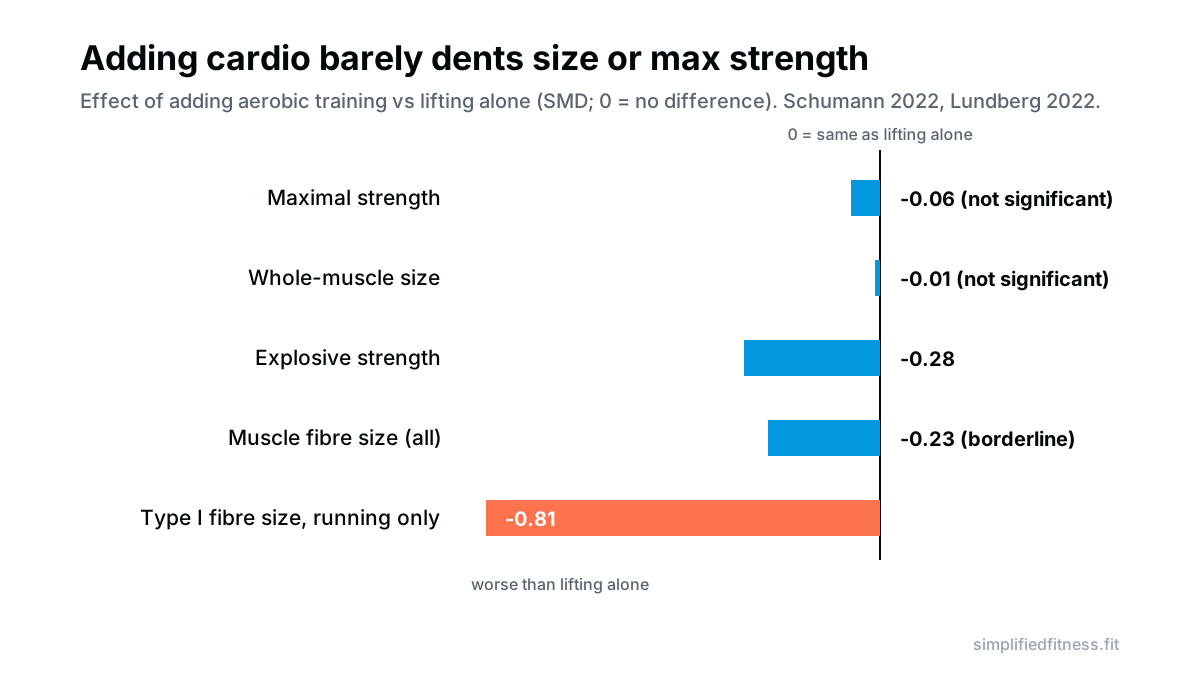
A closer look at individual fibres. A follow-up analysis of 15 studies measured fibre size directly. Overall fibre hypertrophy showed a small negative effect (-0.23, borderline at p = 0.050). The signal was clearest for type I fibres when the aerobic work was running (-0.81) but not cycling, and the authors call that preliminary (Lundberg et al., 2022).
The umbrella view. A 2026 umbrella review pooled 17 meta-analyses covering 144 studies. Strength, power and hypertrophy outcomes were comparable between concurrent training and lifting alone, while aerobic capacity improved more with concurrent training. Trends hinted that lifting before cardio on the same day might favour strength and hypertrophy, but the sequence effect was not significant, and data on highly trained athletes remain scarce (Held et al., 2026).
Why the studies disagree
Three reasons come up repeatedly.
- Different questions. Wilson pooled many designs and outcomes, including comparisons between types of concurrent training. Schumann restricted itself to cases where the lifting prescription was identical, which isolates the effect of adding cardio.
- Different amounts of cardio. Some trials used a modest dose, others used marathon-style volumes. The dose matters.
- Different people. Most subjects are untrained or recreationally trained. That says little about a natural lifter with six years of training who is already near the top of their curve.
The cautious takeaway: moderate cardio probably costs most lifters very little muscle. Heavy running volume on top of hard lifting is where the risk concentrates.
For a deeper look at what “muscle loss from cardio” actually means in practice, see can cardio cause muscle loss.
The AMPK vs mTOR explanation: neat story, messy data
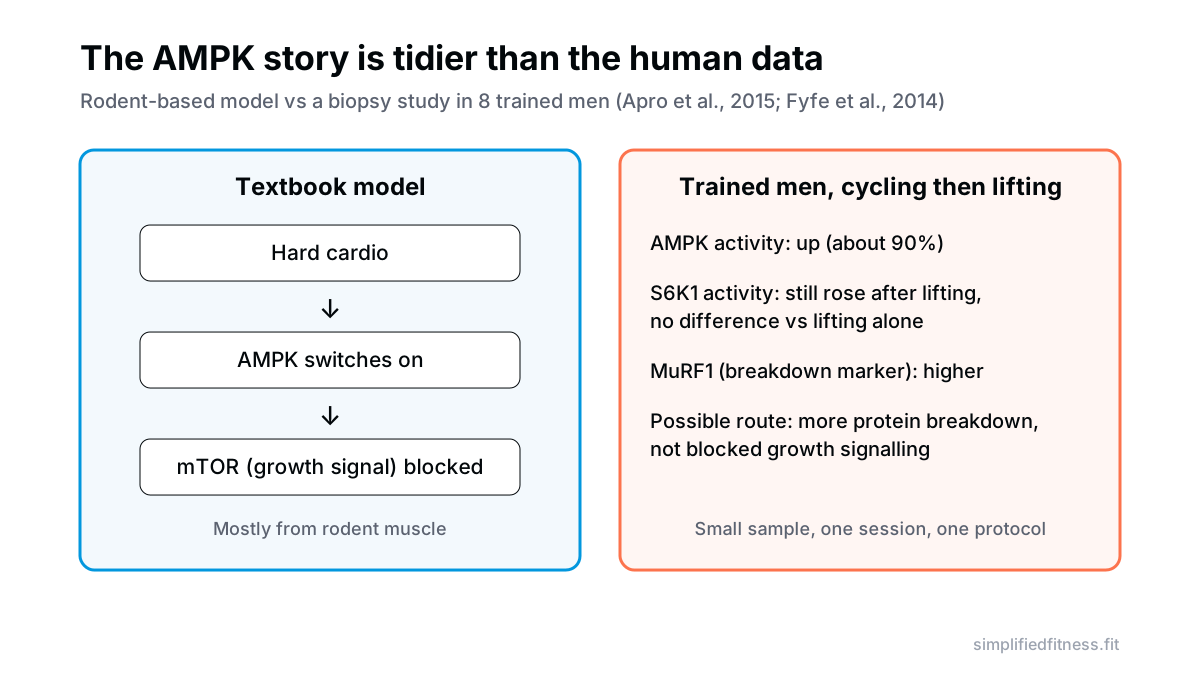
You have probably heard the mechanism. Cardio switches on AMPK (the cell’s energy sensor), AMPK blocks mTOR (the growth switch), so muscle protein synthesis shuts down. It is a tidy story. It also comes mostly from rodent muscle.
In humans, the picture is less clean. A review of the molecular literature noted that endurance exercise can inhibit growth-related signalling in muscle and stimulate breakdown in the lab, yet human studies have generally not found molecular interference after an acute session that explains compromised hypertrophy (Fyfe et al., 2014).
One direct test in eight trained men had them do either lifting alone or interval cycling followed by lifting, taking muscle biopsies throughout. AMPK activity rose (about 90%) after the cycling, yet S6K1, a downstream mTOR marker, was not inhibited. What did differ was MuRF1, a protein-breakdown marker, which went up in the combined session. The authors suggested interference may work through protein breakdown, not by blocking growth signalling (Apro et al., 2015).
If you want the full molecular walkthrough, we cover it in AMPK vs mTOR in concurrent training. Note too that calorie surplus or deficit changes mTOR and AMPK signalling on its own, which muddies any simple cardio explanation.
Does the type of cardio matter? Running, cycling and walking
Yes, probably, though not as dramatically as gym lore says. Running has the strongest “interference” reputation, for a mix of plausible reasons: it has an eccentric, impact-heavy component, it taxes the same muscles as squats and lunges, and it is easy to overdo in volume.
The data is mixed rather than damning:
- Wilson (2012) linked running, not cycling, to decrements in hypertrophy and strength.
- Lundberg (2022) found a type I fibre signal specific to running.
- Schumann (2022) found no difference between cycling and running across whole-muscle outcomes.
- Sabag (2018), looking at HIIT, saw a trend the other way for lower-body strength: cycling HIIT (-0.377, p = 0.074) looked worse than running HIIT (-0.176, p = 0.261), though neither reached significance (Sabag et al., 2018).
So no clean winner. A sensible reading is that high-volume running is the riskiest combination for lifters, while moderate cycling and walking are the easiest to fit around heavy legs. Our dedicated comparison of cycling vs running for lifters goes through the practical details, and incline treadmill walking is a strong low-impact option if you have a treadmill. If you have knee concerns, Stairmaster vs outdoor incline walking compares the loading.
Cardio frequency, duration and intensity: how much is too much?
The honest answer is that nobody has a proven threshold. What we have are signals.
Wilson’s meta-analysis found negative correlations between the frequency and duration of endurance training and outcomes for hypertrophy, strength and power. Schumann, by contrast, did not find a difference between more than 5 and fewer than 5 concurrent weekly sessions. The two analyses used different methods and study sets, so both can be partly right: more total endurance work probably costs more, but the cost may be smaller than once thought.
A practical frame for natural lifters:
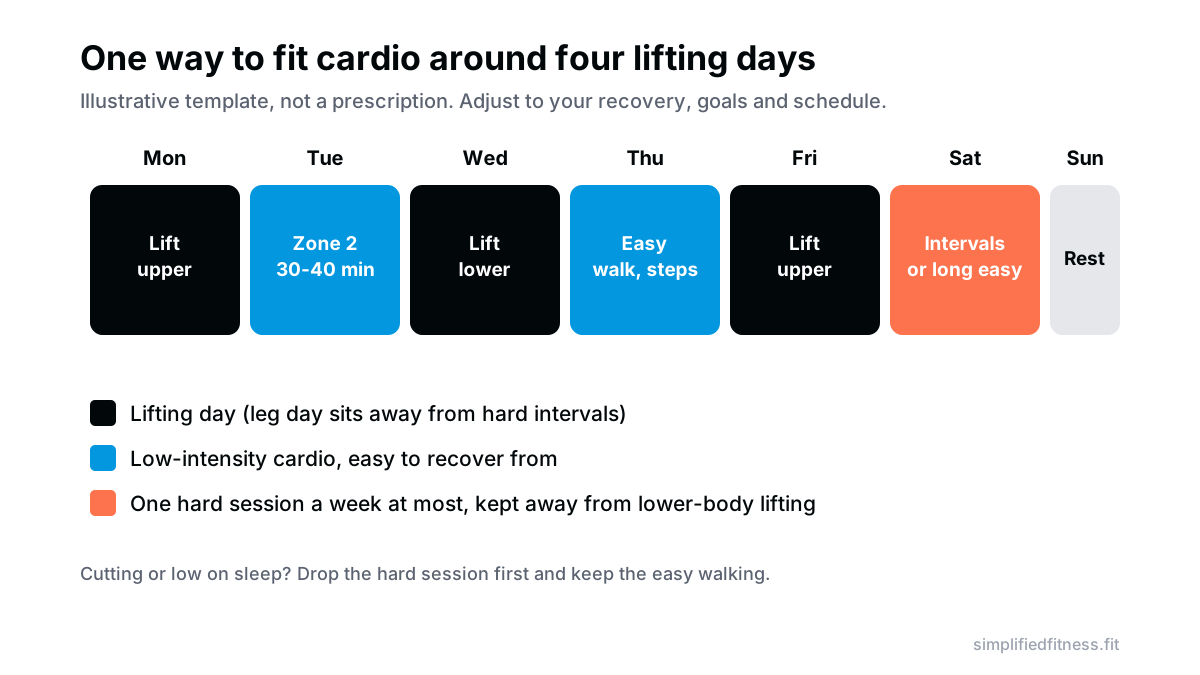
- Default dose: 2-3 easy sessions of 20-40 minutes plus daily walking.
- Hard sessions: about one a week, not more, away from heavy leg work.
- Warning signs: stalled or falling lifts, legs that stay heavy for days, poor sleep, a resting heart rate creeping up.
If those warning signs appear, cut the hardest cardio first and see if lifting recovers within a couple of weeks. That is usually faster than rebuilding your whole program. Our guide to minimum effective dose of cardio for longevity covers the lower end of what you need.
Does it matter if you are male or female, trained or untrained?
It might. A 2024 meta-analysis of 59 studies and 1,346 participants found that concurrent training blunted lower-body strength gains in males (-0.43) but not in females (+0.08). It also found untrained people, but not trained or highly trained endurance athletes, showed lower VO2 max gains with concurrent training (Huiberts et al., 2024).
Be careful with that. Fewer trials include women, and the authors themselves call for more studies in females and in highly trained athletes. It is a hint that the interference effect is not the same for everyone, not a rule.
Cardio timing: before, after, or on a separate day?
If you do both on the same day, the evidence leans toward lifting first when strength and size are the priority, but it is not conclusive. The 2026 umbrella review found no significant effect of order, only trends favouring resistance training before endurance training (Held et al., 2026).
Separation helps with one specific outcome. In Schumann’s analysis, the loss in explosive strength was more pronounced when concurrent training happened in the same session than when sessions were at least 3 hours apart (Schumann et al., 2022). Sabag’s HIIT analysis similarly suggested longer rest between modes might soften the lower-body strength penalty.
What this means for your week:
- Best: cardio on separate days from heavy legs.
- Next best: lift first, then cardio, with an easy effort.
- If you must do both close together: a gap of several hours is better than none. A morning walk and an evening lift is a common and sensible split.
We go deeper on scheduling in timing cardio and weights: before, after or separate days, and our workout splits guide shows where cardio fits inside different weekly structures.
Zone 2 cardio for lifters: what it is and whether you need it
Zone 2 is steady, easy aerobic work, roughly the pace at which you can still speak in full sentences. For many people that is around 60-70% of max heart rate, though the exact number varies, so the talk test is a better guide than a formula. Our heart rate zone calculator gives you a starting range.
Why lifters like it: it is easy to recover from, easy to fit around heavy training, and builds an aerobic base. The case for building that base is strong at the health level (more on that below). The case for zone 2 specifically being better than other moderate cardio is weaker, and much of the enthusiasm comes from endurance-athlete research rather than lifter trials. So zone 2 is a sensible default, not a proven edge.
A simple starting point is 2 sessions a week of 30-40 minutes on a bike, incline treadmill or brisk walk, at an effort where breathing is steady. For the mitochondrial rationale and how to find your zone, see zone 2 cardio for lifters and mitochondrial health.
LISS vs HIIT: which is better for lifters and for fat loss?
It depends what you want from it.
For aerobic fitness. A meta-analysis of 28 controlled trials (723 healthy adults aged 18-45) found both endurance training and HIT produced large improvements in VO2 max, with a possibly small additional benefit for HIT (about 1.2 mL/kg/min over endurance training) (Milanovic et al., 2015). Notably, those were mostly young, healthy participants, not lifters.
For muscle. In Sabag’s analysis, concurrent HIIT and lifting produced similar hypertrophy and upper-body strength to lifting alone, though lower-body strength gains were a bit smaller (ES = -0.248, p = 0.049) (Sabag et al., 2018).
For fat loss. The differences are small. A meta-analysis of 13 trials in overweight and obese adults found both methods reduced whole-body fat mass with no significant difference between them, while HIIT needed about 40% less training time (Wewege et al., 2017). A larger 2019 meta-analysis of 36 trials found similar drops in body fat percentage, but interval training produced somewhat more absolute fat loss (about 28.5% more) (Viana et al., 2019). Either way, your overall calorie deficit matters far more than the format. HIIT saves time. Steady cardio is easier on recovery and joints. Our LISS vs HIIT comparison for muscle preservation lays this out in detail.
| Factor | LISS / zone 2 | HIIT |
|---|---|---|
| Time per session | 30-60 min | 15-30 min |
| Recovery cost | Low | Moderate to high |
| VO2 max gains | Large | Large, possibly a bit more |
| Effect on leg training | Small if low impact | Can cut into leg recovery |
| Best for | Base, recovery days, cutting | Time-poor weeks, fitness peaks |
| Suggested dose for lifters | 2-3 sessions a week | 1 session a week at most |
How to build VO2 max without wrecking your lifting
VO2 max matters beyond sport. A 2024 overview of meta-analyses covering over 20.9 million observations found high cardiorespiratory fitness was associated with a hazard ratio of 0.47 for all-cause mortality compared with low fitness. Each 1-MET increase in fitness was linked to an 11-17% lower all-cause mortality risk (Lang et al., 2024). That is observational, so it shows association rather than proof, but the direction is consistent.
To raise it, interval work is the efficient route. The commonly used “Norwegian 4x4” format has you work hard for 4 minutes, rest actively for a few minutes, and repeat four times. It is demanding, so start with shorter, gentler intervals and build up over several weeks. Details and progressions are in VO2 max training for lifters: the Norwegian 4x4 protocol.
Keep the load on your week in check: one interval session, not three, and on a day when your legs will not be asked to do anything heavy the next morning.
Is fasted cardio better for fat loss?
The evidence does not support that. The idea is that exercising after an overnight fast makes you burn more fat. In the narrow sense, it does: a 2016 meta-analysis of 27 studies (273 participants) found higher fat oxidation during exercise in the fasted state than the fed state (Vieira et al., 2016).
But burning more fat during a session is not the same as losing more body fat. In a randomised trial, 20 young women on a hypocaloric diet did 1 hour of steady-state cardio 3 days a week for 4 weeks, either fasted or after a meal. Both groups lost weight and fat mass, and there were no significant differences between them (Schoenfeld et al., 2014). The sample was small and short, and all participants were young women, so it is not the last word, but it is a direct test of the real-world question.
Your body tracks energy balance over days and weeks, not over one morning session. If you feel good training fasted, go ahead. If you feel weak or dizzy, eat something first. More on this in fasted vs fed cardio and the fat loss myths.
Do steps count? The 10,000 steps question
Yes, they count, and more than most lifters assume. A meta-analysis of 15 cohorts (47,471 adults, 3,013 deaths) found more steps per day were associated with a progressively lower risk of all-cause mortality, levelling off around 6,000-8,000 steps for adults aged 60 and over, and 8,000-10,000 for younger adults (Paluch et al., 2022).
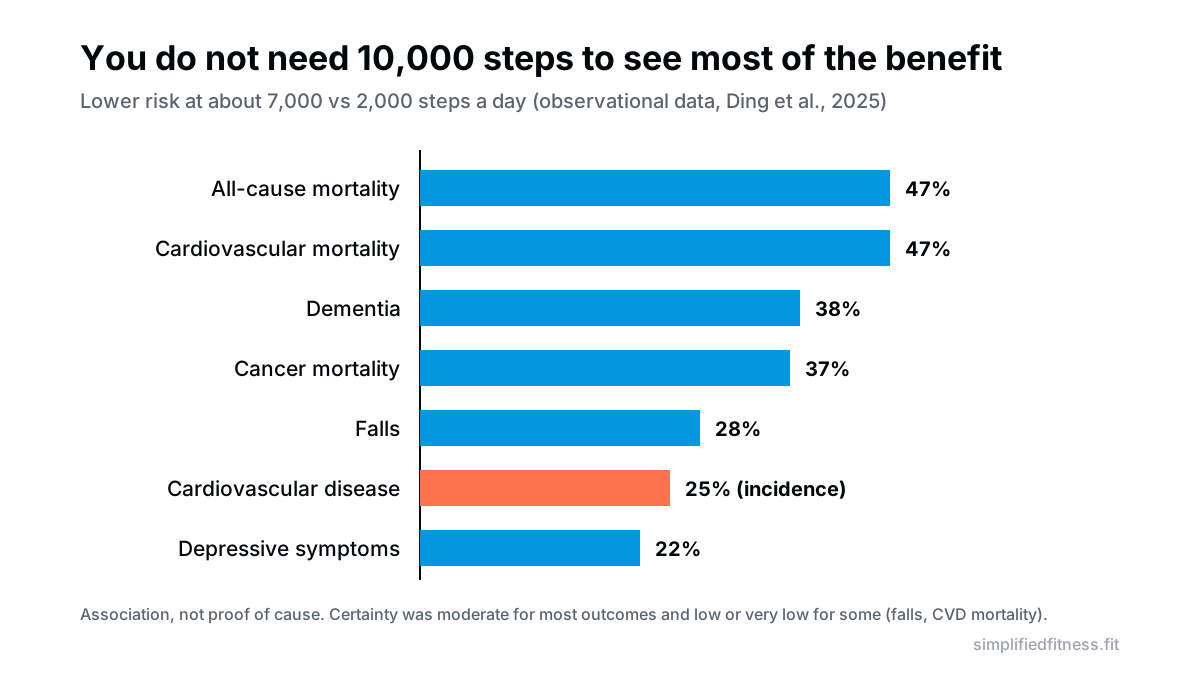
A 2025 dose-response meta-analysis went wider. Compared with 2,000 steps a day, 7,000 steps was associated with a 47% lower risk of all-cause mortality, 25% lower cardiovascular disease incidence, 14% lower type 2 diabetes risk, and 22% lower risk of depressive symptoms, with benefits for several outcomes flattening near 5,000-7,000 steps. The authors say 10,000 can still be a good target for already-active people, while 7,000 may be a more realistic goal for others. They also flag limits such as few studies for some outcomes and residual confounding (Ding et al., 2025).
Why this matters to a lifter: walking is the lowest-cost way to add activity. It barely touches recovery, it burns extra energy during a cut, and it does not compete with leg day. For fat loss specifically, see NEAT and 10,000 steps vs intense cardio. Use our calories burned calculator to estimate what a walk is worth.
Conditioning that suits lifters: beyond running
If you dislike running, there are good alternatives.
- Sled pushes, rowing and air bikes add conditioning with little eccentric muscle damage. See sled pushes, rowing and air bikes.
- Jump rope is cheap and compact, but heavy on calves and ankles. Our jump rope guide for lifters covers how to start.
- Rucking (walking with a loaded backpack) is a low-impact way to raise effort without running. See rucking for lifters.
- Swimming is joint-friendly but needs shoulder tolerance. See swimming for lifters.
If your goal is simply getting through hard sets without gasping, aerobic conditioning for hypertrophy and work capacity explains how a bigger aerobic base may help you repeat quality sets, though direct evidence in lifters is limited.
Cardio during a cut, recovery and hybrid training
Cardio during a cutting phase is useful but easy to overdo. A very large deficit, low protein and poor sleep are bigger threats to muscle on a cut than moderate cardio. Use walking and easy sessions to widen the deficit gently, and protect your lifting volume. Our cardio during the cutting phase guide has a step-by-step approach, and the full nutrition side lives in our energy balance, fat loss and bulking pillar.
Sleep is the other lever. Hard conditioning is cheap to add and expensive to recover from when you are short on sleep, which is why sleep and recovery belong in any concurrent-training plan. If you track your heart rate variability, HRV for concurrent training discusses how to use it without overreacting to daily noise.
For lifters who also run races, programming concurrent training for lifting and 5K-10K running gives a weekly layout. Hybrid athlete programming is basically the same principles at higher volume: protect your priority, keep the second goal at maintenance or modest progress, and expect trade-offs.
Indian context: heat, diet and budgets
A few practical points for training in India.
Heat. At the same pace, your heart rate runs higher in heat, so use the talk test, not a fixed speed. Train early or late, drink water, and stop if you feel dizzy or unwell.
Fuel. Interval days work better when you are not short on carbohydrates. Roti, rice, poha, oats or a banana before a session, with dal, curd, paneer or soya for protein across the day, covers most needs. Our diet plan shows how to build these meals on a budget.
Cost. Walking, stairs, skipping and cycling to work cost almost nothing. A Stairmaster or a branded watch is optional, not required.
Who should check with a doctor first
Cardio is safe for most people, but see a doctor before starting hard intervals if you have known heart or lung disease, chest pain or pressure, unexplained breathlessness, fainting, high blood pressure that is not controlled, or you are pregnant. The same applies if you are over about 40 and have been inactive for years. Stop and get medical help if you get chest pain, severe dizziness or unusual breathlessness during exercise.
This article is general education and not a diagnosis or a personal prescription.
The bottom line
Cardio and muscle growth are more compatible than gym lore suggests. In pooled data, adding cardio to lifting did not meaningfully reduce muscle size or max strength, though explosive strength and lower-body strength can take a small hit, particularly when sessions are packed close together and possibly with a lot of running.
So: keep easy cardio 2-3 times a week, keep hard intervals to one session at most, separate them from heavy legs when you can, walk a lot, and judge your cardio by what your lifts do over the next month. If you want a lifting program to pair with this, try our free workout plans, starting with leg day.
Go deeper: every guide in this topic
- Aerobic Conditioning and Hypertrophy: How Work Capacity Improves Inter-Set Recovery
- Can Cardio Cause Muscle Loss? The Calorie and Volume Thresholds Behind the Fear
- Cardio During a Cut: How Much You Need and When to Stop Adding
- Cycling vs Running for Lifters: Which Protects Muscle and Squat Strength?
- Fasted Cardio vs Fed Cardio: Does Skipping Breakfast Burn More Fat?
- Heart Rate Variability (HRV) in Concurrent Training: Tracking Autonomic Recovery
- Incline Treadmill Walking for Lifters: Settings, Science and Limits
- Jump Rope for Lifters: Ankle Stiffness, Footwork, and Calorie Burn
- LISS vs HIIT for Muscle Preservation: Which Cardio Should Lifters Pick?
- Minimum Effective Dose of Cardio for Longevity: Meeting the 150-Minute Health Guideline
- The Molecular Interference Effect: Does AMPK Really Switch Off mTOR When You Do Cardio?
- NEAT and Fat Loss: Why 10,000 Steps Often Beats Intense Cardio
- Programming Concurrent Training: Combining 4 Days of Lifting with 5k/10k Running Goals
- Rucking for Lifters: What Weighted Walking Does for Conditioning and Core
- Sled Pushes, Rowing, and Air Bikes: Low-Soreness Conditioning for Lifters
- Stairmaster vs Outdoor Incline Walking: Joint Impact, Knee Stress, and Caloric Burn
- Swimming for Lifters: Shoulder Mobility, Non-Impact Conditioning, and Lat Recovery
- Timing Cardio and Weights: Should You Do Cardio Before, After, or on Separate Days?
- VO2 Max Training for Lifters: The Norwegian 4x4 Protocol and Longevity
- Zone 2 Cardio for Lifters: What It Does for Mitochondria, Capillaries and Work Capacity
Frequently Asked Questions
Does cardio kill your gains?
Not in the way most gym talk suggests. A 2022 meta-analysis of 43 studies found no meaningful difference in muscle size or maximal strength between people who lifted and did cardio and people who only lifted. If gains stall, check total weekly fatigue, calories and sleep before blaming the treadmill.
What is the interference effect in simple terms?
It is the idea that endurance training can blunt some of the adaptations you get from lifting when the two are combined. The clearest signal in the research is smaller gains in explosive strength and lower-body strength, while muscle size is mostly preserved. It depends heavily on how much, how hard and how close together the sessions are.
Is running worse than cycling for muscle growth?
Possibly, but the evidence is mixed. A 2012 meta-analysis found running, not cycling, was linked to losses in hypertrophy and strength, and a 2022 analysis found running looked worse for type I fibre size. A separate 2022 analysis found no difference in whole-muscle outcomes between the two, so pick the one you will actually do and keep volume moderate.
How much cardio can I do without losing muscle?
There is no single proven ceiling. Older pooled data linked higher cardio frequency and longer sessions with worse strength and size outcomes, so more is not free. A practical range for most lifters is 2-3 easy sessions of 20-40 minutes plus daily walking, adjusted to how your lifting is going.
Should I do cardio before or after weights?
On the same day, do weights first if strength and size are your priority. A 2026 umbrella review found no significant effect of order but trends favouring lifting before cardio. If you can separate the sessions by about 3 hours or more, explosive strength gains looked less affected.
What is zone 2 cardio?
Zone 2 is steady, easy effort where you can still speak in full sentences, often around 60-70% of max heart rate. It is popular because it is easy to recover from and builds an aerobic base. The strongest evidence for aerobic fitness comes from endurance and general training studies, not zone 2 specifically in lifters, so treat it as a sensible default rather than a proven edge.
Is HIIT or steady-state cardio better for fat loss?
The differences are small. A 2017 meta-analysis in overweight adults found similar fat loss with both, with HIIT taking about 40% less time, while a 2019 meta-analysis found similar drops in body fat percentage but slightly more absolute fat lost with intervals. Choose by schedule and recovery, because your overall calorie deficit matters far more.
Does fasted cardio burn more fat?
It burns more fat during the session, but that does not translate into more fat loss over weeks. A 2016 meta-analysis found higher fat oxidation during fasted exercise, while a 4-week trial in young women on a hypocaloric diet found similar fat loss fasted or fed. Train fasted only if it suits your stomach and schedule.
Do I need cardio if I only want muscle?
For muscle alone, not strictly. For health, though, cardiorespiratory fitness is one of the strongest predictors of lower mortality in large cohort data. A few weekly sessions and daily steps cover most of the benefit.
Is 10,000 steps a day necessary?
No. A 2025 meta-analysis found benefits flattened out around 5,000-7,000 steps a day for several outcomes, with 7,000 linked to a 47% lower risk of all-cause mortality than 2,000. Aim for the highest comfortable number, and treat 10,000 as a good target if you are already active.
Can I do HIIT and heavy legs in the same week?
Yes, if you manage the spacing. A 2018 meta-analysis found concurrent HIIT and lifting left muscle size and upper-body strength intact but showed a small drop in lower-body strength gains. Keep intervals to one session a week and place them away from your heaviest leg day.
How long should I wait between cardio and lifting?
Around 3 hours or more looked helpful in one pooled analysis, mainly for explosive strength. Separate days are even simpler if you have the schedule. If you cannot split them, lift first and keep the cardio easy.
Does cardio help recovery between sets?
It may help, but the evidence for lifters specifically is limited. The idea is that a stronger aerobic system replenishes energy faster between hard sets. Build the base with easy cardio and see if your later sets feel more repeatable.
Will cardio make me lose muscle on a cut?
Moderate cardio is unlikely to be the main threat. A very large calorie deficit, low protein and poor sleep are bigger concerns for muscle on a cut. Keep lifting hard, eat enough protein, and use walking or easy cycling to widen the deficit gently.
Is walking enough cardio for lifters?
For general health, a lot of daily walking gets you much of the benefit seen in step studies. For maximal aerobic fitness, you also need some higher-intensity work because walking alone may not challenge a fit person enough. Many lifters do well with daily steps plus one or two structured sessions.
What is VO2 max and does it matter for lifters?
VO2 max is the highest rate at which your body can use oxygen during hard exercise, and it is a common measure of cardiorespiratory fitness. A 2024 overview of meta-analyses found high fitness was linked to about 53% lower all-cause mortality than low fitness (HR 0.47). Improve it with a mix of easy sessions and occasional intervals.
Do women face the same interference effect as men?
Possibly not. A 2024 meta-analysis of 59 studies found blunted lower-body strength gains in males but not in females with concurrent training. The data on females is still smaller, so treat this as promising rather than settled.
Is the 4x4 interval protocol safe for beginners?
It is demanding, so start with shorter, easier intervals and build up. The usual 4x4 format has you working hard for 4 minutes, four times, with easy recovery between. If you have heart disease risk factors, chest pain, or you are new to exercise after a long break, check with a doctor first.
How do I know if I am doing too much cardio?
Warning signs are lifts that stall or drop, heavy legs for days, poor sleep and a resting heart rate that creeps up. These point to total fatigue, not just cardio. Cut the hardest cardio first and see if lifting performance recovers within 2-3 weeks.
What cardio is best for lifters who want to protect their knees?
Low-impact options like cycling, incline walking and rowing are gentler on joints than running. Pick the one you can do pain free and progress slowly. If you have ongoing knee pain, see a doctor or physiotherapist rather than pushing through it.
Can I build a good aerobic base on a vegetarian Indian diet?
Yes, as long as total energy and protein are adequate. Dal, curd, paneer, soya and roti with enough rice around sessions can fuel both lifting and cardio. If your sessions feel flat, check you are not under-eating carbohydrates, especially on interval days.
Is cardio safe in hot Indian weather?
It can be, with adjustments. Heat raises heart rate at the same pace, so use effort or the talk test instead of a fixed speed. Train early or late, drink water, and stop if you feel dizzy, confused or unwell.
When should I see a doctor before starting cardio?
See a doctor first if you have known heart or lung disease, chest pain, unexplained breathlessness, fainting, or you are pregnant. Anyone over about 40 who has been inactive and plans hard intervals should also check in. Stop and seek help if you get chest pain or severe dizziness during exercise.
Sources & References
Every claim above is checked against peer-reviewed research (PubMed, U.S. National Library of Medicine) or guidance from established health bodies. How we fact-check.
- Wilson JM, et al. Concurrent training: a meta-analysis examining interference of aerobic and resistance exercises. J Strength Cond Res. 2012. PMID: 22002517
- Schumann M, et al. Compatibility of concurrent aerobic and strength training for skeletal muscle size and function: an updated systematic review and meta-analysis. Sports Med. 2022. PMID: 34757594
- Lundberg TR, et al. The effects of concurrent aerobic and strength training on muscle fiber hypertrophy: a systematic review and meta-analysis. Sports Med. 2022. PMID: 35476184
- Sabag A, et al. The compatibility of concurrent high intensity interval training and resistance training for muscular strength and hypertrophy: a systematic review and meta-analysis. J Sports Sci. 2018. PMID: 29658408
- Huiberts RO, et al. Concurrent strength and endurance training: a systematic review and meta-analysis on the impact of sex and training status. Sports Med. 2024. PMID: 37847373
- Held S, et al. Maximizing adaptations in concurrent training: an umbrella review of meta-analyses. Sports Med. 2026. PMID: 41762427
- Apro W, et al. Resistance exercise-induced S6K1 kinase activity is not inhibited in human skeletal muscle despite prior activation of AMPK by high-intensity interval cycling. Am J Physiol Endocrinol Metab. 2015. PMID: 25605643
- Fyfe JJ, et al. Interference between concurrent resistance and endurance exercise: molecular bases and the role of individual training variables. Sports Med. 2014. PMID: 24728927
- Schoenfeld BJ, et al. Body composition changes associated with fasted versus non-fasted aerobic exercise. J Int Soc Sports Nutr. 2014. PMID: 25429252
- Vieira AF, et al. Effects of aerobic exercise performed in fasted v. fed state on fat and carbohydrate metabolism in adults: a systematic review and meta-analysis. Br J Nutr. 2016. PMID: 27609363
- Milanovic Z, et al. Effectiveness of high-intensity interval training (HIT) and continuous endurance training for VO2max improvements: a systematic review and meta-analysis of controlled trials. Sports Med. 2015. PMID: 26243014
- Paluch AE, et al. Daily steps and all-cause mortality: a meta-analysis of 15 international cohorts. Lancet Public Health. 2022. PMID: 35247352
- Ding D, et al. Daily steps and health outcomes in adults: a systematic review and dose-response meta-analysis. Lancet Public Health. 2025. PMID: 40713949
- Lang JJ, et al. Cardiorespiratory fitness is a strong and consistent predictor of morbidity and mortality among adults: an overview of meta-analyses representing over 20.9 million observations from 199 unique cohort studies. Br J Sports Med. 2024. PMID: 38599681
- Wewege M, et al. The effects of high-intensity interval training vs. moderate-intensity continuous training on body composition in overweight and obese adults: a systematic review and meta-analysis. Obes Rev. 2017. PMID: 28401638
- Viana RB, et al. Is interval training the magic bullet for fat loss? A systematic review and meta-analysis comparing moderate-intensity continuous training with high-intensity interval training (HIIT). Br J Sports Med. 2019. PMID: 30765340

Umair Hazrami · Founder & Head Coach, Simplified Fitness
Umair Hazrami founded Simplified Fitness and the Simplified Lifter channel to cut through fitness noise. With 4+ years of consistent training and 10+ coaching clients, he writes every guide from the peer-reviewed research and links the sources so you can check them. Our editorial standards.
Educational content only, not medical advice. If you have a medical condition, are pregnant, or take medication, talk to a qualified doctor before changing your diet, supplements or training. Full disclaimer.
Keep reading
Strength & Cardio
1-Rep Max Testing vs 1RM Formulas: Which Is More Accurate and What Does Each Cost You?
1RM testing vs calculation: how accurate are Epley and Brzycki, when a true max is worth the risk, and a safe protocol if you do test. Studies linked.
9 min read

Strength & Cardio
Accommodating Resistance: Do Bands and Chains Really Match the Squat and Bench Strength Curve?
Accommodating resistance with bands and chains makes the top of a lift heavier. See what trials show on power and strength, and how to set it up safely.
9 min read
Strength & Cardio
Aerobic Conditioning and Hypertrophy: How Work Capacity Improves Inter-Set Recovery
Does better cardio help you recover between sets? See what work capacity resistance training research says, where theory outruns data, and what to do.
9 min read
Strength & Cardio
Can Cardio Cause Muscle Loss? The Calorie and Volume Thresholds Behind the Fear
Does cardio cause muscle loss? Not at normal doses. See what the meta-analyses say about deficits, protein and running volume, and how to protect your muscle.
9 min read