Accommodating Resistance: Do Bands and Chains Really Match the Squat and Bench Strength Curve?
Accommodating resistance with bands and chains makes the top of a lift heavier. See what trials show on power and strength, and how to set it up safely.

TL;DR. The short answer
- Accommodating resistance means attaching chains or bands to a barbell so the load gets heavier as you approach lockout, which loosely matches the way most lifters get stronger toward the top of a squat or bench.
- Acutely, variable resistance raised mean bar velocity (SMD 0.68) and mean power (SMD 1.02) in a 16-study meta-analysis, but long-term results are mixed: a 17-study meta-analysis found no significant difference in strength or power versus plain barbell training, while two other meta-analyses reported a modest strength edge.
- Chains or bands are best treated as a power and bar-speed tool for experienced lifters, using roughly 10-20% of the load from the accommodating piece, not as a shortcut to a bigger max.
- Bands and chains behave differently: heavy bottom-matched chains slowed the bench bar in one study, and the choice changes spinal loading in the squat.
- Start light, keep the setup stable, and see a doctor or physio if you have shoulder, back or knee pain that does not settle.
Part of our complete guide: Maximal Strength, Neuromuscular Adaptations & Powerlifting Science for General Lifters
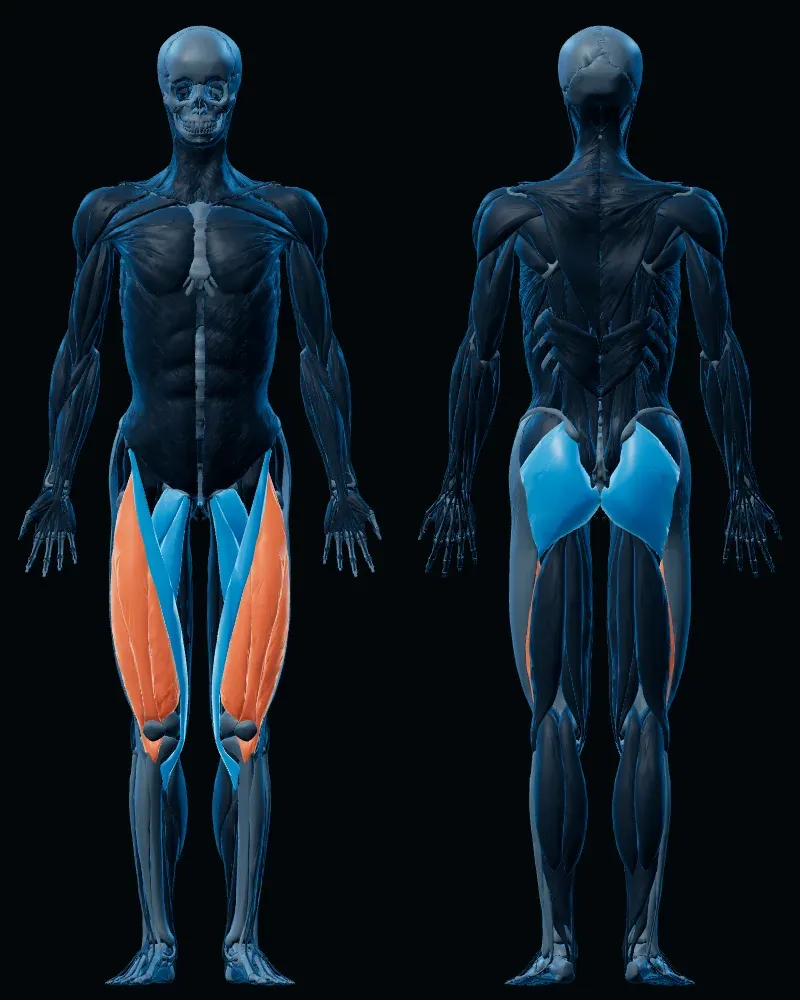
Muscles worked: quads
Main movers: rectus femoris and the three vasti
Assisting: adductors, sartorius and glutes
Table of contents
Accommodating resistance means attaching chains or elastic bands to a barbell so the load rises as you get closer to lockout (part of our maximal strength and powerlifting guide). It is built around the idea that you are usually stronger at the top of a squat or bench than at the bottom, so a plain barbell is too easy at the end and too hard at the start. Whether that turns into a bigger max is less clear, and that is what this article sorts out. It also complements our piece on matching resistance profiles to human strength curves.
Short version: the research supports bands and chains as a way to move the bar faster and produce more power in the session. It does not clearly show that they build more strength than normal training.
What is accommodating resistance and why use it?
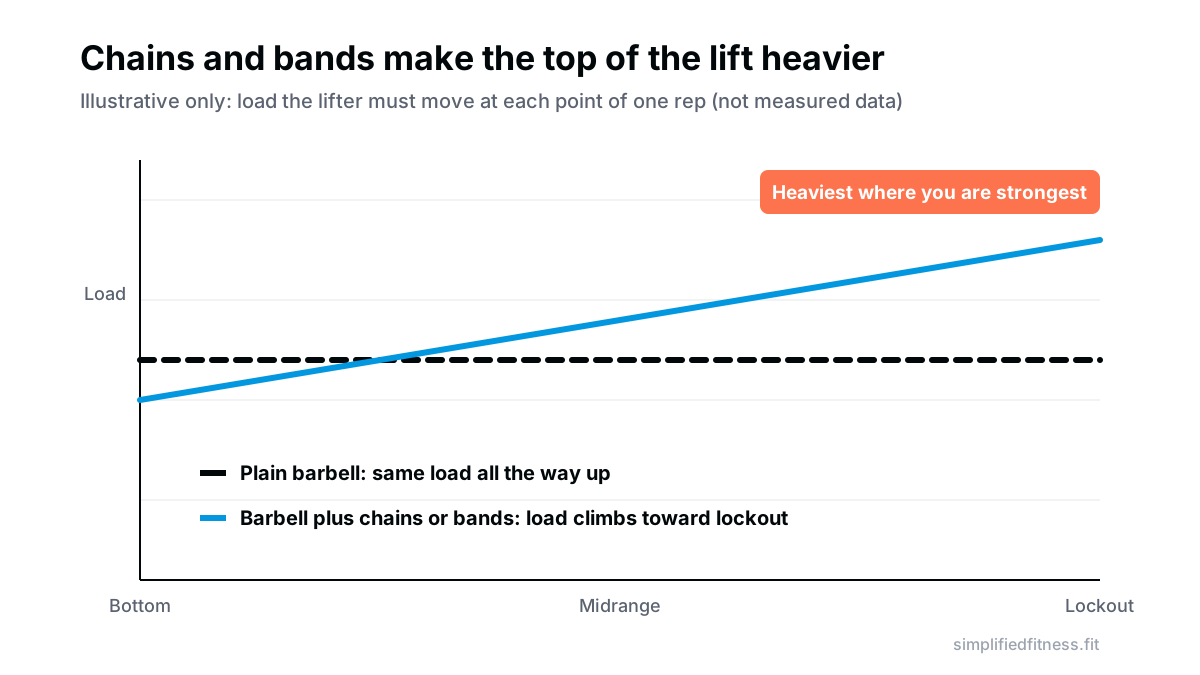
A barbell weighs the same at every point of the rep. Your joint angles and muscle force do not stay the same. In a squat, the bottom is where the hips and knees are in the weakest position and the top is where you can push hardest. The bench has a similar story, with a sticking region partway up and an easier lockout.
So on a plain barbell, you pick a load you can grind through the hard part, and the easy part is undersold. If you try to move the bar fast, you may also be decelerating near the top, because there is no reason to keep pushing once the hard bit is over.
Accommodating resistance changes that. As the bar rises, chain links leave the floor, or a band attached to the rack base stretches further. Either way, the lifter pushes against a heavier bar near lockout.
This approach is closely tied to the Westside Barbell system associated with Louie Simmons, which pairs heavy max effort work with lighter dynamic effort days using bands and chains. The coaching logic is plausible. The research, as you will see, is more mixed than gym lore suggests.
How do bands and chains actually differ?
They both make the bar heavier near the top, but they feel different.
Chains are steady. Each link that leaves the floor adds a little weight, so the load ramps up in a fairly smooth way. At the bottom of a squat, part of the chain is resting on the floor and does not count.
Bands behave like springs. The further they stretch, the harder they pull. They can also add downward pull on the way down, so the bar can come down faster than you expect, which affects control in the lowering phase.
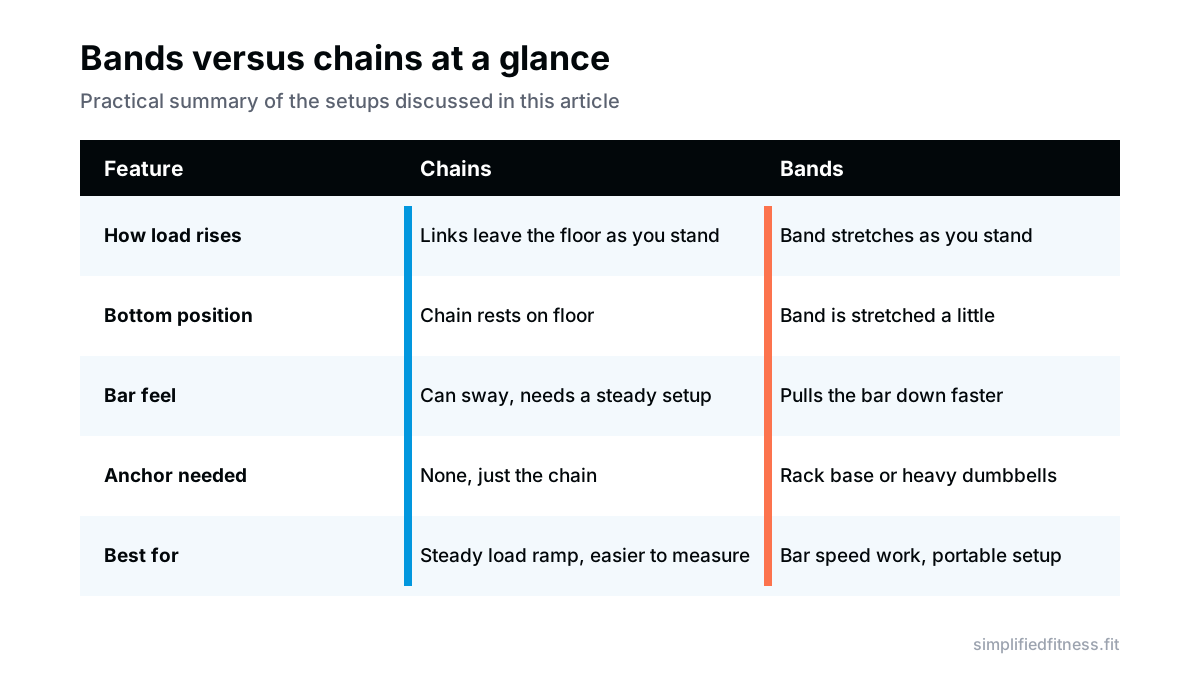
A 2026 lab study of 15 men back squatting with chains, elastic bands and free weights found real differences. Peak ground reaction force was greater with plain free weights than with either variable resistance setup, but concentric rate of force development was greater with chains than with free weights. Joint velocities were mostly faster with variable resistance, and free weights produced greater hip and lumbar spine moments. The authors suggested chains may be preferable for power adaptation, and bands may suit lifters prone to lumbar problems, because they stimulate the legs while lowering spinal loading (Alves et al., 2026). That was a small acute study in men, so treat it as a hint, not a rule.
Does accommodating resistance build explosive power?
In the session itself, it often does. A 2022 meta-analysis pooled 16 crossover studies with 207 participants. Variable resistance produced greater mean velocity (SMD 0.675, moderate-quality evidence) and greater mean power (SMD 1.022, low-quality evidence) than constant resistance. Subgroup analysis found the clearest gains in mean velocity and mean power when the total load was equated. However, when the variable setup was the heavier one, peak velocity was marginally reduced. The meta-regression also found that peak velocity, peak power and rate of force development were positively moderated by the use of elastic bands (Shi et al., 2022).
Individual studies agree in direction. Ten men squatting with elastic bands produced greater power and velocity in both the acceleration and deceleration phases, although force during acceleration was lower than with free weights (Kubo et al., 2018). In eight trained rugby players, chains at 15% of 1RM on top of a 30% constant load gave likely greater mean bar velocity and bar acceleration in a bench throw than a constant 45% load, though peak and mean power differences were trivial or unclear (Godwin et al., 2018).
There is also a warm-up angle. In 15 strength-trained men, a set of three trap bar deadlifts at 80% of 1RM with about 15% of 1RM in band tension improved a squat jump 90 seconds later, while the same lift with free weights alone did not (effect size 0.34) (Masel et al., 2024). That is a one-off acute effect in a small group. If you want the wider picture on that topic, see our article on post-activation performance potentiation.
Does it build more maximal strength? The studies disagree
This is the part where the story gets uncomfortable for the gym lore.
Studies finding a benefit. In a 7-week trial of 44 resistance-trained athletes, those who added elastic resistance to back squat and bench press gained 16.47 kg on the squat versus 6.84 kg for the control group, and 6.68 kg versus 3.34 kg on the bench, with larger average power gains too (Anderson et al., 2008). A 2022 meta-analysis of 14 studies reported higher maximal strength with variable resistance (ES 0.80 overall, 0.57 in trained subjects). In trained subjects the advantage appeared when the load was 80% of 1RM or more, and not below that (Lin et al., 2022). A 2026 meta-analysis found long-term advantages for maximal strength and jump distance (SMD 0.28 to 0.37), especially with chains or a variable-load share of 20% or less (Li et al., 2026).
Studies finding no difference. A different 2022 meta-analysis of 17 studies and 491 adults aged 18-37 found no significant difference between variable and traditional training for lower-body strength (SMD -0.10) or upper-body strength (SMD -0.17), and none for muscle power either (Andersen et al., 2022). In 19 women athletes, bench press with chains at 5% of the load gained 17.4% versus 11.8% for traditional training over 16 sessions, but the difference was not statistically significant (Burnham et al., 2010). And in 19 strength-trained women over 7 weeks, accommodating resistance improved Wingate peak power but not 1RM compared with traditional training (Parten et al., 2023).
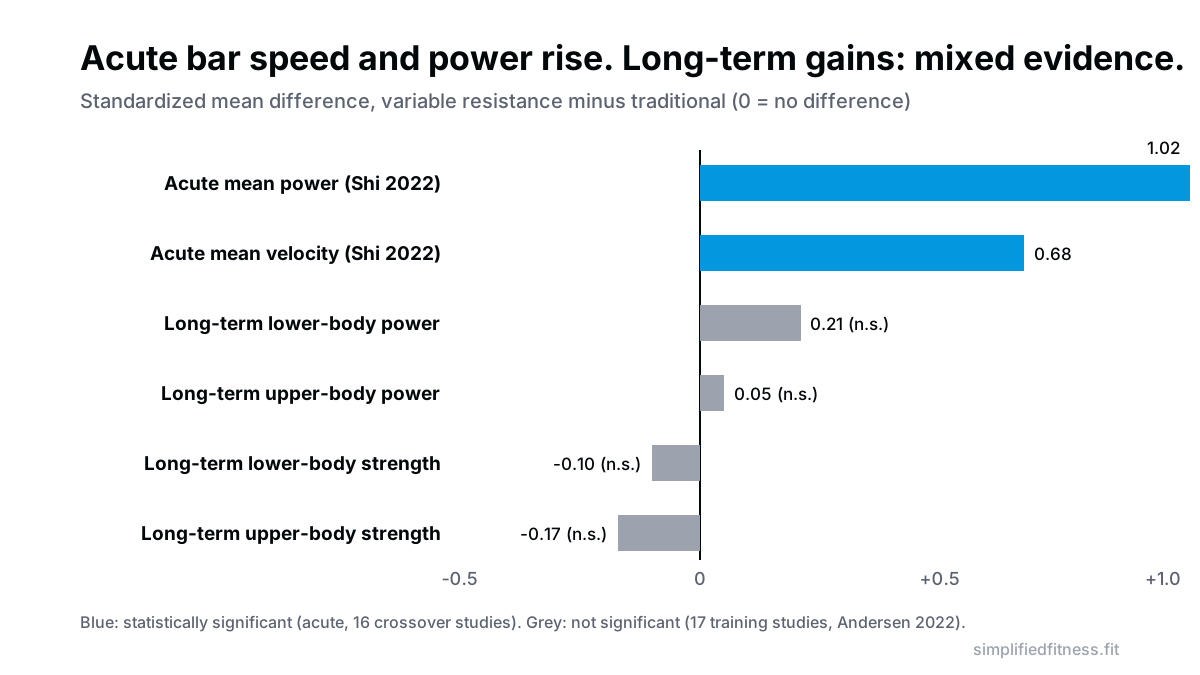
Why might they differ? The meta-analyses did not use the same sets of studies, definitions or outcome measures. Training periods are short, often 6-8 weeks. Participants differ in training status, and the amount of variable load, the equipment, the exercise and the way total load was matched all vary. Several of the positive trials are also small.
A cautious takeaway. Accommodating resistance is unlikely to hurt, and it may give a modest edge in power or in max strength for some experienced lifters. It is not a proven shortcut. If your plain-barbell training is progressing, you do not need it.
How to use bands and chains in your training
The coaching question is where it fits, and the answer is on lighter, faster work.
Choose a purpose. If your goal is rate of force development or bar speed, use it on a dynamic effort day. Our article on rate of force development and explosive training covers the bigger picture of that quality. For the intent side, see moving the bar with explosive intent.
Keep the accommodating share modest. The 2026 meta-analysis found long-term advantages with a variable-load share of 20% or less. Acutely, a share above 20% gave higher force output, while above 37% lower velocity and power than free weights (Li et al., 2026). One older clean pull study (six teenage female weightlifters) found adding elastic tubing at 10% of 90% 1RM gave the best increase in power, force and velocity (Paditsaeree et al., 2016). A reasonable starting point is about 10-20% of the bar’s total load coming from the chain or band.
Do not match the bottom load too heavily. In resistance-trained men benching at 85% of 1RM, chains matched to the resistance at the bottom produced lower peak velocities and longer lifting times than the conventional lift. Muscle activation changed mainly in the lowering phase (van den Tillaar et al., 2022). In plain terms, if you stack too much chain on top of a heavy bar, you slow the very thing you were trying to speed up.
For the squat, lifters can see the exercise in practice below.
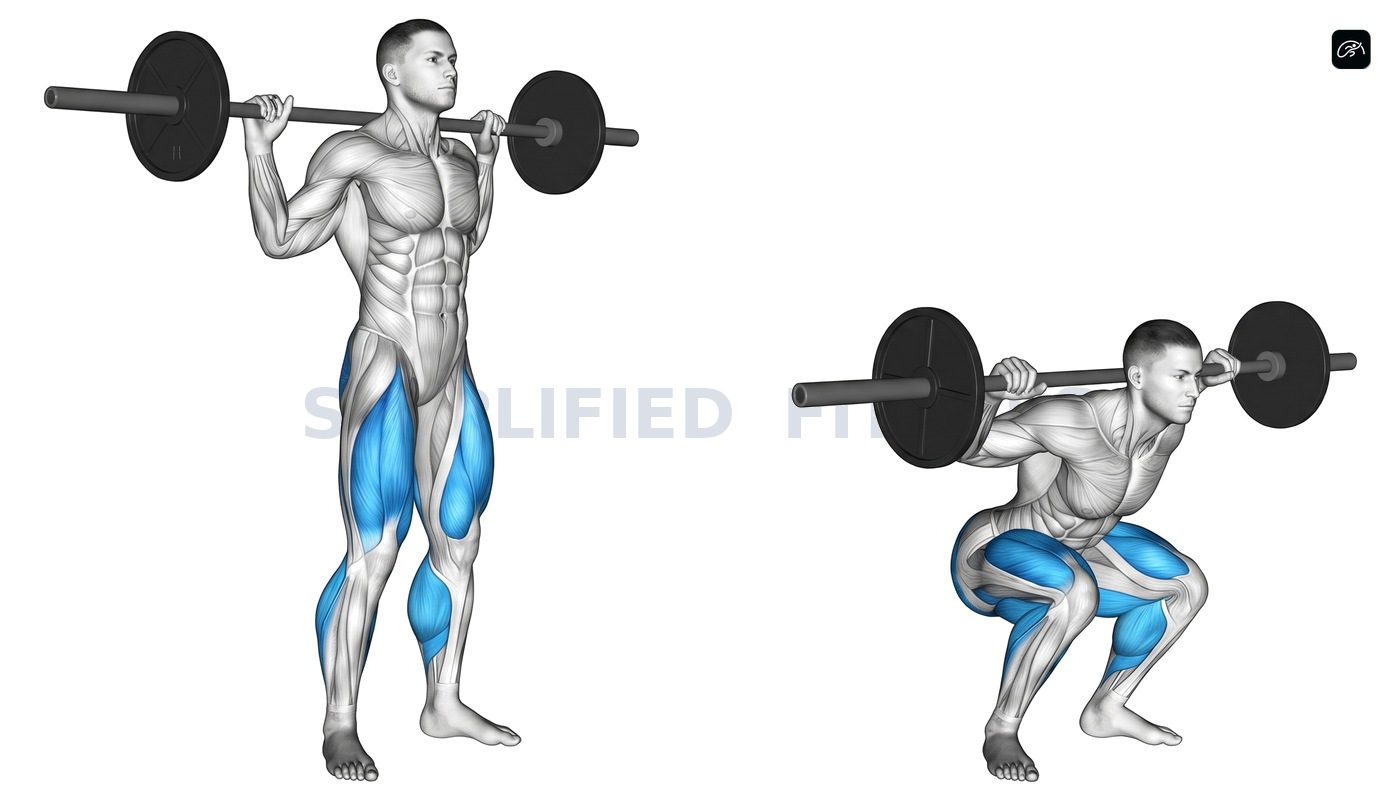
Setup basics.
- Use a power rack with safeties set below the bottom of your squat or bench.
- Anchor bands firmly to the base of the rack or a heavy fixture, and inspect them for nicks.
- Hang chains on loops or smaller chains over the sleeve so they are centred and do not swing.
- Unrack with the extra load on and take a few lighter warm-up sets, because the bar behaves differently.
If you also train legs separately, our free leg day plan shows where heavy squat work usually sits in a week.
What are the common mistakes?
- Going too heavy with the accommodating piece. Very high variable-load shares reduced velocity and power in the 2026 meta-analysis.
- Expecting it to fix a sticking point. The studies measure bar speed, power and strength, not whether one weak range improved. For that problem, see sticking point analysis for squat, bench and deadlift.
- Skipping safety. Bands can slip and chains swing. A rack with safeties matters more here than normally.
- Turning every session into a gimmick. If your plain-barbell numbers are not climbing, check your sets, sleep and food first.
Who should (and should not) bother?
It makes the most sense for lifters who already have a few years of consistent training, a stable technique and a plateau, or for athletes who care about speed and power. Beginners progress fast on a plain bar and gain little from the extra complexity.
If you only want bigger muscles, there is no evidence in the studies reviewed here that accommodating resistance beats standard training for hypertrophy, because they did not measure it. Standard sets near failure remain the default.
For lifters in India training in a commercial gym, chains and bands may not be available, and they are not essential. Paused reps, controlled tempo and moving the bar with intent cover most of the same training purpose at no cost.
When to see a doctor
Variable resistance changes the bar path and loading pattern. If you get sharp pain in your shoulder, lower back or knee, numbness, or pain that lingers for days, stop and get checked by a doctor or physiotherapist. Do not train through pain that changes how you move. This article is education, not medical advice.
Frequently asked questions
The questions people ask most are in the FAQ section below. If you want a structured way to fit speed work into your week, our free training plans are a good place to start, and the maximal strength guide shows how the pieces fit together.
Frequently Asked Questions
What is accommodating resistance in weightlifting?
Accommodating resistance is any setup where the load changes through the range of motion, usually by hanging chains or looping bands on a barbell. As you stand up or press, more chain leaves the floor or the band stretches further, so the bar feels heavier near lockout. Try it first on a lighter speed day, not your heaviest work.
Do bands and chains build more strength than a normal barbell?
Not reliably. A 17-study meta-analysis of 491 healthy adults found no significant difference in maximal strength between variable and traditional resistance training, while another meta-analysis (14 studies) reported an advantage for variable resistance. Treat it as an optional variation, and judge it by your own squat and bench numbers over a 6-8 week block.
Do chains or bands increase explosive power?
Acutely, often yes. A meta-analysis of 16 crossover studies found higher mean velocity and mean power with variable resistance than with constant resistance, though peak velocity could drop when the variable load was high. Use it on speed work where you move a moderate load as fast as you can.
How much weight should chains or bands add?
The research points to a modest share of the load coming from the accommodating piece. A 2026 meta-analysis found long-term gains with 20% or less variable load, higher acute force output above 20%, and lower velocity and power above 37%. For most lifters, keeping it near 10-20% of the bar load is a sensible starting range.
Are chains or bands better for squats?
Neither is clearly better for everyone. In a small study of 15 men, chains produced greater concentric rate of force development than a free-weight squat, while bands reduced hip and lumbar moments compared with free weights. Pick chains for a steadier load ramp and bands if you want less spinal loading, and keep reps crisp.
Can I use bands or chains on bench press?
Yes, but they change the bar path and speed. In resistance-trained men, chains matched to the bottom position produced lower peak velocity and longer lifts than a conventional 85% bench. Use a power rack with safeties or a spotter, and start with light chains on submaximal sets.
What is the Westside Barbell method?
It is the powerlifting system associated with Louie Simmons, which uses dynamic effort days with bands and chains alongside max effort work. The theory is that variable resistance trains acceleration through the sticking point. The theory is plausible, but controlled trials show mixed long-term results, so use it as one option rather than a rule.
Are bands and chains safe?
They are reasonably safe when set up properly, but they add an unstable element. Bands can snap or slip and chains can swing, so check wear, anchor firmly and use safeties. If you have a joint or back problem, get a clinician's advice before adding them.
Do I need bands and chains if I am a beginner?
No. Beginners get faster results from simply adding weight with good technique and enough sets. Variable resistance matters more once progress on a plain barbell has slowed, and even then the evidence for it is modest.
Can I train at home without bands or chains?
Yes. Your strength gains come mainly from progressive overload, so a plain barbell with plates is enough. Tempo changes, paused reps and moving the bar with intent can replicate some of the speed work without extra equipment.
Does accommodating resistance fix a sticking point?
Not directly, and the evidence is thin. The idea is that the lighter bottom lets you accelerate through the weak spot, but studies mostly measure bar speed and power rather than sticking point strength. If one point is your limiter, a targeted fix such as paused reps often makes more sense.
Do bands and chains help hypertrophy?
Probably not much more than a standard barbell. The research reviewed here measured strength, power and velocity rather than muscle size, so any hypertrophy benefit is unproven. Use standard sets close to failure for size, and keep accommodating resistance for speed work.
Sources & References
Every claim above is checked against peer-reviewed research (PubMed, U.S. National Library of Medicine) or guidance from established health bodies. How we fact-check.
- Andersen V, et al. Comparing the effects of variable and traditional resistance training on maximal strength and muscle power in healthy adults: A systematic review and meta-analysis. J Sci Med Sport. 2022. PMID: 36130847
- Shi L, et al. Acute effects of variable resistance training on force, velocity, and power measures: a systematic review and meta-analysis. PeerJ. 2022. PMID: 35996662
- Lin Y, et al. Effects of Variable-Resistance Training Versus Constant-Resistance Training on Maximum Strength: A Systematic Review and Meta-Analysis. Int J Environ Res Public Health. 2022. PMID: 35886409
- Li J, et al. Comparison of Variable Resistance and Free Weight Training on Long-Term and Acute Effects on Different Assessments of Strength: A Systematic Review and Meta-Analysis. J Strength Cond Res. 2026. PMID: 41460711
- Anderson CE, et al. The effects of combining elastic and free weight resistance on strength and power in athletes. J Strength Cond Res. 2008. PMID: 18550975
- Burnham TR, et al. Bench press training program with attached chains for female volleyball and basketball athletes. Percept Mot Skills. 2010. PMID: 20391870
- Parten AL, et al. Seven-Week Accommodating Resistance Training Improves Wingate Peak Power But Not Muscular Strength or Endurance in Strength-Trained Females. J Strength Cond Res. 2023. PMID: 37115950
- van den Tillaar R, et al. The Acute Effects of Attaching Chains to the Barbell on Kinematics and Muscle Activation in Bench Press in Resistance-Trained Men. J Funct Morphol Kinesiol. 2022. PMID: 35645301
- Alves AV, et al. Joint-Level Analysis of the Barbell Back Squat During Chain and Elastic Variable Resistance Use. J Strength Cond Res. 2026. PMID: 42017976
- Masel S, et al. Accommodating resistance is more effective than free weight resistance to induce post-activation performance enhancement in squat jump performance after a short rest interval. J Exerc Sci Fit. 2024. PMID: 38173797
- Kubo T, et al. Effect of Accommodating Elastic Bands on Mechanical Power Output during Back Squats. Sports (Basel). 2018. PMID: 30469523
- Godwin MS, et al. Effects of Variable Resistance Using Chains on Bench Throw Performance in Trained Rugby Players. J Strength Cond Res. 2018. PMID: 29309388
- Paditsaeree K, et al. Comparison Between the Effects of Combining Elastic and Free-Weight Resistance and Free-Weight Resistance on Force and Power Production. J Strength Cond Res. 2016. PMID: 24662231

Umair Hazrami · Founder & Head Coach, Simplified Fitness
Umair Hazrami founded Simplified Fitness and the Simplified Lifter channel to cut through fitness noise. With 4+ years of consistent training and 10+ coaching clients, he writes every guide from the peer-reviewed research and links the sources so you can check them. Our editorial standards.
Educational content only, not medical advice. If you have a medical condition, are pregnant, or take medication, talk to a qualified doctor before changing your diet, supplements or training. Full disclaimer.
Keep reading
Strength & Cardio
1-Rep Max Testing vs 1RM Formulas: Which Is More Accurate and What Does Each Cost You?
1RM testing vs calculation: how accurate are Epley and Brzycki, when a true max is worth the risk, and a safe protocol if you do test. Studies linked.
9 min read
Strength & Cardio
Competition Bench Press Technique: Arch, Leg Drive, Lats and Bar Path Explained
Competition bench press technique explained: scapular setup, leg drive, lat tension, bar path and pause commands, plus what the research does and does not show.
10 min read
Strength & Cardio
Conventional vs Sumo Deadlift: Which Suits Your Hips, Limbs and Back?
Conventional vs sumo deadlift biomechanics: what the studies show on muscle demand, bar path and back load, plus a simple test to pick the style for your body.
10 min read

Strength & Cardio
Daily Undulating Periodization (DUP) for Concurrent Strength and Hypertrophy
A powerbuilding program with DUP: heavy, moderate and volume days in one week, with the research, a 12-week template and a rule for ordering lifts.
8 min read