Knee Sleeves vs Knee Wraps for Squats: What Each One Really Does
Knee sleeves vs knee wraps for squats: sleeves add a few kg and a feeling of stability, wraps store elastic energy. See the lab data and which one to buy.

TL;DR. The short answer
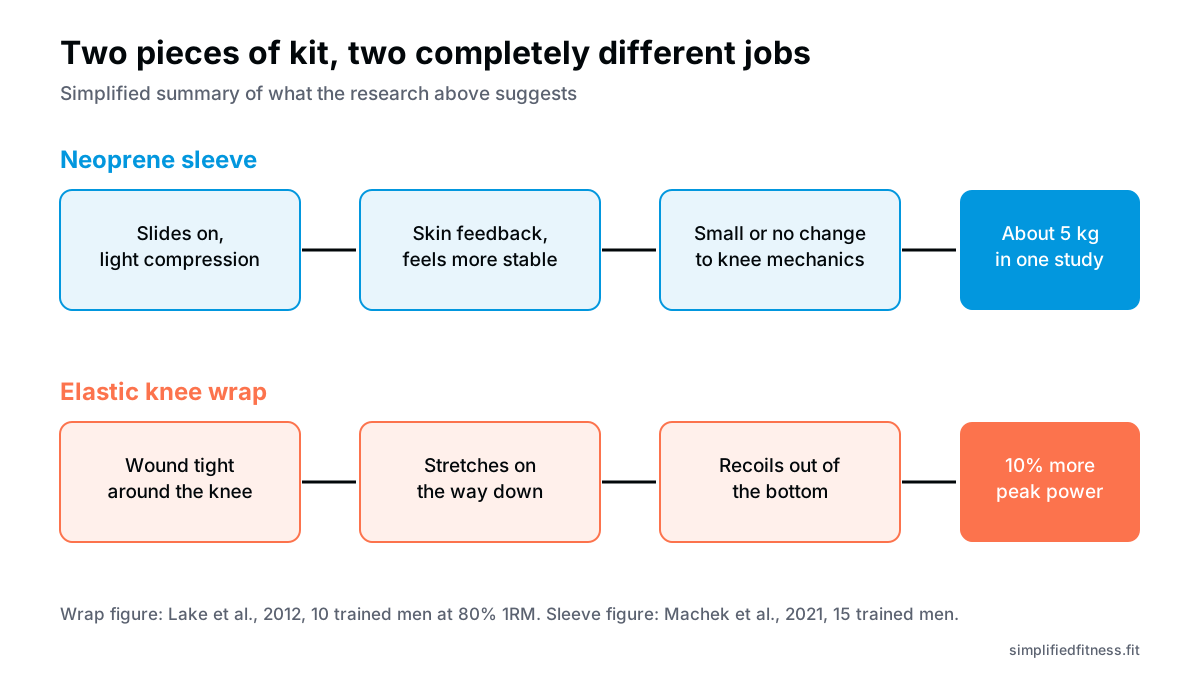
- Neoprene knee sleeves gave about 5 kg more on squat 1RM (161 vs 166 kg) in one crossover study of 15 trained men, with no change in jump power or leg extension performance.
- Elastic knee wraps store energy on the way down and release it out of the hole. In 10 trained men at 80% of 1RM, wraps raised peak power by 10% and changed squat technique.
- Sleeves are the sensible default for training. Wraps are a competition tool for equipped lifters, and the authors of the wrap study advised against using them in routine training.
- Evidence that sleeves reduce knee pain is weak. A Cochrane review found very low quality evidence of no meaningful pain benefit for knee orthoses in patellofemoral pain.
- Sharp, swelling or persistent knee pain needs a doctor or physio, not a piece of neoprene.
Part of our complete guide: Maximal Strength, Neuromuscular Adaptations & Powerlifting Science for General Lifters
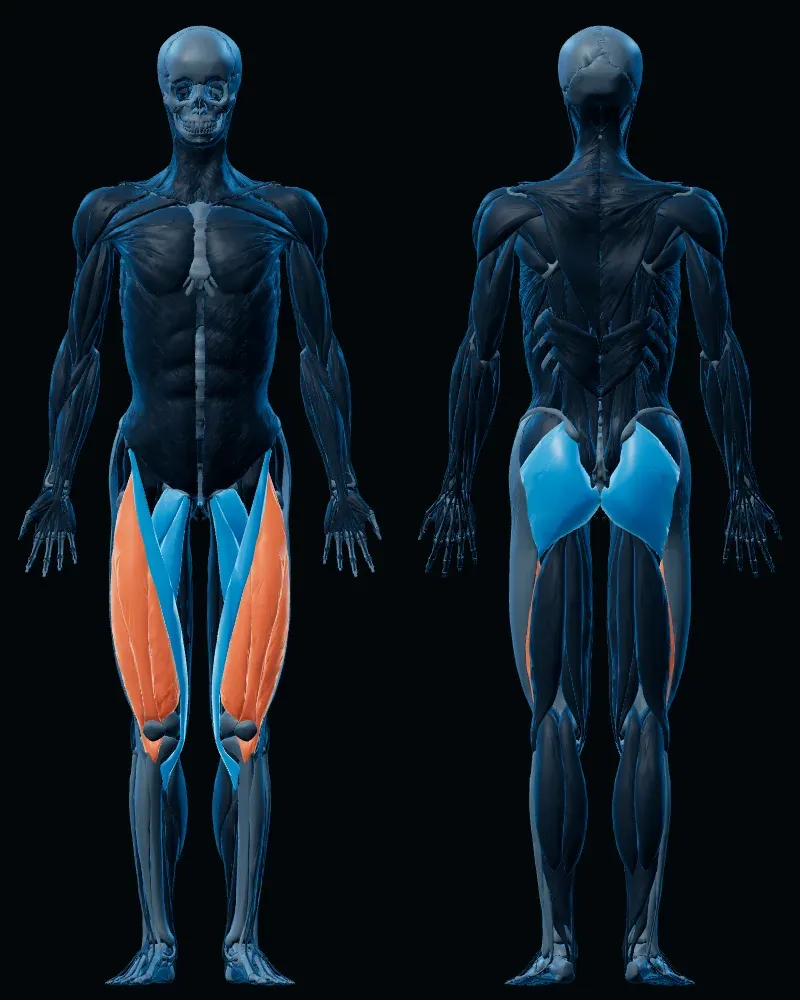
Muscles worked: quads
Main movers: rectus femoris and the three vasti
Assisting: adductors, sartorius and glutes
Table of contents
Knee sleeves vs knee wraps for squats comes down to this: a neoprene sleeve is a comfort and confidence tool that may add a few kilograms, while an elastic wrap is an equipment tool that stores energy in the bottom of the squat and gives it back. Most lifters training raw should start with a sleeve. Wraps only make sense if you compete in an equipped division.
This article sits under our maximal strength and powerlifting science guide. It is about the gear, not the squat itself. For technique, see our low-bar squat guide.
One caveat up front. The research on both items is small. The performance studies tested 10 to 17 trained men each, in a lab, so the numbers below are signals, not promises.
What do knee sleeves do for your squat?
A knee sleeve is a tube of neoprene, usually 5 mm or 7 mm thick, that you slide over the knee. It does not store meaningful elastic energy. What it does is compress, trap heat and give your skin constant feedback.
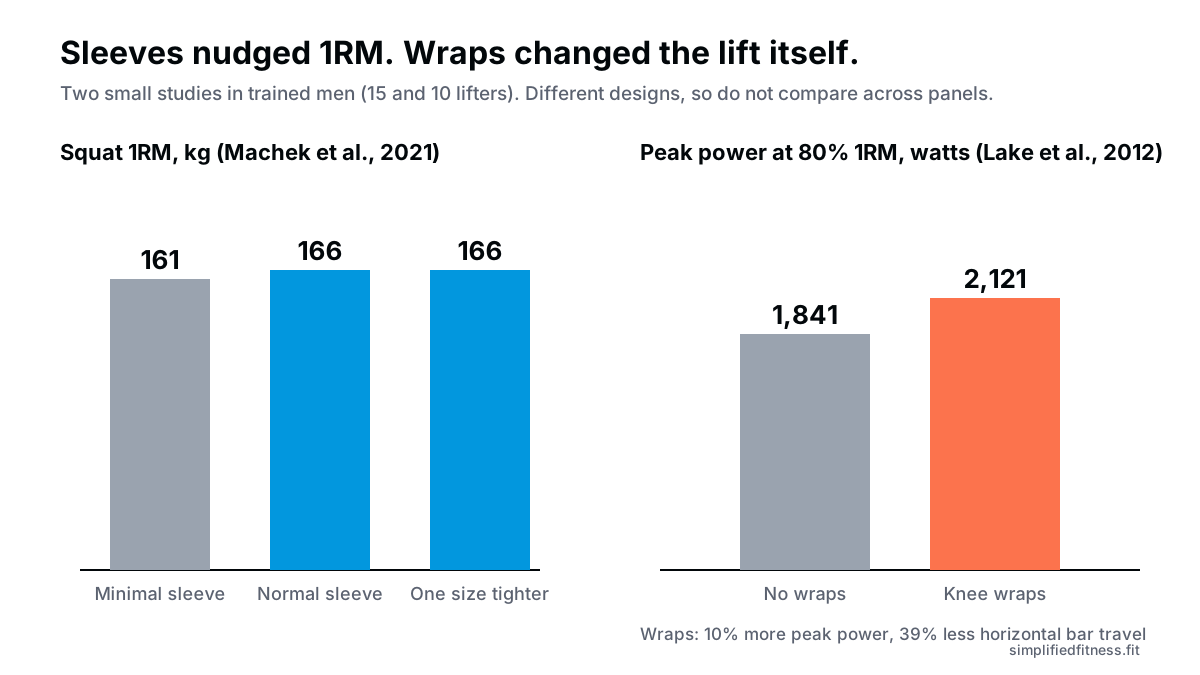
The cleanest data come from a 2021 randomized crossover trial by Machek and colleagues. Fifteen resistance-trained men squatted in three conditions: a minimally supportive control sleeve, a normal-sized neoprene sleeve and a sleeve one size smaller (Machek et al., 2021). Squat 1RM was 161 ± 22 kg in the control sleeve and 166 kg in both neoprene conditions. No other measure improved, including jump power, bar velocity and leg extension performance.
So roughly 5 kg, on one lift, with no extra benefit from squeezing into a smaller size. The authors suggested an exercise-specific effect that is not fully explained yet.
A second study tested 7 mm sleeves in 17 male CrossFit participants doing front squats and box jumps (Maynart et al., 2024). Sleeves lowered peak knee external adduction moment during the front squat and increased front squat 1RM. Overall the authors concluded sleeves have little impact on knee biomechanics, yet 94% of lifters said they felt more stable.
How do knee wraps add weight to your squat?
Wraps are long elastic bandages, wound tightly around the knee before the lift. Think of a thick rubber band. You stretch it by sitting into the hole, and it recoils as you stand up.
Lake and colleagues tested this in 10 resistance-trained men with a squat 1RM of about 160 kg (Lake et al., 2012). Each performed single squats at 80% of 1RM with and without wraps. With wraps:
- Horizontal bar displacement fell by 39%.
- The lowering phase was 45% faster (1.13 vs 1.57 seconds).
- Vertical impulse during the lift was 10% greater.
- Peak power rose 10% (2,121 vs 1,841 W).
The authors attributed this to elastic energy being stored in the wrap on the way down. They also noted that wraps altered squat technique in a way likely to change which muscles do the work, and possibly compromise the knee joint. Their advice was not to wear wraps during general strength and conditioning.
Note what this study did not measure. It did not test 1RM, and it did not measure joint forces directly. You may see claims online of “15 to 30 kg” added by wraps. We could not confirm a specific range like that from the studies we reviewed, and the amount likely varies by wrap, wrapping style and lifter.
Do knee sleeves help knee pain when lifting?
This is the most common reason people buy a sleeve, and the evidence is the weakest part of the story.
A Cochrane review looked at knee orthoses (braces, sleeves, straps) for patellofemoral pain, the classic achy-front-of-the-knee problem (Smith et al., 2015). It included five trials with 368 people, all of whom were also doing exercise. Pooling the three trials with pain data (234 people), there was very low quality evidence of no clinically important difference in pain over 2 to 12 weeks between orthosis and no-orthosis groups (mean difference 0.46 points lower with an orthosis on a 0 to 10 scale, 95% CI 1.16 lower to 0.24 higher). All trials were at high risk of bias, so the authors were “very uncertain” about the results. One trial also reported discomfort or skin abrasion in 16 of 44 knees (36%) given sleeves.
A broader literature review of 20 studies found that 12 reported improvements, mostly in proprioception in healthy knees, gait and balance in osteoarthritic knees and function in injured knees, while eight found no significant effect (Mohd Sharif et al., 2017). The authors called the studies heterogeneous and not rigorous enough for firm conclusions.
Reading both together: a sleeve might make a sore knee feel better in the moment, and some people clearly like that. But it is not a treatment. If your knee hurts under load, the likely levers are squat depth, stance, load and weekly volume, and a physio can help work out which.
Do sleeves improve proprioception?
Proprioception is your sense of where a joint is in space. The idea is that the compression of neoprene gives extra skin feedback.
Results conflict. Van Tiggelen and colleagues tested 64 healthy subjects with and without a neoprene sleeve and found that after a fatigue protocol, joint position error stayed near baseline on the braced knee (Van Tiggelen et al., 2008). In contrast, Bottoni and colleagues tested 20 healthy male sport students and found no significant change in detection of passive knee movement with a brace or sleeve (Bottoni et al., 2013).
Why might they differ? The first study fatigued the muscles and measured active repositioning, while the second tested rested, passive detection. A sleeve may help most when you are tired, which is exactly when a heavy set gets sloppy, but that is a hypothesis, not a finding.
What about joint warmth?
Neoprene holds heat, and a warm knee feels looser on a cold morning. That is real as a feeling. We did not find controlled evidence in this search that sleeve warmth prevents injury or boosts squat performance, so we will not claim it does. In a hot, humid Indian summer, a thick 7 mm sleeve can be sweaty and itchy by set three. A proper warm-up, with lighter sets of the squat itself, is the more reliable way to get your knees ready.
Sleeves vs wraps: side-by-side
| Neoprene sleeve (5-7 mm) | Elastic knee wrap | |
|---|---|---|
| Main effect | Compression, warmth, feel | Elastic energy storage and return |
| Measured performance | About 5 kg squat 1RM in one study | 10% more peak power at 80% 1RM |
| Technique change | Small or none | Noticeable (less bar drift, faster descent) |
| Best for | Everyday training, raw lifting | Equipped competition and meet prep |
| Ease of use | Slide on in seconds | Needs practice wrapping |
| Evidence for pain relief | Weak | None that we found |
| Typical concern | Skin irritation, heat | Changed technique, poor long-term data |
How to choose, and how to use them
A few practical points:
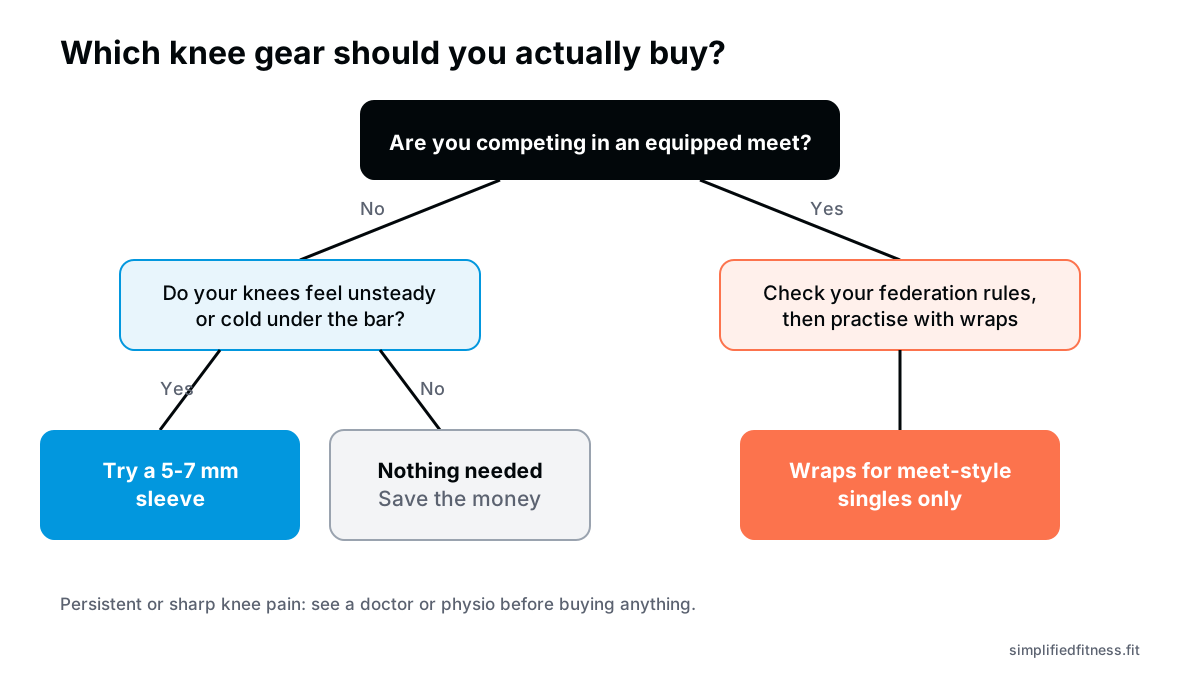
- Healthy knees, raw training: you do not need either. A sleeve is optional comfort.
- Raw competitor: train in the sleeve you will wear. Check your federation’s rules on thickness and length.
- Equipped lifter: wraps are legal in many equipped divisions. Practise wrapping and squatting heavy singles in them well before the meet, because the squat feels different.
- Budget: a decent sleeve pair costs a fraction of a good pair of lifting shoes. Our 1RM calculator is free, so you can track whether sleeves actually change your numbers instead of guessing.
- Sizing: snug, never numbing. Tighter did not mean stronger in the study.
If you notice a pattern where your squat is fine bare in warm-ups but feels “unsafe” the second the bar is heavy, test it. Do one top set with and one without across a few weeks and compare bar speed and effort. Our RPE calculator helps you record how hard each felt.
Gear sits on top of the basics. If your squat stalls, look at sticking points and bracing before you open your wallet. Our belt guide covers the other piece of kit lifters ask about, and the elastic energy and tendon stiffness article explains why your own tendons already act like a spring. If you worry about knee wear in general, read our joint-friendly lifting myth guide.
When to see a doctor
Get checked if you have knee swelling, locking, giving way, pain at night or at rest, pain that lasts beyond a couple of weeks, or any sharp pain during a squat. We are not able to diagnose anything here, and no sleeve or wrap replaces assessment.
The bottom line
For most lifters in India or anywhere else, the sensible order is: fix technique and programming, then try a sleeve if it makes you feel more secure, and keep wraps for equipped competition. The evidence supports small, uncertain gains from sleeves and a clear mechanical effect from wraps, with limited data on long-term safety.
Frequently Asked Questions
Are knee sleeves or knee wraps better for squats?
It depends on the goal. Sleeves suit everyday training because they are comfortable and only nudge performance, while wraps are built to add rebound for maximal attempts. For most lifters who are not competing in an equipped division, sleeves are the more practical choice.
Do knee sleeves actually add weight to your squat?
Possibly a little. In a 2021 crossover study of 15 trained men, squat 1RM was about 5 kg higher in sleeves than in a minimal control sleeve (166 vs 161 kg). The sample was small and young, so treat it as a modest, likely individual effect rather than a guarantee.
How do knee wraps add weight to your squat?
Wraps stretch as you descend and store elastic energy, then recoil as you drive up. In a 2012 study of 10 trained men, this produced 10% more peak power and 39% less horizontal bar movement at 80% of 1RM. You can only use that rebound if you practise with them, because the squat feels and moves differently.
What is the difference between 5 mm and 7 mm knee sleeves?
Thickness mainly changes how stiff and warm the sleeve feels. We found no study comparing 5 mm and 7 mm sleeves directly. The study we cite found that a normal fit and a one-size-smaller sleeve gave the same 1RM result, so tightness at least may matter less than people think. Pick the thickness you find comfortable and a size that does not cut off circulation.
Do knee sleeves help knee pain when squatting?
The evidence is thin. A Cochrane review of orthoses for patellofemoral pain found very low quality evidence that they did not meaningfully reduce pain over 2 to 12 weeks. A sleeve may feel reassuring, but fix technique, load and volume first and see a physio if pain persists.
Do knee sleeves improve proprioception?
Results are mixed. One study in 64 healthy people found a neoprene sleeve offset the drop in joint position sense after a fatigue protocol, while another in 20 healthy sportsmen found no change in movement detection threshold. Treat improved awareness as plausible but unproven.
Are knee wraps bad for your knees?
There is no long-term injury data, so we cannot say they cause harm. The authors of the 2012 wrap study noted that wraps change squat technique and possibly compromise the knee joint, and advised against using them in general training. Keep them for occasional heavy meet-style work and build up gradually.
Can I wear knee sleeves for every set?
Yes, most lifters do and there is no evidence of harm. The risk is mental dependence, where the knees feel unstable without them. Try your warm-up sets bare and use the sleeves for working sets if you like the feel.
Are knee sleeves allowed in powerlifting competition?
Many federations allow neoprene sleeves in raw divisions, but thickness and length rules differ and wraps are often restricted to equipped classes. Rules change, so read your federation's current rulebook before buying. Train in the exact gear you plan to compete in.
How tight should knee sleeves be?
Snug, but not painful. In the Baylor study, a sleeve one size smaller gave the same 1RM as the manufacturer-recommended size, so extra tightness did not add anything measurable. Follow the size chart and make sure you can squat to depth without the sleeve digging into the back of the knee.
Do I need knee sleeves if my knees feel fine?
No. If your knees are healthy and you squat well, sleeves are optional. Money is usually better spent on good shoes, a belt you will actually use or a gym membership that gets you in four times a week.
Do knee sleeves keep the joint warm?
They trap heat around the knee, and many lifters like that on cold mornings. We did not find controlled trial evidence that this warmth lowers injury risk or raises performance. In a hot Indian summer you may find a thick neoprene sleeve more annoying than useful.
Sources & References
Every claim above is checked against peer-reviewed research (PubMed, U.S. National Library of Medicine) or guidance from established health bodies. How we fact-check.
- Lake JP, et al. Wearing knee wraps affects mechanical output and performance characteristics of back squat exercise. J Strength Cond Res. 2012. PMID: 22995993
- Machek SB, et al. Neoprene knee sleeves of varying tightness augment barbell squat one repetition maximum performance without improving other indices of muscular strength, power, or endurance. J Strength Cond Res. 2021. PMID: 33201154
- Maynart FR, et al. Are 7 mm neoprene knee sleeves capable of modifying the knee kinematics and kinetics during box jump and front squat exercises in healthy CrossFit practitioners? J Bodyw Mov Ther. 2024. PMID: 39593408
- Bottoni G, et al. The effect of knee brace and knee sleeve on the proprioception of the knee in young non-professional healthy sportsmen. Knee. 2013. PMID: 23726648
- Van Tiggelen D, et al. The use of a neoprene knee sleeve to compensate the deficit in knee joint position sense caused by muscle fatigue. Scand J Med Sci Sports. 2008. PMID: 17490457
- Smith TO, et al. Knee orthoses for treating patellofemoral pain syndrome. Cochrane Database Syst Rev. 2015. PMID: 26645724
- Mohd Sharif NA, et al. Biomechanical and functional efficacy of knee sleeves: a literature review. Phys Ther Sport. 2017. PMID: 28673759

Umair Hazrami · Founder & Head Coach, Simplified Fitness
Umair Hazrami founded Simplified Fitness and the Simplified Lifter channel to cut through fitness noise. With 4+ years of consistent training and 10+ coaching clients, he writes every guide from the peer-reviewed research and links the sources so you can check them. Our editorial standards.
Educational content only, not medical advice. If you have a medical condition, are pregnant, or take medication, talk to a qualified doctor before changing your diet, supplements or training. Full disclaimer.
Keep reading
Strength & Cardio
1-Rep Max Testing vs 1RM Formulas: Which Is More Accurate and What Does Each Cost You?
1RM testing vs calculation: how accurate are Epley and Brzycki, when a true max is worth the risk, and a safe protocol if you do test. Studies linked.
9 min read
Strength & Cardio
Accommodating Resistance: Do Bands and Chains Really Match the Squat and Bench Strength Curve?
Accommodating resistance with bands and chains makes the top of a lift heavier. See what trials show on power and strength, and how to set it up safely.
9 min read
Strength & Cardio
Competition Bench Press Technique: Arch, Leg Drive, Lats and Bar Path Explained
Competition bench press technique explained: scapular setup, leg drive, lat tension, bar path and pause commands, plus what the research does and does not show.
10 min read
Strength & Cardio
Conventional vs Sumo Deadlift: Which Suits Your Hips, Limbs and Back?
Conventional vs sumo deadlift biomechanics: what the studies show on muscle demand, bar path and back load, plus a simple test to pick the style for your body.
10 min read