Rate of Force Development (RFD): How to Train Explosive Strength
Rate of force development is how fast you build force, not how much. See what the research says about jump squats, plyometrics and heavy lifting for RFD.

TL;DR. The short answer
- Rate of force development (RFD) is how quickly you can raise force after a contraction starts. It is the change in force divided by the change in time, and it matters most in the first 50-100 milliseconds.
- Both explosive training and heavy lifting can improve RFD, mainly by improving how quickly muscles are activated rather than by making them bigger.
- Plyometrics improved vertical jump height by roughly 5-9% on average in a meta-analysis of healthy people, with countermovement jumps improving the most.
- Weaker lifters tend to get more from getting stronger first. Stronger lifters can add jump squats, throws and fast lifts while keeping heavy work in the plan.
- Keep explosive sets short (3-5 reps), fresh, and stop while every rep is still fast. Fatigue turns power work into slow conditioning.
Part of our complete guide: Maximal Strength, Neuromuscular Adaptations & Powerlifting Science for General Lifters
Table of contents
Rate of force development (RFD) is how quickly you can build force once a muscle starts to contract. It is the change in force divided by the change in time, and it tends to matter most in the first 50-100 milliseconds. You can improve it with explosive training such as jumps and throws, with heavy lifting, and most sensibly by combining both with the intent to move fast.
This guide is a deep dive inside our complete guide to maximal strength and powerlifting science. We will cover what RFD is, what happens in your nervous system in those first fractions of a second, and how to train it without wrecking your lifting. Where studies disagree, I will say so.
What is rate of force development?
Maximal strength asks “how much force can you produce, given all the time you want?” RFD asks “how much can you produce in a very short window?”
That distinction matters because many real movements are quick. A jump take-off, a sprint stride or a fast bench press off the chest gives your muscles a limited time to build force. If force rises slowly, you may not get to use your full strength before the movement is over.
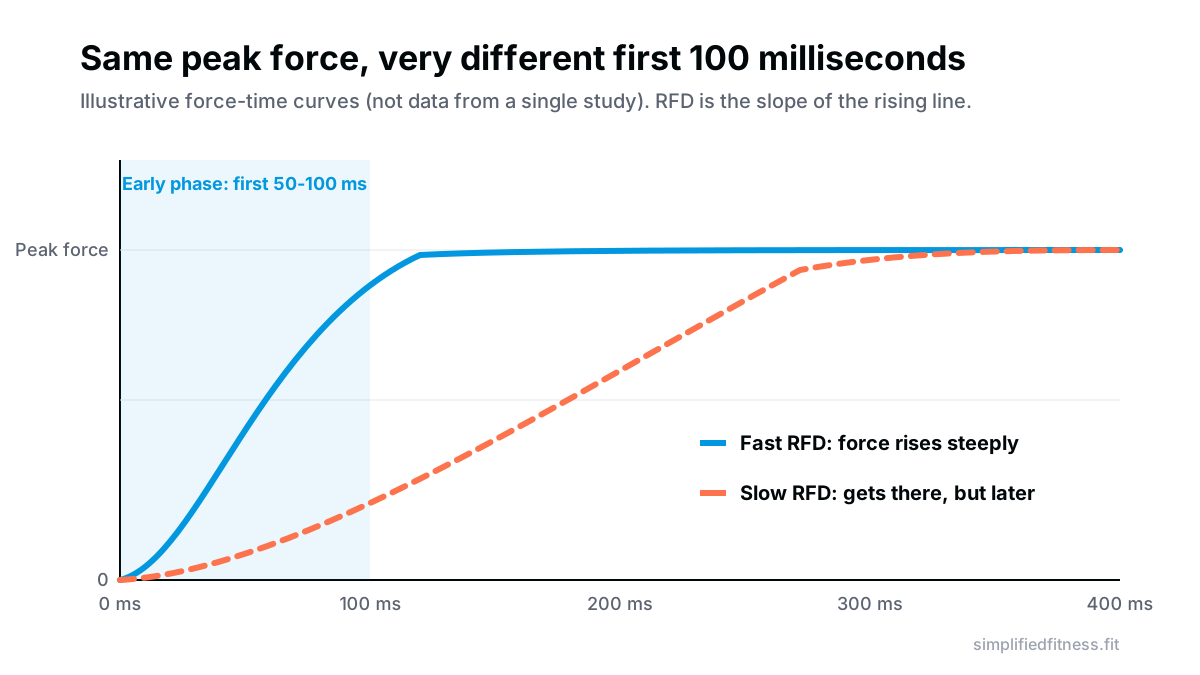
Researchers usually measure RFD as the slope of the force-time curve over fixed windows, such as 0-50, 0-100 or 0-200 ms, often during a maximal isometric push. A review by Maffiuletti and colleagues notes that RFD is quite difficult to measure in a valid and reliable way, which is a polite warning not to over-read any single number from a gadget (Maffiuletti et al., 2016).
What controls RFD in the first 50-100 milliseconds?
The same review concluded that RFD seems to be mainly determined by the capacity to produce maximal voluntary activation in the early phase of an explosive contraction (the first 50-75 ms), particularly through increased motor unit discharge rate (Maffiuletti et al., 2016). A motor unit is one motor neuron and the muscle fibres it controls. Discharge rate is how often that neuron fires.
In plain gym language: early RFD depends on how quickly and how hard your nervous system turns the muscle on. Later in the contraction (roughly beyond 100-200 ms), maximal strength and muscle properties are generally thought to play a bigger role.
That is why a stronger muscle is not automatically a faster one. For the wider picture of how your nervous system limits strength, see our guide on neuromuscular foundations of maximal strength, and for the fibre-type side, slow vs fast-twitch muscle fibres.
Does heavy lifting improve RFD?
Sometimes, and the studies are not unanimous.
What study A found. Aagaard and colleagues trained 15 men for 14 weeks (38 sessions) with heavy-resistance strength training. Maximal isometric strength rose, and RFD in the first 30, 50, 100 and 200 ms rose too. Muscle electrical activity in the early phase of contraction increased substantially, which they interpreted as enhanced neural drive (Aagaard et al., 2002).
What study B found. Del Vecchio and colleagues examined motor unit data before and after 4 weeks of strength training. Maximal force increased, but RFD did not change, because the number of motor units recruited per second and their initial discharge rate during rapid contractions were unchanged (Del Vecchio et al., 2022). They concluded that increases in the recruitment speed of motoneurons would be needed to raise RFD.
Why they may differ. The first study ran for 14 weeks, the second for 4. The training also differed (heavy dynamic work versus a 4-week isometric programme), and so did the way contractions were performed. Both are small lab studies in men, so I would not draw a hard line.
Practical takeaway. Heavy lifting can improve RFD over a longer period, but a short block of strength work may raise maximal force without improving the early rise. If speed matters to you, include some work where you deliberately move fast. The Maffiuletti review states that RFD can be improved by both explosive-type and heavy-resistance training, mainly through improved rapid muscle activation (Maffiuletti et al., 2016).
How do ballistic exercises train explosive strength?
A ballistic exercise lets you accelerate the whole way and let go or leave the ground. In a normal bench press or squat, you must slow the bar near the end so you do not drop it or fall over. With a jump squat or a medicine ball throw, you can keep pushing until the last moment.
Examples that work well in a normal gym:
- Jump squats (bodyweight or a light load)
- Box jumps (step down, do not jump down)
- Medicine ball chest passes or slams against a wall or the floor
- Kettlebell swings, which are fast hip drives with the load travelling in an arc
- Explosive push-ups where your hands leave the floor
One practical detail from the research: in a 10-week study of weightlifting-style training that included jump squats, results depended on how strong people were to start with. The stronger group saw a very large improvement in RFD at 20% of squat 1RM at the mid-point, while the weaker group improved more slowly and showed a more force-dominant adaptation (James et al., 2022). It was a small study, so treat it as a hint rather than a rule.
Do plyometrics improve explosive power?
For jumping, yes. A meta-analysis of 26 studies in healthy people found that plyometric training improved vertical jump height by about 4.7% in the squat jump, 8.7% in the countermovement jump, 7.5% in the countermovement jump with arm swing, and 4.7% in the drop jump (Markovic, 2007).
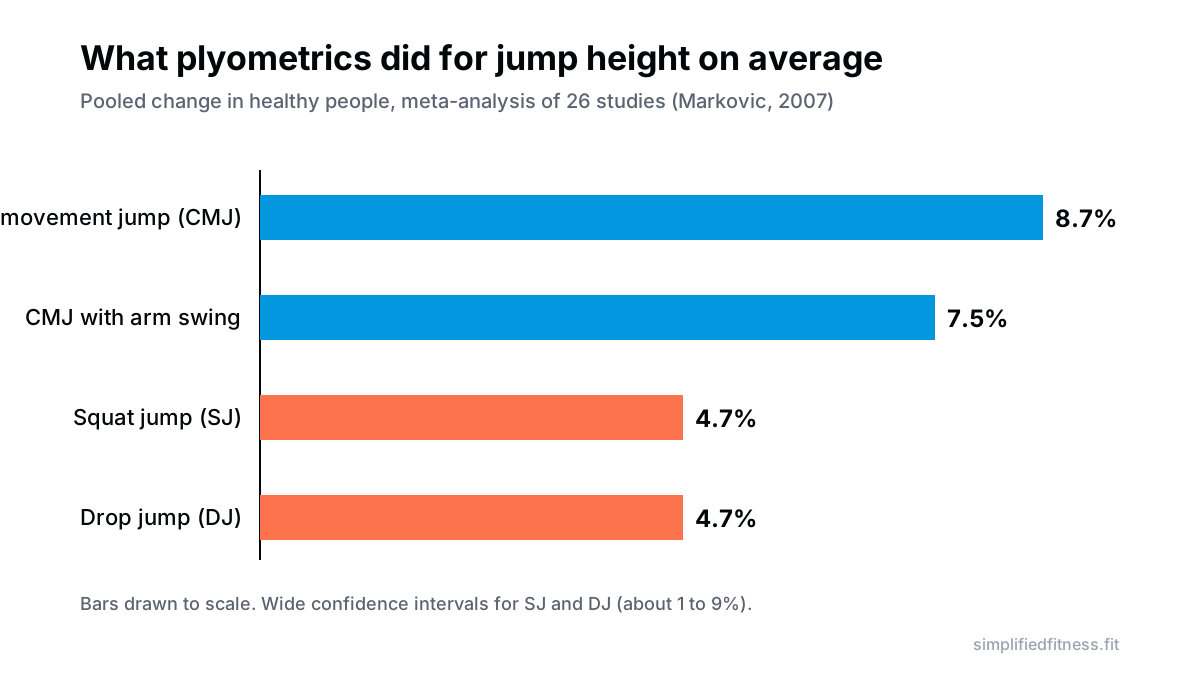
Two caveats. First, this was a review of studies in healthy individuals of mixed training levels, not elite powerlifters. Second, jump height is not the same as RFD, so these figures show that jump ability improved, not that early force rose by a particular amount.
Should you train heavy, fast, or both?
The most useful framing is a mix.
A review by Suchomel and colleagues suggests that weaker athletes should focus on developing strength before emphasising power-type training, while stronger athletes may begin to emphasise power-type training while maintaining or improving strength. They also note that programming which combines heavy and light loads may improve strength and underpin other strength-power characteristics (Suchomel et al., 2018).
That fits what many coaches do. Early on, building a solid squat usually gives you more to work with than a jump program. Later, speed becomes the thing that separates two lifters of equal strength.
A 2026 meta-analysis of 19 studies (537 participants, from sedentary to highly trained) compared complex training (heavy lifts combined with ballistic work in one session) with ballistic training alone. Complex training produced larger gains in squat 1RM, squat jump and 10 m and 40 m sprint, while 5 m and 20 m sprint, change of direction, countermovement jump and jump power improved similarly. The certainty of evidence was low or very low, and longer programs (over 7.5 weeks) seemed to favour complex training (Thapa et al., 2026). In other words, combining heavy and fast work is a reasonable bet, though not a proven formula.
| Method | What it trains | Example | Good for |
|---|---|---|---|
| Heavy strength | Maximal force, later-phase force | Squat, 3-5 reps | Everyone, especially beginners |
| Ballistic | Fast force, early activation | Jump squat, med ball throw | Intermediate and advanced lifters |
| Plyometric | Stretch-shortening cycle, stiffness | Box jump, depth landing | Athletes with a strength base |
| Isometric ballistic | Early RFD in a set joint angle | Fast push into pins | Low-fatigue options, joint-specific |
Does intent to move fast matter with heavy loads?
Even with a heavy load that moves slowly, trying to move it fast changes the output. In a randomized crossover study of 14 recreationally trained men, squatting 4 reps at a 5RM load with maximal intended speed raised half-squat peak power, peak velocity and maximum RFD compared with a controlled tempo. However, neither condition significantly improved later countermovement jump performance, though some individuals showed small jump gains after the fast version (O’Grady et al., 2021).
So intent seems to change the lift you are doing, but it is not a trick for boosting the next exercise. We unpack the concept in intent to move explosively.
Another related option is ballistic isometrics. A narrative review reported that performing isometric strength training in a ballistic manner can maximise the improvement of RFD (Lum et al., 2019). That can be useful if you want low-fatigue work at a specific joint angle, but it is a narrative review, so take it as a suggestion.
Does the phase of RFD you train matter?
It can. In a study of 20 healthy men, eight weeks of fast-velocity eccentric knee extension training (three days a week) raised maximal isometric torque by 28% and early-phase RFD (the 0-50 and 50-100 ms windows) by about 30%, with no change in late-phase RFD (Oliveira et al., 2016). That suggests early and late RFD can respond differently to different training. It is one small study in active men, so the numbers will not generalise to everyone.
Elastic tissue plays a role in quick movement too, which we cover in tendon stiffness and the stretch-shortening cycle.
How to add RFD work to your week
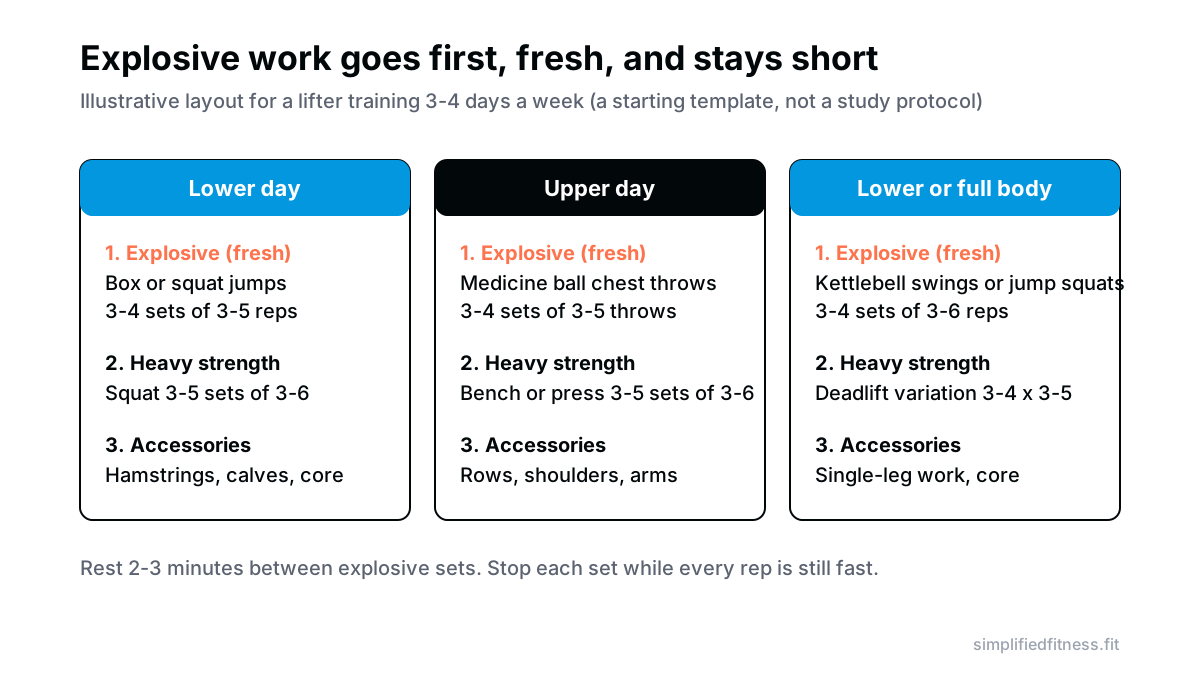
A practical starting template, based on coaching convention and the principles above:
- Warm up fully, then do explosive work first.
- Pick 1-2 ballistic exercises, 3-4 sets of 3-5 reps with 2-3 minutes rest.
- Move on to heavy strength work (for example 3-5 sets of 3-6 reps).
- Do accessories last.
- Run it for 6-8 weeks, then reassess.
If you do not know your working weights, use our 1RM calculator to estimate them, and our leg day plan shows where jumps can slot in.
Who should be careful?
Landing from jumps loads your knees, ankles and Achilles tendons. If you have current joint or tendon pain, a history of surgery, or you are returning from injury, speak to a doctor or physiotherapist before adding plyometrics. Begin with low-impact ballistic work such as medicine ball throws and kettlebell swings, and build up volume slowly. Pregnant lifters, people with heart conditions and older adults should also get individual advice first, because most of the research here is in healthy, younger people.
The bottom line
Rate of force development is about how fast you build force, and it depends heavily on how quickly your nervous system switches the muscle on in the first 50-100 ms. Heavy lifting can raise it over time, but the evidence is mixed, so adding jumps, throws and fast lifts is a sensible move once you have a base of strength. Keep the sets short, fresh and fast, and let your heavy training stay in the plan. For where this fits with the rest of your programme, go back to the maximal strength and powerlifting guide, and for the difference between getting stronger and getting bigger, read strength gains vs muscle growth.
Frequently Asked Questions
What is rate of force development (RFD)?
RFD is how fast you can build force once a contraction begins, calculated as the change in force divided by the change in time. It is usually measured over windows such as the first 50, 100 or 200 milliseconds. A lifter with a high RFD gets more force on the bar or ground before the movement is over, so practise fast, intentional contractions.
Is rate of force development the same as power?
No, they are related but different. RFD describes the slope of the force-time curve at the start of a contraction, while power is force multiplied by velocity during a movement. Many sporting actions are over in a fraction of a second, so early RFD can matter even when peak force is similar. Train both by combining heavy lifts with fast, light-to-moderate explosive work.
How do I increase RFD in lifting?
Combine heavy strength work with short sets of jumps, throws or fast lifts done with maximal intent. Reviews report that RFD can improve with both explosive-type and heavy-resistance training, mainly through faster muscle activation. Start with 2-3 explosive exercises, 3-5 reps per set, before your heavy work.
Does heavy lifting improve explosive strength?
It can. In one study of 15 men, 14 weeks of heavy training increased RFD and the early rise in muscle activity. Not every study agrees, so do not rely on slow, grinding reps alone if explosive output is your goal. Add some work where you deliberately move the load fast.
What are ballistic exercises?
Ballistic exercises are movements where you accelerate through the whole range and release or leave the ground, such as jump squats, medicine ball throws and kettlebell swings (loosely). Because there is no braking phase, you can keep accelerating to the end. Pick one lower body and one upper body option and keep sets to 3-5 reps.
Are jump squats better than regular squats for explosiveness?
Neither is clearly better alone, and they do different jobs. Heavy squats build the strength base, while jump squats train you to apply force quickly. A 2026 meta-analysis found complex training (heavy plus ballistic work together) beat ballistic training alone for squat strength, squat jump and sprint outcomes, though the certainty of evidence was low or very low. Use both in the same week.
How many reps should I do for explosive training?
Usually 3-5 reps per set, with 2-3 minutes of rest between sets. The aim is quality, so every rep should look as fast as the first one. This is a practical coaching convention rather than a number from one trial, so adjust based on how your speed holds up.
Do plyometrics actually work?
Yes, for jumping at least. A meta-analysis of 26 studies in healthy people found vertical jump height improved by about 4.7% to 8.7% depending on the jump type. The studies were in healthy people, not elite lifters, so results may differ in a very strong lifter. Add small doses of jumps once you can land under control.
Can beginners do explosive training?
Yes, in small doses, but strength should come first. A review of strength training considerations suggests weaker athletes should focus on building strength before emphasising power-type training. Begin with low-impact options such as box jumps (step down) and medicine ball throws, and build the volume slowly.
Does moving the bar fast on purpose matter if the load is heavy?
Probably, because intent changes how the nervous system is driven even when the bar moves slowly. In a small randomized crossover study of 14 trained men, squatting with maximal intended speed raised peak power, velocity and RFD in the squat itself. It did not improve the jump afterwards on average, so intent helps the lift, not necessarily the next exercise. Try pushing every concentric as hard as possible.
How often should I train for RFD?
Two to three short sessions per week is a sensible starting point for most lifters. Research does not give one perfect frequency, so treat this as a practical range. Keep the explosive block to 10-15 minutes and stop if your speed drops.
Can I train RFD at home or in a small gym?
Yes. Squat jumps, broad jumps, clap push-ups, kettlebell swings and medicine ball slams need very little equipment. What matters is intent and fresh quality, not the machine. Do them at the start of the session, not after exhausting sets.
Is RFD training safe for knees and tendons?
Landing forces are high, so ramp up gradually. I have not cited injury-rate data here, so treat this as general coaching caution. If you have tendon or joint pain, see a doctor or physiotherapist before adding jumps, and begin with low-impact ballistic work.
Sources & References
Every claim above is checked against peer-reviewed research (PubMed, U.S. National Library of Medicine) or guidance from established health bodies. How we fact-check.
- Maffiuletti NA, et al. Rate of force development: physiological and methodological considerations. Eur J Appl Physiol. 2016. PMID: 26941023
- Aagaard P, et al. Increased rate of force development and neural drive of human skeletal muscle following resistance training. J Appl Physiol. 2002. PMID: 12235031
- Del Vecchio A, et al. Lack of increased rate of force development after strength training is explained by specific neural, not muscular, motor unit adaptations. J Appl Physiol. 2022. PMID: 34792405
- Oliveira AS, et al. Effects of fast-velocity eccentric resistance training on early and late rate of force development. Eur J Sport Sci. 2016. PMID: 25695853
- Markovic G. Does plyometric training improve vertical jump height? A meta-analytical review. Br J Sports Med. 2007. PMID: 17347316
- Thapa RK, et al. Effects of complex training versus ballistic training on physical fitness abilities of athletes and healthy individuals: a systematic review with meta-analysis. Sports Med. 2026. PMID: 41731268
- Suchomel TJ, et al. The importance of muscular strength: training considerations. Sports Med. 2018. PMID: 29372481
- James LP, et al. Rate of force development adaptations after weightlifting-style training: the influence of power clean ability. J Strength Cond Res. 2022. PMID: 35622107
- O'Grady MW, et al. Effect of intention to squat explosively on acute countermovement jump performance. J Strength Cond Res. 2021. PMID: 32032233
- Lum D, et al. Brief review: effects of isometric strength training on strength and dynamic performance. Int J Sports Med. 2019. PMID: 30943568

Umair Hazrami · Founder & Head Coach, Simplified Fitness
Umair Hazrami founded Simplified Fitness and the Simplified Lifter channel to cut through fitness noise. With 4+ years of consistent training and 10+ coaching clients, he writes every guide from the peer-reviewed research and links the sources so you can check them. Our editorial standards.
Educational content only, not medical advice. If you have a medical condition, are pregnant, or take medication, talk to a qualified doctor before changing your diet, supplements or training. Full disclaimer.
Keep reading

Strength & Cardio
1-Rep Max Testing vs 1RM Formulas: Which Is More Accurate and What Does Each Cost You?
1RM testing vs calculation: how accurate are Epley and Brzycki, when a true max is worth the risk, and a safe protocol if you do test. Studies linked.
9 min read

Strength & Cardio
Accommodating Resistance: Do Bands and Chains Really Match the Squat and Bench Strength Curve?
Accommodating resistance with bands and chains makes the top of a lift heavier. See what trials show on power and strength, and how to set it up safely.
9 min read

Strength & Cardio
Competition Bench Press Technique: Arch, Leg Drive, Lats and Bar Path Explained
Competition bench press technique explained: scapular setup, leg drive, lat tension, bar path and pause commands, plus what the research does and does not show.
10 min read
Strength & Cardio
Conventional vs Sumo Deadlift: Which Suits Your Hips, Limbs and Back?
Conventional vs sumo deadlift biomechanics: what the studies show on muscle demand, bar path and back load, plus a simple test to pick the style for your body.
10 min read