Can Cardio Cause Muscle Loss? The Calorie and Volume Thresholds Behind the Fear
Does cardio cause muscle loss? Not at normal doses. See what the meta-analyses say about deficits, protein and running volume, and how to protect your muscle.
TL;DR. The short answer
- Cardio on its own does not melt muscle. A 2022 meta-analysis of 43 studies found that adding aerobic training to lifting did not reduce muscle growth (SMD -0.01) or maximal strength.
- The bigger muscle threats are a large calorie deficit (about 500 kcal/day or more blunts lean mass gains), low protein, and training so much that you cannot recover.
- Running showed more interference than cycling in one older meta-analysis, and more weekly cardio time meant more interference. Newer analysis did not find a running versus cycling difference.
- No study gives a clean mileage cutoff where muscle starts burning. Ultra-endurance events can reduce measured muscle mass, but that is far from a 20-minute jog.
- If you are cutting, keep protein high (about 2.3-3.1 g/kg of lean mass for lean lifters in a hard cut), keep lifting hard, and add cardio gradually.
Part of our complete guide: Cardio and Concurrent Training: Build Endurance Without Losing Muscle (The Interference Effect)
Table of contents
Does cardio cause muscle loss? Not at the doses most lifters do. A 2022 meta-analysis of 43 studies found that adding aerobic training to a lifting program did not reduce muscle growth or maximal strength. What does cost muscle is a big calorie deficit, too little protein, or more training than you can recover from. (This article is a deep dive from our guide to cardio and the interference effect.)
If you have ever skipped a 20-minute jog because “it will eat my gains,” this one is for you. One distinction first: whether cardio slows new muscle growth is the interference question, which we cover in does cardio kill gains. This article is about the scarier version, losing muscle you already have, and the conditions that make that happen.
Does cardio cause muscle loss? What the big reviews found
Start with the best evidence, which is meta-analyses. A caveat up front: these reviews measured whether cardio blunted muscle gains during a lifting program, not whether it stripped existing muscle. If adding cardio does not even slow growth, it is hard to see it causing outright loss at the same doses.
The 2022 review by Schumann and colleagues pooled 43 studies in healthy adults. Compared with the same lifting program alone, adding aerobic work changed muscle hypertrophy by essentially nothing (SMD -0.01) and maximal strength by -0.06, neither significant. Explosive strength was the exception, dropping slightly (SMD -0.28) (Schumann et al., 2022). The authors found no significant effect from the type of cardio, how often people did concurrent training, training status or age.
An older analysis tells a slightly different story. Wilson and colleagues pooled 21 studies and found mean hypertrophy effect sizes of 1.23 for strength training alone, 0.85 for concurrent training and 0.27 for endurance only (Wilson et al., 2012). Strength and concurrent training both beat endurance-only training for hypertrophy, and running (not cycling) was linked to smaller hypertrophy and strength gains. Higher frequency and longer duration of endurance work correlated with smaller gains.
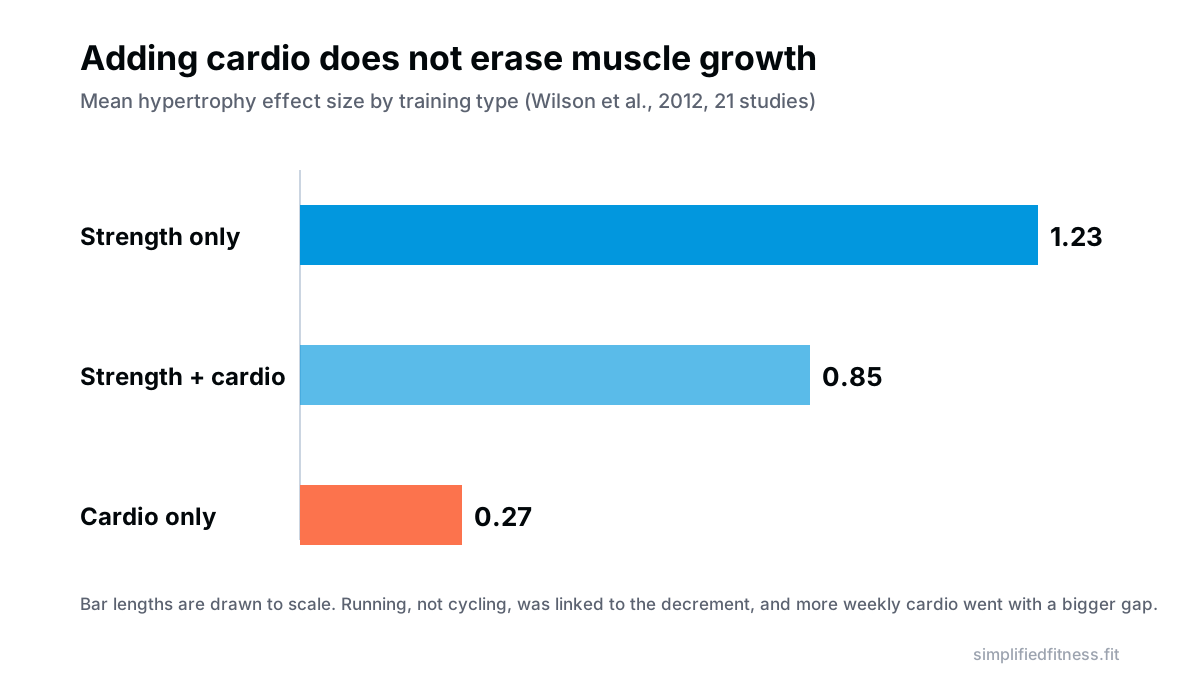
Why the two reviews differ is not fully settled. Studies vary in how much cardio people did, how hard, and how they measured muscle. My reading: interference is real but small for most people, and it grows with how much endurance work you stack on top of lifting. If you want the cell-level story behind this, see our piece on the AMPK and mTOR interference effect.
One more finding worth knowing: a 2024 meta-analysis of 59 studies found small interference for lower-body strength in males but not in females, and data on hypertrophy were too thin to conclude anything (Huiberts et al., 2024). Most of this research is in healthy adults over short blocks, so it says less about years of heavy cardio.
Where does the muscle-loss fear come from?
Mostly from a half-truth. Muscle protein can be used for fuel when energy is scarce, and endurance athletes do sometimes look lean and light. Add social media scare posts and “cortisol is eating your biceps” and the fear writes itself.
Here is the catch. Looking at endurance athletes tells you what long, heavy endurance training plus low calories does. It does not tell you what 25 minutes of cycling after leg day does.
How much cardio before muscle catabolism?
I wish I could give you a clean number, such as “stay under X km a week.” The honest answer is that no study I reviewed defines one.
What the evidence does show:
- More weekly endurance time went with smaller gains in the 2012 meta-analysis, so there is a dose effect.
- Running showed more interference than cycling there, but the 2022 meta-analysis found no difference.
- Very long events can reduce measured muscle mass. In 21 well-trained men running 338 km in 5 days, calculated skeletal muscle mass fell by 0.63 kg, mostly in the first stage, with body fat unchanged (Knechtle & Kohler, 2007). The authors flag that hydration changes could confound this, since muscle mass was estimated from skinfolds and limb circumferences.
That is a multi-day ultra event in experienced runners. It is a long way from your gym routine. You will sometimes see “more than 40 miles a week” quoted as the cutoff, but I could not find a study that sets that number for lifters.
Calorie deficit: the threshold that matters more
This is where the stronger evidence sits.
A 2022 meta-analysis and meta-regression of trials where people lifted in an energy deficit found lean mass gains were impaired compared with people not in a deficit (ES -0.57), while strength gains were comparable. The regression suggested an energy deficit of about 500 kcal per day prevented gains in lean mass, and the authors advise people trying to preserve lean mass to avoid deficits larger than that (Murphy & Koehler, 2022).
Cardio adds to your daily energy expenditure, so it can quietly deepen the deficit. A 500 kcal gap built from 250 kcal of food cuts and 250 kcal of walking is not the same stress as a 1,000 kcal gap from crash dieting plus daily runs.
Low energy availability in male endurance athletes is also linked with lower testosterone, according to a 2023 mini-review (Cupka & Sedliak, 2023). That is a narrative review in endurance-trained men, so it describes a pattern, not a precise cause. The practical point: you do not need to chase a cortisol-to-testosterone number. Eat enough and sleep.
To set a sensible deficit, our calorie calculator is a decent starting point, and the guide on setting a moderate versus aggressive deficit goes deeper.
Protein: the cheapest muscle insurance
Low protein is the second lever. In the trial below, 1.2 g/kg was the lower-protein group and it barely held lean mass, so lean lifters in a hard cut probably need more.
A systematic review of lean, resistance-trained athletes in caloric restriction (6 studies) estimated protein needs at 2.3-3.1 g/kg of fat-free mass, scaled up with the severity of the deficit and leanness (Helms et al., 2014). That is a small, mixed evidence base, and the top of the range is meant for very lean people on aggressive cuts, not everyone.
A randomized trial adds a real-world stress test. Young men ate a diet about 40% below requirements for 4 weeks and trained with lifting plus high-intensity intervals 6 days a week. The group on 2.4 g/kg protein gained 1.2 kg of lean mass and lost 4.8 kg of fat. The group on 1.2 g/kg gained 0.1 kg lean and lost 3.5 kg of fat (Longland et al., 2016). The authors also noted that cortisol changes were associated with body composition changes but did not explain much of the variance.
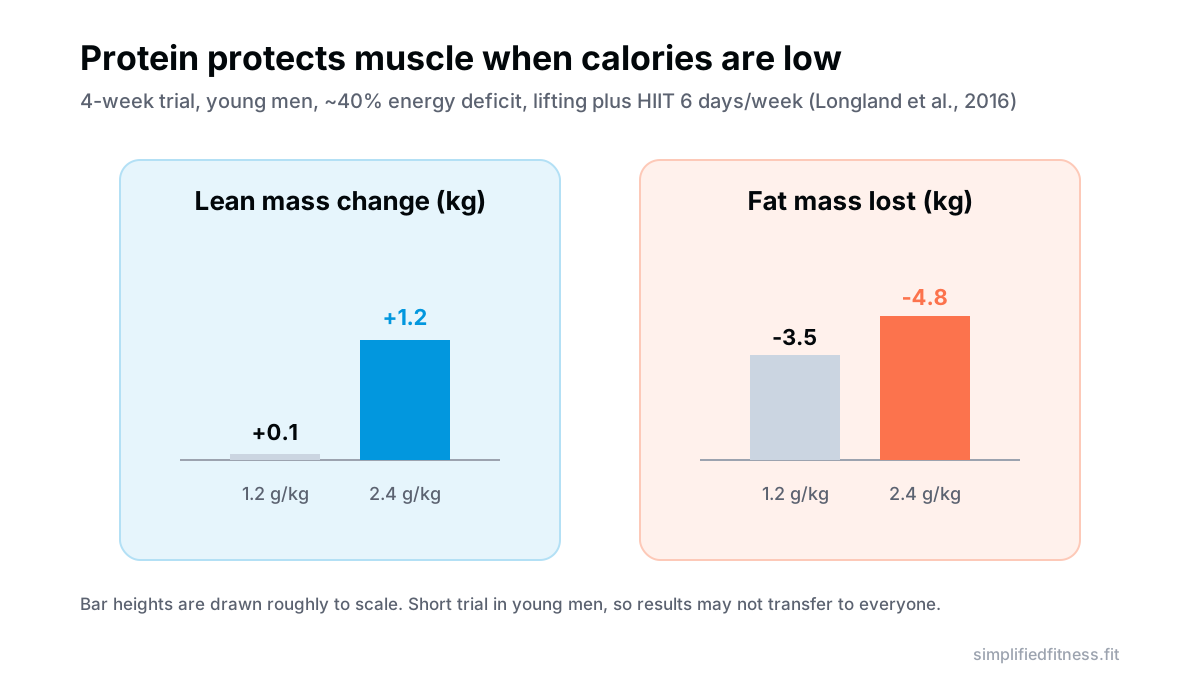
That was a 4-week study in young men, so do not stretch it to everyone. Still, it is hard to argue that cardio itself was the issue when people doing a lot of it gained muscle.
For most Indian lifters, hitting 1.6-2.2 g/kg is realistic with dal, paneer, curd, eggs, chicken, soya chunks and a scoop of whey if needed. Our protein calculator will give you a personal number, and the high-protein cutting guide covers meals.
Cortisol and testosterone: should you worry?
Short answer: not for ordinary cardio.
Cortisol rises during hard exercise, and that is a normal response, not proof you are burning muscle. In the Longland trial the cortisol link to body composition was weak. The endurance-athlete literature shows lower testosterone mainly in people with low energy availability and large training loads, as in the 2023 review above.
If you are fatigued for weeks, losing libido, sleeping badly and your lifts keep falling, that is a reason to eat more, cut back and book a check-up with a doctor. Do not self-diagnose from a symptom list or a wearable.
Rules to protect your muscle while doing cardio
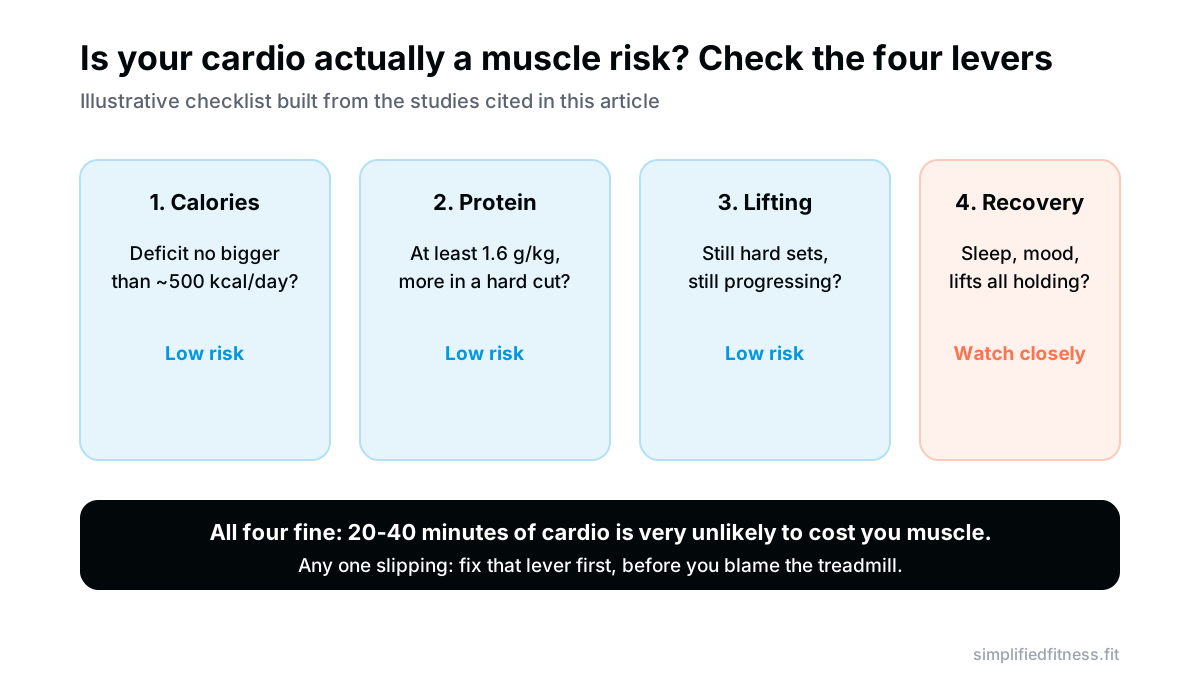
Here is the working checklist I would give a lifter who wants cardio without the worry.
- Keep the deficit moderate. Aim for about 300-500 kcal below maintenance rather than crash dieting.
- Hit protein every day. At least 1.6 g/kg, and toward the higher end if you are lean and cutting hard.
- Keep lifting heavy. Do not swap heavy sets for light “toning” work. Cardio does not replace the stimulus.
- Start with 2-3 cardio sessions. 20-40 minutes each, then adjust.
- Prefer lower-impact options if legs are fried. Cycling and incline walking are easier on recovery.
- Separate sessions if you can. Explosive strength was blunted more when cardio and lifting shared a session than when they were at least 3 hours apart.
- Eat carbs around longer sessions. Rice, roti, banana or poha before a long run helps you keep training quality up.
For heart rate targets, the heart rate zone calculator helps you keep easy sessions easy. For a longer look at how to schedule cardio on a cut, see cardio during a cutting phase.
Which choices raise the real risk?
| Situation | Muscle risk | What to do |
|---|---|---|
| 20-40 min cardio, 2-4 days/week, eating at maintenance or small deficit | Very low | Carry on, keep lifting |
| Moderate deficit, high protein, lifting hard | Low | Track lifts and waist |
| Deficit of 500 kcal/day or more with cardio on top | Moderate | Trim the deficit, keep protein high |
| Low protein, skipped meals, daily long runs | Higher | Raise protein and food, cut run volume |
| Ultra-endurance events or very high weekly mileage | Highest | Plan nutrition and recovery, expect some muscle trade-off |
The ranking here is my own summary of the studies above, not a formal risk score.
When to see a doctor
Chest pain, unusual breathlessness, fainting, or a sudden unexplained drop in strength need a medical check, not a training tweak. The same goes for missed periods, loss of libido that does not recover, or persistent fatigue despite eating and sleeping well. Those can point to low energy availability or other conditions that a coach cannot diagnose.
The bottom line
Cardio is not your enemy. If you eat enough, hit your protein and keep lifting hard, 2-4 normal cardio sessions a week should not take your muscle. The fear is built mostly on extreme cases. Treat the deficit, protein and recovery as your levers, and enjoy the heart health benefits.
Frequently Asked Questions
Does cardio cause muscle loss?
Not at normal doses. A 2022 meta-analysis of 43 studies found that adding aerobic training to a lifting program did not reduce muscle hypertrophy or maximal strength. If you eat enough and keep lifting, 2-4 sessions of 20-40 minutes a week is very unlikely to cost you muscle.
Can running make you lose muscle?
It can interfere more than cycling at higher volumes, but running itself is not a muscle-burning machine. An older meta-analysis found running, not cycling, was linked to smaller gains in hypertrophy and strength, while a 2022 analysis found no difference between the two. Keep runs moderate, protect your leg days, and eat enough protein.
How much cardio is too much for muscle growth?
There is no single proven number. A 2012 meta-analysis found that higher frequency and longer duration of endurance work went with smaller gains in hypertrophy, strength and power. Start with 2-3 sessions a week and only add more if your lifts and recovery stay steady.
Does the body burn muscle for fuel during cardio?
Only a small share of fuel comes from protein during normal cardio, because fat and carbohydrate do most of the work. Muscle becomes a bigger fuel source when carbohydrate stores and energy intake are low for a long time. Eat carbs around longer sessions and keep daily protein high.
Is fasted cardio worse for muscle?
I could not find a lifting-specific trial in this review that settles it, so treat it as unproven either way. What the evidence does show is that total energy deficit and protein intake matter more than the clock. If fasted sessions leave you flat on your lifts, eat before them.
How big a calorie deficit protects muscle?
A 2022 meta-regression found an energy deficit of about 500 kcal per day prevented lean mass gains in people lifting weights. For preserving muscle on a cut, that analysis suggests avoiding larger deficits than that. Use the calorie calculator to set a moderate deficit instead of crash dieting.
How much protein do I need if I do cardio and lift?
For lean, resistance-trained people in a deficit, a systematic review estimated 2.3-3.1 g/kg of fat-free mass. Protein helps keep lean tissue when energy is low, and a 2016 trial showed 2.4 g/kg beat 1.2 g/kg during a hard cut. Work out your number with the protein calculator and spread it across meals.
Does cardio lower testosterone?
Moderate cardio is not known to do so, but long-term low energy availability in male endurance athletes is linked with lower testosterone. A 2023 mini-review describes this pattern in endurance-trained men. If you feel flat, lose libido or stall for weeks, eat more and see a doctor for blood work.
Can I lose muscle from walking?
Walking alone is very unlikely to cost you muscle, because it is low in intensity and recovery cost. Muscle loss in lifters tends to come from deep deficits, low protein or giving up resistance training. Keep walking, keep lifting, and eat adequate protein.
Should I do cardio before or after weights to keep muscle?
Order is not a proven muscle-saver for hypertrophy, but separating sessions may help explosive strength. A 2022 meta-analysis found that explosive strength was blunted more when cardio and lifting were in the same session than when they were at least 3 hours apart. If you can, split them, otherwise lift first.
Can vegetarians do cardio without losing muscle?
Yes, if total protein and energy are adequate. Dal, paneer, curd, soya and eggs can get you to your target, and the muscle-sparing effect depends on the amount rather than the source. Plan protein at each meal and add a protein powder only if food falls short.
Does HIIT burn more muscle than steady cardio?
I found no evidence that it does, though no study I reviewed compared the two head to head for muscle. A 2016 trial combined lifting with HIIT six days a week in a 40% energy deficit and lean mass still rose with high protein. Hard intervals cost recovery, so keep them to 1-2 sessions a week and watch your lifts.
How do I know if I am losing muscle?
The best warning signs are lifts that drop week after week, measurements that shrink while the scale falls fast, and poor recovery. Scale weight alone cannot tell fat from muscle. Track lift numbers, waist and photos, and slow the deficit if strength keeps sliding.
Sources & References
Every claim above is checked against peer-reviewed research (PubMed, U.S. National Library of Medicine) or guidance from established health bodies. How we fact-check.
- Wilson JM, et al. Concurrent training: a meta-analysis examining interference of aerobic and resistance exercises. J Strength Cond Res. 2012. PMID: 22002517
- Schumann M, et al. Compatibility of concurrent aerobic and strength training for skeletal muscle size and function: an updated systematic review and meta-analysis. Sports Med. 2022. PMID: 34757594
- Huiberts RO, et al. Concurrent strength and endurance training: a systematic review and meta-analysis on the impact of sex and training status. Sports Med. 2024. PMID: 37847373
- Murphy C, et al. Energy deficiency impairs resistance training gains in lean mass but not strength: a meta-analysis and meta-regression. Scand J Med Sci Sports. 2022. PMID: 34623696
- Helms ER, et al. A systematic review of dietary protein during caloric restriction in resistance trained lean athletes: a case for higher intakes. Int J Sport Nutr Exerc Metab. 2014. PMID: 24092765
- Longland TM, et al. Higher compared with lower dietary protein during an energy deficit combined with intense exercise promotes greater lean mass gain and fat mass loss: a randomized trial. Am J Clin Nutr. 2016. PMID: 26817506
- Knechtle B, et al. Running 338 kilometres within five days has no effect on body mass and body fat but reduces skeletal muscle mass: the Isarrun 2006. J Sports Sci Med. 2007. PMID: 24149470
- Cupka M, et al. Hungry runners: low energy availability in male endurance athletes and its impact on performance and testosterone: mini-review. Eur J Transl Myol. 2023. PMID: 37052052

Umair Hazrami · Founder & Head Coach, Simplified Fitness
Umair Hazrami founded Simplified Fitness and the Simplified Lifter channel to cut through fitness noise. With 4+ years of consistent training and 10+ coaching clients, he writes every guide from the peer-reviewed research and links the sources so you can check them. Our editorial standards.
Educational content only, not medical advice. If you have a medical condition, are pregnant, or take medication, talk to a qualified doctor before changing your diet, supplements or training. Full disclaimer.
Keep reading
Strength & Cardio
Aerobic Conditioning and Hypertrophy: How Work Capacity Improves Inter-Set Recovery
Does better cardio help you recover between sets? See what work capacity resistance training research says, where theory outruns data, and what to do.
9 min read

Strength & Cardio
Cardio During a Cut: How Much You Need and When to Stop Adding
How much cardio during cutting phase? Learn the food-first rule, a walking base, sample weekly schedules and signs you are doing too much. Every study linked.
7 min read

Strength & Cardio
Cycling vs Running for Lifters: Which Protects Muscle and Squat Strength?
Cycling vs running for lifters: Wilson's meta-analysis found running, not cycling, blunted gains. We compare it with newer reviews and give a bike plan.
8 min read

Strength & Cardio
Fasted Cardio vs Fed Cardio: Does Skipping Breakfast Burn More Fat?
Fasted cardio vs fed cardio for fat loss: what the trials show on fat burn, muscle loss and cortisol, plus what to eat before a 6am session. Every study linked.
9 min read