Competition Bench Press Technique: Arch, Leg Drive, Lats and Bar Path Explained
Competition bench press technique explained: scapular setup, leg drive, lat tension, bar path and pause commands, plus what the research does and does not show.
TL;DR. The short answer
- Competition bench press technique is a tight setup (shoulder blades pinned back and down, feet planted, chest high) followed by a controlled lowering to the lower chest, a pause if the rules require one, and a press that travels up and slightly back over the shoulders.
- Powerlifters use a measurably different bar path and shorter range of motion than recreational lifters, and they are relatively more shoulder dominant, with lower elbow joint moments (Mausehund and Krosshaug, 2023, 34 lifters).
- Arching is not magic: in 11 competitive powerlifters, 1RM was virtually identical with a flat and an arched bench (115.9 kg vs 115.7 kg), so arch only as far as it feels strong and stable for you.
- Leg drive and lat tension are widely coached, but I could not find trials that isolate their effect on 1RM, so treat them as practical cues for stability, not proven 15 kg shortcuts.
- Pain at the front of the shoulder during benching is worth getting checked by a physio or doctor rather than pushing through.
Part of our complete guide: Maximal Strength, Neuromuscular Adaptations & Powerlifting Science for General Lifters
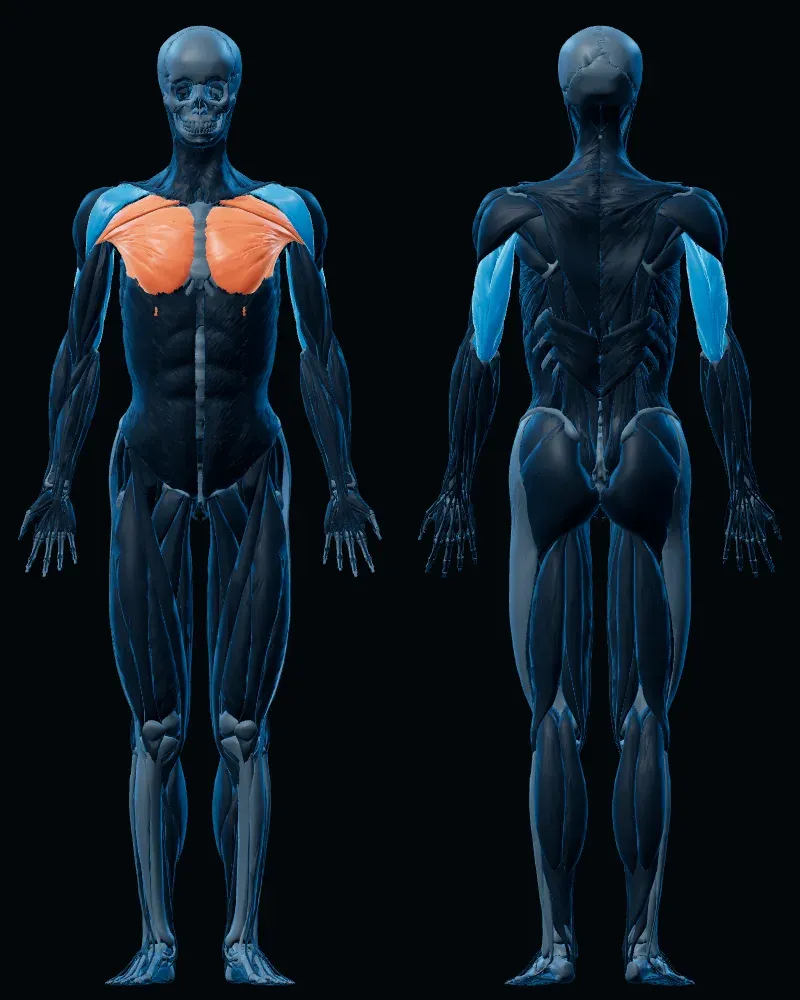
Muscles worked: chest
Main movers: pectoralis major
Assisting: front delts and triceps
Table of contents
Competition bench press technique is mostly a setup problem. You lock your shoulder blades into the bench, plant your feet, lower the bar to the lower chest, wait for the referee if there is a pause, and press along a curve that finishes back over the shoulders.
This article is the technical layer of our maximal strength and powerlifting science guide. I will give you the setup order, then be straight about which parts have research behind them and which are coaching habits. You will also see why “add 15 kg instantly” is not something the evidence supports.
What actually makes a competition bench press different?
A gym bench and a meet bench are not the same lift. In the gym you can bounce, flare, lift your hips and chase a pump. On the platform you have to start on a command, keep your head, shoulders and glutes down, hold the bar still on the chest and wait for the next command.
One study compared 12 powerlifters with 22 recreational lifters, all doing a 6-8 rep max set (Mausehund and Krosshaug, 2023). Powerlifters used a different bar path and had shorter joint ranges of motion. They also had lower normalized peak elbow joint moments, and the authors concluded that powerlifters (and men compared with women) are more shoulder dominant on the bench press. That is a small sample, so read it as a description of how experienced lifters tend to move, not a rule everyone must follow.
How do you set up the competition bench press?
Think of the setup as a checklist you run before every single rep, warm-ups included. Skipped steps on warm-ups become skipped steps at 180 kg.
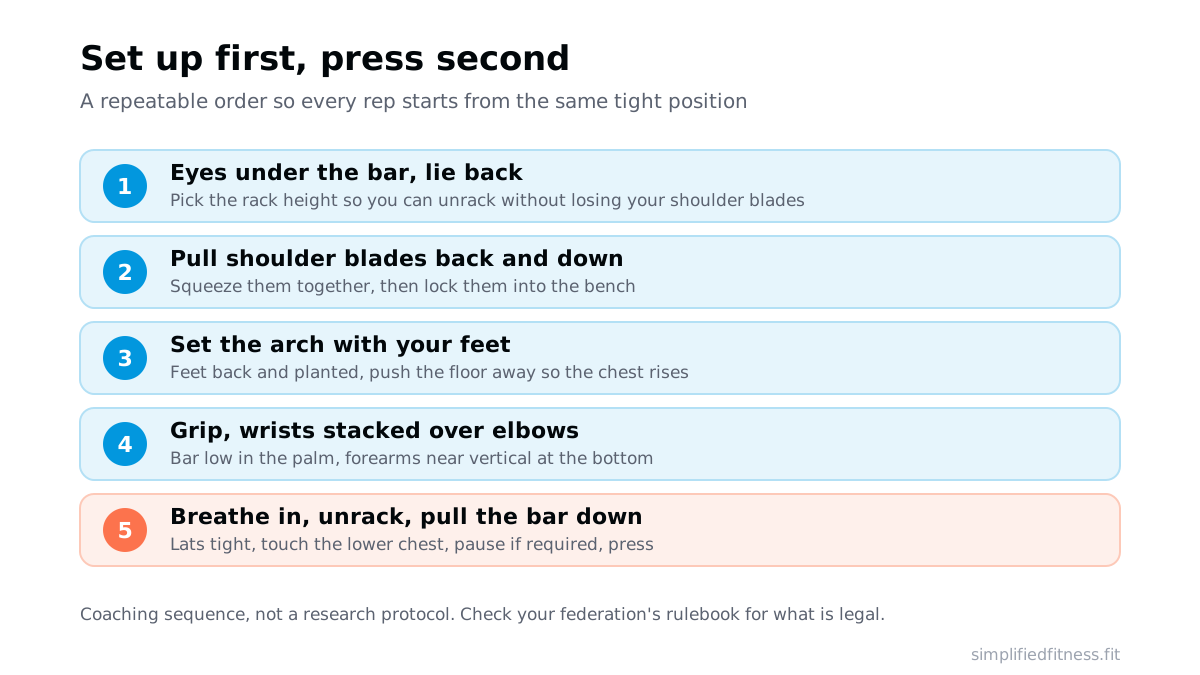
- Eyes under the bar. Lie back so your eyes are roughly under the bar, with the rack set so you can unrack without your shoulders shrugging forward.
- Set the scapulae. Pull your shoulder blades back and down, as if tucking them into your back pockets, then press them into the bench.
- Plant the feet. Feet go back and flat (or as your federation allows), with enough tension that your chest rises.
- Grip and wrists. Bar low in the palm, wrists stacked over the forearm, hands set so the forearms are close to vertical at the bottom.
- Breathe and unrack. Big breath into your belly, unrack with the lats engaged and pull the bar down, rather than letting it fall.
The most common mistake here is rushing step 2. People lie down, grab the bar and let the shoulders roll forward as soon as the bar leaves the rack. Everything after that is damage control.
How big should the arch be?
An arch shortens the distance the bar has to travel and lets you keep your upper back tight. It is also the most over-sold part of powerlifting technique.
In 11 competitive male powerlifters, researchers compared a flat bench (natural arch and moderate scapular retraction) with an arched bench (pronounced lumbar arch and scapular retraction) (Garcia-Ramos et al., 2021). 1RM was 115.9 kg flat and 115.7 kg arched, with no significant difference. Barbell velocities were also similar. The authors concluded these lifters did not necessarily hit a higher 1RM with the arched version.
Why might your result differ? That was one session each in men who already benched for a living. An unpractised lifter may need weeks to learn an arch, and a lifter with a stiff thoracic spine may never get a big one. If you want to see how arching changes things for bodybuilding instead, see our guide on the bench press arch for powerlifting versus bodybuilding.
How do you use leg drive on the bench press?
Leg drive is probably the most misunderstood cue in the sport. You are not trying to shove your hips up. You are pushing your feet into the floor so the force travels through your legs, hips and upper back and holds your torso tight against the bench.
The common coaching cue is “push the floor away” or “drive your torso toward the head of the bench”, which sounds like it would slide you up the bench. In practice the shoulder blades stay pinned, so the drive turns into extra stiffness through your body rather than movement. That is the point: a stiffer platform to push from.
Here is what I could and could not find. I did not find controlled studies that isolate leg drive and measure 1RM. So I cannot tell you it adds a specific amount, and anyone who gives you a number is guessing. What it plausibly does is protect your arch and stability under heavy loads.
Do lats really matter on the bench press?
Coaches talk about “using your lats” constantly. The evidence is thinner than the cue’s popularity.
In one study of 12 national and international level bench press athletes, EMG was measured in the pectoralis major, deltoids, biceps, triceps and latissimus dorsi during 6RM bench presses (Saeterbakken et al., 2017). The paper compared grip widths and bench angles, and it reported no significant differences in activation between most variations, with exceptions for the triceps and biceps. It measured the lats but did not test whether cueing them changes your 1RM.
So here is the cautious takeaway. Lat tension helps many lifters feel stable and control the bar on the way down, and there is no harm in using it as a cue. But “engage your lats” is a coaching idea, not a proven performance booster, and it should not replace the basics of a tight setup.
What is the bench press bar path?
Powerlifters usually describe the competition bench path as a curve: down and slightly toward the feet to the lower chest, then up and slightly back toward the shoulders and face. People call it a “J curve” or reverse J.
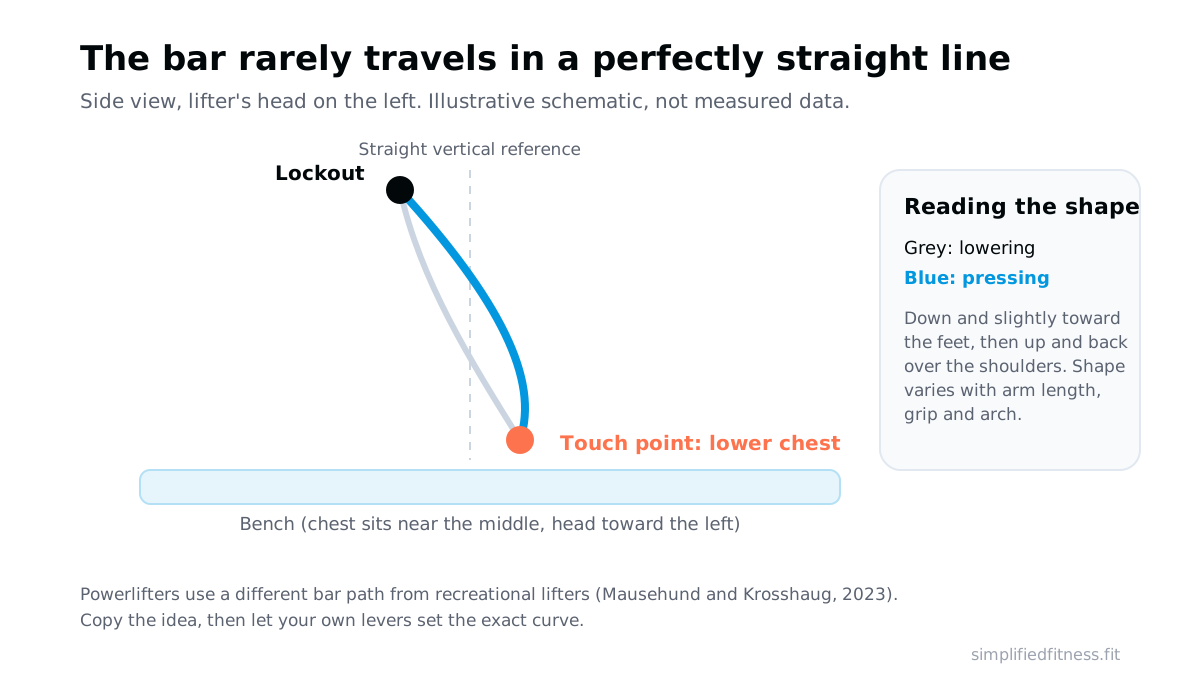
You will often hear that this curve is proven to be the most efficient path. The research does not go that far. What I can say from the data is that experienced powerlifters use a different bar path from recreational lifters (Mausehund and Krosshaug, 2023). I did not find a study that proves one shape of path is optimal for everyone, and the right curve depends on your arm length, grip and arch.
A related finding: in 12 experienced powerlifters, everyone had a clear sticking region, but it did not occur at the same joint angles with narrow, medium and wide grips (Gomo et al., 2016). The authors suggest differences in the barbell’s moment arm about the elbow could explain it. Your grip changes your lever arms, which changes where the lift gets hard. For fixes by sticking point, see our guide on sticking point analysis for squat, bench and deadlift.
Where should the bar touch, and what about wrist and elbow position?
Most coaches teach a touch point on the lower chest (the lower sternum or just below). Three checks help:
- Forearms near vertical at the bottom. If they lean far forward or back, your grip is probably too narrow or too wide for your arms.
- Wrists stacked. The bar sits low in the palm, the knuckles point at the ceiling and the wrist does not bend backward.
- Elbows roughly 45 degrees from your torso. Not pinned to your ribs, not flared to 90 degrees. This is a coaching convention, not a measured optimum, and arm length changes it.
A 2022 study of 35 strength-trained adults found that narrower grips raised the elbow joint moments and the activity of the triceps, anterior deltoid and clavicular pec, while wider grips raised the shoulder moments and the activity of the abdominal pec head (Mausehund et al., 2022). So your grip width and elbow angle change which joint carries more of the load.
How wide should your grip be?
Medium to wide, within your federation’s maximum grip width. The 6RM data clearly support the “not narrow” part; they do not show that the widest legal grip is best for everyone.
| Study | Who | What was found |
|---|---|---|
| Saeterbakken et al., 2021 | 28 men, novice and resistance trained | Both groups lifted lower 6RM loads with a narrow grip than with other widths |
| Saeterbakken et al., 2017 | 12 national and international bench athletes | 6RM was 5.8-11.1% higher with medium and wide grips than narrow |
| Mausehund et al., 2022 | 35 strength-trained adults | Narrow grips loaded the elbow more, wide grips loaded the shoulder more |
The 2017 paper recommended a wide grip on a flat bench for high load hypertrophy work in bench press athletes (Saeterbakken et al., 2017). The 2021 paper found similar results in novice and trained men, with biceps activity rising as the grip widened and triceps activity lower with a wide grip than a medium or narrow one (Saeterbakken et al., 2021). If you also care about chest versus triceps, see bench press grip width and pec and triceps clearance.
Caveat: these are single-session strength and EMG studies. They tell you what feels strongest on test day, not what will build the biggest bench in six months.
What do the pause and meet commands look like?
Pausing on the chest is a skill you need before a meet, and it is a different feeling from touch and go. In many federations the sequence is: you unrack and hold the bar at arms’ length until the “start” signal, then a “press” command after the bar is motionless on the chest, and a “rack” command at the end. Rules vary, so check yours.
Practise it. Pause for a real, honest count in training, including on your working sets in the final weeks. If you are building the skill from scratch, our guide on paused repetitions and deficit movements covers how to use them.
You can estimate what a competition-style single could look like with our 1RM calculator, then use the plate calculator to plan your warm-up loads so you are not doing math between sets.
Does technique matter more than muscle?
This is where the “add 15 kg instantly” promise falls apart. In 13 elite competitive male powerlifters, structural factors (lean and bone mass, brachial index, arm circumference, agonist cross-sectional area) correlated at r = 0.58-0.74 with bench 1RM relative to body mass (Reya et al., 2021). Technical factors did not correlate with performance (r ≤ 0.49). Lean body mass, brachial index and isometric shoulder flexion torque together predicted 59% of the variance.
That is a small, cross-sectional sample of elite men, and “technical factors” in a study is not the same as coaching a lifter from poor to good technique. A beginner with a sloppy setup will gain a lot from a better one. But once you are decent, expect progress to come mostly from building muscle and strength, not new cues.
Is the competition bench press hard on the shoulders?
A 2024 narrative review in powerlifters describes the shoulder as a high-risk area, linking consistent high-load training, fatigue and shoulder mechanics to injury risk (Motlagh and Lipps, 2024). It suggests prioritising approaches such as velocity-based training, RPE or RIR and autoregulation over repetitions until failure to lower the risk of overexertion. It is a narrative review, so it does not prove cause and effect.
Practically, that means three things. Keep most sets 1-3 reps short of failure. Do not grind heavy singles on days when your shoulder already hurts. If you get sharp pain, pain that lingers, or numbness, see a physiotherapist or doctor. Our shoulder pain bench press fixes guide covers common technique changes, but it cannot replace an assessment.
Also, a tight, well-practised setup is not just a performance trick. Holding your breath and bracing correctly matters too, which we cover in intra-abdominal pressure and the Valsalva maneuver.
A simple practice plan
- Twice a week: one heavy day with pauses, one lighter day for volume and bar path.
- Warm-ups: treat them as rehearsals. Same setup, same pause, same touch point.
- Film: one side view and one front view every couple of weeks.
- Change one thing at a time. If you change grip, arch and foot position at once, you will not know which helped.
- Veg or non-veg: your bench cares about total calories and protein more than the source. Dal, paneer, curd, soya and eggs all work, and our protein calculator gives you a daily target.
The bottom line
The competition bench press is a skill built on a setup you repeat on every rep. Tight scapulae, planted feet, a touch point on the lower chest, a pause you can actually hold, and a bar path that suits your arms. The research supports that experienced lifters move differently, that medium to wide grips lift more on test days, and that a bigger arch does not automatically raise your 1RM.
It does not give us trial-level proof for leg drive or lat cues, so use them as stability tools and judge them by how your heavy sets feel. And if your shoulder is complaining, get it looked at.
Frequently Asked Questions
What is the correct competition bench press technique?
Lie with your eyes under the bar, pull your shoulder blades back and down, plant your feet, lower the bar under control to the lower chest, pause if the federation requires it, then press back up. Powerlifters tend to use a shorter range of motion and a different bar path from recreational lifters. Practise the full setup on every rep, including warm-ups, so it is automatic on the platform.
How do you use leg drive on the bench press?
Leg drive means pushing your feet into the floor so the force travels through your hips and upper back into the bench, which keeps your chest high and your body stable. It is a coaching cue rather than a heavily tested technique, so the research on its exact effect is thin. Plant your feet before unracking, push the floor away as you press, and keep your hips on the bench the whole time.
Does leg drive really add weight to your bench press?
Many lifters report feeling stronger with it, but I could not find controlled studies that isolate leg drive and measure the change in 1RM, so the size of any gain is unknown. What it plausibly does is improve stability and keep the arch locked in under heavy loads. Test it over a few weeks of your own training and keep it only if your top sets feel steadier.
What is the bench press bar path in powerlifting?
The bar is lowered to the lower chest and then pressed up and slightly back toward the shoulders, rather than straight up and down. A 2023 study of 12 powerlifters and 22 recreational lifters found powerlifters used a different bar path with shorter joint ranges of motion. The exact curve depends on your arm length, grip and arch, so copy the idea but let your own build decide the shape.
Where should the bar touch on a competition bench press?
Most coaches teach a touch point on the lower chest, around the lower sternum or just below it, with the forearms close to vertical at the bottom. This shortens the distance the bar travels and keeps the elbows in a strong position. Film a set from the side to check that your forearms are roughly vertical when the bar touches.
How do I engage my lats on the bench press?
Think about pulling the bar apart and down into your chest on the way down, as if you were doing a row in reverse, and keep your shoulder blades pinned to the bench. Lat activity was measured in competitive bench pressers in one study, but it did not test lat cues against performance, so this is a practical coaching idea rather than a proven lift booster. If the cue makes your setup feel tighter and your shoulders feel better, keep it.
Does a bigger arch let you bench more?
Not necessarily. In 11 competitive male powerlifters, 1RM was 115.9 kg with a flat bench and 115.7 kg with an arched bench, with no significant difference. An arch can shorten the range of motion and help some lifters feel stable, but the benefit is individual. Use the arch that you can hold safely and repeat on every rep, not the biggest one you can force.
How wide should my grip be for a competition bench press?
In a study of 28 men, narrow grips lifted lighter 6RM loads than medium or wide grips, and in 12 competitive bench pressers the 6RM was 5.8-11.1% higher with medium and wide grips than narrow. Wider grips also shifted more of the work to the shoulder horizontal adductors. Pick a width where your forearms are near vertical at the bottom and check your federation's maximum grip rule.
What does 'press', 'rack' and the pause mean at a meet?
In many federations you unrack the bar yourself (or with a spotter's help), wait at arms' length for a 'start' signal, lower the bar, receive a 'press' command once it is motionless on your chest, and wait for a 'rack' command after lockout. Exact rules differ between federations. Read your federation's rulebook and train the pause with a real count in the weeks before the meet.
Is the bench press bad for your shoulders?
A 2024 narrative review describes the shoulder as a high-risk area in powerlifters and links heavy training, fatigue and shoulder mechanics to injury risk. That does not mean benching is harmful for everyone, but it does mean technique, volume and effort management matter. If you get sharp or lingering shoulder pain, see a physiotherapist or doctor rather than testing it with heavier weight.
How much can I add to my bench press with better technique?
There is no reliable number, and any promise of an instant 15 kg gain should be treated with suspicion. In elite powerlifters, structural and strength factors such as lean mass and arm anatomy explained more of 1RM than technique did. Good technique helps you use the strength you have more consistently, but muscle and training still drive the big changes.
Should I bench press with my elbows tucked or flared?
Most competition lifters sit somewhere in between, often around 45 degrees from the torso rather than fully flared or pinned to the ribs. Narrower grips load the elbow extensors more and wider grips load the shoulders more, so the best position depends on your arm length and which muscles limit your lift. Film your reps from above and the front and choose the angle that keeps your wrists stacked and your shoulders comfortable.
How often should I practise the competition bench press?
Many lifters practise it two or three times per week with a mix of heavy, moderate and paused work. Frequent practice builds the skill, but total volume still needs to fit your recovery. Keep most sets 1-3 reps short of failure and save true maxes for testing.
Sources & References
Every claim above is checked against peer-reviewed research (PubMed, U.S. National Library of Medicine) or guidance from established health bodies. How we fact-check.
- Mausehund L, et al. Understanding Bench Press Biomechanics-Training Expertise and Sex Affect Lifting Technique and Net Joint Moments. J Strength Cond Res. 2023. PMID: 35157403
- Reya M, et al. Factors Underlying Bench Press Performance in Elite Competitive Powerlifters. J Strength Cond Res. 2021. PMID: 30908368
- Garcia-Ramos A, et al. Differences in the one-repetition maximum and load-velocity profile between the flat and arched bench press in competitive powerlifters. Sports Biomech. 2021. PMID: 30526366
- Saeterbakken AH, et al. The Effect of Grip Width on Muscle Strength and Electromyographic Activity in Bench Press among Novice- and Resistance-Trained Men. Int J Environ Res Public Health. 2021. PMID: 34198674
- Saeterbakken AH, et al. The Effects of Bench Press Variations in Competitive Athletes on Muscle Activity and Performance. J Hum Kinet. 2017. PMID: 28713459
- Mausehund L, et al. Understanding Bench Press Biomechanics-The Necessity of Measuring Lateral Barbell Forces. J Strength Cond Res. 2022. PMID: 33555823
- Gomo O, et al. The effects of grip width on sticking region in bench press. J Sports Sci. 2016. PMID: 26055260
- Motlagh JG, et al. The Contribution of Muscular Fatigue and Shoulder Biomechanics to Shoulder Injury Incidence During the Bench Press Exercise: A Narrative Review. J Strength Cond Res. 2024. PMID: 39808810

Umair Hazrami · Founder & Head Coach, Simplified Fitness
Umair Hazrami founded Simplified Fitness and the Simplified Lifter channel to cut through fitness noise. With 4+ years of consistent training and 10+ coaching clients, he writes every guide from the peer-reviewed research and links the sources so you can check them. Our editorial standards.
Educational content only, not medical advice. If you have a medical condition, are pregnant, or take medication, talk to a qualified doctor before changing your diet, supplements or training. Full disclaimer.
Keep reading
Strength & Cardio
1-Rep Max Testing vs 1RM Formulas: Which Is More Accurate and What Does Each Cost You?
1RM testing vs calculation: how accurate are Epley and Brzycki, when a true max is worth the risk, and a safe protocol if you do test. Studies linked.
9 min read
Strength & Cardio
Accommodating Resistance: Do Bands and Chains Really Match the Squat and Bench Strength Curve?
Accommodating resistance with bands and chains makes the top of a lift heavier. See what trials show on power and strength, and how to set it up safely.
9 min read
Strength & Cardio
Conventional vs Sumo Deadlift: Which Suits Your Hips, Limbs and Back?
Conventional vs sumo deadlift biomechanics: what the studies show on muscle demand, bar path and back load, plus a simple test to pick the style for your body.
10 min read

Strength & Cardio
Daily Undulating Periodization (DUP) for Concurrent Strength and Hypertrophy
A powerbuilding program with DUP: heavy, moderate and volume days in one week, with the research, a 12-week template and a rule for ordering lifts.
8 min read