Psychological Readiness and Arousal in Max Lifting: Visualization, Cues, and Nervous System Prep
Mental preparation for heavy lifting PR attempts: how much arousal helps, what visualization and cues do, and why psyching up works better for some lifts.
TL;DR. The short answer
- Mental preparation for a heavy PR works best when it is simple and repeatable: a fixed setup routine, a short mental picture of the rep, one external cue, and an arousal level matched to the lift.
- A systematic review of cognitive strategies found that about 61-65% of results favoured better strength performance, but findings varied by strategy and most psyching-up studies used untrained people, so expect modest and variable gains.
- The inverted-U idea (more arousal helps simple, forceful tasks, less helps technical ones) is a useful rule of thumb in lifting, not a proven law. Test it on your own lifts.
- Attentional focus on the outcome of the lift (external) beat focus on the body (internal) for acute strength in a meta-analysis of 10 studies (SMD 0.34).
- Visualization alone is not a substitute for lifting. Imagery added to normal training matched physical training alone in one meta-analysis.
Part of our complete guide: Maximal Strength, Neuromuscular Adaptations & Powerlifting Science for General Lifters
Table of contents
Mental preparation for heavy lifting PR attempts comes down to four things: a repeatable setup routine, a brief mental rehearsal, one simple cue, and an arousal level that suits the lift. Research on this is real but modest. A systematic review found cognitive strategies were linked with better strength performance in roughly 61-65% of results, and no strategy made things worse overall (Tod et al., 2015).
This article sits inside our maximal strength and powerlifting science guide. It is about the minute before a heavy single, not the months of training before it. If your problem is hesitating to add weight at all, read why lifters stall on progressive overload instead.
Why does arousal change how a heavy lift feels?
Walk up to a 1RM attempt and your body reacts before you do. Heart rate climbs, breathing speeds up, hands get clammy. That is sympathetic arousal, and lifters have chased it for decades with shouting, music and slaps on the back.
The classic idea behind it is the inverted U. Too little arousal and you are flat, too much and you are shaky and rushed, with the best performance somewhere between. Sports psychologists have long added that the sweet spot moves: simple, forceful tasks tolerate more arousal, fine technical tasks tolerate less.
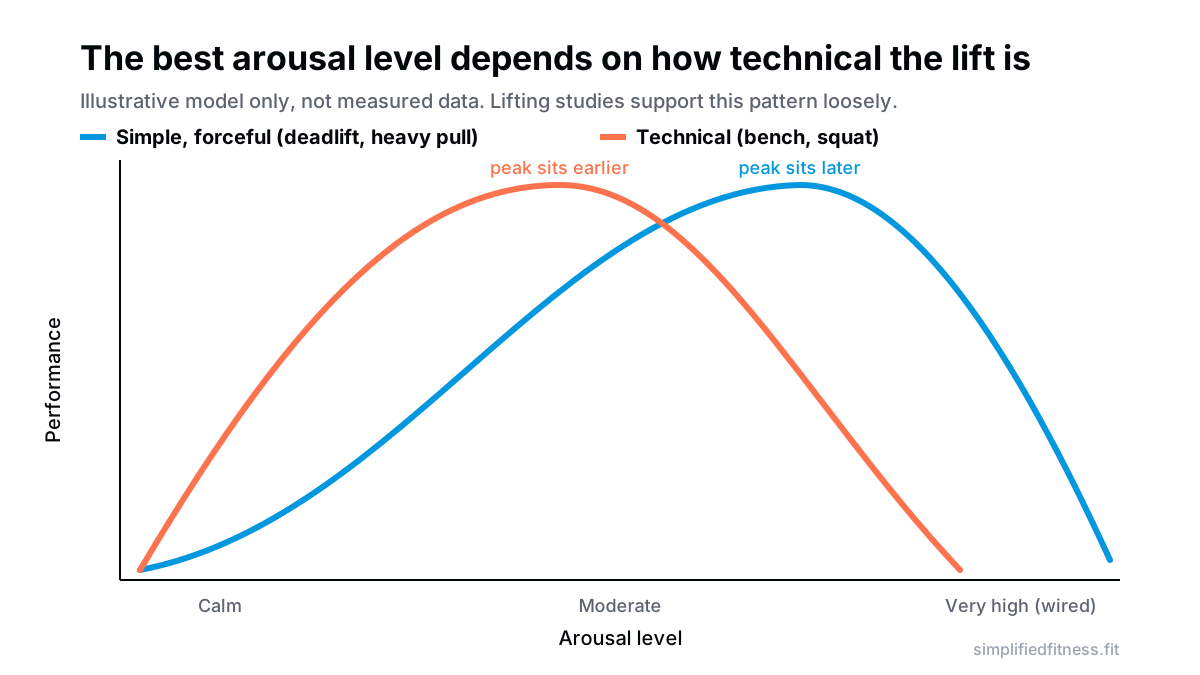
Here is the honest caveat. In lifting, this exact pattern is hard to pin down. A review of psyching-up research concluded that firm conclusions are not possible, that psyching up may help dynamic strength and endurance tasks, and that preparatory arousal looked like the most effective strategy. It also pointed out that most studies used undergraduates or untrained people, and only a few used well-trained lifters (Tod et al., 2003).
So the inverted U is a useful way to think, not a law.
Should I psych up for a deadlift but stay calm for a bench press?
That is a sensible starting hypothesis, and you can test it yourself. Do not treat it as proven.
A deadlift is mostly a big, simple pull from a dead stop. A heavy bench press or a squat that is grinding at the bottom asks more of your coordination and bar path. When you are hyped up, it is easy to rush the unrack, flare your setup or let the bar drift. On a pull, a bit of extra aggression often costs less.
A practical way to use the idea:
- Heavy pulls (deadlift, rack pulls): allow more intensity. Music, a hard breath, a short burst of aggression.
- Bench press: keep your breathing slow and your setup deliberate. Intensity comes from the push, not from the setup.
- Squat: somewhere in the middle. Many lifters go calm during the walkout and then ramp up at the bottom.
One thing to note about where “arousal” comes from. Arousal is a state in your body. How you label it matters too. Many lifters feel the same racing heart and call it excitement on good days and panic on bad ones. A deliberate breath and a line like “this is my body getting ready” can change how it feels.
Do smelling salts, music and shouting work?
They change how you feel more reliably than they change how much force you produce.
Ammonia inhalants. In a randomized trial of 14 non-resistance-trained men, ammonia inhalants raised heart rate, alertness and perceived performance, yet handgrip and knee-extension force, rate of force development and jump power did not change (Campbell et al., 2022). The population was untrained and the sample small, so it does not close the case for experienced lifters. In that study, at least, it felt better without measurably producing more force.
Music. The evidence is a bit more encouraging. In 12 resistance-trained men, preferred music produced more bench press reps at 75% of 1RM, plus higher bar velocity and power in the first three reps, than non-preferred music (Ballmann et al., 2021). A 2025 study in 20 regional-level athletes also found that self-selected music beat no music for bench press power, and that the music they chose themselves raised felt activation more than a stimulative playlist (Bozzato et al., 2025). These are small crossover studies at submaximal loads, so I would not promise a 1RM jump. The practical message is to use music you actually like.
Shouting and slapping. Less studied in well-controlled trials, so I will not pretend to have numbers. If it helps your focus, fine. If it makes your setup sloppy, drop it.
Does visualization work for weightlifting?
Yes, in a limited way. It is a supplement, not a substitute.
The idea is that imagining a movement partly engages the same motor planning networks used when you actually do it. That is the rationale, and the evidence for strength is better than you might expect from something that sounds mystical. A meta-analysis of 25 randomized trials in healthy adults found motor imagery training improved maximum voluntary force compared with no exercise (effect size 1.10), but was inferior to physical training (ES 0.38 in favour of physical training). Combining imagery with physical training was equivalent to physical training alone. The benefit looked larger in older adults and small finger muscles than in young adults and large muscles (Liu et al., 2022).
Read that carefully. Imagery clearly beat doing nothing, and it helped older adults more than young ones. But added to normal training, it was no better than training alone. Where it may earn its place is when you cannot train: a separate review found imagery reduced strength loss after short-term immobilization and ACL injury (Slimani et al., 2016). For a lifter who is training normally, expect little extra strength from it.
That same review reported that internal imagery (feeling the movement from inside your body) tended to show bigger strength effects than external imagery (watching yourself like a video), mostly in students, novices and young athletes, and that imagery ability, motivation and self-efficacy seemed to mediate the effect (Slimani et al., 2016).
So what is it good for on PR day? Mostly confidence and rehearsal. Five to ten seconds before the bar: feel the grip, the brace, the first inch of movement, the bar speed through the sticking point, the lockout. Keep it in the first person and keep it quick. Imagining the lift going wrong is the usual trap.
Internal or external focus: what should I think about mid-rep?
For a max attempt, think about the bar or the floor, not a muscle.
Two terms first. An internal focus is on your body (“squeeze the glutes”). An external focus is on the effect of the movement (“push the floor away”, “drive the bar to the ceiling”).
A meta-analysis of 10 studies found a significant acute benefit of external focus on muscular strength (standardized mean difference 0.34, 95% CI 0.22-0.46). Over the long term, the difference in strength gains between internal and external focus was not significant overall (SMD 0.32, CI -0.08 to 0.73), though lower-body exercises favoured external focus (SMD 0.47) (Grgic et al., 2021). A systematic review of 16 studies on attentional focus in weight training pointed the same way, with an external focus helping movement economy, and explained it through the idea that external focus promotes automatic control instead of conscious micromanaging (Neumann, 2019).
Now the twist. Muscle size may tell a different story. In an 8-week trial of 30 untrained young men, an internal focus (contracting the target muscle) produced greater elbow flexor thickness gains than an external focus (12.4% vs 6.9%), and strength differences did not reach significance (Schoenfeld et al., 2018). The participants were untrained and the sample small, so it needs replication.
Why might both be true? Possibly because the goals differ. A max single is about producing force through a well-learned pattern, where staying out of your own way helps. Hypertrophy is about loading a specific muscle, where feeling it may help, at least on lighter loads. Bench press EMG work in trained men suggests the mind-muscle effect on muscle activity showed up up to about 60% of 1RM but not at 80% (Calatayud et al., 2016). That is another reason not to expect internal focus to do much at near-max loads.
The practical takeaway: external cues on heavy attempts, mind-muscle focus on lighter, higher-rep work.
| Situation | Suggested focus | Example cue |
|---|---|---|
| Heavy squat single | External | “Push the floor away” |
| Heavy bench single | External | “Drive the bar to the ceiling” |
| Heavy deadlift | External | “Push the floor, bend the bar” |
| Hypertrophy sets (lighter) | Internal can help | “Squeeze the muscle through the rep” |
How do I build a setup ritual for a PR attempt?
Make it identical, short, and boring. A ritual is not superstition. It removes decisions, so your brain has fewer things to argue about when the bar is heavy.
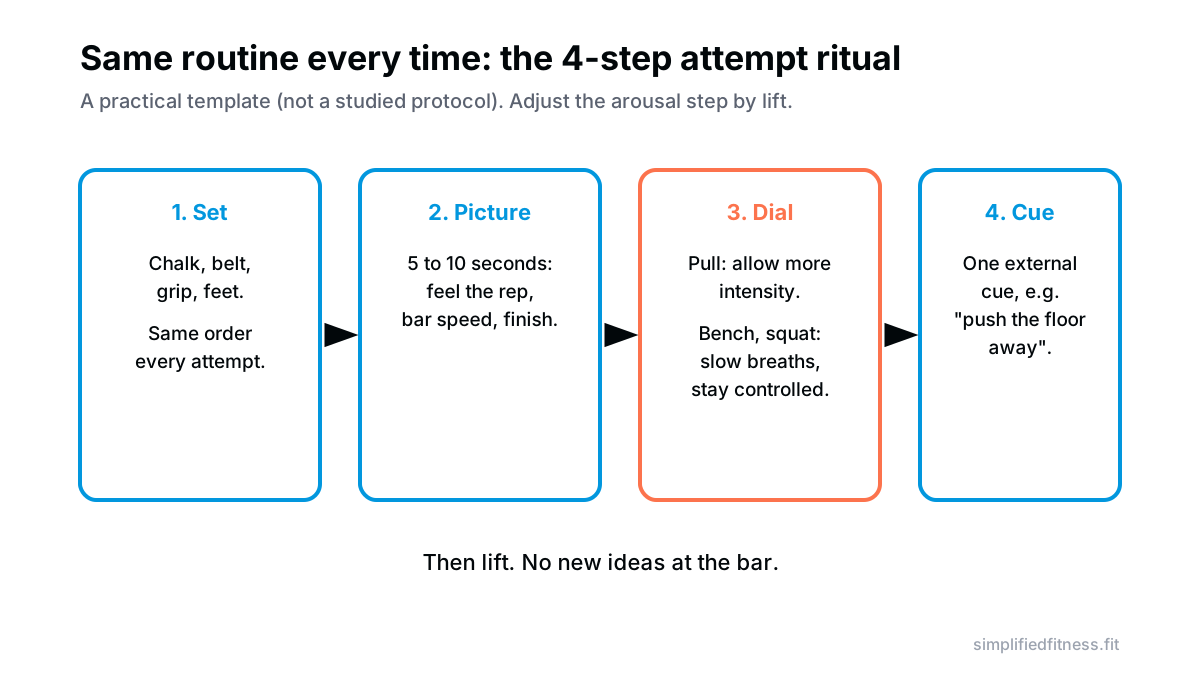
A simple template (a practical suggestion, not a studied protocol):
- Set. Chalk, belt, grip, feet or back position, always in the same order.
- Picture. Five to ten seconds of first-person rehearsal.
- Dial. Raise intensity on pulls, slow your breathing on bench or technical squats.
- Cue. One external cue. Not three.
Run it on your last two warm-up sets, too. If the ritual only shows up on the heaviest attempt, it will feel foreign exactly when you need it to feel familiar. It also pairs well with sensible RPE-based top singles, which let you rehearse the routine at manageable loads. Bracing is part of this too, and our guide to the Valsalva maneuver and intra-abdominal pressure covers how to do it well.
What about nerves and anxiety on PR day?
Nerves are normal, and a little may even help. The aim is not to feel nothing, it is to stay in control while you feel something.
Things that can help in practice:
- Slow your exhale for a few breaths before you approach the bar, then ramp up the moment you start the ritual.
- Keep the attempt choice sensible. If the weight scares you for the wrong reasons, a smaller jump might be the smarter move. Our guide to testing a 1RM versus estimating it and our RIR/RPE calculator can help you pick attempts from your data.
- Use safeties or a competent spotter so that failing is not scary.
- Warm up well. A sloppy warm-up feeds nervousness. See warm-up ramping without fatigue.
If anxiety around lifting or performance is intense, constant, or affects your sleep, work or daily life, please talk to a doctor or a qualified mental health professional. A gym article cannot diagnose or treat that. Also, if you have high blood pressure or a heart condition, check with your doctor before using strong stimulants or maximal breath-holding.
What does this look like for an Indian lifter on a budget?
You do not need anything expensive here. Speakers are not needed either: a pair of earphones and a playlist you like costs nothing extra. Smelling salts are optional and the evidence says they mostly change perception. In a hot, crowded commercial gym, a few slow breaths and a fixed ritual are more useful than anything you can buy.
If the gym is loud or the equipment is shared, shorten your ritual rather than skipping it. Even 20-30 seconds of the same sequence is better than a different improvisation each time. If you want to see how your heavy attempts compare with your estimated max, try our 1RM calculator.
Putting it together
A realistic plan for the next heavy block:
- Pick one external cue per main lift and write it in your log.
- Rehearse the four-step ritual on every top single, not just on test day.
- Rate arousal 1-10 and bar speed after each heavy single for a few weeks.
- Keep what correlates with your best lifts. Drop the rest.
- Do not change anything big in the final week before a meet or PR attempt. If you are peaking, our peaking and tapering guide covers the physical side.
Bench specialists may also want the setup details in our guide to the competition bench press, because a calm, well-practised setup is half of the lift.
The honest summary: the psychology of a max lift is a small lever, and the research is smaller and younger than the confident claims online suggest. Pull it only after the big levers (training, sleep, food) are pulled.
Frequently Asked Questions
How do I mentally prepare for a heavy lifting PR?
Use a short, fixed routine: set up the same way every time, picture the rep for 5-10 seconds, set your arousal to suit the lift, and think of one external cue. A systematic review found cognitive strategies were linked with better strength performance in about 61-65% of results, though effects are modest and vary by person. Practise the routine on your heavy singles in training so it feels automatic on PR day.
Does psyching up actually increase strength?
It may help a little, but the evidence is tentative. A review of psyching-up research concluded it may enhance dynamic strength and endurance tasks, with preparatory arousal the most effective strategy, while noting most studies used untrained people. Try it on your heavy sets and keep it only if your bar speed or reps genuinely improve.
What is the inverted-U theory of arousal in lifting?
It says performance rises with arousal up to a point, then falls if you get too wired. The usual extension is that simple, forceful tasks tolerate higher arousal than technical ones. In lifting, research on this specific pattern is limited, so treat it as a rule of thumb and check it against how your own attempts feel.
Should I get angry or stay calm before a max attempt?
It depends on the lift and on you. A deadlift or heavy pull may tolerate more intensity, while a bench press or a tight squat usually rewards controlled, calm breathing. Experiment across training sessions and note which state gives your cleanest, fastest reps.
Does visualization work for weightlifting?
Mental imagery can raise strength compared with doing nothing, but it does not beat actual lifting. A meta-analysis of 25 studies found imagery improved maximum force versus no exercise (ES 1.10), was inferior to physical training, and combining the two matched physical training alone. Use it as a 5-10 second rehearsal before sets, not as a replacement for them.
Is internal or external focus better for lifting heavy?
For acute strength, an external focus (the bar, the floor, the outcome) did better than an internal focus (a muscle) in a meta-analysis of 10 studies. For building muscle size, an 8-week trial in untrained men favoured an internal focus. So use external cues on heavy attempts and save mind-muscle focus for lighter hypertrophy work.
What are good external cues for squat, bench and deadlift?
Good cues point at the bar or the environment, such as 'push the floor away', 'drive the bar up', or 'bend the bar'. They tend to keep your movement automatic instead of micromanaged. Pick one cue per lift, rehearse it in training, and avoid adding a second one at the platform.
Do smelling salts improve lifting performance?
Probably not for strength itself. A randomized trial in 14 non-resistance-trained men found ammonia inhalants raised heart rate, alertness and perceived performance but did not change peak strength, power or neuromuscular drive. If you use them, treat them as a feeling, not a force booster, and do not rely on them.
Does listening to music help before heavy lifts?
It can. In 12 resistance-trained men, preferred music produced more reps and higher bar velocity at 75% 1RM than non-preferred music, and a 2025 study in 20 athletes found self-selected music beat no music for bench press power. Choose music you actually like, since personal preference seems to matter.
Can too much adrenaline ruin my form?
Yes, it can. Very high arousal can narrow attention and make you rush the setup or lose bar path control, especially on technical lifts. Slow breathing, a fixed routine and one cue help you stay in control.
How long should my pre-lift routine be?
Aim for roughly 60-90 seconds from approaching the bar to starting the rep. The exact length is not studied, but a consistent routine reduces decision-making at the bar. Time it in training and keep it the same on PR day.
Should I stop trying PRs if I feel anxious?
Not necessarily. Some nerves are normal and may even help. If anxiety is severe, persistent or spills into daily life, speak to a doctor or a qualified mental health professional, and meanwhile keep the weight manageable and use a spotter or safeties.
Is mental preparation more important than training?
No. Mental strategies only fine-tune what your training has built, and the reviews describe modest effects. Get the programming, sleep and food right first, then use mental prep to access what you already have.
Sources & References
Every claim above is checked against peer-reviewed research (PubMed, U.S. National Library of Medicine) or guidance from established health bodies. How we fact-check.
- Tod D, et al. A Systematic Review of the Effect of Cognitive Strategies on Strength Performance. Sports Med. 2015. PMID: 26378003
- Tod D, Iredale F, Gill N. 'Psyching-up' and muscular force production. Sports Med. 2003. PMID: 12477377
- Grgic J, Mikulic I, Mikulic P. Acute and Long-Term Effects of Attentional Focus Strategies on Muscular Strength: A Meta-Analysis. Sports (Basel). 2021. PMID: 34822352
- Schoenfeld BJ, et al. Differential effects of attentional focus strategies during long-term resistance training. Eur J Sport Sci. 2018. PMID: 29533715
- Liu XJ, et al. Elderly may benefit more from motor imagery training in gaining muscle strength than young adults: A systematic review and meta-analysis. Front Psychol. 2022. PMID: 36687842
- Slimani M, et al. Effects of Mental Imagery on Muscular Strength in Healthy and Patient Participants: A Systematic Review. J Sports Sci Med. 2016. PMID: 27803622
- Campbell AK, et al. Elevated arousal following acute ammonia inhalation is not associated with increased neuromuscular performance. Eur J Sport Sci. 2022. PMID: 34228592
- Ballmann CG, et al. Effects of Preferred vs. Nonpreferred Music on Resistance Exercise Performance. J Strength Cond Res. 2021. PMID: 30531416
- Bozzato M, et al. Self-selected music enhances bench press performance compared to no-music alone and mood compared to stimulative and no-music conditions. J Sports Sci. 2025. PMID: 40605330
- Neumann DL. A Systematic Review of Attentional Focus Strategies in Weightlifting. Front Sports Act Living. 2019. PMID: 33344931
- Calatayud J, et al. Importance of mind-muscle connection during progressive resistance training. Eur J Appl Physiol. 2016. PMID: 26700744

Umair Hazrami · Founder & Head Coach, Simplified Fitness
Umair Hazrami founded Simplified Fitness and the Simplified Lifter channel to cut through fitness noise. With 4+ years of consistent training and 10+ coaching clients, he writes every guide from the peer-reviewed research and links the sources so you can check them. Our editorial standards.
Educational content only, not medical advice. If you have a medical condition, are pregnant, or take medication, talk to a qualified doctor before changing your diet, supplements or training. Full disclaimer.
Keep reading
Strength & Cardio
1-Rep Max Testing vs 1RM Formulas: Which Is More Accurate and What Does Each Cost You?
1RM testing vs calculation: how accurate are Epley and Brzycki, when a true max is worth the risk, and a safe protocol if you do test. Studies linked.
9 min read
Strength & Cardio
Accommodating Resistance: Do Bands and Chains Really Match the Squat and Bench Strength Curve?
Accommodating resistance with bands and chains makes the top of a lift heavier. See what trials show on power and strength, and how to set it up safely.
9 min read
Strength & Cardio
Competition Bench Press Technique: Arch, Leg Drive, Lats and Bar Path Explained
Competition bench press technique explained: scapular setup, leg drive, lat tension, bar path and pause commands, plus what the research does and does not show.
10 min read
Strength & Cardio
Conventional vs Sumo Deadlift: Which Suits Your Hips, Limbs and Back?
Conventional vs sumo deadlift biomechanics: what the studies show on muscle demand, bar path and back load, plus a simple test to pick the style for your body.
10 min read