Daily Undulating Periodization (DUP) for Concurrent Strength and Hypertrophy
A powerbuilding program with DUP: heavy, moderate and volume days in one week, with the research, a 12-week template and a rule for ordering lifts.

TL;DR. The short answer
- A powerbuilding program with DUP changes the rep range every session: heavy 3-5 reps for strength, 8-12 reps for hypertrophy, and a lighter or faster third day. You train all three qualities every week instead of one at a time.
- When total volume is equated, a 2022 meta-analysis found undulating periodization beat linear for 1RM strength in trained lifters (effect size 0.61, interval just touching zero) and did not differ for muscle growth.
- Muscle growth tracks hard weekly sets per muscle more closely than the rep range you pick, so use DUP to organise volume, not to replace it.
- Put the heavy competition lift first in the session and the bodybuilding accessories after it. Keep the heavy day's accessories light so it does not wreck your next session.
- Beginners do not need DUP. It suits intermediates who can recover from three or four sessions a week and who care about both numbers on the bar and size.
Part of our complete guide: Maximal Strength, Neuromuscular Adaptations & Powerlifting Science for General Lifters
Table of contents
A powerbuilding program with DUP trains strength and size inside the same week by changing the rep range every session. One day is heavy (3-5 reps), one is moderate (8-12 reps), and one is lighter, faster or higher-rep. For trained lifters, that structure tends to match or beat linear plans for strength, and it matches them for muscle growth, as long as total weekly volume is the same.
This article is the practical build-out of the strength ideas in our maximal strength and powerlifting science guide. If you want the hypertrophy-only comparison of DUP and block plans, see rep-range periodization: DUP vs block for hypertrophy. Here the goal is different: a squat, bench and deadlift that keep climbing while your physique fills out.
What is a powerbuilding program with DUP?
Powerbuilding borrows from two worlds. Powerlifters practise a few heavy lifts for low reps. Bodybuilders accumulate lots of moderate-rep sets across many exercises. A common way to fail at both is to do everything every day and burn out.
Daily undulating periodization fixes that by giving each session one main job. The “undulating” part means the load and reps wave up and down across the week instead of climbing slowly over months, which is what linear periodization does.
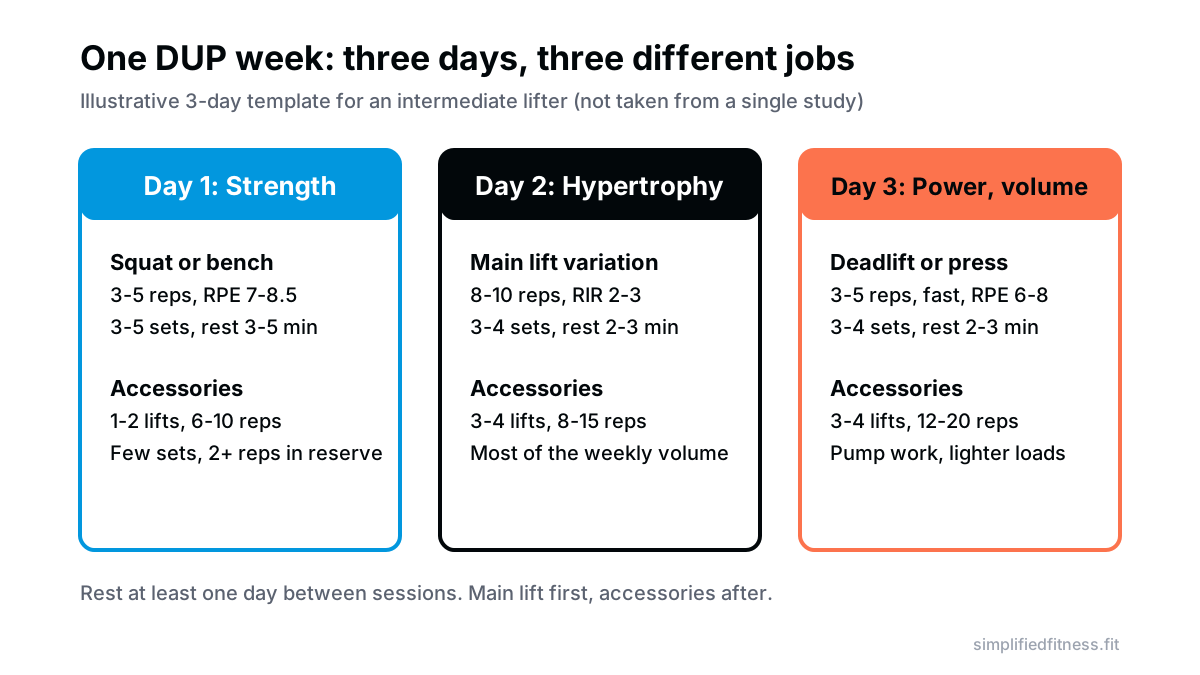
The usual three-day pattern:
- Day 1, strength: heavy squat or bench for 3-5 reps with long rests.
- Day 2, hypertrophy: moderate loads for 8-12 reps, more exercises and more sets.
- Day 3, power or volume: faster, lighter reps, or higher reps (12-20) on accessories.
Why the rep range matters less than you think
The old “repetition continuum” said heavy loads build strength, moderate loads build muscle and light loads build endurance. A 2021 review argues that this is too rigid, and proposes that muscular adaptations can be obtained, and in some cases optimised, across a wide spectrum of loading zones (Schoenfeld et al., 2021).
A meta-analysis of 21 studies backs this up. When sets were taken to failure, 1RM strength gains favoured high-load training, whereas hypertrophy was similar between low-load (60% of 1RM or less) and high-load training (Schoenfeld et al., 2017). Put simply, heavy work is the specific way to get better at heavy lifts, and many rep ranges can grow muscle.
That is the logic behind DUP for powerbuilding. Heavy days practise the skill of lifting near-maximal loads. Moderate and light days supply the sets that drive size, without needing every set to be heavy.
Does DUP actually beat other models?
Here the research is more mixed, and it helps to see both sides.
For DUP. In a 12-week study of 40 men with at least one year of training experience, the DUP group improved bench press 1RM by 25.08% versus 18.2% for linear, and leg press by 40.61% versus 24.71%. The authors noted that DUP produced the biggest gains in every exercise, though the differences between groups were not statistically significant (Prestes et al., 2009).
The pooled picture. A 2022 systematic review and meta-analysis of volume-equated trials (35 studies) found periodized training beat non-periodized training for 1RM (effect size 0.31), and undulating beat linear for 1RM (0.31). In trained participants the undulating advantage was 0.61, while in untrained participants it was 0.06. Muscle hypertrophy did not differ between linear and undulating models (0.05) (Moesgaard et al., 2022).
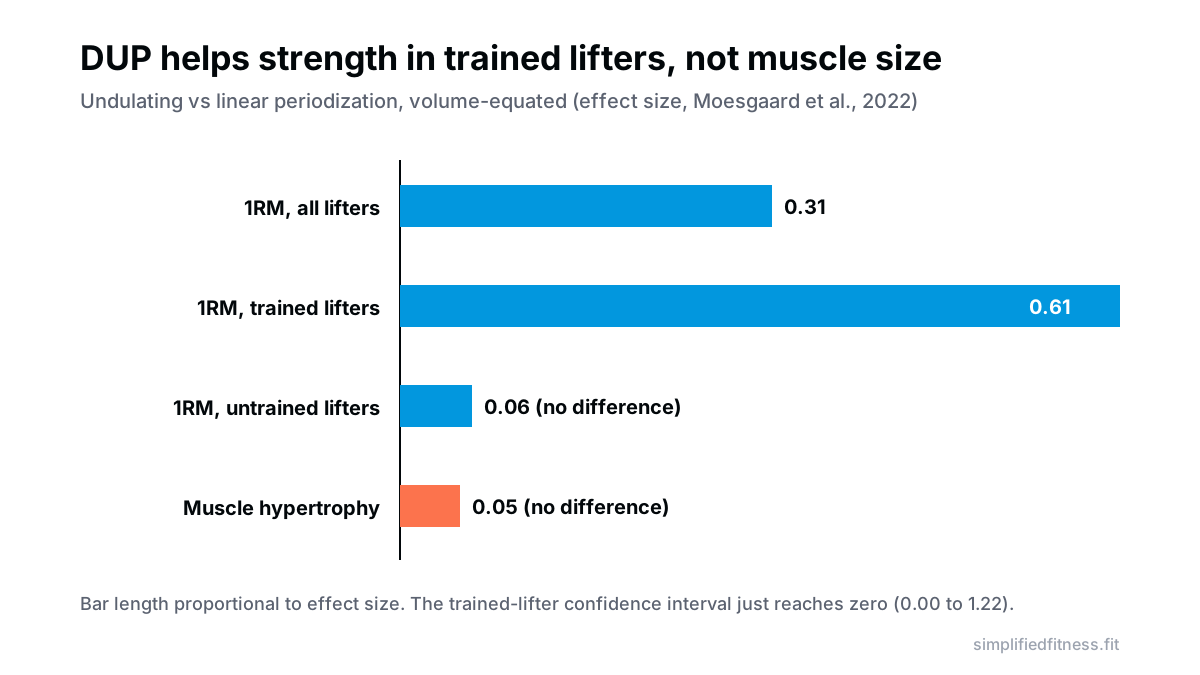
Why the results differ. Untrained lifters improve on almost any plan, so differences wash out. Trained lifters have already harvested the easy gains, so variation in intensity may keep the neural side of strength training fresh. The authors suggest the benefit may relate to neurophysiological adaptations rather than extra muscle. Also, the trained-lifter interval ran from 0.00 to 1.22, so the advantage is plausible but not tightly pinned down.
Practical takeaway. If you are an intermediate and you care about your 1RM, DUP is a reasonable default. If you only care about size, the model matters much less than how many hard sets you do each week.
How to manage volume in a powerbuilding split
Hypertrophy follows weekly volume. A 2017 meta-regression of 15 studies found that more weekly sets were associated with greater muscle gains: each additional set was linked to about a 0.37% increase in percentage gain, and the higher-volume groups gained about 3.9% more than lower-volume ones (Schoenfeld et al., 2017). The relationship was graded, but it was built from only 15 short studies, and it does not tell you how much you personally can recover from. More sets only help if you can recover from them. We cover the curve in the weekly set volume dose-response guide.
For powerbuilding, that gives you a simple frame:
- Count hard sets per muscle per week across all three days, including the heavy compounds.
- Start at the low end of what you can recover from (roughly 8-12 sets for most muscles) and add a set or two every few weeks.
- Let the moderate day carry most of the volume. The heavy day stays low in sets so you arrive at the bar fresh.
The most common mistake here is treating the strength day as a full bodybuilding session with five exercises after the heavy lifts. By week three the top sets are slow and the next day’s session is compromised.
Sequencing: compounds first, accessories after
Order matters because heavy lifts depend on technique and force output. Fatigue from earlier sets reduces both. So:
- Heavy compound first. Squat, bench or deadlift while fresh.
- Variation or secondary compound next. Pause squats, front squats, incline press, Romanian deadlifts.
- Accessories last. Machines, cables and isolation work. These are easier to do well when tired, and safer to take close to failure.
The one reasonable exception is a lagging muscle on the moderate day. If your chest is behind, you can start Day 2 with it. Keep that to one or two exercises, since “everything first” means nothing is first.
Use effort targets so loads self-adjust. Our RIR and RPE load calculator helps translate rep targets into loads, and RPE-based top singles and back-off sets shows how to run the heavy day when you want a single.
A sample 12-week powerbuilding template
This is illustrative programming, not a protocol tested in a trial. It applies the research above to a 3-day week for an intermediate lifter, three 4-week blocks. If you have a fourth day, add an upper or lower body hypertrophy session built from the Day 2 pattern.
| Day | Main lift | Weeks 1-4 | Weeks 5-8 | Weeks 9-12 |
|---|---|---|---|---|
| 1 Strength | Squat, then bench | 4 x 5 at RPE 7 | 4 x 4 at RPE 8 | 5 x 3 at RPE 8.5 |
| 2 Hypertrophy | Squat or deadlift variation, incline press | 3 x 10 at RIR 3 | 3 x 9 at RIR 2 | 4 x 8 at RIR 2 |
| 3 Power plus volume | Press or deadlift (fast), accessories | 3 x 5 fast, 3 x 15 accessories | 4 x 4 fast, 3 x 15 | 4 x 3 fast, 3 x 12 |
Accessories by day, all done after the main lifts:
- Day 1: one back movement and one hamstring or triceps movement, 2-3 sets each, 6-10 reps.
- Day 2: 3-4 movements covering back, quads or hamstrings, chest and shoulders, 3 sets each, 8-15 reps.
- Day 3: lateral raises, curls, calves, a row or pulldown, 3 sets each, 12-20 reps.
If you want a plain structure to start from, our free workout plans give you the movement pattern, and the training volume calculator helps check weekly sets. For progression rules and deloads, the progressive overload and deload guide fills in the detail.
Which order should the days go in?
One small study in 18 male college-aged powerlifters compared two DUP orders over 6 weeks. A “hypertrophy, power, strength” week produced greater bench press 1RM gains than “hypertrophy, strength, power”, with higher total volume in squat and bench, and no difference for squat and deadlift 1RM (Zourdos et al., 2016). It was short, in young male powerlifters, and only one lift clearly benefited.
So the cautious takeaway is: put your heaviest day after a lighter day, and avoid heavy squats and deadlifts back to back. Everything else about day order is a preference, not a rule.
Who should skip this approach
- Beginners. You will progress on almost any plan. Learn the lifts first.
- Anyone who cannot train three days a week. DUP needs at least three exposures to rotate qualities. With two days, use a simple upper-lower split instead.
- Lifters returning from injury or with unresolved pain. Heavy loading needs a clean movement pattern. If a joint hurts or you have pain that changes with load, see a doctor or physiotherapist before working near maximal loads.
Fuelling it on an Indian diet
Heavy lifting plus volume raises recovery demands. You do not need exotic food. Rotate dal, curd, paneer, soya chunks, eggs, chicken or fish if you eat them, and add roti, rice or poha to support training. Set a protein target with our protein calculator. In hot weather, drink enough water and expect your top sets to feel heavier on humid days: lower the load a notch rather than forcing it.
The bottom line
DUP is a tidy way to organise powerbuilding. It gives heavy lifts a dedicated day, hands the moderate day most of the volume, and keeps the third day for speed or pump work. The evidence supports it for strength in trained lifters, and says it is no worse for muscle growth when volume is matched. It does not replace the basics: enough hard sets per muscle, progressive overload, protein, sleep and the discipline to keep heavy days fresh.
Run the 12-week template, log your top sets, and change one thing at a time.
Frequently Asked Questions
What is daily undulating periodization (DUP)?
DUP is a training structure where rep ranges and loads change from session to session within the same week, for example heavy triples on Monday and sets of 10 on Wednesday. Because each day targets a different quality, you practise strength and build muscle at the same time. Pick three distinct days and rotate them rather than doing the same rep range every session.
What is powerbuilding?
Powerbuilding is training that chases both a bigger squat, bench and deadlift and a bigger physique. It works because heavy sets build strength skill while moderate-rep and higher-rep work adds the volume muscle needs. A simple version is one heavy day, one moderate day and one higher-rep day per week.
Is DUP better than linear periodization for strength?
In a 2022 meta-analysis of volume-equated studies, undulating periodization gave a small edge for 1RM (effect size 0.31), and the edge was larger in trained lifters (0.61) than in untrained ones (0.06). The confidence interval for trained lifters ran from 0.00 to 1.22, touching zero, so treat it as a modest advantage, not a guarantee. Choose the model you will follow consistently.
Is DUP better for muscle growth?
No clear advantage has been shown. The same meta-analysis found hypertrophy did not differ between linear and undulating models (effect size 0.05) when volume was matched. Focus on weekly hard sets per muscle and progressive overload.
How many days a week do I need for DUP?
Three days is the minimum to rotate heavy, moderate and light-load sessions. Four days works well if you split upper and lower body, and each lift then gets a heavy and a moderate exposure. Take at least one rest day between sessions that hit the same muscles.
What rep ranges should I use on each DUP day?
A common setup is 3-5 reps on the strength day, 8-12 on the hypertrophy day and 3-5 fast reps plus 12-20 rep accessories on the third day. The loading research shows muscle can grow across a wide range of loads, while heavy loads are better for maximal strength. Stay a few reps short of failure on most sets and push closer on the final set of accessories.
Should I train to failure on heavy days?
Usually no. Heavy sets taken to failure on squat or deadlift cost a lot of recovery for little extra benefit, and they eat into the quality of later sessions. Stop with 1-3 reps in reserve on heavy compounds and save near-failure work for machines and isolation lifts.
How should I order compound lifts and accessories?
Do the heavy compound first while you are fresh, then the hypertrophy accessories. Technique and force output fall when you are tired, and heavy lifts are the ones where that costs you most. If a muscle is a weak point, you can place its accessory earlier in the session on the moderate day.
How many sets per week do I need for muscle growth in a powerbuilding program?
A 2017 meta-regression found a graded dose-response, with more weekly sets linked to more growth, and each extra set was associated with about 0.37% more gain. In practice, many intermediates do well with roughly 10-20 hard sets per muscle per week, then adjust based on recovery. Count hard sets across all three days, including the heavy compounds.
Can beginners use DUP?
They can, but they do not need it. Untrained lifters improve on almost any sensible plan, and the 2022 meta-analysis found no strength difference between models in untrained people. Start with a simple full-body or push-pull-legs routine and add DUP when progress slows.
Do I need to deload during a 12-week DUP block?
Most lifters benefit from an easier week every 4-6 weeks, or sooner if performance is falling and joints feel beaten up. A deload is a planned drop in volume or load, not time off. Cut sets by about a third and keep the bar moving.
Can I do powerbuilding on a vegetarian Indian diet?
Yes, provided protein and calories are adequate. Dal, paneer, curd, soya chunks, eggs if you eat them, and a whey or plant protein can cover it. Because heavy training plus volume needs good recovery, eat enough carbohydrate (roti, rice, poha) and use the protein calculator to set a daily target.
What if I am sore or tired and cannot hit the planned rep range?
Use the day's intent rather than the exact numbers. If a heavy day feels like a grind at the first set, drop the load a little and keep the reps, or cut one set. Track effort with RPE or reps in reserve so heavy days stay productive and you do not turn every session into a max test.
Sources & References
Every claim above is checked against peer-reviewed research (PubMed, U.S. National Library of Medicine) or guidance from established health bodies. How we fact-check.
- Moesgaard L, et al. Effects of Periodization on Strength and Muscle Hypertrophy in Volume-Equated Resistance Training Programs: A Systematic Review and Meta-analysis. Sports Med. 2022. PMID: 35044672
- Schoenfeld BJ, et al. Loading Recommendations for Muscle Strength, Hypertrophy, and Local Endurance: A Re-Examination of the Repetition Continuum. Sports (Basel). 2021. PMID: 33671664
- Schoenfeld BJ, et al. Strength and Hypertrophy Adaptations Between Low- vs. High-Load Resistance Training: A Systematic Review and Meta-analysis. J Strength Cond Res. 2017. PMID: 28834797
- Schoenfeld BJ, et al. Dose-response relationship between weekly resistance training volume and increases in muscle mass: A systematic review and meta-analysis. J Sports Sci. 2017. PMID: 27433992
- Klemp A, et al. Volume-equated high- and low-repetition daily undulating programming strategies produce similar hypertrophy and strength adaptations. Appl Physiol Nutr Metab. 2016. PMID: 27218448
- Prestes J, et al. Comparison between linear and daily undulating periodized resistance training to increase strength. J Strength Cond Res. 2009. PMID: 19910831
- Zourdos MC, et al. Modified Daily Undulating Periodization Model Produces Greater Performance Than a Traditional Configuration in Powerlifters. J Strength Cond Res. 2016. PMID: 26332783

Umair Hazrami · Founder & Head Coach, Simplified Fitness
Umair Hazrami founded Simplified Fitness and the Simplified Lifter channel to cut through fitness noise. With 4+ years of consistent training and 10+ coaching clients, he writes every guide from the peer-reviewed research and links the sources so you can check them. Our editorial standards.
Educational content only, not medical advice. If you have a medical condition, are pregnant, or take medication, talk to a qualified doctor before changing your diet, supplements or training. Full disclaimer.
Keep reading
Strength & Cardio
1-Rep Max Testing vs 1RM Formulas: Which Is More Accurate and What Does Each Cost You?
1RM testing vs calculation: how accurate are Epley and Brzycki, when a true max is worth the risk, and a safe protocol if you do test. Studies linked.
9 min read

Strength & Cardio
Accommodating Resistance: Do Bands and Chains Really Match the Squat and Bench Strength Curve?
Accommodating resistance with bands and chains makes the top of a lift heavier. See what trials show on power and strength, and how to set it up safely.
9 min read

Strength & Cardio
Competition Bench Press Technique: Arch, Leg Drive, Lats and Bar Path Explained
Competition bench press technique explained: scapular setup, leg drive, lat tension, bar path and pause commands, plus what the research does and does not show.
10 min read
Strength & Cardio
Conventional vs Sumo Deadlift: Which Suits Your Hips, Limbs and Back?
Conventional vs sumo deadlift biomechanics: what the studies show on muscle demand, bar path and back load, plus a simple test to pick the style for your body.
10 min read