Sticking Point Analysis: How to Fix Weak Points in Squat, Bench and Deadlift
How to fix sticking points in squat, bench and deadlift: find where the bar stalls, what the research says causes it, and which accessory to try first.
TL;DR. The short answer
- A sticking point is the part of a rep where the bar slows most. Bench press research suggests it is mostly a mechanically poor position rather than a sudden drop in muscle activation.
- Where the bar stalls (off the chest, mid-range, lockout, above parallel, off the floor) points to a likely weak link, but technique faults can mimic weak muscles, so film the lift first.
- Targeted variations (pause work, Spoto press, close-grip bench, pin squats, deficit or block pulls) are widely used by coaches. Direct trials proving they fix a specific sticking point are scarce, so treat them as tests, not guarantees.
- Training the full range of motion matters: a 2021 meta-analysis found full range training beat partial range for strength gains, so partials should supplement the main lift, not replace it.
- Change one thing at a time for 4-8 weeks, then film again. If you are in pain at the sticking point, see a doctor or physiotherapist rather than pushing through.
Part of our complete guide: Maximal Strength, Neuromuscular Adaptations & Powerlifting Science for General Lifters
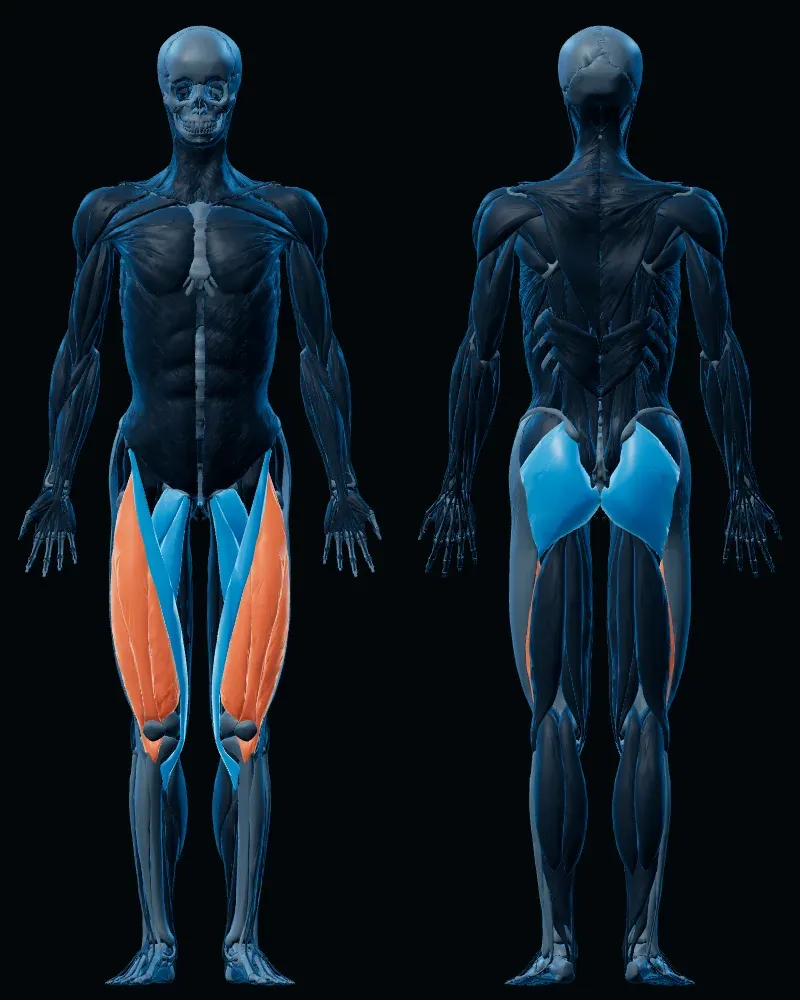
Muscles worked: quads
Main movers: rectus femoris and the three vasti
Assisting: adductors, sartorius and glutes
Table of contents
If you want to know how to fix sticking points, start with this: a sticking point is the spot in a rep where the bar slows the most, and the fix depends on where that spot is and why. A bench that dies halfway, a squat that stalls above parallel, a deadlift that will not leave the floor: each points to a different likely weak link. The catch is that technique faults can look exactly like weak muscles, so you diagnose before you add accessories.
This guide gives you a simple troubleshooting method, what the biomechanics research actually says, and a fix list for each lift. It sits inside our wider maximal strength and powerlifting science guide. Where the research is thin (and for accessory-by-accessory fixes, it is), I will say so.
What is a sticking point, really?
The sticking region is the part of the lift where bar velocity falls to its lowest point after the initial push. You grind, the bar crawls, and it either gets through or it does not.
Two explanations have been argued over. One says muscle activation drops or potentiation fades (the early “boost” runs out). The other says the position is just mechanically poor, so you can produce less force there.
The evidence leans toward the second. In ten elite powerlifters, the prime movers (sternal pecs, anterior delts, triceps long head) reached maximal activation at the start of the ascent and stayed essentially unchanged throughout the sticking region, so the stall was not explained by muscles switching off (Elliott et al., 1989). A later study tested 12 resistance-trained men in a normal 1RM and in isometric presses at 12 fixed bar heights. Both showed a region of lower force output, which supports the poor-position idea and argues against fading potentiation (van den Tillaar et al., 2012).
Practical meaning: the fix is rarely “try harder” or “get psyched”. It is to get stronger in that position and clean up how you reach it.
Step one: find your sticking point before you pick a fix
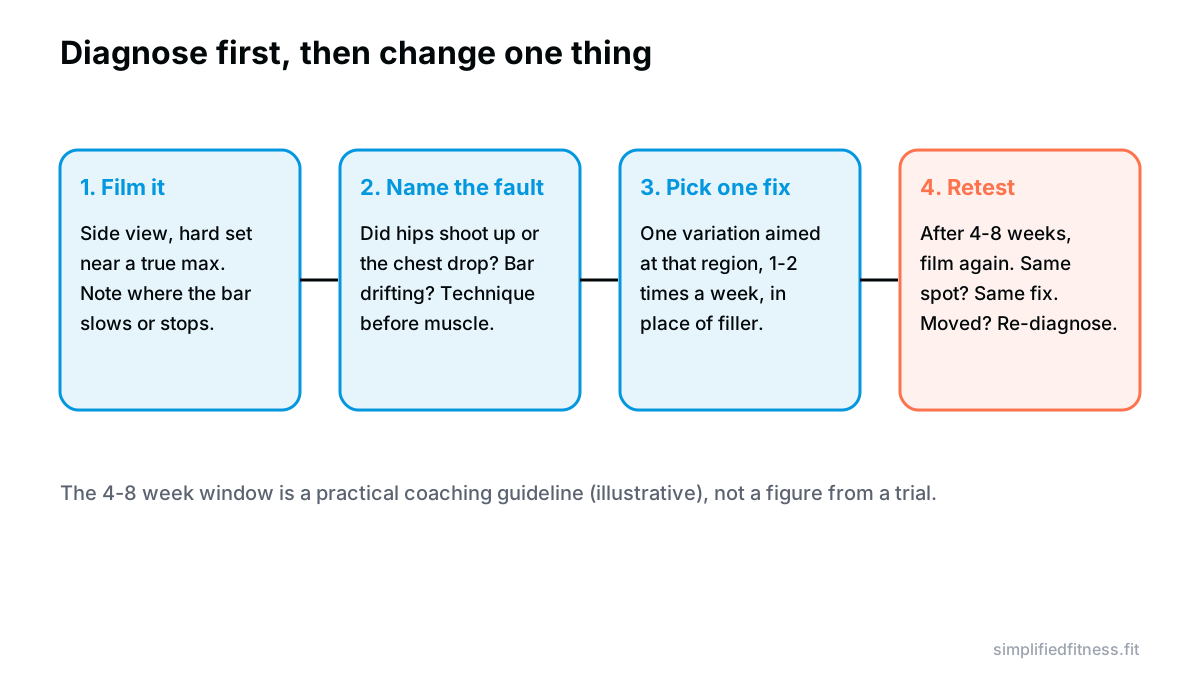
Film a heavy set (RPE 9 or a true max) from the side at hip height. Watch where the bar slows, or where it speeds up again after a slow patch. Do not trust feel alone. It is easy to blame the wrong region.
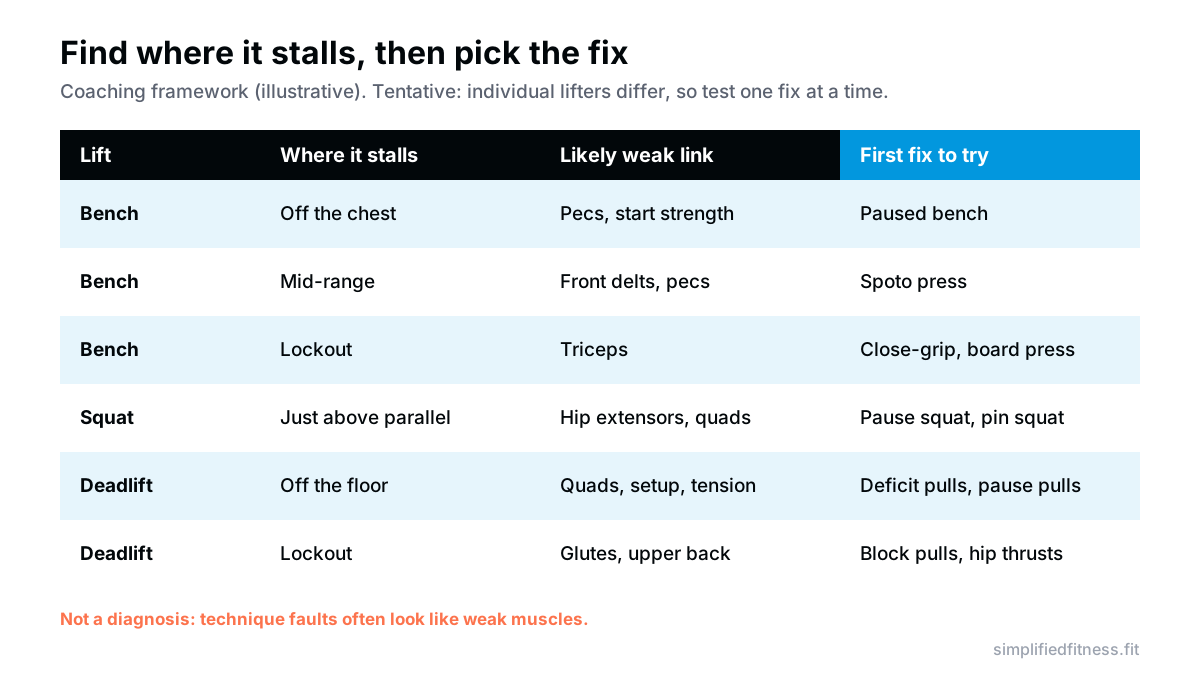
Then ask the uncomfortable question: is this a strength problem or a position problem? Hips shooting up in the squat, the bar drifting forward off the floor, or a flat upper back on the bench can all create a “sticking point” that no accessory will cure. Fix the position first.
How to fix a bench press sticking point (off chest, mid-range, lockout)
Bench is the best studied of the three, and it also has the clearest “regions” to talk about.
Off the chest. A stall within the first few centimetres is usually read as a start strength problem, where the pecs and a tight setup matter most. A pause on the chest removes the bounce and makes you drive from a dead stop. Try 3-5 sets of 3-5 reps with a 1-2 second pause on lighter loads. If the bar only dies when you do not pause, look at your upper back tightness and leg drive. Our competition bench technique guide covers both.
Mid-range. A bench that stalls in the middle is common, and it matches the lab finding of a low force region partway up. Coaches usually reach for the Spoto press (a pause an inch or so above the chest) or dumbbell pressing to strengthen the front delts and pecs through that range. Paused work in general is covered in our guide to paused repetitions and deficit movements.
Lockout. When the bar moves fine until the elbows are nearly straight, the triceps are the usual suspect. Close-grip bench, board presses and triceps extensions are the standard answers. Grip choice matters. In 14 bench-trained men, triceps medialis activity was greater with medium and narrow grips than with a wide grip, while wide and medium grips produced similar shoulder and elbow moments at the slowest bar point (Larsen et al., 2020). Our close-grip bench press guide covers wrist and hand spacing.
One more detail: the sticking region is not fixed. In a 10-week trial of 35 resistance-trained men, all three chest-press groups lifted more slowly at the post-training 6RM test (with heavier loads) and took longer to reach the sticking and post-sticking regions, and the authors concluded that improved strength itself altered the sticking region (Saeterbakken et al., 2020). So do not expect your stall to stay put forever.
Squat sticking point: why you stall halfway up
The back squat tends to fail somewhere around or just above parallel. A 2021 study of 25 recreationally trained lifters did 3-RM back squats and looked at what changes in the sticking region. Torso forward lean, hip moment arm and the hip contribution to total moment increased, while knee contribution decreased. Hip extensor (gluteus maximus and biceps femoris) activity rose after the sticking region, and the authors suggest large hip moment arms combined with lower hip extensor activity make it a poor region for force output (Larsen et al., 2021).
In plain terms: when the chest drops and the hips take over, the lift gets harder right where you cannot afford it. That fits what coaches see when a squat “turns into a good morning”.
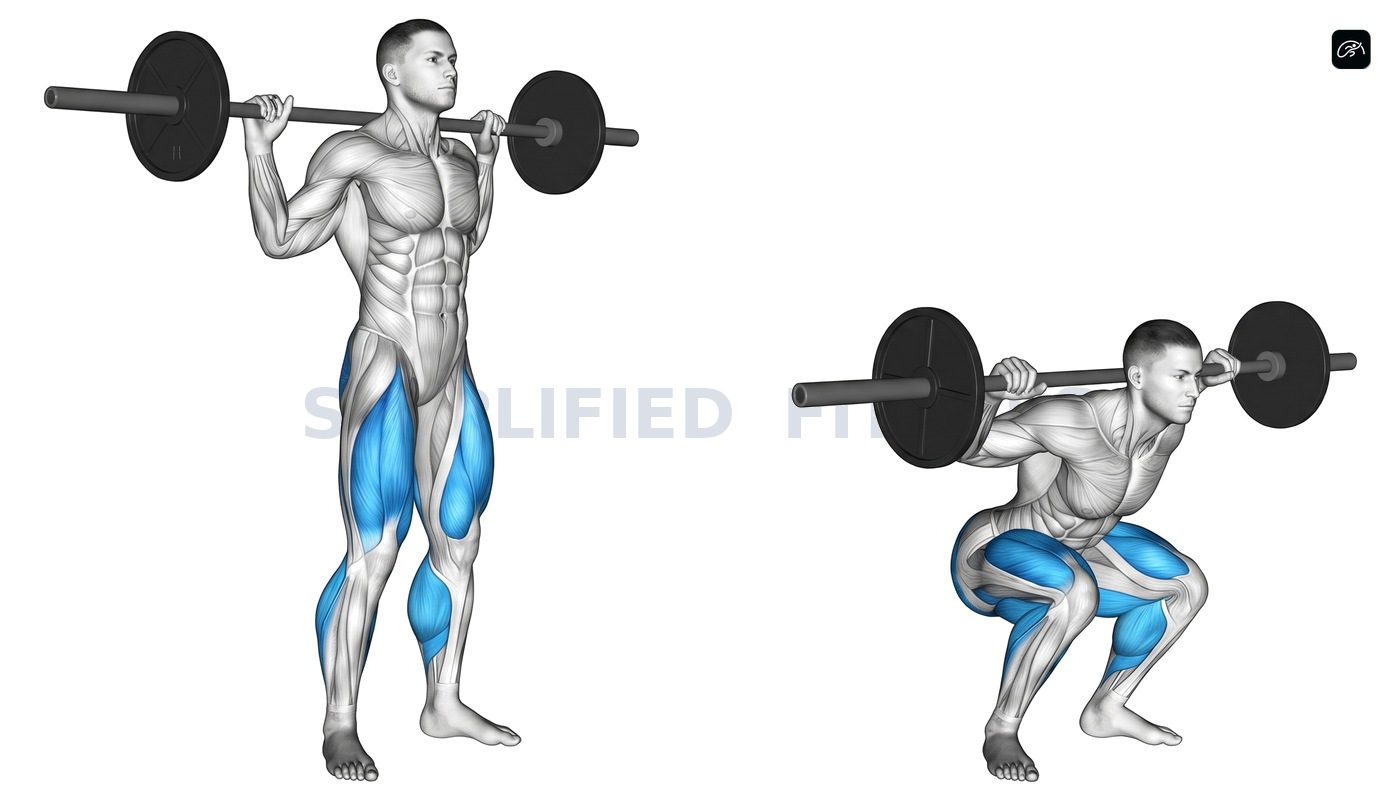
What to try, one at a time:
- Pause squats (1-3 seconds in the hole) for control and drive from a dead stop.
- Pin squats or squats to a box, starting from the stalling position, to build force there.
- Hip-focused work (hip thrusts, RDLs) if the hips clearly shoot up. See hip thrusts versus squats for glutes.
- Technique review, including bar placement. Our low-bar squat biomechanics guide explains how bar position changes torso angle.
This study was in recreationally trained lifters at 3RM. Elite lifters may use different strategies, and one systematic review noted that lifters can adopt distinct mechanical strategies near the sticking point (Bakhshinejad et al., 2025).
Deadlift sticking point: off the floor vs lockout
The deadlift is not a slow squat. A kinematic study of 25 competing lifters compared the sticking points of the two lifts and found the squat looked like a simultaneous movement and the deadlift a sequential one, with different thigh and trunk angles and different bar velocities (0.09 m/s in the squat, 0.20 m/s in the deadlift). The authors concluded there is no direct crossover between the lifts (Hales et al., 2009).
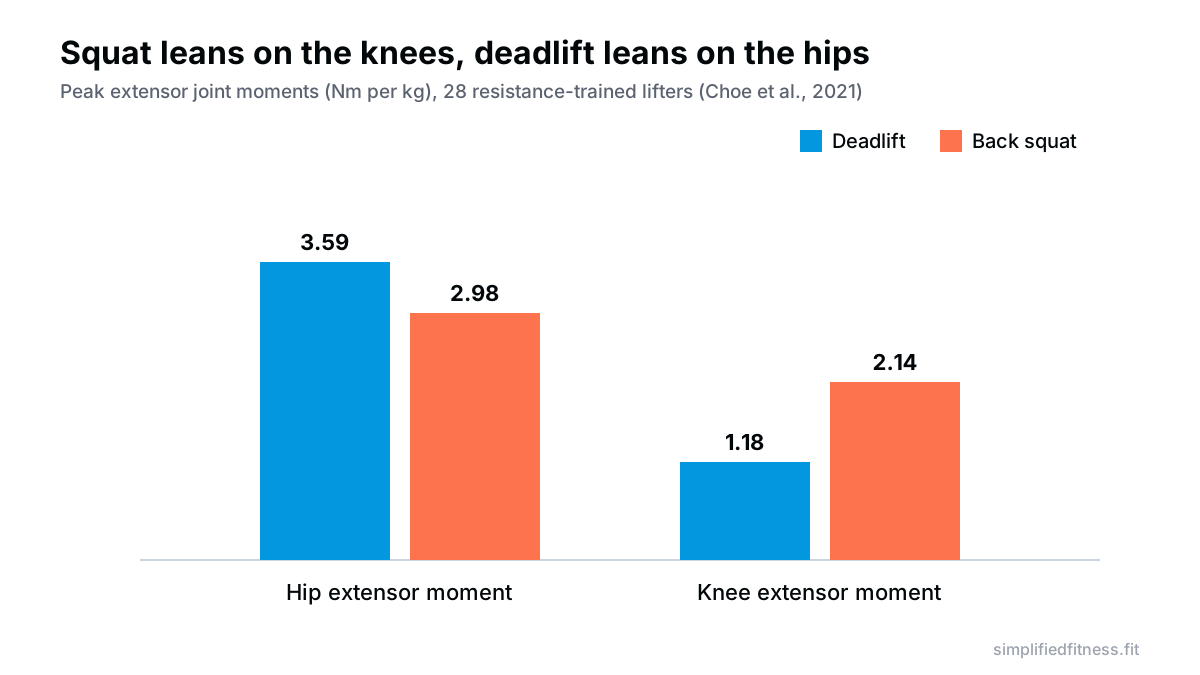
The same joint-moment data helps here. In 28 resistance-trained people, the deadlift produced a larger hip extensor moment (3.59 vs 2.98 Nm per kg) while the back squat produced a larger knee extensor moment (2.14 vs 1.18 Nm per kg) (Choe et al., 2021). It is a useful reminder that the lifts load the joints differently.
Weak off the floor. Common causes are setup (bar not over mid-foot, slack in the lats), poor leg drive, or hips that rise first. Deficit deadlifts and paused pulls just off the floor spend more time in the weakest position. Our deficit and pause guide goes deeper, and the conventional versus sumo guide helps if your stance is the real problem.
Weak at lockout. If the bar flies off the floor and then crawls near the top, glutes and upper back are the usual targets. Block pulls (or rack pulls) and hip thrusts are standard. A quick check: if a rack pull from just below the knee feels easy, lockout is probably not your limiter.
Do weak point exercises actually work? What the evidence supports
Honest answer: partly proven, partly coaching consensus. I could not find controlled trials showing that a particular accessory fixes a particular sticking point. What we have is related.
Training is task specific. A 2025 meta-analysis of 43 studies and 1,660 participants found dynamic training raised dynamic strength with a moderate effect (SMD 0.98) but transferred less to isometric strength tests (SMD 0.42) (Saeterbakken et al., 2025). That supports training positions that resemble the stall, but it does not prove any specific accessory.
Full range still matters. A 2021 meta-analysis of 16 studies found full range of motion training beat partial range for strength (ES = 0.56) and lower-limb hypertrophy (ES = 0.88) (Pallarés et al., 2021). So pins and boards are supplements, not replacements.
A simple way to run it
- Film your heaviest recent set and mark where the bar slows.
- Decide: technique fault, or genuine weakness there?
- Pick one variation aimed at that region. Keep it for 4-8 weeks.
- Run it once or twice a week after your main lift, around 3-5 sets in the 3-8 rep range, at loads you can control.
- Retest with video. If the stall moved, find the new weak link. If not, reconsider the diagnosis.
Use the 1RM calculator to set percentages for variations, and see our systematic plateau flowchart if nothing is moving. If you want structure, the free push pull legs plan leaves room for one accessory slot per lift.
Who should be careful
Pain is different from a sticking point. Sharp pain, pain that lingers, numbness, or pain at the same point every rep is not a weak link to train through. Stop and see a doctor or physiotherapist. Heavy partials and max attempts add load on joints, so build up gradually, particularly if you are returning from injury.
The bottom line
The sticking point is usually a mechanically hard position, not a muscle that “switches off”. Find it on video, separate technique from strength, pick one targeted variation, and retest. The specific accessories are coaching tools backed by sensible logic more than by direct trials, so stay humble and let your own video tell you whether they work.
Frequently Asked Questions
What is a sticking point in lifting?
A sticking point (or sticking region) is the part of a rep where bar speed drops to its lowest and the lift is most likely to fail. It reflects a position where you can produce less force relative to the load. Film a heavy set from the side and note where the bar slows so you know where to aim your training.
How do I fix a bench press sticking point off the chest?
A stall right off the chest usually points to start strength, so paused bench presses are a common fix because they remove the bounce and force you to drive from a dead stop. Technique matters here too, since a loose setup or lost upper back tightness can look like weak pecs. Pause for 1-2 seconds on lighter sets, film from the side, and recheck after a few weeks.
Why does my bench press stall at the midpoint?
Research on the bench press found a region of lower force output in the middle of the rep, even in isometric tests at fixed positions, which suggests it is a mechanically poor position rather than a timing problem. Coaches often respond with Spoto presses (a pause just above the chest) or dumbbell work to build strength through that range. Try one variation for 4-8 weeks and see whether the slowest point moves.
How do I fix a bench press lockout?
A lockout stall often points to the triceps, so close-grip bench press, board press and triceps extensions are common choices. Grip width changes triceps involvement, with one study finding more triceps medialis activity at medium and narrow grips than wide. Add close-grip work after your main bench and keep the elbows tucked to a comfortable angle.
Why do I get stuck halfway up in the squat?
In a study of 25 recreationally trained lifters, the sticking region in 3-RM back squats came with a bigger hip contribution, more forward torso lean and lower hip extensor activity. That points to the hips, so technique cues and hip-focused work are worth testing. Pause squats and pin squats are sensible variations, and a low-bar or high-bar change may also matter.
How do I get out of the hole in the squat?
Getting stuck in the hole is often a mix of leg drive, bracing and balance, not one weak muscle. Pause squats at the bottom train control and drive from a dead stop. Start with 3-5 sets of 3-5 reps at about 70-80% of your usual squat load and film from the side.
Why can I not pull the deadlift off the floor?
A stall at the floor is often about setup and tension, plus leg drive. Deficit deadlifts and paused pulls just off the floor are popular fixes because they spend more time in the weakest position. Check that the bar is over mid-foot, your lats are tight and you push the floor away before you pull.
Why does my deadlift stall at lockout?
Lockout stalls are commonly linked to the glutes and upper back, although a hips-shoot-up fault earlier can cause the same problem. Block pulls and hip thrusts are common choices. Compare a rack pull with your floor pull, and if it is much easier, lockout may not be the real problem.
Do weak point exercises actually work?
Coaches use them widely, but I could not find trials showing that a specific accessory fixes a specific sticking point. Related evidence shows training effects are task specific, so work that resembles the stalling position is a reasonable bet. Treat each fix as a test: change one variable, wait 4-8 weeks and retest.
Should I use partial reps to fix a sticking point?
Partial reps can be a useful supplement, but a 2021 meta-analysis of 16 studies found full range of motion training produced greater strength gains than partial range. That suggests the main lift should stay full range. Use partials or pins for a block of training and keep the competition-style lift in the plan.
How long does it take to fix a sticking point?
There is no research-backed timeline, but most coaches use blocks of about 4-8 weeks before judging a change. Strength gains also change the sticking region itself: a 10-week study in trained men concluded that improved strength altered it. Film before and after so you are judging the bar path, not just the number on the plate.
Is the sticking point caused by lost muscle activation?
For the bench press, the evidence says mostly no. A classic study of ten elite powerlifters found muscle activity stayed essentially unchanged through the sticking region of the bench press, and a later study found a low force region even in isometric tests. The sticking region looks more like a mechanically poor position, so training should build force at that position and fix technique. Squat data are less clear-cut, since one study suggested lower hip extensor activity may play a part.
Can a sticking point be a technique problem and not a weak muscle?
Yes, and it is an easy mistake to make when you self-diagnose. Hips rising early in a squat or bar drift in a bench can produce a stall that feels like weakness. Film from the side and fix the bar path before you add accessories.
Sources & References
Every claim above is checked against peer-reviewed research (PubMed, U.S. National Library of Medicine) or guidance from established health bodies. How we fact-check.
- Larsen S, et al. New Insights About the Sticking Region in Back Squats: An Analysis of Kinematics, Kinetics, and Myoelectric Activity. Front Sports Act Living. 2021. PMID: 34169277
- Elliott BC, et al. A biomechanical analysis of the sticking region in the bench press. Med Sci Sports Exerc. 1989. PMID: 2779404
- Tillaar RV, et al. Is the occurrence of the sticking region the result of diminishing potentiation in bench press? J Sports Sci. 2012. PMID: 22304656
- Larsen S, et al. A Biomechanical Analysis of Wide, Medium, and Narrow Grip Width Effects on Kinematics, Horizontal Kinetics, and Muscle Activity on the Sticking Region in Recreationally Trained Males During 1-RM Bench Pressing. Front Sports Act Living. 2020. PMID: 33554113
- Saeterbakken AH, et al. The effects of ten weeks resistance training on sticking region in chest-press exercises. PLoS One. 2020. PMID: 32645111
- Hales ME, et al. Kinematic analysis of the powerlifting style squat and the conventional deadlift during competition: is there a cross-over effect between lifts? J Strength Cond Res. 2009. PMID: 19910816
- Choe KH, et al. Hip and Knee Kinetics During a Back Squat and Deadlift. J Strength Cond Res. 2021. PMID: 30335723
- Pallarés JG, et al. Effects of range of motion on resistance training adaptations: A systematic review and meta-analysis. Scand J Med Sci Sports. 2021. PMID: 34170576
- Bakhshinejad JA, et al. Effects of Intensity and Fatigue on the Kinetics and Kinematics of the Barbell Squat, Bench Press, and Deadlift in Experienced Lifters: A Systematic Review. Sports Med Open. 2025. PMID: 41085612
- Saeterbakken AH, et al. Task Specificity of Dynamic Resistance Training and Its Transferability to Non-trained Isometric Muscle Strength: A Systematic Review with Meta-analysis. Sports Med. 2025. PMID: 40314751

Umair Hazrami · Founder & Head Coach, Simplified Fitness
Umair Hazrami founded Simplified Fitness and the Simplified Lifter channel to cut through fitness noise. With 4+ years of consistent training and 10+ coaching clients, he writes every guide from the peer-reviewed research and links the sources so you can check them. Our editorial standards.
Educational content only, not medical advice. If you have a medical condition, are pregnant, or take medication, talk to a qualified doctor before changing your diet, supplements or training. Full disclaimer.
Keep reading
Strength & Cardio
1-Rep Max Testing vs 1RM Formulas: Which Is More Accurate and What Does Each Cost You?
1RM testing vs calculation: how accurate are Epley and Brzycki, when a true max is worth the risk, and a safe protocol if you do test. Studies linked.
9 min read
Strength & Cardio
Accommodating Resistance: Do Bands and Chains Really Match the Squat and Bench Strength Curve?
Accommodating resistance with bands and chains makes the top of a lift heavier. See what trials show on power and strength, and how to set it up safely.
9 min read
Strength & Cardio
Competition Bench Press Technique: Arch, Leg Drive, Lats and Bar Path Explained
Competition bench press technique explained: scapular setup, leg drive, lat tension, bar path and pause commands, plus what the research does and does not show.
10 min read
Strength & Cardio
Conventional vs Sumo Deadlift: Which Suits Your Hips, Limbs and Back?
Conventional vs sumo deadlift biomechanics: what the studies show on muscle demand, bar path and back load, plus a simple test to pick the style for your body.
10 min read