Short Rest Intervals (30-60s): When Compressed Rests Are Useful and What They Cost Your Gains
Are short rest intervals bad for muscle growth? See what the research shows on 60-second rests, the small penalty, and how to compress your workout smartly.
TL;DR. The short answer
- Short rest intervals (60 seconds or less) cost you a small amount of muscle growth on average, but not all of it. A 2024 Bayesian meta-analysis found a small benefit for resting longer than 60 seconds and no clear extra benefit beyond about 90 seconds.
- The penalty comes mostly from lost reps. When you start the next set before you have recovered, you usually get fewer reps or lift lighter, so you do less quality work.
- Short rests make the most sense for isolation lifts, machines and time-crunched days, where fatigue is lower and the cost is smaller.
- If you compress rest, keep the sets honest. Add a set when reps drop sharply, or pair opposing muscles in supersets to save time without cutting recovery.
- For your big compound lifts, 2-3 minutes is still the safer default when you have the time.
Part of our complete guide: Reps in Reserve, Rep Ranges and Rest Times: The Evidence-Based Guide to How Hard Every Set Should Be
Table of contents
Short rest intervals (60 seconds or less) are not a disaster for muscle growth, but they are not free either. Pooled research suggests a small benefit to resting longer than 60 seconds, mostly because short rests cut the reps and load you can use on the next set. If gym time is limited, you can still build muscle with compressed rests, as long as you program them on purpose (the wider framework is in our load, rep ranges, RIR and rest intervals guide).
This article is the practical side of the question. The head-to-head case for longer rests lives in rest intervals for hypertrophy: why 2-3+ minutes beats 60 seconds. Here we ask a different question: when you have to rest less, where does it cost you least, and what do you do about it?
What is the real cost of short rest intervals?
The cost is not a mysterious hormone effect. It is arithmetic.
You squat 100 kg for 10 reps. Rest 60 seconds and your next set might be 8. Then 6. Each set is still hard, but you are doing less total work at a given load. And hard reps near failure, summed across the week, are what drive growth.
Reviews of the rest interval literature found the same pattern. When training at loads between 50% and 90% of 1RM, 3-5 minutes of rest allowed more repetitions across multiple sets than shorter rests, and resting 3-5 minutes produced greater gains in absolute strength through higher training volume (de Salles et al., 2009). That review is about strength more than size, but the mechanism (more reps at a given load) carries over to hypertrophy.
A note on numbers. You may see claims that short rests drop your rep performance by a fixed percentage. The studies reviewed here did not support a single figure. The drop depends on the exercise, the load, how close to failure you go, and how fit you are. Treat any exact percentage with caution and track your own reps instead.
Does 60 seconds of rest hurt muscle growth?
Slightly, in the best-known trial, and less clearly in the pooled data.
In 2016, 21 resistance-trained young men were randomly assigned to 1-minute or 3-minute rests. Everything else was matched: 3 full-body workouts a week, 3 sets of 8-12RM on 7 exercises, for 8 weeks. The 3-minute group gained more maximal strength on both squat and bench press, and more thickness in the anterior thigh. The triceps showed a trend in the same direction (p = 0.06). Upper-body muscular endurance improved in both groups equally (Schoenfeld et al., 2016).
That is a small, 8-week study in trained men, so it is a strong signal but not the last word.
The bigger picture is less one-sided. A 2017 systematic review of six studies called the findings “equivocal” and concluded that both short and long rests can be useful for hypertrophy, with a possible advantage for long rests in trained participants measured with sensitive tools (Grgic et al., 2017).
Then in 2024, a Bayesian meta-analysis pooled 19 measurements from 9 studies. Average effect sizes overlapped heavily: 0.48 for short rests and 0.56 for longer rests. For the thigh the difference favoured longer rests (0.17), for the arm too (0.13), while for whole-body measures it was close to zero and marginally favoured shorter rest (-0.08). All of those intervals included zero. The authors concluded there is a small hypertrophic benefit to resting more than 60 seconds, perhaps through reduced volume load, with no appreciable difference beyond about 90 seconds (Singer et al., 2024).
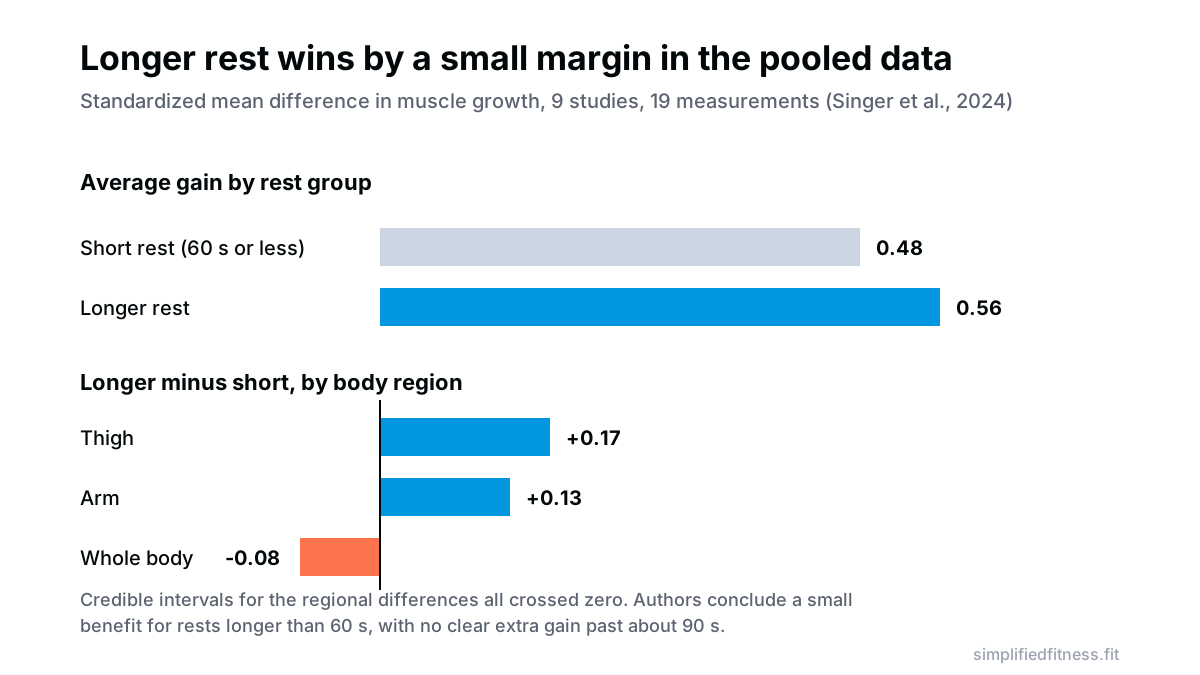
Why do the studies disagree? Differences in training status, exercise selection, load, whether sets went to failure, and how muscle size was measured. A cautious reading: resting under 60 seconds probably costs a little, resting 90 seconds or more probably costs very little extra, and the evidence cannot pin that down more tightly.
Why did people think short rest was better?
Because older reviews suggested it, and the reasoning sounded good. One 2006 review advised that for hypertrophy, consecutive sets should be performed before full recovery, with 30-60 seconds of rest linked to higher acute growth hormone (Willardson, 2006). A 2009 review said the same about moderate-intensity sets with 30-60 second rests (de Salles et al., 2009).
Newer work challenges the logic. In a 2016 lab study, 16 young men did four sets of leg press and knee extension at 75% of 1RM to failure, with either 1 or 5 minutes of rest, then took 25 g of whey. Myofibrillar protein synthesis in the first 4 hours rose 76% above resting in the 1-minute group and 152% in the 5-minute group. Circulating testosterone and lactate were higher with short rests, which is the “hormonal” environment older theories liked. By 24-28 hours, protein synthesis was indistinguishable between groups (McKendry et al., 2016).
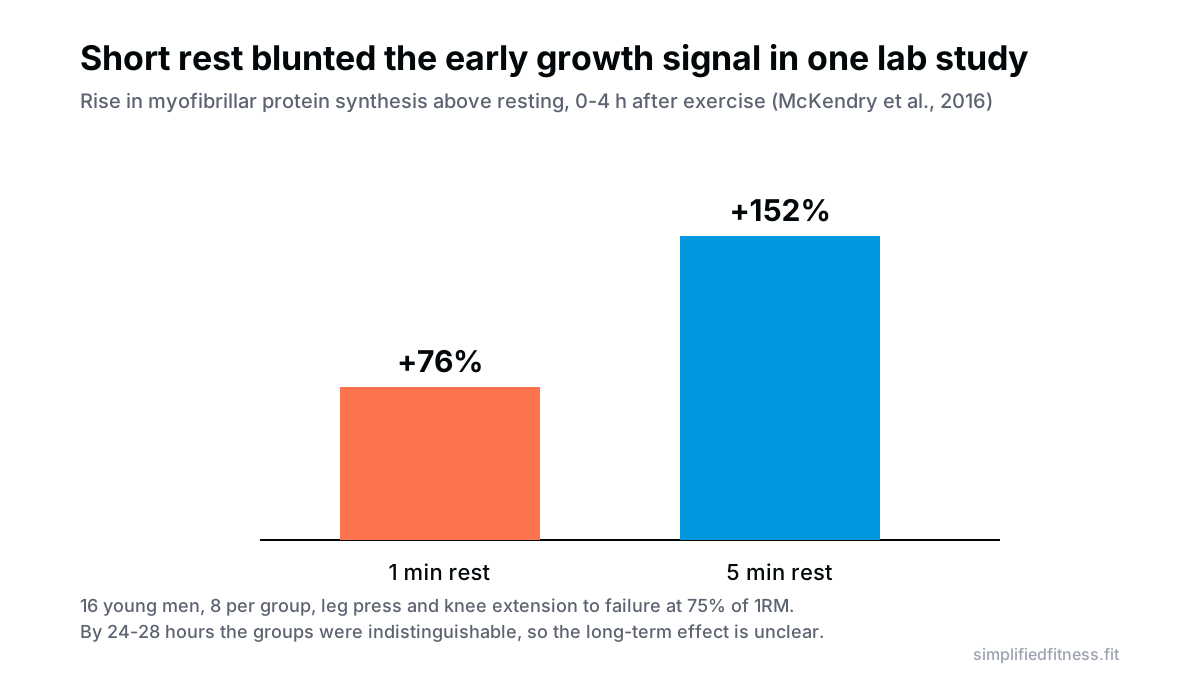
Eight men per group, and a short-term measure of one session. Do not over-read it. But it fits the idea that acute hormone changes are a poor guide, and that the extra fatigue from short rests may get in the way.
When are short rest intervals actually useful?
Short rests earn their place in a few specific situations.
1. Time-crunched sessions. You have 40 minutes, not 75. Training with shorter rests beats skipping sets or skipping the session. A small penalty beats zero training.
2. Isolation and machine work. Single-joint lifts such as lateral raises, cable curls and leg extensions are less fatiguing systemically. Your reps tend to hold up better on short rests than on a heavy squat. Lateral raises are a good example: when time is short, 60-90 seconds is a reasonable start, and our longer-rest article suggests 1.5-2 minutes when you have the time.
3. Antagonist supersets. Pair biceps and triceps, or chest and back. One muscle rests while the other works, so each muscle still gets close to a normal recovery. We cover this in antagonist arm supersets.
4. Light or low-load work. Warm-ups, finishers and low-load blood flow restriction (BFR) sets. A meta-analysis found low-load BFR training and high-load training produced similar hypertrophy, though high-load training produced bigger strength gains (Lixandrao et al., 2018). The practical details are in our BFR gym guide.
5. Hot, crowded Indian gyms. When equipment is shared at peak hours and you cannot hold a bench for three minutes, supersetting two non-competing exercises is a better answer than rushing rest.
Where they are less useful: heavy compounds trained near failure, and any lift where your reps collapse from 10 to 5 across three sets.
How do I program short rests without losing results?
Here is a simple approach. It is a coaching framework, not a research protocol, so adjust to how you respond.
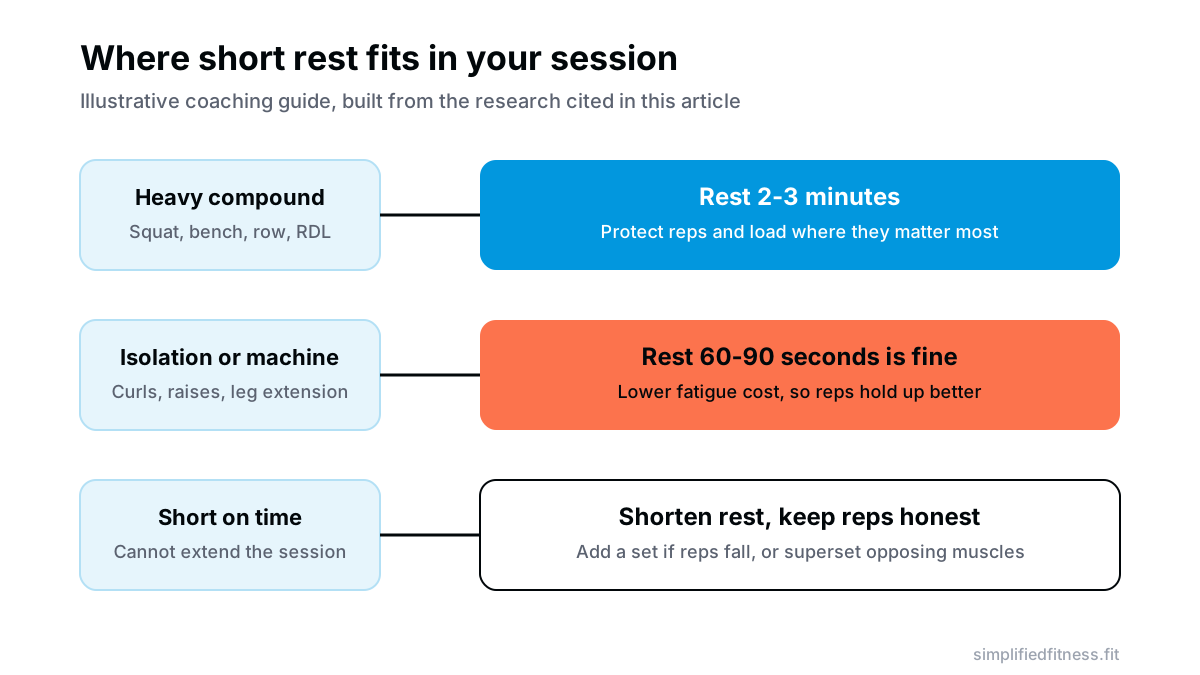
- Rank your lifts. Give your 1-2 heaviest compounds the longest rest, 2-3 minutes. Cut rest on everything else first.
- Cut from the least costly place. Drop isolation rests to 60-90 seconds before touching compound rests.
- Watch your rep drop. If you hit 10, 8, 5 across three sets, the rest is too short for that lift. Add 30 seconds, or accept it and add a set.
- Add a set, not more fatigue. Volume has a dose-response relationship with growth. A meta-regression of 15 studies found each extra weekly set was associated with about 0.37% more muscle gain, with a graded relationship overall (Schoenfeld et al., 2017). An extra set can offset some lost work. But there is a limit, which we cover in junk volume and per-session set volume.
- Count hard sets. Our training volume calculator helps you total weekly sets per muscle, so you can see if compression is eating your volume.
| Situation | Suggested rest | Why |
|---|---|---|
| Heavy squat, bench, row (6-10 reps) | 2-3 min | Protects reps and load on later sets |
| Machine or cable compound | 90-120 s | Less systemic fatigue |
| Lateral raise, curl, leg extension | 60-90 s | Reps tend to hold up |
| Antagonist superset | 60-90 s between pairs | Each muscle rests while the other works |
| Short on time, all lifts | 60-90 s, add a set if reps drop | Keep the work, not the clock |
These are starting points drawn from the research above and common coaching practice. They are not exact prescriptions.
What about fat loss and conditioning?
Short rests feel harder, so people assume they burn more fat. We did not find evidence in these studies that rest length drives fat loss in a lifting program. A calorie deficit does that. Strength training in a deficit helps you hold on to muscle, and that works best when you can still lift heavy enough. Our calorie calculator is a better starting point than a stopwatch.
If conditioning is your goal, short rests in a circuit are a legitimate tool. The trade-off is that circuit-style training is not the best choice if your main goal is maximum muscle on big lifts.
Who should be careful?
If you get dizzy, see spots or feel chest pain when you train with minimal rest, stop and see a doctor, especially if you have high blood pressure or heart disease. Heavy lifting with very short rests can push your heart rate and blood pressure up fast. Beginners, older lifters and anyone returning from a break should keep rest comfortable and build up gradually.
The bottom line
Short rest intervals are a trade, not a trap. On average they cost a small amount of hypertrophy, mostly through lost reps, and the cost seems to plateau beyond about 90 seconds. Where time is tight, use them on isolation lifts, supersets and lighter work, protect 2-3 minutes on your heavy compounds when you can, and add a set if reps fall.
Start with a plan that fits your week, like our free push, pull and legs plan, and see the muscle hypertrophy guide for natural lifters for the wider picture.
Frequently Asked Questions
Are short rest intervals bad for muscle growth?
Not bad, but slightly less efficient on average. A 2024 Bayesian meta-analysis found a small hypertrophic benefit to resting longer than 60 seconds, with large uncertainty and a lot of variation between studies. If time is tight, short rests still build muscle, so keep them and watch your rep counts.
Is 60 seconds rest enough for hypertrophy?
Yes, it can work, particularly for isolation exercises and lighter loads. In an 8-week trial of 21 trained men, 1-minute rests gave smaller strength and thigh growth than 3-minute rests, so 60 seconds is workable but not optimal for big lifts. Use it where reps hold up and extend rest on heavy compounds.
Do short rest periods burn more fat?
There is no good evidence that shorter rests meaningfully change fat loss in a lifting program. Fat loss is driven mainly by your calorie deficit, and weight training helps you keep muscle while you diet. Choose the rest period that lets you train hard, not the one that feels more tiring.
How many extra sets do I need if I use short rests?
There is no fixed number, because the cost depends on the exercise, load and how close to failure you go. A practical rule is to add one set when your reps fall noticeably across the first sets. A 2017 meta-analysis found a graded dose-response link between weekly sets and muscle growth, so replacing lost work with an extra set is reasonable.
Does the pump from short rests mean more muscle growth?
No. The pump is temporary swelling and blood pooling, not a reliable sign of long-term growth. One study found that 1-minute rests produced a smaller early rise in muscle protein synthesis than 5-minute rests. Judge your session by reps and load progress, not by how pumped you feel.
Did short rests raise growth hormone, and does that matter?
Older reviews noted that 30-60 second rests raise acute growth hormone, and some suggested that helps hypertrophy. Controlled trials have not shown that this translates into more muscle, and one acute study showed lower muscle protein synthesis with 1-minute rests despite a better circulating hormone profile. Acute hormone spikes are not a good guide for programming.
Should I use short rests for isolation exercises?
Often yes. Single-joint lifts like lateral raises or cable curls are less taxing, so you recover faster and your reps hold up better. Start with 60-90 seconds and lengthen it if your reps fall off a cliff.
What is the best rest time for compound lifts?
For heavy squats, presses and rows, 2-3 minutes is a sensible default when time allows. Research reviews show that 3-5 minutes allows more reps across multiple sets at 50-90% of 1RM. If you must save time, drop to 90-120 seconds before dropping to 60.
Can I use supersets to save time instead of cutting rest?
Yes, supersetting opposing muscle groups lets you rest one muscle while working another. This keeps recovery for each muscle closer to normal while cutting total session time. Try pairing biceps with triceps or chest with back, and see our guide on antagonist arm supersets.
Does resting longer make me waste gym time?
Only if the extra rest does not buy you better sets. Beyond roughly 90 seconds the meta-analysis found no appreciable extra hypertrophy, so there is a point where more waiting stops paying. Use the rest you need to repeat your target reps, and no more.
Does resting 30 seconds ruin a workout?
It does not ruin it, but 30 seconds will cut your reps on most hard sets. You then do fewer effective reps, which lowers the stimulus per set. Keep 30-second rests for light accessory work or circuits, not your main lifts.
How should I time my rest between sets?
Use a phone timer or the gym clock, since estimating rest by feel tends to run short. Start the clock when you rack the weight, and begin the next set when the timer ends and your breathing has settled. Note your rep counts so you can see whether your rest period is working.
Sources & References
Every claim above is checked against peer-reviewed research (PubMed, U.S. National Library of Medicine) or guidance from established health bodies. How we fact-check.
- Schoenfeld BJ, et al. Longer Interset Rest Periods Enhance Muscle Strength and Hypertrophy in Resistance-Trained Men. J Strength Cond Res. 2016. PMID: 26605807
- Singer A, et al. Give it a rest: a systematic review with Bayesian meta-analysis on the effect of inter-set rest interval duration on muscle hypertrophy. Front Sports Act Living. 2024. PMID: 39205815
- Grgic J, et al. The effects of short versus long inter-set rest intervals in resistance training on measures of muscle hypertrophy: A systematic review. Eur J Sport Sci. 2017. PMID: 28641044
- McKendry J, et al. Short inter-set rest blunts resistance exercise-induced increases in myofibrillar protein synthesis and intracellular signalling in young males. Exp Physiol. 2016. PMID: 27126459
- de Salles BF, et al. Rest interval between sets in strength training. Sports Med. 2009. PMID: 19691365
- Willardson JM. A brief review: factors affecting the length of the rest interval between resistance exercise sets. J Strength Cond Res. 2006. PMID: 17194236
- Schoenfeld BJ, et al. Dose-response relationship between weekly resistance training volume and increases in muscle mass: A systematic review and meta-analysis. J Sports Sci. 2017. PMID: 27433992
- Lixandrao ME, et al. Magnitude of Muscle Strength and Mass Adaptations Between High-Load Resistance Training Versus Low-Load Resistance Training Associated with Blood-Flow Restriction: A Systematic Review and Meta-Analysis. Sports Med. 2018. PMID: 29043659

Umair Hazrami · Founder & Head Coach, Simplified Fitness
Umair Hazrami founded Simplified Fitness and the Simplified Lifter channel to cut through fitness noise. With 4+ years of consistent training and 10+ coaching clients, he writes every guide from the peer-reviewed research and links the sources so you can check them. Our editorial standards.
Educational content only, not medical advice. If you have a medical condition, are pregnant, or take medication, talk to a qualified doctor before changing your diet, supplements or training. Full disclaimer.
Keep reading

Programming
Blood Flow Restriction (BFR) Practical Guide: Cuff Pressures, Rep Schemes, and Light Loads
How to do BFR training safely: cuff placement, pressure as a percentage of occlusion, the 30-15-15-15 scheme and who should skip it. Every study linked.
8 min read
Programming
Calibrating True RIR: A Safe Gym Test for Technical vs Absolute Failure
Calibrating RIR means testing how many reps you really have left. Use this safe machine protocol to find true failure and fix your 2 RIR guesses.
8 min read

Programming
CNS Fatigue vs Peripheral Fatigue: How Failure Hits Squats and Curls Differently
CNS fatigue vs peripheral fatigue: why failing a squat flattens you for days while failing a curl barely registers, and how many reps to leave in reserve.
9 min read
Programming
Failure on Machines and Cables vs Free Barbells: Managing Injury Risk and Axial Fatigue
Failure on machines vs barbells: why machine sets feel safer and less draining, what the research says, and where to push hard or stop at 1-2 RIR.
8 min read